Showing posts with label children. Show all posts

Saturday, December 23, 2017

Guest Post: Could lies about Santa be good for your child?

Kristen Dunfield, Concordia University

Christmas is a magical time of year, especially for children. Unfortunately, between elaborate Elf on the Shelf staging and fending off questions about Santa, parents are often left wondering how much of the magic depends on them.

Specifically, many parents worry about whether they should encourage their children’s belief in the physical reality of Santa, about the potential impact of lying to them and what to do when their children realize they’ve been duped.

Rest assured, parents, it’s not all up to you. In fact, the best approach involves supporting your kids while they figure it out on their own. They will, and it won’t be as bad as you expect.

As a developmental scientist, I spend most of my time researching children’s trust. I’m interested in how trust develops and what happens when it’s broken. During the holiday season, I spend a lot of time thinking about Santa.
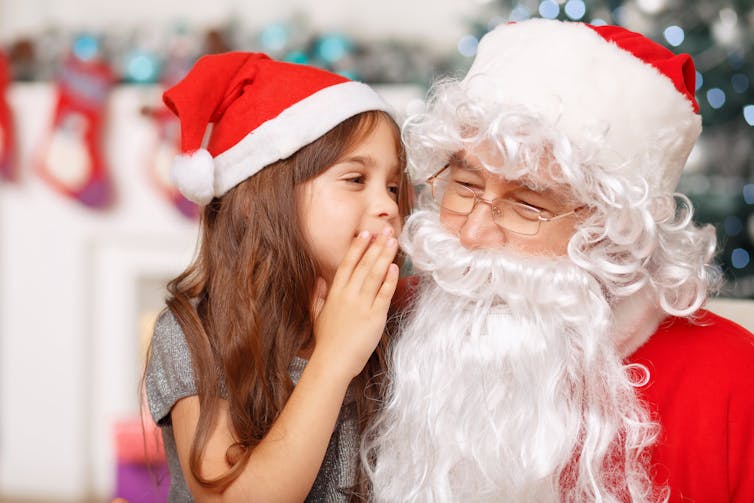


Santa Claus and child on lap

Developmental psychology suggests that fantastical beliefs in children are associated with positive developmental outcomes. And parents need not worry, children will bust the Santa myth themselves, when the time is right.
(Shutterstock)


As a proud auntie of three children under the age of four, my Santa musings have taken on a new significance. But, unlike many parents, I see the development of a belief in the physical reality of Santa, and the eventual myth-busting, as impressive achievements to be celebrated, not feared!

Research in the field of developmental psychology suggests that such fantastical beliefs are not actually harmful, but are associated with a number of positive developmental outcomes — from exercising the “counterfactual reasoning skills” needed for human innovation to boosting emotional development.

When kids question the magic


The vast majority of children will at some point believe in Santa. While many children learn these beliefs at home, the cultural support for Santa is so strong that children in households that don’t actively endorse the myth still sometimes believe.

Yet, despite Santa’s impressive marketing strategy, most children will abandon their belief by the age of eight. Though many parents fear this transition, it’s an inevitable part of growing up.


Santa is a mix of mundane and magical qualities. He is a jolly man dressed in red with a snowy beard. He also flies with the help of reindeer, visits all the world’s children in a single night and knows if you’ve been naughty or nice.

With age, a child’s thinking develops to the point where they start to notice Santa does magical things that physical objects can’t. This newfound knowledge is evident in the types of questions children are asking.

Younger children are often interested in general details about Santa, like: “Where does Santa live?” Older children are more likely to hone in on Santa’s extraordinary abilities: “How does Santa get around the whole world in a single night?”

Should you bust the myth?


Recognizing these challenging questions for what they are — cognitive development in action — may free some parents from the burden of belief.

If your goal is to extend your child’s belief in the physical reality of Santa, you can respond to the questions with plausible explanations or evidence. This is where NORAD, the online tracker that shows Santa’s progress around the globe on Christmas Eve, can come in handy.


If instead you want to let your child take the lead, you can simply direct the question back to them, allowing your child to come up with explanations for themselves: “I don’t know, how do you think the sleigh flies?”

Finally, if you think it’s time to usher your child into the common adult understanding of Santa as a beloved fantasy figure, you can provide different, disconfirming evidence and explanations.

My Santa myth was busted shortly after the discovery of Santa’s gift tags in my mother’s robe pocket. Regardless of which strategy you choose, it is inevitable that eventually the evidence against Santa will become overwhelming and the belief will become unsustainable.

Lies with good intentions


If you choose to extend your child’s belief in Santa, and your child realizes you have deceived them, how will they respond?


boy in Santa hat

If Santa’s elves make handmade toys, how does he deliver electronics? And what does this do to the magic of Christmas for children from poorer families?
(Shutterstock)


As it turns out, probably pretty well. In a study examining children’s reaction to discovering the truth about Santa, parents generally took the transition much harder than their children, who actually felt quite positive about the discovery.

And why wouldn’t they? Santa is one of countless things children learn through the testimony of others. Because we rely on others for so much of what we know, humans are surprisingly well-equipped for the task. They evaluate both the source and content of the information they have received in light of their existing knowledge and their memory of past interactions with the source.

This means that, when compared to all of the reliable information that parents share with their children over their lives, it is highly unlikely a single lie will cause irreparable damage.

Children are also discovering the truth about Santa at around the same time they are starting to understand that some lies, like Santa lies, are told with good intentions.

Why Santa is for small gifts


Believing in impossible beings such as Santa is a special kind of magic available only to children.

Research suggests that fantastical beliefs are associated with a number of positive developmental outcomes. So, if your child is still a believer, feel free to protect that belief.

As your child ages, especially if there are younger siblings in the house, there are creative ways to keep the Santa experience positive, even after their belief in the physical reality of Santa has been abandoned.

Finally, always remember, as children are figuring out how the world really works, that they are going to look to the people and things around them for evidence.

The ConversationIt might be a good idea to give modest gifts from Santa and save the big ones for parents, because no matter what your family income, every child deserves to feel loved by Santa on Christmas morning.

Kristen Dunfield, Assistant Professor of Psychology, Concordia University

This article was originally published on The Conversation. Read the original article.

Guest Post: Your child probably knows the truth about Santa


by Kate Ellis-Davies, Nottingham Trent University

Most parents lie to their children. It’s usually done to get the children to behave the way the parents want. One study found that well over 80% of American parents and more than 90% of Chinese parents admitting to this kind of “instrumental” lying. Lying about the existence of Father Christmas often falls into this category, used as a tool to teach pro-social behaviour (helping and sharing) through the promise of presents if the children are good.

Santa Claus Rick Sincere 1960s
Of course, there can be other reasons for carrying on the Santa myth that are more to do with children’s immediate happiness. These could include extending the naivety of childhood and raising the excitement of the holiday season. But given what we know about children’s ability to figure out the truth, it seems likely that slightly older kids may well be playing along with their parents’ fantasy in order to reap the benefits of the promised rewards.

When studies have questioned whether lying to children about Father Christmas does them any harm, the theory seems to be that the dishonesty undermines parents’ image as trustworthy and reliable sources of information. But there’s no real evidence of any lasting damage.

Research with children who no longer believe has shown that they tend to stop believing in Santa around seven years of age. When interviewed about their feelings about being lied to – and how they felt about Santa now – the children generally tended to report positive happy emotions around the topic. Parents, on the other hand, were left saddened by their child’s loss of Santa belief.

Children tend to come to the end of their belief of Santa either through their own tenacious questioning of the logic and practicality of the myth, or by older, more seasoned siblings and peers bursting the bubble. This is particularly the case for today’s tech-savvy kids, who have the internet to answer every question and give them extra space for conversations away from the protective guidance of adults keen to keep the myth alive.

Yet while children often come to the realisation that Santa is not what they had been lead to believe on their own, they also tend to act along with the fiasco and continue to play along with 58% of children in one study playing the role of Santa-believer. This goes counter to the under-sevens’ tendency to correct the mistakes adults make, in speech for example, and to trust more reliable adults.

So what’s in it for the kids in maintaining the lie? Well the commonly written letter to Santa may give us some clues. Rather than reading this note assuming that this child believes in Santa, if we cynically consider that he or she no longer believed in Santa but is playing along – then the child is playing along like a pro.

We can see children’s willingness to play along with pretence and fantasy well beyond the seasonal myths into a more general eagerness to suspend reality for the enjoyment of play, something long associated with their development. The act of playing along may also support children as they test out out their knowledge and theories of the real world.

Logical to pretend


Santa Claus truthWithin the letter to Santa, children often recognise the premise that they should have been good to warrant the requested presents, demonstrating they have followed the behavioural compliance set out by their parents. They put in a good mix of optimistic present requests, but with a placating note for those that might be overreaching and some humbler suggestions with a higher likelihood of approval. Plus there may be a nod to their doting grandparents for the affection it can be assumed they appreciate.

Really, the traditional letter represents a child’s well-constructed communication to people they know are lying in the hope they will reward the pro-social behaviour and willingness to play along. So, while researchers have reported that younger Santa cynics may have well-developed abilities in logic and reasoning, this doesn’t necessarily mean they won’t play along with the myth for a little longer. Doing so may be enjoyable in itself, have some present-shaped benefits, and be a positive family experience.

There is also little evidence that childhood myths challenge otherwise trusted and secure parent-child relationships. Instead, when children realise that their parents were engaged in a protracted deception, the children appear to be less saddened than their parents.

The Conversation

Kate Ellis-Davies, Senior Lecturer, Division of Psychology, Nottingham Trent University

This article was originally published on The Conversation. Read the original article.

Sunday, December 10, 2017

Guest Post: Blocks are still the best present you can buy children for Christmas


Kym Simoncini, University of Canberra and Kevin Larkin, Griffith University

With Christmas looming, many people will be considering what present to buy for their children, nieces and nephews, grandchildren and friends. Soon, if not already, we will be reading lists of the top trending presents for 2017. These lists will no doubt include, and may even be totally dominated by, all the latest gadgets and devices.

The purpose of these lists is to attempt to persuade parents of young children if they want to give their child the best start in life, and all the advantages for doing well later at school, they need to purchase the latest technology.


Read more: ‘Digital play’ is here to stay … but don’t let go of real Lego yet


Missing from these Christmas lists, but what should actually be at the very top in terms of learning, are blocks. Blocks have been part of children’s play for a long time. But there’s still no other toy that compares in promoting all areas of children’s development. Any early childhood teacher can easily identify all the areas block play develops including fine motor, social, language and cognitive skills.

Blocks develop spatial reasoning skills


As children experiment by stacking, balancing, or building with blocks, they need to share, respect other children’s constructions, ask for desired blocks and describe what they are creating. Perhaps more importantly, children develop problem solving skills, creativity and imagination in creating their masterpieces. Finally, let’s not forget persistence where children try again and again to build the tallest tower or most elaborate castle.


Kids learn to play and work together when using blocks.

Kids learn to play and work together when using blocks.
Shutterstock


Less well known is that blocks also foster spatial reasoning. Spatial reasoning is the ability to mentally manipulate objects or to think in a way that relates to space and the position, area, and size of things within it. We use spatial reasoning skills in everyday life when we read maps, pack the car for holidays, assemble flat pack furniture or cut cake into equal slices.

Spatial reasoning skills are linked to mathematics skills. Children who have good spatial skills tend to have better maths skills. Many people are unaware of the research, but early mathematics skills are a better predictor of later school success than either early reading or social-emotional skills. Block play helps children understand many mathematical concepts in number, measurement and geometry. During block play children count, measure, estimate, pattern, transform, and learn about symmetry.

Perhaps most surprising to readers will be the research that shows spatial reasoning skills are the best predictor of whether children will end up in a Science, Technology, Engineering and Mathematics (STEM) related career. Spatial skills are especially important in STEM related jobs where people are required, for example, to create or read X-ray and ultrasound imaging, engineering and architectural designs, or cross sections of heating and plumbing systems.


blocks are still the best toy you can buy your child.

Christmas lists usually suggest the latest and greatest technology, but blocks are still the best toy you can buy your child.
Shutterstock


Blocks also help develop spatial language


Block play also fosters spatial language. When children play with blocks they hear and produce more words related to spatial reasoning including things such as beneath, above, next to, behind, and so on.

One study showed block play elicited more spatial language than any other type of play. The other types of play included playing with puppets, playing house, shops, school, zoos, chefs and throwing a ball.

Other research that looked at spatial language showed the more spatial words children heard, the more spatial words they produced and the better they performed on spatial tasks. In this study, researchers looked at language relating to the spatial features and properties of objects such as the dimensions of objects (such as how big small, wide, tall), the forms of shapes (for example rectangle, circle, square) and other spatial properties (like bent, pointy, curved).

Different blocks for different ages and stages


kids playing with blocks

The best way to get your kids playing with blocks is to play along with them.
Shutterstock


There are a wide variety of choices for blocks for children including MegaBloks for really young children, Duplo, wooden blocks or waffle blocks for preschoolers, and Eco bricks and Lego for older children.

These age guidelines are suggestions only. My ten and fourteen year old daughters will still play with the wooden blocks. Much of the reason blocks are such enduring toys is due to the fact they’re “loose parts”. That is, they can be moved, arranged, combined, taken apart, and put together in any number of ways. Frobel, the father of kindergarten, created ten gifts for children of which six were blocks.

The best way to engage children in block play is to play alongside them and show your interest and enthusiasm in block building. My friend has a ritual of playing half an hour every afternoon with Duplo with her three young boys aged five, three and one. She says it’s her favourite time of day.


Read more: Can toys really be ‘educational’? Well that depends on the parents


The ConversationSo, when those lists appear in your inbox or on social media, just remember the best toy of all is likely to be missing.

Kym Simoncini, Assistant Professor in Early Childhood and Primary Education, University of Canberra and Kevin Larkin, Senior Lecturer in Mathematics Education, Griffith University

This article was originally published on The Conversation. Read the original article.

Sunday, June 18, 2017

Guest Post: How families with 2 dads raise their kids

Andrew Leland, Rutgers University

Kentucky family court judge W. Mitchell Nance says he refuses to hold hearings on same-sex couples’ adoptions “as a matter of conscience.”

He’s not the only authority defying the 2015 Supreme Court ruling that made marriage equality the law of the land. So-called “religious freedom” bills in Texas, South Dakota and Alabama could let private adoption agencies discriminate against same-sex couples. When pressed on the question, Education Secretary Betsy DeVos recently refused to tell lawmakers whether she believes the federal government should deny government funds to schools that discriminate against the children of LGBT parents – or LGBT students.


How families with 2 dads raise their kids

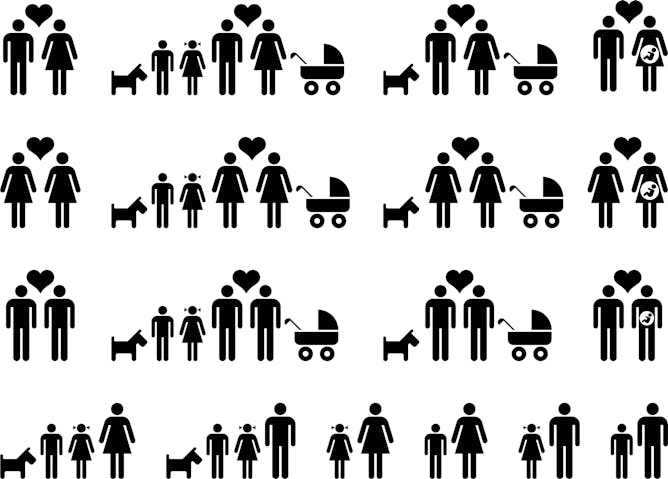
The number of men married to each other who have children is rising following legal rulings about marriage equality.
Shutterstock


Maybe these officials, judges and lawmakers should check out the research on how gay parents differ from straight parents. So far, most of this scholarship has focused on the social, emotional and cognitive outcomes of children they raise. (Spoiler alert: These kids turn out fine.)

As a former teacher who now researches gay dads and their families while pursuing a doctorate in education, I am studying how the growing number of men married to other men are raising their children. So far, I’m finding few differences between them and their straight peers of similar socioeconomic status – especially regarding their children’s schooling.

A growing population


Since the Census Bureau estimates but does not count the number of households headed by two fathers, it’s hard to track them.

Plans were taking shape for the Census Bureau to begin counting same-sex-parented households in 2020. They seem unlikely to move forward due to recent budget cuts, the census director’s recent resignation and the political climate.

Nevertheless, The American Community Survey, the Census Bureau’s ongoing demographic survey of approximately three million households, already follows same-sex parenting. It estimates that in 2015, almost 40,000 two-dad households were raising children, compared to about 30,000 in 2010.


Actors Neil Patrick Harris Gideon Scott Burtka-Harris Smurfs

Actors Neil Patrick Harris and Gideon Scott Burtka-Harris, who are married to each other, brought their twins to the ‘Smurfs 2’ premiere in 2013.
John Shearer/Invision/AP


Parenting roles


How do parents in these families settle into specific roles? In short, just like heterosexual parents do.

Research suggests that affluent, white, two-father households adhere to traditional parenting roles. One is the primary breadwinner, while the other earns either less income or none at all and handles most of the caregiving and chores.

However, two-dad households can challenge the 1940s Norman Rockwell image of gendered parenting – just like heterosexual couples can.

Households with two fathers working full-time rely on daycare facilities, babysitters, housekeepers and nearby relatives for support. Some of these men even take on responsibilities based on skills and strengths, rather than who fits the socially and culturally constructed mold of being more “motherly” or “fatherly.”


two-dad households families children gay marriage
Research suggests that two-dad households may not differ that much from the parenting patterns of heterosexual couples.
www.shutterstock.com


Community and school engagement


And that’s where the parenting of gay dads may differ from a traditional heterosexual household, as my research and the work of other scholars suggests.

While interviewing and spending time with 20 two-dad families living in the Northeast for my current study, I have learned that they’re apt to step up. Many become involved as classroom parents, voluntarily assisting teachers, reading books or leading singalongs. Some take leadership roles by becoming active PTA members or organizing events that go beyond their children’s classes. In some cases, gay fathers become PTA presidents or serve on school boards.

Like all civically engaged parents, gay fathers support their local museums and libraries and enroll their kids in camps and extracurricular activities. They sometimes do additional volunteer work for social justice groups.

The largest-scale survey to date was conducted in 2008 by the Gay Lesbian Straight Education Network, an organization focused on the safety of LGBT students in schools. That study, which included 588 LGBT parents, suggested that gay fathers could be more likely to be involved in school-based activities than heterosexual dads.

Aside from the simple fact that they love their children just like all parents do, Abbie Goldberg, a Clark University researcher, and her colleagues have shown that increased presence may be due, in part, to fathers’ initiatives to counter bias and assert more same-sex visibility and inclusion in schools. My current study, indicates the same. Many of the men taking part have told me that being actively involved helps them preemptively counteract potential negative encounters with school personnel and other families.

The ConversationGay dads prefer schools and communities that are safe and inclusive. Beyond that, they want judges like Nance and lawmakers bent on barring them from fatherhood to see that two-dad families are for the most part just like any other family.

Andrew Leland, Ph.D. Candidate, Graduate School of Education, Rutgers University

This article was originally published on The Conversation. Read the original article.

Sunday, December 25, 2016

Guest Post: Why children believe (or not) that Santa Claus exists


by Jacqueline D. Woolley, University of Texas at Austin

The holiday season is upon us, and so are its attendant myths, most prominent of which is the Santa Claus story. This is the time that many children are told about a man who lives forever, resides at the North Pole, knows what every child in the world desires, drives a sleigh pulled by flying reindeer and enters one’s house through a chimney, which most children don’t even have.

Given the many absurdities and contradictions in this story, it’s surprising that even young children would believe it. Yet research from my lab shows that 83 percent of five-year-olds think that Santa Claus is real.

Why?

An evolutionary advantage?


At the root of this paradox is a very basic question regarding the nature of the young child as an inherently credulous being – that is, believing everything he or she is told – versus a rational one.

The noted author and ethologist Richard Dawkins, in a 1995 essay, proposed that children are inherently credulous, and prone to believing in just about anything. He even suggested that it was an evolutionary advantage for children to believe.

He illustrated that quite convincingly with an example of a young child living near an alligator-infested swamp. His point was that the child who is skeptical, and prone to critically evaluating his parents’ advice not to go swimming in that swamp, has much less chance of surviving than does the child who unthinkingly heeds his parents’ advice.

This view of young children who believe easily is shared by many, including 18th-century philosopher Thomas Reid, and developmental psychologists, who argue that children are strongly biased to trust what people tell them.

Not very different from adults?


Yet research from my lab shows that children actually are rational, thoughtful consumers of information. In fact, they use many of the same tools as adults to decide what to believe.

So, what are some of the tools that adults use to decide what to believe, and what evidence is there that children possess them?

I’ll focus on three: One is attention to the context in which new information is embedded. A second is the tendency to measure new information against one’s existing knowledge base. And the third is the ability to evaluate the expertise of other people.

Let’s look first at context.

Imagine reading an article about a new species of fish – let’s call them “surnits.” Then imagine you’re reading this article in two very different contexts – one in which your doctor is late and you’re in the waiting room reading the article in a copy of National Geographic, the official magazine of a scientific society.

In another context, you encounter a report of this discovery while waiting in line at the grocery store and perusing the National Enquirer, an American supermarket tabloid. My guess is that the context surrounding your introduction to this new information would guide your judgment about the reality status of this new fish.

We essentially did this with children. We told them about animals they’d never heard of, like surnits. Some children heard about them in a fantastical context, in which they were told that dragons or ghosts collect them. Other children learned about surnits in a scientific context, in which they were told that doctors or scientists use them.

Children as young as four were more likely to claim that surnits really existed when they heard about them in the scientific context versus in the fantastical context.

How children use knowledge and expertise


One of the primary ways we, as adults, learn about new things is by hearing about them from others. Imagine hearing about a new kind of fish from a marine biologist versus from your next-door neighbor who often regales you with reports of his alien abductions. Your evaluation of the expertise and trustworthiness of these sources presumably will guide your beliefs about the true existence of this fish.

In another research project, we presented young children with novel animals that were either possible (e.g., a fish that lives in the ocean), impossible (e.g., a fish that lives on the moon) or improbable (e.g., a fish as big as a car). Then we gave them the choice to figure out on their own whether the entity really existed or to ask someone. They also heard reports from either a zookeeper (an expert) or a chef (a nonexpert).

We found that children believed in the possible entities and rejected the impossible ones. Children made these decisions by comparing the new information to their existing knowledge. For the improbable animals – ones that could possibly exist but were rare or odd – children were significantly more likely to believe in them when the zookeeper claimed they were real than when the chef did.

In other words, children use expertise, just as adults do.

It’s the adults


If children are so smart, why do they believe in Santa?

The reason is simple: Parents and others go to great lengths to support the Santa myth. In a recent study we found that 84 percent of parents reported taking their child to visit more than two Santa impersonators during the Christmas season.

The Elf on the Shelf, originally a children’s picture book about elves who inform Santa about children’s behavior around Christmastime, is now a multi-million-dollar franchise. And the United States Postal Service now promotes a “Letters from Santa” program in which it provides personal replies to children’s letters to Santa.

Why do we feel compelled to go to such great lengths? Why does Uncle Jack insist on climbing onto the roof on Christmas Eve to stomp around and shake jingle bells?

The answer is simply this: Children are not unthinkingly credulous and do not believe everything we tell them. So, we adults must overwhelm them with evidence – the bells on the roof, the live Santas at the mall, the half-eaten carrot on Christmas morning.

How children evaluate


Given this effort, it essentially would be irrational for children not to believe. In believing in Santa Claus, children, in fact, exercise their scientific thinking skills.

First, they evaluate sources of information. As ongoing research in my lab indicates, they’re more likely to believe an adult than a child about what’s real.

Second, they use evidence (e.g., the empty glass of milk and half-eaten cookies on Christmas morning) to come to a conclusion about existence. Other research from my lab shows that children use similar evidence to guide their beliefs about a fantastical being, the Candy Witch, who visits children on Halloween night and leaves new toys in exchange for candy.

Third, research shows that, as children’s understanding becomes more sophisticated, they tend to engage more with the absurdities in the Santa Claus myth, like how a fat man can fit through a small chimney, or how animals could possibly fly.

Wondering what to tell your child?


Some parents wonder whether they are harming their children by engaging in the Santa myth. Philosophers and bloggers alike have mounted arguments against perpetuating the “Santa-lie,” some even claiming that it could lead to permanent distrust of parents and other authorities.

So, what should parents do?

There is no evidence that belief, and eventual disbelief in Santa, affects parental trust in any significant way. Furthermore, not only do children have the tools to ferret out the truth; but engaging with the Santa story may give them a chance to exercise these abilities.

So, if you think it would be fun for you and your family to invite Santa Claus into your home at Christmas time, you should do so. Your children will be fine. And they might even learn something.

The Conversation

Jacqueline D. Woolley, Professor and Department of Psychology Chair, University of Texas at Austin

This article was originally published on The Conversation. Read the original article.

Friday, December 23, 2016

Why young children often prefer wrapping paper and boxes to actual presents

by Julie Brierley, University of Hull

We’ve all been there: you spend an unthinkable amount on a child’s toy – lulled by the promise that the interaction with the flashing lights and whooshing noises will excite, stimulate and educate our little people. Yet on the big day, we watch as our child’s interest in the toy quickly diminishes and the attraction of the discarded wrapping paper and packaging takes over.

We watch with confusion as our young children show us the real pleasures of Christmas – not their new shiny toy, but all that is destined for the recycling bin. And as they roll around on the floor in the wrapping paper and jump in and out of the boxes, we question our own sanity in spending ridiculous sums of money on a child who would have clearly preferred a cardboard box for Christmas.

But while our child’s preoccupation with screwed up wrapping paper and packaging may seem barmy to us adults, it is in fact just another way to play – and can help children to learn about themselves and the world around them.

The psychology of wrapping paper


At a very early age, children use play to drive their own learning. And when young children are allowed and actively encouraged to explore and follow their own interests, they develop understanding from their actions.

In recent years, neuroscientific studies have led to a greater appreciation of the importance of young children’s brain development. These studies have shown us that the first three years of a child’s life are a critical period for learning and development. This confirms a direct relationship between the quality of experiences young children gain and the growth and development of the brain.


‘Just look at this paper!’
Shutterstock


So, when children explore and experiment with objects such as boxes, paper and ribbons, they are using both their sensory and physical senses to extend their thinking.

“What is this and what can I do with it? Can I fit my hand inside? what else fits in?” – young children’s questioning minds are pivotal to their learning. And engagement in self-directed play helps to aid learning and supports the development of language as well as mathematical, scientific, creative, personal and social concepts.

The power of play


In today’s society, the power of play is frequently misunderstood and underestimated. Children these days have less time to “free play” given that so much of their playtime is structured or involves a parental onlooker.

But young children are physical beings, who gain sensory perceptions and feedback from the whole of their bodies – and these perceptions contribute to essential brain development. So seemingly meaningless actions such as twirling, jumping, rolling and messing around with objects can actually help children to learn about who they are and the world around them.

Through the sensory and physical exploration of the discarded boxes and Christmas wrapping paper, the foundations of learning and cognitive development are occurring. Children become sensitised and motivated to further their explorations, allowing more complex thoughts and understanding to develop.


Living the dream.
Shutterstock


So a young child who repeatedly fills and empties a box, climbs in and out, puts things in then tips them out, is not just making a mess. Instead they are exploring the “insideness” of the object – which helps them to understand concepts such as capacity, volume and space.

And with this in mind, rather than just filling the toy cupboard with a load of manufactured creations, it is important that young children are also able to make their own discoveries and to construct their own understanding, too.

So this Christmas, make sure your child has a chance to play with all the wrapping paper before it is neatly tidied up and disposed of. Because not only are you helping them to cultivate a desire to learn, you are also helping to develop their inquisitive resolve and creative expression.

You will also be allowing them the opportunity to strengthen the bits of their brain that are responsible for development – and this will help to ensure they have the foundations for future learning. And what could be a better gift than that?

The Conversation

Julie Brierley, Lecturer in Early Years & Education, University of Hull

This article was originally published on The Conversation. Read the original article.

Saturday, November 29, 2014

A Look Back at the Making of the First 'Peter Pan' Movie (1924)

Peter Pan Live NBC Christopher Walken Minnie DriverWith the much-hyped television broadcast of Peter Pan Live!, starring Allison Williams, Minnie Driver, and Christopher Walken, coming up on Thursday, December 4, on NBC, it seems worthwhile to look back on other versions of the classic J.M. Barrie work.  (On Twitter, the show is being promoted as #PeterPanLive.)  This production is a follow-up to last December's virally successful The Sound of Music Live! The cast also includes Broadway veterans Christian Borle and Kelli O'Hara and (relative) newcomers Taylor Louderman, Jake Lucas, and John Allyn as the Darling family.

I have seen Sandy Duncan on stage as Peter Pan and Mary Martin on TV, as well as the 1953 Disney animated production with Bobby Driscoll voicing Peter.  I missed Mia Farrow and Cathy Rigby in the role but, for my money, Jeremy Sumpter was the most heatedly erotic Peter in the movies, but most audiences are not looking for that particular quality in what is usually intended as a children's story.

The first movie presentation of Peter Pan was released in 1924 by Paramount.  It was produced by Adolph Zukor and directed by Herbert Brenon.  Sir James M. Barrie was involved in the project and approved of the casting although -- as the anecdotes recounted below note -- his original screenplay was set aside for one credited to Willis Goldbeck.  The film was shot by renowned cinematographer James Wong Howe.

Stewart Stern Rebel without a Cause James DeanIn 2007,  screenwriter Stewart Stern (Oscar-nominated for Rebel Without a Cause and an Emmy winner for Sybil) appeared at the Virginia Film Festival, where in addition to a shot-by-shot workshop of Rebel Without a Cause he offered opening remarks at a screening of the 1924 Peter Pan.

Stern, then 85 years old, recalls the casting process that resulted in the choice of Betty Bronson as the first screen Peter but he also describes his own experiences in seeing Eva Le Gallienne and Elsa Lanchester on stage as Peter, and the personal touches he received not just from those actresses but also from J.M. Barrie himself.

Here is video of screenwriter Stewart Stern, speaking at the Paramount Theater in downtown Charlottesville on November 3, 2007.  Part I offers some anecdotes about Barrie and the first stage production of Peter Pan and the casting of Bronson in the title role.  (Partial transcript follows the video clip.)

Stewart Stern on Peter Pan - Part I


It always begins with a writer. Sir James Matthew Barrie, who wrote Peter Pan, was a very small Scotsman, barely taller than a child, with a very large head, deep melancholy eyes, a mustache to cover his shyness, and a pipe that made everyone cough.

He rarely smiled but he could wiggle his ears and he mainly trusted children and certain Newfoundland dogs of his acquaintance, whom he would one day roll up into Nana. There were those five little boys in Kensington Gardens whom he fell in love with, and the Davies boys, whom he wisely treated as his superiors, and grew so close to, that in a way he stole them, even as Peter Pan stole the Darling children, and they made up Peter's story together.

It was born as a game they played at Barrie's country house, and it just kept making itself up as he and his boys played it – sometimes this way, sometimes that way – and that's how Barrie put it on the stage and that's why it always keeps changing. That's the character of Peter, too: he won't stand still, never remembers what he did last, and he's always finding new adventures to hide his loneliness inside.

During rehearsals, Barrie would sit huddled in the dark of the Duke of York's Theatre in London, his great coat and bowler hat, watching the children with envy as they practiced flying around the stage, until one days someone asked him what the matter was. He said, “I would very much like to fly, too!”

So, they hoisted him up in the magical arrangement that helps you do it, and flew him around the stage in absolute ecstasy, bowler hat, pipe, greatcoat and all, twinkling like a firefly, until they finally sat him down.

Barrie's favorite critic on opening night was a little boy whom he'd taken to the theatre. And he asked him, what part of it did you like best, when the final curtain came down. And the little boy said, “Oh, the part I liked best was tearing up my program into little bits and throwing them down on the people!” And of all the reviews his play received, Barrie liked that one the most.

In about 1920, my uncle, Adolph Zukor, who started Paramount Pictures, decided to make the first movie of Peter Pan. He had to find the perfect Peter to please Mr. Barrie, so a nationwide search began all across America.

Betty Bronson as Peter Pan silent movies
Betty Bronson as Peter Pan
Countless screen tests were made and the best ones were taken to London on an ocean liner by the movie's director, Mr. Herbert Brenon, and by another uncle of mine, Mr. Albert Kaufman, who was Uncle Adolph's studio manager. These men would show the tests to Barrie for him to choose his favorite, and among the candidates was a tiny, 17-year-old girl from New Jersey who had come to Hollywood to break into movies and who called herself Betty Bronson. She banged on every door at Paramount Studios until Mr. Brenon agreed to see her, and she told him that she was born to play Peter, she had to pay Peter, she would play Peter, and so Mr. Brenon had no choice but to make a test.

In the London screening room, the two Americans unreeled those tests for Barrie, day after day, and to break up a long afternoon, Barrie invited them to his flat, overlooking the River Thames, for tea.

They were awed to be at the home of such a famous man, a man great enough to be knighted by the king. Barrie left his guests in the big inglenook by the fire, where he wrote, to go and see about the tea. But while they waited in their straight-back chairs, saying very little, for the whistle at the kettle to come from the kitchen, there was such a long, alarming silence, that they went exploring through the flat, and they finally found Barrie frozen at the kitchen door with his shoes in his hands and his face a mask of terrible guilt. “It's housekeeper's day off,” Barrie said, “and I'm not allowed in the kitchen. Mrs. Porter absolutely forbids me to set foot in it.”

Uncle Al said, “Well, I'll go in. I'll make the tea.”

But Barrie said, “No, no, no, no. She'll be able to tell. She puts things around I have to move out of the way and that gives her hints.”

So that was it for tea.

The very next day, a telegram reached Uncle Adolph's desk in New York. It was from London. “Betty Bronson chosen to play the role of Peter Pan. Signed, Barrie.”

In part two of the video from the Virginia Film Festival, Stern describes the magic of Eva Le Gallienne as Peter Pan (in a production she also directed), and the fright that Elsa Lanchester brought to the role. He describes his own two degrees of separation from Sir James Barrie and his particular attachment to thimbles. (Partial transcript follows the video.)

Stewart Stern on Peter Pan - Part II

The film was a huge success and many of the effects in it – the great broom sweeping the fairies away, Captain Hook's Jolly Roger rising up off the mermaids' lagoon and flying the children home – were all Barrie's own ideas for the movie version, special effects way before their time. And it's a wonderful script to read. It's a complete screenplay and filled with fancy but they decided, no, they wouldn't use it – just this and that of it. And so the movie has a more theatrical look than what might have happened if Barrie had had his screenplay used.

Like all very old children who never grew up – this isn't a hook, by the way, it's to do Charlie Chaplin imitations and it's also a reminder that I'm 85, so I'm only half young – anyway, I have loved Peter Pan my whole life. My first Peter Pan when I was little was the great Eva Le Gallienne. She gave special children matinees at the old Civic Repertory Theatre in New York at 11 o'clock Saturday mornings, and then she went on in the rest of the day to play grown-up roles in the afternoon and evening, in plays like Camille, Romeo & Juliet, and Ibsen's Ghosts, and the next morning she was back being Peter Pan.

But they weren't half as exciting as Peter Pan, those other plays, those grown-up plays. So Saturday after Saturday, my mother moved us up to the cheaper and cheaper seats, up to the tip-tip-top of the theatre, where the poorest children sat on benches that only cost 50 cents.
Sitting on those hard seats, miles above the people, we had the best thrill of anyone in the theatre because at the end, Peter Pan flew, not just over the audience way down there but above the balconies that were below us – there were two that were below us, and then the audience down there – but all the way up here, she touched our hands as we leaned out over the railing and shouted good-bye as she flew past us and then zoomed down to the stage. It was the most thrilling thing I've ever seen in my life and it still stays with me.

Screenwriter Stewart Stern Virginia Film Festival 2007
Stewart Stern in Charlottesville, Nov. 3, 2007
All children who saw Peter Pan wanted to fly. Until I was ten, I dreamed of flying out my window so many times that one morning I found my bare footprints in the snow on my window sill facing out over New York City, eight floors up. The next my dad had metal guards attached to the window. I could never fly again.
I pleaded with my mom to make me a Peter Pan costume and I wore it everywhere except to school. I'd come home, climb onto my book case in my Peter Pan suit, doing my homework with Peter's rubber dagger stuck in my teeth in case Hook came into the room.

And one day, on Uncle Adolph's golf course, I was up in my usual tree, dressed as Peter and tootling on my pipes, when my father came along with a man I didn't know who had an English accent and wore knickerbockers. When he heard my tootling, as he was about to hit the ball, he said, “Good lord! That's the 'Pirate Song' from Peter Pan. What's it doing in that tree?”

My dad said, “It's just Peter, otherwise known as my son.”

The man peered through the leaves until he found me, and we stared at each other for one long meaningful moment, and I won.

He said, “By George, it is Peter Pan, the real one! Bicarbonate of soda, it is!”

That man with the accent turned out to be Sir William Wiseman, a friend of Barrie's, and a few weeks later a package came in the mail from London, a first edition of Peter Pan and Wendy autographed “To Stewart Stern, kind regards, from J.M. Barrie.”

I wished he had sent me a thimble in it, that silver thing you wear on your finger when you sew a button on, that Peter called a kiss.

My letters from Eva Le Gallienne all had thimbles in them. She'd write, “Bless you, my dear, I send you a very nice thimble.” And my letter from Betty Bronson had thimbles in it, too.

But not Elsa Lanchester's, who came down her flying wire like a black widow spider after its prey and acted the whole part – and she told me this – pretending to be Hitler at the age of 6. Children shook when she came on and they rushed to Captain Hook to comfort them – and Captain Hook was Charles Laughton, her husband.

Stewart Stern is still alive at the age of 92. No doubt, if he watches Peter Pan Live! next Thursday, his TV viewing experience will be warmed by his childhood memories of Peter Pan and the actresses who played him.