Showing posts with label classics. Show all posts

Wednesday, January 03, 2018

Guest Post: Celebrating Cicero's Birthday

by Gary M. Galles

Marcus Tullius CiceroJohn Adams said of Marcus Tullius Cicero (106-43 BCE) that “All ages of the world have not produced a greater statesman and philosopher combined.” Anthony Everitt called him an “architect of constitutions that still govern our lives.” Thomas Jefferson said the Declaration of Independence was based on “the elementary books of public right, as Aristotle, Cicero, Locke, Sidney, etc.”

Cicero was a Roman Senator whose writings, as Historian Edward Gibbon put it, “breathed the spirit of freedom.” Particularly influential was his idea of natural law, echoed by John Locke and other enlightenment thinkers: Human nature included reason, which could discover justice, which was the basis of law. Voltaire said “He taught us how to think.”

Cicero stayed loyal to the Roman Republic against Julius Caesar. Antony had him murdered for his principles, and his head and hands were nailed to the Senate speaker’s podium as a warning to others, making him a model of resistance against tyranny to America’s revolutionary leaders.

Cicero’s ideas, particularly on justice, law and liberty still merit remembering, two millennia later, on his January 3 birthday.

Justice

Justice is the crowning glory of the virtues.
Justice consists in doing no injury to men.
Justice is the set and constant purpose which gives every man his due.
The foundations of justice are that no one should suffer wrong; then, that the public good be promoted.
Justice must be observed even to the lowest.
Justice does not descend from its pinnacle.
Justice extorts no reward, no kind of price; she is sought...for her own sake.
Law
True law is right reason in agreement with nature; it is of universal application.
The welfare of the people is the ultimate law.
The precepts of the law are these: to live honestly, to injure no one, and to give everyone else his due.
According to the law of nature it is only fair that no one should become richer through damages and injuries suffered by another.
The strictest law often causes the most serious wrong.
The more laws, the less justice.
The arrogance of officialdom should be tempered and controlled.
The administration of government, like a guardianship, ought to be directed to the good of those who confer, not of those who receive the trust.
When a government becomes powerful...it is an usurper which takes bread from innocent mouths and deprives honorable men of their substance for votes with which to perpetuate itself.
Liberty
We are in bondage to the law so that we might be free.
The essence of liberty is to live as you choose.
Freedom is a man’s natural power of doing what he pleases, so far as he is not prevented by force or law.
Freedom is a possession of inestimable value.
What is so beneficial to the people as liberty...to be preferred to all things.
Liberty is rendered even more precious by the recollection of servitude.
Only in states in which the power of the people is supreme has liberty any abode.
Peace is liberty in tranquility. Servitude is the worst of all evils, to be resisted not only by war, but even by death.
Cicero was an important influence behind the American Revolution. He symbolized opposition to tyranny and his ideas on justice, law, and liberty inform our founding documents, which is why Jim Powell’s The Triumph of Liberty begins with Cicero’s story. Though he wrote two millennia ago, his understanding of why defending liberty requires tightly constraining government was thoroughly modern: “Never was a government that was not composed of liars, malefactors and thieves.”

If Americans are serious about their liberty, which is defended by treating our founding documents as more than mere words on paper, Cicero merits renewed attention today.

Gary M. Galles

Gary M. Galles is a professor of economics at Pepperdine University. His recent books include Faulty Premises, Faulty Policies (2014) and Apostle of Peace (2013). He is a member of the FEE Faculty Network.

This article was originally published on FEE.org. Read the original article.


Monday, January 01, 2018

Guest Post: Who was Janus, the Roman god of beginnings and endings?

Caillan Davenport, Macquarie University

January 1 can be a day of regret and reflection – did I really need that fifth glass of bubbly last night? – mixed with hope and optimism for the future, as we make plans to renew gym memberships or finally sort out our tax files. This January ritual of looking forward and backward is fitting for the first day of a month named after Janus, the Roman god of beginnings and endings.

Doorkeeper of the heavens


In Roman mythology, Janus was a king of Latium (a region of central Italy), who had his palace on the Janiculum hill, on the western bank of the River Tiber. According to the Roman intellectual Macrobius, Janus was given divine honours on account of his own religious devotion, as he set a pious example for all his people.


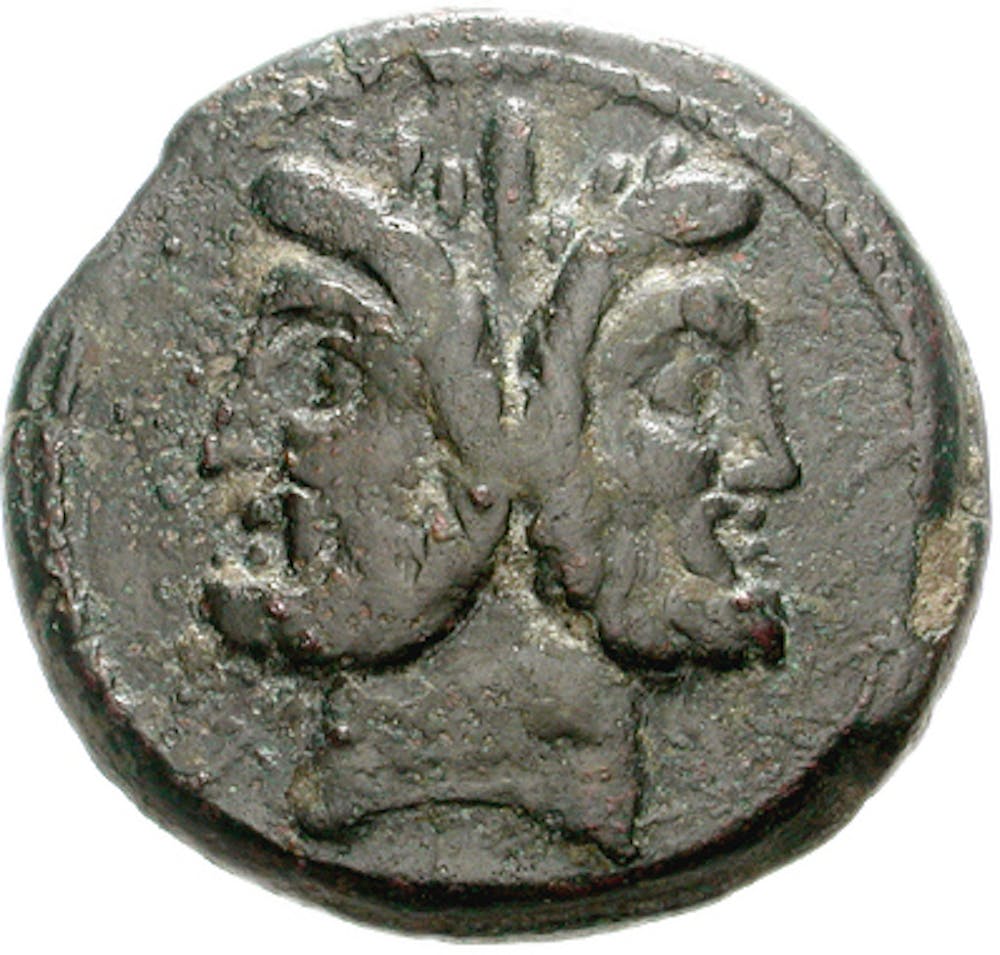
Roman coin showing the two-headed Janus

Roman coin showing the two-headed Janus.
Wikimedia Commons


Janus was proudly venerated as a uniquely Roman god, rather than one adopted from the Greek pantheon. All forms of transition came within his purview – beginnings and endings, entrances, exits, and passageways. The name Janus (Ianus in Latin, as the alphabet had no j) is etymologically related to ianua, the Latin word for door. Janus himself was the ianitor, or doorkeeper, of the heavens.

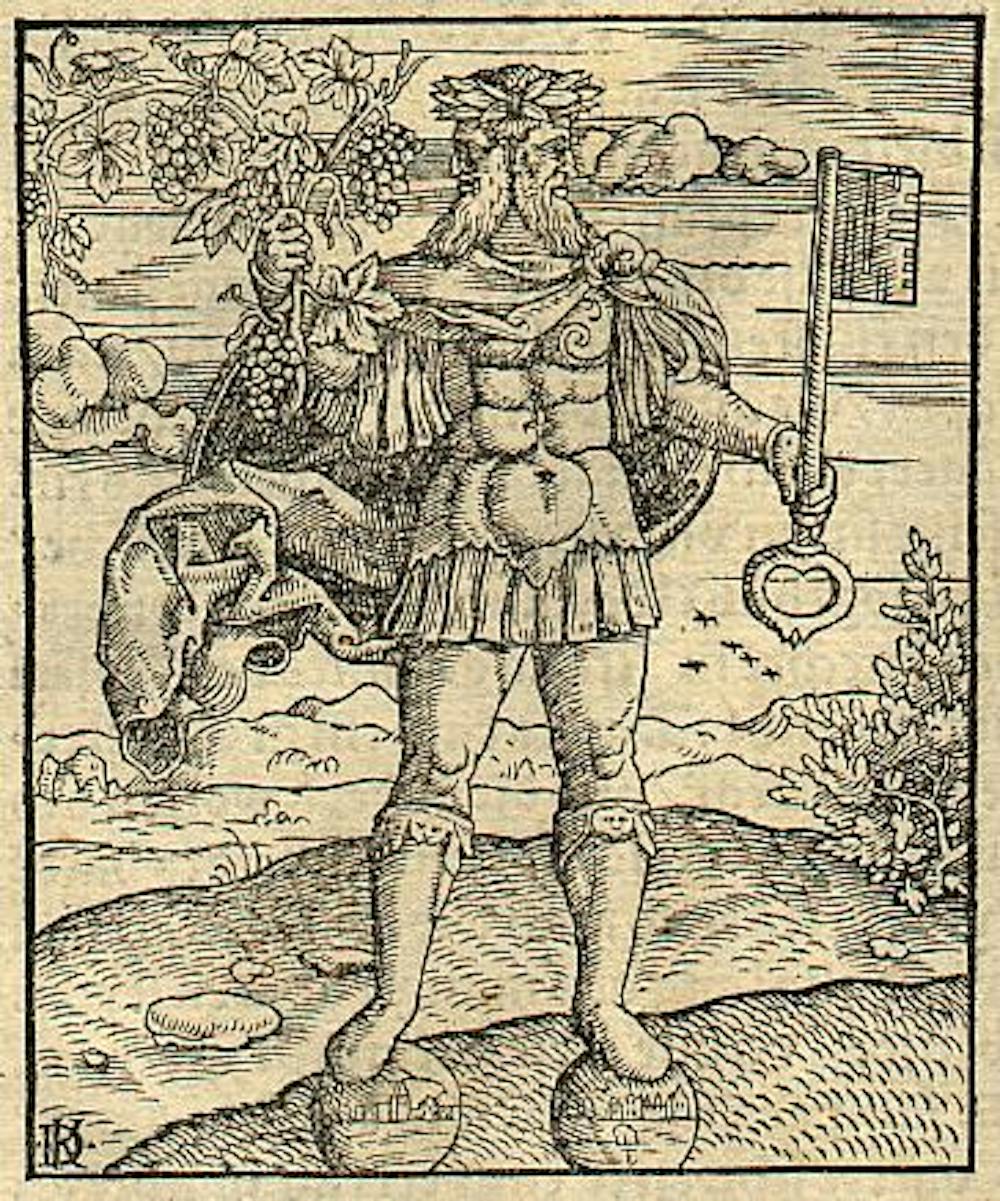
The cult statue of Janus depicted the god bearded with two heads. This meant that he could see forwards and backwards and inside and outside simultaneously without turning around. Janus held a staff in his right hand, in order to guide travellers along the correct route, and a key in his left to open gates.

War and Peace


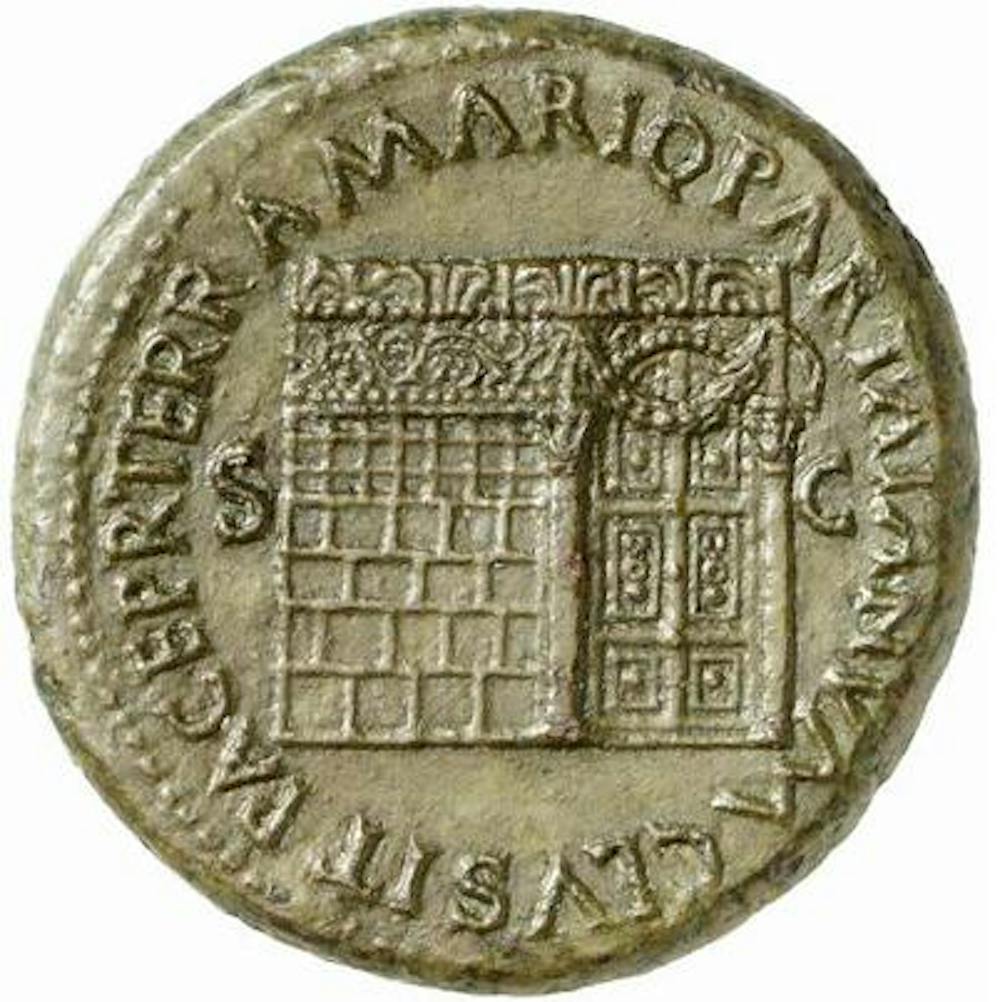
 Shrine of Janus as depicted on a coin of the emperor Nero

Shrine of Janus, as depicted on a coin of the emperor Nero.
Wikimedia Commons


Janus is famously associated with the transition between peace and war. Numa, the legendary second king of Rome, who was famed for his religious piety, is said to have founded a shrine to Janus Geminus (“two-fold”) in the Roman Forum, close to the Senate House. It was located in the place where Janus had bubbled up a spring of hot boiling water in order to thwart an attack on Rome by the Sabines.

The shrine was an enclosure formed by two arched gates at each end, joined together by walls to form a passageway. A bronze statue of Janus stood in the middle, with one head facing towards each gate. According to the historian Livy, Numa intended the shrine:

as an index of peace and war, that when open it might signify that the nation was in arms, when closed that all the peoples round about were pacified.

The gates of Janus are said to have stayed closed for 43 years under Numa, but rarely remained so thereafter, although the first emperor Augustus boasted that he closed the shrine three times. Nero later celebrated his conclusion of peace with Parthia by minting coins showing the gates of Janus firmly shut.

Happy New Year


The God Janus by Sebastian Münster 1550

The God Janus by Sebastian Münster, 1550.
Wikimedia Commons


Romans believed that the month of January was added to the calendar by Numa. The association between Janus and the calendar was cemented by the construction of 12 altars, one for each month of the year, in Janus’s temple in the Forum Holitorium (the vegetable market). The poet Martial thus described Janus as “the progenitor and father of the years”.

From 153 BC onwards, the consuls (the chief magistrates of the Republic) took office on the first day of January (which the Romans called the Kalends). The new consuls offered prayers to Janus, and priests dedicated spelt mixed with salt and a traditional barley cake, known as the ianual, to the god. Romans distributed New Year’s gifts of dates, figs, and honey to their friends, in the hope that the year ahead would turn out to be sweet, as well as coins – a sign of hoped-for prosperity.

Janus assumed a key role in all Roman public sacrifices, receiving incense and wine first before other deities. This was because, as the doorkeeper of the heavens, Janus was the route through which one reached the other gods, even Jupiter himself. The text On Agriculture, written by Cato the Elder, describes how offerings would be made to Janus, Jupiter, and Juno as part of the pre-harvest sacrifice to ensure a good crop.

So if you’re feeling caught between two worlds this January 1, why not head outside and celebrate Roman-style? Pack up some sweets to share, grab your keys, and shut the door on 2017.

The ConversationTomorrow: Explainer: the gods behind the days of the week.

Caillan Davenport, Lecturer in Roman History and ARC DECRA Research Fellow, Macquarie University

La version originale de cet article a été publiée sur The Conversation.