Showing posts with label Rome. Show all posts

Wednesday, February 14, 2018

Guest Post: Was the 'real' St. Valentine a patron of love?

Lisa Bitel, University of Southern California – Dornsife College of Letters, Arts and Sciences

On Feb. 14, sweethearts of all ages will exchange cards, flowers, candy, and more lavish gifts in the name of St. Valentine. But as a historian of Christianity, I can tell you that at the root of our modern holiday is a beautiful fiction. St. Valentine was no lover or patron of love.

Valentine’s Day, in fact, originated as a liturgical feast to celebrate the decapitation of a third-century Christian martyr, or perhaps two. So, how did we get from beheading to betrothing on Valentine’s Day?
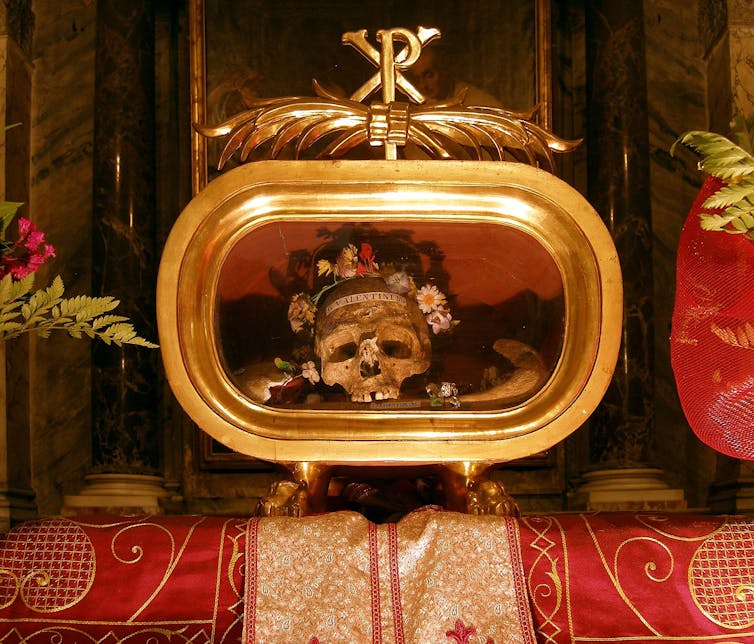

 Relics of St. Valentine of Terni at the basilica of Saint Mary in Cosmedin.

Relics of St. Valentine of Terni at the basilica of Saint Mary in Cosmedin.
Dnalor 01 (Own work) , CC BY-SA


Early origins of St. Valentine


Ancient sources reveal that there were several St. Valentines who died on Feb. 14. Two of them were executed during the reign of Roman Emperor Claudius Gothicus in 269-270 A.D., at a time when persecution of Christians was common.

How do we know this? Because, an order of Belgian monks spent three centuries collecting evidence for the lives of saints from manuscript archives around the known world.

They were called Bollandists after Jean Bolland, a Jesuit scholar who began publishing the massive 68-folio volumes of “Acta Sanctorum,” or “Lives of the Saints,” beginning in 1643.

Since then, successive generations of monks continued the work until the last volume was published in 1940. The Brothers dug up every scrap of information about every saint on the liturgical calendar and printed the texts arranged according to the saint’s feast day.

The Valentine martyrs


The volume encompassing Feb. 14 contains the stories of a handful of “Valentini,” including the earliest three of whom died in the third century.
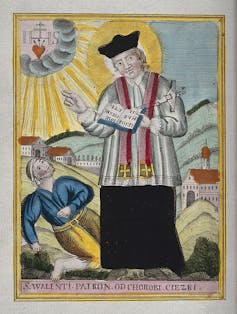


 St. Valentine blessing an epileptic.

St. Valentine blessing an epileptic.
Wellcome Images, CC BY


The earliest Valentinus is said to have died in Africa, along with 24 soldiers. Unfortunately, even the Bollandists could not find any more information about him. As the monks knew, sometimes all that the saints left behind was a name and day of death.

We know only a little more about the other two Valentines.

According to a late medieval legend reprinted in the “Acta,” which was accompanied by Bollandist critique about its historical value, a Roman priest named Valentinus was arrested during the reign of Emperor Gothicus and put into the custody of an aristocrat named Asterius.

As the story goes, Asterius made the mistake of letting the preacher talk. Father Valentinus went on and on about Christ leading pagans out of the shadow of darkness and into the light of truth and salvation. Asterius made a bargain with Valentinus: If the Christian could cure Asterius’s foster-daughter of blindness, he would convert. Valentinus put his hands over the girl’s eyes and chanted:

“Lord Jesus Christ, en-lighten your handmaid, because you are God, the True Light.”

Easy as that. The child could see, according to the medieval legend. Asterius and his whole family were baptized. Unfortunately, when Emperor Gothicus heard the news, he ordered them all to be executed. But Valentinus was the only one to be beheaded. A pious widow, though, made off with his body and had it buried at the site of his martyrdom on the Via Flaminia, the ancient highway stretching from Rome to present-day Rimini. Later, a chapel was built over the saint’s remains.

St. Valentine was not a romantic


The third third-century Valentinus was a bishop of Terni in the province of Umbria, Italy.
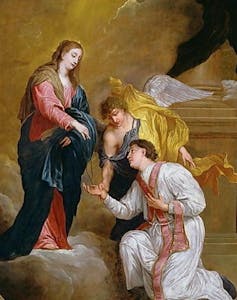

 St. Valentine kneeling

St. Valentine kneeling.
David Teniers III


According to his equally dodgy legend, Terni’s bishop got into a situation like the other Valentinus by debating a potential convert and afterward healing his son. The rest of story is quite similar as well: He too, was beheaded on the orders of Emperor Gothicus and his body buried along the Via Flaminia.

It is likely, as the Bollandists suggested, that there weren’t actually two decapitated Valentines, but that two different versions of one saint’s legend appeared in both Rome and Terni.

Nonetheless, African, Roman or Umbrian, none of the Valentines seems to have been a romantic.

Indeed, medieval legends, repeated in modern media, had St. Valentine performing Christian marriage rituals or passing notes between Christian lovers jailed by Gothicus. Still other stories romantically involved him with the blind girl whom he allegedly healed. Yet none of these medieval tales had any basis in third-century history, as the Bollandists pointed out.
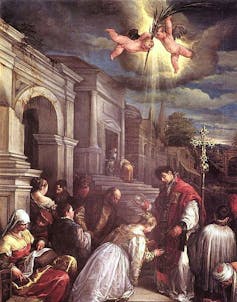

St. Valentine baptizing St. Lucilla. Jacopo Bassano (Jacopo da Ponte)

St. Valentine baptizing St. Lucilla.
Jacopo Bassano (Jacopo da Ponte)


In any case, historical veracity did not count for much with medieval Christians. What they cared about were stories of miracles and martyrdoms, and the physical remains or relics of the saint. To be sure, many different churches and monasteries around medieval Europe claimed to have bits of a St. Valentinus’ skull in their treasuries.

Santa Maria in Cosmedin in Rome, for example, still displays a whole skull. According to the Bollandists, other churches across Europe also claim to own slivers and bits of one or the other St. Valentinus’ body: For example, San Anton Church in Madrid, Whitefriar Street Church in Dublin, the Church of Sts. Peter and Paul in Prague, Saint Mary’s Assumption in Chelmno, Poland, as well as churches in Malta, Birmingham, Glasgow, and on the Greek isle of Lesbos, among others.

For believers, relics of the martyrs signified the saints’ continuing their invisible presence among communities of pious Christians. In 11th-century Brittany, for instance, one bishop used what was purported to be Valentine’s head to halt fires, prevent epidemics, and cure all sorts of illnesses, including demonic possession.

As far as we know, though, the saint’s bones did nothing special for lovers.

Unlikely pagan origins


Many scholars have deconstructed Valentine and his day in books, articles and blog postings. Some suggest that the modern holiday is a Christian cover-up of the more ancient Roman celebration of Lupercalia in mid-February.

Lupercalia originated as a ritual in a rural masculine cult involving the sacrifice of goats and dogs and evolved later into an urban carnival. During the festivities half-naked young men ran through the streets of Rome, streaking people with thongs cut from the skins of newly killed goats. Pregnant women thought it brought them healthy babies. In 496 A.D., however, Pope Gelasius supposedly denounced the rowdy festival.

Still, there is no evidence that the pope purposely replaced Lupercalia with the more sedate cult of the martyred St. Valentine or any other Christian celebration.

Chaucer and the love birds


The love connection probably appeared more than a thousand years after the martyrs’ death, when Geoffrey Chaucer, author of “The Canterbury Tales” decreed the February feast of St. Valentinus to the mating of birds. He wrote in his “Parlement of Foules”:

“For this was on seynt Volantynys day.
Whan euery bryd comyth there to chese his make.”

It seems that, in Chaucer’s day, English birds paired off to produce eggs in February. Soon, nature-minded European nobility began sending love notes during bird-mating season. For example, the French Duke of Orléans, who spent some years as a prisoner in the Tower of London, wrote to his wife in February 1415 that he was “already sick of love” (by which he meant lovesick.) And he called her his “very gentle Valentine.”

English audiences embraced the idea of February mating. Shakespeare’s lovestruck Ophelia spoke of herself as Hamlet’s Valentine.

In the following centuries, Englishmen and women began using Feb. 14 as an excuse to pen verses to their love objects. Industrialization made it easier with mass-produced illustrated cards adorned with smarmy poetry. Then along came Cadbury, Hershey’s, and other chocolate manufacturers marketing sweets for one’s sweetheart on Valentine’s Day.

Today, shops everywhere in England and the U.S. decorate their windows with hearts and banners proclaiming the annual Day of Love. Merchants stock their shelves with candy, jewelry and Cupid-related trinkets begging “Be My Valentine.” For most lovers, this request does not require beheading.

Invisible Valentines


It seems that the erstwhile saint behind the holiday of love remains as elusive as love itself. Still, as St. Augustine, the great fifth-century theologian and philosopher argued in his treatise on “Faith in Invisible Things,” someone does not have to be standing before our eyes for us to love them.

The ConversationAnd much like love itself, St. Valentine and his reputation as the patron saint of love are not matters of verifiable history, but of faith.

Lisa Bitel, Professor of History & Religion, University of Southern California – Dornsife College of Letters, Arts and Sciences

This article was originally published on The Conversation. Read the original article.


Wednesday, January 03, 2018

Guest Post: Celebrating Cicero's Birthday

by Gary M. Galles

Marcus Tullius CiceroJohn Adams said of Marcus Tullius Cicero (106-43 BCE) that “All ages of the world have not produced a greater statesman and philosopher combined.” Anthony Everitt called him an “architect of constitutions that still govern our lives.” Thomas Jefferson said the Declaration of Independence was based on “the elementary books of public right, as Aristotle, Cicero, Locke, Sidney, etc.”

Cicero was a Roman Senator whose writings, as Historian Edward Gibbon put it, “breathed the spirit of freedom.” Particularly influential was his idea of natural law, echoed by John Locke and other enlightenment thinkers: Human nature included reason, which could discover justice, which was the basis of law. Voltaire said “He taught us how to think.”

Cicero stayed loyal to the Roman Republic against Julius Caesar. Antony had him murdered for his principles, and his head and hands were nailed to the Senate speaker’s podium as a warning to others, making him a model of resistance against tyranny to America’s revolutionary leaders.

Cicero’s ideas, particularly on justice, law and liberty still merit remembering, two millennia later, on his January 3 birthday.

Justice

Justice is the crowning glory of the virtues.
Justice consists in doing no injury to men.
Justice is the set and constant purpose which gives every man his due.
The foundations of justice are that no one should suffer wrong; then, that the public good be promoted.
Justice must be observed even to the lowest.
Justice does not descend from its pinnacle.
Justice extorts no reward, no kind of price; she is sought...for her own sake.
Law
True law is right reason in agreement with nature; it is of universal application.
The welfare of the people is the ultimate law.
The precepts of the law are these: to live honestly, to injure no one, and to give everyone else his due.
According to the law of nature it is only fair that no one should become richer through damages and injuries suffered by another.
The strictest law often causes the most serious wrong.
The more laws, the less justice.
The arrogance of officialdom should be tempered and controlled.
The administration of government, like a guardianship, ought to be directed to the good of those who confer, not of those who receive the trust.
When a government becomes powerful...it is an usurper which takes bread from innocent mouths and deprives honorable men of their substance for votes with which to perpetuate itself.
Liberty
We are in bondage to the law so that we might be free.
The essence of liberty is to live as you choose.
Freedom is a man’s natural power of doing what he pleases, so far as he is not prevented by force or law.
Freedom is a possession of inestimable value.
What is so beneficial to the people as liberty...to be preferred to all things.
Liberty is rendered even more precious by the recollection of servitude.
Only in states in which the power of the people is supreme has liberty any abode.
Peace is liberty in tranquility. Servitude is the worst of all evils, to be resisted not only by war, but even by death.
Cicero was an important influence behind the American Revolution. He symbolized opposition to tyranny and his ideas on justice, law, and liberty inform our founding documents, which is why Jim Powell’s The Triumph of Liberty begins with Cicero’s story. Though he wrote two millennia ago, his understanding of why defending liberty requires tightly constraining government was thoroughly modern: “Never was a government that was not composed of liars, malefactors and thieves.”

If Americans are serious about their liberty, which is defended by treating our founding documents as more than mere words on paper, Cicero merits renewed attention today.

Gary M. Galles

Gary M. Galles is a professor of economics at Pepperdine University. His recent books include Faulty Premises, Faulty Policies (2014) and Apostle of Peace (2013). He is a member of the FEE Faculty Network.


This article was originally published on FEE.org. Read the original article.


Tuesday, January 02, 2018

Guest Post: The gods behind the days of the week

Margaret Clunies Ross, University of Sydney

The origins of our days of the week lie with the Romans. The Romans named their days of the week after the planets, which in turn were named after the Roman gods:

  • dies Solis “the day of the sun (then considered a planet)”
  • dies Lunae “the day of the moon”
  • dies Martis, “the day of Mars”
  • dies Mercurii, “the day of Mercury”
  • dies Iovis, “the day of Jupiter”
  • dies Veneris, “the day of Venus”
  • dies Saturni, “the day of Saturn”

When the Germanic-speaking peoples of western Europe adopted the seven-day week, which was probably in the early centuries of the Christian era, they named their days after those of their own gods who were closest in attributes and character to the Roman deities.

It was one of those peoples, the Anglo-Saxons, that brought their gods and language (what would become English) to the British Isles during the fifth and sixth centuries AD.


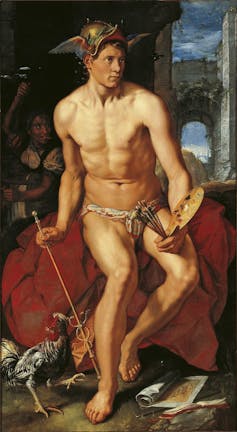
Hendrik Goltzius, Mercury, oil on canvas (1611)

Hendrik Goltzius, Mercury, oil on canvas (1611). Wikimedia Commons


In English, Saturday, Sunday and Monday are named for Saturn, the sun and moon respectively, following the Latin.

The remaining four days (Tuesday, Wednesday, Thursday and Friday) are named for gods that the Anglo-Saxons probably worshipped before they migrated to England and during the short time before they converted to Christianity after that.

Tuesday is named for the god Tiw, about whom relatively little is known. Tiw was probably associated with warfare, just like the Roman god Mars.

Wednesday is named for the god Woden, who is paralleled with the Roman god Mercury, probably because both gods shared attributes of eloquence, the ability to travel, and the guardianship of the dead.

Thursday is Thunor’s day, or, to give the word its Old English form, Thunresdæg “the day of Thunder”. This sits beside the Latin dies Iovis, the day of Jove or Jupiter. Both of these gods are associated with thunder in their respective mythologies.

You may recognise a similarity here with the name of the famous Norse god Thor. This may be more than coincidence. Vikings arrived in England in the ninth century, bringing their own very similar gods with them. Anglo-Saxons were already Christian by this time, but may have recognised the similarity between the name of their ancestors’ deity Thunor and the Norse god. We don’t know, but the word Thor does appear in written texts from the period.

Friday is the only weekday named for a female deity, Frig, who is hardly mentioned anywhere else in early English. The name does appear, however, as a common noun meaning “love, affection” in poetry. That is why Frig was chosen to pair with the Roman deity Venus, who was likewise associated with love and sex, and was commemorated in the Latin name for Friday.

Of gods and weekdays

The concept of the week, that is, a cycle of seven numbered or named days with one of them (usually Sunday or Monday) fixed as the first, was originally probably associated with the Jewish calendar. This was complicated by the fact that early medieval Europe inherited its idea of the week from imperial Rome, via the Christian church.

In early Christianity the reckoning of time was crucial to the proper celebration of the church’s feast days and holidays, especially the variable feast of Easter.

We find day names similar to English in related European languages, like Dutch, German, and all the Scandinavian or Norse languages. Gods with comparable names, like Tyr, Othinn, Thor and Frigg, were certainly known to the Scandinavians and gave their names to weekdays in Scandinavian languages (compare Modern Danish tisdag, onsdag, torsdag, fredag).

The ConversationThe Latin names for the days of the week, and the Roman gods for which they were named, still live on in all the European Romance languages, like French, Spanish and Italian. Think of French lundi, mardi, mercredi, jeudi and vendredi, for example, and you will find the Latin Luna, Mars, Mercurius, Iovis and Venus hidden behind them.


Margaret Clunies Ross, Eneritus Professor of English Language and Early English Literature, University of Sydney

La version originale de cet article a été publiée sur The Conversation.

Monday, January 01, 2018

Guest Post: Who was Janus, the Roman god of beginnings and endings?

Caillan Davenport, Macquarie University

January 1 can be a day of regret and reflection – did I really need that fifth glass of bubbly last night? – mixed with hope and optimism for the future, as we make plans to renew gym memberships or finally sort out our tax files. This January ritual of looking forward and backward is fitting for the first day of a month named after Janus, the Roman god of beginnings and endings.

Doorkeeper of the heavens


In Roman mythology, Janus was a king of Latium (a region of central Italy), who had his palace on the Janiculum hill, on the western bank of the River Tiber. According to the Roman intellectual Macrobius, Janus was given divine honours on account of his own religious devotion, as he set a pious example for all his people.


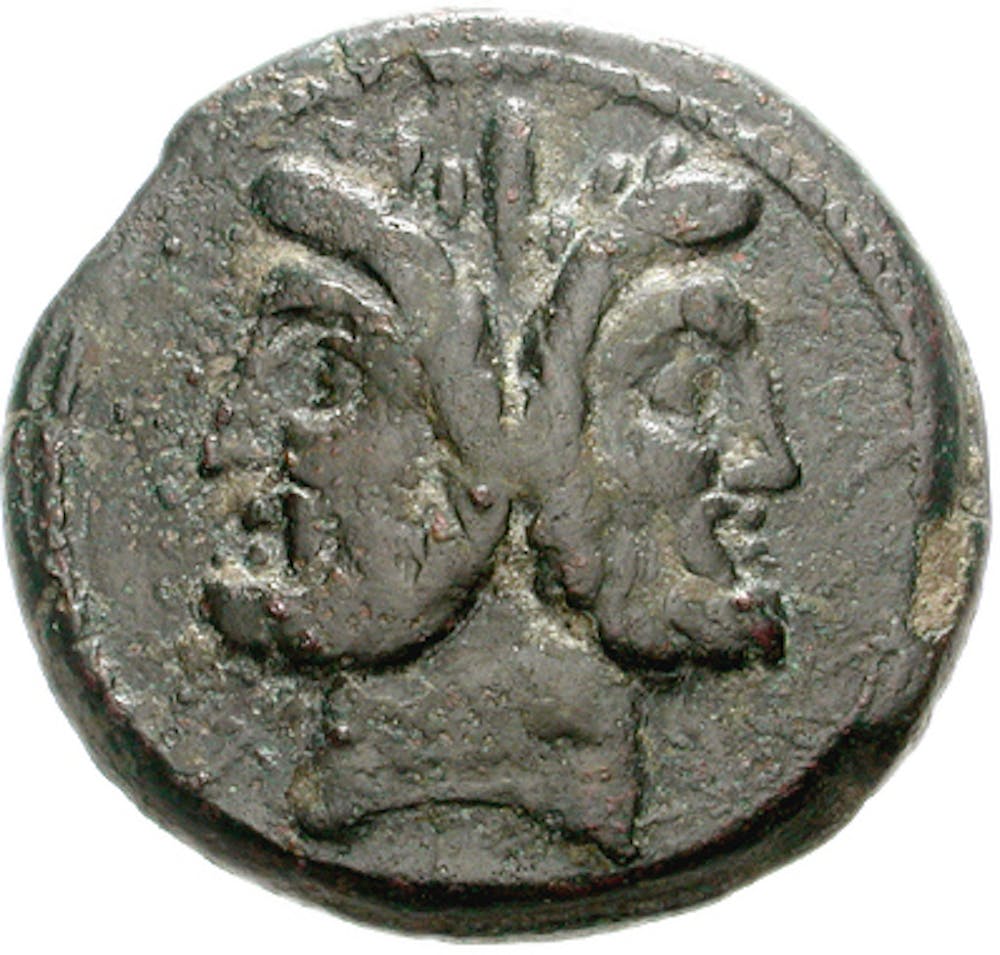
Roman coin showing the two-headed Janus

Roman coin showing the two-headed Janus.
Wikimedia Commons


Janus was proudly venerated as a uniquely Roman god, rather than one adopted from the Greek pantheon. All forms of transition came within his purview – beginnings and endings, entrances, exits, and passageways. The name Janus (Ianus in Latin, as the alphabet had no j) is etymologically related to ianua, the Latin word for door. Janus himself was the ianitor, or doorkeeper, of the heavens.

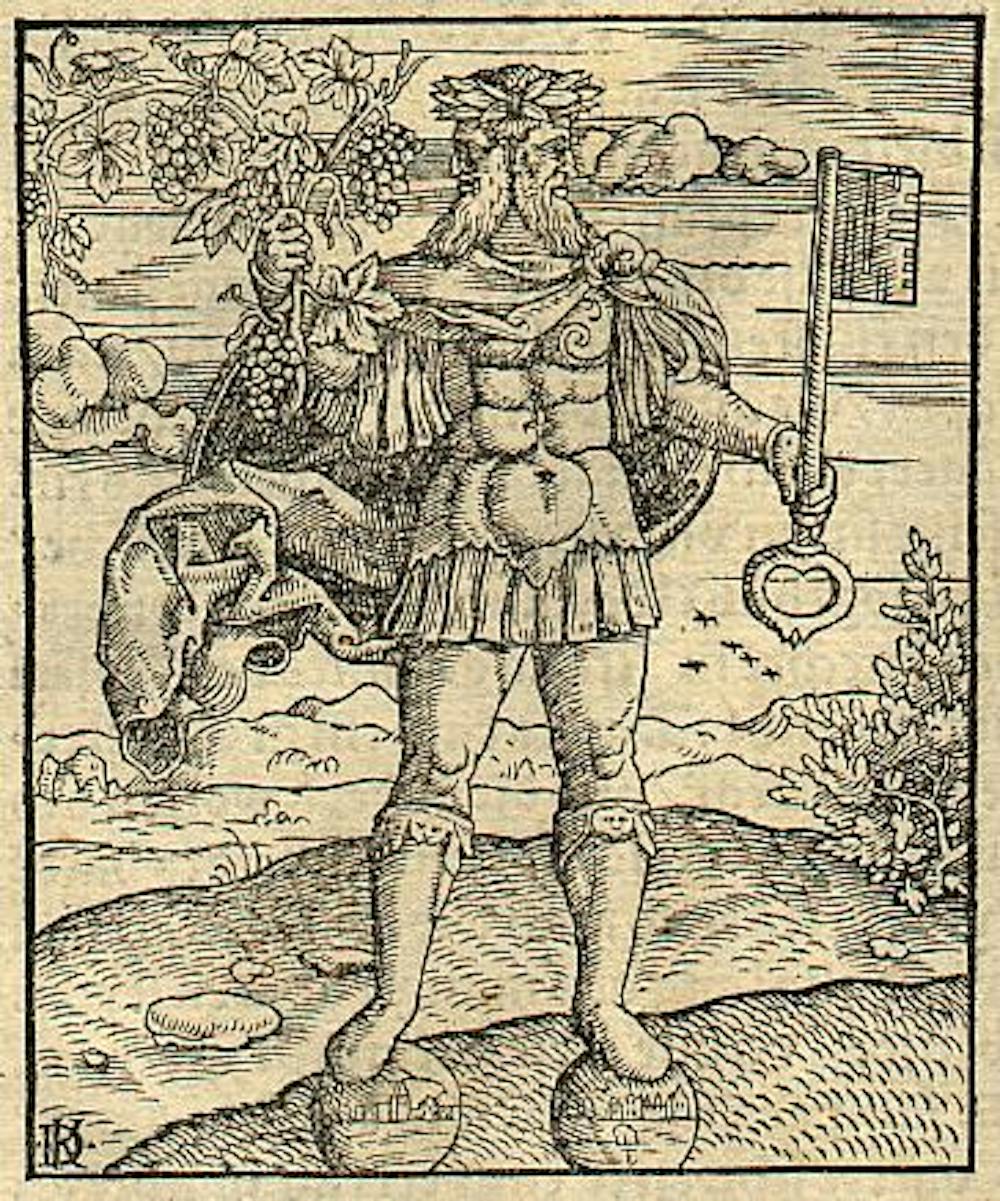
The cult statue of Janus depicted the god bearded with two heads. This meant that he could see forwards and backwards and inside and outside simultaneously without turning around. Janus held a staff in his right hand, in order to guide travellers along the correct route, and a key in his left to open gates.

War and Peace


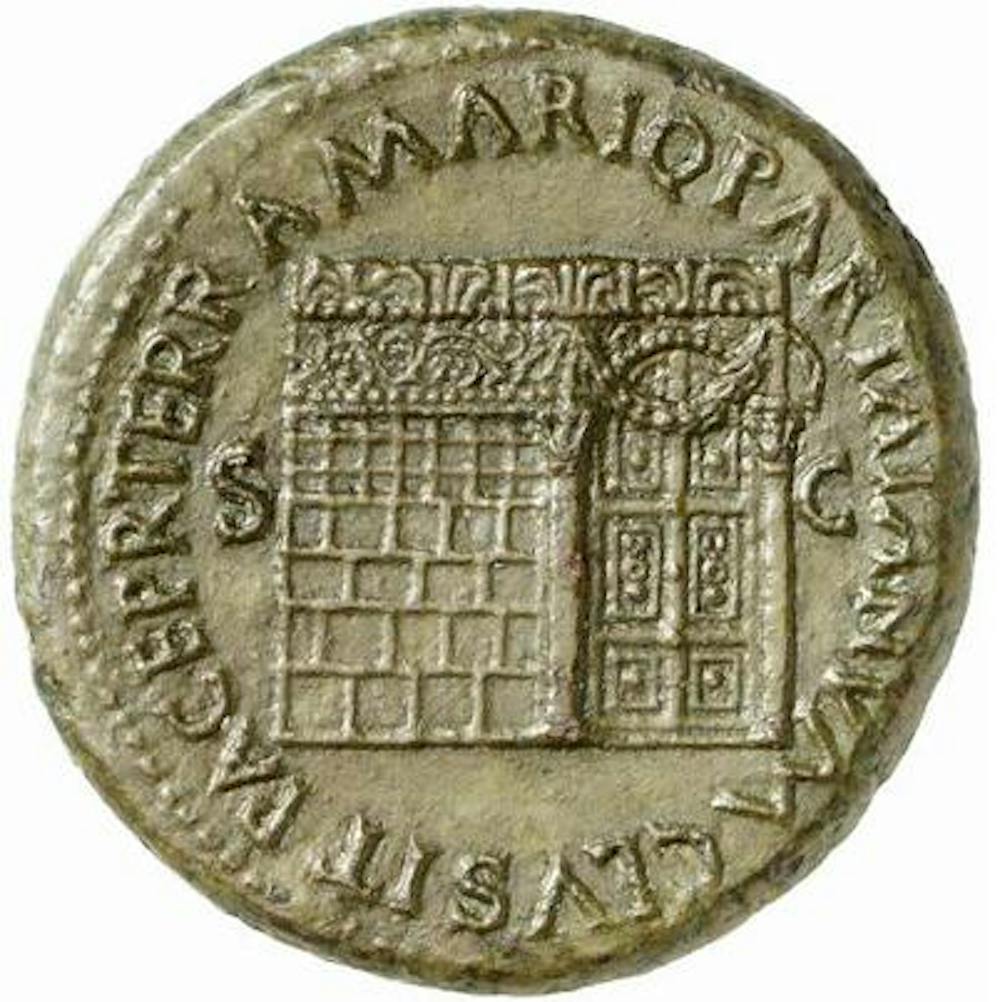
 Shrine of Janus as depicted on a coin of the emperor Nero

Shrine of Janus, as depicted on a coin of the emperor Nero.
Wikimedia Commons


Janus is famously associated with the transition between peace and war. Numa, the legendary second king of Rome, who was famed for his religious piety, is said to have founded a shrine to Janus Geminus (“two-fold”) in the Roman Forum, close to the Senate House. It was located in the place where Janus had bubbled up a spring of hot boiling water in order to thwart an attack on Rome by the Sabines.

The shrine was an enclosure formed by two arched gates at each end, joined together by walls to form a passageway. A bronze statue of Janus stood in the middle, with one head facing towards each gate. According to the historian Livy, Numa intended the shrine:

as an index of peace and war, that when open it might signify that the nation was in arms, when closed that all the peoples round about were pacified.

The gates of Janus are said to have stayed closed for 43 years under Numa, but rarely remained so thereafter, although the first emperor Augustus boasted that he closed the shrine three times. Nero later celebrated his conclusion of peace with Parthia by minting coins showing the gates of Janus firmly shut.

Happy New Year


The God Janus by Sebastian Münster 1550

The God Janus by Sebastian Münster, 1550.
Wikimedia Commons


Romans believed that the month of January was added to the calendar by Numa. The association between Janus and the calendar was cemented by the construction of 12 altars, one for each month of the year, in Janus’s temple in the Forum Holitorium (the vegetable market). The poet Martial thus described Janus as “the progenitor and father of the years”.

From 153 BC onwards, the consuls (the chief magistrates of the Republic) took office on the first day of January (which the Romans called the Kalends). The new consuls offered prayers to Janus, and priests dedicated spelt mixed with salt and a traditional barley cake, known as the ianual, to the god. Romans distributed New Year’s gifts of dates, figs, and honey to their friends, in the hope that the year ahead would turn out to be sweet, as well as coins – a sign of hoped-for prosperity.

Janus assumed a key role in all Roman public sacrifices, receiving incense and wine first before other deities. This was because, as the doorkeeper of the heavens, Janus was the route through which one reached the other gods, even Jupiter himself. The text On Agriculture, written by Cato the Elder, describes how offerings would be made to Janus, Jupiter, and Juno as part of the pre-harvest sacrifice to ensure a good crop.

So if you’re feeling caught between two worlds this January 1, why not head outside and celebrate Roman-style? Pack up some sweets to share, grab your keys, and shut the door on 2017.

The ConversationTomorrow: Explainer: the gods behind the days of the week.

Caillan Davenport, Lecturer in Roman History and ARC DECRA Research Fellow, Macquarie University

La version originale de cet article a été publiée sur The Conversation.

Thursday, June 15, 2017

Guest Post: A same-sex marriage ceremony in... Renaissance Rome?


Gary Ferguson, University of Virginia

Gary Ferguson same-sex marriage Renaissance RomeIn the late 16th century, the famous French essayist Michel de Montaigne wrote about two marriages between people of the same sex. The first involved women in eastern France, the second a group of men in Rome. At the time, same-sex marriages were not recognized by religious or civil law, and sodomy – a term that included a wide range of sexual acts – was a crime. As a result, when those involved were discovered they were usually brought to trial and punished, sometimes by death.

These episodes, along with many others, reveal that even in Renaissance Europe, marriage was a highly contested issue.

Marriage between two men or two women might seem like a concept that has emerged only in recent decades. For centuries, however, same-sex couples have appropriated marriage in their own ways. I investigate a particularly notable example of this – the second of the two cases recounted by Montaigne – in my recent book “Same-Sex Marriage in Renaissance Rome: Sexuality, Identity and Community in Early Modern Europe.”

An evolving institution


Throughout the Middle Ages, marriage involved not only two individuals but also their relatives, local communities, and secular and religious authorities. Each of these had different – sometimes conflicting – ideas, priorities and goals.

From the 12th century on, the Catholic Church considered matrimony a sacrament that required only the free consent of the spouses, in the form of an exchange of vows. As a social institution, however, marriage was usually based on a legal contract for the transfer of property (the bride’s dowry), which was signed in front of a notary.


Saint John at the Latin Gate in Rome gay marriage Gary Ferguson

French essayist Michel de Montaigne once described a ceremony between two male lovers at Saint John at the Latin Gate in Rome.
Gary Ferguson, Author provided


The 16th century was a watershed period that saw sweeping changes and the introduction of stringent new requirements designed to prevent clandestine (or secret) unions that heads of families opposed. In countries converted to one of the new Reformed or Protestant faiths, marriage ceased to be a sacrament, and laws were passed strengthening parents’ control over their dependent children.

In response to pressure from secular governments, the Catholic Church also modified its position considerably in 1563, when the Council of Trent decreed that a wedding must henceforth be performed in a parish church, by an authorized priest, in the presence of witnesses, and following the proclamation of “banns” (the public announcement of the ceremony).

Changes in legislation did not always translate immediately into changes in practice, however. Situations of doubt or dispute were common and frequently ended up in court.

On the margins of the papal city


This is the volatile background against which the marriages between men in Rome were set.

After piecing together information from several sources – diplomatic dispatches, newsletters, fragments of a trial transcript and brief wills – a much fuller, if incomplete, picture of what took place emerges.


Michel de Montaigne

Michel de Montaigne.
Wikimedia Commons


On a Sunday afternoon in July 1578, a sizable group of men gathered at Saint John at the Latin Gate, a beautiful but remote church on the outer edge of Rome. Many of them were friends who had met there on previous occasions. They were mostly poor immigrants from Spain and Portugal but included several priests and friars. They ate and drank in an atmosphere that was festive, yet strangely subdued. It turned suddenly to confusion and fear with the arrival of the police, who arrested 11 of those present. The rest fled.

The Roman authorities had been tipped off about the group’s plans to celebrate a marriage, perhaps not for the first time, between two of its members. In the end, the wedding between Gasparo and Gioseffe hadn’t taken place: The latter – reportedly ill – failed to appear. But Gasparo was among those taken prisoner, and, following a trial that lasted three weeks, executed.

The exact nature and purpose of the intended ceremony remain uncertain. Some sources describe a marriage celebrated after Mass. Others refer to the giving of rings, a hermit who officiated or adolescents taking part under constraint or even disguised as women.

What we know for sure is that the afternoon was to culminate, like most weddings at the time, in a celebratory feast and the consummation of the union – that is, in the couple (and, in this instance, perhaps others) having sex.

Like husband and wife?


Although the same was not true of all the group’s members, Gasparo and Gioseffe conformed to established gender norms when having intercourse: According to evidence from the trial, the latter took a “male” (penetrative) role, the former a “female” (receptive) one.

Gary Ferguson renaissance France gayIn other respects, however, their relationship didn’t resemble that of traditional spouses. Most importantly, Gioseffe was a friar, prevented from marrying in the eyes of the Church. Gioseffe’s attachment to a convent also means that it’s unlikely the pair planned on living together. This distinguishes them not only from men and women who married but also from the female married couples we know about from the period, who – like the women described by Montaigne – often did establish a common household, with one cross-dressing and living as a man.

In light of the group’s generally promiscuous behavior, it seems equally unlikely that Gasparo and Gioseffe intended to embark on a sexually exclusive relationship and thus that they believed the sacrament would remove the sinfulness that the Church attached to all extramarital sex.

Finally, the purpose of the feast following the planned wedding was not personal or religious but communal. Despite the fact that it greatly increased the chances that the men would be caught, it was clearly important to them as a way to express and build a sense of community. The socially marginalized friends at the Latin Gate had, in fact, developed several of the characteristics of a sexual subculture, like those that would later be found in large European cities in the 18th century. In a number of ways, they anticipated the networks of “mollies” in London and Paris’ “gens de la manchette” (“men of the cuff”), with their regular meeting places, social activities and a shared slang.

The evidence, then, points to a handful of motivations behind the Roman weddings. Since the friends took the ceremony seriously enough to put themselves at considerable risk, it very likely served to recognize and sanction Gasparo and Gioseffe’s relationship, claiming that such a union should be possible. At the same time, it may also have had a playful element, parodying and subtly criticizing elements of a traditional wedding.

An argument for marriage equality?


In one sense, the context for extending marriage rights to same-sex couples today is very different from the 16th century, when most marriages weren’t based primarily on love and didn’t establish legal equality between the spouses.

It was after the changes effected by the women’s rights movement in the second half of the 20th century to make the institution more equitable that gay and lesbian activists adopted marriage equality as their major goal.

Nevertheless, the stories from the 16th century show that marriage has never been a universal and fixed phenomenon. It has a contested history, one that both excludes and includes same-sex couples, who have claimed marriage on their own terms.

The ConversationWhen viewed through this lens, the ceremony planned that summer afternoon in Rome overturns the narrative that recent political victories were only the culmination of a modern, 20th-century campaign. The friends who met at the Latin Gate offer a striking example of how same-sex couples have long claimed the right to marry and, at the same time, challenged some of marriage’s traditional norms.

Gary Ferguson, Douglas Huntly Gordon Distinguished Professor of French, University of Virginia

This article was originally published on The Conversation. Read the original article.

Sunday, December 25, 2016

Guest Post: Romans needed a mid-winter break too ... it lasted for 24 days


by Richard Flower, University of Exeter

In the Doctor Who Christmas Special from 2010, Michael Gambon’s Scrooge-like character remarks that across different cultures and worlds people come together to mark the midpoint of winter. It is, he imagines, as if they are saying: “Well done, everyone! We’re halfway out of the dark!”

The actual reasons for celebrating Christmas at this particular time in the year have long been debated. Links have often been drawn to the winter solstice and the Roman festival of Saturnalia. Some people have also associated it with the supposed birthday of the god Sol Invictus, the “unconquered sun”, since a fourth-century calendar describes both this and Christ’s birth as taking place on December 25.

Such speculation has inevitably led to claims that this traditionally Christian festival is little more than a rebranding of earlier pagan activities. But questions about the “religious identity” of public celebrations are, in fact, nothing new and were being asked in the later periods of the Roman empire as well.

This is particularly evident in the case of a rather obscure Roman festival called the Brumalia, which started on November 24 and lasted for 24 days. We cannot be sure exactly when it began to be celebrated, but one of our best accounts of it comes from the sixth century AD. A retired public official called John the Lydian explained that it had its origins in earlier pagan rites from this time of year, including Saturnalia.

Dionysus Brumalia Saturnalia Christmas
Dionysus
Some people celebrated Brumalia by sacrificing goats and pigs, while devotees of the god Dionysus inflated goat skins and then jumped on them. We also believe that each day of the festival was assigned a different letter of the Greek alphabet, starting with alpha (α) on November 24 and finishing with omega (ω) on December 17.

A person would wait until the day that corresponded to the first letter of their own name and then throw a party. This meant that those with a wide circle of friends – and, in particular, friends with a wide variety of names – might potentially get to go to 24 consecutive celebrations.

We also have other evidence for the popularity of the Brumalia during the sixth century. A speech by the orator Choricius of Gaza praises the festivities laid on by the emperor Justinian (527–565), remarking that the emperor and his wife, Theodora, celebrated the Brumalia on adjacent days, since the letter iota (ι) – for Justinian – directly follows theta (θ) – for Theodora – in the Greek alphabet. Surviving accounts from the cellars of a large estate in Egypt also detail the wine distributions to officials and servants for the Brumalia of the master, Apion, which fell on the first day of the festival.

Yet, the origins of the Brumalia are far from clear. It seems to have been related to the earlier Roman Bruma festival, which took place on a single day in November and looked ahead to the winter solstice (or bruma in Latin) a month later, but little is known about this.

It is only really from the sixth century onwards that it appears in surviving sources, even though by then most Romans were Christians and had been ruled by Christian emperors for more than two centuries. John the Lydian also states that the “name day” aspect of the celebrations was a recent innovation at this time. As far as we can tell, therefore, this was not merely a remnant from a distant pagan past, but had actually developed and grown at precisely the same time as emperors, including Justinian, were endeavouring to clamp down on perceived “paganism” in their empire.

The historian Roberta Mazza, in one of the most comprehensive modern discussions of the festival, has argued that the Brumalia was simply too popular to get rid of entirely, but that Justinian sought to strip it of “pagan” elements. She says that in doing so, the emperor “reshaped and reinvented the meanings and purposes of the feast” and made it “both acceptable from a religious point of view and useful for constructing a common cultural identity throughout the different provinces of the empire”.

The true meaning of Brumalia


We know that the Brumalia continued to be celebrated at the imperial court in Constantinople until at least the tenth century, but it was certainly not without its opponents. John the Lydian reports that the church was opposed to the Brumalia, and similar statements of disapproval and attempts to ban it were also made by church councils in 692 and 743. For some Christians, it remained just too pagan for comfort. Controversy also surrounded other celebrations in late antiquity, including the wearing of masks at New Year, the Roman Lupercalia (with its naked runners), and the processions and dancing involved in the “Bean Festival” at Calama in North Africa.

How then should we view the Brumalia? Was it still essentially “pagan”, or had it become safely Christianised or secularised? I think that any attempt to neatly categorise these festivals, let alone their participants, is destined to fail. For some people, the religious elements will have loomed larger, while for others they will have been almost entirely irrelevant, as also happens with Christmas today.

The Brumalia could be celebrated in a variety of ways and have a multitude of meanings to different people throughout the empire, even if all of them saw themselves as Christians. Rather than arguing that Justinian or others who enjoyed the Brumalia were “less Christian” than its opponents, we might instead treat it as a vivid illustration of the fluidity and malleability of notions of culture and identity.

We cannot ever discover the true meaning of Brumalia, but we can be sure that it brought people together to commemorate being halfway out of the dark.

The Conversation

Richard Flower, Senior Lecturer in Classics and Ancient History, University of Exeter

This article was originally published on The Conversation. Read the original article.