Showing posts with label Mythology. Show all posts

Tuesday, January 02, 2018

Guest Post: The gods behind the days of the week

Margaret Clunies Ross, University of Sydney

The origins of our days of the week lie with the Romans. The Romans named their days of the week after the planets, which in turn were named after the Roman gods:

  • dies Solis “the day of the sun (then considered a planet)”
  • dies Lunae “the day of the moon”
  • dies Martis, “the day of Mars”
  • dies Mercurii, “the day of Mercury”
  • dies Iovis, “the day of Jupiter”
  • dies Veneris, “the day of Venus”
  • dies Saturni, “the day of Saturn”

When the Germanic-speaking peoples of western Europe adopted the seven-day week, which was probably in the early centuries of the Christian era, they named their days after those of their own gods who were closest in attributes and character to the Roman deities.

It was one of those peoples, the Anglo-Saxons, that brought their gods and language (what would become English) to the British Isles during the fifth and sixth centuries AD.
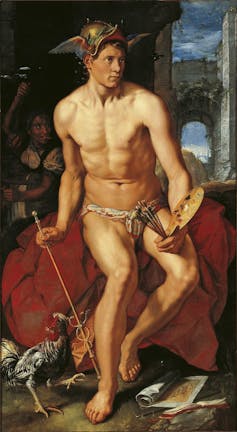


Hendrik Goltzius, Mercury, oil on canvas (1611)

Hendrik Goltzius, Mercury, oil on canvas (1611). Wikimedia Commons


In English, Saturday, Sunday and Monday are named for Saturn, the sun and moon respectively, following the Latin.

The remaining four days (Tuesday, Wednesday, Thursday and Friday) are named for gods that the Anglo-Saxons probably worshipped before they migrated to England and during the short time before they converted to Christianity after that.

Tuesday is named for the god Tiw, about whom relatively little is known. Tiw was probably associated with warfare, just like the Roman god Mars.

Wednesday is named for the god Woden, who is paralleled with the Roman god Mercury, probably because both gods shared attributes of eloquence, the ability to travel, and the guardianship of the dead.

Thursday is Thunor’s day, or, to give the word its Old English form, Thunresdæg “the day of Thunder”. This sits beside the Latin dies Iovis, the day of Jove or Jupiter. Both of these gods are associated with thunder in their respective mythologies.

You may recognise a similarity here with the name of the famous Norse god Thor. This may be more than coincidence. Vikings arrived in England in the ninth century, bringing their own very similar gods with them. Anglo-Saxons were already Christian by this time, but may have recognised the similarity between the name of their ancestors’ deity Thunor and the Norse god. We don’t know, but the word Thor does appear in written texts from the period.

Friday is the only weekday named for a female deity, Frig, who is hardly mentioned anywhere else in early English. The name does appear, however, as a common noun meaning “love, affection” in poetry. That is why Frig was chosen to pair with the Roman deity Venus, who was likewise associated with love and sex, and was commemorated in the Latin name for Friday.

Of gods and weekdays

The concept of the week, that is, a cycle of seven numbered or named days with one of them (usually Sunday or Monday) fixed as the first, was originally probably associated with the Jewish calendar. This was complicated by the fact that early medieval Europe inherited its idea of the week from imperial Rome, via the Christian church.

In early Christianity the reckoning of time was crucial to the proper celebration of the church’s feast days and holidays, especially the variable feast of Easter.

We find day names similar to English in related European languages, like Dutch, German, and all the Scandinavian or Norse languages. Gods with comparable names, like Tyr, Othinn, Thor and Frigg, were certainly known to the Scandinavians and gave their names to weekdays in Scandinavian languages (compare Modern Danish tisdag, onsdag, torsdag, fredag).

The ConversationThe Latin names for the days of the week, and the Roman gods for which they were named, still live on in all the European Romance languages, like French, Spanish and Italian. Think of French lundi, mardi, mercredi, jeudi and vendredi, for example, and you will find the Latin Luna, Mars, Mercurius, Iovis and Venus hidden behind them.


Margaret Clunies Ross, Eneritus Professor of English Language and Early English Literature, University of Sydney

La version originale de cet article a été publiée sur The Conversation.
Monday, January 01, 2018

Guest Post: Who was Janus, the Roman god of beginnings and endings?

Caillan Davenport, Macquarie University

January 1 can be a day of regret and reflection – did I really need that fifth glass of bubbly last night? – mixed with hope and optimism for the future, as we make plans to renew gym memberships or finally sort out our tax files. This January ritual of looking forward and backward is fitting for the first day of a month named after Janus, the Roman god of beginnings and endings.

Doorkeeper of the heavens


In Roman mythology, Janus was a king of Latium (a region of central Italy), who had his palace on the Janiculum hill, on the western bank of the River Tiber. According to the Roman intellectual Macrobius, Janus was given divine honours on account of his own religious devotion, as he set a pious example for all his people.


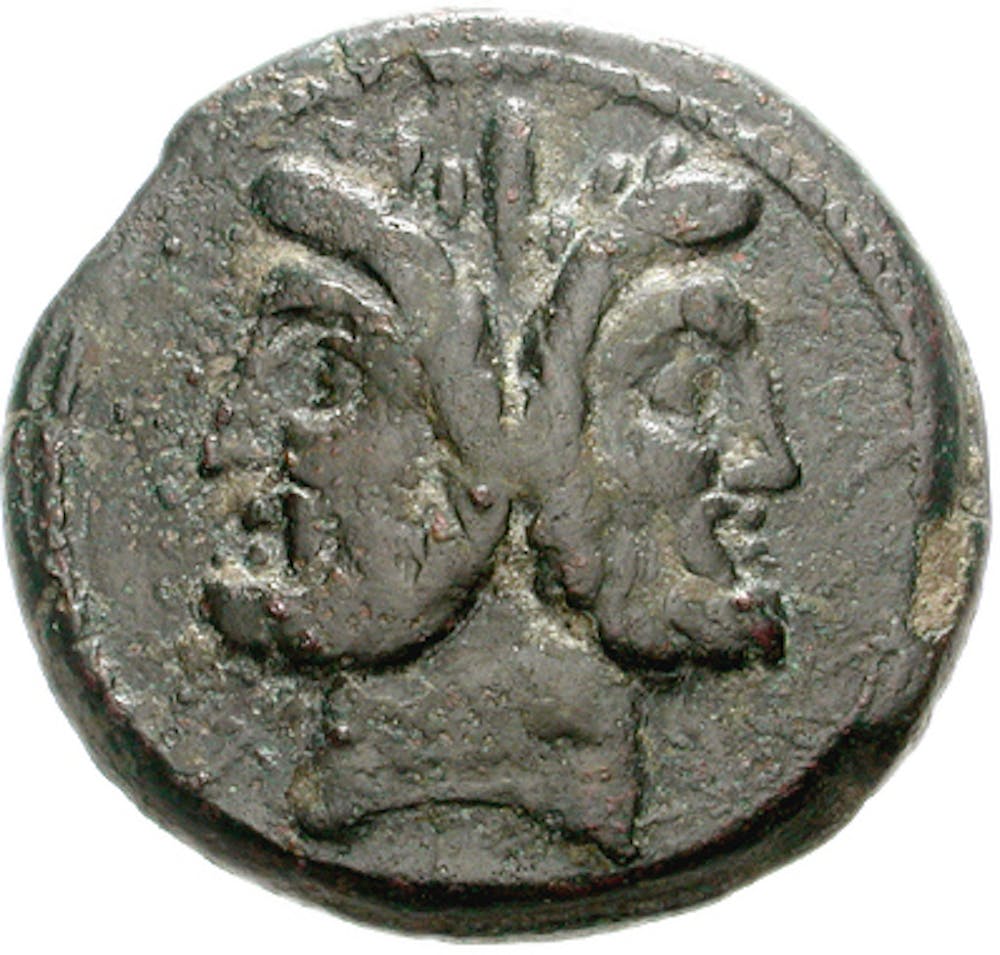
Roman coin showing the two-headed Janus

Roman coin showing the two-headed Janus.
Wikimedia Commons


Janus was proudly venerated as a uniquely Roman god, rather than one adopted from the Greek pantheon. All forms of transition came within his purview – beginnings and endings, entrances, exits, and passageways. The name Janus (Ianus in Latin, as the alphabet had no j) is etymologically related to ianua, the Latin word for door. Janus himself was the ianitor, or doorkeeper, of the heavens.

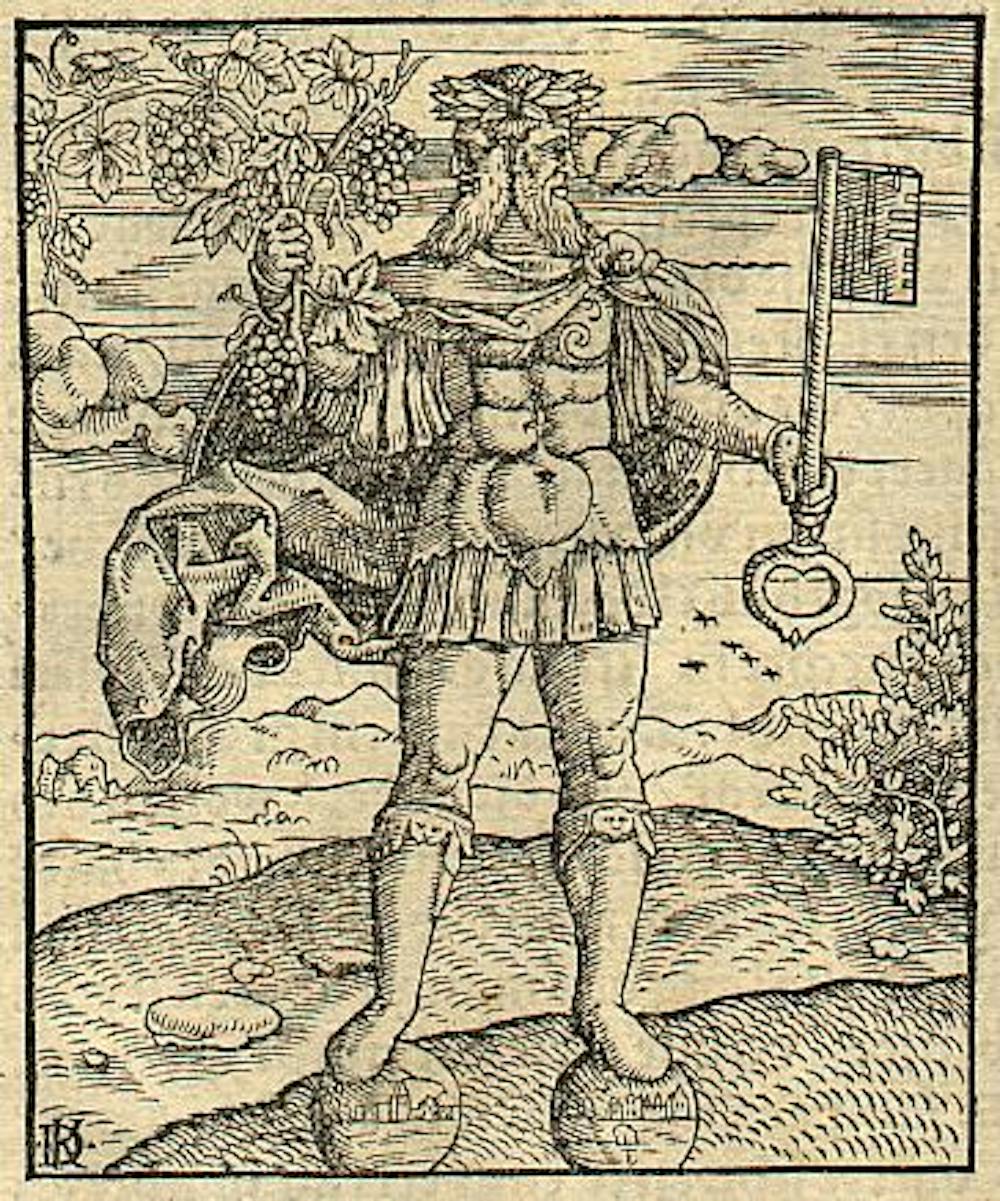
The cult statue of Janus depicted the god bearded with two heads. This meant that he could see forwards and backwards and inside and outside simultaneously without turning around. Janus held a staff in his right hand, in order to guide travellers along the correct route, and a key in his left to open gates.

War and Peace


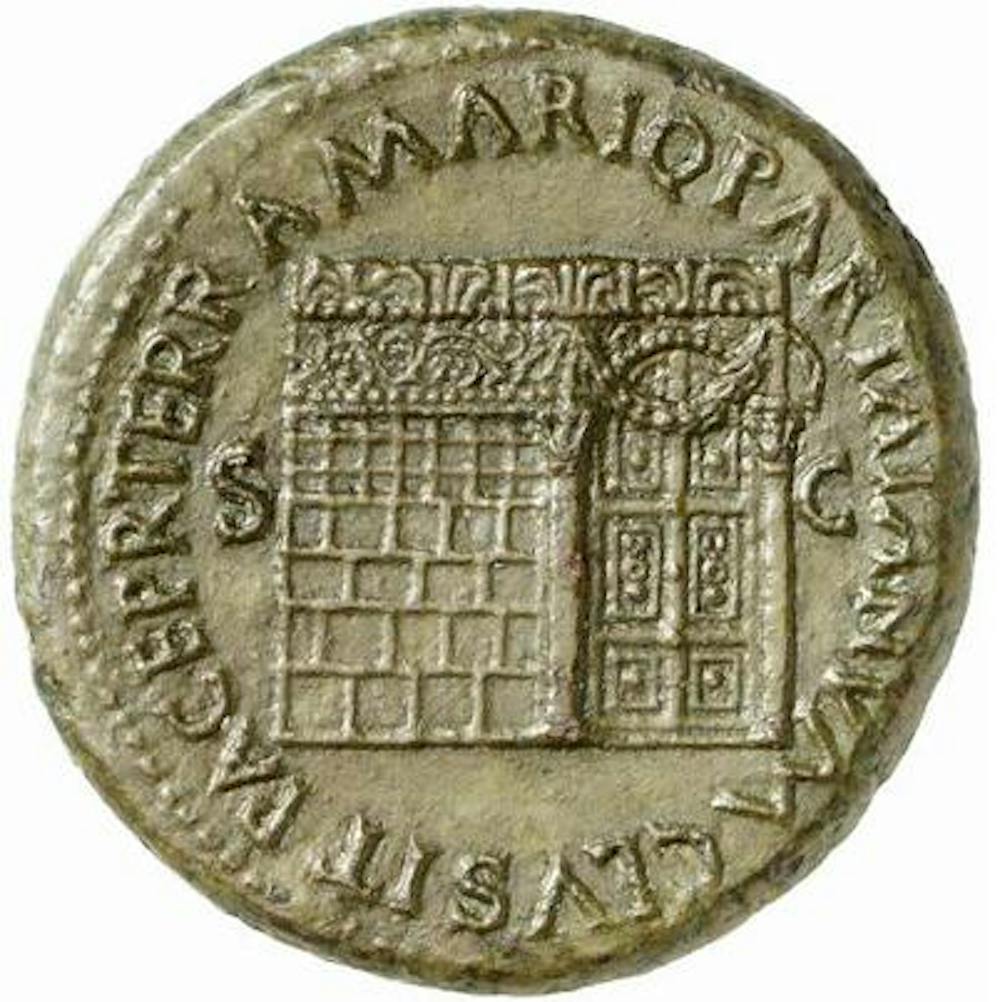
 Shrine of Janus as depicted on a coin of the emperor Nero

Shrine of Janus, as depicted on a coin of the emperor Nero.
Wikimedia Commons


Janus is famously associated with the transition between peace and war. Numa, the legendary second king of Rome, who was famed for his religious piety, is said to have founded a shrine to Janus Geminus (“two-fold”) in the Roman Forum, close to the Senate House. It was located in the place where Janus had bubbled up a spring of hot boiling water in order to thwart an attack on Rome by the Sabines.

The shrine was an enclosure formed by two arched gates at each end, joined together by walls to form a passageway. A bronze statue of Janus stood in the middle, with one head facing towards each gate. According to the historian Livy, Numa intended the shrine:

as an index of peace and war, that when open it might signify that the nation was in arms, when closed that all the peoples round about were pacified.

The gates of Janus are said to have stayed closed for 43 years under Numa, but rarely remained so thereafter, although the first emperor Augustus boasted that he closed the shrine three times. Nero later celebrated his conclusion of peace with Parthia by minting coins showing the gates of Janus firmly shut.

Happy New Year


The God Janus by Sebastian Münster 1550

The God Janus by Sebastian Münster, 1550.
Wikimedia Commons


Romans believed that the month of January was added to the calendar by Numa. The association between Janus and the calendar was cemented by the construction of 12 altars, one for each month of the year, in Janus’s temple in the Forum Holitorium (the vegetable market). The poet Martial thus described Janus as “the progenitor and father of the years”.

From 153 BC onwards, the consuls (the chief magistrates of the Republic) took office on the first day of January (which the Romans called the Kalends). The new consuls offered prayers to Janus, and priests dedicated spelt mixed with salt and a traditional barley cake, known as the ianual, to the god. Romans distributed New Year’s gifts of dates, figs, and honey to their friends, in the hope that the year ahead would turn out to be sweet, as well as coins – a sign of hoped-for prosperity.

Janus assumed a key role in all Roman public sacrifices, receiving incense and wine first before other deities. This was because, as the doorkeeper of the heavens, Janus was the route through which one reached the other gods, even Jupiter himself. The text On Agriculture, written by Cato the Elder, describes how offerings would be made to Janus, Jupiter, and Juno as part of the pre-harvest sacrifice to ensure a good crop.

So if you’re feeling caught between two worlds this January 1, why not head outside and celebrate Roman-style? Pack up some sweets to share, grab your keys, and shut the door on 2017.

The ConversationTomorrow: Explainer: the gods behind the days of the week.

Caillan Davenport, Lecturer in Roman History and ARC DECRA Research Fellow, Macquarie University

La version originale de cet article a été publiée sur The Conversation.
Sunday, December 24, 2017

Guest Post: Miraculous births and divine parents in the time of Jesus


by Meredith J C Warren, University of Sheffield

Many people are familiar with the stories in the New Testament gospels of Luke and Matthew about Jesus’ conception and birth. But what is less well known is how common such stories are when the lives of great men are told. From the initial announcement of an impending conception (to Mary in Luke, to Joseph in Matthew) to the signs and portents signalling the birth of the miraculous child, ancient Greek and Roman writings share a lot with the gospel accounts.

The Annunciation by Fra Angelico (1430-1432)
The gospels claim that Jesus’ birth was foretold in advance. Matthew quotes from the prophet Isaiah to establish Jesus’ birth as a divine promise that would usher in a time of peace and justice.

Virgil, writing in the early first century AD, wrote about a promised child, the offspring of the gods, who would bring a golden age of peace and prosperity to the Roman Empire – in other words, the emperor. Augustus Caesar’s birth was foretold by portents, according to the Roman historian Suetonius. Unusual astronomical occurrences were understood as divine omens in Roman culture, so it is no wonder that Jesus’s birth – like Augustus’s – was depicted as important using a miraculous star.

Alexander the Great’s birth also had meteorological omens surrounding it. Plutarch tells us that both Philip and Olympias, Alexander’s parents, were sent dreams from the gods announcing Alexander’s birth. Olympias dreamed that her womb was struck by lightning, while Philip dreamed that he put a seal on his wife’s womb in the image of a lion. Most significant, though, is the report that Philip spied a divine serpent sleeping next to his wife, which he took as a sign that he should avoid sleeping with her himself, since it was clear that she was to conceive from a divine rather than human source.

Massacre of the Infants


Just as Matthew records Herod’s attempts to stop the prophesied child by killing all newborn babies, Suetonius tells a similar account of Roman leaders attempting to prevent Augustus’s rise to power by ordering that no male child be reared. In Matthew, Jesus and his family escape the “Massacre of the Infants” by fleeing to Egypt – whereas in Suetonius (like in the Moses story) fathers- and mothers-to-be thwart the murderous plans, in the Roman case, by preventing the decree from being officially registered with the treasury.

Son of a god


Although both Matthew and Luke trace Jesus’s lineage through his non-biological father Joseph, Jesus is depicted as God’s own offspring.

Augustus Caesar was also adopted by his father, Julius Caesar, and likewise considered himself the descendent of a god – Venus Genetrix. Augustus traced his lineage to Venus through his ancestor Romulus, the legendary founder of Rome. Romulus, and his twin brother Remus, were conceived by the virgin priestess after the god Mars impregnated her. This priestess, as Virgil reports, was herself descended from Venus through her ancestor Aeneas, Venus’s beloved son.

Alexander the Great’s divine parentage was reinforced he grew up. Just as the adult Jesus was publicly claimed by God as his son in all four gospel accounts, Alexander’s father, Zeus Ammon, confirmed his son’s divine identity. Plutarch tells us that when Alexander approached an Egyptian oracle to ask whether he had avenged his father’s murder, the priest made him rephrase his request, since his father was not a mortal man, and addressed Alexander in oracular speech as “O son of Zeus”.

Jesus the hero


One of the most common places to find stories of miraculous births is in the life of heroes, often born of a union between a god and a human being. Hercules, perhaps the most famous of the Greek heroes, is the son of Zeus and the mortal woman Alcmene, for example. Zeus disguised himself as Alcmene’s husband in order to trick her into bed with him. The divine parentage that Hercules enjoyed enabled him to do many wondrous feats.

Likewise, Asclepius, son of Apollo, rescued from the womb of Coronis, was gifted with miraculous healing abilities and was later considered divine in his own right.

Since Matthew and Luke don’t agree with each other about what happened when Jesus was born, it’s especially interesting that they both relate something miraculous in their narratives. The idea of Jesus’s own miraculous birth may have supported the Gospel’s claims about Jesus’ miracle working ability, including healings and other wondrous feats.

The Conversation

Meredith J C Warren, Lecturer in Biblical and Religious Studies, University of Sheffield

This article was originally published on The Conversation. Read the original article.

Sunday, October 14, 2007

Colossus of Idaho?

According to a news story in the Idaho Statesman in Boise:

U.S. Sen. Larry Craig was honored Saturday evening for his many years of public service at an Idaho Hall of Fame ceremony.

David Leroy, the emcee for the ceremony and former lieutenant governor, noted at the opening of the event that the board had been criticized by media outlets nationwide for its decision not to pull Craig from their group of inductees, which includes Gov. Butch Otter and Boise State University President Bob Kustra.

"The Idaho Hall of Fame board has well considered each of these nominees," Leroy said, adding later that the Hall of Fame honors a history of achievement.

In his introduction of Craig, he entertained the audience with quotes about the price of fame, including one by author Truman Capote, who said, "Fame is only good for one thing — they will cash your check in a small town."

Given what Senator Craig has told us about himself, does this honor make him the "Colossus of Idaho"? Take a look:


Just asking.