Showing posts with label ancient history. Show all posts

Wednesday, December 12, 2018

Guest Post: An archaeological dig in Israel suggests how feasting became an important ritual


Natalie Munro, University of Connecticut

This holiday season millions of families will come together to celebrate their respective festivals and engage in myriad rituals. These may include exchanging gifts, singing songs, giving thanks, and most importantly, preparing and consuming the holiday feast.


Archaeological evidence shows that such communally shared meals have long been vital components of human rituals. My colleague Leore Grosman and I discovered the earliest evidence of a ritual feast at a 12,000-year-old archaeological site in northern Israel and learned how feasts came to be integral components of modern-day ritual practice.


First, what are rituals?


Rituals involve meaningful, often repeated actions. In modern-day practices they are expressed through rites such as the hooding of a doctoral student, birthdays, weddings or even sipping wine at Holy Communion or lighting Hanukkah candles.
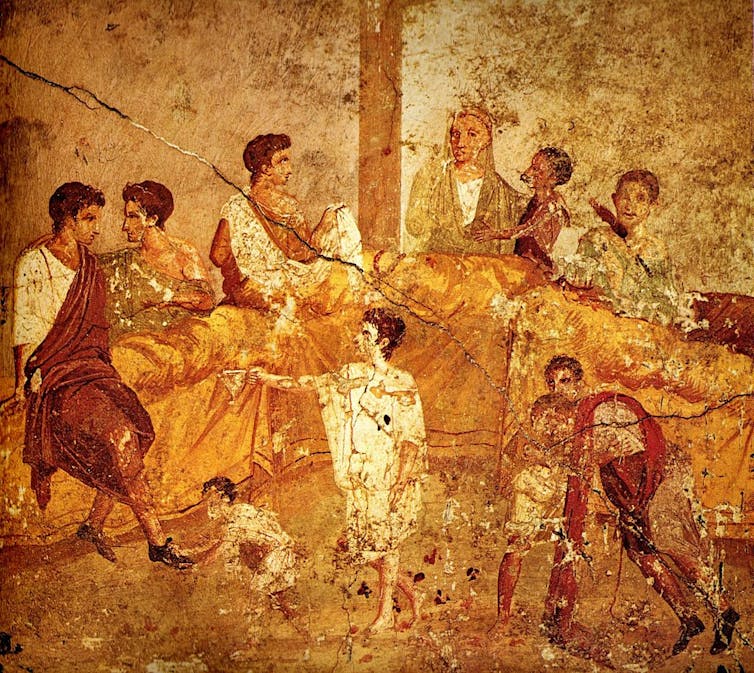


Pompeii family feast painting Naples

Pompeii family feast painting, Naples.
Unknown painter before 79 AD, via Wikimedia Commons


Ritual practice may have emerged along with other early modern human behaviors more than 100,000 years ago. However, proving this with material evidence is a challenge. For example, researchers have found that both Neanderthals and early modern humans buried their dead, but scholars weren’t certain whether this was for spiritual or symbolic reasons and not for something more mundane like maintaining site hygiene. Likewise, the discovery of 100,000-year-old symbolic artifacts like pierced shell ornaments and decorated chunks of red ochre in caves in South Africa, was not sufficient to prove that they were part of any ritual activities.

It was only when archaeologists found these artifacts, placed in graves going back 40,000-20,000 years, that it was confirmed they were part of ritual practice.

The first feasts


We had a similar experience during our research. When Leore Grosman and I first embarked on the excavations at Hilazon Tachtit in the late 1990s, we were only hoping to document the activities of the last hunter-gatherers in Israel, at what appeared to be a small campsite. It was only over several seasons of excavation that it slowly became clear to us that this was not a site where people had lived. Rather it was a site for rituals.
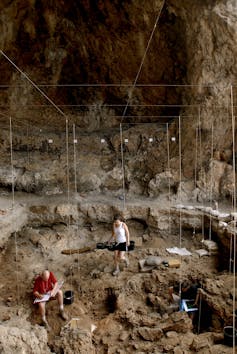


Hilazon Tachtit cave interior. Naftali Hilger

Hilazon Tachtit cave interior.
Naftali Hilger, CC BY-NC-ND


No houses, fireplaces or cooking areas were recovered. Instead the cave yielded the skeletal remains of at least 28 individuals interred in three pits and two small structures.

One of these structures contained the complete skeleton of an older woman, who we interpreted as a shaman based on her special treatment at death. Her grave stood apart due to its fine construction – the walls were plastered with clay and inset with flat stone slabs. Even more remarkable was the eclectic array of animal body parts buried alongside of her. The pelvis of a leopard, the wing tip of an eagle, the skulls of two martens and many other unusual body parts surrounded her skeleton.

The butchered remnants of more than 90 tortoises buried in the grave and the leftovers of at least three wild cattle deposited in a second adjacent depression excavated in the cave floor represent the remains of a funeral feast.
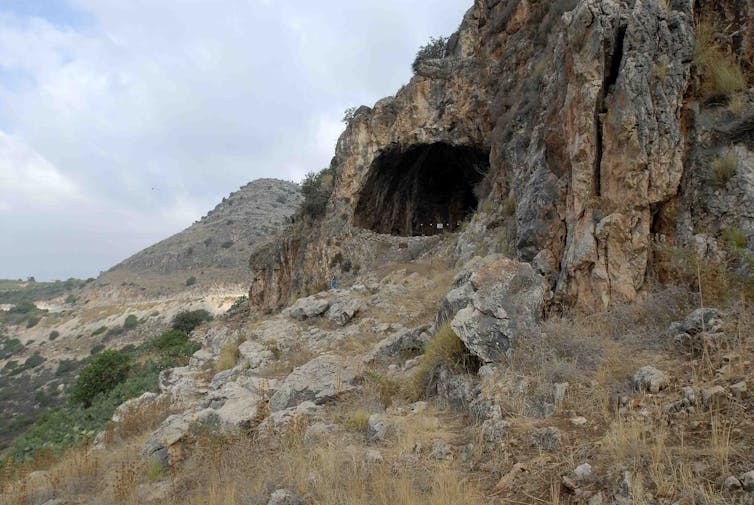


Hilazon Tachtit cave. Naftali Hilger

Hilazon Tachtit cave.
Naftali Hilger, CC BY-NC-ND


The outstanding preservation of the grave enabled us to detect multiple phases of a ritual performance that included the consumption of the feast, the burial of the woman, and the filling of the grave in several stages, including the intentional deposition of garbage from the feast.

Feasting at the beginning of agriculture


Archaeologists have found other sites that show evidence of ritual feasting. Many of these date to the time when humans were beginning to farm.
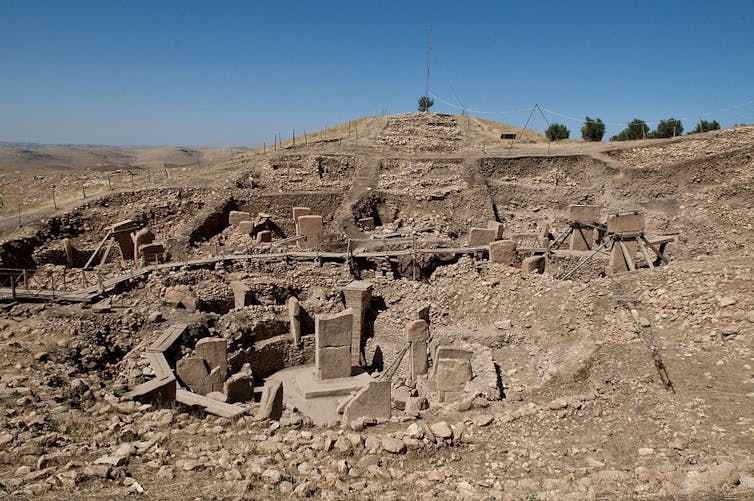


Site of Göbekli Tepe. Teomancimit

Site of Göbekli Tepe.
Teomancimit (Own work) , via Wikimedia Commons, CC BY-SA


One of the most striking is the site of Göbekli Tepe in southeastern Turkey, dating slightly later than Hilazon Tachtit. It includes multiple large structures adorned with benches and giant stone slab carved with exquisite animal depictions in relief dating to 11-12,000 years ago. Perhaps, these were very early communal buildings. The archaeologists who excavated Göbekli Tepe argue that massive quantities of animal bones associated with the structures represent the remains of feasts.

Twelve thousand years ago humans were still hunter-gatherers, subsisting entirely on wild foods. Nevertheless, these people differed from those who went before – they were sitting on the brink of the transition to agriculture, one of the most significant economic, social and ideological transformations in human history.

Sickle blades and grinding stones used to harvest and process cereal grains are found at Hilazon Tachtit and other contemporary archaeological sites. These findings indicate that these ritual feasts started around the same time that people adopted agriculture. When people began to rely more heavily on wild cereals like wheat and barley, they became increasingly tethered to landscapes that were ever more crowded and began to settle into more permanent communities. In other words, feasting became a part of their life, once they moved away from nomadic life.

Rituals that bind


These feasts had an important role to play. Adapting to village life after hundreds of millennia on the move was no simple act. Research on modern hunter-gatherer societies shows that closer contact between neighbors dramatically increased social tensions. New solutions to avoid and repair conflict were critical.

The simultaneous appearance of feasting, communal structures and specialized ritual sites suggest that humans were seeking to solve this problem by engaging the community in ritual practice.

One of the central functions of ritual in these communities was to provide a kind of social glue that bound community members by promoting social cohesion and solidarity. Feasts generate loyalty and commitment to the community’s success. Sharing food is intimate and it builds trust.

Communal rituals would have provided a shared sense of identity at a time when social circles were increasing in scale and permanence. They reinforced new ideologies that emerged out of a dramatic reorganization of economic and social life.

Role of feasts today

Feasting plays the same essential role today. Like the earliest feasts, our holiday celebrations are replete with actions that are repeated year after year.

The holiday feast today builds family traditions. By cooking and sharing food together, telling stories of past holidays and exchanging intergenerational wisdom, holiday rituals bond extended families and give them a shared identity.The Conversation

Natalie Munro, Professor, University of Connecticut

This article is republished from The Conversation under a Creative Commons license. Read the original article.


Tuesday, January 02, 2018

Guest Post: The gods behind the days of the week

Margaret Clunies Ross, University of Sydney

The origins of our days of the week lie with the Romans. The Romans named their days of the week after the planets, which in turn were named after the Roman gods:

  • dies Solis “the day of the sun (then considered a planet)”
  • dies Lunae “the day of the moon”
  • dies Martis, “the day of Mars”
  • dies Mercurii, “the day of Mercury”
  • dies Iovis, “the day of Jupiter”
  • dies Veneris, “the day of Venus”
  • dies Saturni, “the day of Saturn”

When the Germanic-speaking peoples of western Europe adopted the seven-day week, which was probably in the early centuries of the Christian era, they named their days after those of their own gods who were closest in attributes and character to the Roman deities.

It was one of those peoples, the Anglo-Saxons, that brought their gods and language (what would become English) to the British Isles during the fifth and sixth centuries AD.


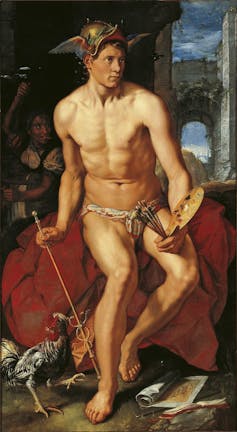
Hendrik Goltzius, Mercury, oil on canvas (1611)

Hendrik Goltzius, Mercury, oil on canvas (1611). Wikimedia Commons


In English, Saturday, Sunday and Monday are named for Saturn, the sun and moon respectively, following the Latin.

The remaining four days (Tuesday, Wednesday, Thursday and Friday) are named for gods that the Anglo-Saxons probably worshipped before they migrated to England and during the short time before they converted to Christianity after that.

Tuesday is named for the god Tiw, about whom relatively little is known. Tiw was probably associated with warfare, just like the Roman god Mars.

Wednesday is named for the god Woden, who is paralleled with the Roman god Mercury, probably because both gods shared attributes of eloquence, the ability to travel, and the guardianship of the dead.

Thursday is Thunor’s day, or, to give the word its Old English form, Thunresdæg “the day of Thunder”. This sits beside the Latin dies Iovis, the day of Jove or Jupiter. Both of these gods are associated with thunder in their respective mythologies.

You may recognise a similarity here with the name of the famous Norse god Thor. This may be more than coincidence. Vikings arrived in England in the ninth century, bringing their own very similar gods with them. Anglo-Saxons were already Christian by this time, but may have recognised the similarity between the name of their ancestors’ deity Thunor and the Norse god. We don’t know, but the word Thor does appear in written texts from the period.

Friday is the only weekday named for a female deity, Frig, who is hardly mentioned anywhere else in early English. The name does appear, however, as a common noun meaning “love, affection” in poetry. That is why Frig was chosen to pair with the Roman deity Venus, who was likewise associated with love and sex, and was commemorated in the Latin name for Friday.

Of gods and weekdays

The concept of the week, that is, a cycle of seven numbered or named days with one of them (usually Sunday or Monday) fixed as the first, was originally probably associated with the Jewish calendar. This was complicated by the fact that early medieval Europe inherited its idea of the week from imperial Rome, via the Christian church.

In early Christianity the reckoning of time was crucial to the proper celebration of the church’s feast days and holidays, especially the variable feast of Easter.

We find day names similar to English in related European languages, like Dutch, German, and all the Scandinavian or Norse languages. Gods with comparable names, like Tyr, Othinn, Thor and Frigg, were certainly known to the Scandinavians and gave their names to weekdays in Scandinavian languages (compare Modern Danish tisdag, onsdag, torsdag, fredag).

The ConversationThe Latin names for the days of the week, and the Roman gods for which they were named, still live on in all the European Romance languages, like French, Spanish and Italian. Think of French lundi, mardi, mercredi, jeudi and vendredi, for example, and you will find the Latin Luna, Mars, Mercurius, Iovis and Venus hidden behind them.
Margaret Clunies Ross, Eneritus Professor of English Language and Early English Literature, University of Sydney

La version originale de cet article a été publiée sur The Conversation.

Monday, January 01, 2018

Guest Post: Who was Janus, the Roman god of beginnings and endings?

Caillan Davenport, Macquarie University

January 1 can be a day of regret and reflection – did I really need that fifth glass of bubbly last night? – mixed with hope and optimism for the future, as we make plans to renew gym memberships or finally sort out our tax files. This January ritual of looking forward and backward is fitting for the first day of a month named after Janus, the Roman god of beginnings and endings.

Doorkeeper of the heavens


In Roman mythology, Janus was a king of Latium (a region of central Italy), who had his palace on the Janiculum hill, on the western bank of the River Tiber. According to the Roman intellectual Macrobius, Janus was given divine honours on account of his own religious devotion, as he set a pious example for all his people.


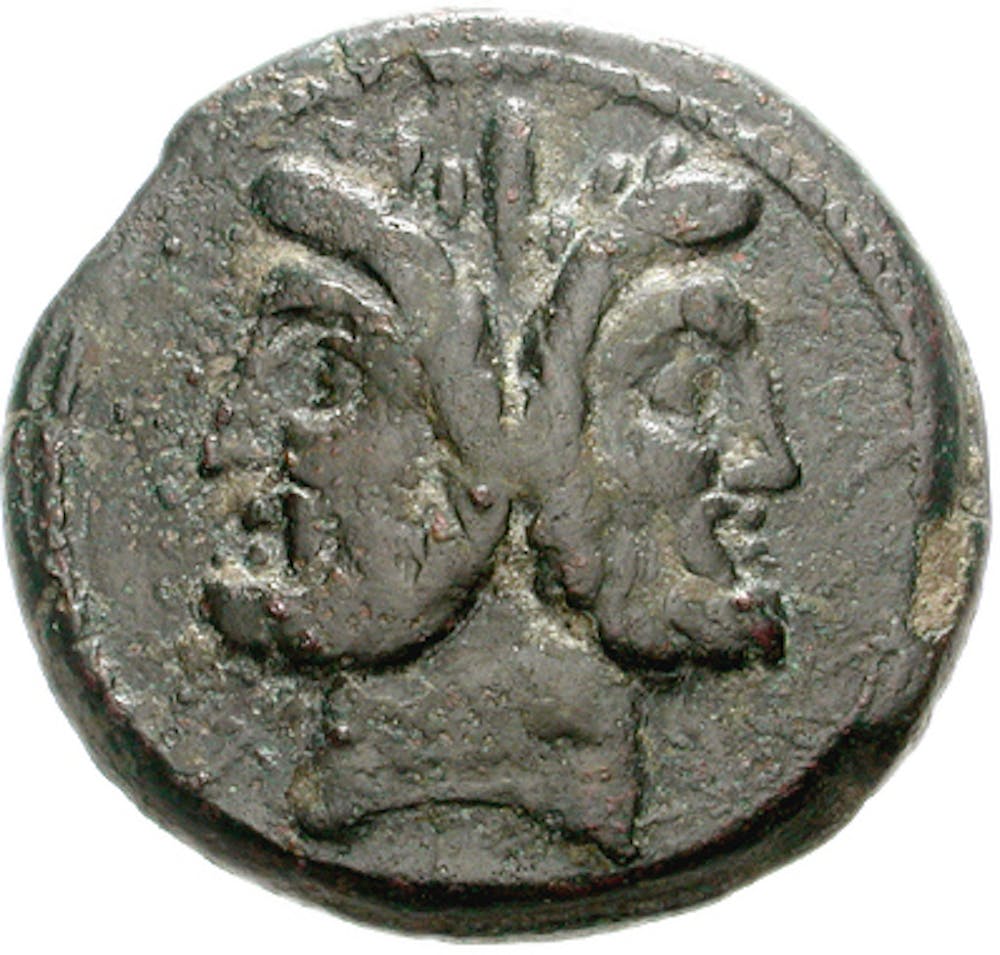
Roman coin showing the two-headed Janus

Roman coin showing the two-headed Janus.
Wikimedia Commons


Janus was proudly venerated as a uniquely Roman god, rather than one adopted from the Greek pantheon. All forms of transition came within his purview – beginnings and endings, entrances, exits, and passageways. The name Janus (Ianus in Latin, as the alphabet had no j) is etymologically related to ianua, the Latin word for door. Janus himself was the ianitor, or doorkeeper, of the heavens.

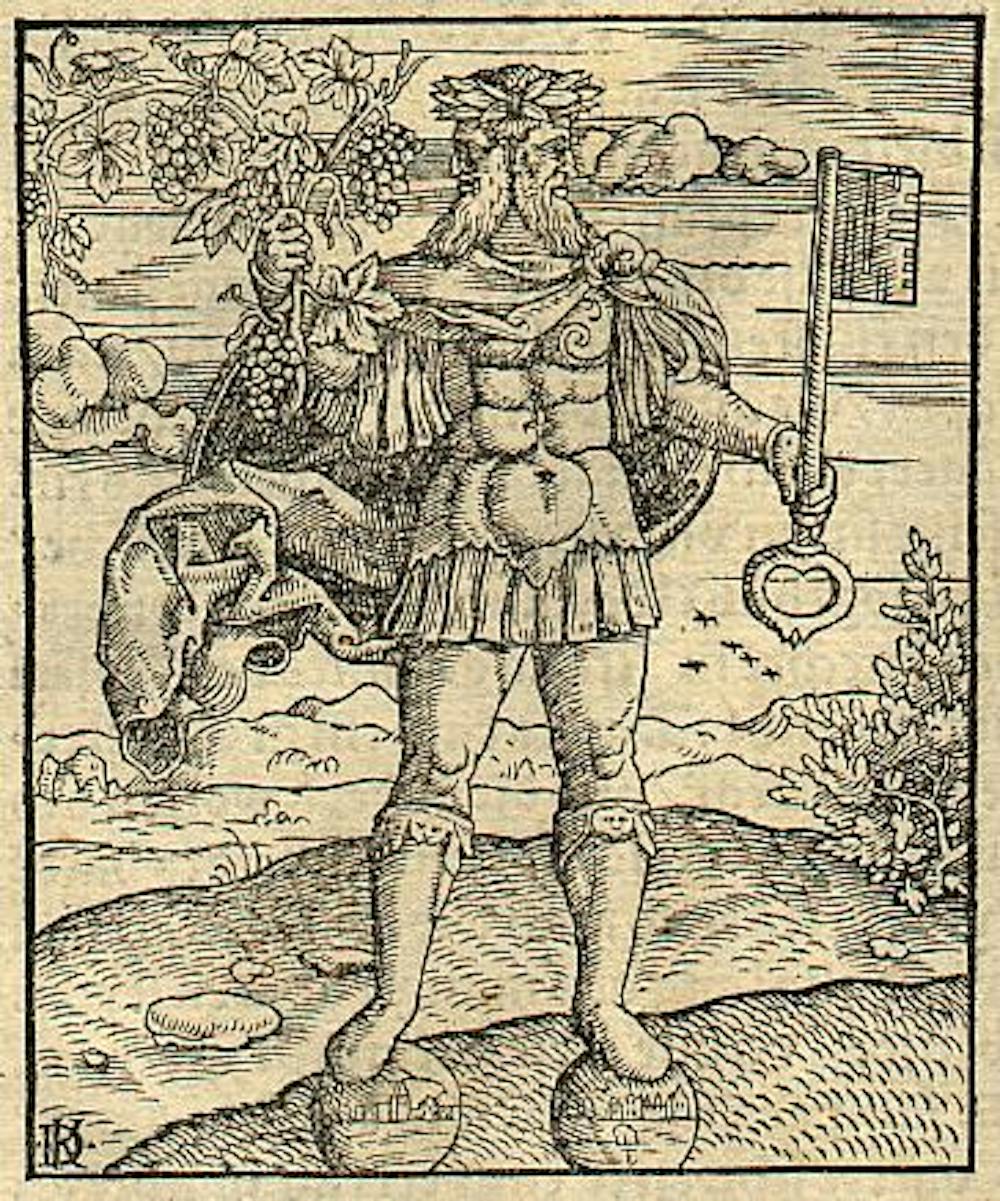
The cult statue of Janus depicted the god bearded with two heads. This meant that he could see forwards and backwards and inside and outside simultaneously without turning around. Janus held a staff in his right hand, in order to guide travellers along the correct route, and a key in his left to open gates.

War and Peace


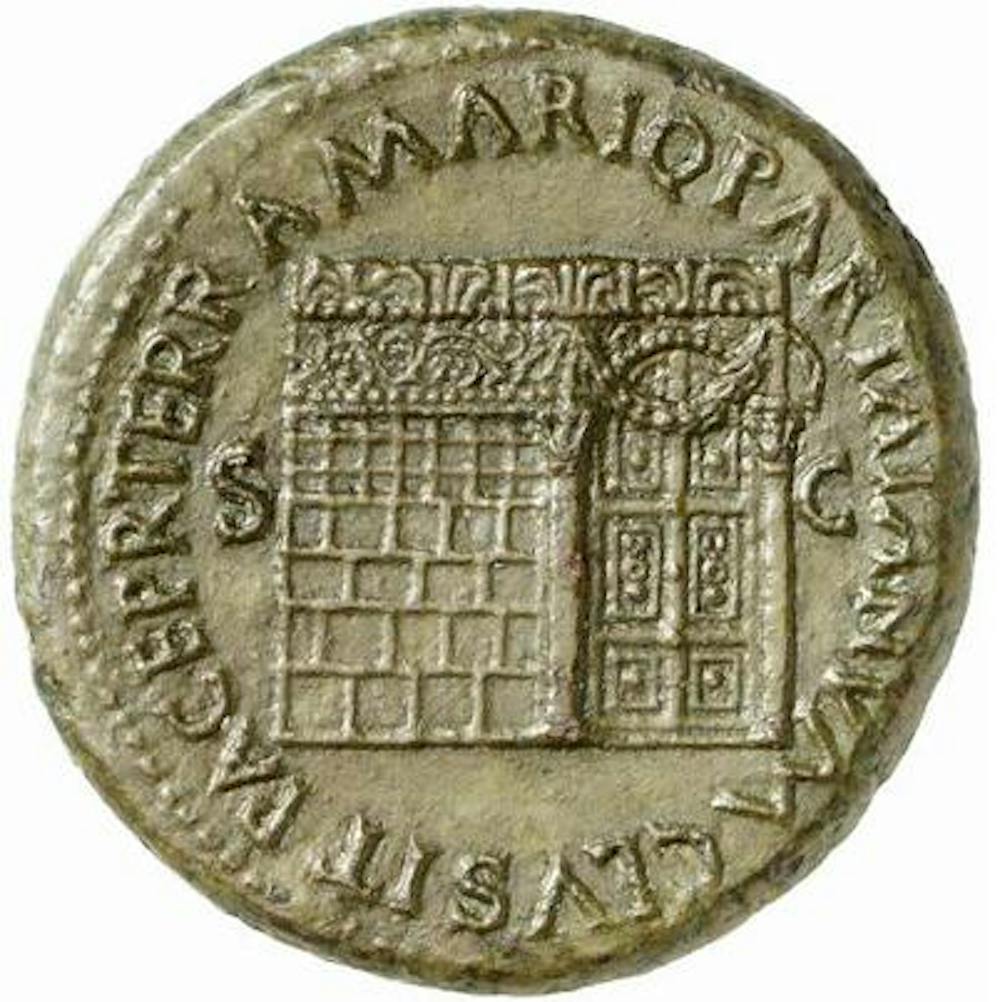
 Shrine of Janus as depicted on a coin of the emperor Nero

Shrine of Janus, as depicted on a coin of the emperor Nero.
Wikimedia Commons


Janus is famously associated with the transition between peace and war. Numa, the legendary second king of Rome, who was famed for his religious piety, is said to have founded a shrine to Janus Geminus (“two-fold”) in the Roman Forum, close to the Senate House. It was located in the place where Janus had bubbled up a spring of hot boiling water in order to thwart an attack on Rome by the Sabines.

The shrine was an enclosure formed by two arched gates at each end, joined together by walls to form a passageway. A bronze statue of Janus stood in the middle, with one head facing towards each gate. According to the historian Livy, Numa intended the shrine:

as an index of peace and war, that when open it might signify that the nation was in arms, when closed that all the peoples round about were pacified.

The gates of Janus are said to have stayed closed for 43 years under Numa, but rarely remained so thereafter, although the first emperor Augustus boasted that he closed the shrine three times. Nero later celebrated his conclusion of peace with Parthia by minting coins showing the gates of Janus firmly shut.

Happy New Year


The God Janus by Sebastian Münster 1550

The God Janus by Sebastian Münster, 1550.
Wikimedia Commons


Romans believed that the month of January was added to the calendar by Numa. The association between Janus and the calendar was cemented by the construction of 12 altars, one for each month of the year, in Janus’s temple in the Forum Holitorium (the vegetable market). The poet Martial thus described Janus as “the progenitor and father of the years”.

From 153 BC onwards, the consuls (the chief magistrates of the Republic) took office on the first day of January (which the Romans called the Kalends). The new consuls offered prayers to Janus, and priests dedicated spelt mixed with salt and a traditional barley cake, known as the ianual, to the god. Romans distributed New Year’s gifts of dates, figs, and honey to their friends, in the hope that the year ahead would turn out to be sweet, as well as coins – a sign of hoped-for prosperity.

Janus assumed a key role in all Roman public sacrifices, receiving incense and wine first before other deities. This was because, as the doorkeeper of the heavens, Janus was the route through which one reached the other gods, even Jupiter himself. The text On Agriculture, written by Cato the Elder, describes how offerings would be made to Janus, Jupiter, and Juno as part of the pre-harvest sacrifice to ensure a good crop.

So if you’re feeling caught between two worlds this January 1, why not head outside and celebrate Roman-style? Pack up some sweets to share, grab your keys, and shut the door on 2017.

The ConversationTomorrow: Explainer: the gods behind the days of the week.

Caillan Davenport, Lecturer in Roman History and ARC DECRA Research Fellow, Macquarie University

La version originale de cet article a été publiée sur The Conversation.

Sunday, December 24, 2017

Guest Post: Miraculous births and divine parents in the time of Jesus


by Meredith J C Warren, University of Sheffield

Many people are familiar with the stories in the New Testament gospels of Luke and Matthew about Jesus’ conception and birth. But what is less well known is how common such stories are when the lives of great men are told. From the initial announcement of an impending conception (to Mary in Luke, to Joseph in Matthew) to the signs and portents signalling the birth of the miraculous child, ancient Greek and Roman writings share a lot with the gospel accounts.

The Annunciation by Fra Angelico (1430-1432)
The gospels claim that Jesus’ birth was foretold in advance. Matthew quotes from the prophet Isaiah to establish Jesus’ birth as a divine promise that would usher in a time of peace and justice.

Virgil, writing in the early first century AD, wrote about a promised child, the offspring of the gods, who would bring a golden age of peace and prosperity to the Roman Empire – in other words, the emperor. Augustus Caesar’s birth was foretold by portents, according to the Roman historian Suetonius. Unusual astronomical occurrences were understood as divine omens in Roman culture, so it is no wonder that Jesus’s birth – like Augustus’s – was depicted as important using a miraculous star.

Alexander the Great’s birth also had meteorological omens surrounding it. Plutarch tells us that both Philip and Olympias, Alexander’s parents, were sent dreams from the gods announcing Alexander’s birth. Olympias dreamed that her womb was struck by lightning, while Philip dreamed that he put a seal on his wife’s womb in the image of a lion. Most significant, though, is the report that Philip spied a divine serpent sleeping next to his wife, which he took as a sign that he should avoid sleeping with her himself, since it was clear that she was to conceive from a divine rather than human source.

Massacre of the Infants


Just as Matthew records Herod’s attempts to stop the prophesied child by killing all newborn babies, Suetonius tells a similar account of Roman leaders attempting to prevent Augustus’s rise to power by ordering that no male child be reared. In Matthew, Jesus and his family escape the “Massacre of the Infants” by fleeing to Egypt – whereas in Suetonius (like in the Moses story) fathers- and mothers-to-be thwart the murderous plans, in the Roman case, by preventing the decree from being officially registered with the treasury.

Son of a god


Although both Matthew and Luke trace Jesus’s lineage through his non-biological father Joseph, Jesus is depicted as God’s own offspring.

Augustus Caesar was also adopted by his father, Julius Caesar, and likewise considered himself the descendent of a god – Venus Genetrix. Augustus traced his lineage to Venus through his ancestor Romulus, the legendary founder of Rome. Romulus, and his twin brother Remus, were conceived by the virgin priestess after the god Mars impregnated her. This priestess, as Virgil reports, was herself descended from Venus through her ancestor Aeneas, Venus’s beloved son.

Alexander the Great’s divine parentage was reinforced he grew up. Just as the adult Jesus was publicly claimed by God as his son in all four gospel accounts, Alexander’s father, Zeus Ammon, confirmed his son’s divine identity. Plutarch tells us that when Alexander approached an Egyptian oracle to ask whether he had avenged his father’s murder, the priest made him rephrase his request, since his father was not a mortal man, and addressed Alexander in oracular speech as “O son of Zeus”.

Jesus the hero


One of the most common places to find stories of miraculous births is in the life of heroes, often born of a union between a god and a human being. Hercules, perhaps the most famous of the Greek heroes, is the son of Zeus and the mortal woman Alcmene, for example. Zeus disguised himself as Alcmene’s husband in order to trick her into bed with him. The divine parentage that Hercules enjoyed enabled him to do many wondrous feats.

Likewise, Asclepius, son of Apollo, rescued from the womb of Coronis, was gifted with miraculous healing abilities and was later considered divine in his own right.

Since Matthew and Luke don’t agree with each other about what happened when Jesus was born, it’s especially interesting that they both relate something miraculous in their narratives. The idea of Jesus’s own miraculous birth may have supported the Gospel’s claims about Jesus’ miracle working ability, including healings and other wondrous feats.

The Conversation

Meredith J C Warren, Lecturer in Biblical and Religious Studies, University of Sheffield

This article was originally published on The Conversation. Read the original article.

Friday, December 22, 2017

Guest Post: Uncovering the language of the first Christmas


by Tony Thorne, King's College London

As Christmas draws near, the now typical jokes pile up on social media. Jesus is commended for having a “stable upbringing”. The three wise men fret: “We’re running low on Frankincense. Don’t worry, though, there’s myrrh where that came from.”

Christmas Nativity scene manger Catholic
But all this facetious word play prompts me to think a little more seriously about the language used in traditional accounts of the nativity, and the language – or languages – that might have been used by the participants themselves.

Let’s begin at the beginning. The christian Christmas drama begins with a baby in a cot, or rather a “manger” – a feeding trough. In biblical times, this was probably an alcove or a ledge projecting from the wall of a stable on which hay was placed as animal feed. In a private house, it may also have been a rectangular stone container or simply a depression in the lower part of the family living space where animals spent the night. The English word comes from the French manger, to eat, via the Old French maingeure, and in turn from the Latin manducare, to chew.

The Biblical reference to an improvised crib uses the Greek φατνη (phatnē), regularly translated as a stall, though some commentators insist that it denotes a feeding box and not a larger enclosure. It has been rendered in Hebrew as אֵבוּס, ebus, which can mean a trough or a booth, and as אֻרָוֹת (urvah), a stall. Mary (Maryam) and Joseph (Yosep) might have described it in their own language, Aramaic, as ܐܽܘܪܺܝܳܐ (awriyah).


The Words of God


But enough of the props, what of the location and the script?

Well, the Greek word commonly translated as “inn”, κατάλυμα (kataluma) can mean a caravanserai or inn, a house or a guest room, but can also be translated as the vaguer “lodging place”. This leads interpreters to disagree on whether the nativity took place in a public guesthouse or a family home made available to the travellers in line with Palestinian traditions of hospitality.

Aramaic English dictionary Christmas languageAramaic was the language spoken by the common people in נָצְרַת (Naṣrat) and בֵּית לֶחֶם‎ (Bet Lehem) – we know them as Nazareth and Bethlehem, of course. However, Hebrew was the official and liturgical language of Palestine, and Greek was used by scholars, administrators and diplomats across the eastern Mediterranean and Near East. Latin, the language of the Roman colonisers, would not have been spoken by many poorer people in the territories in question in the first century AD.

The Hebrew historian Josephus described Hebrew words as belonging to “the Hebrew tongue” but referred to Aramaic words as belonging to “our tongue” or “our language” or “the language of our country”.

Aramaic survived to become the common language of Jews both in the Holy Land and elsewhere in the Middle East by around 200AD and remained so until the Islamic conquests in the seventh century introduced Arabic. Its descendant dialects, formerly known as Syriac, are still spoken today by the Assyrian people of northern Iraq, northeast Syria, southeast Turkey and northwest Iran. I’m not the first to try to connect imaginatively with the authentic voices of the Christmas story, as a 2009 recording of a carol sung in Aramaic testifies.


Interpretations


The wise men from the East, whatever their native tongues, would have communicated with King Herod via his officials in Greek – Herod would also have been familiar with Latin, Hebrew and possibly an Arabic dialect from his youth. Unless they knew some Aramaic, they would have done the same, with or without the help of interpreters, when they paid their respects to the Holy Family.

The shepherds – ποιμὴν (poimén) – who feature in one of the two versions of the nativity would have had few difficulties expressing their veneration of the Christ-child, being Aramaic speakers, though not with the Galilean accent shared by the newborn’s “imma”, mother Mary and “abba”, father Joseph.

Greek English lexicon Christmas languageWe don’t know what social status Mary and Joseph enjoyed, but unless it was fairly elevated they would not have been fluent in Greek or Latin and their knowledge of Hebrew would likely have been limited to some devotional terms. Although Aramaic shared some elements with Hebrew, the two were at least as different as modern English and German.

So, frustratingly, even those few key words of Greek, Aramaic or Hebrew that are present in the original Bible account are open to multiple interpretations. If we go on to consider the familiar words that became attached to the story more recently – “inkeeper”, “stable”, “cattle-shed”, “kings”, even the “little town” and the imperial “decree” that summoned the family – we find no ultimate justification for them at all.

They only serve to conjure up an enduring legend of outsiders grappling with adversity, to dramatise an interplay of the royal, humble and supernatural in surroundings that are at once impoverished and magical.

Biblical scholars will continue to dispute the nuances of translation and the “facts” that underlie them. As for me, from a brief encounter with the sublime, I’m drawn back to the ridiculous as the wits of Twitter banter on: “If you’re telling a nativity joke it’s all in the delivery”; “Already getting complaints about my front lawn nativity tableau. Apparently it’s not customary to depict the actual birth.”

The Conversation

Tony Thorne, Director of Slang and New Language Archive, Faculty of Arts and Humanities, King's College London

This article was originally published on The Conversation. Read the original article.

Friday, January 06, 2017

Guest Post: What the magi had in common with scientists


by Roger Barlow, University of Huddersfield

Picturesque and exotic, with their crowns and camels, the three kings regularly appear on Christmas cards and in nativity scenes. But how much is original, and how much is later addition for the sake of a good story?

All we know is what Matthew’s gospel tells us, and that does not include their number. They brought gifts of gold, frankincense and myrrh, but to suppose that three gifts means three givers is no more than a guess. More importantly, they were not kings. In his account Matthew consistently describes the visitors as magoi which is the same as the English word “mage”. It’s an unusual word and is often translated as “wise men”.

The early church upgraded them to royal status, perhaps because of descriptions in Isaiah 60 and Psalm 72 of kings worshipping the messiah – but Matthew himself, whose gospel is full of references back to the psalms and prophets, does not make this link, and he would never have let such an opportunity drop.

What they saw


They had seen a star, which shows they were astronomers – or astrologers as there was no difference back then. What was this star? Some scholars have posited that in 7BC there was a triple conjunction (when the planets catch up and overtake each other: quite a dramatic sight) of Jupiter and Saturn, in the constellation of Pisces. These three elements were linked in astrology to royalty, the messiah and the Jews respectively.

Some astronomers, for example Patrick Moore, are unhappy with this theory and suggest that the star the wise men followed was a nova, a comet, or meteors. But there is no firm evidence for any of these. They point out that conjunctions are rare but not unique, and ask why were there no emissaries to Israel on other occasions. Perhaps there were – we only have this single record because of its link to the larger story.

I think what really worries them is that if you accept this interpretation it implies accepting the validity of astrology, and today’s astronomers really hate astrologers (never ask an astronomer what their star sign is). But you don’t have to. Even the sceptical can accept that a visit to Jerusalem and Bethlehem by foreigners looking for the messiah would have made a good story which would be told and retold – and eventually get attached to the birth of Jesus. Matthew wrote his gospel for a Jewish readership, and the Jewish religion then was hostile to astrology, so the suggestion that he just made up the story as propaganda is implausible.


A familiar approach


We can imagine the situation. The star was not a surprise: conjunctions are predictable – today lists of upcoming ones are available on the internet – and even if this was not available 2,000 years ago, astronomers then made careful observations on which they could make predictions using geocentric theories which were fundamentally wrong but which nevertheless seemed to work.

Stonehenge astrology astronomy science
Stonehenge astronomical observatory
For months and years beforehand the “wise men” will have discussed and organised the expedition: the practicalities, the funding. We know how they must have felt, planning a project, looking for money to pay for it, arguing whether their theory’s predictions were really firm or could have some other interpretation.

At this point we realise that we have a better word to translate magoi – a word not available to the translators of the Authorised Version of the Bible in King James’ reign, as it was only invented in 1833.

The word is scientists.

Looking back 2,000 years, they and we are not so different. They used their understanding of the universe to predict what would happen in the world – and, working as a group, they investigated their predictions, despite the cost and trouble and hardships. This is something any scientist today can recognise and identify with. Their understanding of the universe is crude and primitive in our eyes – but what will today’s scientific theories look like in 2,000 years time?

So, when we see pictures of the three kings at Christmas, we should spare them a thought, as colleagues who believed in their theories and followed through the consequences, despite the trouble and expense and personal effort involved. The strength of their conviction and their resolution to follow it, 2,000 years ago, can be an example to us today.

The Conversation

Roger Barlow, Research Professor and Director of the International Institute for Accelerator Applications, University of Huddersfield

This article was originally published on The Conversation. Read the original article.

Sunday, December 25, 2016

Guest Post: Romans needed a mid-winter break too ... it lasted for 24 days


by Richard Flower, University of Exeter

In the Doctor Who Christmas Special from 2010, Michael Gambon’s Scrooge-like character remarks that across different cultures and worlds people come together to mark the midpoint of winter. It is, he imagines, as if they are saying: “Well done, everyone! We’re halfway out of the dark!”

The actual reasons for celebrating Christmas at this particular time in the year have long been debated. Links have often been drawn to the winter solstice and the Roman festival of Saturnalia. Some people have also associated it with the supposed birthday of the god Sol Invictus, the “unconquered sun”, since a fourth-century calendar describes both this and Christ’s birth as taking place on December 25.

Such speculation has inevitably led to claims that this traditionally Christian festival is little more than a rebranding of earlier pagan activities. But questions about the “religious identity” of public celebrations are, in fact, nothing new and were being asked in the later periods of the Roman empire as well.

This is particularly evident in the case of a rather obscure Roman festival called the Brumalia, which started on November 24 and lasted for 24 days. We cannot be sure exactly when it began to be celebrated, but one of our best accounts of it comes from the sixth century AD. A retired public official called John the Lydian explained that it had its origins in earlier pagan rites from this time of year, including Saturnalia.

Dionysus Brumalia Saturnalia Christmas
Dionysus
Some people celebrated Brumalia by sacrificing goats and pigs, while devotees of the god Dionysus inflated goat skins and then jumped on them. We also believe that each day of the festival was assigned a different letter of the Greek alphabet, starting with alpha (α) on November 24 and finishing with omega (ω) on December 17.

A person would wait until the day that corresponded to the first letter of their own name and then throw a party. This meant that those with a wide circle of friends – and, in particular, friends with a wide variety of names – might potentially get to go to 24 consecutive celebrations.

We also have other evidence for the popularity of the Brumalia during the sixth century. A speech by the orator Choricius of Gaza praises the festivities laid on by the emperor Justinian (527–565), remarking that the emperor and his wife, Theodora, celebrated the Brumalia on adjacent days, since the letter iota (ι) – for Justinian – directly follows theta (θ) – for Theodora – in the Greek alphabet. Surviving accounts from the cellars of a large estate in Egypt also detail the wine distributions to officials and servants for the Brumalia of the master, Apion, which fell on the first day of the festival.

Yet, the origins of the Brumalia are far from clear. It seems to have been related to the earlier Roman Bruma festival, which took place on a single day in November and looked ahead to the winter solstice (or bruma in Latin) a month later, but little is known about this.

It is only really from the sixth century onwards that it appears in surviving sources, even though by then most Romans were Christians and had been ruled by Christian emperors for more than two centuries. John the Lydian also states that the “name day” aspect of the celebrations was a recent innovation at this time. As far as we can tell, therefore, this was not merely a remnant from a distant pagan past, but had actually developed and grown at precisely the same time as emperors, including Justinian, were endeavouring to clamp down on perceived “paganism” in their empire.

The historian Roberta Mazza, in one of the most comprehensive modern discussions of the festival, has argued that the Brumalia was simply too popular to get rid of entirely, but that Justinian sought to strip it of “pagan” elements. She says that in doing so, the emperor “reshaped and reinvented the meanings and purposes of the feast” and made it “both acceptable from a religious point of view and useful for constructing a common cultural identity throughout the different provinces of the empire”.

The true meaning of Brumalia


We know that the Brumalia continued to be celebrated at the imperial court in Constantinople until at least the tenth century, but it was certainly not without its opponents. John the Lydian reports that the church was opposed to the Brumalia, and similar statements of disapproval and attempts to ban it were also made by church councils in 692 and 743. For some Christians, it remained just too pagan for comfort. Controversy also surrounded other celebrations in late antiquity, including the wearing of masks at New Year, the Roman Lupercalia (with its naked runners), and the processions and dancing involved in the “Bean Festival” at Calama in North Africa.

How then should we view the Brumalia? Was it still essentially “pagan”, or had it become safely Christianised or secularised? I think that any attempt to neatly categorise these festivals, let alone their participants, is destined to fail. For some people, the religious elements will have loomed larger, while for others they will have been almost entirely irrelevant, as also happens with Christmas today.

The Brumalia could be celebrated in a variety of ways and have a multitude of meanings to different people throughout the empire, even if all of them saw themselves as Christians. Rather than arguing that Justinian or others who enjoyed the Brumalia were “less Christian” than its opponents, we might instead treat it as a vivid illustration of the fluidity and malleability of notions of culture and identity.

We cannot ever discover the true meaning of Brumalia, but we can be sure that it brought people together to commemorate being halfway out of the dark.

The Conversation

Richard Flower, Senior Lecturer in Classics and Ancient History, University of Exeter

This article was originally published on The Conversation. Read the original article.