Showing posts with label museums. Show all posts

Friday, December 01, 2017

From the Archives - 'Cosmic Voyage': Ride of the New Millennium

This movie review appeared in The Metro Herald in August 1996:

Cosmic Voyage: Ride of the New Millennium
Rick Sincere
Metro Herald Entertainment Editor

A new film in the tradition of To Fly and The Blue Planet has opened at the Langley Theatre at the National Air and Space Museum. Called Cosmic Voyage, this IMAX film will give you the ride of your life.

Morgan Freeman Virginia Film Festival 2006 Cosmic Voyage Rick Sincere
Morgan Freeman (c) 2006 Rick Sincere
Narrated by award-winning actor Morgan Freeman, Cosmic Voyage takes its audience from inside the smallest atom in a drop of water to the outer reaches of the known universe. Using the latest scientific calculations and most current computer animation technologies, Cosmic Voyage offers a seamless blend of live-action and animation.

Cosmic Voyage premiered on August 8 as part of the Smithsonian Institution's 150th anniversary celebrations. As Dennis O'Connor, the Smithsonian's provost, put it, Cosmic Voyage is the Air and Space Museum's "candle for the Smithsonian's 150th birthday cake."

Last month, the Air and Space Museum marked the 20th anniversary of To Fly, one of the most popular IMAX offerings. According to Don Engen, director of the museum, To Fly has been seen by 13 million people in the Langley Theatre. Like Destiny in Space, its predecessor film that opened two years ago, Cosmic Voyage is what astronauts like to call "the next best thing to doing it."

Engen added that Cosmic Voyage was made with an audience of middle- and high-school students in mind, a view echoed by Gary Tooker, president of the Motorola Foundation (which financed the making of the film). Tooker told the opening night audience that "our future depends on nurturing the young minds interested in science and engineering, because that's the future of our company." He said that he and his colleagues at Motorola hope "people will be stimulated to think about the universe and the role we play in it."

Anyone seeing this film will, in fact, be struck by our tininess in comparison to the vastness of the universe -- and how big we humans are in comparison to protozoa and the atoms, electrons, and quarks that are the building blocks of all matter. Bayley Silleck, director of Cosmic Voyage, noted that the film's creative process was a "two-year adventure" that instilled "a sense of humility about our place in the universe."

It may be difficult, during the summer tourist season, to see Cosmic Voyage. Lines will no doubt be very long. If you want to experience the adventure, however, clip this article and pull it out sometime in January or February. I can't imagine a better antidote to mid-winter blues than participating in Cosmic Voyage's 35-minute roller-coaster ride. (Actually, I can: George Lucas has announced that his Star Wars trilogy will be re-released over President's Day weekend -- all three films to be screened in one day, with added special effects and new scenes. But until then, Cosmic Voyage deserves a visit.)

Cosmic Voyage
is that rare blend of short films -- both educational and entertaining. This is a family movie, appropriate for children and adults of all ages.

The complete Cosmic Voyage, directed by Bayley Silleck and narrated by Morgan Freeman, has been uploaded to YouTube:

Friday, October 16, 2009

Libertarian Evolution

The front page of the Style section of Thursday's Washington Post had a long article on the announcement of a new exhibition at the Smithsonian's National Museum of Natural History.

The article, by Jacqueline Trescott, begins:

The National Museum of Natural History announced Wednesday that it is dedicating a new hall to the story of human evolution, giving emphasis not only to how we became humans but how changes in the natural world affected human development.

The Hall of Human Origins, tracing a 6 million-year history, is scheduled to open March 17 -- 100 years to the day that the museum opened.

A news release from the Smithsonian Institution states:
The $20.7 million exhibition hall will be complemented by ongoing human origins research and education programs, which are all key components of the museum’s broader initiative, “Human Origins: What Does It Mean to Be Human?” The initiative focuses on the epic story of human evolution and how the defining characteristics of the species have evolved over 6 million years as its ancestors adapted to a changing world. The museum will launch a compelling new Smithsonian Human Origins Web site and a revolutionary virtual experience hosted on the Blue Mars 2150 virtual Web site. It will include a complete reproduction of the physical exhibition plus additional features visitors can only experience on the Web....

More than 50 U.S. and international scientific research and education organizations, such as the U.S. National Academies of Science, the American Association for the Advancement of Science, the National Museum of Kenya and the Chinese Academy of Sciences, and more than 70 distinguished scientists and educators are collaborating with the Human Origins Initiative’s research, education and outreach programs.

Visitors to the 15,000-square-foot Hall of Human Origins will be immersed in a unique, interactive museum experience illuminating the major milestones in the origin of human beings and the drama of climate change, survival and extinction that have characterized humans’ ancient past. On entering the exhibition from the Sant Ocean Hall, visitors will travel through a dramatic time tunnel depicting life and environments over the past 6 million years. Visitors will also engage with life-size forensically reconstructed faces of early human species, all designed to provide visitors with a sense of personal connection as they look into the eyes and faces of their distant ancestors.

Other key features in the exhibition include interactive snapshots in time using the actual field sites where research is being conducted, a display of more than 75 skulls (cast reproductions) and an interactive human family tree showcasing 6 million years of evolutionary evidence from around the world, a “One Species Living Worldwide” amphitheater show and a special “Changing the World” gallery, in which visitors can address pressing questions and issues surrounding climate change and humans’ impact on the Earth.
It turns out that the new exhibition is being funded, in large part, with a donation from libertarian philanthropist David Koch -- the same David Koch who was Ed Clark's running mate on the LP presidential ticket in 1980. Trescott continues:
The 15,000-square-foot space will be named for David H. Koch, a chemical engineer and executive vice president of Koch Industries who gave $15 million for the hall's construction. The other primary donor to the project is Peter Buck, a physicist and co-founder of Subway restaurants, who gave $15 million to an endowment for research and accompanying education programs.

The total cost of the hall is $20.7 million, with $3.5 million from other private sources and $2.2 million from the Smithsonian's federal funds.

In a statement, Koch saluted the Human Origins Program, saying, it "has the power to influence the way we view our identity as humans, not only today, but for generations to come." Koch, an MIT-educated engineer, has given generously to many educational, cultural and medical institutions, as well as to conservative political groups. He was the 1980 Libertarian vice presidential candidate.
The article doesn't mention that in 1995, Koch purchased the apartment that once belonged to Jacqueline Kennedy Onassis when she lived in New York City. Koch sold the flat in 2006. (File that under "real estate trivia.")

No doubt there will be some complaints that the exhibition -- whose displays will trace back human evolution some four million years and include the recently discovered "Ardi" -- is the work of godless libertarians.

Such complaints might come from the Creation Museum in Petersburg, Kentucky. Those behind the Creation Museum believe -- and offer as scientific fact -- that the Earth is only about 10,000 years old, or younger, and that men and dinosaurs co-existed. Though the Answers in Genesis Creation Museum boasts that it is within a 650-mile drive for two-thirds of the U.S. population, it only attracted some 750,000 visitors in the two years after it opened in May 2007.

In contrast, the National Museum of Natural History has drawn about 6 million visitors already this year, as well as 7 million in 2008, 7.1 million in 2007, and 5.8 million in 2006.

Of course, the Natural History Museum offers more than a male porn star portraying Adam in the Garden of Eden. It also has the Hope Diamond, "Wild Ocean 3D" in on an Imax screen, and the reconstructed skeleton of a triceratops. So not everyone who wanders through the Natural History Museum's doors from the National Mall is coming for edification about evolution.

Even so, it is heartening to learn that millions more people are interested in actual science than in charlatanism.

(Illustrations credit: RPDI [Reich & Petch Design International]; courtesy of Smithsonian Institution)


Be sure to visit my CafePress store for gifts and novelty items!
Read my blog on Kindle!
Follow my tweets on Twitter!

Monday, March 31, 2008

Forty Years Ago Tonight


On March 31, 1968, at the end of a speech about the course of the war in Vietnam, President Lyndon B. Johnson surprised a nationwide television audience by announcing that he would not be a candidate for re-election that year.

Most of the speech is forgotten, but the last minute and a half or so is among the most memorable passages of all (non-oratorical) presidential speeches:

With American sons in the fields far away, with America's future under challenge right here at home, with our hopes and the world's hopes for peace in the balance every day, I do not believe that I should devote an hour or a day of my time to any personal partisan causes or to any duties other than the awesome duties of this office -- the Presidency of your country.

Accordingly, I shall not seek, and I will not accept, the nomination of my party for another term as your President. But let men everywhere know, however, that a strong and a confident and a vigilant America stands ready tonight to seek an honorable peace; and stands ready tonight to defend an honored cause, whatever the price, whatever the burden, whatever the sacrifice that duty may require.
The History Channel has that portion of the speech on line:


The entire speech, for those who are interested, is available in audio format on the web site of the Miller Center of Public Affairs at the University of Virginia.

Last August, after attending the annual users group meeting for Hart Intercivic (the company that manufactures the voting equipment used in Charlottesville), I took some time to visit the Lyndon Baines Johnson Library and Museum on the campus of the University of Texas at Austin. Here is some video I took that afternoon, which was just a few weeks after the death of Lady Bird Johnson.

Part I of the video includes some interesting exhibits about the popular culture of the 1960s, as well as Lady Bird's recollections of the Kennedy assassination of November 22, 1963. Part II of the video begins with a creepy animatronic LBJ delivering some jokes over a barnyard fence and also includes a look at the Oval Office as it was configured during LBJ's presidency.

Part I:


Part II:


Those of you interested in these sorts of exhibits may wish to compare the video I took last July at the Ronald Reagan Presidential Library and Museum in Simi Valley, California.

Friday, February 15, 2008

The "Getting High" Series

Last July I made a cross-country trip anchored on two events, my high school reunion and my nephew's first birthday. The trip included stops in Illinois (where our plane landed), Wisconsin, Michigan, Minnesota, and California. (I don't include the layover at the Dallas-Fort Worth airport as a "stop.")

George Mason University student Richard Morrison accompanied me on the trip, and we played tourist for most of the two-week journey. I have already posted video from our visit to the Ronald Reagan Presidential Library. YouTube has a video of "Gavin's First Birthday Cake," which may end up here someday, too -- perhaps in time for Gavin's second birthday.

Along the way, Richard and I had several opportunities to get high. Don't fret, drug warriors: By "get high," I mean nothing more than that we climbed to a height that provided breathtaking vistas of the landscape around us.

Our first climb was to the top of the Wisconsin state capitol building in Madison, courtesy of State Senator Glenn Grothman, who obtained permission to see parts of the capitol usually off-limits to tourists. (There is still more video, so far unedited, of the capitol's chambers, committee rooms, and reception areas -- that will be posted here eventually, too.)

"Getting High in Wisconsin, Part I":


To tell the truth, my acrophobia kept me from going all the way to the top, but Richard braved it along with recent Marquette High graduate Joseph Kay. They provided the most dramatic video.

At Rib Mountain State Park near Wausau, however, Richard and I both reached the summit. Rib Mountain is the third-highest peak in Wisconsin, at 1,940 feet. A 60-foot tower brings the full height to 2,000 feet, with a view on a clear day that encompasses several counties.

I remember visiting Rib Mountain as a child with my parents, but this was my first time there in nearly 40 years. The tower was the same but didn't seem to be quite so high as it was when I was 8 years old.

"Getting High in Wisconsin, Part II":


After Wausau, Richard and I headed farther north, passing through Manitowish Waters, where my family and I used to vacation, and ending up in Hurley, said to be the Wisconsin town with the most taverns per capita. My friend, Gene Cisewski, is the innkeeper of a bed-and-breakfast in downtown Hurley called the Anton-Walsh House. Gene is also president of the local historical society and a former member of the Iron County Board of Supervisors.

Gene took us on a tour of the area, which included a trip to Bayfield and Madeline Island in Lake Superior and to several of the picturesque waterfalls along the Montreal River and other streams that traverse the Wisconsin border with the Upper Peninsula of Michigan. (There's plenty of unedited video from those days, too.)

When we crossed the border into Michigan, Gene took us to the Copper Peak Ski Flying Hill, one of the tallest structures used for snow skiing anywhere in the world. Once again, I clung to the floor about halfway up the man-made hill, but Gene and Richard made it all the way to the top, where the view on a clear day encompasses three states and Lake Superior.

Coincidentally, I recently had a chat in Washington with the man who was instrumental in raising the funds to build Copper Peak, and I may write about him and his efforts once I have received permission to do so.

"Getting High in Michigan":


The Midwest is not the most likely place to find great heights with dramatic vistas. That's not so in California. Even the Reagan Library looks down on Simi Valley from a peak of its own.

The day before we went to the Reagan Library, Richard and I visited the Getty Center in Los Angeles, which also sits atop a mount. You can see downtown Los Angeles -- even on a Sunday, enshrouded in smog -- and surrounding canyons from the Getty's plaza.

This video also includes some shots from inside the Getty museum.

"Getting High in Los Angeles":


As I have already suggested, there will be more travel videos posted here as time permits. Last year (2007) was a big travel year for me, with trips to Las Vegas, New Orleans, and Austin, as well as Milwaukee, Hurley, and Los Angeles. That resulted in a lot of raw video that has to be reduced to 10-minute segments suitable for posting to YouTube and cross-posting here.

Tuesday, December 06, 2005

California Dreamin' 3


Writing is harder when I'm traveling. (I could never be an effective and efficient foreign correspondent.) So I'm going to rely once again on graphic images to describe my short stay in La-La Land.

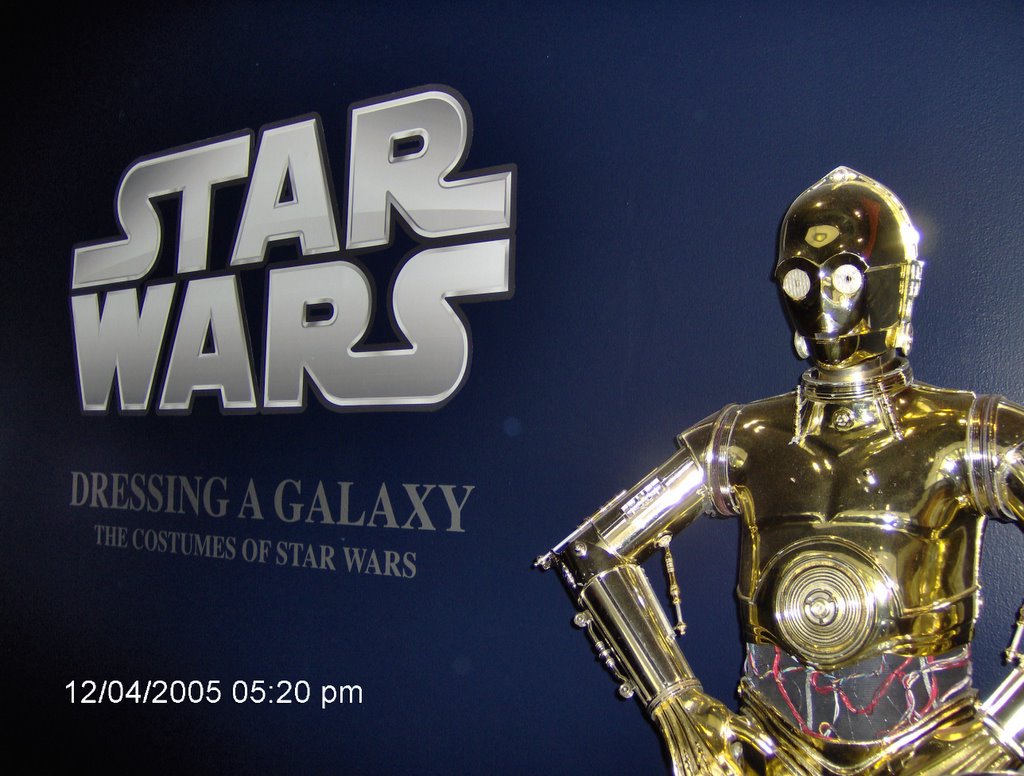
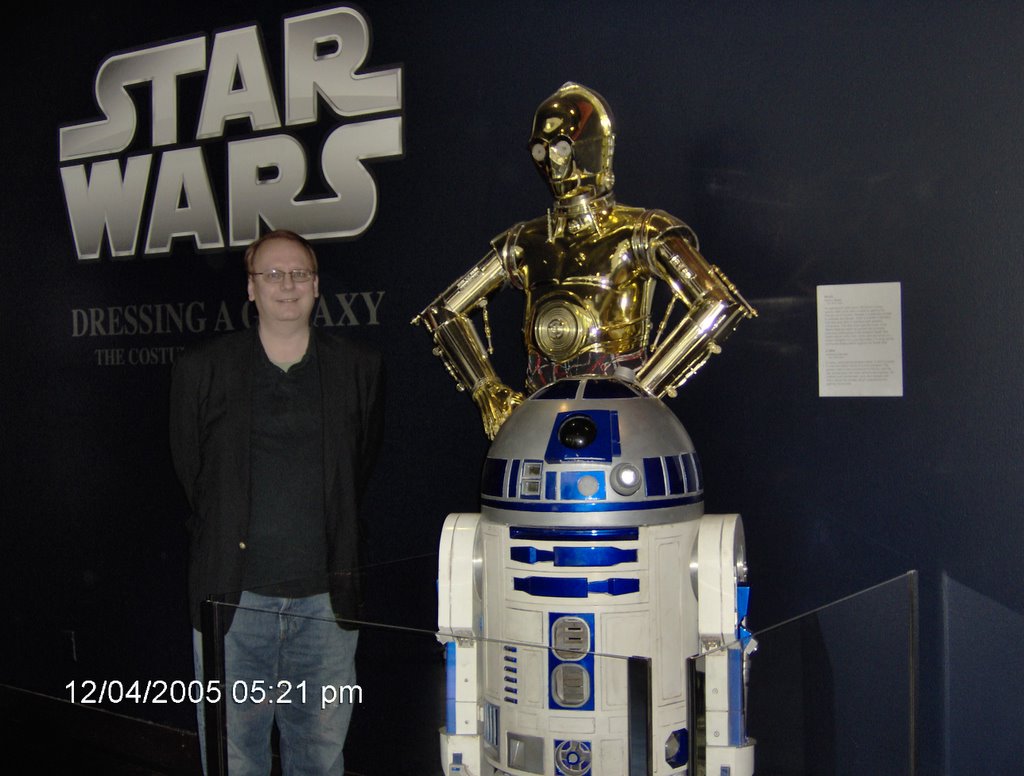
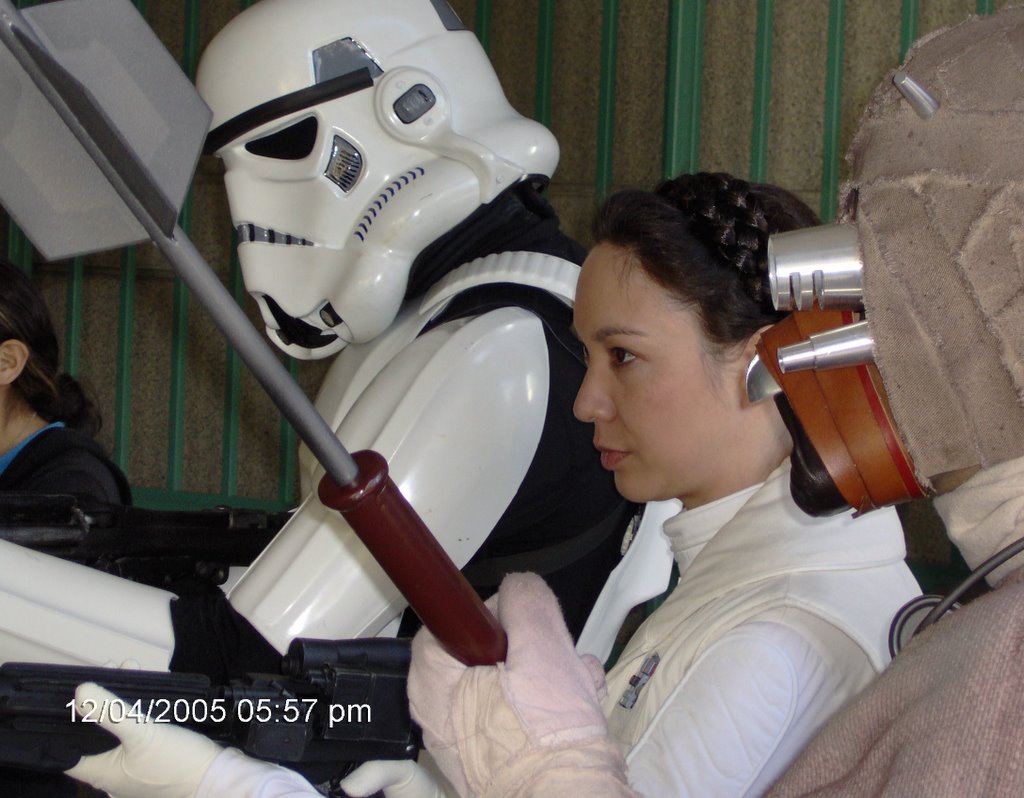
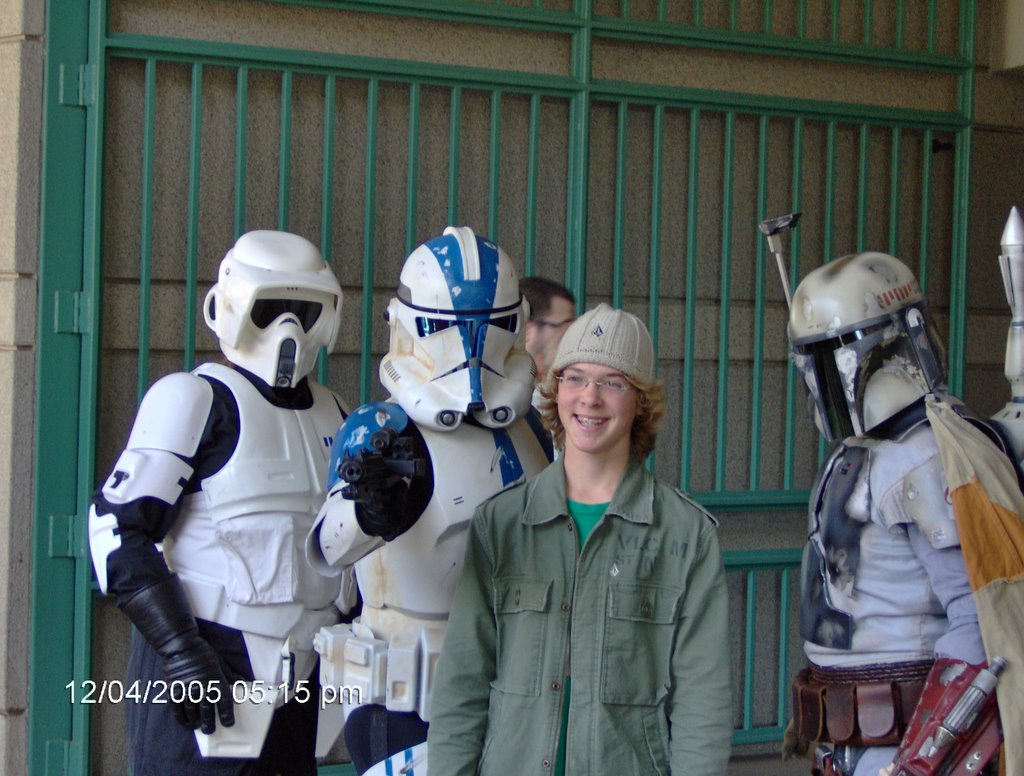
On Sunday, we went to downtown Los Angeles, to visit the Fashion Institute of Design Museum, where a display of Star Wars costumes from Episodes I, II, and III is nearing its end. As it happened, Sunday was "fan day," so there were an inordinate number of children (and adults, as well -- grown-ups who apparently emerged from the cocoons of their mothers' basements for the day) in costumes as authentic as those of designer Trisha Biggar inside the museum.

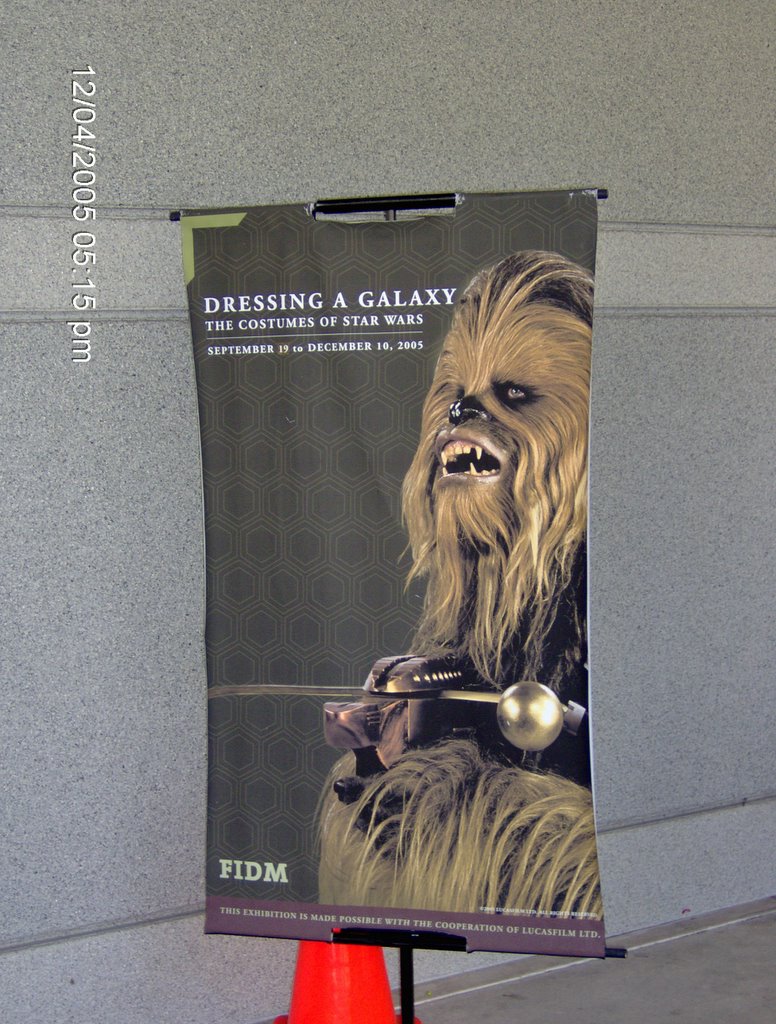
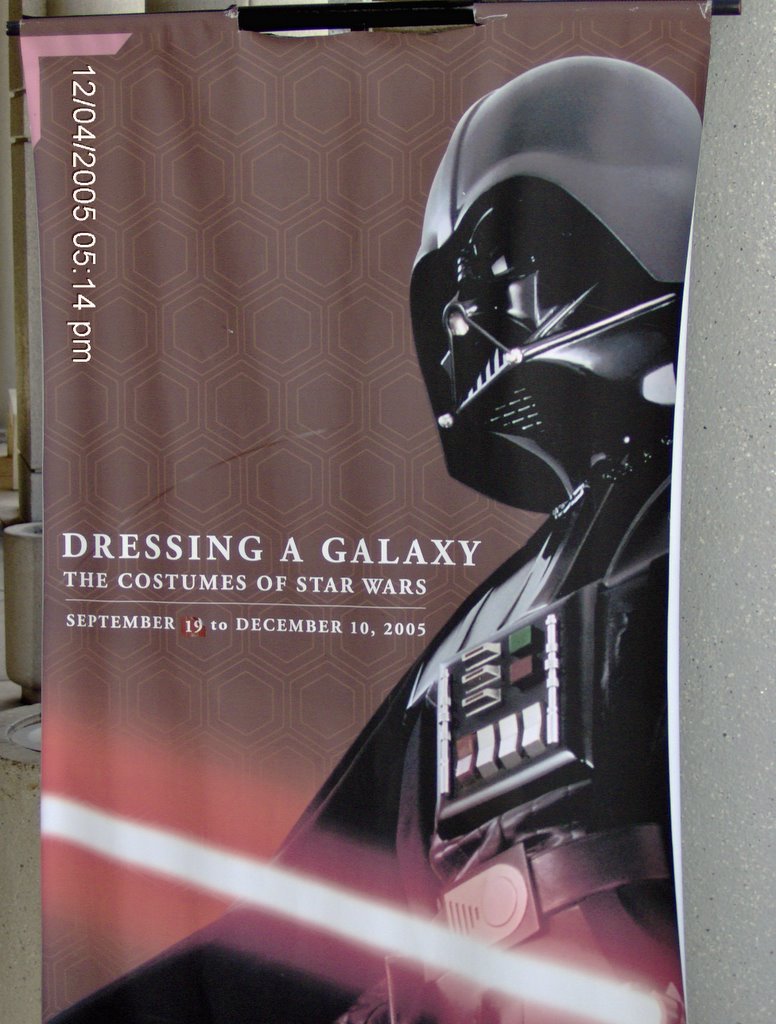
A few choice moments from the afternoon's excursion to "Dressing a Galaxy: The Costumes of Star Wars," which remains open until December 10:


To my astonishment, photography was allowed in the "Dressing a Galaxy" exhibit, although flash photography was permitted only at the entrance, where visitors could pose with C3PO and R2D2, the two droids who provide a link through the six Star Wars movies.


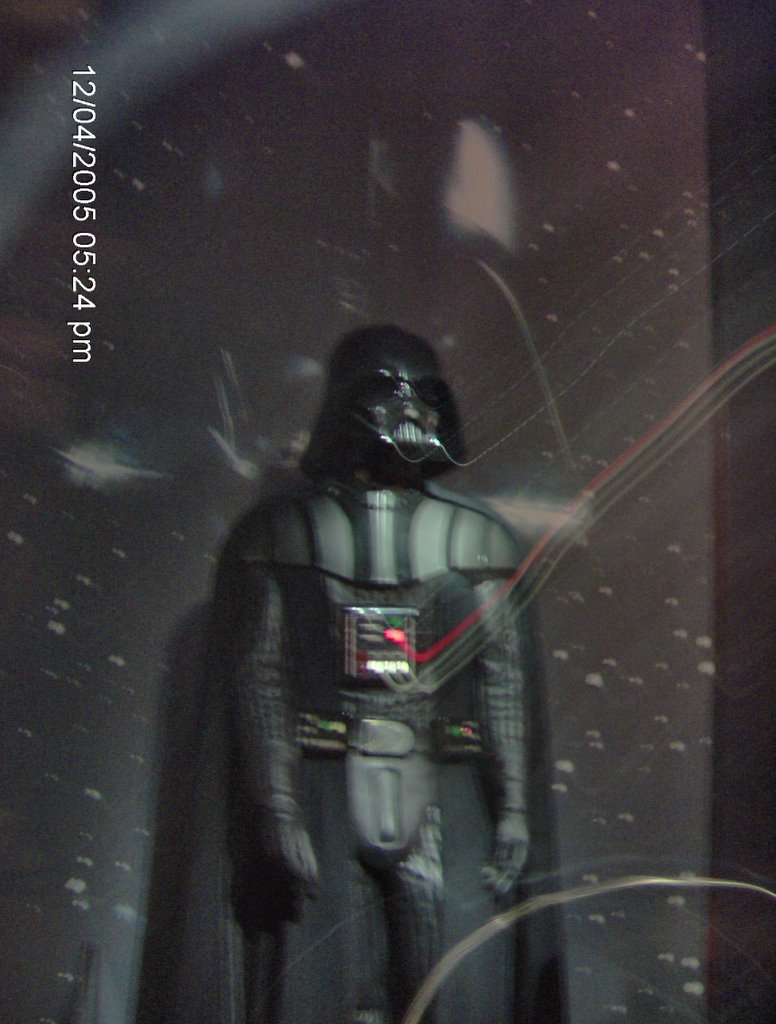
Inside the exhibit, where the lighting was iffy, at best, was a phantasmagorical collection of costumes (and models) representing many Star Wars characters, including the Dark Lord of the Sith, Darth Vader.


Ambassadors of the Trade Federation.


I'm not sure which of the Fetts this is, Boba or Jango. You've seen one bounty hunter, you've seen them all.

Outside the museum, where the lighting was better, was an X-Wing Fighter, looking ready for action.


There were so many Storm Troopers wandering around the grounds of the FIDM, I thought I was on the set of a commercial advocating a stronger USA PATRIOT Act.


They certainly look determined, don't they?


And they seem to be trying to recruit from among our nation's youth.


See what I mean?


"Dressing a Galaxy" was a delight, and I am glad to have caught it in its final days. I recommend it highly to anyone who is able to attend before it closes next weekend.