Showing posts with label satire. Show all posts

Friday, May 11, 2018

Guest Post: Question Authority - How Mad Magazine's ethos still matters


Michael J. Socolow, University of Maine

Mad Magazine is still hanging on. In April, it launched a reboot, jokingly calling it its “first issue.”

But in terms of cultural resonance and mass popularity, it’s largely lost its clout.

At its apex in the early 1970s, Mad’s circulation surpassed 2 million. As of 2017, it was 140,000.

As strange as it sounds, I believe the “usual gang of idiots” that produced Mad was performing a vital public service, teaching American adolescents that they shouldn’t believe everything they read in their textbooks or saw on TV.
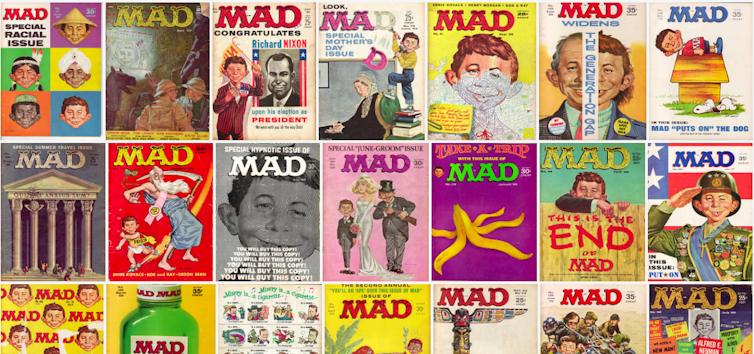


Mad Magazine comedy humor parody satire

The magazine taught its readers to never swallow what they’re served.
Nick Lehr/The Conversation via Jasperdo, CC BY-NC-ND


Mad preached subversion and unadulterated truth-telling when so-called objective journalism remained deferential to authority. While newscasters regularly parroted questionable government claims, Mad was calling politicians liars when they lied. Long before responsible organs of public opinion like The New York Times and the CBS Evening News discovered it, Mad told its readers all about the credibility gap. The periodical’s skeptical approach to advertisers and authority figures helped raise a less credulous and more critical generation in the 1960s and 1970s.

Today’s media environment differs considerably from the era in which Mad flourished. But it could be argued that consumers are dealing with many of the same issues, from devious advertising to mendacious propaganda.

While Mad’s satiric legacy endures, the question of whether its educational ethos - - its implicit media literacy efforts – remains part of our youth culture is less clear.

A merry-go-round of media panics


In my research on media, broadcasting and advertising history, I’ve noted the cyclical nature of media panics and media reform movements throughout American history.

The pattern goes something like this: A new medium gains popularity. Chagrined politicians and outraged citizens demand new restraints, claiming that opportunists are too easily able to exploit its persuasive power and dupe consumers, rendering their critical faculties useless. But the outrage is overblown. Eventually, audience members become more savvy and educated, rendering such criticism quaint and anachronistic.

During the penny press era of the 1830s, periodicals often fabricated sensational stories like the “Great Moon Hoax” to sell more copies. For a while, it worked, until accurate reporting became more valuable to readers.
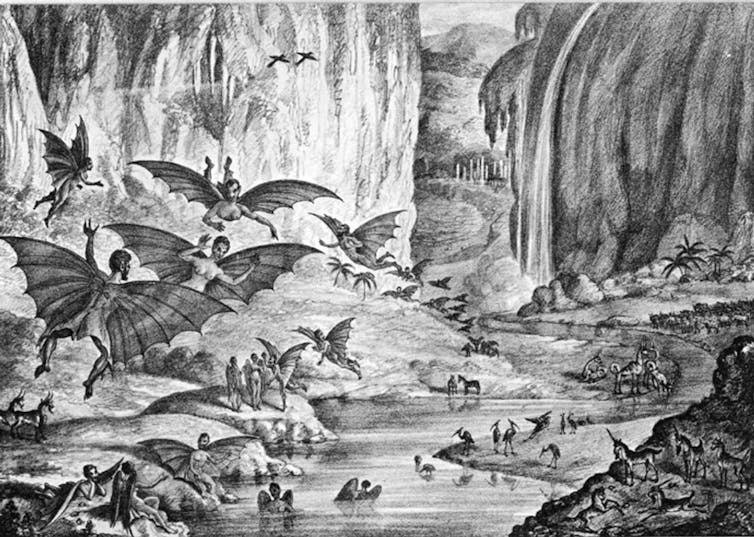


Great Moon Hoax New York Sun

During the ‘Great Moon Hoax,’ the New York Sun claimed to have discovered a colony of creatures on the moon.
Wikimedia Commons


When radios became more prevalent in the 1930s, Orson Welles perpetrated a similar extraterrestrial hoax with his infamous “War of the Worlds” program. This broadcast didn’t actually cause widespread fear of an alien invasion among listeners, as some have claimed. But it did spark a national conversation about radio’s power and audience gullibility.

Aside from the penny newspapers and radio, we’ve witnessed moral panics about dime novels, muckraking magazines, telephones, comic books, television, the VCR, and now the internet. Just as Congress went after Orson Welles, we see Mark Zuckerberg testifying about Facebook’s facilitation of Russian bots.

Holding up a mirror to our gullibility


But there’s another theme in the country’s media history that’s often overlooked. In response to each new medium’s persuasive power, a healthy popular response ridiculing the rubes falling for the spectacle has arisen.

For example, in “The Adventures of Huckleberry Finn,” Mark Twain gave us the duke and the dauphin, two con artists traveling from town to town exploiting ignorance with ridiculous theatrical performances and fabricated tall tales.

They were proto-purveyors of fake news, and Twain, the former journalist, knew all about selling buncombe. His classic short story “Journalism in Tennessee” excoriates crackpot editors and the ridiculous fiction often published as fact in American newspapers.

Then there’s the great P.T. Barnum, who ripped people off in marvelously inventive ways.

“This way to the egress,” read a series of signs inside his famous museum. Ignorant customers, assuming the egress was some sort of exotic animal, soon found themselves passing through the exit door and locked out.

They might have felt ripped off, but, in fact, Barnum had done them a great – and intended – service. His museum made its customers more wary of hyperbole. It employed humor and irony to teach skepticism. Like Twain, Barnum held up a funhouse mirror to America’s emerging mass culture in order to make people reflect on the excesses of commercial communication.

‘Think for yourself. Question authority’


Mad Magazine embodies this same spirit. Begun originally as a horror comic, the periodical evolved into a satirical humor outlet that skewered Madison Avenue, hypocritical politicians and mindless consumption.

Teaching its adolescent readers that governments lie – and only suckers fall for hucksters – Mad implicitly and explicitly subverted the sunny optimism of the Eisenhower and Kennedy years. Its writers and artists poked fun at everyone and everything that claimed a monopoly on truth and virtue.

“The editorial mission statement has always been the same: ‘Everyone is lying to you, including magazines. Think for yourself. Question authority,’” according to longtime editor John Ficarra.

That was a subversive message, especially in an era when the profusion of advertising and Cold War propaganda infected everything in American culture. At a time when American television only relayed three networks and consolidation limited alternative media options, Mad’s message stood out.

Just as intellectuals Daniel Boorstin, Marshall McLuhan and Guy Debord were starting to level critiques against this media environment, Mad was doing the same – but in a way that was widely accessible, proudly idiotic and surprisingly sophisticated.

For example, the implicit existentialism hidden beneath the chaos in every “Spy v. Spy” panel spoke directly to the insanity of Cold War brinksmanship. Conceived and drawn by Cuban exile Antonio Prohías, “Spy v. Spy” featured two spies who, like the United States and the Soviet Union, both observed the doctrine of Mutually Assured Destruction. Each spy was pledged to no one ideology, but rather the complete obliteration of the other – and every plan ultimately backfired in their arms race to nowhere.
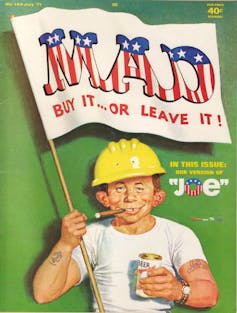


Mad Magazine question authority parody satire humor comedy

Mad skewered those who mindlessly supported the people who controlled the levers of power.
Jasperdo, CC BY-NC-SA


The cartoon highlighted the irrationality of mindless hatred and senseless violence. In an essay on the plight of the Vietnam War soldier, literary critic Paul Fussell once wrote that U.S. soldiers were “condemned to sadistic lunacy” by the monotony of violence without end. So too the “Spy v. Spy” guys.

As the credibility gap widened from the Johnson to Nixon administrations, the logic of Mad‘s Cold War critique became more relevant. Circulation soared. Sociologist Todd Gitlin – who had been a leader of the Students for a Democratic Society in the 1960s – credited Mad with serving an important educational function for his generation.

“In junior high and high school,” he wrote, “I devoured it.”

A step backward?


And yet that healthy skepticism seems to have evaporated in the ensuing decades. Both the run-up to the Iraq War and the acquiescence to the carnival-like coverage of our first reality TV star president seem to be evidence of a widespread failure of media literacy.

We’re still grappling with how to deal with the internet and the way it facilitates information overload, filter bubbles, propaganda and, yes, fake news.

But history has shown that while we can be stupid and credulous, we can also learn to identify irony, recognize hypocrisy and laugh at ourselves. And we’ll learn far more about employing our critical faculties when we’re disarmed by humor than when we’re lectured at by pedants. A direct thread skewering the gullibility of media consumers can be traced from Barnum to Twain to Mad to “South Park” to The Onion.

While Mad’s legacy lives on, today’s media environment is more polarized and diffuse. It also tends to be far more cynical and nihilistic. Mad humorously taught kids that adults hid truths from them, not that in a world of fake news, the very notion of truth was meaningless. Paradox informed the Mad ethos; at its best, Mad could be biting and gentle, humorous and tragic, and ruthless and endearing – all at the same time.

The ConversationThat’s the sensibility we’ve lost. And it’s why we need an outlet like Mad more than ever.

Michael J. Socolow, Associate Professor, Communication and Journalism, University of Maine

This article was originally published on The Conversation. Read the original article.

Wednesday, December 18, 2013

Signature Theatre to Resurrect Political Musical 'The Fix'

Welcome news arrived in the form of an emailed news release from Arlington's Signature Theatre this week.  To mark the end of its 25th anniversary season, Signature will be reviving The Fix, a musical play about political corruption that was produced there in 1998 in its first American outing.

For someone like me, whose interests in musical theatre and politics rarely overlap, this is a development worth celebrating.

As explained in the press release:

The revival, directed by Signature’s Artistic Director Eric Schaeffer, will round out an anniversary season chock-full of work by some of the Theatre’s brightest collaborators from the past 25 years.

“The Fix paints a picture of American politics that’s part fun-house, part haunted house,” said Schaeffer. “It’s twisted, and it pushes boundaries. It instantly became one of Signature’s favorite projects. And on top of that, it’s one of the shows most requested by our audiences. It’s only fitting that we close the season celebrating our first 25 years by bringing it back in an all-new production.”

With a rock-laced, eclectic score and scandalous lyrics, The Fix skewers the American bureaucratic machine. Reminiscent of Sondheim, with tinges of Kander and Ebb and a voice uniquely its own, it is a darkly brilliant, over-the-top, audaciously fun ride through the shenanigans of political elections.

When a popular presidential candidate dies in his mistress’s bed, his ambitious wife Violet thrusts their lackluster son Cal into the spotlight. With the help of her strategic brother-in-law, Violet transforms Cal into the perfect citizen. Together they create one of the most dysfunctional – and brutally entertaining – almost-first families ever.
(My original review of The Fix from April 1998 can be found here.)

Writing in the Washington Post Style section, Jessica Goldstein reports:
For its 25th anniversary season, Signature is bringing back “The Fix,” a production which, unless the political process somehow gets squeaky clean between press time and when you read this, is as relevant a show today as it ever was. “The Fix” will run in 2015, from May 12 to June 28.

“I say it’s ‘The Manchurian Candidate’ meets ‘Caligula,’ ” said Signature Artistic Director Eric Schaeffer, who directed the 1998 production and will helm 2015’s as well. For the young’uns, that basically means it’s like “Scandal” meets, well, “Scandal.”

The script will be getting some tweaks to allow for changes in “the communication things, sending this picture and that,” Schaeffer said. Even our fictional politicians don’t know that no one wants to catch them with their pants down on Twitter. “John [Dempsey, who wrote the book and lyrics] is looking to make it even more dangerous.”
Signature's current musical production is the classic Gypsy, with a book by Arthur Laurents, music by Jule Styne, and lyrics by Stephen Sondheim.  The show, directed by Joe Calarco, has been extended through January 26 and first reviews should appear early next week.


Sunday, August 10, 2008

Revisiting 'The Fix'

Leslie Carbone brings our attention to this quotation-cum-apologia from failed Democratic presidential candidate John Edwards, who explains how he fell from the hair-perfect heights to the hair-shirt depths:

"I went from being a senator, a young senator to being considered for vice president, running for president, being a vice presidential candidate and becoming a national public figure. All of which fed a self-focus, an egotism, a narcissism that leads you to believe that you can do whatever you want. You're invincible. And there will be no consequences."
The first thought that came to my mind as I watched the Edwards saga unfold was: Isn't it a shame that Saturday Night Live is on summer hiatus?

My second thought was: John Edwards makes Newt Gingrich look like Husband of the Year.

My third thought was: This reminds me of a play I once saw; which one?

"The one" turned out to be The Fix, which premiered in London in 1997 and had its American premiere a year later at Signature Theatre in Arlington.

Written by the same team (John Dempsey and Dana Rowe) that later gave us The Witches of Eastwick, The Fix is musical play about politics. Those are rare. (What else falls into this niche category? Of Thee I Sing, which was a Pulitzer Prize-winning success. 1600 Pennsylvania Avenue, a miserable flop. Mr. President, Irving Berlin's last original musical, unmemorable. One could include Call Me Madam in this category, simply to add another hit, but that would be a stretch. However you count, the numbers are few.)

It's unfortunate that The Fix has not had another life beyond its London and stateside premieres. It deserves another look, and an election year may be just the best time to do it.

With John Edwards adultery still in the headlines and the political conventions just around the corner, what better time to revisit my review of Dempsey and Rowe's The Fix?

This review appeared in The Metro Herald in April 1998.
Signature Scores with 'The Fix'
Rick Sincere
Metro Herald Entertainment Editor

Arlington's Signature Theatre has another hit on its hands, a welcome antidote to the disappointment of its last production, the flaccid Shooting in Madrid.

With The Fix, however, Signature has produced a rich, raunchy, cynical musical comedy that combines the best of Stephen Sondheim and Andrew Lloyd Webber without being derivative from either. This American premiere of The Fix has been made possible by a grant from megahit producer Cameron Mackintosh, who also underwrote the show's London premiere last year at the Donmar Warehouse, a non-profit theatre that shares many characteristics with Signature.

Director Eric D. Schaeffer, working with librettist John Dempsey and composer Dana P. Rowe, has made some changes -- invariably improvements -- from the London version of The Fix. What remains is a tight, nearly operatic, look at the tragedy that ensues from political ambition, personal weakness, and corruption. Not a moment is wasted.

The plot centers on a prominent political family -- it could be the Kennedys, it could be the Caesars -- whose leading light, Senator Reed Chandler (Jim Walton) collapses and dies in the embrace of his mistress on the eve of his near-certain election to the presidency. Not missing a beat, the Senator's widow, Violet (Linda Balgord), decides to push her young son, Cal (Stephen Bienskie) in the direction her husband was heading, saying "If I can't be the wife of the President, you can bet your ass I'll be his mother!" Cal is none too sure about this course of action, correctly doubting his own abilities, but he cannot withstand the pressure from his mother and his uncle, political strategist Grahame Chandler (Sal Mistretta). After a stint in combat with the Army, Cal is elected to the city council, then the governorship. Along the way he gets married, becomes a father, gets addicted to cocaine and heroin, and takes a mistress of his own, an ex-stripper named Tina McCoy (Natalie Toro). Entangled with the mob, Cal takes hits from the media and law enforcement officials, finally coming clean at a press conference intended to announce his entry into a campaign for the U.S. Senate. True to The Fix's roots in Greek tragedy, Cal comes to an untimely end -- but not before we see his seven-year-old son, Cal Jr. (Joel Carron), emerge as a true heir to his father and grandfather.

In some ways, this play seems torn directly from today's headlines. A philandering politician -- where have we heard that one before? At one point, when Cal announces to the public that he has ties to a prominent mobster, a TV reporter notes that polls show his favorability rating has gone up and continues to rise. Yet the themes outlined here are far more universal than current events would allow. The story could be set today or in the 1830s or in the Roman Empire.

In fact, creators Dempsey and Rowe first conceived The Fix as a play about Caligula and Claudius, the third and fourth Roman emperors and members of the clan founded by Caesar Augustus. Their story -- as anyone familiar with the TV series "I, Claudius" remembers -- involved multiple court intrigues, ambitious mothers and grandmothers whose weapon of choice was poison, sexual and psychological excesses, extramarital affairs, and common murder. Translate that rough story into modern dress, and you get The Fix.

Musically, this show is nothing but a success. The score is a mixture of rock, gospel, blues, Tin Pan Alley, vaudeville, country and western, sweet ballads, inspiring anthems. Each character is defined by the music that he or she sings. One result is that most of the characters get a solo number that allows them to comment on the action and, indeed, on the state of their own souls. An exception is Reed Chandler, who despite a rousing opening number in which he takes a lead, is denied the second-act hit tunes that his wife, brother, son, and son's mistress all get. Sadly, this means that the talents of Jim Walton, who originated the role of Franklin Shepard in Merrily We Roll Along, are underutilized. If the creators plan any future changes in the play, this is one that should be rectified.

The Fix owes much to Merrily We Roll Along, Stephen Sondheim and George Furth's 1980 morality tale that follows the financial rise and spiritual fall of a talented composer. There is one musical phrase, in fact, repeated several times by the chorus in The Fix that is lifted directly from Merrily's score, where it served the same purpose. One speculates as to whether this is due to the influence of director Eric Schaeffer and his longtime collaborator, musical director Jon Kalbfleish, both Sondheim aficionados for many years, since the phrase is not heard on the London cast recording. In any event, this probably represents a tribute to Sondheim rather than anything more sordid.

There are so many brilliant moments in The Fix that it is hard to list them. One song, "I See the Future," is Cal's victory speech on election day. It is completely platitudinous and insubstantial. The brilliance in the number is this: The audience can read the speech on the "teleprompter" used by Cal, complete with stage directions for "spontaneous" gestures. The façade of politics is split wide open.

The Fix is an adult musical, with mature themes and strong language. It is satire in the tradition of Of Thee I Sing, but it is much deeper than that. The Fix deserves wide attention.

Could The Fix be Broadway bound? An earlier Signature production this season, Never the Sinner, arrived in New York to great acclaim. Signature Theatre is already swimming in Helen Hayes awards and nominations -- with The Fix, there could be a Tony within its grasp.

The Fix runs through April 26 at the Signature Theatre, 3806 S. Four Mile Run Drive in Arlington. Tickets are available by calling ProTix at 1-800-955-5566 or 703-218-6500. Multiple sellouts are likely, so call quickly to make reservations.
As we now know, The Fix never made it to Broadway. (If the Wikipedia article on Dempsey and Rowe is correct, there have been no other productions of the show since it played Signature.) Too bad.

Maybe there are some producers out there, reading this article today, who might be inspired to get The Fix back on the boards before Election Day. Timing is everything -- in politics as in comedy.

Thursday, December 14, 2006

But I'm a Carnivore!

An article from WorldNetDaily that asserts soy-based food products cause homosexuality -- tofu in particular -- is taking a beating in the blogosphere. When I sent a copy of the article to a group of friends, the first response I got was: "This has got to be satire."

Sadly, it's not.

Still, one might get the impression from its headline that the article originates from The Onion: "A devil food is turning our kids into homosexuals." I should say, from the original headline when it was first posted on line. The editors at WND must have caught wind of what a laughingstock the piece is and they have since changed the headline to read "Soy is making kids 'gay'." Not much better, but somewhat less diabolical.

Written not by a physician or nutritionist or any sort of scientist, but rather by James Rutz, a self-appointed minister at "Megashift Ministries" (which sounds like the name of a 1970s-era gay bar), the opinion piece makes some astounding claims:

The dangerous food I'm speaking of is soy. Soybean products are feminizing, and they're all over the place. You can hardly escape them anymore.

I have nothing against an occasional soy snack. Soy is nutritious and contains lots of good things. Unfortunately, when you eat or drink a lot of soy stuff, you're also getting substantial quantities of estrogens.

Estrogens are female hormones. If you're a woman, you're flooding your system with a substance it can't handle in surplus. If you're a man, you're suppressing your masculinity and stimulating your "female side," physically and mentally....

Soy is feminizing, and commonly leads to a decrease in the size of the penis, sexual confusion and homosexuality. That's why most of the medical (not socio-spiritual) blame for today's rise in homosexuality must fall upon the rise in soy formula and other soy products. (Most babies are bottle-fed during some part of their infancy, and one-fourth of them are getting soy milk!) Homosexuals often argue that their homosexuality is inborn because "I can't remember a time when I wasn't homosexual." No, homosexuality is always deviant. But now many of them can truthfully say that they can't remember a time when excess estrogen wasn't influencing them.
Rutz ends on a somewhat hopeful note, for those of us who frequent Asian restaurants:
Soy sauce is fine. Unlike soy milk, it's perfectly safe because it's fermented, which changes its molecular structure. Miso, natto and tempeh are also OK, but avoid tofu.
I do avoid tofu, not because it's "feminizing," but because it's unappetizing.

Real scientists have already debunked Rutz's ridiculous ramblings. Vivian Paige points to a rebuttal (if I can call it that -- a rebuttal should be reserved to reply to an authentic argument) at Science Blogs that says, in reference to Rutz's assertions about delayed menarche in girls and puberty in boys, that
I searched PubMed, and there's nothing on soy and menarche or menstruation; I found a few articles on soy and puberty, and they say things like "The literature offers no evidence of endocrine effects in humans from infant consumption of modern soy-based formulas" and "To date, no adverse effects of short- or long-term use of soy proteins have been observed in humans and exposure to soy-based infant formulas does not appear to lead to different reproductive outcomes than exposure to cow milk formulas" and "Available evidence from adult human and infant populations indicates that dietary isoflavones in soy infant formulas do not adversely affect human growth, development, or reproduction." There are many more papers on its putative effects on breast cancer and the symptoms of menopause, and even there it's a study in ambiguity: some reports of slight positive effects, many more stating that there isn't a detectable effect.

There doesn't seem to be any strong evidence that eating tofu will turn your sons into girlie-boys, I'm afraid; there are better grounds to be concerned about known endocrine disruptors like atrazine and PCBs.
Andrew Sullivan, meanwhile, goes back to Alfred Kinsey himself to knock down Rutz's assertion that homosexual men have small genitalia. Quoting a 2004 article in the Archives of Sexual Behavior ("The Relation between Sexual Orientation and Penile Size") that examined a Kinsey survey of the 1940s, he says:
The relation between sexual orientation and penile dimensions in a large sample of men was studied. Subjects were 5,122 men interviewed by the Kinsey Institute for Research in Sex, Gender, and Reproduction from 1938 to 1963. They were dichotomously classified as either homosexual (n = 935) or heterosexual (n = 4187). Penile dimensions were assessed using five measures of penile length and circumference from Kinsey's original protocol. On all five measures, homosexual men reported larger penises than did heterosexual men. Explanations for these differences are discussed, including the possibility that these findings provide additional evidence that variations in prenatal hormonal levels (or other biological mechanisms affecting reproductive structures) affect sexual orientation development.
(I know I'm now going to be inundated with visits derived from Google hits for "penile size," "larger penises," "penile length," and "penile circumference." Those will be high on the list, along with "Jeremy Sumpter nude," "creationists circumcision," "granddad sex movies," and "Alex Trebek shirtless." I hope those readers stick around to read some more, but I digress ...)

Waldo Jaquith also got a nice discussion going on this topic, in which he makes the equally plausible claim that evangelical megachurches cause homosexuality (at least in their pastors).

Just when you think you've seen it all, now the third-graders will have a new name to tag their less-than-butch friends with: "tofu-eater!" (And when I say "third-graders," you know who I mean. And him, too.)

Thursday, August 17, 2006

'MacBird!' to Open TACT Season

The American Century Theatre (TACT), under the artistic direction of Jack Marshall, has announced its new season, to be performed in Arlington. The Washington Post has a listing of all of the company's shows for 2006-07, which include Eugene O'Neill's Desire Under the Elms, Jason Miller's That Championship Season, and an evening of Depression-era one-act plays. In addition, according to a press release received last month,

The theater also announced that its short-run “Rescues” production will be the Edna Ferber/George S. Kauffman back-stage pot-boiler Stage Door. “Rescues” is TACT’s staged reading series bringing to audiences the delights of great shows that have become nearly impossible to produce because of their cast size and technical requirements.
Opening the new season will be the 1960s-vintage satire Macbird!. Here's TACT's news release announcing Macbird:

American Century Theater Mounts New Production of
MacBird! The Controversial 1960’s Anti-War Satire: Opens September 8

No stage comedy in the past 50 years caused the uproar to compare to MacBird! Now, as international events, domestic unrest and a looming mid-term election are raising many of the same issues that inspired Barbara Garson to write her ground-breaking Viet Nam era comedy, the American Century Theater is bringing it back to its natural habitat: the Washington, D.C. area.

It was February 1967, before Saturday Night Live and The Daily Show, before The National Lampoon and “The Onion." Gentle satire like Vaughn Meader’s portrayal of the Kennedy’s was considered cutting edge; Bob Hope was still getting laughs talking about politicians’ golf games. Something was in the air and Garson saw it coming: a generation reeling from JFK’s assassination with lingering doubts about a cover-up, an increasingly politically energized population, and a hunger for rougher forms of humor.

The Viet Nam war and all the tumult of the ‘60’s was the catalyst for MacBird! Lyndon Baines Johnson’s landslide victory in 1964, propelled by the grand social agenda of the Great Society, had turned sour as the body count had risen. American college campuses were irrupting, pro and anti demonstrations being organized, and the public debate over Viet Nam getting louder, angrier, and more violent. Johnson himself was considered by too many a perfect subject for political theater…the drawl and the outsized features.

Johnson took the full brunt of satirist Garson’s murderous satire. With Stacy Keach in the starring role, MacBird! opened Off-Broadway to a chorus of boos from the establishment. Questioning a President’s integrity and humanity in the midst of a war? Implying that all parties and participants in the American political process are corrupt or corrupted?

MacBird! is a double satire, as Garson deftly mocked Shakespeare and his interpreters while transforming the tragedy of the Scottish king into a bitterly comic tale of treachery and ambition in LBJ’s Washington. MacBird! may strike the ear and eye differently today, its comedic tone, which seemed so harsh in 1967, may now be in tune with the riffs of Charles Black and Chris Rock.

Most of the Garson’s targets are firmly embedded in the nation’s historical memories: Ladybird Johnson, here styled as Lady MacBeth, the “Ken O’Dunc” brothers, John, Robert and Teddy, Earl Warren and Adlai Stevenson. And looming above them all, MacBird himself; the profane, conflicted, tragically flawed Lyndon Baines Johnson.

Director Ellen Dempsey (It Had to Be You) has cast two outstanding actors in the roles of the MacBirds. TACT stalwart Joe Cronin, outstanding in such productions as Mister Roberts, Moby Dick Rehearsed, The Seven Year Itch and others, tackles the mammoth role of “MacBird”. “Joe has all the tools for this role,” notes Dempsey. “The comic and satirical skills, the facility with dialects, the comfort with Shakespeare, and a savvy knowledge of history.” The part of “Lady MacBird” has been entrusted to Charlotte Akin, making her first appearance with the company. She has built a sterling reputation in the Capital area with her outstanding and varied work with the Keagan, Scena and Fountainhead Theaters in such roles as “Big Mama” in Cat on a Hot Tin Roof and Linda Loman in Death of a Salesman.

The large supporting cast includes: J.J. Area, Colby Codding, Joshua Drew, Brian Crane, Suzanne Edgar, Theo Hadjimichael, Steve McWilliams, Anne Nottage, Alex Perez, Robert Rector, Theodore M. Snead, Maura Stadem, Dwane Starlin and Jay Tilley.

Producer Rhonda Hill has put together a cracker-jack group of artisans including Tom Kennedy, set designer, Ayun Fedorcha, lighting designer, Matt Otto, sound designer, Jennifer Tardiff, costume designer and Eleanor Gomberg, props.

MacBird! runs September 8-October 7, 2006. Performances are Wednesday-Saturday evenings at 8 PM and 2:30 matinees on September 10, 17, 24, 30 and October 7. Performances are at Theater II, Gunston Arts Center, 2700 S. Lang Street, Arlington, VA 22206. Visit: www.americancentury.org or call 703-553-8782. Tickets are $23-29.

The American Century Theater is a 501(c)(3) professional nonprofit theater company dedicated to producing great, important, and neglected 20th Century American plays and playwrights. TACT is funded in part by the Arlington County Cultural Affairs Division of the Department of Parks, Recreation and Community Services, the Virginia Commission for the Arts and numerous foundations and many generous donors.
# # #
I am looking forward to seeing how a satire like MacBird! holds up after almost four decades, and whether its commentary is relevant to today's political and foreign policy situation.

Tuesday, July 25, 2006

The Children's Hour?

Tim Hulsey sent me the link to this video, "Ernest and Bertram." Somehow Lillian Hellman's dialogue never sounded so poignant, nor so authentic. (Though for my money, the opening title sequence shows the subtlest wit.)


I have to wonder: What would Avenue Q's Rod think about all this?