Showing posts with label humor. Show all posts

Friday, May 11, 2018

Guest Post: Question Authority - How Mad Magazine's ethos still matters


Michael J. Socolow, University of Maine

Mad Magazine is still hanging on. In April, it launched a reboot, jokingly calling it its “first issue.”

But in terms of cultural resonance and mass popularity, it’s largely lost its clout.

At its apex in the early 1970s, Mad’s circulation surpassed 2 million. As of 2017, it was 140,000.

As strange as it sounds, I believe the “usual gang of idiots” that produced Mad was performing a vital public service, teaching American adolescents that they shouldn’t believe everything they read in their textbooks or saw on TV.
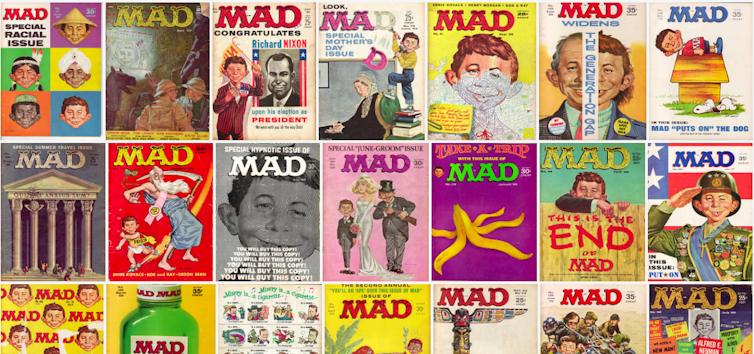


Mad Magazine comedy humor parody satire

The magazine taught its readers to never swallow what they’re served.
Nick Lehr/The Conversation via Jasperdo, CC BY-NC-ND


Mad preached subversion and unadulterated truth-telling when so-called objective journalism remained deferential to authority. While newscasters regularly parroted questionable government claims, Mad was calling politicians liars when they lied. Long before responsible organs of public opinion like The New York Times and the CBS Evening News discovered it, Mad told its readers all about the credibility gap. The periodical’s skeptical approach to advertisers and authority figures helped raise a less credulous and more critical generation in the 1960s and 1970s.

Today’s media environment differs considerably from the era in which Mad flourished. But it could be argued that consumers are dealing with many of the same issues, from devious advertising to mendacious propaganda.

While Mad’s satiric legacy endures, the question of whether its educational ethos - - its implicit media literacy efforts – remains part of our youth culture is less clear.

A merry-go-round of media panics


In my research on media, broadcasting and advertising history, I’ve noted the cyclical nature of media panics and media reform movements throughout American history.

The pattern goes something like this: A new medium gains popularity. Chagrined politicians and outraged citizens demand new restraints, claiming that opportunists are too easily able to exploit its persuasive power and dupe consumers, rendering their critical faculties useless. But the outrage is overblown. Eventually, audience members become more savvy and educated, rendering such criticism quaint and anachronistic.

During the penny press era of the 1830s, periodicals often fabricated sensational stories like the “Great Moon Hoax” to sell more copies. For a while, it worked, until accurate reporting became more valuable to readers.
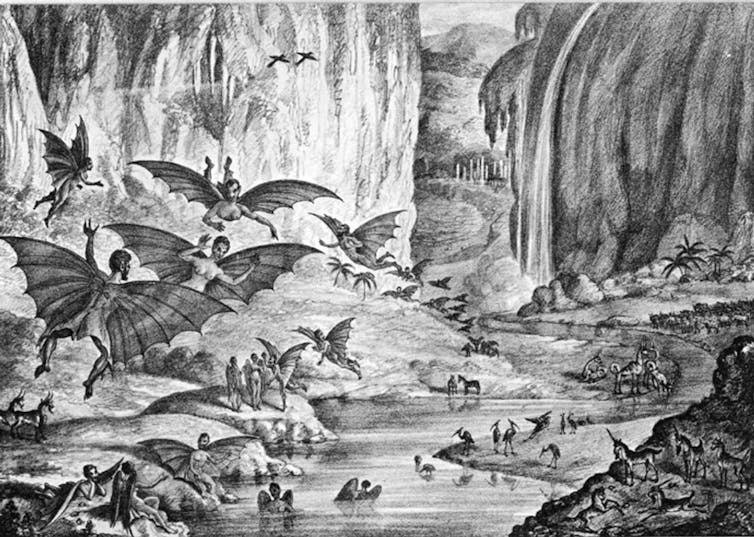


Great Moon Hoax New York Sun

During the ‘Great Moon Hoax,’ the New York Sun claimed to have discovered a colony of creatures on the moon.
Wikimedia Commons


When radios became more prevalent in the 1930s, Orson Welles perpetrated a similar extraterrestrial hoax with his infamous “War of the Worlds” program. This broadcast didn’t actually cause widespread fear of an alien invasion among listeners, as some have claimed. But it did spark a national conversation about radio’s power and audience gullibility.

Aside from the penny newspapers and radio, we’ve witnessed moral panics about dime novels, muckraking magazines, telephones, comic books, television, the VCR, and now the internet. Just as Congress went after Orson Welles, we see Mark Zuckerberg testifying about Facebook’s facilitation of Russian bots.

Holding up a mirror to our gullibility


But there’s another theme in the country’s media history that’s often overlooked. In response to each new medium’s persuasive power, a healthy popular response ridiculing the rubes falling for the spectacle has arisen.

For example, in “The Adventures of Huckleberry Finn,” Mark Twain gave us the duke and the dauphin, two con artists traveling from town to town exploiting ignorance with ridiculous theatrical performances and fabricated tall tales.

They were proto-purveyors of fake news, and Twain, the former journalist, knew all about selling buncombe. His classic short story “Journalism in Tennessee” excoriates crackpot editors and the ridiculous fiction often published as fact in American newspapers.

Then there’s the great P.T. Barnum, who ripped people off in marvelously inventive ways.

“This way to the egress,” read a series of signs inside his famous museum. Ignorant customers, assuming the egress was some sort of exotic animal, soon found themselves passing through the exit door and locked out.

They might have felt ripped off, but, in fact, Barnum had done them a great – and intended – service. His museum made its customers more wary of hyperbole. It employed humor and irony to teach skepticism. Like Twain, Barnum held up a funhouse mirror to America’s emerging mass culture in order to make people reflect on the excesses of commercial communication.

‘Think for yourself. Question authority’


Mad Magazine embodies this same spirit. Begun originally as a horror comic, the periodical evolved into a satirical humor outlet that skewered Madison Avenue, hypocritical politicians and mindless consumption.

Teaching its adolescent readers that governments lie – and only suckers fall for hucksters – Mad implicitly and explicitly subverted the sunny optimism of the Eisenhower and Kennedy years. Its writers and artists poked fun at everyone and everything that claimed a monopoly on truth and virtue.

“The editorial mission statement has always been the same: ‘Everyone is lying to you, including magazines. Think for yourself. Question authority,’” according to longtime editor John Ficarra.

That was a subversive message, especially in an era when the profusion of advertising and Cold War propaganda infected everything in American culture. At a time when American television only relayed three networks and consolidation limited alternative media options, Mad’s message stood out.

Just as intellectuals Daniel Boorstin, Marshall McLuhan and Guy Debord were starting to level critiques against this media environment, Mad was doing the same – but in a way that was widely accessible, proudly idiotic and surprisingly sophisticated.

For example, the implicit existentialism hidden beneath the chaos in every “Spy v. Spy” panel spoke directly to the insanity of Cold War brinksmanship. Conceived and drawn by Cuban exile Antonio Prohías, “Spy v. Spy” featured two spies who, like the United States and the Soviet Union, both observed the doctrine of Mutually Assured Destruction. Each spy was pledged to no one ideology, but rather the complete obliteration of the other – and every plan ultimately backfired in their arms race to nowhere.
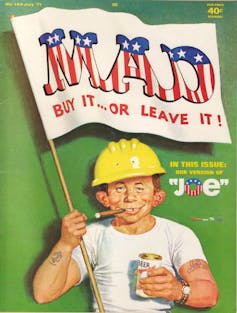


Mad Magazine question authority parody satire humor comedy

Mad skewered those who mindlessly supported the people who controlled the levers of power.
Jasperdo, CC BY-NC-SA


The cartoon highlighted the irrationality of mindless hatred and senseless violence. In an essay on the plight of the Vietnam War soldier, literary critic Paul Fussell once wrote that U.S. soldiers were “condemned to sadistic lunacy” by the monotony of violence without end. So too the “Spy v. Spy” guys.

As the credibility gap widened from the Johnson to Nixon administrations, the logic of Mad‘s Cold War critique became more relevant. Circulation soared. Sociologist Todd Gitlin – who had been a leader of the Students for a Democratic Society in the 1960s – credited Mad with serving an important educational function for his generation.

“In junior high and high school,” he wrote, “I devoured it.”

A step backward?


And yet that healthy skepticism seems to have evaporated in the ensuing decades. Both the run-up to the Iraq War and the acquiescence to the carnival-like coverage of our first reality TV star president seem to be evidence of a widespread failure of media literacy.

We’re still grappling with how to deal with the internet and the way it facilitates information overload, filter bubbles, propaganda and, yes, fake news.

But history has shown that while we can be stupid and credulous, we can also learn to identify irony, recognize hypocrisy and laugh at ourselves. And we’ll learn far more about employing our critical faculties when we’re disarmed by humor than when we’re lectured at by pedants. A direct thread skewering the gullibility of media consumers can be traced from Barnum to Twain to Mad to “South Park” to The Onion.

While Mad’s legacy lives on, today’s media environment is more polarized and diffuse. It also tends to be far more cynical and nihilistic. Mad humorously taught kids that adults hid truths from them, not that in a world of fake news, the very notion of truth was meaningless. Paradox informed the Mad ethos; at its best, Mad could be biting and gentle, humorous and tragic, and ruthless and endearing – all at the same time.

The ConversationThat’s the sensibility we’ve lost. And it’s why we need an outlet like Mad more than ever.

Michael J. Socolow, Associate Professor, Communication and Journalism, University of Maine

This article was originally published on The Conversation. Read the original article.

Sunday, March 18, 2018

Guest Post: Why is sarcasm so difficult to detect in texts and emails?

Sara Peters, Newberry College

This sentence begins the best article you will ever read.

sarcasm communication social mediaChances are you thought that last statement might be sarcasm. Sarcasm, as linguist Robert Gibbs noted, includes “words used to express something other than and especially the opposite of the literal meaning of a sentence.” A form of irony, it also tends to be directed toward a specific individual.

However, it’s not always easy to figure out if a writer is being sarcastic – particularly as we march ahead in a digital age that has transformed the way we communicate, with texting, emailing and online commentary replacing face-to-face chats or phone conversations.

In writing, the signal of sarcasm can be muddied. For example, say you’re texting with a friend about meeting at the movies:

Friend: I’m waiting at the front. Movie starts in 5.

You: I’m on my way now. Should be there in 10.

Friend: I’m glad you were watching the clock today.

Was the friend being sarcastic or sincere? The later you are, the more upset they’ll likely be, and the higher the probability their response is a sarcastic jab. But if your friend knows you’re usually much later, they could be sincere.

So there’s one thing to look for: How well does the attitude the writer is conveying agree with the situation and the person?

Nonetheless, the struggle to interpret written sarcasm is real.

Studies have shown that people realize that they have a tough time interpreting sarcasm in writing. Studying the use of email, researchers found writers who think they’re being obviously sarcastic still confuse readers.

Sarcasm thrives in ambiguous situations – and that’s the main issue.

When delivered in person, sarcasm tends to assume a cutting, bitter tone. But written messages don’t always get that attitude across or give you much else to go on. We still need more information.

Signals that go missing in texts


Studies have examined the use of sarcasm in a variety of everyday situations, whether it’s at work to give criticism or praise, or in situations where social norms get violated. (Be on time to movies, people!)

The problem is that a lot of previous studies of sarcasm have been done on spoken sarcasm, which tends to give listeners cues.

When you have a conversation with someone face-to-face (or FaceTime-to-FaceTime) and they say something sarcastic, you’ll see their facial expression, and they may look slightly bemused or tense. Equally or more helpful, the tone of their voice will likely change, too – they may sound more intense or draw out certain phrases.

You’ll also be firmly grounded in the real-time context of the situation, so when they say, “Man, nice job ironing your clothes,” you can look down – and see your wrinkled shirt.

All of these cues have been researched, and we know enough about them that we have the ability to artificially make a sincerely spoken statement sound sarcastic.

And yet when we text, a lot of that information goes missing.

There are no facial cues, no vocal tones and maybe even a delayed response if a person can’t text you back immediately. And if you don’t know the person all that well, there goes your last potential cue: history.

Emojis to the rescue?


So after what you thought was an unexceptional first date – exactly how do you interpret the following flurry of texts?

Date: I had a great time. (12:03 a.m.)

Date: That was the most fun I’ve had in years. (12:05 a.m.)

Date: Really, it could not have gone better. (12:30 a.m.)

Was the date really that good? Did they really seem like they had that much fun? Or are they just a jerk lamenting the wasted time? All valid questions. And the recipient could come to a lot of conclusions.

Fear not. The digital age has developed some ways to mitigate some of the tortuous ambiguity. You can probably include an emoji to make it clearer to a reader something was meant sarcastically.

Date: I had a great time. (12:03 a.m.)

Date: That was the most fun I’ve had in years. 😂 (12:05 a.m.)

Date: It really, could not have gone better. 😑 (12:30 a.m.)

Ambiguity reduced, and facial expression taken care of. Probably not headed for date #2.

If we’re talking about email, we also have modifications that that can be made to text. We can italicize or bold words to change the way that a reader interprets the message.


sarcasm emoji

‘Oh great – salad with no dressing. My favorite!’
Wikimedia Commons, CC BY-SA


Lastly, social media platforms like Twitter have given writers even more tools to allow people to communicate their intent. A study that included sarcastic tweets found that tweeters who include the hashtag #sarcasm tend to use more interjections (wow!) and positive wording for negative situations in their sarcastic tweets.

Algorithms have actually been built to determine the presence of sarcasm and rudeness in tweets, user reviews and online conversations. The formulas were able to identify language that’s outright rude pretty easily. But in order to correctly detect sarcasm, researchers found that algorithms need both linguistic (language) and semantic (meaning) information built in.

In other words, sarcasm’s subtlety means that the algorithms require more specification in their coding – unless you #sarcasm, of course.

The ConversationWith so many options to choose from, it’s time to make sure that text you send at 2:30 a.m. really gets your point across 😉.

Sara Peters, Assistant Professor of Psychology, Newberry College

This article was originally published on The Conversation. Read the original article.

Friday, March 30, 2012

Why Can't I Stop Laughing?

This afternoon I was listening to Science Friday on NPR, which was featuring its annual April Fools' Day jokes show.  A good number of the jokes were amusing enough to make me smile, but I keep thinking about this one and laugh out loud each time I remember it:

Schrödinger is driving with Heisenberg in a car when Heisenberg says, "I think we just ran over a cat."

"Is it dead?" asks Schrödinger.

Heisenberg replies: "I can't be certain."
Why does that make me LOL so much? Even as I typed it, I had to stifle a chuckle.

Be sure to visit my CafePress store for gifts and novelty items!
Read my blog on Kindle!
Follow my tweets on Twitter! 

Friday, July 01, 2011

'Beaded Curtain'

The other night, during his Tweets and emails segment, TV's Craig Ferguson naughtily coined a phrase:  "beaded curtain."

Well, he didn't coin it per se; the two-word term has been around for a long, long time.  What he did was add an air of mystery to it, making it a sexually suggestive phrase.

Shortly after the show signed off for the night, I signed on to Urban Dictionary to submit a new definition:

A vaguely sexual allusion intended to distract and confuse network television censors. Originally used by CBS late-night host Craig Ferguson on June 29, 2011, in response to a question posed by a viewer via email.

Geoff Peterson: "I enjoy a good beaded curtain now and again."
Craig Ferguson: "Go ahead, censors, look it up. We'll wait."
To my surprise and disappointment, Urban Dictionary rejected my submission.

I think that web site will come to regret this decision. "Beaded curtain" in this sense is going to begin to take root. The Robot Skeleton Army (the Craig Ferguson fan club, so to speak) has already taken up the cause of adding "beaded curtain" to the national lexicon:
Is Beaded Curtain a Thing?

If it wasn’t, it is now. Craig and Geoff’s conversation about beaded curtains got the RSA’s @doxieone1 inspired to come up with a fun poster.
Here's a link to that poster, which shows Geoff Peterson behind a beaded curtain.

I predict you'll be hearing the phrase "beaded curtain" before too long, and you'll titter when you hear it. (And maybe titter about it on Twitter soon afterward.)
Be sure to visit my CafePress store for gifts and novelty items!
Read my blog on Kindle!
Follow my tweets on Twitter! 

Saturday, May 21, 2011

Governor Gary Johnson Plays 'Not My Job' on NPR

Gary Johnson in Charlottesville
"Wait, Wait ... Don't Tell Me!" is a weekly quiz show on NPR stations, usually broadcast on Saturdays or Sundays.  The show is recorded on Thursdays.  It's normal home is in Chicago, but sometimes it goes on the road.  A few years ago, I attended a taping at Lisner Auditorium at George Washington University in Washington, D.C.

Each week features a segment called "Not My Job," in which a celebrity -- actor, singer, author, race-car driver, computer guru -- has to answer three questions on an obscure topic.  The point is that the questions are about things the contestant knows nothing about.

This week's "Not My Job" contestant was former New Mexico Governor Gary Johnson, a candidate for the 2012 Republican presidential nomination.  In the introduction, "Wait, Wait" host Peter Sagal (author of The Book of Vice:  Very Naughty Things [and How to Do Them]) reviewed Governor Johnson's qualifications for high office:
Gary Johnson built a construction business from nothing; then became a two-term Republican governor of a Democratic-leaning state, New Mexico. He cut taxes and put the budget in surplus. He has competed in triathlons and climbed Everest. He lives in a house he built himself. And he once put our a forest fire with his feet.
During the pre-quiz interview, Sagal noted:
We looked you up and we were amazed. You are like - if we had like a campaign consultant draw up the ideal candidate, it would be you. You are fiscally conservative, which is absolutely essential these days. You cut taxes in New Mexico. You vetoed all these budget - I mean you actually held the record for vetoes nationally, right, during your two terms?
When Johnson replied that he had vetoed more bills than the other 49 governors combined, Sagal quipped:
Right. And Republicans love that. They love people who hate laws.
Later, the host recounted some of Johnson's additional accomplishments, and how they might prepare him for the presidency:
I just want to say, I mean one of the things you hear a lot about in presidential primaries is toughness, how tough is he. And you've got this locked. You've done four or fire Hawaii Ironman Triathlons. That's the two mile swim, the hundred mile bike ride, the marathon....

You've climbed Mount Everest, plus three other of the tallest mountains on the various continents. Don't you think after all that the Oval Office would be dull?
Johnson's response says a lot about his character:
From a personal standpoint, I think this is really one of life's great adventures, and I'm really thrilled to be a part of it. I wouldn't be doing this if I didn't think I could do the job. I wouldn't be doing this is I didn't think I could do a good job at doing the job. But thirdly, that personal notion of this really, I think, is right up there with regard to adventure and maybe one of the great adventures of humankind.
Sagal went on to point out that while a lot of Republicans "pick and choose" when it comes to small government, Johnson is a libertarian through and through. That leads to a discussion of traffic signals and speed limits.

At the end of the interview -- just before the three quiz questions about sex tapes and viral videos involving Paris Hilton, Rebecca Black, and Sandra Bullock's ex, Jesse James -- Sagal asked Johnson a general question about the other GOP presidential candidates. Johnson's off-the-cuff response is priceless. Here's the partial transcript:
SAGAL: Do you ever look around at the other candidates on the dais with you or on the trail with you and say "oh I wish I had that"? Is there any characteristic of any other Republican candidate that you wish you had?

(Soundbite of laughter)

Gov.JOHNSON: Or, do I look around and go, you know I got the best of all of that stuff?

(Soundbite of laughter)

(Soundbite of applause)
I have to say, it's nice to hear my favorite presidential candidate on my favorite public radio program.

If you like this blog post, you might also like:
Sagal and Ferguson on the 'Real America'
Gary Johnson on WINA's 'The Schilling Show'
RLC Videos: Peter Schiff and Gary Johnson
"Wait, Wait ... Don't Tell Me"
Is There a Litmus Test for Conservative Republicans?
And on Examiner.com, you'll find:
At the 9/12 March on Washington: Former NM Gov. Gary Johnson aims 'to put a voice to the outrage'
Gary Johnson wins RLC straw poll, places third in CPAC poll
Gary Johnson reflects on his first visit to Jefferson's Monticello
You can hear Gary Johnson's interview and find out how well he did on the "Not My Job Quiz" by listening here. To listen to the complete program, click here.

Update:  The Johnson for President campaign has put the full interview and "Not My Job" quiz on YouTube.
Be sure to visit my CafePress store for gifts and novelty items!
Read my blog on Kindle!
Follow my tweets on Twitter! 

Four Music Videos for the Rapture that Didn't Happen

Reports from beyond the International Dateline suggest that Harold Camping was wrong again.  There were no earthquakes or tsunamis or asteroid crashes that led to the end of the world, time zone by time zone.

Not that anyone of sound mind took Camping's predictions seriously.  He had been wrong before, and he'll no doubt make another inaccurate prediction again.  (I hope nobody is taking stock market advice from this crackpot.)

Still, unlike in 1994, the last time the Family Radio mogul made his wild-eyed prediction that the Rapture was imminent, for some reason the "end-is-near-and-it's-May 21" meme caught the popular imagination. 

People were having fun with it.  There actually may be some disappointment among those who planned to be Left Behind that there will be no post-Rapture parties (raves? barn dances? orgies? pig-outs at Hooters?) to celebrate the departure of the prigs and the prudes.

In the spirit of post-Rapture bacchanalia, however, I present four examples of the kind of music that might have been played at those non-stop dance parties.  Enjoy!

First, here's Skeeter Davis singing her hit country song, "Don't They Know It's the End of the World?," from "The Star Route Show" on television in 1963:


There has long been a rumor among high school debaters that Michael Stipe wrote the R.E.M. song "It's the End of the World as We Know It (and I Feel Fine)" based upon his own experience as a debater, piling disadvantage upon disadvantage on top of the podium. As I understand it Stipe has denied the connection, but the rumors persist -- and no wonder, since the rhythms of the verse mimic the delivery of a debater at full-spread speed.
It would be a shame to forget Blondie's "Rapture," which charted 30 years ago and brought rap music to a wider audience. The video based on the song was also something of a genre-bender. (Videos were not widely seen back then; MTV didn't take to the airwaves until August 1981, eight months after "Rapture" was released.)
Finally, I want to add a song I heard performed by Elaine Paige the other night, in the new production of Stephen Sondheim's Follies at the Kennedy Center. Considering that the Rapture hasn't happened, what can be more appropriate than "I'm Still Here."

Here's the original Carlotta (Yvonne DeCarlo -- yes, Lily Munster), performing the song on a 1979 television show. (Unfortunately, whoever posted this on YouTube provided no more specific information about the program.) There's a slight hiccup at about 2 minutes in, cutting the words "Beverly Hills," but the rest is largely intact -- which is more than you can say for the original cast recording. (The vamp at the end is also cut short. C'est la vie!)

Enjoy the remains of your day -- even for Harold Camping, it's the first day of the rest of your life!

Be sure to visit my CafePress store for gifts and novelty items!
Read my blog on Kindle!
Follow my tweets on Twitter! 
 

Thursday, February 10, 2011

Eugene Delgaudio Channels Stephen Glass

Eugene Delgaudio is probably Virginia's most embarrassing elected official.  The Loudoun County Supervisor is obsessed with male-male sex acts and probably should never be within 1,000 feet of a Gold's Gym.  How he won his seat on the Loudoun Board of Supervisors is a mystery wrapped in an enigma wrapped in plain brown paper.

Not since "Spring Breakdown," the notorious faked 1997 article in The New Republic by serial fabulist Stephen Glass, has a more lurid portrayal of the goings-on at the annual Conservative Political Action Conference (CPAC) come to light.

Until now.

Today I opened my inbox to find a fundraising email from Delgaudio's "organization," the so-called Public Advocate of the United States (a name that implies authority and perhaps even government sanction) with the sensationalistic subject line, "CPAC Enables Homosexual Predators."

It seems that Delgaudio is worried that the innocence of college students -- the same ones who played drinking games and engaged in rough sex with ugly women in the Glass article of more than a dozen years ago -- might be compromised by the presence of members of GOProud, an organization of gay conservatives that last year hosted a reception in New York featuring Ann Coulter and whose board of advisors includes such radical leftists as Andrew Breitbart and Grover Norquist. (Frank Gaffney may concede that the latter is not a leftist, though he may be, per Gaffney, a jihadist. [I think he's just a Norqu-ist.])

At the suggestion of an acquaintance of mine who saw Delgaudio's missive and said, "Fascinating reading -- please disseminate widely in the name of sunlight," I reprint the man from Loudoun County's fantasy here:

For years, the Conservative Political Action Conference (CPAC) was the scene of exciting speakers throughout the day.

But at night there have always been dozens of alcohol parties.

These parties are viewed as festive opportunities to meet conservatives from all over the country in a more social atmosphere.

I try to avoid parties when attending conferences as it’s hard enough keeping a day schedule and parties can be distractions which take away from the serious fight to preserve the family.

Much more importantly, the alcohol abuse and other shenanigans that take place just aren’t my idea of a good time.

It would be better to have late evening vigils and after the dinner speeches at the nearby churches.

However, I was often outnumbered when I attended CPAC back in my days serving as a member of the national board for Young Americans for Freedom.

But knowing the problems at these CPAC parties, I took it upon myself to chaperone younger visitors from around the country who were attending their first political gathering.

And the stories I have to tell will shock you.

It was not unusual for me to have to escort adult predators, even some openly homosexual men out of these parties because they could not resist the urge to prey upon the younger teenage victims at their disposal in a vulnerable place a long distance from their home and without their parents’ presence.

On more than one occasion I had to clean out the lot of them in an upheaval or turmoil that was cast as a political purge.

These days the predator homosexuals use political cover to gain access to their intoxicated victims.

Sometimes it seems my efforts were all for naught...

As I’ve told you before, the Conservative Political Action Conference has been infiltrated by the Homosexual Lobby.

Radical Homosexual front groups like “GOProud” will be in attendance to push their perversion on young conservatives.

This sort of predator behavior was illegal and immoral back when I had to clean house and condemn them.

And it is still illegal and immoral to create an atmosphere in which those same misdeeds could occur again.

Parents should be warned and frankly the authorities at CPAC should be told that there are minor age students who need to be looked after and protected.

Have the Radical Homosexuals really infiltrated that deeply into what used to be a pro-family movement?

Has the leadership of CPAC gone so far as to actually not read anything or think it’s just “political opinion” propagated by old fashioned and outdated leaders that adult homosexual predators exist?

Well, they DO exist and they are taking advantage of the alcohol parties at CPAC to poison the minds and pollute the bodies of young conservatives who are still too naïve to know what is being done to them.

I stand with the dozens of pro-family leaders and the thousands of pro-family supporters who are boycotting this event because of what it has been turned into.

For the Family,

Eugene Delgaudio
President
Public Advocate of the U.S.
P.S. I ask you to prayerfully consider chipping in with a contribution of $10 or more to help fund the fight for traditional values.

Thank you very much for your support in advance.
If even 5 percent of what Delgaudio wrote is true, CPAC would attract several thousand more attendees each year.

In fact, according to what I hear from CPAC (where I'll be tomorrow), the number of vendors in the exhibit area is bigger than last year, and it seems there are more people in attendance than last year, as well.

So much for the "boycott" by anti-gay organizations.  Even Sarah Palin agrees that GOProud members and other gay conservatives should participate in the annual conference.
Be sure to visit my CafePress store for gifts and novelty items!
Read my blog on Kindle!
Follow my tweets on Twitter! 

Tuesday, January 18, 2011

This Is Not Ironic -- Is It?

Am I wrong to think it is entirely appropriate that the Department of Homeland Security is going to be headquartered in an insane asylum?

According to an article published last October (but which just came to my attention) in The Architect's Newspaper,

In September, the General Services Administration (GSA) and the Department of Homeland Security (DHS) held a ceremonial groundbreaking to celebrate the creation of a DHS headquarters on the 172-acre west campus of St. Elizabeths—a National Historic Landmark and the first federally operated hospital for the insane.
Best known as the "home" of Ronald Reagan's would-be assassin, John Hinckley, St. Elizabeths also confined fascist poet Ezra Pound and numerous other crazies during its "golden years."

Now if only the administrators of St. Elizabeths could figure out a way to put a straitjacket on the administrators of the DHS.

Be sure to visit my CafePress store for gifts and novelty items!
Read my blog on Kindle!
Follow my tweets on Twitter! 

Thursday, April 22, 2010

Happy Earth Day (Plus 40)!

What better way to celebrate Earth Day's 40th anniversary than to listen to the late, great George Carlin, who really understands the resilience of the Earth and how man is dwarfed by the planet.


Crystal Clear Conservative has also posted this video and comments:
Earth Day has taken many twists and turns over the years. Now, thanks to the advent of “An Inconvenient Truth” and a degree of hyper-environmentalism, we are faced with a new slogan “Recycle or die” or Cap and Trade legislation, which would regulate industries that produce clean energy. Earth Day is no longer about promoting conservation within reason....

George Carlin says it best time and again as evidenced in this clip.
We lost not just a wit and an entertainer when George Carlin passed away (shortly after being named the recipient of the Kennedy Center's Mark Twain Prize for American Humor), but an intelligent, plain-speaking social philosopher who was not afraid to take on the sacred cows of both left and right.


Be sure to visit my CafePress store for gifts and novelty items!
Read my blog on Kindle!
Follow my tweets on Twitter! 

See my articles on Examiner.com!

Tuesday, March 23, 2010

Homophones

The New York Daily News today has an article on its web site about Vice President Joe Biden using "colorful" language in introducing President Obama at a public ceremony.  (I do not know if this article appears, or will appear, in the paper's print edition.)

Reporter Michael Sheridan writes:

Health care reform isn't just a big deal, it's a "big f---ing deal."

At least, that's what Vice President Joe Biden thinks.

The 67-year-old former senator introduced President Obama prior to his signing of the historic health care reform bill into law on Tuesday, and let the colorful word slip while shaking the commander-in-chief's hand.

"You did it," Biden told his boss. "It's a big f---ing deal."
What caught my eye -- and what makes this article fodder for this blog -- is the penultimate paragraph, which says:
Fowl language may be a favorite for vice presidents. Ex-Veep Dick Cheney famously used the infamous phrase on several occasions during his two terms.
Something tells me that Sheridan did not want to suggest that Biden and Cheney talk like our avian friends. He meant to say "foul language," not "fowl language."

A good copy editor would have caught that.

Of course, it might be that the Daily News is trying to suggest that Biden (and, by extension, Cheney) are "chicken s--t."

Crossposted from Where Are the Copy Editors?


Be sure to visit my CafePress store for gifts and novelty items!
Read my blog on Kindle!
Follow my tweets on Twitter! 


Wednesday, October 28, 2009

One of the Best Congressional News Releases ... Ever

By sheer coincidence, I ate at an Asian restaurant last night and received a fortune in my fortune cookie that said "Leaders are readers."

Here is the entirety of a news release from the office of U.S. Representative Jeff Flake (R-Arizona):

Congressman Flake Releases Statement Regarding His Vote Against Honoring the 2560th Birthday of Confucius


Washington, D.C., Oct 28 - Republican Congressman Jeff Flake, who represents Arizona’s Sixth District, today released the following statement regarding his vote against H.Res.784, a bill “honoring the 2560th anniversary of the birth of Confucius and recognizing his invaluable contributions to philosophy and social and political thought.”

He who spends time passing trivial legislation may find himself out of time to read healthcare bill,” said Flake.
H/T: Radley Balko via Twitter


Be sure to visit my CafePress store for gifts and novelty items!
Read my blog on Kindle!
Follow my tweets on Twitter!

Monday, October 05, 2009

And Now for Something Completely Different ...

It was forty years ago today -- October 5, 1969 -- that Monty Python's Flying Circus first took to the airwaves on the BBC. A leader in today's Guardian notes:

"I'll give you 13 shows, but that's all," said the BBC's head of light entertainment in 1969, and Monty Python's Flying Circus aired to a perplexed, but eventually grateful, British audience on Monday 5 October that same year. Over the subsequent 45 shows, the rules of television comedy were rewritten as John Cleese, Graham Chapman, Michael Palin, Terry Jones, Eric Idle and Terry Gilliam created lunatic characters and sketches, as funny today as they were 40 years ago.
The Oxbridge-educated group brought silliness and erudition in nearly equal amounts to television sketch comedy. Not exactly sui generis -- the Pythons had roots in pantomime, music hall, and British radio and movie comedies of the 1940s and '50s, as well as the satirical shows at Oxford and Cambridge, the Edinburgh Fringe, and even Beyond the Fringe -- when it reached America via public television, Monty Python seemed revolutionary.

In Milwaukee in the mid-1970s, Monty Python's Flying Circus was played on Tuesday evenings at 10:30 on WMVS-TV (Channel 10), so on Wednesday mornings, the senior lounge, the Blue & Gold Room, and the cafeteria at Marquette University High School were all abuzz with teenage boys imitating and trying their best to recreate, verbatim, the sketches they had seen the night before. It's a tribute to the quality of Python performances that, even after a single viewing, they could be recreated (at least by the smartest ones). Later, when vinyl LP recordings became available, memorization became easier, if a bit less daunting. We would spend hours on "The Argument Clinic," "Dead Parrot," and, among many others, "The Spanish Inquisition." (Bet you didn't expect that!) For a sample of Monty Python's influence on MUHS students, check out "Life on Film" from 2007.

It was under the influence of Monty Python -- how else would 16-year-old Midwesterners be introduced to existential philosophers? -- that I and some of my classmates came up with this cheer for the MUHS sports teams (nicknamed the Hilltoppers):
Socrates, Plato, Bertrand Russell
Here we go, Toppers --
Husserl, Husserl!
It might not have inspired anyone to audition for place kicker, but whoever said public TV can't be educational?

Monty Python's Flying Circus is being celebrated all over the web today. For instance, Stephen Beard, a correspondence for public radio's Marketplace, had a report on today's broadcast about how many of the early Monty Python sketches reflected the socio-economic realities of Britain in the 1950s and 1960s.

Entertainment Weekly's Josh Wolk offers "10 Ways Monty Python Changed Comedy," in which he mentions The Whitest Kids U' Know (brainchild of Charlottesville's Trevor Moore and his co-conspirators) in the same breath as Python and The Kids in the Hall.

Michael Saba at Paste Magazine offers four of his favorite Python moments, with videos culled from YouTube.

The Christian Science Monitor notes:
It's Monty Python week on IFC, where the cable film channel marks the 40th anniversary of the cheeky, British comedy troupe. Events will include a six-episode interview/documentary, "Monty Python: Almost the Truth (The Lawyer's Cut)," featuring all of the remaining group members discussing the ensemble's cultural impact and legacy. The week will also include, of course, the classic Python films.
Radio Times has a whole set of Monty Python features, including a collection of Python-related covers, film reviews (for Monty Python and the Holy Grail, Monty Python's The Meaning of Life, Monty Python's Life Of Brian, and Erik the Viking), and a blog post with Terry Jones' favorite Python moments.

And here, ladies and Bruces, from a live performance at the Hollywood Bowl, Monty Python performs "The Philosophers' Song":

"I drink, therefore I am." Now that's a way to get high school boys interested in serious philosophical discourse!


Be sure to visit my CafePress store for gifts and novelty items!
Read my blog on Kindle!

Wednesday, September 16, 2009

New Candidate Emerges in 99th

The Virginia blogosphere is atwitter with the news that a write-in candidate has emerged in the 99th House of Delegates district, challenging incumbent Delegate Albert Pollard (D) and tinfoil-hat conspiracy theorist Catherine Crabill, a nominal Republican who has been repudiated by the GOP's candidates at the top of the ticket and by the state GOP chairman.

As reported on Virginia Virtucon:

CAROLINE COUNTY, VA – Hamilton “Ham” Sandwich, Esq. today announced his campaign as a Republican write-in candidate for the 99th House of Delegates District on the popular local blog “I’m Surrounded By Idiots” run by Timothy Watson. Ham previously ran for Prince William County Commonwealth’s Attorney in 2007 as a write-in candidate and received more than 700 votes countywide with votes coming from every precinct in the county according to Prince William County Registrar Betty Weimer.
Can a ham sandwich win a write-in campaign against two ballot-statused candidates? Stay tuned through November 4 to find out.


Be sure to visit my CafePress store for gifts and novelty items!
Read my blog on Kindle!

Wednesday, September 09, 2009

Write Your Own Headline

Why bother to comment when I can just cut-and-paste a single paragraph?

From a report in yesterday's New York Observer:

Naomi Wolf is going back to her roots. The journalist and author, who has seemingly been on a break for the past couple of years from writing books on the kinds of feminist themes that made her famous in the early 1990s, has signed on with the Ecco Press for a project tentatively titled A Cultural History of the Vagina.
Feel free to offer your suggestions for a headline in the comments section, below.


Be sure to visit my CafePress store for gifts and novelty items!
Read my blog on Kindle!

Tuesday, June 30, 2009

'It Was a Dark and Stormy ...'

Snoopy is not the only imitator of Paul Clifford, the novel by Edward Bulwer-Lytton with the much-mocked opening sentence that begins, "It was a dark and stormy night..."

For 27 years, San Jose State University in California has sponsored the Bulwer-Lytton Fiction Contest, which aims to inspire bad writing (in the form of opening sentences) from contestants who enter from around the globe.

This year's winner is David McKenzie of Washington state. UPI notes his winning sentence:

"Folks say that if you listen real close at the height of the full moon, when the wind is blowin' off Nantucket Sound from the nor' east and the dogs are howlin' for no earthly reason, you can hear the awful screams of the crew of the Ellie May, a sturdy whaler captained by John McTavish; for it was on just such a night when the rum was flowin' and, Davey Jones be damned, big John brought his men on deck for the first of several screaming contests."
The San Jose Mercury News explains:
"The judges liked his sentence because of the way it pulls the rug from under the reader. You compose yourself to hear about another wreck of the Edmund Fitzgerald, then find that it's just about some drunks having a screaming contest," said Scott Rice, who began the contest 26 years ago.
For the record, the sentence that began it all reads like this:
It was a dark and stormy night; the rain fell in torrents, except at occasional intervals, when it was checked by a violent gust of wind which swept up the streets (for it is in London that our scene lies), rattling along the housetops, and fiercely agitating the scanty flame of the lamps that struggled against the darkness.
Those who like this sort of thing (and I am one of them) can entertain themselves with several volumes of bad writing compiled by Scott Rice, including the original It Was a Dark and Stormy Night and its sequels, including Bride of Dark and Stormy: Yet More of the Best (?) From the Bulwer-Lytton Contest and Dark and Stormy Rides Again.

UPDATE: NPR interviews winner David McKenzie about his 87-word sentence on "All Things Considered."


Be sure to visit my CafePress store for gifts and novelty items!
Read my blog on Kindle!