Saturday, April 19, 2014

Will Fifth District Democrats refuse to challenge Robert Hurt in 2014?
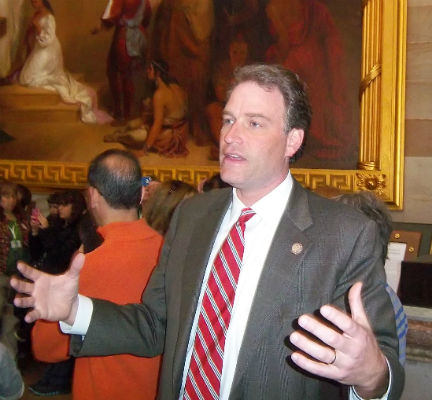
Hurt-Rotunda
Robert Hurt in the U.S. Capitol Rotunda
It appears there is a good chance that Fifth District U.S. Representative Robert Hurt will not face a Democratic challenger in the 2014 general election.

About two months ago, Bearing Drift broke the news that Ben Hudson of Fluvanna County, a retired U.S. Army officer, was seeking the Democratic nomination to challenge Hurt. Hudson had run for the same office in 2012 as a write-in candidate, getting 388 scattered votes.

Subsequently, another candidate emerged. Last month, the Daily Progress reported that television and film actor Lawrence Gaughan of Albemarle County had thrown his hat in the ring.

Both candidates submitted their candidacy papers properly by the April 1st filing deadline. They will both be on the ballot at a convention of Fifth District Democrats to be held at Fluvanna County High School on Saturday, May 31.

A funny thing happened on the way to the nomination, however.

Fifth District Democratic leaders are unimpressed, and in some cases displeased, by the choices they have before them.

Hudson, for instance, despite the tepid results of his write-in candidacy in 2012, had actively opposed Democratic nominee John Douglass. One local Democratic activist told me that he was puzzled over the fact that Hudson had expressed views at odds with Democratic policy positions on about five key issues, positions that he has now reversed without explanation.

For his part, Gaughan -- who has lived outside the district for about five years, until recently -- tried to run against incumbent Virgil Goode and challenger and future congressman Tom Perriello in 2008 as a candidate for the Green Party, but the party's central committee refused to nominate him.

Neither Gaughan nor Hudson has reported any campaign receipts or expenditures to the Federal Election Commission. (During the reporting period ending March 31, Congressman Hurt's campaign received $643,625 in contributions with $378,679 cash on hand and no debts.)

It appears Fifth District Democrats are looking for a way to avoid fielding a weak candidate against Hurt, in the belief that no candidate is better than one who may bring disrepute upon the party.

In fact, "no candidate" is one of the choices that will be on the ballot at the May 31 convention in Fluvanna.

During the delegate selection process, which will take place in the form of "assembled caucuses" in each of the district's cities and counties, according to the convention call,
After caucus participants have been certified as eligible to participate, all participants will be asked to assemble into caucuses, with one caucus for each filed Congressional candidate, a “No Candidate” caucus, and an “uncommitted” caucus.
and this:
A delegate candidate or alternate candidate may indicate a preference for a filed Congressional candidate on his or her filing form, or he or she may file as a “No Candidate” delegate or alternate or as an “Uncommitted” delegate or alternate. If a delegate or alternate candidate fails to indicate a preference on the filing form, the committee shall list such persons as “uncommitted”.
Most pertinent, the convention call exercises an option offered in Section 12.5 of the Democratic Party Plan implemented in September 2013 -- essentially "none of the above" as an alternative to selecting a candidate:
The Temporary Rules Committee shall prepare the pre-printed ballot, which shall be on white paper and which shall contain the names of all filed candidates for Congress as well as the option of selecting "No Candidate".
While Fifth District Democratic party leaders cannot prudently advocate in the open for the "no candidate" option, they are hoping that its prominent inclusion will nudge delegates in that direction. Like their counterparts in the Seventh Congressional District, who are running nobody against House Majority Leader Eric Cantor, they are calculating that having no candidate to run against an incumbent Republican is better for Fifth District Democrats in the long run than having a candidate who will embarrass the party.

The question that remains is this: Will the Libertarian Party or the Independent Green or Green parties take advantage of this potential vacuum to run a challenge against Hurt, who is seeking his third term? Stay tuned -- there may be more news to come.

This article has been cross-posted from Bearing Drift.


Tuesday, April 15, 2014

Should Virginia taxpayers subsidize the film industry?

Regal Cinemas: 'Welcome Virginia Film Festival'
How should Virginia's relate to the film industry?

The Commonwealth has become a popular location for shooting prestige motion pictures. Steven Spielberg's Lincoln used Richmond as a stand-in for 1860s Washington, and Spielberg used the Shenandoah Valley as a stand-in for Massachusetts in his 2005 War of the Worlds remake. Other movies shot on location here include Gods and Generals, Sommersby, Killing Kennedy, Evan Almighty, Giant, Toy Soldiers, and Swedish Auto (those last four made in the Charlottesville area).

Not simply a location for making films, Virginia often is an early venue for seeing other big movies.

For example, one of the Oscars' Best Picture nominees for 2013, Alexander Payne's Nebraska, had pre-release screenings both at the Virginia Film Festival in Charlottesville, where co-star Will Forte and producer Ron Yerxa discussed the film, but also at the new Middleburg Film Festival, where Yerxa appeared with lead actor (and Oscar nominee) Bruce Dern. The 2013 Virginia Film Festival also screened Philomena, another Best Picture nominee this year. In 2011, eventual Best Picture winner The Artist was a closing night feature at the Virginia Film Festival. Oscar-winning live-action short subject West Bank Story also had an early screening at the 2005 festival in Charlottesville.

It's clear that Virginia has strong ties to the film making industry. But should Virginia taxpayers have to pay for them?

Although Virginia has, for some time, offered substantial tax benefits to movie companies that come here to make films, a bill introduced in this year's General Assembly -- and passed by both chambers -- would expand tax credits to the millionaires who would probably do business here anyway.

According to the summary of HB 460, patroned by Terry Kilgore (R-Gate City) and copatroned by Chris Peace (R-Mechanicsville, the bill
Changes the motion picture production income tax credit by (i) increasing the percentage of qualifying expenses eligible to be claimed from 15 percent to 20 percent, and from 20 percent to 25 percent for productions in an economically distressed areas, (ii) increasing the total biennium cap for all such credits from $5 million to $25 million, and (iii) having the credit expire on December 31, 2023. The bill also requires the Department to publish information regarding the credit regardless if it does not prevent the identification of the taxpayer claiming the credit. The bill is effective for taxable years beginning on or after January 1, 2014.
Does this make good sense as policy? Economists say no.

Even uber-liberal Robert Reich, the Clinton administration's Labor Secretary, agrees that states that subsidize the film industry are making a mistake.

According to Variety, Reich
called the bonanza of states offering production tax credits a “race to the bottom,” as competition sees governments sweetening the pot to try to lure movies and TV shows within their borders.

“These tax credits and tax incentives are a zero sum game,” he said in an interview last week. “They don’t create a single new job. They just move jobs around, and they rob the states of the money they need for education and infrastructure.”
Closer to home, the Mercatus Center at George Mason University headlined an article by one of its scholars, Antony Davies, "The Film Tax Credit Farce." Davies, an economist at Duquesne University, wrote:
According to the nonpartisan Tax Foundation, every independent study of film tax credits has found that the credits are money-losers for the states. Arizona's Department of Commerce calculated that Arizona made back 28 cents in tax revenue for every $1 it “invested” in film tax credits. Connecticut's Department of Economic Development estimated that the state earned 7 cents in tax revenue for every $1 it lost. State agencies in Massachusetts, Michigan, New Mexico and even Pennsylvania's Legislative Budget and Finance Committee found that state coffers received less than 30 cents for every dollar they paid out in film tax credits.

If film production is such a great cash cow, why aren't venture capitalists lining up for a piece of the action? The problem is that the film industry wants special treatment. It wants someone else to shoulder the risk of investment while it keeps the profit for itself. No investor would agree to such a deal, and that is why the film industry has turned to our state government.

Filmmakers know the state can force taxpayers to invest in something taxpayers would never choose on their own.
Some politicians are getting the message that tax credits for the film industry do not bring states the benefits touted by their proponents. Variety quotes another GMU source, economist Eileen Norcross:
Other arguments against incentives hold that they don’t help the states that offer them. In March, the Massachusetts revenue commission issued a scathing report on the state’s tax credit program, which stated that two-thirds of the total $175 million awarded in 2011 went to out-of-state spending. “The critique is that while they appear to bring in short-term temporary activity to a state or community, a lot of those benefits flow to the production companies,” says Eileen Norcross, a senior research fellow at George Mason U. “The people who are hired locally tend to be (in) more low-wage service industry jobs. It provides a temporary economic blip on the radar, and then it’s sort of fleeting.”
In a commentary piece for U.S. News and World Report, Norcross explained the case against film industry subsidies. States, she said, are
finding that it is barely worth the lost revenue. A recent report by the Massachusetts Department of Revenue found that of the $44 million in tax credits awarded in 2011, two-thirds of the $175 million in spending generated due to economic activity went to out-of-state workers, and 47 percent of the wages generated, or $53 million, went to those earning over $1 million.

On net, Massachusetts' film credit program is costing the state more than it delivers. After subtracting payments to out-of-state residents and the budget reductions required to fund the credits, only $39 million in state economic activity resulted. The findings have prompted Governor Deval Patrick to cap the state's program to $40 million in annual credits.

North Carolina's Legislative Services Office analysis shows their film credit program realizes even less impressive returns. In 2011, the state awarded $30.3 million in film credits – reimbursing productions that spent over $250,000 up to 25 percent for qualifying expenses. Yet, the program could only claim about 55 to 70 new jobs. Based on their model, the report claims that if instead North Carolina's business taxes had been reduced across the board by $30.3 million, between 340 and 450 jobs and $14 million in personal income would have materialized.
Why, against all this evidence, are states -- including Virginia -- continuing to transfer tax dollars from poor- and middle-class residents to rich out-of-state film producers?

There's a widely held belief that putting the state's locales on film encourages more tourism. That's dubious. Consider the examples above: Tom Cruise fought Martians in the hills near Lexington, Virginia, in War of the Worlds. But Virginia was never mentioned in the film. Virginia played Massachusetts. Daniel Day-Lewis was Abraham Lincoln while Richmond was Washington, D.C.

Of course, even 50 years after it was made, The Sound of Music still brings tourists to Salzburg, Austria, and its environs, and The Lord of the Rings trilogy became the basis to attract tourists to New Zealand. Those are outlying exceptions, however, with cult followings that films like Evan Almighty and Swedish Auto can't match.

In addition, politicians hopefully believe connections with film producers, directors, and actors bring with them "movie magic," as though having Sally Field or Dakota Fanning in town will result in fairy dust falling on Richmond or Lexington. Even governors and senators are dazzled by celebrity, not to mention delegates and city council members.

As Variety's David Cohen pointed out on public radio's Here & Now,
place after place has discovered these things are rife with corruption and they don't deliver the returns that they expect. But there's always another politician or another city that's willing to be seduced by Hollywood glamour.
It turns out that HB 460 passed both chambers of the General Assembly and was signed into law by Governor Terry McAuliffe on April 6, with an effective date of July 1, 2014.

Too bad the governor failed to listen to his friend Bill Clinton's old friend Robert Reich.  He has helped  Virginia join the "race to the bottom."

Adapted from an earlier post on Bearing Drift.

Monday, April 14, 2014

Will Medicaid expansion actually make poor people healthier?

Members of the General Assembly who oppose Governor Terry McAuliffe's proposals to expand Medicaid in Virginia under the terms of the Affordable Care Act (ACA, also called "Obamacare") may find some intellectual ammunition to bolster their case in a study published on March 24 by the Mercatus Center at George Mason University.

The Economics of Medicaid: Assessing the Costs and Consequences, edited by Jason J. Fichtner, contains a lot of wonkish economic analysis, such as Nina Owcharenko's chapter on "the state side of the budget equation," which shows the astronomical growth in Medicaid spending and enrollment over the past two decades (see the graph to the upper left), but the most significant findings may be in the book's last chapter, by Robert F. Graboyes and titled "Medicaid and Health."

Graboyes relies on previous studies in several states and on reports from the Government Accountability Office and other federal agencies to demonstrate that people who rely on Medicaid for health insurance not only have worse health comes than those who have other types of insurance, but worse than people with no insurance at all.

What's more, rather than taking patients out of emergency rooms and putting them in doctors' offices for routine health care, expansion of Medicaid coverage tends to increase emergency room visits by Medicaid recipients.

I'll let Graboyes -- a senior research fellow who was formerly an economist with Chase Manhattan Bank and the Federal Reserve Bank of Richmond, as well as a faculty member at the University of Richmond -- tell it in his own words (end notes omitted).

Pages 175-76:
A Mercatus publication I authored in 2013 stated the following: “An ideal health care system will provide better health to more peo­ple at lower cost on a continuous basis.” By this standard, Medicaid is an abject failure. For lower-income Americans, Medicaid yields poor coverage, poor care, and poor medical outcomes. While prom­ising coverage far beyond the program’s original scope, it fails to enroll millions of people who are among its intended population and who are eligible for enrollment. The data suggest that Medicaid does surprisingly little to improve its recipients’ health and in some ways may even harm them indirectly. It is a pennywise-and-pound-foolish program that, paradoxically, sends costs soaring by underpaying pro­viders. And the coverage, care, and cost elements show little or no improvement over time.

Pages 181-82:

In 2010, the University of Virginia conducted a large-scale study that suggested that an individual without insurance has better health outcomes than an individual on Medicaid.47 Even after adjusting for risk factors, Medicaid patients had higher in-hospital mortality, longer hospital stays, and higher costs—compared with the uninsured, those on Medicare, and those on private insurance plans.48 A University of Pennsylvania study examined data on patients receiving surgery for colorectal cancer; Medicaid patients had higher mortality and surgical complications than uninsured patients.49 A 2011 Johns Hopkins study found that “Medicare and Medicaid patients have worse survival after [lung transplantation] compared with private insurance/self-paying patients.”

Perhaps the most damning of all the recent studies is the Oregon Experiment. This was a rare example of a large-scale, fully ran­domized experiment in health care. In 2008, Oregon expanded its Medicaid program. Approximately 90,000 people applied for 30,000 newly available slots, and the state used a lottery to choose who got in and who did not. Afterward, the state tracked the health of 6,387 adults who were chosen and 5,842 who were not. From a standpoint of physical health, the results were devastating: “This randomized, controlled study showed that Medicaid coverage generated no sig­nificant improvements in measured physical health outcomes in the first 2 years, but it did increase use of health care services, raise rates of diabetes detection and management, lower rates of depression, and reduce financial strain.” Supporters of Medicaid point to positives that follow the word “but” in the preceding sentence.

Page 177:


Rapid expansion of Medicaid, as envisioned under the ACA, also has the potential to touch off a cycle of expansion, financial over­load, and mass cancellations of coverage. The best example of such a process is the TennCare disaster that began in 1994 in Tennessee. The state sought to convert Medicaid to managed care, assuming this would lead to enough savings (from efficiency gains) to cover children and the uninsured. In less than a decade, however, enroll­ ment swelled far beyond what had been predicted, and the savings proved elusive. The expansion threatened the state government with bankruptcy and, by 2006, the program was forced to cancel cover­age for approximately 200,000 Tennesseans. A high-profile study of Oregon’s Medicaid expansion provides powerful new evidence that expansion increases rather than decreases the use of emergency services; putting it another way, one of the principal arguments in favor of expansion now appears illusory [emphasis added].

The whole book, which is also available in a Kindle edition, is chock-a-block with nuggets like these. Even legislators who don't read bills before they vote on them should read this book.

Cross-posted from Bearing Drift (April 12, 2014).

Sunday, April 13, 2014

2014 Jefferson Muzzle awards have been announced

Violators of freedom of expression are the "winners" of the 2014 Jefferson Muzzle Awards from the Thomas Jefferson Center for the Protection of Free Expression in Charlottesville. Now in their 23rd year, the Muzzles are announced to coincide with Mr. Jefferson's birthday (April 13).

Josh Wheeler
The ten recipients this year include three educational institutions, three state government agencies, and four federal government agencies. They were announced by the Center's executive director, Josh Wheeler, via a press release on Thursday, April 10.

The awards include implicit criticism of the White House press office for limiting access to the news media to even trivial events and of the Department of Justice for "secretly seiz[ing] dozens of phone records of the Associated Press and falsely label[ing] Fox News reporter James Rosen a criminal 'co-conspirator' in order to obtain a search warrant for the reporter’s phone records and emails."

The National Security Agency (NSA) and Department of Homeland Security are joint recipients of a Muzzle
For causing an online retailer to remove from its website a Minnesota man’s products satirizing various government entities on T-shirts, bumper stickers, and other items. Zazzle.com pulled the items from its marketplace after receiving cease and desist letters from the NSA and Homeland Security. Among the items removed were products featuring a variation of the NSA seal along with the statement “The NSA: The only part of government that actually listens.”
The North Carolina General Assembly police are cited for arresting a reporter who was covering a protest at the state capitol, while the Tennessee General Assembly gets dinged for criminalizing undercover reporting at agricultural facilities.

The Kansas Board of Regents receives a 2014 Muzzle award because
Following controversial statements by a member of the University of Kansas faculty on his personal Twitter account, the Kansas Board of Regents (the governing board of the state’s public universities) adopted a social media policy that allows for the firing of a faculty member for using social media in such a way that “impairs…harmony among co-workers,” or that the university’s chief executive officer deems “contrary to the best interest of the university.”
A Florida high school principal gets an award for cutting off the microphone of a graduation speaker who was stumbling over his words and then denying the student an opportunity to accept his diploma with the rest of the class. His reason? He thought the stumbling was an attempt to go "off script" on the approved text of the speech.

The principal of Pemberton High School in New Jersey wins a Muzzle for censoring two articles in the student newspaper, and then forbidding the same newspaper from publishing an article about censorship.

My favorite 2014 Muzzle concerns a case that received a lot of publicity last September. At Modesto Junior College in California, a student was refused permission to distribute copies of the U.S. Constitution on Constitution Day. Here's the Thomas Jefferson Center's citation:
Campus police confronted Robert van Tuinen outside the student center as he handed out free copies of the Constitution to his fellow students on September 17—Constitution Day. Officers informed van Tuinen that school policy only permitted literature to be distributed within a tiny designated spot on campus, and only then if scheduled several days in advance.
If you missed the widely-distributed video of this incident, here it is:
To hear Thomas Jefferson Center director Josh Wheeler talk about how the Muzzle Award winners are determined, check out this interview on The Score.

Cross-posted from Bearing Drift (April 9, 2014).


Saturday, March 29, 2014

HAH! Celebrate Human Achievement Tonight

On March 29th, from 8:30 to 9:30 p.m. in their local time zones, millions of soul-sapped, misanthropic pessimists will be sitting in the dark marking "Earth Hour."

For the rest of us, that same time period will be celebrated as "Human Achievement Hour," offering an opportunity to turn on the lights, watch television, listen to the radio, or surf the Internet and ponder the wonders of ingenuity and the capacity of man to rise above brute poverty into a scintillating world of his own making that includes art, poetry, music, and machines.

The Competitive Enterprise Institute describes Human Achievement Hour like this:
Human Achievement Hour (HAH) is a celebration of individual freedom and appreciation of the achievements and innovations that people have used to improve their lives throughout history. To celebrate Human Achievement Hour, participants need only to spend the hour from 8:30 pm to 9:30 pm on March 29 enjoying the benefits of capitalism and human innovation: Gather with friends in the warmth of a heated home, watch television, take a hot shower, drink a beer, call a loved one on the phone, or listen to music.

On Saturday, March 29, 2014, from 8:30 pm to 9:30 pm, some people will shut off their lights and spend an hour in darkness as a symbolic vote against global climate change. Observers of Earth Hour want world leaders to “do something” about pollution and energy use. What this means is that they want politicians to use legal mandates and punitive taxes to prevent individuals from freely using resources, hindering our ability to create the solutions and technologies of the future. Instead, the Competitive Enterprise Institute asks you to spend that hour with your lights *on* in celebration of Human Achievement Hour.

HAH is an annual event meant to recognize and celebrate the fact that this is the greatest time to be alive, and that the reason we have come is that people have been free to use their minds and the resources in their environment to experiment, create, and innovate. Participants in HAH recognize the necessity to protect the individual persons from government coercion, so that we may continue innovating and improving our lives and the world around us.
A short video demonstrates some of the amazing things people have done with their hands and their imaginations:
Be sure to leave a comment below, telling everyone how you like to celebrate human achievement. Or more: What human achievement do you most appreciate? What human achievement do you anticipate will make our lives better over the next five or ten years?


Friday, March 21, 2014

My 1991 Interview with Geraldine Ferraro

Hank Stuever's review in Friday's Washington Post of a new Showtime documentary about 1984 Democratic vice-presidential nominee Geraldine Ferraro reminded me that I once interviewed her.

Rick Sincere interviews Geraldine Ferraro, 1991
The occasion was a Human Rights Campaign Fund (now Human Rights Campaign) fundraising dinner in late 1991. I was a correpondent for Gay Fairfax, a local TV magazine show in Northern Virginia that also appeared on various public-access cable channels around the country. The interview, which was cut away from excerpts of Ferraro's speech that night, was broadcast months later, on February 10, 1992.

At the time, Ferraro was embarking on a campaign to unseat then-Senator Alfonse D'Amato in New York. D'Amato was a Republican who had first been elected in the Reagan landslide of 1980.

As John Peter Olinger later noted about Ferraro's appearance at the HRCF banquet in an undated paper for the Rainbow History Project, "It was striking to watch as the crowd at the Human Rights Campaign dinner in 1992 [sic] cheered wildly as Geraldine Ferraro said she was running against Senator D’Amato and to realize that just six years later that same organization endorsed Senator D’Amato’s re-election."

As it turns out, the former congresswoman did not even win the Democratic primary to face D'Amato in November. She lost that election to New York attorney general Robert Abrams in a crowded field that also included pre-MSNBC Al Sharpton, New York City comptroller Elizabeth Holtzman, and U.S. Representative Robert Mrazek.

My interview was rather short (although, if you watch closely, you can see that some of it must have ended up on the cutting-room floor).  Note the references to Dick Cheney, who was then Secretary of Defense for President George H.W. Bush, and the military gay ban, which a little over two years later would become Bill Clinton's "Don't Ask, Don't Tell" policy, with repeal two decades in the future.

Ferraro also refers to "the gay rights act," which I interpret to mean ENDA, the Employment Non-Discrimination Act, another bill that has been in Congress for decades without being passed into law.

The first question I posed mentioned a book Ferraro was working on.  She notes that she had deferred finishing it while running for the Senate, but a search on Amazon.com reveals that no book by Ferraro on that topic -- tensions between the First and Sixth Amendments to the Constitution --  was ever published.

Here is a complete transcript, including introductions by Gay Fairfax anchors Beth Goodman and Dave Hughes.
Beth Goodman: Gay Fairfax correspondent Rick Sincere recently got an exclusive interview from Geraldine Ferraro at the 1991 Human Rights Campaign Fund banquet.

Dave Hughes: Miss Ferraro ran for the United States Senate in New York State. Rick asked her about her views on gay and lesbian issues.

Rick Sincere: Welcome to Gay Fairfax.

Geraldine Ferraro: Thank you.

Sincere: And welcome to the Human Rights Campaign Fund annual dinner.

One of the questions I'd like to ask you is about the book you're working on about the conflict between the First Amendment and privacy rights. Could you comment on how that relates to the question of outing and ...

Ferraro: It doesn't. It doesn't. What it is is it's a book on the tension between the first and sixth amendments. The sixth amendment is the right to a fair trial. I'm a former prosecutor and so out of my experiences over the last number of years, I've sat down and really tried to analyze how much of an impact a good deal of publicity has on a person's right to have a fair trial. But to be very honest, I'm not really writing the book anymore. I've put it aside; I'm now running for the United States Senate. That preoccupies all of my time so the book will be put on the back burner for another day. Perhaps after I'm in the Senate a couple of terms.

Sincere: Right. Give it another twelve years or so, you can get back to it. Tell us about your relationship to the gay and lesbian rights movement. You've been a long term, long-time supporter of gay rights and here you are the Human Rights Campaign Fund dinner. What do you think is top on the agenda for the gay and lesbian community?

Ferraro: Well, I think the issue of funding for AIDS research into to move along i think that's probably most immediate problem, I mean there are obviously others, the immigration laws, the gay rights act which is in the Senate and in the House, I'd like to see that moved.

But again, I think, evidently funding and finding a cure for a disease that is just destroying this nation.

Sincere: What do you think about the problem of the military's discrimination against gay men and lesbians? Do you think there's hope for movement in that direction?

Ferraro:
I sure hope so. I think Secretary Cheney has a very good opportunity to make some significant rules on the issue now especially in light of the report that just came out that indicates that gays and lesbians have no impact on security, no problem with security. Take a look at what happened during Desert Storm, the number of people who served and served valiantly who are gays and lesbians.

I know Dick Cheney. He was in my class in the Congress. I think he is an honorable man, and I would hope that he would be also a man of conscience and would take a very close look at what's happening in the military.

We're facing some very, very tough times and we need the talents of all of our people. We shouldn't discriminate because of race or gender or sexual orientation or anything else, or religion. So I look forward to being able to talk a little bit tonight about the issue, and I look forward to being able to come down in the Senate and doing something about it.

You can watch Ferraro's speech, my interview, and a musical performance by an a capella group, The Flirtations, here on Gay Fairfax:

Ferraro passed away in 2011 at the age of 75. The new Showtime movie about her is called Geraldine Ferraro: Paving the Way. It is directed by her daughter, Donna Zaccaro.


Friday, February 07, 2014

At start of Sochi Olympics, State Department issues Russia travel warning

On the same day as the opening ceremonies of the 2014 Winter Olympic Games in Sochi, Russia, the U.S. Department of State distributed a travel alert that, while couched in diplomatic language, seems designed to discourage American citizens from attending the Olympics this month.

Here's how the travel alert -- which I received by email -- begins:

The Department of State alerts U.S. citizens planning to attend the 2014 Olympic Games in Russia that they should remain attentive regarding their personal security at all times. The Olympic and Paralympic Games will take place in Sochi, Russia, from February 7 to March 16, 2014. This travel alert replaces the alert issued on January 24, 2014, and provides updated information on reported threats against the Games, cyber-security risks, identification requirements, and lodging. This Travel Alert expires on March 24, 2014. Full information about the Olympic and Paralympic games for U.S. citizen visitors is available on the Sochi Fact Sheet and the Country Specific Information for the Russian Federation on our website, travel.state.gov. The Department strongly recommends that all U.S. citizens residing or traveling abroad enroll in the Smart Traveler Enrollment Program (STEP) in order to receive pertinent safety and security information.
The State Department advisory goes on to note potential problems with medical care, hotel room availability, terrorism, crime, and cybersecurity and none of the language is likely to promote confidence in anyone's capacity to remain safe in Sochi:
MEDICAL CARE: The Olympics are the first large-scale event to be held in Sochi and medical capacity and infrastructure in the region are untested for handling the volume of visitors expected for the Olympics. Medical care in many Russian localities differs substantially from Western standards due to differing practices and approaches to primary care. Travelers should consider purchasing private medical evacuation and/or repatriation insurance.

Western Russia (Source: Central Intelligence Agency)
LODGING: There may be shortages of hotel rooms during the Olympics. Some hotels are still under construction, and there are reports that some rooms booked in advance have not been available upon arrival. Advertised rates for standard rooms are currently $300-1,000 per night.

TERRORISM: Large-scale public events such as the Olympics present an attractive target for terrorists, and the U.S. government continues to monitor reported threats of potential terrorist attacks in Sochi or in Russia in general. Acts of terrorism, including bombings and hostage takings, continue to occur in Russia, particularly in the North Caucasus region. Between October 15 and December 30, 2013, there were three suicide bombings targeting public transportation in the city of Volgograd (600 miles from Sochi), two of which occurred within the same 24-hour period. In early January 2014, media reports emerged about the possible presence of so-called "black widow" suicide bombers in Sochi. These reports have not been corroborated, and the U.S. government continues to seek further information. Other bombings over the past 10-15 years occurred at Russian government buildings, airports, hotels, tourist sites, markets, entertainment venues, schools, and residential complexes. There have also been large-scale attacks on public transportation including subways, buses, trains, and scheduled commercial flights, in the same time period. On January 11, 2014 Russia implemented a "no liquids" policy for carry-on bags on flights originating within Russia in response to potential security threats against commercial aircraft. In line with the Government of Russia's actions, on February 6, 2014, the U.S. Transportation Security Administration implemented similar precautionary measures for direct flights between the United States and Russia.

In July 2013, Doku Umarov, the head of the Caucasus Emirate (an organization the United States designated as a terrorist organization in 2010, and known in Russian as the Imirat Kavkaz or IK) released a video message rescinding prior directions not to attack civilians and calling for attacks on the Winter Olympics in Sochi. The Caucasus Emirate is responsible for many of the aforementioned attacks. The group has targeted civilians, as indirect supporters of the government, including through attacks on a ski resort, metro system, high-speed rail, airport, and a theater. Westerners have not specifically been targeted, but are viewed by IK as complicit in the Russian government's efforts to control the North Caucasus region. In January 2014, another video was released by a radical Islamist group claiming responsibility for the Volgograd bombings and promising "a present for tourists" in connection with the Olympic Games in Sochi.

Travelers to Sochi should expect increased police presence and enhanced security measures in and around the Olympic venues. There is no indication of a specific threat to U.S. institutions or citizens, but U.S. citizens should be aware of their personal surroundings and follow good security practices. U.S. citizens are urged to remain vigilant and exercise good judgment and discretion when using any form of public transportation. When traveling, U.S. citizens may wish to provide a friend, family member, or coworker a copy of their itinerary.

The U.S. Embassy will continue to monitor the security situation in Sochi throughout the Olympics. In the event the U.S. government receives information of any specific and credible threat, the Department of State will immediately provide information to the public. Information about potential threats to safety and security can be found on the Embassy's website and the Department of State's travel website. Individuals who have enrolled in STEP will receive this information directly via email.

CRIME: U.S. citizens planning to attend the Games in Sochi should remain alert regarding their personal security at all times. Criminal activity in Sochi is similar to other cities of comparable size. However, major events such as the Olympic Games are a prime opportunity for criminal elements to target tourists, and travelers should be alert to the possibility of mugging, pick pocketing, theft, and harassment. Travelers should avoid going out alone at night and carrying large amounts of money or other valuables. Since cash may be the only accepted form of payment outside Olympic venues, consider keeping money in a hotel safe or dividing money and placing it in several different locations on your person. Purses, wallets, cell phones, and electronics should be secured in public, especially while traveling on buses, trains, or other forms of public transportation. Travelers should only use marked taxi services and prearrange transportation through hotel concierge or other reputable services whenever possible. If you are stopped by the police, you may ask to see the officer's identification. Photocopies of passports, visas, credit cards, and other important documents should be kept in a secure location so proper notifications can be made if original documents are lost or stolen.

CYBER SECURITY: U.S. travelers should be aware of cyber security threats and understand that they have no expectation of privacy when sharing sensitive or personal information utilizing Russian electronic communication networks.
Finally, the State Department travel warning notes that the Russian police have a "papers please!" policy, that freedom of expression is limited, and that Russia is not a welcoming environment for gay people:
IDENTIFICATION: Russian police officers have the authority to stop people and request identity and travel documents at any time and without cause. Due to the possibility of random document checks by police, U.S. citizens are strongly advised to carry at all times their original passports, Russian visas, hotel registration, and migration cards (issued at the airport upon entry into Russia.)

PUBLIC DEMONSTRATIONS: U.S. citizens should avoid large crowds in areas that lack enhanced security measures. Use caution in any areas where protests, demonstrations, or other public disturbances are taking place. Demonstrations intended to be peaceful can develop quickly and unpredictably, sometimes turning violent.

On January 10, Vice Prime Minister Dmitriy Kozak announced that the Sochi authorities have determined that the village of Khost, located seven miles from the Olympic venues, will be the designated area for political demonstrations during the Winter Olympics. Demonstrations must be unrelated to the Olympics and the organizers must receive permission prior to the event from the regional authorities of the Ministry of Interior and the Federal Security Service (FSB). It is also worth noting that the International Olympic Committee (IOC) Charter states "no kind of demonstration or political, religious or racial propaganda is permitted in any Olympic sites, venues or other areas."

LESBIAN, GAY, BISEXUAL, AND TRANSGENDER (LGBT) ISSUES: In June 2013, Russia's State Duma passed a law banning the "propaganda of nontraditional sexual relations" to minors. The U.S. government understands that this law applies to both Russian citizens and foreigners in Russia. Russian citizens found guilty of violating the law could face a fine of up to 100,000 rubles ($3,100). Foreign citizens face similar fines, up to 14 days in jail, and deportation. The law makes it a crime to promote LGBT equality in public, but lacks concrete legal definitions for key terms. Russian authorities have indicated a broad interpretation of what constitutes "LGBT propaganda," and provided vague guidance as to which actions will be interpreted by authorities as "LGBT propaganda." LGBT travelers should review the State Department's LGBT Travel Information page.


Saturday, February 01, 2014

America asks: What time is the Super Bowl?

Friday evening's edition of the public radio show, Marketplace, ended with this squib by host Kai Ryssdal:

This final note which comes to us courtesy of the letters SEO. As in search engine optimization. So here you go: What time is the Super Bowl? (It starts at 6:30 p.m. ET, by the way.) Turns out most people, don't know how to spell Superbowl. Helpful hint: It's actually two words, both capitalized. A couple years back the Huffington Post published a story titled, "What time does the superbowl start?," just to game the web traffic. And, of course, it blew up. The rest of the Internet keeps trying to get a piece of that Super Bowl traffic. This year's version... the search words of choice … Superb owls.
That set me to thinking: What other questions are Americans asking the Google gods about the Super Bowl (or the "Big Game," as any unlicensed advertiser says to avoid trademark litigation)?

For instance, some people wonder, What is the best snack food for Super Bowl Sunday?

The Food Network has a hefty answer: "50 Super Bowl Snacks," from chunky guacamole to mini veggie pockets.

You might want to know, What is the best beer to drink during the Super Bowl?

Matt Rudnitzky of Sports Grid offers more than one choice in "Super Bowl BEER POWER RANKINGS: Buy These 9 Delicious Beers, Be Your Party’s Hero." His number one answer: "A German hefeweizen from Heaven, Germany."

If you want to combine those two questions, I recommend this article by my sister, who blogs as the Bierlady, called (naturally) "Cooking with Beer." There are some good recipes there.

Another question that comes to mind: What are the best Super Bowl commercials?

CNN is on top of that story already. Correspondent Breeanna Hare recommends "Seven Commercials to Watch" during the 2014 Super Bowl,including spots featuring Anna Kendrick, the Muppets, Noah's ark, and puppies.

Speaking of puppies, some people may want to know: "What time is the Puppy Bowl?" It turns out that the tenth addition of the adorability classic kicks off at 3:00 o'clock p.m. Eastern Standard Time on Sunday, February 2, on Animal Planet.

Here's a query you might not have thought about. What's the best book about the Super Bowl?

I know nothing about football, and therefore even less about football literature, but I'll go out on a limb and recommend The Ultimate Super Bowl Book: A Complete Reference to the Stats, Stars, and Stories Behind Football's Biggest Game - and Why the Best Team Won, a 2009 volume by Bob McGinn. At least it looks comprehensive.

Is there a "best movie about the Super Bowl"?

Again, I don't have a good base of knowledge from which to make a judgment, but Chris Eggertsen, Daniel Fienberg, Josh Lasser, Drew McWeeny, Melinda Newman, and Alan Sepinwall have created a list of the "10 greatest football films of all time" on HitFix.

Their choices include The Marx Brothers' Horse Feathers from 1932, which I have actually seen, as well as the tearjerker 1971 TV movie, Brian's Song. Also on the list is Harold Lloyd's silent classic, The Freshman, and Sean Astin's 1993 star turn in Rudy.

Tom Cruise's follow-up to Risky Business, All the Right Moves, is listed, along with Heaven Can Wait, the 1978 Warren Beatty-Buck Henry remake of Here Comes Mr. Jordan, and the Burt Reynolds' prison comedy, The Longest Yard (but not the 2005 remake with Chris Rock and Adam Sandler).


The last three on the HitFix list are Oliver Stone's Any Given Sunday, Peter Berg's Friday Night Lights (which became a TV series), and another Tom Cruise vehicle, Jerry Maguire,which won an Academy Award for Cuba Gooding, Jr.


Somehow the 1977 John Frankenheimer thriller, Black Sunday, did not make the list. Maybe the plot about a deranged Vietnam veteran facilitating a terrorist attack on a football stadium from the Goodyear Blimp was too distasteful to merit its inclusion.  (That movie starred one of this year's Oscar nominees, Nebraska leading actor Bruce Dern.)

Given that this is the tenth anniversary of "Nipplegate," the half-time show that gave the world the term "wardrobe malfunction," there may be a few people who wonder who this year's Super Bowl half-time entertainers will be.

It's a good bet not to be Justin Timberlake and Janet Jackson.  Or Justin Bieber.

No, this year the musical performers will be Bruno Mars and the Red Hot Chili Peppers. I'm guessing the former is meant to attract younger viewers and the latter group aims to satisfy the older crowd.

By the way, do you know who the most frequent Super Bowl half time performers have been?

According to The First Book of Seconds by Matthew Murrie & Steve Murrie,  the Grambling State University marching band played at the first two Super Bowl games (in 1967 and 1968) and four more times after that.  The squeaky-clean choral group, Up with People, has played the Big Game five times.

Finally, in answer to the question that started this whole discussion, the broadcast of the NFL's Super Bowl XLVIII between the Seattle Seahawks and Denver Broncos will begin on Fox at 6:30 p.m. EST.  Check your local listings.

As for "superb owls"? I have no idea. Maybe there's an ornithology blog that can point you in the right direction.


Thursday, January 30, 2014

Meanwhile, over on Examiner.com ...

The last few days have been busy ones for me in terms of posting articles as the Charlottesville Libertarian Examiner on Examiner.com.

I have two articles based on reactions to President Barack Obama's fifth State of the Union Address:
Virginia Republican Congressmen Respond to 2014 State of the Union Message
and
Gay groups comment on Obama's 2014 State of the Union address
On Monday, libertarian/anarchist activist Adam Kokesh was in Charlottesville to read excerpts from his forthcoming book and talk about his time incarcerated for civil disobedience in support of the Second Amendment. I interviewed him about some current issues and this is the result:
Podcaster Adam Kokesh talks about NSA spying, gay marriage, and Justin Bieber
Earlier, I posted three articles about Virginia political issues:
Legal ethicist Jack Marshall weighs in on Bob McDonnell 'Giftgate' scandal
Virginia Attorney General Mark Herring will challenge anti-gay marriage laws
Virginia political leaders react to Governor Bob McDonnell's federal indictment
Still earlier, I gathered some comments that expressed skepticism about President Obama's planned reforms of the NSA's extensive domestic spying operation:
Negative reactions to President Barack Obama's speech on NSA domestic spying
And finally, my last Examiner.com article of 2013 dealt with a professional interest of mine, Africa. This one was based on an interview with a libertarian Africanist -- not a phrase you're likely to hear very often.
Omidyar Network's Karol Boudreaux offers optimistic view of African economies
Keep checking back here to see when I link to new Examiner.com articles.


Friday, January 24, 2014

Does Justin Bieber think he's Michael Jackson? What does this odd photo say?

Earlier this afternoon, Justin Bieber broke two days of silence on Instagram -- interrupted by his arrest in Miami Beach for drag racing, DUI, and resisting arrest -- to post this photograph of himself as he left the court house:

Justin Bieber and Michael Jackson: via Instagram

It's possible that the Canadian teen heartthrob has juxtaposed his photo with that of the former King of Pop is simply that he saw aesthetic similarites. The two photographs have similar composition and framing, and they both benefit from a certain black-and-white chiaroscuro.

I think, however, it is more likely an expression of the Biebs' feeling victimized by "The Man," just as MJ was before his grisly, drug-induced death.

After all, the caption Bieber put on his photo -- which has been "liked" more than 513,000 times -- was:  "What more can they say".

I'm not sure I could have put it better myself.


Wednesday, January 22, 2014

Designed to eliminate confusion: New name for NFL

Rick Sincere Ripon Wisconsin National Forensics League NFL
Rick Sincere at NFL HQ in Ripon, 2012
News comes from Ripon, Wisconsin, that the venerable National Forensic League is changing its name to the National Speech & Debate Association.

The decision was made by the NFL's board last May.  One of the purposes behind the change in nomenclature was to reduce two separate but equally frustrating forms of confusion:  with the National Football League and with the term "forensics" as crime scene investigation procedures, as if the NFL were the trade association for characters played on TV by David Caruso, Ted Danson, and Gary Sinise.

To be fair, the term "forensics" derives from the courtroom rhetoric used by lawyers to prove their case beyond a shadow of a doubt.  Eventually this grew to encompass all the tools used by law enforcement and prosecuting attorneys, from fingerprints to DNA analysis as well as deductive reasoning and argumentation.  Orators and debaters laid claim to the word before the maggot-studying scientists started to use it.

In an FAQ on what used to be the NFL's web site, the reason for the rebranding is explained:
As a communication organization, we need to effectively communicate who we are and what we do. There is a common misunderstanding of “NFL” or “forensics,” including confusion with the National Football League or crime scene investigation; changing our name to focus on the activity of speech and debate will appeal to more students, coaches, alumni, sponsors, and the general public. We believe rebranding the organization as the National Speech & Debate Association will help us strengthen existing relationships, build new partnerships, increase national and local support for speech and debate, and allow us to pursue our mission to the fullest potential.
I have written on previous occasions about the positive impact speech and debate have had on my life and career.  Participating in debate through Marquette University High School's Webster Club and coaching younger debaters at the Georgetown University Forensics Institute (there's that word again) for three summers gave me analytical skills that I use every day.  Writing a blog post is not so different from writing a debate brief.  There just aren't as many bodies piled up on the podium, and you don't breathlessly tell your readers to "pull that across your flow."

It's too bad that popular culture has seldom offered a realistic view of speech and debate.  (Even the well-received play, Speech & Debate by Stephen Karam, is off the mark.)  Films like Thumbsucker and Listen to Me deserve thumbs up for effort but raspberries for accuracy.

The only recognizable portrayal of competitive speech on the high school circuit I have found is in James Magruder's novel, Sugarless.  In a brief review of that book in 2010, I wrote:
I don't read much fiction, in general, but when I received a review copy of James Magruder's Sugarless late last year, I simply could not put it down.

It has been almost a year since I read the book, but I still think about it because it resonates with my personal experience so much: not in every aspect, but hitting a sufficient number of points on the matrix to make me believe it.

Sugarless is the story of Rick, a 15-year-old high school student in suburban Chicago during the mid-1970s who, almost purely by chance, ends up on the speech team and finds out he has a talent for dramatic interpretation (or dramatic interp, for those in the know).

Magruder's verisimilitude about high school forensics struck me more than anything else in the book, even the parts about the protaganist's struggle with coming out as gay in an era far less accepting of that than it is now. His descriptions of the scenes at speech tournaments are amazingly accurate, and his portrayals of coaches and competitors are eerily familiar to me.

The one detail that other readers might find difficult to believe is the choice of the protaganist's speech coach to have him do an excerpt from Mart Crowley's play, The Boys in the Band. People unfamiliar with high school forensics may think that a play about gay men would be off-limits, especially in 1976, and especially in the American Midwest.

The truth is, a cutting from The Boys in the Band was circulating at that time, and my own coach asked me to do it. For reasons unrelated to the content of the piece, I ended up doing a different selection. (If I recall correctly, it was the courtroom scene in A Man for All Seasons, a far more conventional choice.) So I can testify against the doubters that an excerpt from The Boys in the Band was, indeed, being performed on the high school forensics circuit in the mid-1970s.

Having just seen the excellent documentary about Crowley and his play, Making the Boys, at the Virginia Film Festival, my memories of reading Sugarless earlier this year and my own experience in high school rushed back to me.
I recommend Sugarless to anyone who has competed in speech and debate or to anyone who was once a gay teenager. It's an excellent book, and a compelling read -- a real achievement for a first-time novelist, even one who, like Magruder, is an accomplished playwright and translator.
I would love to see Sugarless on screen, although I doubt that's likely to happen anytime soon. Too niche; too talky; too gay -- but delicious all the same.

Having mentioned Sugarless, I should also note Mark Oppenheimer's relatable, readable memoir, Wisenheimer: A Childhood Subject to Debate. Oppenheimer portrays accurately the debate environment in which he competed, but that was not policy debate under the auspices of the NFL or the NCFL (National Catholic Forensic League). It was, rather, a self-contained regional circuit populated by New England prep school teams, different from the kind of debate people tend to encounter elsewhere in the country (Upper Midwest, Texas) and even in today's urban debate leagues. My review of Wisenheimer was published in December 2010.

While old-timers like myself may feel the rebranding of the National Forensic League into the National Speech & Debate Association (no approved acronym or abbreviation ) is a rejection of the organization's historical roots, at least it is an accurately descriptive moniker for the group.  It requires no more explanation than what can fit on a business card.

A final note:  it was announced earlier this month that the policy debate topic for the 2014-15 school year will be "Resolved: The United States federal government should substantially increase its non-military exploration and/or development of the Earth's oceans."

Ocean policy got me into college and was one-quarter of my master's degree -- but those are stories for another time, another day.


Tuesday, January 21, 2014

Busy Snow Day: Indictments and Anti-Discrimination

Former Virginia Governor Bob McDonnell
While most of the Mid-Atlantic and northeastern states have been pummeled by the season's biggest snowstorm -- dubbed a bombogenesis by some meteorologists -- political life goes on in the Commonwealth of Virginia.

Topic A today has been the indictment by a federal grand jury of former Governor Bob McDonnell and his wife, Maureen, on multiple counts of corruption-related crimes, including honest-services wire fraud, obstruction of a federal proceeding, and making false statements.

(Left-libertarian lawyer Harvey Silverglate has written about the vagueness of the federal "honest services" statute on the Volokh Conspiracy, which just today found a new home at the Washington Post.)

I wrote about reactions to the charges against the McDonnells on Examiner.com. Among other things, the 43-page indictment has an intriguing appendix of sorts:
The indictment includes a colorfully descriptive list of items subject to forfeiture, including a Silver Rolex Watch engraved with "71st Governor of Virginia"; one baby blue striped Peter Millar golf shirt; one Heather Mackenzie water color and frame; two pairs of Foot Joy golf shoes; black Rebecca Minkoff shoes; and 30 boxes of Anatabloc®, the dietary supplement at the center of the scandal that has come to be known as “Giftgate.”

Later in the day -- on the cusp of the evening -- McDonnell made a public statement that was broadcast on NBC12 in Richmond.  He was accompanied by his wife, one of his daughters, and his son-in-law.  It's somewhat refreshing to see the wife of a politician standing by his side as he makes a proclamation of his innocence, without her seething inside about the way he's cheated on her with a high-priced prostitute or an Israeli boy toy.

In other Virginia political news, earlier this week a state Senate committee killed a bill -- SB 248, copatroned by Donald McEachin and Adam Ebbin -- that would have prohibited discrimination on the basis of sexual orientation or gender identity in state employment (not private sector employment).

I wrote about this issue on Bearing Drift today, asking whether GOP lawmakers are shooting themselves in the foot when they oppose popular legislation like this.
Four years ago, when similar legislation was under consideration by the General Assembly, I spoke in favor of SB66 as a representative of the Republican Liberty Caucus of Virginia I noted that the RLCVA had endorsed the bill “because we believe it is not the place of the government to discriminate on irrelevant characteristics in employment regarding otherwise law-abiding citizens and taxpayers.”

I added that “if this bill extended to the private sector, I would not support it, and neither would our organization but it is also important to note that the private sector is way ahead of the government in terms of non-discrimination policy. Private businesses recognize that non-discrimination is good business practice. Government is always sluggish and slow to develop ideas like this.”
I noted that this position is at odds with general public opinion, pointing to recent polls by Rasmussen Reports and TargetPoint Consulting. That latter pollster explained:
An overwhelming majority of Americans –including’Republicans – support a federal law that protects gays, lesbians and transgender Americans from discrimination in the workplace. Here – unlike other surveys on similar topics – we asked specifically about federal legislation: 68% of registered voters support federal protection, with only 21% oppose. And indeed, intensity here very much lies with the supporters, as 46% strongly favor the law while only 15% strongly oppose it. When it comes to Republicans, 56% support a federal anti-discrimination law, while only 32% oppose.
That same poll revealed that support for a federal ENDA (Employment Non-Discrimination Act) stands at 65 percent.

Read the whole thing here.