Showing posts with label Justin Bieber. Show all posts

Monday, December 25, 2017

Guest Post: The science behind our love-hate relationship with holiday songs

Alexandra Lamont, Keele University

In the run-up to Christmas, we’re subjected to a daily barrage of festive music – on the radio and television, in shops, train stations, restaurants, pubs and bars. In the UK, old favourites by bands such as Slade and Weezer are doing their regular rounds along with newer contenders from Kelly Clarkson and Justin Bieber. And, of course, Britain’s two most popular Christmas songs by Mariah Carey and The Pogues are getting their annual airing.

So are you humming "Jingle Bells" or "All I Want for Christmas" while you wrap your presents? Catchy music, “sticky tunes” or earworms, as they have become known, are songs that get stuck in our heads – and while about two-thirds are pleasant or neutral, some can become quite annoying. Earworms are common. Nearly 90% of Finnish adults reported having one earworm a week.
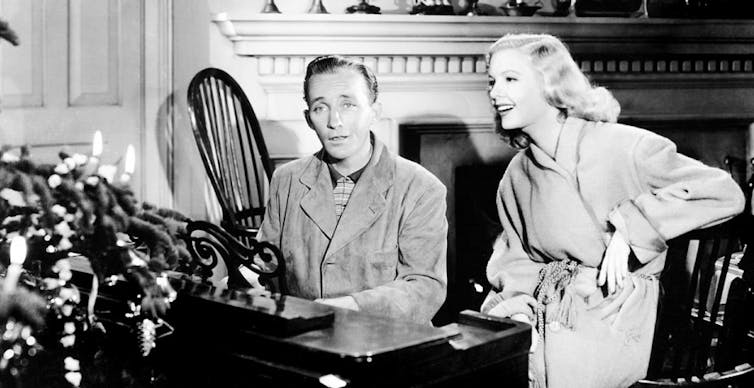


Bing Crosby White Christmas Holiday Inn

The best-selling Christmas song of all-time: White Christmas.


Musically, earworms seem to come more often from songs which have fairly conventional melodic patterns together with something unusual – a key change, or unexpected leaps or repetitions. Just like the well-known negative effects of actually heard background music on concentration and task performance, it seems that earworms can even impair our concentration on other tasks – whether those are songs with lyrics which could interfere with memory or even purely instrumental sequences like the Star Wars theme.

Read more: Why some songs get stuck in our heads more than others

There’s a piece doing the rounds written by journalism professor Adam Ragusea, who claims to have identified an elusive “Christmas chord” (a diminished minor 7th flat 5) that might explain the popularity of Christmas songs and why they give us earworms, although not all commentators are entirely convinced. New York-based musician Adam Neely argues it’s more about context.


But research suggests that although there could be some common features, the specific songs that evoke earworms are different from person to person. This chimes with what we find when we look at how people listen to music in general. Even very similar types of listeners who live together choose different daily favourite pieces of music – and our music listening and preferences are highly individualised.

What’s different about Christmas music is we are all listening to a much smaller pool of musical options at this time of year. Because of the dominance of Christmas music in public settings such as shops and bars or on the radio, we all get a lot more exposure to the same songs than we do at other times of year. So we could argue that Christmas music helps bring us together – whether we love it or hate it.

Dreaming of a hit record


Among the cheesy sleigh bells-filled tunes, there are some great Christmas classics – and it’s interesting to note that "White Christmas" by Irving Berlin is not only consistently one of the most well-known Christmas songs but is the best-selling song of all time. It also has the characteristics of an earworm, with melodic shifts and slides around a simple rising and falling melodic shape, and it (like many other songs) contains that scrunchy “Christmas chord”. But how does a song like that maintain its popularity over the decades?

The pattern of liking for an individual song over time is held to fit an inverted U-shape curve. According to this, when we first hear a new piece of music we tend to not like it very much. But repetition breeds liking – and repetition both within a song and through repeated listening over days, weeks and months will usually increase our liking in a fairly rapid linear way.


There’s a limit to this repetition effect. Too much exposure sends liking down the other side of the curve, meaning that when we have heard something too much we eventually, and quickly, get quite fed up with it. In our research we find that people regulate their own exposure to their own music over very long periods of time, putting things to one side in favour of new music and constantly keeping their current music fresh.

Following this, coming back to music after a period of time away means it moves back up the liking curve and we can tolerate or enjoy it again. Most of us do this quite intuitively, filing songs away physically or figuratively for later, and we have labelled this kind of listening the “squirrel” approach.

The ConversationThat means a lot of Christmas music, whether we think it’s good or bad, will be more popular than it might deserve to be as it usually only gets aired a few months of the year. By the time we’re taking down the Christmas tree in January, we’ve all become thoroughly sick of Mariah and Weezer and so we put them away in the attic with the tree, to be dusted off and enjoyed again next year.

Alexandra Lamont, Senior Lecturer in Music Psychology, Keele University

La version originale de cet article a été publiée sur The Conversation.

Saturday, January 07, 2017

From the Archives: Justin Bieber, Gary Becker, and the future of marijuana prohibition

Publisher's note: This article was originally published on Examiner.com on January 7, 2013. The Examiner.com publishing platform was discontinued July 1, 2016, and its web site went dark on or about July 10, 2016. I am republishing this piece in an effort to preserve it and all my other contributions to Examiner.com since April 6, 2010. It is reposted here without most of the internal links that were in the original.

Justin Bieber, Gary Becker, and the future of marijuana prohibition

What do teen heartthrob Justin Bieber and a Nobel prize-winning economist have in common?

It turns out that both, in their own way, have made a strong argument in favor of ending the War on Drugs.

Bieber, the Canadian singer and actor, was allegedly caught on film smoking a blunt (marijuana in a cigar wrapper), as reported by celebrity gossip site TMZ. The incident occurred not long after Bieber was involved in a traumatic accident that resulted in the death of a paparazzo trying to photograph the teen idol in his white Ferrari on a Los Angeles street.

Soon after the photographs surfaced, Bieber tweeted to his fans: “everyday growing and learning. trying to be better. u get knocked down, u get up” – not an apology but a subtle acknowledgment that the allegations may have substance.

Losing the war

The same day that TMZ published the Bieber photos, Nobel laureate economist Gary Becker published an article in the Wall Street Journal asking, “Have We Lost the War on Drugs?

Becker and his co-author, University of Chicago economist Kevin Murphy, point out that the “paradox of the war on drugs is that the harder governments push the fight, the higher drug prices become to compensate for the greater risks. That leads to larger profits for traffickers who avoid being punished. This is why larger drug gangs often benefit from a tougher war on drugs, especially if the war mainly targets small-fry dealers and not the major drug gangs. Moreover, to the extent that a more aggressive war on drugs leads dealers to respond with higher levels of violence and corruption, an increase in enforcement can exacerbate the costs imposed on society.”

Becker and Murphy argue for, at the very least, decriminalizing now-illegal drugs, as Colorado and Washington state voters did with regard to marijuana in last November's election.

“Decriminalization of all drugs by the U.S. would be a major positive step away from the war on drugs,” the economists said in the Wall Street Journal.

“In recent years, states have begun to decriminalize marijuana, one of the least addictive and less damaging drugs. Marijuana is now decriminalized in some form in about 20 states, and it is de facto decriminalized in some others as well. If decriminalization of marijuana proves successful, the next step would be to decriminalize other drugs, perhaps starting with amphetamines. Gradually, this might lead to the full decriminalization of all drugs.”

Saving money, raising revenue

Becker and Murphy are not the first notable economists to argue for an end to the drug war on the grounds that it is economically indefensible.

In 2005, a statement signed by 500 economists, including Nobel laureate Milton Friedman and several from Virginia's George Mason University, argued that ending marijuana prohibition “would save $7.7 billion per year in state and federal expenditures on prohibition enforcement and produce tax revenues of at least $2.4 billion annually if marijuana were taxed like most consumer goods. If, however, marijuana were taxed similarly to alcohol or tobacco, it might generate as much as $6.2 billion annually.”

The absence of a public outcry over Justin Bieber's alleged pot smoking, along with the Colorado and Washington initiatives and the adoption of laws permitting the medicinal use of marijuana in 18 states, suggest that the American people are more open to a rational discussion about ending the drug war. Bieber's non-apology on Twitter itself suggests that he views the incident as uncontroversial and unworthy of further attention.

While Gary Becker and other economists make erudite and logically rigorous arguments against drug prohibition, Bieber's near-silence is eloquent in its own way and equally compelling.

Politicians do not seem to be following expert opinion or public sentiment, however. While two years ago, then-Delegate Harvey Morgan (R-Gloucester) introduced legislation with the effect of decriminalizing marijuana possession, this year the emphasis in the Virginia General Assembly seems to be toward extending the reach of drug laws. Delegate Bill Carrico (R-Grayson County), for instance, has submitted a bill that would require welfare recipients to be tested for cannabis and other drugs. Nobody in Richmond seems to have taken on Delegate Morgan's mantle in the wake of his retirement.

Eventually, as Becker and similar thinkers point out, the law will catch up to public opinion.


Monday, December 19, 2016

From the Archives: Cultural critic Paul Cantor assesses the politics of the new TV season

Publisher's note: This article was originally published on Examiner.com on September 30, 2010. The Examiner.com publishing platform was discontinued July 1, 2016, and its web site went dark on or about July 10, 2016. I am republishing this piece in an effort to preserve it and all my other contributions to Examiner.com since April 6, 2010. It is reposted here without most of the internal links that were in the original.

Cultural critic Paul Cantor assesses the politics of the new TV season

While best known in academic circles as a scholar of Shakespeare and of 19th-century English Romanticism, University of Virginia English Professor Paul Cantor is also a well-regarded critic of popular culture whose 2001 book, Gilligan Unbound, took a close look at TV staples from the 1960s through the 1990s, including Gilligan’s Island, Star Trek, The Simpsons, and The X-Files.

Cantor’s most recent book, co-edited with Stephen Cox, is Literature and the Economics of Liberty: Spontaneous Order in Culture, which applies concepts of Austrian economics to the analysis of literary works.

At an event hosted by Students for Individual Liberty on the UVA grounds on September 29, Professor Cantor was in the audience and, afterward, spoke to the Charlottesville Libertarian Examiner about the new television season.

'CSI' and Justin Bieber

His first thought was about the season opening episode of CSI: Crime Scene Investigation (the original franchise, set in Las Vegas).

Paul Cantor
“I read a description of” the episode in TV Guide, he said, and “was a little suspicious of it.”

After viewing the first episode, Cantor suggested that it may have been “first salvo in Hollywood’s attack on the Tea Party,” because, as he described the show, “it more or less treated Tea Party types as if they were some sort of 1960s-style militia, as if they were terrorists.”

He explained that, “on the one hand, it [showed] a gathering of dissident political figures [who] clearly were attacking -- though not by name -- the Obama administration. On the other hand, they were then connected with bombings and terrorist acts,” including exploding a policeman’s coffin at his funeral.

“I’m afraid,” Cantor said ruefully, that “this is the Hollywood take on the Tea Party. This is the beginning of a lot that we’ll be seeing on television.”

Cantor is not alone in his assessment: political commentator Alex Knepper made a similar point on Big Hollywood on Wednesday.

The fact that Canadian singer Justin Bieber made his debut as a dramatic actor in the season opener of CSI was not coincidental, Cantor said.

“They were certainly exploiting” the teen idol’s celebrity, he explained. “Clearly they were trying to get him to get more interest in this episode.”

The producers “probably got a lot of people to watch the show who might not have watched it” otherwise. Bieber “actually gave a surprisingly good performance. He was supposed to convey an aura of innocence and yet then turn out to be involved,” in the domestic terrorism. Moreover, the ending of first show is “setting him up as a returning character.”

'The Event'

Cantor said the new NBC mystery-thriller series, The Event, is “clearly a recycling of The X-Files. I don’t know where it’s headed but it does seem to be the first attempt to portray Obama on television.”

In terms of plot, The Event is “an allegory of the issue of shutting down Guantanamo, though in this case it’s a holding area for extraterrestrials in Alaska. (Don’t ask me to explain that.)”

Veteran TV actor Blair Underwood plays a Cuban-American president, who is also black, and, Cantor said, “he’s being portrayed as a sympathetic character.”

In the second episode, the Underwood character is shown “in charge of things,” Cantor explained, “but there was this amazing line where he was trying to get information out of one of the aliens and he said, ‘I hope I’m not being too narcissistic, I hope I’m not being too obsessed with my place in history.’”

For Cantor, that line “was very interesting because it’s such an accurate characterization of Obama.”

'X-Files,' 'Weeds,' 'Breaking Bad'

Today’s cultural climate, Cantor agreed, is “absolutely” open to conspiracy-type shows along the lines of the 1990s Fox cult hit, The X-Files.

Having written about The X-Files in his book, Gilligan Unbound, Cantor said he gets “annoyed when people treat The X-Files as dead and buried and said it was, ‘a show for the ‘90s.’”

Virtually “half the shows on television now are conspiracy shows,” Cantor said, naming Rubicon, Sons of Anarchy, Weeds, and Breaking Bad as examples.

Shows like Weeds and Breaking Bad, he added, are rather sympathetic to (in this case) drug dealers” and they also “portray DEA officials in a very negative light.”

That, he said, is “an interesting sign of what’s going on in popular culture.”

Cantor’s personal “must-see TV” is Breaking Bad on AMC. He notes that it is produced by X-Files alumnus Vince Gilligan and judges it to be “the most powerful show dramatically.”

As an aside, Cantor adds, Breaking Bad “has a strong libertarian element in it, so I can recommend it on political as well as on aesthetic grounds.”

Wednesday, August 31, 2016

From the Archives: Civil liberties lawyer John Whitehead recalls Beatles' social, political impact

Publisher's note: This article was originally published on Examiner.com on February 13, 2014. The Examiner.com publishing platform was discontinued July 1, 2016, and its web site was scheduled to go dark on or about July 10, 2016.  I am republishing this piece in an effort to preserve it and all my other contributions to Examiner.com since April 6, 2010. It is reposted here without most of the internal links that were in the original.

Civil liberties lawyer John Whitehead recalls Beatles' social, political impact

Sunday, February 9, will mark the 50th anniversary of the Beatles' first appearance on American television. That evening in 1964, the Fab Four – John, Paul, George, and Ringo – were guests on The Ed Sullivan Show. In the studio audience were hundreds of screaming teenagers but across the country, 73 million viewers tuned in, almost twice as many as had previously watched a single television broadcast.

Charlottesville civil liberties attorney John Whitehead reminisced on February 7 about that night and what followed that decade in an interview on WCHV-FM's “Inside Charlottesville.” On Friday afternoon's program, host Coy Barefoot asked him to recall the beginnings of Beatlemania and its subsequent impact on society.

Taken by surprise
Whitehead, founder of the Rutherford Institute, began by noting that, according to their photographer, when the Beatles landed in New York on February 7, 1964, “and they heard all this yelling and stuff, they thought the President had landed, or some dignitary. They didn't realize [until] they went down the ramp that all those 5,000 teenagers” who crowded the runway “were there for them. They were taken totally by surprise.”

They should not have been so surprised, however, because the Beatles' popularity had preceded them to America.

“They had the top five tunes in the Top 40” in February 1964, Whitehead explained. “No one's ever duplicated that, which is amazing. I think that seven out of the top 10 songs were Beatles songs when they landed in the country.”

So many people were indoors that Sunday to watch the band on Ed Sullivan, he said, the country experienced its lowest crime rate in something like ten years. George Harrison later quipped that “even the Kremlin was tuned in,” Whitehead recalled. “It was amazing.”

The Sixties begin
Reflecting on the Beatles' later impact on politics and society, he suggested that “the Sixties, in my opinion, started that night on The Ed Sullivan Show.”

That performance began “all that upheaval” that continued with the worldwide broadcast over the BBC of “All You Need Is Love” (with 400 million viewers) and culminated with “the summer of love” and Sgt. Peppers Lonely Hearts Club Band in 1967.

The Beatles, he said, “captivated the world with peace, harmony, and love, which was their great message.”

He added that John Lennon “took off on his own and started his worldwide campaign for peace, and anti-war.” In reaction to that, he said, “the FBI went after him, collected 400 pages” of intelligence on Lennon's activities “and tried to intimidate him and get him deported. Richard Nixon considered John Lennon his number one enemy at that time. It was really weird.”

Horrified parents
Asked by Barefoot where he was that night 50 years ago, Whitehead recalled that he “watched the show” and his “parents were horrified.”

Years later, he continued, shortly before his mother passed away, “I asked her, what was the worst thing that ever happened to America? She looked at me and said 'The Beatles.'”

His mother was not alone. He also remembered attending a conference in “1983 or 1984” when a prominent minister took the stage and said to the audience of 10,000, “I want to tell you what has really destroyed America: The Beatles.”

Whitehead looked around at the young people around him and they all had the same puzzled looks on their faces. The minister “never explained what he meant” but he was probably referring to “the youth rebellion” of the 1960s.

That rebellion, Whitehead went on, “was focused.” It “brought down a crooked president” and the protesters “stopped the Vietnam War.”

Youth in rebellion
He expressed his admiration for the youth rebellion of that era.

“I'd like to see all that again, folks. I've often said, if you've got a picket sign and you're out there active, I don't care what you believe. I may not like what you're saying, [but] I'll go to my death to defend it," Whitehead said. "I just like activism."

John Lennon, he pointed out, “epitomized” the spirit of youthful rebellion and was even vilified by some on the Left for his idealism.

When Lennon released the song “Revolution” (on The White Album) and said “if you want destruction, count me out,” Whitehead remembered, “The Village Voice actually criticized him for being too peaceful.” Lennon's response was along the lines of, “What do you want to do, kill people? Why would we destroy anyone if we want peace?”

It's that kind of idealism that Whitehead would “like to see all that again but I don't see a lot of it.”

Expressing some frustration, he added: “Here's the thing. A guy like Lennon, the other Beatles -- they took their fame and tried to advance an agenda, a very positive agenda, but I'm looking around for entertainers today like that. Justin Bieber? I don't know.”

John Whitehead, author of A Government of Wolves, has also published an essay, “50 Years After the Beatles: Isn’t It Time for Another Political & Cultural Revolution?,” on the Rutherford Institute's web site.

SUGGESTED LINKS

Charlottesville civil liberties lawyer assesses 2012-13 Supreme Court term
Rutherford Institute asks local lawmakers to speak out against drones
Charlottesville lawyers compile rules against ‘politically correct’ Xmas
Rutherford Institute endorses Charlottesville marijuana resolution
Attorney General Cuccinelli calls Charlottesville ABC sting operation 'overkill'

Original URL: http://www.examiner.com/article/civil-liberties-lawyer-john-whitehead-recalls-beatles-social-political-impact

Wednesday, July 27, 2016

From the Archives: Top 10 most-read Charlottesville Libertarian Examiner stories of 2014

Publisher's note: This article was originally published on Examiner.com on December 31, 2014. The Examiner.com publishing platform was discontinued July 1, 2016, and its web site was scheduled to go dark on or about July 10, 2016.  I am republishing this piece in an effort to preserve it and all my other contributions to Examiner.com since April 6, 2010. It is reposted here without most of the internal links that were in the original.

Top 10 most-read Charlottesville Libertarian Examiner stories of 2014

Virginia's Senate and congressional races dominated the attention paid by readers to the Charlottesville Libertarian Examiner's coverage of politics in 2014. In fact, only one story in the top ten was not about current politics – a retrospective look at the impact of the Beatles on American culture.

Interviews with the three U.S. Senate candidates – Republican Ed Gillespie, Libertarian Robert Sarvis, and Democrat Mark Warner, who narrowly won re-election in November – were among the top ten, as well as an assessment of David Brat's surprise victory over House Majority Leader Eric Cantor in the Republican primary. Early in the year, conservative activist Grover Norquist correctly predicted that the GOP would gain control of the Senate.

Gay marriage, Governor Bob McDonnell's indictment on federal corruption charges, podcaster Adam Koresh's views on NSA spying, and the self-defense products sold by entrepreneur Paul Jones rounded out the top ten most-read stories by the Charlottesville Libertarian Examiner.

Rankings are based on reported traffic statistics from Google Analytics.

Number 10: “Civil liberties lawyer John Whitehead recalls Beatles' social, political impact,” published February 8, 2014.

Excerpt:
Reflecting on the Beatles' later impact on politics and society, he suggested that “the Sixties, in my opinion, started that night on The Ed Sullivan Show.”

That performance began “all that upheaval” that continued with the worldwide broadcast over the BBC of “All You Need Is Love” (with 400 million viewers) and culminated with “the summer of love” and Sgt. Peppers Lonely Hearts Club Band in 1967.

The Beatles, he said, “captivated the world with peace, harmony, and love, which was their great message.”

Number 9: “Virginia political leaders react to Governor Bob McDonnell's federal indictment ,” published January 21, 2014

Excerpt:
Former Virginia Governor Bob McDonnell and his wife, Maureen, were indicted January 21 on federal corruption charges. McDonnell, a Republican, left office earlier this month when he was succeeded by Democrat Terry McAuliffe.

A grand jury for the Eastern District of Virginia handed up a 14-count, 43-page indictment alleging honest-services wire fraud, conspiracy to obtain property under color of official right, false statements, and obstruction of official proceeding.

The indictment includes a colorfully descriptive list of items subject to forfeiture, including a Silver Rolex Watch engraved with "71st Governor of Virginia"; one baby blue striped Peter Millar golf shirt; one Heather Mackenzie water color and frame; two pairs of Foot Joy golf shoes; black Rebecca Minkoff shoes; and 30 boxes of Anatabloc®, the dietary supplement at the center of the scandal that has come to be known as “Giftgate.”

Number 8: “Senator Mark Warner defends his record against GOP challenger Ed Gillespie,” published June 21, 2014

Excerpt:
His challenger, Ed Gillespie, disagrees that Warner has a record of bipartisanship.

Instead, Gillespie has emphasized a claim that Warner has voted with President Obama and Senate Majority Leader Harry Reid "97 percent of the time."

Warner denied this.

“If I had that kind of record,” he said, “John Warner wouldn't be endorsing me for the United States Senate. I've got a record that shows [that for] every major piece of legislation I work on, I have a Republican partner.”

Warner said that he differs with the President on issues like the Keystone pipeline, export of natural gas, and the U.S. government's reaction to Syria.

Number 7: “James Carr assesses David Brat's defeat of Eric Cantor, plus Jack Trammell,” published June 16, 2014

Excerpt:
Brat's unexpected victory was due to “a lot of factors,” [Carr] explained, and the story is one that “most of the media is getting incorrect.” The media have been “focusing on one issue and saying that that was the reason for the win. It really wasn't. It is the voters' dissatisfaction and the complete ineptitude in Washington right now.”

For voters in Virginia's seventh district, he said, “the idea of the permanent professional politician, living in Washington, being disconnected from those whom they're supposed to represent, no longer listening to those that they represent, no longer holding town hall meetings” is unpalatable.

Instead, they want someone who connects with voters. “They clearly didn't have that with Mr. Cantor,” Carr asserted, and they wanted “to get rid of him.”

Number 6: “GOP can regain control of Senate in 2014, says strategist Grover Norquist ,” published March 9, 2014

Excerpt:
Even in Virginia, where popular former Governor Mark Warner is seeking re-election to the U.S. Senate this year, Norquist sees reason for Republicans to be hopeful.

Warner is vulnerable, he said, basing his assessment on having spoken with the incumbent Senator at a recent event in Washington.

“I ran into Mark Warner at a party the other day and, he said, [he] wasn't in Davos” for the annual global economics conference because Republican challenger Ed Gillespie is running for office.

“'So I'm here,'” Norquist quoted Senator Warner.

Number 5: “Senate candidate Robert Sarvis reacts to Ferguson events in radio interview,” published August 15, 2014

Excerpt:
Sarvis identified “the heart of the matter” as “the militarization of the police, the loss of civil liberties, and the changing relationship between police and citizens.”

The real issue, he continued, “is the drug war,” which has led to the militarization of local police forces. He noted, however, that with legalization of marijuana in Colorado and Washington state, and polls showing support for more widespread legalization, “we're moving forward on it as a country.”

[Radio host Coy] Barefoot asked whether there is a contradiction when conservatives argue that government is too big but then support laws that limit individual freedoms.

“When people ask the difference between a libertarian and a conservative,” Sarvis replied, “I jump at the chance to point out that I'm consistent on individual freedom. Republicans care a lot about law and order; I do too. Being a policeman is a hard job but that doesn't mean we should give up our civil liberties.”

Number 4: “Charlottesville entrepreneur Paul Jones sells non-lethal self-defense products,” published February 18, 2014

Excerpt:
“I like everybody to be safe,” [Jones] explained. “I can make money helping people to be safe. To me, it was a no-brainer.”

The non-lethal self-protection products The Belvedere Company sells are easy to use, Jones noted. “You don't have to be physically strong or fast or nimble, but you have to be willing to use it and you have to be alert and aware of your surroundings all the time.”

Even though he hopes to make a profit selling self-defense products, Jones cautions that “the number one way to defend yourself is to avoid problems. Don't go into a dangerous situation.”

The best way to stay safe, he says, is not “to put yourself into a position that's like walking down a dark alley at night in a strange city. There's no sense doing it if you can avoid it.”

Number 3: “Podcaster Adam Kokesh talks about NSA spying, gay marriage, and Justin Bieber,” published January 28, 2014

Excerpt:
Asked about the recent arrest in Florida of pop star Justin Bieber, who was charged with drunk driving, drag racing, and resisting arrest – although some of the charges were later dropped – Kokesh expressed admiration for the Canadian heartthrob's apparent aplomb.

“Seeing Justin Bieber's mugshot and people comparing it to mine, where I was smiling every time they pointed a camera at me, I just want to say, 'Good for him,'” he said.

“I'm sure he's enjoying the attention” in the wake of his arrest, Kokesh suggested, especially because Bieber seems to have “become a pawn of the big music industry and the major studios” – a situation that recently led to an announcement “that he was going to retire.”

Number 2: “Virginia U.S. Senate candidates react to Fourth Circuit gay marriage ruling,” published July 29, 2014

Excerpt:
“Marriage freedom is a deeply important issue to me,” said Sarvis, “which is why I made it a centerpiece of my campaign for governor last year.” He noted that it was a Virginia case, Loving v. Virginia, that led to the U.S. Supreme Court's ruling that prohibitions on mixed-race marriages are unconstitutional -- a ruling that made Sarvis' own marriage legal in Virginia.

“Public opinion in Virginia has shifted dramatically since the Marshall-Newman Amendment was enacted in 2006. In fact,” Sarvis pointed out, “polls now show that a majority of Virginians support marriage equality.”

Sarvis explained that while he preferred that Virginia change its marriage laws “through the democratic process,” it was judicial action that made it possible to see “same-sex couples in Virginia celebrating their marriages and enjoying equal treatment under the law.”

Number 1: “'Republicans have learned a lesson' says GOP Senate candidate Ed Gillespie,” published July 6, 2014

Boosted by mentions in a Mark Warner campaign email to supporters and in several mainstream publications, this article went viral and was seen by more readers than any other piece this year by the Charlottesville Libertarian Examiner.

Excerpt:

In an interview following the annual Independence Day parade in Crozet in western Albemarle County on July 5, U.S. Senate candidate Ed Gillespie said that “Republicans have learned a lesson” after presiding over unprecedented growth in the size and scope of government from 2001 to 2007, when the party controlled the White House and both chambers of Congress.

“The difference between Republicans and Democrats,” he told the Charlottesville Libertarian Examiner at Claudius Crozet Park, “is, I think, Republicans have learned a lesson.”

Continuing, he noted that “the fact is, I agree that when Republicans had the House, the Senate, and the White House that we spent too much money.”

SUGGESTED LINKS

Barry Goldwater 'absolutely' was a libertarian, his son explains
Cato Institute panel discusses obscure but pivotal gay civil rights case
Gov. Terry McAuliffe touts Virginia film industry at Charlottesville movie fest
Virginia Senate hopeful Robert Sarvis talks about U.S. policy toward Africa
Monique Luiz, 'Daisy Girl' from controversial 1964 campaign ad, speaks at UVA

 Original URL:  http://www.examiner.com/article/top-10-most-read-charlottesville-libertarian-examiner-stories-of-2014

Monday, June 23, 2014

Are Selena Gomez and Justin Bieber an 'Emerging Threat'?

Last week the celebrity gossip pages were reporting the news that the on-again, off-again romance of bad boy Justin Bieber and Disney Channel songstress Selena Gomez was on again.

The 21-year-old ex Disney star and the Canadian pop star reportedly spent the past few days together riding Bieber's three-wheeled motorcycle and attending mutual friend Alfredo Flores' birthday party.

"Justin and Selena are definitely full-on back together at the moment," a source told Us. "They spent all day riding together on a Can-Am Spyder on Sunset Blvd. Justin drove while Selena sat on the back holding on to [him]."

The insider added that Bieber "was incredibly sweet with her and they looked super happy and in love."


Someone at UPI decided to have fun with the story.  In an email news roundup, the story headlined "Justin Bieber, Selena Gomez back together again" was listed under "emerging threats."

Here's a screen shot:


When I had the chance last week, I should have asked Virginia Senator Mark Warner whether Justin Bieber is such a threat that he should be deported back to Canada.


Thursday, January 30, 2014

Meanwhile, over on Examiner.com ...

The last few days have been busy ones for me in terms of posting articles as the Charlottesville Libertarian Examiner on Examiner.com.

I have two articles based on reactions to President Barack Obama's fifth State of the Union Address:
Virginia Republican Congressmen Respond to 2014 State of the Union Message
and
Gay groups comment on Obama's 2014 State of the Union address
On Monday, libertarian/anarchist activist Adam Kokesh was in Charlottesville to read excerpts from his forthcoming book and talk about his time incarcerated for civil disobedience in support of the Second Amendment. I interviewed him about some current issues and this is the result:
Podcaster Adam Kokesh talks about NSA spying, gay marriage, and Justin Bieber
Earlier, I posted three articles about Virginia political issues:
Legal ethicist Jack Marshall weighs in on Bob McDonnell 'Giftgate' scandal
Virginia Attorney General Mark Herring will challenge anti-gay marriage laws
Virginia political leaders react to Governor Bob McDonnell's federal indictment
Still earlier, I gathered some comments that expressed skepticism about President Obama's planned reforms of the NSA's extensive domestic spying operation:
Negative reactions to President Barack Obama's speech on NSA domestic spying
And finally, my last Examiner.com article of 2013 dealt with a professional interest of mine, Africa. This one was based on an interview with a libertarian Africanist -- not a phrase you're likely to hear very often.
Omidyar Network's Karol Boudreaux offers optimistic view of African economies
Keep checking back here to see when I link to new Examiner.com articles.


Friday, January 24, 2014

Does Justin Bieber think he's Michael Jackson? What does this odd photo say?

Earlier this afternoon, Justin Bieber broke two days of silence on Instagram -- interrupted by his arrest in Miami Beach for drag racing, DUI, and resisting arrest -- to post this photograph of himself as he left the court house:

Justin Bieber and Michael Jackson: via Instagram

It's possible that the Canadian teen heartthrob has juxtaposed his photo with that of the former King of Pop is simply that he saw aesthetic similarites. The two photographs have similar composition and framing, and they both benefit from a certain black-and-white chiaroscuro.

I think, however, it is more likely an expression of the Biebs' feeling victimized by "The Man," just as MJ was before his grisly, drug-induced death.

After all, the caption Bieber put on his photo -- which has been "liked" more than 513,000 times -- was:  "What more can they say".

I'm not sure I could have put it better myself.