Showing posts with label London. Show all posts

Thursday, November 05, 2009

Remember, Remember

On this Guy Fawkes' Day, it is appropriate to celebrate an internationally-known political blogger who has assumed the persona of Guy -- or "Guido" -- Fawkes in his attempts to engage, stimulate, influence, and taunt conservative debate and discussion in the United Kingdom.

(For those unfamiliar with Guy Fawkes' Day, it marks the so-called "Gunpowder Plot" by Catholics who wanted to overthrow the stifling Protestant regime of King James I. There has been debate whether Fawkes was a ringleader, a patriot, or just a scapegoat, but his name is celebrated on the 5th of November each year with fireworks, bonfires, and libation. In recent years, the day has acquired some of the style and and customs of American Hallowe'en. The character of Guy Fawkes was also celebrated in the libertarian-themed film, V for Vendetta.)

Last week, as part of its series of reports marking the 4oth anniversary of the Internet, NPR's "All Things Considered" featured the creator of Order-Order.com, Paul Stains, a libertarian/conservative activist who has done for the British blogosphere what Glenn Reynolds or Michelle Malkin have done on this side of the pond. (I mention those names by way of example; there are many others I could have chosen.)

Correspondent Vickie Barker began her report by noting that, in London,

there are arguably only two types of politicians: those who admit they follow the Guy Fawkes blog and those who do, but won't admit it.
She continues:
Five years ago, four centuries after his namesake, Paul Stains created his online alter ego. The nearly bankrupt businessman suddenly had a lot of time on his hands. A libertarian who once organized acid house parties in his student days, he described himself as Thatcher on drugs, Stains consciously set out to become Britain's Matt Drudge.

Like Drudge, he was initially dismissed as a know-nothing outsider, a purveyor of unfounded rumor and gossip. Like Drudge, he's been able to tap into a rich vein of disgruntlement among underpaid, overworked underlings....

He thinks the blog's chatty style - full of accounts of bumping into people in pubs, of getting drunk, of being thrown out of meetings - makes him more approachable to his mostly young sources. Guy Fawkes now registers 100,000 hits a week. It's consistently rated Britain's most influential political blog.

Stains works out of a cramped office in Clerkenwell, a Dickensian corner of East London. He readily acknowledges that he, a non-journalist with a somewhat checkered professional past, could never have reached the heights he has without the Internet. He calls that his strength.
Were it not for NPR, part of the mainstream media, I never would have learned about Order-Order.com, definitely part of the alternative media.

Who can deny that the two are linked in a symbiotic relationship, in which both bloggers and the MSM benefit?


Be sure to visit my CafePress store for gifts and novelty items!
Read my blog on Kindle!
Follow my tweets on Twitter!

Tuesday, June 30, 2009

'It Was a Dark and Stormy ...'

Snoopy is not the only imitator of Paul Clifford, the novel by Edward Bulwer-Lytton with the much-mocked opening sentence that begins, "It was a dark and stormy night..."

For 27 years, San Jose State University in California has sponsored the Bulwer-Lytton Fiction Contest, which aims to inspire bad writing (in the form of opening sentences) from contestants who enter from around the globe.

This year's winner is David McKenzie of Washington state. UPI notes his winning sentence:

"Folks say that if you listen real close at the height of the full moon, when the wind is blowin' off Nantucket Sound from the nor' east and the dogs are howlin' for no earthly reason, you can hear the awful screams of the crew of the Ellie May, a sturdy whaler captained by John McTavish; for it was on just such a night when the rum was flowin' and, Davey Jones be damned, big John brought his men on deck for the first of several screaming contests."
The San Jose Mercury News explains:
"The judges liked his sentence because of the way it pulls the rug from under the reader. You compose yourself to hear about another wreck of the Edmund Fitzgerald, then find that it's just about some drunks having a screaming contest," said Scott Rice, who began the contest 26 years ago.
For the record, the sentence that began it all reads like this:
It was a dark and stormy night; the rain fell in torrents, except at occasional intervals, when it was checked by a violent gust of wind which swept up the streets (for it is in London that our scene lies), rattling along the housetops, and fiercely agitating the scanty flame of the lamps that struggled against the darkness.
Those who like this sort of thing (and I am one of them) can entertain themselves with several volumes of bad writing compiled by Scott Rice, including the original It Was a Dark and Stormy Night and its sequels, including Bride of Dark and Stormy: Yet More of the Best (?) From the Bulwer-Lytton Contest and Dark and Stormy Rides Again.

UPDATE: NPR interviews winner David McKenzie about his 87-word sentence on "All Things Considered."


Be sure to visit my CafePress store for gifts and novelty items!
Read my blog on Kindle!

Monday, September 24, 2007

Better Late Than Never

City Councilor Dave Norris has announced his intention to vote against a proposed $300,000 appropriation to install so-called "anti-crime" cameras in downtown Charlottesville.

On his blog, Norris points to a British study highlighted on cvillenews.com that states that these cameras, ubiquitous in London and other UK cities, are virtually useless.

I could have told you that.

In fact, I did -- more than two-and-a-half years ago, in a blogpost entitled, "Ubiquitous TV Cameras Don't Reduce Crime, UK Study Says," and published on February 24, 2005.

That post quoted an AP story that reported:

Video cameras have blossomed in Britain since the 1990s. An estimated 4.2 million cameras now observe the country's 60 million people going about their everyday business, from getting on a bus to lining up at the bank to driving around London. It's widely estimated that the average Briton is scrutinized by 300 cameras a day.

For the Home Office-funded study, academics from the University of Leicester studied 14 closed-circuit TV systems in a variety of settings, including town centers, parking lots, hospitals and residential areas. Only the parking lot scheme was shown to cause a fall in crime.

Previous studies of the effectiveness of closed-circuit TV systems have come to similar conclusions.
Those "similar conclusions" are echoed in the London Evening Standard article found by Waldo Jaquith and linked from cvillenews.com:
London has 10,000 crime-fighting CCTV cameras which cost £200 million, figures show today.

But an analysis of the publicly funded spy network, which is owned and controlled by local authorities and Transport for London, has cast doubt on its ability to help solve crime.

A comparison of the number of cameras in each London borough with the proportion of crimes solved there found that police are no more likely to catch offenders in areas with hundreds of cameras than in those with hardly any.

In fact, four out of five of the boroughs with the most cameras have a record of solving crime that is below average.

The figures were obtained by the Liberal Democrats on the London Assembly using the Freedom of Information Act.
(Politicians and bureaucrats hate it, but we citizens have got to love FOIA.)

Let's hope the other four city councilors follow the lead of Dave Norris and vote against this boondoggle before it's too late.

Now if only we could get rid of that useless transit center on the downtown mall and return the money to the taxpayers ...

Saturday, April 07, 2007

The Pope's Medieval Economics

Pope Benedict XVI, in a new book scheduled to be published next month, condemns the West for exploiting the Third World. News reports about the book -- called Jesus of Nazareth and excerpted earlier this week in the Italian newspaper Corriere Della Sera (which happens to be owned by Rizzoli, the publishers of the book) -- do not indicate whether the pontiff similarly condemns the rulers of Third World countries for their kleptocratic practices that serve to keep their subjects in poverty while the government elites party like the wealthy title character in the parable of the Rich Man and Lazarus.

Somehow I doubt he does, since -- whatever the Pope's merits as a theologian and rhetorician, which are considerable -- he lacks an understanding of basic economics. In fact, given what I have seen (again, based just on news reports), his views on economics are positively medieval, offering a sense that economics is a zero-sum game. That is to say, he seems to think that some people are rich because other people are poor. (All I can conclude from this is that Benedict somehow missed studying anything on economics written since before the Spanish Scholastics were around.)

Here is one quotation from the book that Reuters chose to illustrate Benedict's thought:

"If we apply it [the parable of the Good Samaritan] to the dimensions of globalised society today, we see how the populations of Africa have been plundered and sacked and this concerns us intimately," the Pope says in his book, which comes out on April 16, his 80th birthday.

He drew a link between the lifestyle of people in the developed world and the dire conditions of people in Africa.

Oddly enough, Reuters correspondent Philip Pullella refers to Jesus of Nazareth as Pope Benedict's "first book," when the Pope is, in fact, a prolific author. (A quick Amazon.com search results in 93 entries in which the Pope -- under his previous name, Joseph Ratzinger -- is listed as author. Even discounting those books in which he contributed only a chapter or a preface, Ratzinger's books as sole or primary author number in the dozens.)

Enough digression. What is particularly surprising and disappointing about the excerpt that appeared in the Italian press is that the German-born Pope appears to refer approvingly to the sociological analysis of Karl Marx, the father of modern Communism. According to EarthTimes,
Pope Benedict XVI draws from Karl Marx's theory of alienation in his forthcoming book on Jesus Christ to illustrate his point that the biblical parable of the Good Samaritan is still relevant today. The reference to the 19th-Century German philosopher and founder of modern communism is found in chapter seven of Jesus of Nazareth, extracts of which were published Wednesday by Italian daily Corriere della Sera.

"Karl Marx describes man's alienation in a drastic way; although by limiting his reasoning to the material sphere he fails to reach the true depths of alienation, he nevertheless provides a clear image of the man who falls victim to the robbers," Joseph Ratzinger writes....

"Is it not true that man ... during the full course of his history, finds himself alienated, mangled, abused?" the pope writes.
At least the Pope tries to distance himself a bit from Marx; still, it is jarring to see the progenitor of Stalin, Mao, and Pol Pot quoted in a papal document in anything other than terms of anathema.

The Catholic Church's skewed views on liberal economics are not new. While I was digging through some old files earlier this week, I came across an article of mine that was published precisely 20 years ago today.

At the time I was living in London, going to graduate school by day and attending as many plays and musicals as I could (using my substantial student discount for tickets) at night. Because the British university system is not quite so rigid in terms of requirements as is its American equivalent, this left me much time for pleasure reading. In ten months, I read dozens of books, many of which had little or anything to do with my studies.

One of those books, which turned out to have a profound effect on my political philosophy, was Jane Jacobs' Cities and the Wealth of Nations. (I often say that the two writers who were most responsible for making me realize I was a libertarian were Jacobs and Charles Murray.) A Vatican statement on global economics provided the news hook I needed to write a brief review of Jacobs' book. It was published in the New York City Tribune, a now-defunct sister publication to the Washington Times, on April 7, 1987 (coincidentally my 28th birthday).

I wrote a lot for the New York City Tribune that year I was abroad, averaging about one article or book review per week for several months, all without benefit of email or even a computer; the checks I received were the pocket money I needed to continue enjoying London as an impoverished student. (Food or theatre? Food or theatre? The answer was always clear.)

Here is that article, which I was surprised to find is still fresh and applicable today; I can identify a few phrases I might reword, but nothing I wince at after two decades:
The Hidden Causes of Third World Poverty
Richard Sincere

LONDON – The Vatican has issued, through the Pontifical Commission on Justice and Peace, an 8,000-word statement on the international debt crisis. “Political officials and economists, social and religious leaders, as well as public opinion throughout the world,” it begins, “recognize the fact that the debt levels of the developing countries constitute a serious, urgent, and complex problem due to their social, economic, and political repercussions.” That is VaticanSpeak for: Third World debt levels are precipitating a crisis of unprecedented proportions.

Average citizens in the industrialized countries of Western Europe and North America might be inclined to shrug off Third World debt as a problem, but no concern of theirs. Leaders in developing countries, they might say, made bad political and economic decisions and are now paying the consequences; it doesn’t affect us.

In fact, though, it does. As the Third World debt whirlpool swallows up capital from all over the developed world, the effects are felt in shrinking national budgets, declining industries, rising interest rates, and increasing trade deficits. For the ordinary person, it means more difficulty in purchasing a home or a car – particularly if he or she is a first-time buyer.

A unique perspective on Third World debt – indeed, on a whole range of issues regarding the world political economy – may be found in a 1984 book, Cities and the Wealth of Nations, by Jane Jacobs. The book was widely reviewed and critically acclaimed when it was first published by Random House in the United States and Canada and by Penguin in the United Kingdom.

Jacobs is respected worldwide for her research and writing on cities. Her 1961 book, The Death and Life of Great American Cities, is required reading for most students of urban planning. The secondhand department at the Economists’ Bookshop in London informs me that they get more requests for Jacobs’ The Economy of Cities (1969) than for any other out-of-print book. These observations reinforce her credibility and scholarship almost as much as the fact that she is a careful and thoughtful writer – averaging one book every seven to 10 years – as well as vibrant, witty, and commonsensical.

Cities and the Wealth of Nations begins by questioning the very structure of the world economy – its division into “nations” as distinct economic entities. They are political and military entities, but this does not mean they are also “the basic, salient entities of economic life or … the reasons for the rise and decline of wealth.” Jacobs argues that the failure of national governments and “blocs of nations” to control economic life effectively “suggests some sort of essential irrelevance.”

Political sovereignty is the only thing various nation-states really have in common, and Jacobs thinks it “affronts common sense, if nothing else, to think of units as disparate as, say, Singapore and the United States, or Ecuador and the Soviet Union, or the Netherlands and Canada, as economic common denominators.”

The basic unit of economic development, Jacobs asserts, is the city, and regions surrounding individual cities, and enlarging that unit inevitably leads to bad economic feedback and bad decision making. This problem cannot be overcome without a radical restructuring of the world economy – but the new structure must reflect free markets, attention to private enterprise, promotion of new industries, and (most important) trade among equals. That means underdeveloped Third World states should concentrate their commerce on other underdeveloped Third World states, learning “import replacement” and avoiding direct competition with the industrialized world unless and until their levels of development are more nearly equal.

Jacobs identifies what she calls “transactions of decline,” which include heavy lending to impoverished or underdeveloped areas. Such lending takes useful capital away from productive cities and sinks it into unproductive rural areas and uncreative towns and cities where it can do no good – and, indeed, often does harm. Transactions of decline like this may initially stimulate commerce and industry, but within a short while both economies – the lender’s and the borrower’s – begin to stagnate and then to decline. The downward spiral continues because policymakers, oblivious to the root causes of the decline, take more money from the pockets of productive workers and entrepreneurs and attempt to induce “development” in depressed areas at home or abroad. In the end the whole process is futile and frustrating. “Subsidies milked from cities,” notes Jacobs, are “profoundly antidevelopment transactions.”

To achieve genuine and lasting development, cities, regions, and whole countries must generate their own capital. Development must come about the old-fashioned way – you earn it.

There is no specific solution available from Jacobs’ analysis. But her arguments are worth pondering. The radical change suggested by Cities and the Wealth of Nations is precisely the opposite of the one demanded by Third World states called the New International Economic Order. Instead of authoritarianism, this change invokes free enterprise; instead of central planning, it calls for pluralism; instead of stagnation, it offers creativity and growth. If we are to solve the international debt crisis – an apparently insoluble problem – this is a good place to start

Richard Sincere is a Washington-based policy analyst who writes frequently on African affairs.
Unfortunately, I don't think anyone at the Vatican was reading the New York City Tribune in the late 1980s; at least not anyone in the Congregation for the Doctrine of the Faith was.

Tuesday, January 30, 2007

Harry Potter, Shirtless

For the (quite literally) hundreds of visitors to this blog pver the past couple of days who have arrived looking for "Daniel Radcliffe shirtless" and similar terms, I offer this link to an article from This Is London, previewing Mr. Radcliffe's West End theatrical debut in a new production of Equus, in which he plays troubled Alan Strang. There you will find two excellent shirtless photos to admire. (I do not reproduce them here because I respect the owners' copyright.)

The numerous seekers and searchers for moviedom's Harry Potter in a state of déshabillage remind me of the other odd terms that Google brings my way (not to mention Yahoo!, Dogpile, and Ask.com).

In the always popular "shirtless" category, we have, to start, "gerald ford shirtless photo." Others (in no particular order) include Aaron Carter, Alex Trebek, Andrew Sullivan, Hunter Parrish, Robert Redford, Jeremy Sumpter, Prince William, Euan Blair, Thomas Gibson, John Stossel, Jonathan Silverman, Glen Campbell, Jason Alexander, Jesse Eisenberg, Dan Quayle, Drake Bell, Bob Moffatt, William Moseley, and the Everly Brothers.

A lot of web surfers -- no surprise -- seem to have sex on their minds. Here are some of the odder things they have been looking for:

catholic view on erectile dysfunction
captain ahab porn
fred flintstone and betty rubble having erotic sex
how to attract a lesbian
pornography in lynchburg
pornographic photoblog
porn make you older
recreational uses of levitra
Then there are those search terms that are simply puzzling:
cannabis prince william george bush tinkey winkey
Is it a sin for a man to watch a woman urinate?
Sweeney Todd Sondheim review United States Catholic Bishops
Things I like about Catholicism
what leisure activities does guinea ecuatorial have for teens
was idi amin authoritarian
Finally, let me point out that there is no truth to the persistent rumor that Daniel Radcliffe is attending the University of Virginia. (There are hundreds of you, out there, who are trying to confirm that one.) As best as I can tell, it got its start with this article about social networking sites from U.S. News & World Report, which begins:

Harry Potter currently attends the University of Virginia. Actually, a search for the name Harry Potter on Thefacebook.com, a popular online social network for college students, retrieves 32 profiles for "Harry Potter" at universities across the nation.

A work of magic? Hardly. The number who use the boy wizard's name as their screen name when they log in underscores the books' popularity with college students. As the Harry Potter generation grows up, they're bringing a dash of Hogwarts School of Witchcraft and Wizardry to the quads and classrooms of real universities.

Eighteen-year-old Emerson Spartz founded mugglenet.com, a popular Potter website that receives more than 15 million hits a month, when he was just 12. This fall, Spartz heads off to the University of Notre Dame, and he says he has already been flooded with E-mails from students there begging him to start a Potter club. If he decides he has time to get one going, it won't be the first. At the University of California-Berkeley, 907 students are members of a Potter group on Thefacebook.com, while 943 Harvard University students list the book series as one of their interests.

I hope that satisfies your interest in this topic. Please don't be discouraged from making repeat visits here, though, and feel free to bookmark this site for future reference.


Be sure to visit my CafePress store for gifts and novelty items!
Read my blog on Kindle!
Follow my tweets on Twitter!

Sunday, October 22, 2006

Aliens Among Us

It is a rare occasion when I find myself in accord with Red Ken, the flaming socialist mayor of London.

Yet when I opened up this morning's Washington Times, I read an article in which Ken Livingstone's views are presented as fully in line with mine.

In a Bloomberg News article (which does not, strangely, appear on the Washington Times web site) about the influx of Polish immigrants to Britain since 2004, Livingstone is paraphrased as saying he thinks immigrants are good for London's economy:

Attracted by jobs and higher pay, immigrants are transforming neighborhoods as shops stock Polish goods, jobseekers post notices in their native language and attendance at Catholic churches booms. The new residents are weakening "community cohesion," lobbying group Migration Watch says.

"Londoners are being displaced by the arrival of immigrants, which is changing the makeup of the city," said Andrew Green, the organization's chairman "It simply isn't sustainable."

Mayor Ken Livingstone disagrees, saying immigrants help the economy grow. The city is investing in transportation, housing and police services to keep pace with the inflow, he said.
Polish Roots immigrants immigration It is hard to see how Polish immigrants might be taking jobs from British natives: The unemployment rate in the UK is now about 3 percent, compared to 11 percent or more in Central Europe.

The article goes on to note the long history of Polish settlers in London, including novelist Joseph Conrad and refugees from Nazi- and Communist-occupied Poland in the middle of the 20th century. I remember having lunch at a Polish restaurant in Chelsea as long ago as 1987, when one of the habitués asked me if I was Polish. (I had to pause to think about my answer, finally settling on, "No, I'm American. But my ancestors were Polish." He seemed satisfied by that.)

Around that same time, I saw a terrific play at the National Theatre called Coming in to Land, written by Stephen Poliakoff and starring the incomparable Dame Maggie Smith as a Polish refugee -- or not -- trying to gain asylum in Britain. Smith's character's name was Halina Sonya Rodziewizowna. (The play, directed by Sir Peter Hall, also included Anthony Andrews and Tim Pigott-Smith in the cast.)

Althought the political situation was far different then than now -- this was the height of the Cold War, remember -- some of the themes echo from the play today. Here's a speech from Act I; you'll notice the parallels as the speaker catalogues the reasons Halina may not be able to stay in Britain:
Firstly, Halina has waited, which is usually fatal. There is a detestation of casual applications -- unless you arrive screaming at the airport, I can't stand it back home and I'm not safe there, demanding immediate asylum, they are intensely suspicious, they are paranoid about all sorts of odds and sods being dumped on them from Eastern Europe...

Secondly, every attempt to land is made in context -- the context of world events, and that isn't too good at the moment is it. The recent sudden squall of East West tension, the expulsion of five Polish students in the US for industrial and military espionage, and three Russians from here...

Moreover Halina does not wishto get involved in ritual 'hate' propaganda about her homeland, understandably.

(Sharply.) Lastly -- Halina is not unfortunately a famous dissident, or even a member of Solidarity, no fashionable reason here, nor obviously is she something nationally desirable, like a ballerina, olympic athlete, boxer, squash player, or even a film director!
What the critics of Polish (and other East European) immigration to London fail to recognize is that London is the premier cosmopolitan city. It was, in fact, the first truly cosmopolitan metropole to emerge since the fall of Rome, and it did so during the Renaissance. London attracted more and different peoples earlier, and in greater numbers, than any other town or city in Western Europe.

That London was a crossroads is a significant -- if not the most important -- factor in Britain's true claim to be the leader in the Industrial Revolution. London attracted thinkers from both the French and Scottish Enlightenments. To paraphrase John F. Kennedy, the dining clubs in London of the 18th century had the most extraordinary collection of talent and of human knowledge gathered in one place -- with the possible exception of when Thomas Jefferson dined alone.

London was the destination for many different types of Britons -- Welsh, Scots, Irish, Geordies -- for centuries. French Huguenots and Jews expelled from continental Europe settled there because it was a safe haven. And it had a Chinatown long before New York or San Francisco did. Recent decades have seen many other lands represented among London's population. As the Bloomberg story explains:
Poles are just the latest wave of newcomers to try their luck in London. Migrants from India, Pakistan and Africa boosted the population in the 1990s. Twenty-eight percent of Londoners were born outside the U.K., according to the 2001 census.
The article includes this astonishing tidbit:
London businesses are adapting to their new customers. Nil Kanth Patel said he learned Polish to serve customers better at his newsstand in Hammersmith.

"The neighborhood has gone through lots of change, especially since 2004," said Patel, who is from Uganda and has run the shop for 17 years. "It's been great for my business, as half of my customers are now Polish."
What could be more emblematic of London's cosmopolitanism -- and indeed of the global economy itself -- than an African immigrant with an Indian surname learning Polish in order to build a better business?

A few weeks ago, I read University of Chicago historian William H. McNeill's memoir, The Pursuit of Truth. The book -- which is worth a review all of its own -- describes McNeill's intellectual struggle to create a coherent "world history" and to make that sub-discipline respectable within the community of professional historians.

One insight that McNeill had is so simple that its profundity might be missed: namely, that progress depends on the interactions of strangers, or, as McNeill puts it,
the continual innovative effect of contacts and and exchanges between civilizations and peoples round about, with special attention to technological transfers....
London has for centuries been a nexus of exchange among strangers. It is, and has been, for that reason, a great city -- if not the greatest. In the 21st century, the contributions of Polish immigrants and others from the new member states of the EU will make London even greater.

Friday, May 19, 2006

A London Theatre Retrospective: February 2001

About two weeks ago, Washington Post Style section reporter Jacqueline Trescott wrote:

The bad news is that Signature Theatre is delaying its move into its new space in the Village at Shirlington almost five months, until early next year, because construction is behind schedule.

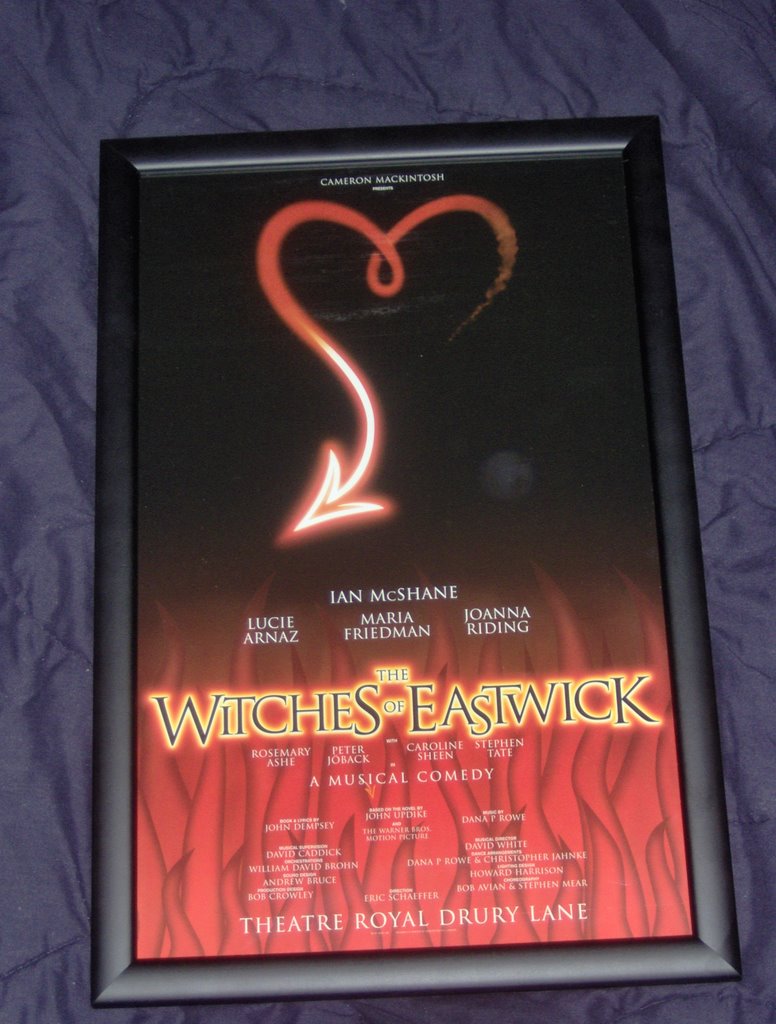
The good news is that because Signature has to juggle its lineup, it has added "The Witches of Eastwick," a musical from producer Cameron Mackintosh that was given a splashy production in London but is being reworked as a more intimate show for Signature.

This article -- and the subsequent news release I received from Signature -- reminded me that I had reviewed the original London production of The Witches of Eastwick just over five years ago, in February 2001. I had spent a couple of days in London in transit from Tel Aviv to Washington, and saw as many shows as I could in a short period of time. Witches was one of them.

The best way to sum up what I thought of Witches is this: Great production of mediocre material. We'll see whether Eric Schaeffer can get the material improved in time for the U.S. premiere next season.

For what it's worth, here is my review of the West End musical, The Witches of Eastwick, along with two other shows from that season, Merrily We Roll Along and Madame Melville, as it appeared in The Metro Herald on March 2, 2001. (There is a temptation, whenever I repost articles like this, to tweak them a bit, change some awkward language, rephrase a sentence or two, or reflect subsequent events. I avoid that temptation because I think it is important to archive these documents as they actually were rather than to alter history -- even though I doubt I could be caught at it.)

OUR MAN RICK CHECKS OUT THE LONDON THEATRE SCENE!

Rick Sincere, our Entertainment Editor, has just returned from across the pond where he checked out three productions currently being staged and presents is reviews for those of you headed for merry olde England. Enjoy, old chaps!

When Failure Rises to Perfection:
Merrily We Roll Along at the Donmar Warehouse


It can be said – though some will disagree – that even Stephen Sondheim’s failures as a composer and lyricist are superior to the best work of his contemporaries.

So what can we say about a flawless production of one of those failures? We have, perhaps, two options: one is to close our eyes and swallow, as if to take a mental picture of this impeccable moment; the other is to swallow poison, for after it is over, there is nothing left to live for.

Let’s hope we take the first option, because there’s always an opportunity for an encore, or perhaps a cast album that can later and forever act as a madeleine to bring back, to our minds, that perfect moment in time.

Such is the situation presented us at the Donmar Warehouse Theatre in London, where Merrily We Roll Along, Stephen Sondheim and George Furth’s 1980 flop, has been in performance since December 1 and, sadly, closes today, March 3.

Designer Christopher Oram has created the perfect set for this show. In contrast to the “big” musicals in the nearby West End, Merrily We Roll Along is the height of simplicity in its design, emphasizing the words and the music. The show is played on a plain, mostly flat stage of blond wood with white highlights – window frames, curtains. The lighting, designed by Tim Mitchell, is stark and mostly white – a potentially disastrous combination in so intimate a space. The actors perform within only a few feet of the audience, as the Donmar is a small theatre, only slightly larger than Arlington’s Signature Theatre.

In common with Signature is Donmar’s reputation for presenting Sondheim shows of the highest quality – the theatre’s first production was the British premiere of Assassins – as well as recent revivals of Company and Into the Woods. Donmar’s artistic director, Sam Mendes, has been honored for such productions as Cabaret and last year won an Academy Award™ for his film debut as a director, American Beauty.

For Merrily We Roll Along, director Michael Grandage has assembled a youthful cast that, in many ways, returns the show to its original concept, as envisioned by director Harold Prince, who was unable to make it work. The concept was this: A show cast entirely of teenagers and young 20-somethings, many with no previous experience on Broadway. The original production brought Jason Alexander his first major role, for instance.

For various reasons, Prince was unable to fulfill his vision, and the original production of Merrily We Roll Along lasted just 16 performances on Broadway. (At the Donmar, I sat in front of a man who told me he saw the original not once, but three times – a rarity, and a lucky one.)

Grandage seems to have overcome the problems Prince stumbled over. Subsequent productions – including the reworked, rewritten revival at Arena Stage in 1990 – have cast grown-ups in the major roles. (Arena’s Douglas Wager cast veterans Victor Garber as Franklin Shepard and David Garrison as Charley Kringas, to name two parts played by well-known “adult” actors.)

Donmar’s production largely goes back to the original work, reinstating the high-school graduation bookends that were eliminated at Arena, with the exception of two interpolated songs from Sondheim’s 1990 rewrite – “Growing Up,” which sounds like a trunk song left over from Sunday in the Park with George, and “The Blob,” which fits in better with the rest of the score.

Grandage’s cast is filled with youthful exuberance, something aided, no doubt, by Peter Darling’s exhilarating choreography. The dance numbers have the raw, fresh feel of Darling’s choreography for the hit movie Billy Elliot. It is happy and heartfelt.

And where to begin in describing this youthful cast? One place to start is Julian Ovenden, the Young Franklin Shepard. True to Hal Prince’s concept, Ovenden essentially has no résumé – just one professional credit before this one. An unknown in the lead? Yes, and what a find! Grandage has discovered a star, a young man with stage presence, musical ability (he sings and plays piano), personal charm, and movie-idol good looks. We will be hearing from him again.

As Frank’s collaborator, Charley Kringas, Daniel Evans has already been honored with an Olivier Award nomination for best actor in a musical. He certainly deserves it, if only for his stand-out number, “Franklin Shepard, Inc.,” in which he goes quite mad in the middle of a live television interview. Washington theatregoers who see Evans might be startled by his remarkable resemblance, in looks and demeanor, to local actor Jason Gilbert.

Also nominated for an Olivier (as best actress in a musical) is Samantha Spiro as Mary Flynn, Frank and Charley’s “old friend.” Spiro plays Mary’s transformation, from youthful-optimist-aspiring-writer to hard-bitten-cynical-film-critic with just about as much fine-tuning as can be imagined. And she plays this tranformation backwards, just like the others.

The rest of the cast is similarly gifted, and much credit must also go to dialect coach Jeanette Nelson, who has taught all these “kids” to speak with believable, authentic American accents.

There’s more: Sondheim’s longtime musical collaborator, Jonathan Tunick, has created new orchestrations for Merrily We Roll Along, fitting for a smaller ensemble in a smaller space. What genius it was for Donmar to go to the original orchestrator to adapt his own work. Brilliant, just brilliant.

If this review seems like breathless cheerleading, it’s because it is, in part. Merrily We Roll Along has been my favorite Sondheim show since I saw the first college production at Catholic University almost 20 years ago. To be sure, if Donmar did a bad job with it, I would tell you so in unmistakable terms.

While the score of Merrily may lack the depth of Sweeney Todd or the sophistication of Passion or the delicacy of Sunday in the Park with George, it is, for Sondheim, unusually accessible. He does here what he seems to decry here: He creates “hum-hum-hummable” melodies. At the same time, the Greek chorus commenting on the action, the reprises prefiguring (in real time) the main songs, the interplay of themes and variations – all these things combine for an intellectually rigorous, challenging score. It is memorable, it is true.

While some have criticized Furth’s book as being weak, it certainly does not seem so at Donmar. While the premise may seem strange – following a group of friends backwards in time to see their transformation from “good” to “bad” – it definitely works. In terms of the way time travels in it, it’s no different than Harold Pinter’s Betrayal. Thematically, it succeeds where Sondheim’s mentor, Oscar Hammerstein II, failed with Allegro.

Donmar’s next production is the London premiere of David Mamet’s new play, Boston Marriage. Previews begin March 8, continuing through April 14. The Donmar Warehouse is located at 41 Earlham Street, London WC2, near the Covent Garden and Leicester Square Tube stations.

For ticket information: 011-44-207-369-1732.

Entertaining But Empty: The Witches of Eastwick in London

London, England — The problem with The Witches of Eastwick is that it has nothing new to say.

The story, about a stranger who upends a small middle American town, is familiar to anyone who has seen Bye, Bye Birdie – and the use of telephones in a “gossip” song is straight from that 1960s hit. And how often have we seen a Mrs. Grundyish matron get her comeuppance from the more “with-it” characters in a play? The cartoonish sets and costumes seem to come from the closets of the designers of Des McAnuff’s revival of How to Succeed in Business Without Really Trying a few years back.


And yet ... and yet ... director Eric Schaeffer, composer Dana P. Rowe, and lyricist/librettist John Dempsey have given us an evening of entertainment thta includes tuneful melodies, clever lyrics, fun-filled dances, and surprising special effects. If you’re looking for pure enjoyment at the theatre, The Witches of Eastwick is a good bet for you.

Based on the novel by John Updike and a Warner Brothers movie starring Jack Nicholson, The Witches of Eastwick tells the story of three women – Alexandra Spofford (Lucie Arnaz), Sukie Rougemont (Maria Friedman), and Jane Smart (Joanna Riding) – who are dissatisfied with their small-town, New England lives. Along comes Darryl van Horne (Ian McShane), who transforms their boredom into excitement and (quite literally) bedevils the town at the same time.

A cute, romantic subplot involves Alexandra’s son, Michael (Peter Jöback), and Jennifer Gabriel (Caroline Sheen), daughter of the town busybody, Felicia (Rosemary Ashe) and her milquetoast husband, newspaper publisher Clyde (Stephen Tate).

The strengths in the show lie in the exquisite sets by Tony®- and Olivier-award-winning Bob Crowley (cartoonish they might be, but also exciting), energetic dancing (choreographed by Broadway veteran Bob Avian and Stephen Mear), and first-rate performances by the principals, particularly McShane and the trio of Arnaz, Friedman, and Riding. Swedish teen idol Jöback also stands out, and his fans seem to be flocking to see him – the night I was at the Theatre Royal, Drury Lane, the audience was peppered with large numbers of Scandinavian tourists between the ages of 11 and 16.

If the plot were not so empty and predictable, The Witches of Eastwick would be a classic in the making. This shortcoming may explain why it is moving from Drury Lane to a much smaller theatre, the Prince of Wales, on March 23. The show’s predecessor at Drury Lane, Miss Saigon, played there continuously for more than ten years, and Sir Cameron Mackintosh, Lord Lloyd Webber, and the other producers no doubt hoped for a repeat of that record with Witches.

Because of its sheer entertainment value, we can probably count on The Witches of Eastwick to have a long run in London, and it is likely to come to New York before too long, as well.

Sweet Memories of Youth:
Madame Melville and Macaulay’s West End Debut

The wonder of London theatre is that one can go, from day to day, from a huge megahit like Starlight Express or The Witches of Eastwick to a perfection-laden, relatively intimate musical like Merrily We Roll Along to a finely-drawn, three-person play like Madame Melville – all within the same price range, all within the same general neighborhood that allows one to walk from marquee to marquee in search of the day’s entertainment.

Richard Nelson is an American playwright better known in England than he is at home, and his work reflects this fact. Most of his plays involve foreigners set in a country not their own and Madame Melville is no exception.


The narrator, and focal character, in Madame Melville is Carl, who presents himself at the outset as a middle-aged American, looking back on an episode in his life at the age of 15, when he was a reluctant transplant (with his parents) in the Paris of 1966. A shy student, he finds himself in the orbit of Madame Melville, a thirty-something literature teacher who takes groups of students to the cinema on Friday nights, and to her flat afterwards for drinks and discussion.

One night Carl (played by Macaulay Culkin, in his West End debut) is left behind by the other students, and discovers he is alone with Madame Melville (Irène Jacob). It is late, and before too long he has missed the last Metro. Unable to get home to his parents, he spends the night ... at first on the sofa, but soon in his teacher’s own bed. She seduces him, and he falls in love.

The affair lasts only through the weekend, though. The next day we meet Madame (really, we learn, Mademoiselle) Melville’s American neighbor, Ruthie (Madeleine Potter), who approves of the budding relationship. (She is, after all, a rather bohemian violinist and violin instructor.) The bliss comes to a sudden end, and in a coda Carl reveals what happens to him and his beloved teacher.

Culkin is surprisingly good in this role. Those who think of him as the mischievous child of the Home Alone movies will be in for a treat. He expresses a range of emotions, and he seems not to be limited by his training in film work, adapting well to the stage and to the necessities of connecting with a live audience.

Jacob is luminous. She’s any 15-year-old boy’s dream of a favorite teacher. The role she plays is fraught with dangers. If she camps it up too much, she might as well be playing Mrs. Robinson in The Graduate up the street. If she stiffens and formalizes too much, she loses her appeal. Jacob walks a fine line successfully.

Potter, for her part, brings a necessary lightness to what, if it were a two-character play, would quickly become cloying and claustrophobic. Ruthie is the world beyond, the recognition that Carl will have a life that simply begins – not ends – in Madame Melville’s flat.

Watching the play, I was struck by the fact that, if the roles were reversed – if the characters were Monsieur Melville and Carla, or if both characters were male – the outcry against this play would be heard from both sides of the Atlantic. There’s some kind of double standard at work that allows men to remember fondly their initiation into sex by an older woman, but not if the pupil is female and the teacher is male.

Oddly enough, at the matinee performance I attended, a school group of English teenagers was in the audience. I wasn’t able to observe the girls, but the boys in the group seemed to have a special appreciation for the show. One wonders if their teachers had a full understanding of the plot they would be seeing.

Richard Nelson – who directs his own script – has done an excellent job in bringing together a cast that has real chemistry. Three-character, drawing-room dramas can be very intense. Nelson leavens the drama with appropriate humor, and Culkin’s introspective, innocent charm carries the play far.

Madame Melville is a pleasant entertainment that also will leave you thinking.

Madame Melville closes in London (now at the Vaudeville Theatre) on March 11, but it transfers to Broadway in April. The Metro Herald was among the first to learn that on April 23, Madame Melville will open at the Promenade Theatre in New York.

Postscript: Daniel Evans and Samantha Spiro did end up winning Olivier Awards that year for their roles in Merrily We Roll Along, which also won the prize for best musical (beating out The Witches of Eastwick). I subsequently was told, by someone who was in a position to know, that Stephen Sondheim did not like the Donmar Warehouse production of Merrily, despite its success and acclaim. The Witches of Eastwick has not yet had a New York premiere, but Macaulay Culkin received a Theatre World award for his performance in Madame Melville off-Broadway. Michael Grandage, who directed Merrily, also directed the Donmar production of Guys and Dolls that I saw in the West End last month.

Tuesday, April 18, 2006

London in the Rain

My last full day in London was drizzly and overcast -- undeniably English weather. Of course, a little rain never stops anyone from walking the streets of London, or enjoying an afternoon in the park.


My hotel was not far from the Marble Arch tube station and its eponymous arch


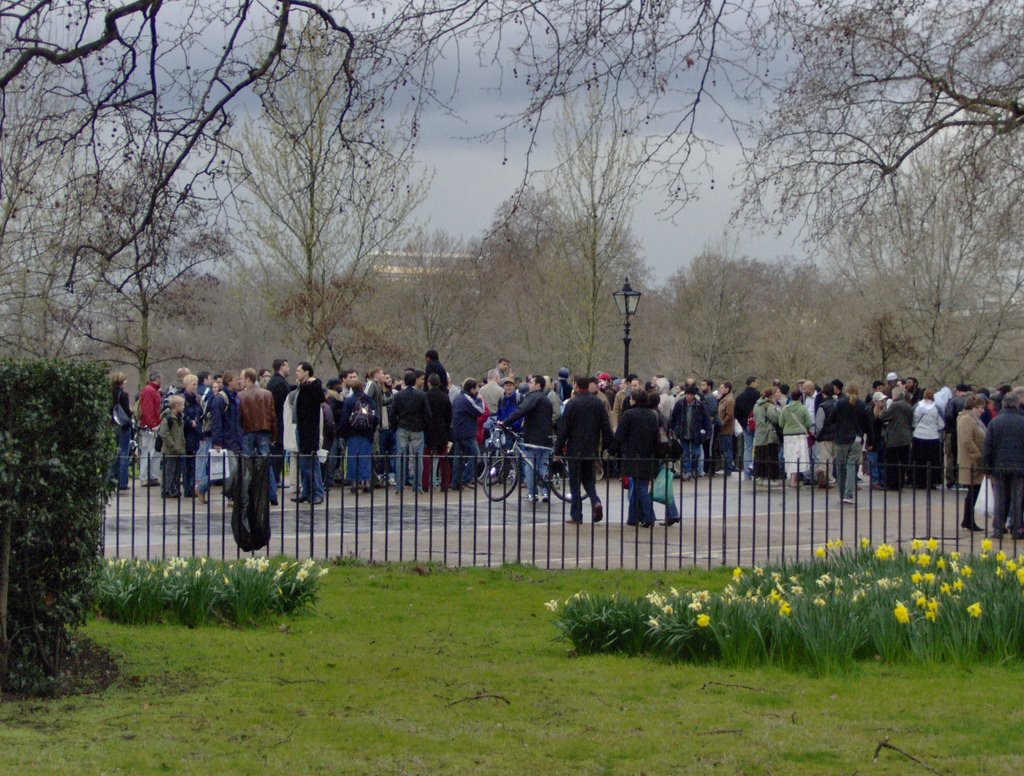
A short walk from Marble Arch is the famed Speaker's Corner at Hyde Park, where people literally stand on soapboxes to have their say to whomever might listen. The speakers I saw that day were mostly Marxists (www.marxist.com?) and Muslims.


As explained at SpeakersCorner.net, "Speakers Corner has been a place of assembly for those battling for their rights since the middle of the 19th Century. It was here that the Chartists, the Reform League, the May Day demonstrators and the Suffragettes held many of their greatest battles, tens of millions have assembled here and many have won reforms!"


Hyde Park is not short of attractions, as you can see.


This statue of Peter Pan in Hyde Park doesn't quite match the image we remember from Mary Martin, Cathy Rigby, or (especially) Jeremy Sumpter.

Monday, April 17, 2006

London at Night

More photos from my recent trip to London. There's not a lot you can do with a camera at night, but there are some pretty bright lights in the West End.


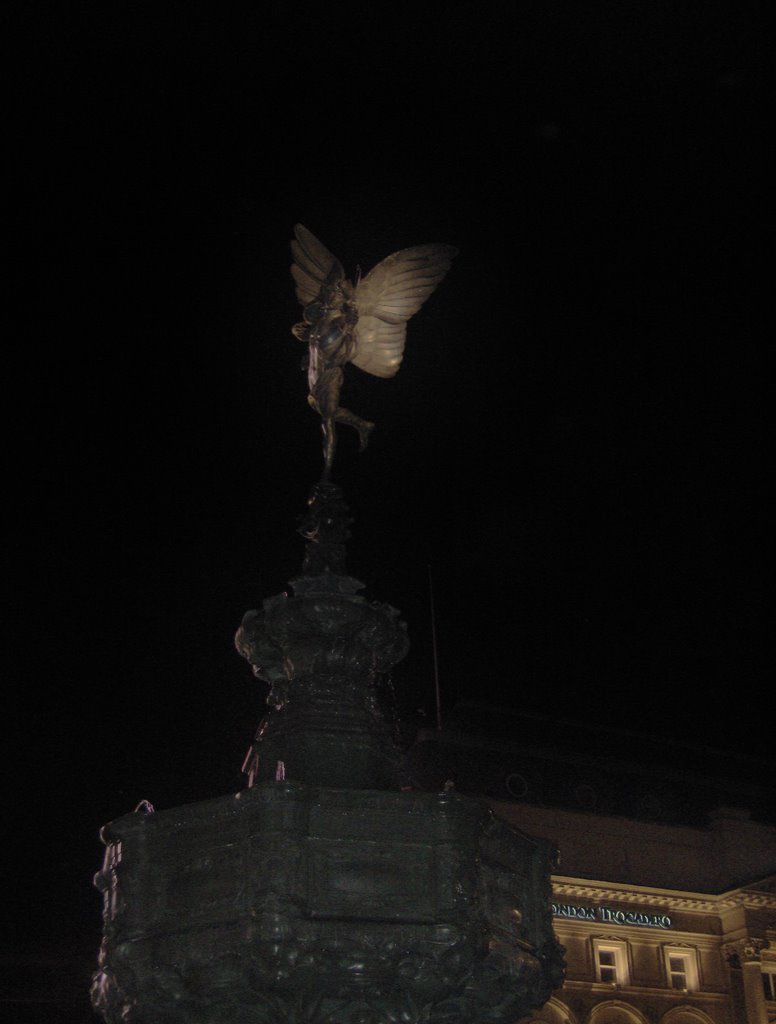
The statue of Eros in Piccadilly Circus


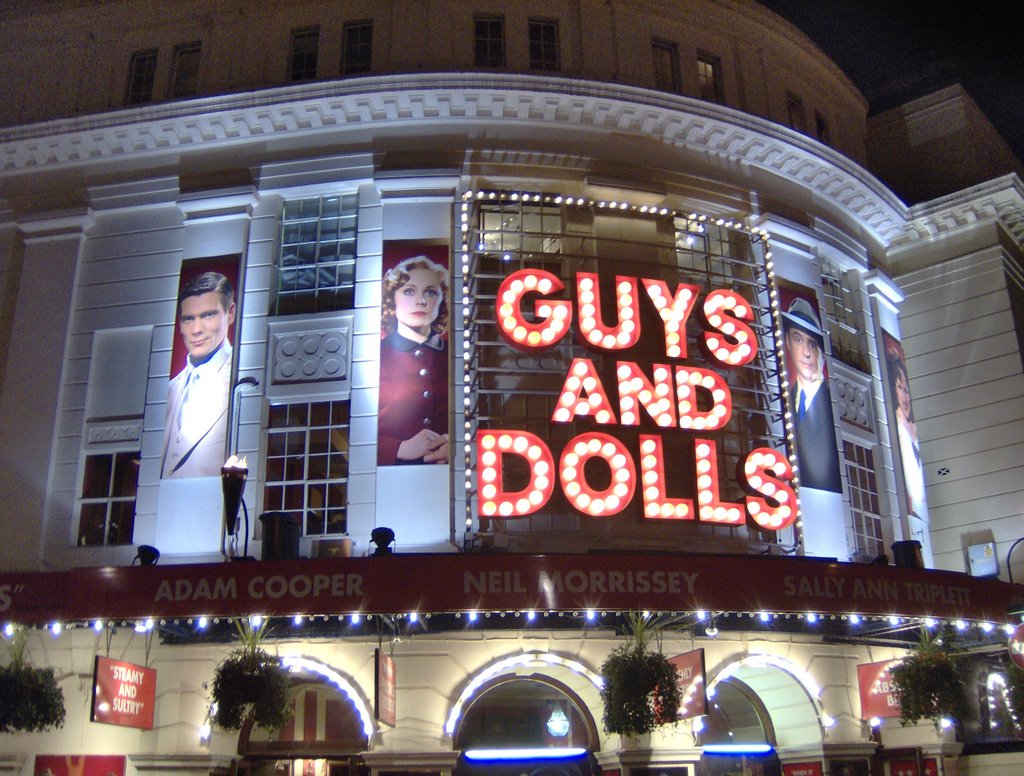
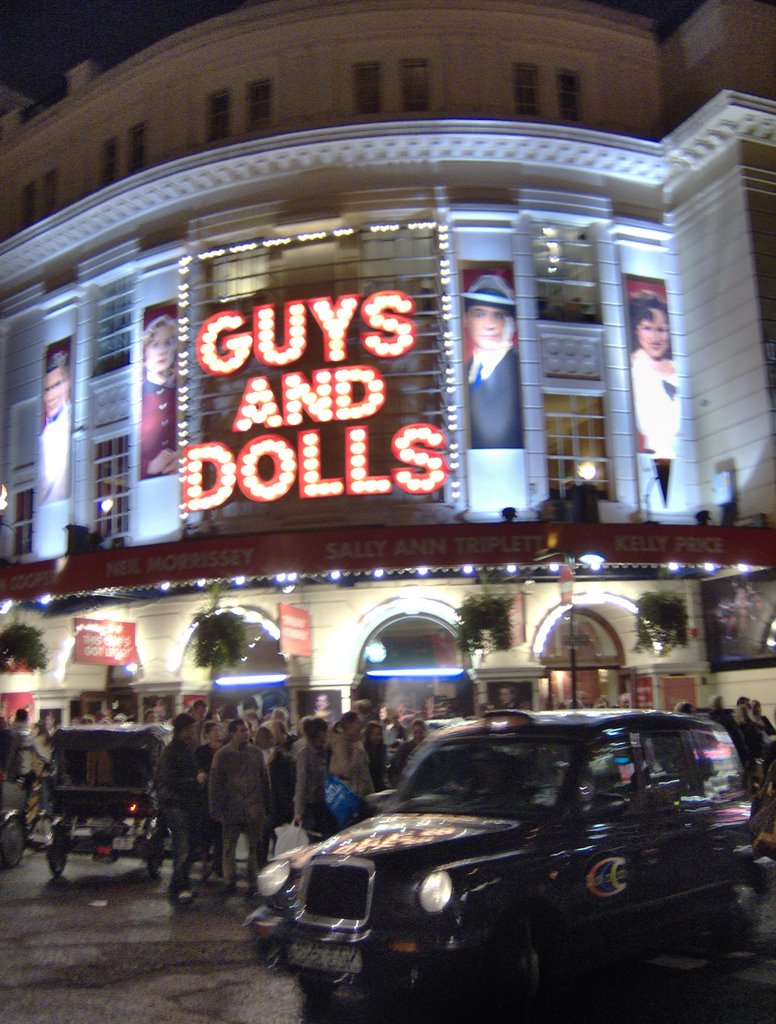
At the Piccadilly Theatre (in Denman Street, where I first lived in London almost 20 years ago), a new production of Guys and Dolls ...


... from another angle ...


... and as the audience files out to grab a taxi or a pedicab


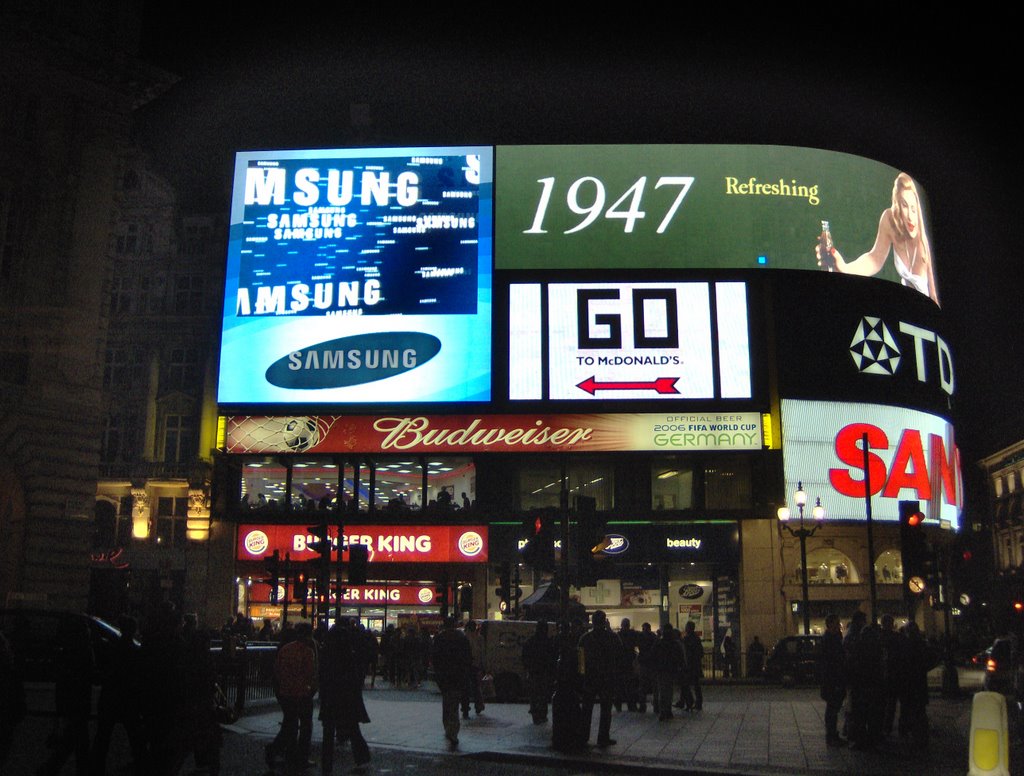
The signage may be high-tech these days, but the effect of the bright lights of Piccadilly Circus is much the same as it was in the 1940s ...


... but things go better with Sanyo (or is that Coke?)

Wednesday, April 12, 2006

Images of Sunny London

A weekend in London is such a disappointment -- but only because it is so short.

My top choices for musicals to see -- Billy Elliot and Mary Poppins -- were sold out (and are sold out, months in advance). I tried to see Hay Fever with Dame Judi Dench, but she was ill and the performance was canceled. So I saw Guys and Dolls, in a new production from the Donmar Warehouse at the Piccadilly Theatre. (Full review to follow.) This was the first time I have ever seen Guys and Dolls on stage, although I was in the show in high school and I have known the score backwards and forwards for almost 30 years.

The weather in London was lovely in that way that London has: drizzly Friday, sunny Saturday, rainy Sunday, and then sunny again on Monday morning, when I had to leave.

Here are some images of London, more or less random, reflecting the sunny Saturday of my whirlwind trip.


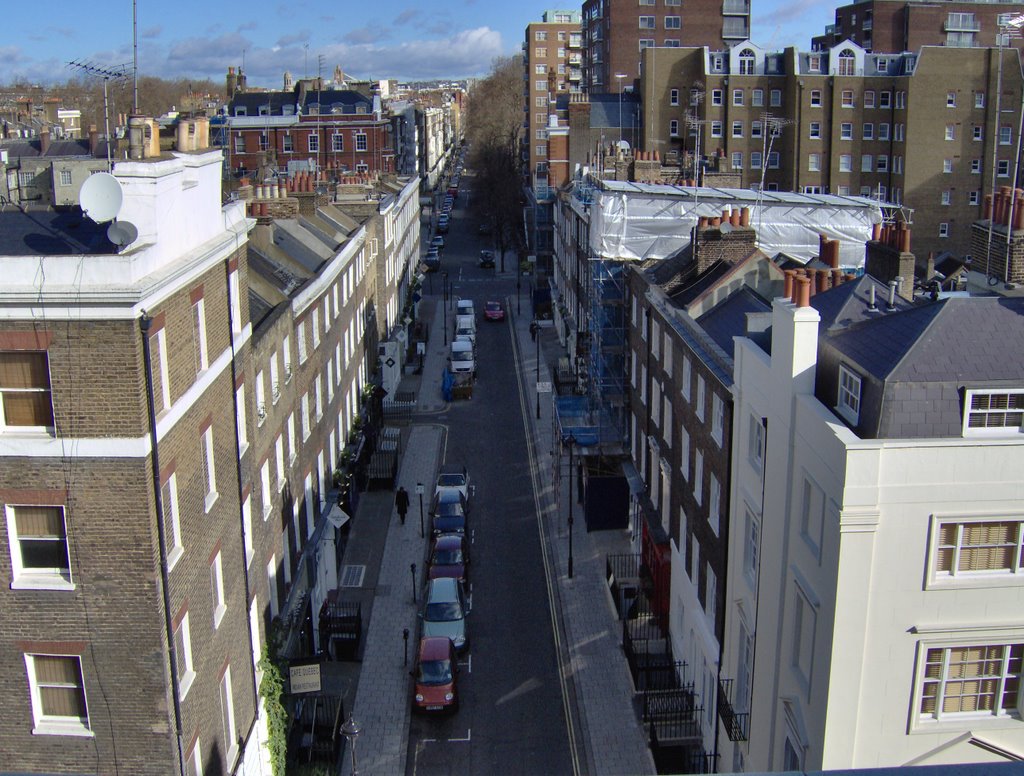
The view from my room in The Leonard Hotel, looking north into Old Quebec Street


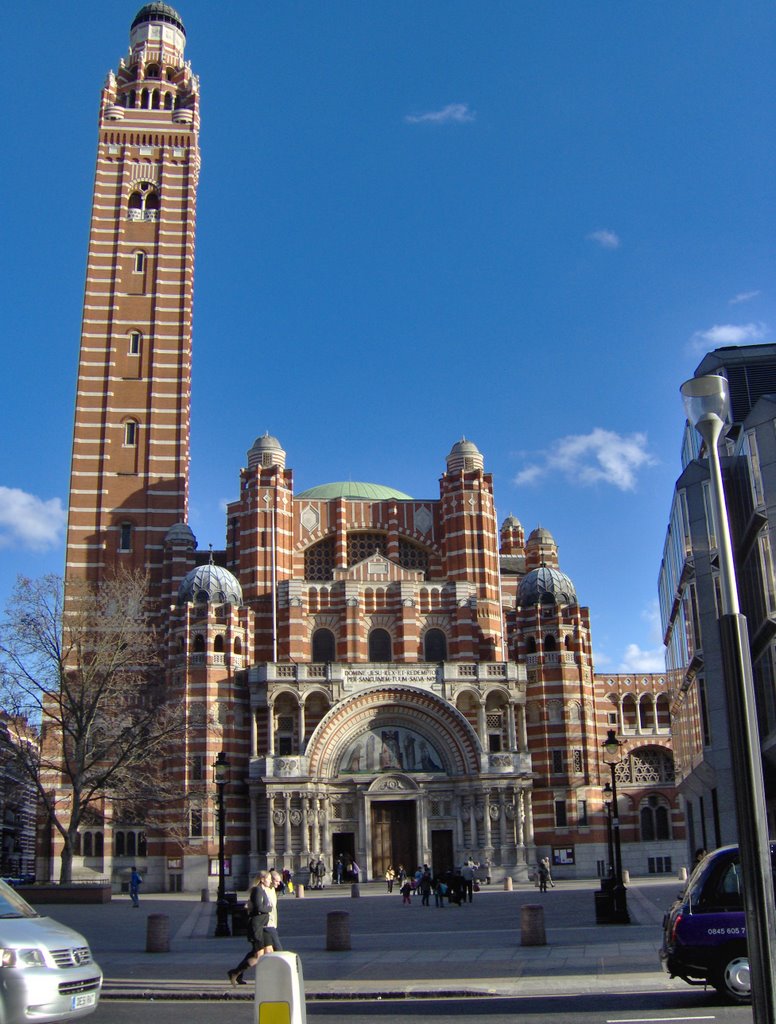
Westminster Cathedral, whose Byzantine style seems to belong more to Venice than to England . . .


. . . especially this campanile


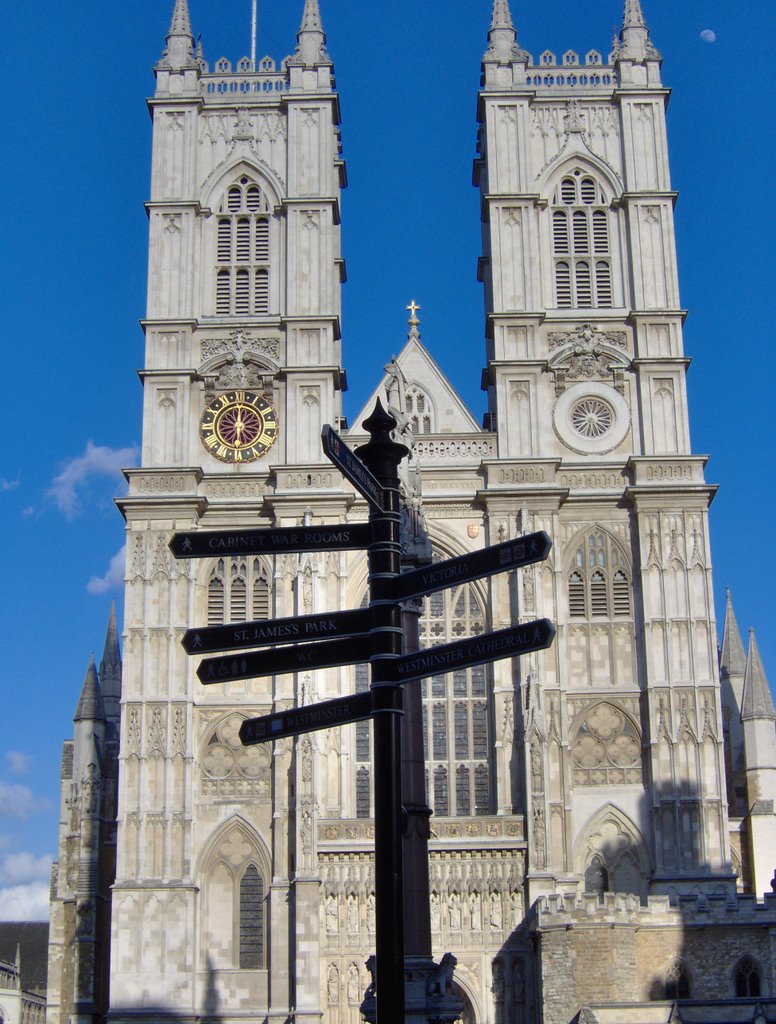
Up the street from the Catholic cathedral is the Anglican Westminster Abbey . . .


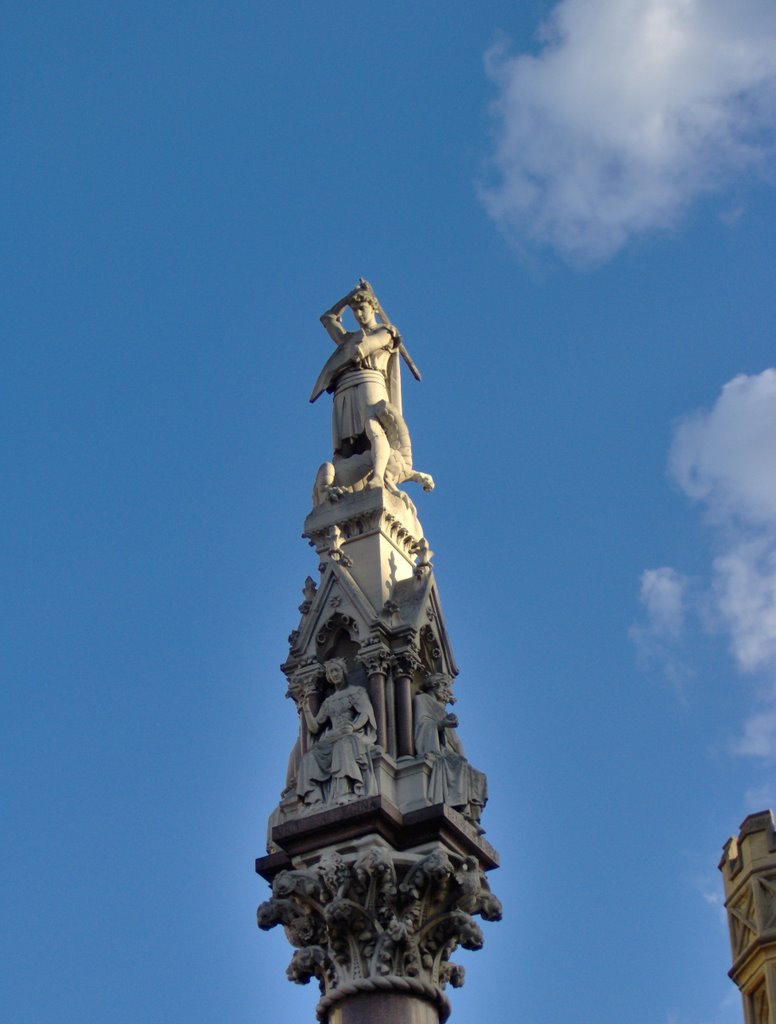
. . . with its statue of St. George, high upon a pedestal


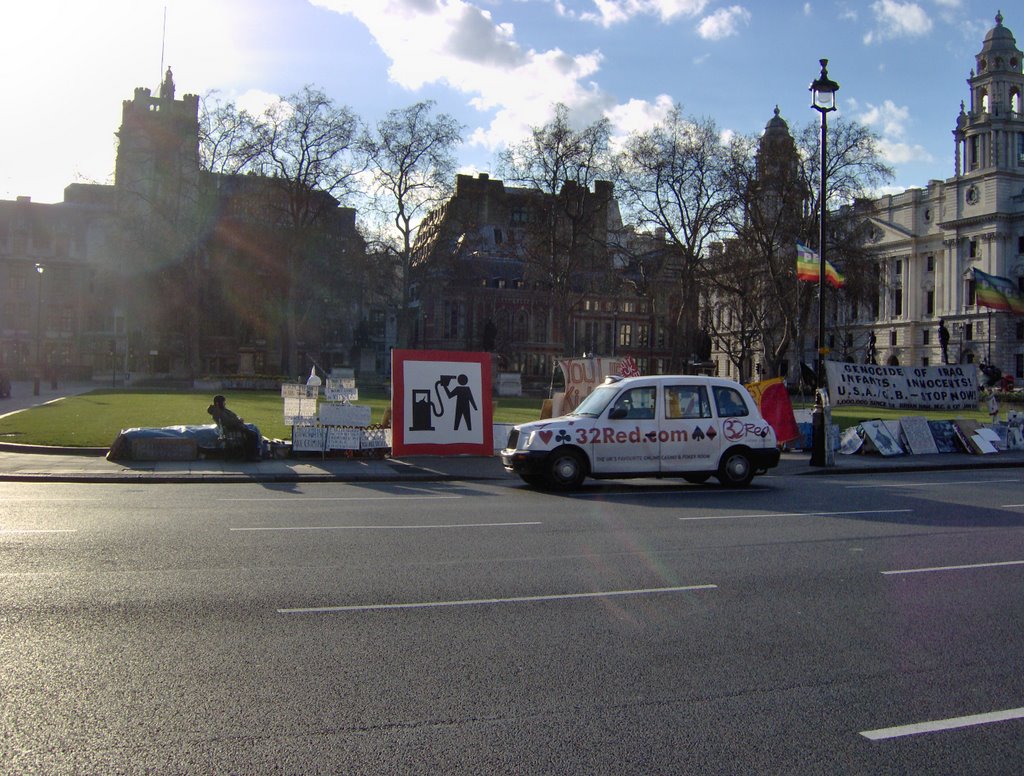
Just beyond the Abbey is the Palace of Westminster, seat of the British Parliament . . .


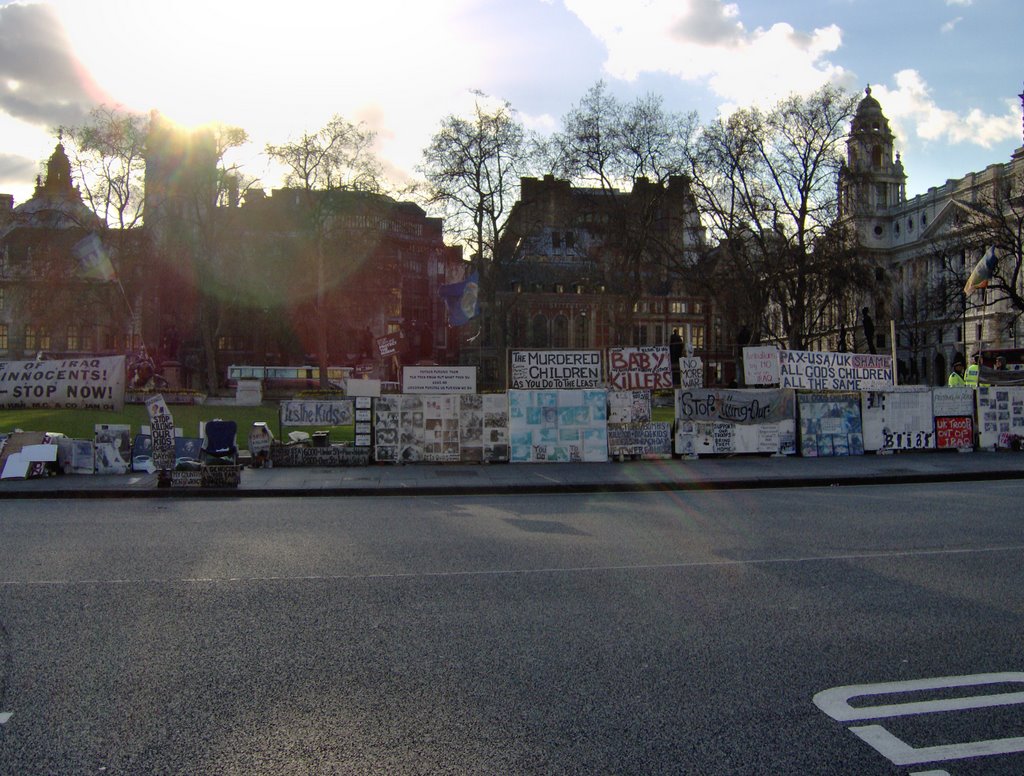
. . . which makes it a natural magnet for anti-war protesters, just like Lafayette Park in Washington


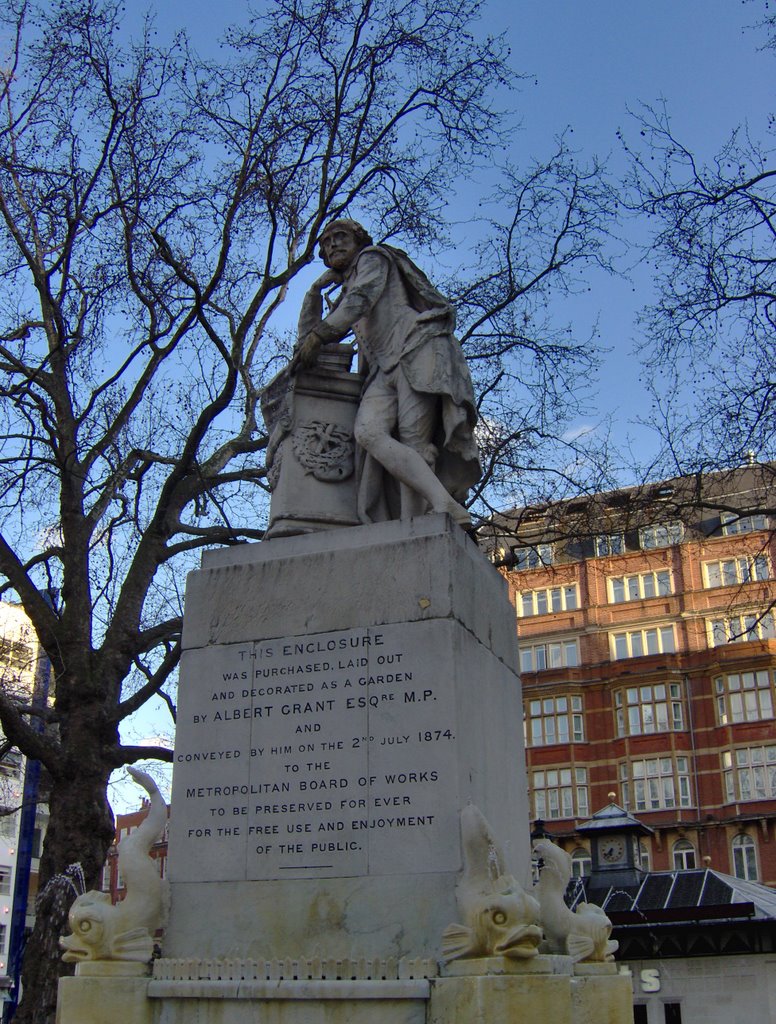
In the center of the theatre district is Leicester Square; in the center of Leicester Square is a statue of William Shakespeare; makes sense.