Showing posts with label technology. Show all posts

Friday, December 15, 2017

Guest Post: What the robots of 'Star Wars' tell us about automation


Paul Salmon, University of the Sunshine Coast

Millions of fans all over the world are eagerly anticipating this week’s release of Star Wars: The Last Jedi, the eighth in the series. At last we will get some answers to questions that have been vexing us since 2015’s The Force Awakens.

Throughout the franchise, the core characters have been accompanied by a number of much-loved robots, including C-3PO, R2-D2 and more recently, BB-8 and K2-SO. While often fulfilling the role of wise-cracking sidekicks, these and other robots also play an integral role in events.

Interestingly, they can also tell us useful things about automation, such as whether it poses dangers to us and whether robots will ever replace human workers entirely. In these films, we see the good, bad and ugly of robots - and can thus glean clues about what our technological future might look like.


The fear of replacement


One major fear is that robots and automation will replace us, despite work design principles that tell us technology should be used as a tool to assist, rather than replace, humans. In the world of Star Wars, robots (or droids as they are known) mostly assist organic lifeforms, rather than completely replace them.
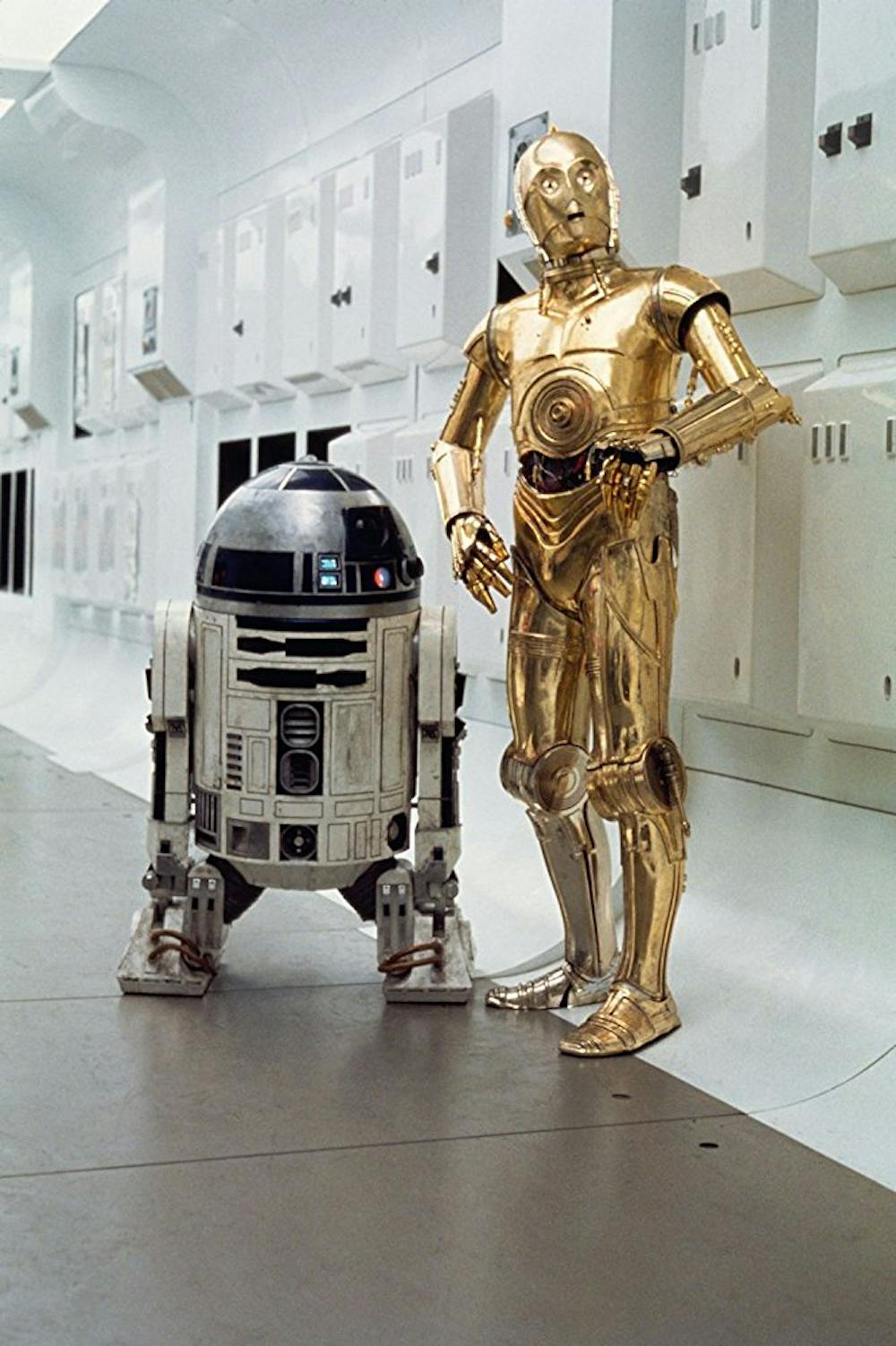


R2-D2 and C3PO in A New Hope.
Lucasfilms/IMDB


So for instance, C-3PO is a protocol droid who was designed to assist in translation, customs and etiquette. R2-D2 and the franchise’s new darling, BB-8, are both “astromech droids” designed to assist in starship maintenance.

In the most recent movie, Rogue One, an offshoot of the main franchise, we were introduced to K2-SO, a wisecracking advanced autonomous military robot who was caught and reprogrammed to switch allegiance to the rebels. K2-SO mainly acts as a co-pilot, for example when flying a U-Wing with the pilot Cassian Andor to the planet of Eadu.

In most cases then, the Star Wars droids provide assistance – co-piloting ships, helping to fix things, and even serving drinks. In the world of these films, organic lifeforms are still relied upon for most skilled work.

When organic lifeforms are completely replaced, it is generally when the work is highly dangerous. For instance, during the duel between Annakin and Obi Wan on the planet Mustafar in Revenge of the Sith, DLC-13 mining droids can be seen going about their work in the planet’s hostile lava rivers.

Further, droid armies act as the frontline in various battles throughout the films. Perhaps, in the future, we will be OK with losing our jobs if the work in question poses a significant risk to our health.



K2-SO in Rogue One Lucasfilm IMDB Star Wars robots droids

K2-SO in Rogue One.
Lucasfilm/IMDB


However, there are some exceptions to this trend in the Star Wars universe. In the realm of healthcare, for instance, droids have fully replaced organic lifeforms. In The Empire Strikes Back a medical droid treats Luke Skywalker after his encounter with a Wampa, a yeti-like snow beast on the planet Hoth. The droid also replaces his hand following his battle with Darth Vadar on the planet Bespin.

Likewise, in Revenge of the Sith, a midwife droid is seen delivering the siblings Luke and Leia on Polis Massa.


Droids assist the birth of Luke and Leia Skywalker in Revenge of the Sith.


Perhaps this is one area in which Star Wars has it wrong: here on earth, full automation is a long way off in healthcare. Assistance from robots in healthcare is the more realistic prospect and is in fact, already here. Indeed, robots have been assisting surgeons in operating theatres for some time now.

Automated vehicles


Driverless vehicles are currently flavour of the month – but will we actually use them? In Star Wars, despite the capacity for spacecraft and star ships to be fully automated, organic lifeforms still take the controls. The spaceship Millenium Falcon, for example, is mostly flown by the smuggler Han Solo and his companion Chewbacca.

Most of the Star Wars starship fleet (A-Wings, X-Wings, Y-Wings, Tie Fighters, Star Destroyers, Starfighters and more) ostensibly possess the capacity for fully automated flight, however, they are mostly flown by organic lifeforms. In The Phantom Menace the locals on Tatooine have even taken to building and manually racing their own “pod racers”.

It seems likely that here on earth, humans too will continue to prefer to drive, fly, sail, and ride. Despite the ability to fully automate, most people will still want to be able to take full control.

Flawless, error proof robots?


Utopian visions often depict a future where sophisticated robots will perform highly skilled tasks, all but eradicating the costly errors that humans make. This is unlikely to be true.

A final message from the Star Wars universe is that the droids and advanced technologies are often far from perfect. In our own future, costly human errors may simply be replaced by robot designer errors.



R5-D4, the malfunctioning droid of A New Hope Star Wars

R5-D4, the malfunctioning droid of A New Hope.
Lucasfilms/IMDB


The B1 Battle Droids seen in the first and second Star Wars films lack intelligence and frequently malfunction. C-3PO is notoriously error prone and his probability-based estimates are often wide of the mark.

In the fourth film, A New Hope, R5-D4 (another astromech droid) malfunctions and explodes just as the farmer Owen Lars is about to buy it. Other droids are slow and clunky, such as the GNK Power droid and HURID-327, the groundskeeper at the castle of Maz Kanata in The Force Awakens.

The much feared scenario, whereby robots become so intelligent that they eventually take over, is hard to imagine with this lot.

The ConversationPerhaps the message from the Star Wars films is that we need to lower our expectations of robot capabilities, in the short term at least. Cars will still crash, mistakes will still be made, regardless of whether humans or robots are doing the work.

Paul Salmon, Professor of Human Factors, University of the Sunshine Coast

This article was originally published on The Conversation. Read the original article.

Sunday, March 19, 2017

Guest Post: The home microwave oven turns 50

by Timothy J. Jorgensen, Georgetown University

The year 2017 marks the 50th anniversary of the home microwave oven. The ovens were first sold for home use by Amana corporation in 1967, but they had actually been used for commercial food preparation since the 1950s. It wasn’t until 1967, however, that technology miniaturization and cost reductions in manufacturing made the ovens small enough and cheap enough (a still steep US$495; US$3,575 in 2017 dollars) for use in the kitchens of the American middle class. Now, it would be hard to find a U.S. home without a microwave. The Conversation


microwave oven Amana Radarange 1960s cooking history

It will be quick and it will be hot.
1967 promotional image for the Amana Radarange


Amana, a subsidiary of Raytheon corporation, actually called their first model the “Radarange” – a contraction of radar and range (as in stove). What do microwave ovens have to do with radar?

Radar is an acronym for “radio detection and ranging.” Developed prior to World War II, the technology is based on the principle that radio waves can bounce off the surfaces of large objects. So if you point a radio wave beam in a certain direction, some of the radio waves will come bouncing back to you, if they encounter an obstruction in their path.

By measuring the bounced-back radio waves, distant objects or objects hidden from view by clouds or fog can be detected. Radar can detect planes and ships, but early on it was also found that rainstorms caused interference with radar detection. It wasn’t long before the presence of such interference was actually utilized to track the movement of rainstorms across the landscape, and the age of modern radar-based weather forecasting began.


radar cavity magnetron

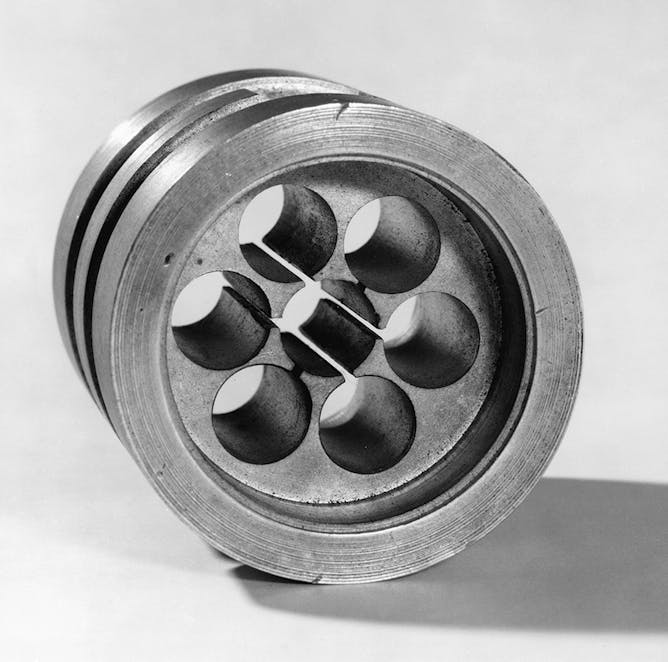
Original cavity magnetron as used to develop radar.
Mrjohncummings, CC BY-SA


At the heart of radar technology is the “magnetron,” the device that produces the radio waves. During World War II, the American military couldn’t get enough magnetrons to satisfy their radar needs. So Percy Spencer, an engineer at Raytheon, was tasked with ramping up magnetron production. He soon redesigned the magnetron so that its components could be punched out from sheet metal – like sugar cookies are cut from dough – rather than each part needing to be individually machined. This allowed mass production of magnetrons, raising wartime production from just 17 to 2,600 per day.

One day, while Spencer was working with a live magnetron, he noticed that a candy bar in his pocket had started to melt. Suspecting that the radio waves from the magnetron were the cause, he decided to try an experiment with an egg. He took a raw egg and pointed the radar beam at it. The egg exploded from rapid heating. Another experiment with corn kernels showed that radio waves could quickly make popcorn. This was a remarkably lucky find. Raytheon soon filed for a patent on the use of radar technology for cooking, and the Radarange was born.


Amana Radarange commercial from 1976.


As time passed and other companies got into the business, the trademarked Radarange gave way to more generic terminology and people started calling them “microwave ovens,” or even just “microwaves.” Why microwaves? Because the radio waves that are used for cooking have relatively short wavelengths. While the radio waves used for telecommunications can be as long as a football field, the ovens rely on radio waves with wavelengths measured in inches (or centimeters); so they are considered “micro” (Latin for small), as far as radio waves go.

Microwaves are able to heat food but not the paper plate holding it because the frequency of the microwaves is set such that they specifically agitate water molecules, causing them to vibrate rapidly. It is this vibration that causes the heat production. No water, no heat. So objects that don’t contain water, like a paper plate or ceramic dish, are not heated by microwaves. All the heating takes place in the food itself, not its container.

Microwaves have never completely replaced conventional ovens, despite their rapid speed of cooking, nor will they ever. Fast heating is not useful for certain types of cooking like bread-baking, where slow heating is required for the yeast to make the dough rise; and a microwaved steak is no taste match for a broiled one. Nevertheless, as the fast-paced American lifestyle becomes increasingly dependent upon processed foods, reheating is sometimes the only “cooking” that’s required to make a meal. Microwave ovens’ uniform and rapid heating make them ideal for this purpose.

Over the years, there have been many myths associated with microwave cooking. But the truth is that, no, they don’t destroy the food’s nutrients. And, as I explain in my book “Strange Glow: The Story of Radiation,” you don’t get cancer from either cooking with a microwave oven or eating microwaved food. In fact, the leakage standards for modern microwave ovens are so stringent that your candy bar is safe from melting, even if you tape it to the outside of the oven’s door.


What’s the deal with metal in the microwave?


Nevertheless, you should be careful about microwaving food in plastic containers, because some chemicals from the plastic can leach into the food. And, yes, you shouldn’t put any metal in the microwave, because metallic objects with pointed edges can interact with the microwaves from the magnetron in a way that can cause electrical sparking (arcing) and consequently damage the oven or cause a fire.

The microwave oven has definitely transformed the way most of us cook. So let’s all celebrate the 50th anniversary of the home microwave and the many hours of kitchen drudgery it has saved us from. But if you want to mark the date with an anniversary cake, best not to cook it in your microwave – you’d likely end up with just a very hot and unappetizing bowl of sweet mush.

Timothy J. Jorgensen, Director of the Health Physics and Radiation Protection Graduate Program and Associate Professor of Radiation Medicine, Georgetown University

This article was originally published on The Conversation. Read the original article.

Thursday, October 08, 2009

Exposing the 'Twitter Gap'

According to a news release from Project Virginia, a campaign consulting service, more Republican than Democratic candidates in the Old Dominion use Twitter as a means of campaign outreach.

As of 12:00 p.m. (does that mean 12:00 noon?) on October 7:

BY THE NUMBERS:
• Republicans in Virginia have more than twice as many total Twitter users following them as their Democratic counterparts. Followers: “R” = 13,074. “D” = 6,328.
• Republicans hold a 33-18 lead among candidates using a dedicated campaign Twitter account.
• 9 of the Top 10 Candidates for VA House of Delegates with the most Twitter followers are Republicans.
• Republican statewide candidates – McDonnell, Bolling, Cuccinelli – have 8,462 followers versus the 5,073 users following Democratic statewide candidates Deeds, Wagner, and Shannon.
Ford O'Connell, the president of Project Virginia, commented:
“It’s clear Virginia Republicans have taken the lead in using Twitter to connect with voters. Twitter’s overall impact on politics has yet to be fully realized or quantified, but it’s apparent that campaigns which are early adopters of social media tools will be more engaged with their supporters.”
The news release also provided a link to all of the Virginia politicians (at least those running for office this year) who have -- and don't have -- Twitter accounts.

I'm not sure whether the "Twitter gap" is significant enough to make a major difference in the outcome of this year's elections for the General Assembly and for statewide offices. It might make a difference in some close races or in contests for open seats, where a slight communications superiority could pull a candidate over the finish line.

I hope that on November 4, somebody does an analysis of Twitter vs. non-Twitter candidates, to see if tweeting gives candidates a winning edge.


Be sure to visit my CafePress store for gifts and novelty items!
Read my blog on Kindle!
Follow my tweets on Twitter!

Monday, June 29, 2009

Not Exactly Thomas Edison, But ...

A lot of odd details about the life of the late Michael Jackson have been cropping up in the days since he died and went to Neverland, sparking one of the largest increases in Internet traffic since Al Gore first told Mr. Watson to "come here, I want you."

For instance, who knew that the King of Pop was an inventor with a patent under his name?

I didn't, but now I do.

According to UnBeige, Jackson invented a kind of gravity-defying footwear:

That's right, intellectual property fans, Jackson is listed as the first of three inventors on United States Patent 5,255,452, granted in 1993 for a "method and means for creating anti-gravity illusion." Translation: special loafers fitted with heels that can slot into the stage floor to allow the wearer to lean forward, Smooth Criminal style, at gravity-defying angles.

According to the patent's abstract, the Jackson-devised system relies on "a hitch member movably projectable through a stage surface. The shoes have a specially designed heel slot which can be detachably engaged with the hitch member by simply sliding the shoe wearer's foot forward, thereby engaging with the hitch member." Jackson co-developed the technique as an improvement upon a previous method in which he and his dancers were rigged up with harnesses and cables.
What's more, UnBeige continues, Jackson's invention is also mentioned as an "antecedent" in a patent application for another highly useful gadget:
...another footwear innovation, patent 7,380,349. Granted last year, it covers flip-flops that have a bottle-opene[r] in the footbed. Perfect when you Wanna Be Startin' Somethin' but are ill prepared.
I guess you could call this a "footnote" to Michael Jackson's life.


Be sure to visit my CafePress store for gifts and novelty items!
Read my blog on Kindle!

Friday, June 20, 2008

Tainted Tomatoes

Salmonella is still in the news. Reuters reported earlier today:

U.S. food safety officials on Wednesday said more than 350 people have fallen ill in a Salmonella outbreak linked to certain types of tomatoes.

According to the U.S. Centers for Disease Control and Prevention, 383 people in 30 states have been infected with Salmonella Saintpaul, a rare strain of the bacteria.

The most recent report of onset is June 5 and at least 48 people have been hospitalized, CDC said.
Yesterday, the New York Times noted:
The Food and Drug Administration may never be able to pinpoint the origin of salmonella-tainted tomatoes that have sickened hundreds of people, an agency official said Wednesday.

“We may not ultimately know the farm where these came from,” Dr. David Acheson, the agency’s associate commissioner for foods, told reporters in a conference call. “Some trace-backs that we thought were looking pretty good have been falling apart.”

Dr. Acheson said he remained optimistic, but added, “I’m trying to be realistic.”

The agency is investigating a cluster of nine people who ate tomatoes at the same restaurant chain, but has not disclosed the chain’s name or location.
Finding the source may ultimately prove irrelevant as well as fruitless. (Can tomatoes be fruitless? That may be an oxymoron. But I digress.)

Last week in the Chicago Tribune
, the former head of the FDA's office of biotechnology, Dr. Henry I. Miller, lamented:
Unfortunately, produce growers cannot protect us 100 percent of the time. A several-month-old outbreak of food poisoning first linked to a rare strain of bacteria called Salmonella Saintpaul in raw tomatoes is tied to at least 160 cases of illness in 16 states in the West, Midwest and Northeast.

Modern farming operations—especially the larger ones—already employ strict standards designed to keep food free of pathogens. And most often they're effective.

But because agriculture is an outdoor activity and subject to all manner of unpredictable challenges, there are limits to how safe we can make it. If the goal is to make a cultivated field completely safe from microbial contamination, the only definitive solution is to pave it over and build a parking lot on it. But we'd only be trading very rare agricultural mishaps for fender-benders.
Dr. Miller, who is the co-author (with Gregory Conko) of The Frankenfood Myth, suggests there are ways of building confidence in the food supply while making it safer:
In the longer term, technology has an important role—or more accurately, it would have if only the organic food advocates and other food-kooks would permit it.

Irradiation of food is an important, safe and effective tool that has been vastly underused, largely due to opposition from the organic food lobby and to government over-regulation. "If even 50 percent of meat and poultry consumed in the United States were irradiated, the potential impact of food-borne disease would be a reduction [of] 900,000 cases and 300 deaths [a year]," according to Michael Osterholm, director of the Center for Infectious Disease Research at the University of Minnesota.
This point reminded me of an article I once wrote (history lesson alert) about the benefits of food irradiation. An early version appeared in The New York City Tribune in 1989; the version that appears below ran in The Metro Herald in August 1993:
The Benefits of Food Irradiation
Richard E. Sincere, Jr.

Nearly 40 percent of the poultry sold in the United States contains deadly salmonella bacteria. According to Consumers' Research magazine, 40,000 cases of salmonella infections are reported each year, though experts believe this is only the tip of the iceberg—the actual number could be between 400,000 and four million. At least 500 people die each year from salmonella infections.

Salmonella is present in a wide range of food products—chicken, beef, pork, shellfish, raw milk, eggs, and fish. It is almost impossible to avoid. A relatively safe, cheap, and simple method to prevent salmonella infections, however, is now available: ionized food processing, also known as "food irradiation."

Because "radiation" is the Freddie Krueger of the anti-consumer network—the nightmare of those groups founded and funded by Ralph Nader as well as all manner of anti-nuclear activist groups—ionized food processing has not yet been fully accepted by American consumers. Still, after more than 35 years of tests and experiments, we know more about food irradiation than almost any other form of food preservation.

The Food and Agricultural Organization of the United Nations recommends ionized food processing—which uses low levels of safe radiation to break down the DNA of infectious bacteria and fungi—as a means of preserving food for the hungry people of the Third World.

USA Weekend magazine reported recently (August 20-22, 1993) that the beef industry may begin to use ionization techniques if a study it is currently conducting shows consumer support for the process. Beef producers probably have nothing to worry about. When Florida approved the sale of ionized food, one Miami supermarket chain, Lorenzo's, began selling irradiated food at premium prices—and customers, pleased by its longer shelf life, quickly bought up all the stock.

Still, fearmongering and irrational beliefs about radiation have prevented the general use of food ionization, to the disadvantage of American consumers. David Rothbard, president of the Committee for a Constructive Tomorrow (CFACT), a grass-roots consumers' organization, has noted: "Opponents of this technology are well organized and have succeeded in misleading the public, as well as many of our elected officials. Relying on flawed studies that have been rejected by almost every credible scientist, these opponents have used scare tactics to block the widespread use of this needed technology."

CFACT and two other groups, the American Council on Science and Health and the Council for Agricultural Science and Technology, have begun a nationwide campaign to encourage use of ionized food preservation. These groups work to educate consumers and grocers across the United States about ionized food preservation. Their message includes these points:

Food irradiation delays spoilage. We lose millions of dollars worth of produce and meats each year due to spoilage. Ionizing radiation can delay the spoilage of highly perishable fresh fish and shellfish, and prolong the shelf life of fruits like strawberries.

Food irradiation is a substitute for toxic pesticides. The American Council on Science and Health reports that "low-dose irradiation can kill insects in grains and other stored foods" and can substitute for fumigants like EDB (now banned by EPA regulations) that are hazardous to farm workers and food handlers.

Food irradiation eliminates trichinosis hazards in pork.

Food irradiation kills salmonella and other infectious germs.

Despite all these advantages, some vocal opposition to ionized food processing still exists. Explains Craig Rucker, executive director of CFACT: "While public demonstrations have intimidated some grocers to boycott ‘irradiated' food, the more serious obstacles to advancing the technology lie in the state legislatures. Most states have passed laws requiring companies to label ionized foods with the word ‘irradiated.'" The clear purpose of this legislation, he adds, "is to saddle ionized food with a negative nuclear connotation." (David Rothbard asks, "Why not just make the labels carry a picture of a mushroom cloud?")

Alaska, Massachusetts, Minnesota, Oregon, and other states are considering even more extreme legislation that would ban the sale and distribution of ionized foods; Maine, New York, and New Jersey have already instituted sales bans. These laws carry harsh penalties for offenders.

Fears of contamination from food irradiation are as foolish as fears about contamination from a microwave oven, a common household appliance. USA Weekend notes that despite opposition from some groups like the Beyond Beef campaign, "tests show no ill effects of irradiation." Every form of cooking is, in essence, a form of radiation. A barbecue uses the radiation from flames; sun-dried raisins use the radiation from the sun's rays; smoked salmon is preserved with the radiation of burning hickory; an egg is poached with electric stovetop radiation. To deny American consumers inexpensive, safe, and disease-free fruits, meats, and vegetables on the basis of anti-nuclear hysteria is simply bad policy.

* * * * * * * * * * * * * * * * * * *

Richard Sincere, vice chairman of the Libertarian Party of Virginia, is a candidate for the Virginia House of Delegates in the 49th District (Arlington County).
To be sure, irradiation is not a panacea that will prevent all food-borne illnesses, as Miller notes in his Chicago Tribune piece. (It will not destroy toxins produced by bacteria even as it destroys the bacteria themselves.) Still, Miller adds:
There is technology available today that could inhibit microorganisms' ability to grow within plant cells and block the synthesis of the bacterial toxins. This technology also can produce antibodies that can be administered to infected patients to neutralize the toxins and produce effective treatments for diarrhea, the primary symptom of food poisoning.
This solution may find its own opposition, however, because it involves recombinant DNA technology, also known as gene-splicing or genetic modification.

Who knew that Mary Shelley was really writing metaphorically about the attack of the killer tomatoes?

Friday, June 13, 2008

Mettez vos mains sur le volant!

An amusing viral video that has attracted almost 200,000 hits on YouTube in about three days turns out to be a publicity gimmick by a company that manufactures hands-free mobile telephone equipment.

The video, which appears under the misleading title "Kid fails driving test 5 times in a day," is a sort of "candid camera" prank, in which several California driving teachers are the targets of the joke.

Here's the video
:


As you can see, the "kid" is not "fail[ing] his driving test," but rather is taking driving lessons from exasperated instructors.

Since the video ends with a plug for "Parrot.com," most people should have got the clue that this was a commercial production, and not some teenager playing amateur "Punk'd" with a hidden dashboard camera.

The truth came out in a FishbowlLA post earlier yesterday:
The video is part of a marketing strategy for a company called Parrot.com to raise the awareness of the new laws in California, as well as, to raise the brand awareness of their hands-free mobile devices in the US. Parrot funded the production of the video.

The video is not scripted. The company installed hidden cameras in the car and hired "John" to test the limits of these driving instructors using his cell phone.
Who is Parrot.com, you may ask?

According to its corporate web site,
Based in Paris and founded in 1994 by Henri Seydoux, its Chairman and CEO, Parrot S.A. is one of the profitable, fast-growing companies that have emerged from the "start-up" generation. Since its beginnings, Parrot's core competence has been the technologies for embedded noise-robust voice recognition and signal processing, with applications in mobile computing and mobile communications.
Parrot also hosts a web site called "ParrotSafeDriving.com," which provides a guide to hands-free driving legislation across North America. Among other things, it offers this useful map of U.S. states and Canadian provinces that prohibit (or are soon to prohibit) driving while using a cellphone or PDA or similar device:


This gives a whole new meaning to "red, blue, and purple states."

Friday, June 06, 2008

The Jeffersoniad's Memo to Jeff Frederick

Last weekend, Delegate Jeff Frederick of Prince William County was elected the new chairman of the Republican Party of Virginia, succeeding John Hager. Members of the Jeffersoniad blogging collective decided to share a few ideas with him as he takes office and begins to shape the party apparatus for the next four years.

Jeffersoniad members sent this memo to Chairman Frederick, who at the moment is taking a well-earned vacation with his family:

To: Chairman Jeff Frederick, Republican Party of Virginia

From: The Jeffersoniad

Date: June 5, 2008

RE: Technology and the RPV


Congratulations on your election to lead the Republican Party of Virginia. We are excited to have an energized leadership team heading up the party in Richmond. We want to help you and your team succeed in your quest to revitalize the Republican Party of Virginia.


As you know, the Jeffersoniad is a coalition of conservative bloggers who write about the issues facing our Commonwealth. Because many of our members have significant political experience and knowledge in Virginia and beyond, we are confident we can be an asset to your team and your plan to improve the Party. Our first offering is this memorandum outlining our ideas on how you can utilize various technologies to expand and improve the communications of the party.


Party activists like to be in the know; they want to be informed about what is going on. For far too long, and for far too many, RPV has been an obscure building in a bad neighborhood in Richmond to which only the most elite of Party insiders had access. You have the opportunity to transform RPV into an integral part of GOP efforts in Virginia accessible to all. Use of technology to disseminate information should be the first item on your list of things to do.


First, we are very pleased with your campaign promise to revamp the RPV website to include elements that will be welcoming to new visitors, and will also give an “inside baseball” feel to all. We look forward to the changes you have planned. If desired by your team, we are available to provide feedback and a medium for outreach so that the revamped site is a success. From providing beta testing of the new site to participating in an explosive launch of the new site, we are here to help you make it work.


Furthermore, on websites, your initiative to ensure every Republican unit has a website is a solid proposal. Many units may not have the resources to produce and host their own site, and as you have stated, RPV should be there for those units. RPV should produce boiler plate sites that can be hosted on RPV servers that, at the very least, contain local party contact and meeting information as well as contact information for local elected Republicans and Republican candidates.


A second element of technology use we would like to see significant work on is email contact lists. Unfortunately, such lists are valuable resources that are often held tight by the owners of those lists. It is imperative for RPV to build and maintain a solid Republican activist list that can be easily sorted by city/county, HOD legislative district, State Senate legislative district, and Congressional District. These lists not only need to be constantly updated, but also should have an easy method by which visitors to the RPV and local committee websites can sign up in the first place. The RPV has Voter Vault. Does someone have the technology to quickly update this database with emails? Or do you want to manage a separate list – if so, then there should be a means to do cross checking and integration.


Social networking sites are all the rage right now. We have seen significant use of sites like Facebook and My Space in the political arena. Many Congressional candidates make effective use of these sites to recruit young volunteers, announce events, and communicate their message. RPV should be in the game as well. RPV needs to create a presence in all popular social networking sites and use these sites to disseminate information about the Party.


We would be remiss if we neglected to mention the role of blogs and the blogging community to advance the Party. Blogs play a very important role in Virginia politics today. RPV should acknowledge the blogs and work with coalitions like the Jeffersoniad to disseminate information important to RPV. Many members of the Jeffersoniad are former candidates, future candidates, former Party officials, current Party officials, and -- of course -- future Party officials. We have vested interests in seeing RPV succeed and grow. You can expect us to be very favorable to actions you take that will improve the Party. At the same time, you can expect us to be very honest if you do not live up to the promises of your campaign.


RPV must embrace blogs, not only as readers and passers of information, but also as active participants. RPV has attempted to incorporate a blog on its website with limited success. RPV should have a blog that can be used to get information out. You should also use the RPV blog to expose the opposition. Obviously, we understand the need for caution when posting on an official Party blog, but those assigned to post to the Party blog should be trusted and have the freedom to post with very limited bureaucratic process to go through for post approval.


Also, we should come to a mutual understanding of free speech. There will be times when the RPV doesn’t want to be branded with the opposition’s labels for everything a blog/blogger has ever said. Likewise, there may be an action or statement from the RPV that blogs/bloggers might want to keep some distance. It’s worth a collective chat to talk about such times before they happen so expectations and responses are held in common understandings.


The use of video, audio and graphics can’t be understated. If RPV opens the door, then we could suggest cogent clips or symbolic statements that RPV can consider to spend the resources, or not, to make them happen. Likewise, the material prepared by users might be considered by RPV for use. As always, good humor and taste are personal and won’t be universally enjoyed.


Blogs should also be used at the local level. Ideally it would great for RPV to develop a blog coalition that is made up of those who make posts to their local unit blogs. There should be mechanism in place that enables RPV posts to be easily pushed down to local unit blogs.


We are very pleased with your campaign promise to create the Majority Blog to get information out to members of the General Assembly. We would encourage more use of these specialty blogs for the purpose of getting information into the right hands.

There are many more tools becoming available every day, we hope RPV takes advantage of all available tools to get information out on the street.


Finally, we would recommend creating the position of Director of New Media within the RPV staff structure. It should be the duty of this position to utilize all of the available technology to get the message of the Republican Party of Virginia out to all.


We hope you take this memo into consideration as you move RPV forward into the 21st Century. We want to see RPV grow and have unprecedented success in the coming years. We wish you luck in your leadership role of the Republican Party of Virginia.


The Jeffersoniad is:


badrose
Bearing Drift
Below The Beltway
CatHouse Chat
Conservativa
Crystal Clear Conservative
Deo Vindice
J's Notes
Leslie Carbone
On The Spot
Rappahannock Red
Rick Sincere News & Thoughts
Right-Wing Liberal
Scott's Morning Brew
Shaun Kenney
Sic Semper Tyrannis
Skeptical Observer
Virginia Virtucon
Write Side of My Brain

Monday, September 24, 2007

Better Late Than Never

City Councilor Dave Norris has announced his intention to vote against a proposed $300,000 appropriation to install so-called "anti-crime" cameras in downtown Charlottesville.

On his blog, Norris points to a British study highlighted on cvillenews.com that states that these cameras, ubiquitous in London and other UK cities, are virtually useless.

I could have told you that.

In fact, I did -- more than two-and-a-half years ago, in a blogpost entitled, "Ubiquitous TV Cameras Don't Reduce Crime, UK Study Says," and published on February 24, 2005.

That post quoted an AP story that reported:

Video cameras have blossomed in Britain since the 1990s. An estimated 4.2 million cameras now observe the country's 60 million people going about their everyday business, from getting on a bus to lining up at the bank to driving around London. It's widely estimated that the average Briton is scrutinized by 300 cameras a day.

For the Home Office-funded study, academics from the University of Leicester studied 14 closed-circuit TV systems in a variety of settings, including town centers, parking lots, hospitals and residential areas. Only the parking lot scheme was shown to cause a fall in crime.

Previous studies of the effectiveness of closed-circuit TV systems have come to similar conclusions.
Those "similar conclusions" are echoed in the London Evening Standard article found by Waldo Jaquith and linked from cvillenews.com:
London has 10,000 crime-fighting CCTV cameras which cost £200 million, figures show today.

But an analysis of the publicly funded spy network, which is owned and controlled by local authorities and Transport for London, has cast doubt on its ability to help solve crime.

A comparison of the number of cameras in each London borough with the proportion of crimes solved there found that police are no more likely to catch offenders in areas with hundreds of cameras than in those with hardly any.

In fact, four out of five of the boroughs with the most cameras have a record of solving crime that is below average.

The figures were obtained by the Liberal Democrats on the London Assembly using the Freedom of Information Act.
(Politicians and bureaucrats hate it, but we citizens have got to love FOIA.)

Let's hope the other four city councilors follow the lead of Dave Norris and vote against this boondoggle before it's too late.

Now if only we could get rid of that useless transit center on the downtown mall and return the money to the taxpayers ...

Tuesday, February 27, 2007

Technology Equalizes

Another example of how advances in technology equalize our capabilities and reduce the cost of living for everyone in the long run comes courtesy of this morning's Guardian:

A top paparazzo has said business for celebrity photographers is under serious threat from an army of amateurs and opportunists snapping stars on their mobile phones.

German Hans Paul, who says he once earned $120,000 for a picture of a then-pregnant Julia Roberts, said fees for paparazzi had been driven to new lows as even fans and autograph hunters now know how to market their pictures.

He said the development of camera technology on mobile phones and the internet meant that ordinary people could send quality pictures to newspapers, web portals and other media within seconds anywhere around the globe, taking business away from professional celebrity snappers.

Demonstrating that the laws of supply and demand apply even in the most sleazy nooks and crannies of the economy, Mr. Paul laments:
"There is no doubt that we paparazzi are suffering from this. There is hardly any money to be made in the everyday business."
Pull out your cellphones, and weep for the paparazzi.