Showing posts with label entertainment. Show all posts

Saturday, December 16, 2017

Guest Post: The secret behind the success of the new 'Star Wars' films

Subimal Chatterjee, Binghamton University, State University of New York

In the 40 years since the original “Star Wars” film premiered, the franchise has been a pop culture powerhouse.

“The Last Jedi” – the latest edition in the series – looks to continue the trend, with huge box office returns expected.

It also looks poised to join “The Force Awakens” (93 percent on Rotten Tomatoes) and “Rogue One” (85 percent) as “Star Wars” films that are both commercially and critically successful.
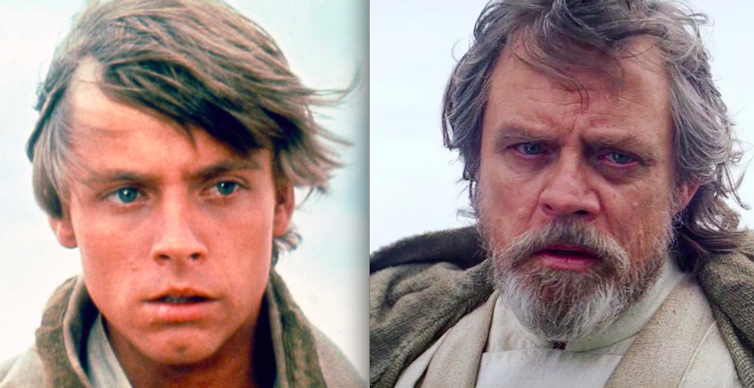


Actor Mark Hammill reemerged in ‘The Force Awakens’ and ‘The Last Jedi.’

Actor Mark Hammill reemerged in ‘The Force Awakens’ and ‘The Last Jedi.’
Nick Lehr/The Conversation via Lucasfilm , CC BY-NC-ND


Not all “Star Wars” films have hit that sweet spot. It’s sometimes easy to forget the prequel trilogy – “The Phantom Menace” (1999), “Attack of the Clones” (2002) and “Revenge of the Sith” (2005) – wasn’t met with the same enthusiastic response from critics and fans, and hasn’t been looked upon kindly since.

What made the prequel trilogy such a (relative) dud? Why are the more recent films being so much better received?

If it isn’t broke, don’t fix it


Research I helped conduct on what makes for a good extension (sequel or prequel) may provide some insight.

My colleagues and I tracked audience reactions to sequels and prequels over the course of nearly a hundred franchises, from “Psycho” to “X-Men.”

Our results show that the successful franchises make smaller, gradual updates – rather than sweeping changes – in each successive film. And it fits well with what we know about audience behavior: They seek a balance between the familiar and the new; while they aren’t looking for a carbon copy of the originals, they’re hoping to relive some of the most vivid, nostalgic moments from the first films.

With these findings in mind, let’s reexamine prequel series of “Star Wars.” When “The Phantom Menace,” the first of the prequels, was released in 1999, it had been 16 years since audiences had seen a new “Star Wars” film. (The original trilogy had just finished up a successful theatrical re-release.)

But fans hoping to relive the magic of the originals were in for a surprise.

The beloved trio of Mark Hamill (Luke Skywalker), Harrison Ford (Han Solo) and Carrie Fisher (Princess Leia) gave way to new faces: Liam Neeson, Ewan McGregor and Natalie Portman. Instead of relying on real sets, miniatures and models to pull off the breathtaking special effects in the originals, director George Lucas opted mostly for computer-generated and digital effects. There were also changes to the rules of the “Star Wars” world. The Force was no longer being described as an all-encompassing life force that bound everyone together; it was now being explained as the result of special biological cells called “midichlorians.” (And I won’t even go into the widely loathed Jar Jar Binks.)

Out with the new, in with the old


In contrast the newest film, “The Last Jedi,” includes many of the original cast members. Mark Hamill and Carrie Fisher return to portray Luke Skywalker and Princess Leia, respectively. And it features the popular “hero’s journey” plot device of the original films, in which an ordinary person’s life is unexpectedly upended, and he is thrust into the role of the hero.

We see this phenomenon in other film series and even product lines. Though the lead actor will occasionally change, the James Bond series never strays from its action-film formula. Apple has a similar approach when releasing new iPhones; before taking the leap to a radically new version, it will release an incremental “S” version of the previous model as a bridge.

That isn’t to say the new “Star Wars” films aren’t making any changes: There are more female protagonists, in addition to a host of new characters. But this isn’t exactly shattering fans’ expectations.

Our research also found that the deeper into a franchise you get, the more major changes audiences are willing to accept. The next “Star Wars” trilogy will expand the boundaries of the “Star Wars” world, exploring planets and featuring characters not yet seen on film.

With this move, the studio is willing to bet that audiences are finally ready to accept some major changes in the franchise – something they weren’t quite ready for yet when the prequels were released.

The ConversationHowever, in order to ensure the Force remains strong over the franchise’s lifetime, these future films would be wise to continue including at least a handful of nods to the original trilogy.

Subimal Chatterjee, Professor of Marketing, Binghamton University, State University of New York

This article was originally published on The Conversation. Read the original article.

Thursday, April 20, 2017

Guest Post: Ella Fitzgerald's flirtation with reefer songs

Adam Gustafson, Pennsylvania State University

“The First Lady of Song” Ella Fitzgerald would have turned 100 on April 25: institutions from the Library of Congress to the Grammy Museum will be honoring her amazing contributions to the jazz canon. The Conversation

It will be interesting to see if any tributes mention Fitzgerald’s “Wacky Dust,” her song about cocaine.


Ella Fitzgerald Wacky Dust cocaine marijuana reefer 4/20


Nick Lehr/The Conversation via Wikimedia Commons


In the 1930s – just as Fitzgerald was getting her start – jazz was under fire for its purported ties to drug culture. The 1936 anti-drug film “Reefer Madness” featured party scenes of young people listening to jazz and ragtime while smoking marijuana. A year later, Harry Anslinger, the commissioner of the Federal Bureau of Narcotics, published “Marijuana, Assassin of Youth,” which pinned the use of drugs on a culture of unscrupulous partying – with big band jazz as its soundtrack.

In this climate, an ascendant singer named Ella Fitzgerald sought to take the opposite tack and cultivated a reputation as the “girl next door.” Fitzgerald walked the fine line between being understood as a jazz artist and an entertainer. Two recordings from the beginning of her career signal this tension. “A-Tisket, a-Tasket” and “Wacky Dust” were both released in 1938. One tune would go on to become a signature hit. The other would be largely forgotten, a side note to an otherwise squeaky-clean career.

A dressed-up nursery rhyme?


By 1938, Fitzgerald had established herself as the primary vocalist for Chick Webb’s orchestra at Harlem’s Savoy Ballroom. Under Webb, Fitzgerald began recording for Decca Records and in May 1938, Decca released Fitzgerald’s first major hit, “A-Tisket, a-Tasket.”

It was a song that perfectly encapsulates Fitzgerald’s girl-next-door image. It opens with Webb leading the orchestra through a stock series of simple chord changes. When Fitzgerald enters, listeners are treated to a reworked nursery rhyme that asks little of them other than to sit back and enjoy. There is no moral value, no hint of the singer’s inner life and no mention of drug use.


Ella Fitzgerald’s ‘A-Tisket, a-Tasket.’


In fact, “A-Tisket, a-Tasket” is barely jazz. As with Goodman and so many other bandleaders in the late 1930s, Webb and Fitzgerald seem more interested in creating a pop tune that fit the 78 RPM format than in staying true to their genre. Yet it became so popular that she and Webb recorded a follow-up track, “I Found My Yellow Basket,” that same year.

But then – just a few months after “A-Tisket, a-Tasket” – Webb and Fitzgerald recorded “Wacky Dust,” a song about the allure and dangers of cocaine use.

Ella’s reefer song


How Fitzgerald moved from a nursery rhyme to a song about cocaine says more about jazz culture than it does Fitzgerald’s own tastes. And while songs about drugs were common in jazz, “Wacky Dust” put Fitzgerald in the awkward position of recording a song that ran contrary to the image that she was trying to cultivate.


Ella Fitzgerald’s ‘Wacky Dust.’


The release of “Wacky Dust” coincided with a massive shift in cultural opinion taking place in the U.S. about the use of drugs like cocaine and marijuana. Once a relatively uncontroversial social issue, drug use in the 1930s increasingly came to be seen as a societal ill that was especially (and incorrectly) tied to African-Americans and jazz musicians. Even sympathetic artists couldn’t help but buy into the stereotype. George Gershwin’s operatic adaptation of DuBose Heyward’s novel “Porgy,” for example, was revolutionary for its diverse cast, but the story, written and adapted by two men of European descent, reinforced the popular perception of prevalent drug use among African-Americans.

Jazz artists in the early 1930s didn’t do much to help this view. Just as big band jazz was coming to dominate the music scene, two of the era’s biggest names released songs with direct references to drug use.

In 1933, Cab Calloway’s “Reefer Man” was used in the film “International House.” A year later, Benny Goodman released “Texas Tea Party,” a reference to both marijuana and to the trombonist on the recording, Jack Teagarden. These were not subtle works, and most jazz artists of the era produced what have since become known as “reefer songs.” Even Louis Armstrong – who, like Fitzgerald, cultivated a rather benign image – was arrested for smoking marijuana and recorded several tunes that allude to drug use.

So when “Wacky Dust” was released, the idea of one of the great New York City house bands recording a jazz tune about drugs wasn’t all that surprising. (Fitzgerald and Webb had experimented with a similar subject a couple of years earlier with the release of “When I Get Low I Get High.”)

Like “A-Tisket, a-Tasket,” Wacky Dust opens with Webb’s orchestra. Fitzgerald doesn’t enter until nearly one-third of the way through the song. The first verse aligns cocaine with jazz and describes how easy it is for musicians to access the drug. The second verse and bridge section describe its wonders, but the final verse takes a turn, with Fitzgerald warning that the drug can’t be trusted and might kill you.

While “A-Tisket, a-Tasket” went on to become one of Fitzgerald’s signature pieces, “Wacky Dust” has faded into relative obscurity outside of specialty albums that feature songs about drug culture. And this makes sense. Fitzgerald was extremely careful about her image, and “Wacky Dust” didn’t fit. In fact, after “Wacky Dust,” Fitzgerald moved entirely away from songs that alluded to drugs.

By the 1950s, she had embarked on a recording career that displayed an unrivaled musicianship and joy for singing. Nonetheless, one has to wonder what her career would have looked like had “Wacky Dust” been the hit of 1938, rather than “A-Tisket, a-Tasket.”

Adam Gustafson, Instructor in Music, Pennsylvania State University

This article was originally published on The Conversation. Read the original article.

Wednesday, May 04, 2016

From the Archives: May the Fourth Be With You - Part I

Seventeen years ago this month, I was among the hundreds of Star Wars fans who camped out in front of the Uptown Theatre in Northwest Washington, D.C., to wait for an opportunity to be the first to buy tickets and, the next week, to see the first screening, of Episode 1: The Phantom Menace.

I also covered the gathering for The Metro Herald, which in succeeding weeks published my report on the sidewalk queue and my review of the movie.

Brought up from deep in the archives, this article ran on the Arts & Entertainment page of The Metro Herald in Alexandria, Virginia, on May 14, 1999:

ADVENTURES IN JEDI-LAND, DC
Rick Sincere
Metro Herald Entertainment Editor

Star Wars Episode 1: The Phantom Menace is, without a doubt, the most anticipated movie in a generation, perhaps since Gone With the Wind. Some would argue that it is more hype than substance, though that remains to be seen, since the vast majority of us have seen only tantalizing snippets in the form of trailers, commercials, music videos, and computer files that end in *.AVI or *.MOV.

For diehard Star Wars fans, however, this is a religious experience. They, like the rest of us, have been waiting for 16 years for the newest film in the series to be released. Yet their wait has not been casual. It has been intense, with the intensity growing in recent weeks as the magic date of May 19 approached.

Starting last Sunday evening with a handful of dedicated fans, growing as a trickle through Monday night, until by Wednesday morning some 325 or more devotees had gathered on the sidewalks outside the Uptown Theatre on upper Connecticut Avenue in Northwest Washington. The line snaked along from the south edge of the theatre, past Starbucks and Ireland’s Four Provinces, past the Cleveland Park Public Library, all the way to the end of the bridge that carries the avenue over Rock Creek Park.

There is no sense of crowdedness, certainly no rowdiness, but definitely a sense of hominess. The sidewalk is littered with sleeping bags, lawn chairs, coolers, pizza boxes, empty soda cans, knapsacks, and more. Some sit on inflatable furniture. (Inflatable Darth Maul chairs are available at Toys-R-Us for $21.95.) Some people have brought along radios and CD players. (The musical score from earlier Star Wars episodes floats through the air along with the chatter of fans.) For the overnight campers, there is the portable entertainment in the form of card games, Star Wars Trivial Pursuit sets, action figures, and plenty to read, from collections of “Bloom County” cartoon strips to J.R.R. Tolkien books to Douglas Adams’ Hitchhiker’s Guide to the Galaxy.

The crowd is mostly young, primarily college students but some people in their thirties and some in their teens. Some come dressed in Star Wars-inspired costumes, but most are dressed simply in shorts and t-shirts, jeans and sweatshirts. As the sun rises across Connecticut Avenue, they rub sleep out of their eyes, wrapped so tightly in their sleeping bags that an unwary observer might think this gathering is for a re-release of Cocoon or The Revenge of the Pod People. But soon they emerge from their protective covers and begin socializing amiably with their neighbors.
One 12-year-old boy is there alone and, in the middle of the night, his mother comes looking for him. Afraid to give away his location because she might be there to drag him home, nearby fans express their sense of hesitancy. “Oh, that’s not why I’m here,” Mom exclaims. “I just brought him some blankets and Three Musketeers bars.” She explains that when she was her son’s age, 22 years ago, she camped out to await the first Star Wars movie (Episode 4: A New Hope) and she felt it would be hypocritical of her not to let him do the same. From one generation to another…

Despite the discomfort of sleeping on concrete overnight, the queue of fans is remarkably chipper so early in the morning. A palpable friendliness permeates the atmosphere. For so many people, the situation is quite calm, peaceful, and orderly. It provides an excellent example of economist Friedrich von Hayek’s “spontaneous order” – particularly appropriate since Hayek’s 100th birthday was celebrated on Saturday, May 8. An ad hoc community has been formed here, where once and future strangers watch out for one another as friends. Need a drink? Does nature call? Leave your things behind; no one will allow them to be pilfered. Everyone seems to get along. Oh, there might be an occasional light-saber fight, but only on the friendliest terms. And in the middle of the night, the whole gang played an elaborate game of “telephone,” with whispering that starts at one end and finishes up three blocks and three hundred people later.

As people pull out their breakfasts – consisting of Mountain Dew, Doritos, potato chips, and chocolate bars – there is no hesitancy about sharing. Local businesses and radio stations have chipped in, too. They are passing out free doughnuts, and Ben & Jerry have brought a load of ice cream treats.

The local media are here, of course. Fox News has a crew on hand all morning long, doing periodic live broadcasts throughout the network’s morning news show. The perky Fox correspondent, Holly Morris, gets the fans to play Trivial Pursuit with her, share their yummy breakfasts, and sing along to the Star Wars theme song (using lyrics invented by Bill Murray on Saturday Night Live more than 20 years ago, in his character of a smarmy Vegas lounge singer). Local radio stations are here en masse: WPGC; WASH 97.1 FM; WHFS; 104.7; Mix 107.3. They’re all passing out promotional materials – free CDs, flyers, T-shirts, various Star Wars souvenirs. They recognize a captive audience when they see one – and they get the fans to play along, too, putting them on the radio, live via cell phone.

Cell phones are ubiquitous, too – a lifeline to home or work for those who have been absent for almost three days. Some troglodytes are still using the pay phones that dot the landscape, but these old-fashioned devices are far from necessary these days.

As the sun rises higher in the sky, shirts come off and the aroma of suntan lotion wafts through the air. The anticipation grows stronger as zero hour – 2:30 PM is when tickets go on sale – approaches. Each person in line will be limited to buying 12 tickets, and all of them must be for a single performance. The most eagerly sought tickets are those for the first showing at 10:00 AM on Wednesday, May 19. Those who are purchasing them are already planning to camp out for the three nights preceding the show, simply so they can have first choice of the choicest seats. It becomes a never-ending story.

Could such a gathering of people occur in the suburbs? It is hard to imagine hundreds of people camping out on the macadam outside a suburban multiplex for days at a time, with traffic zooming by on the surrounding four-lane highways. A barren parking lot lacks the vitality of a central city’s sidewalks. Star Wars fans, with their souls in another galaxy, far, far away, have their feet firmly on the ground in the most traditional of settings, the urban village.

Next week: Reactions to the movie.


Monday, June 23, 2014

Are Selena Gomez and Justin Bieber an 'Emerging Threat'?

Last week the celebrity gossip pages were reporting the news that the on-again, off-again romance of bad boy Justin Bieber and Disney Channel songstress Selena Gomez was on again.

The 21-year-old ex Disney star and the Canadian pop star reportedly spent the past few days together riding Bieber's three-wheeled motorcycle and attending mutual friend Alfredo Flores' birthday party.

"Justin and Selena are definitely full-on back together at the moment," a source told Us. "They spent all day riding together on a Can-Am Spyder on Sunset Blvd. Justin drove while Selena sat on the back holding on to [him]."

The insider added that Bieber "was incredibly sweet with her and they looked super happy and in love."


Someone at UPI decided to have fun with the story.  In an email news roundup, the story headlined "Justin Bieber, Selena Gomez back together again" was listed under "emerging threats."

Here's a screen shot:


When I had the chance last week, I should have asked Virginia Senator Mark Warner whether Justin Bieber is such a threat that he should be deported back to Canada.


Sunday, January 11, 2009

Charlottesville's Role in the Golden Globes

Two movies that had their local premieres at the Virginia Film Festival won big at the Golden Globe awards tonight.

Mickey Rourke won the best actor (drama) award for his role in The Wrestler, which has just recently gone into general release. The Wrestler also won the best song award for the title song by Bruce Springsteen.

Slumdog Millionaire
, director Danny Boyle's colorful story about a lower-class young man from Mumbai who wins the Indian version of Who Wants to Be a Millionaire, received multiple awards: best motion picture (drama), best screenplay by Simon Beaufoy (motion picture), best original score by A.R. Rahman (motion picture), and best director (motion picture).

I confess to not seeing either of these films at when they played at the Virginia Film Festival, knowing that they would be showing in cinemas by the end of the year. (I tend to go for the more obscure films that can't be seen elsewhere.) I hope to see both of them before the Oscar nominations are announced.


Be sure to visit my CafePress store for gifts and novelty items!
Read my blog on Kindle!

Monday, January 21, 2008

Plan Your SOTU Party Now

President George W. Bush will make his final State of the Union Address a week from today, on Monday, January 28, before a Joint Session of Congress at the U.S. Capitol. John McCaslin offers some ideas for how best to enjoy the speech in his "Inside the Beltway" column, which appears in the Washington Times and other newspapers:

We had reminded readers [January 17] that President Bush's final State of the Union address will be delivered on Monday, Jan. 28, at 9 p.m.

Now we are reminded of a popular pastime held each year, "The State of the Union Drinking Game 2008."

Organizers say: "If all goes well, you'll be unconscious by the time they show the other party's response."

New rules will be in place this year, but last year, every time the president said "Mahmoud Ahmadinejad," players had to take two gulps of their chosen beverage, and swallow a third if Mr. Bush pronounced the Iranian president's name correctly.

In addition, players had to take one shot of extra-virgin olive oil every time Mr. Bush said "addicted to oil," as well as one shot of tequila when he said "illegal immigration."
Coincidentally, I just bought a bottle of tequila last week, so now I'm thinking of hosting a viewing party for this year's SOTU. Anyone care to join me?

Thursday, November 01, 2007

Virginia Film Festival 2007 - Preview


Last night I traveled to Harrisonburg to see a play by Paula Vogel, The Mineola Twins, performed by a local community theatre group, The Playhouse, at Court Square Theatre. The Mineola Twins is a provocative but ultimately unsatisfactory (and unsettling) bit of political satire (my colleague, Tim Hulsey, prefers the term "agitprop"), which sets up two twin sisters as left-wing and right-wing terrorists (though not in as balanced a manner as that nutshell description implies). The play has many pop-culture references that evoke laughs from those in the know (which should be virtually anyone who lived in the '50s, '60s, '70s, or '80s), but many of the jokes fell flat among the audience that watched the show with me.

There were a few highlights worth noting, however, such as the performance of John Michael Schott in two roles, as cousins Kenny (son of right-wing Myrna) and Ben (son of left-wing Myra), both 14 years old and neither inheriting the values of their respective mothers. With a twinkle in his eye and a firm understanding of the emotional crippledness of each character, Schott was the clear stand-out in the gender-bending cast of five.

Live theatre aside, however, tonight is the beginning of what I have come to view as the best weekend of the Charlottesville calendar year: the annual Virginia Film Festival opens tonight with a screening of John Sayles' new film, Honeydripper, which explores the roots of rock and roll music in the American south.

The Virginia Film Festival is in its 20th year (already?) and this year it brings directors, screenwriters, producers, and a few actors to Charlottesville to celebrate the artistry of film and to discuss their craft with fans and aspiring filmmakers. Among those who will be appearing to discuss their films are director Tamara Jenkins (Slums of Beverly Hills), screenwriter Stewart Stern (Rebel Without a Cause), director Charles Burnett (Killer of Sheep), UVa film professor Walter Korte (discussing the films of Luchino Visconti), actor and director John Turturro (Romance and Cigarettes), and many others. (A full film festival program can be found at www.vafilm.com.)

The theme of the 2007 Virginia Film Festival is "Kin Flicks" -- not to be confused with the 1976 novel of the same name, by Lisa Alther -- with a focus on films about families and their relationships.

The Volvo Adrenaline Film Project will be the climax of the festival again this year. This gives teams of young filmmakers an opportunity to produce a short film within a 72-hour period in which they must write, film, and edit it before being shown to an audience that acts as a jury to award the best of the dozen or so films created in those three days. Charlottesville native and film director Jeff Wadlow and his producing partner, Beau Bauman, act as mentors during the project.

Another highlight will be screened on Saturday afternoon: the 1924 silent version of Peter Pan, with live musical accompaniment by Donald Sosin, Joanna Seaton, and Paul Reisler, along with Terri Allard's Kid Pan Alley (local school kids singing original music in chorus). This film, with cinematography by the legendary James Wong Howe, was long thought to be lost, but it has been found and will be on screen at the Paramount.

Watch this space over the course of the weekend for nightly updates -- with photos, video, and text -- on the 2007 Virginia Film Festival.

(Photos and graphics courtesy of the Virginia Film Festival.)

Sunday, September 23, 2007

Marcia, Marcia , Marcia!

Half a century ago, ad-man Stan Freberg caught heat from the censors for his send-up of radio and TV soap operas, with a novelty record called "John and Marsha." The dialogue in "John and Marsha" consisted of only two words ("John" and "Marsha"). But that genius Freberg directed his actors -- he might have been one of them -- to say those words of dialogue with such torrid inflection that he angered the bluenoses of the 1950s, who actually got the record banned from several radio stations around the country.

That, of course, led to increased sales of the single and subsequent album, but that's a story for another day.

What would Freberg make of this tasty tidbit from ABC News? Would he redo his recording with new actors and new dialogue, calling it "Jan and Marcia"? Read on:

The book publisher for Maureen McCormick, who played Marcia Brady on the 1970s sitcom "The Brady Bunch," is shooting down rumors that she had a lesbian on-set affair with co-star Eve Plumb, who played her younger sister Jan.

The story of the alleged lesbian affair started circulating the Internet Friday, and was picked up by at least one newspaper on Saturday.

The reported source of the story was McCormick herself in her new tell-all book, "Here's the Story," slated to come out next year.

But the book's publisher said, though there are plenty of other revelations in the book, a lesbian affair is not one of them.


Once again, the headline ("Lesbian Bradys? Publisher Denies Report") sets us up for a sensational story about torrid lesbianism in Hollywood, only to be shot down with truthiness.

To much of Middle America, the idea of the Brady sisters coupled in lesbian incest would be akin to finding out that Lawrence Welk and Myron Floren had a Hoover/Tolson-style relationship.

Yet the tabloids press on.

If only Stan Freberg were still as active as he was in the '50s and '60s. I can hear it now:

"Jan!"
"Marcia!"
"Jan…"
"Marcia…"
"Jan?"
"Um… Marcia…"
(-Snif-) "Jan!"
"Marcia?"
"John…."
"Marcia, Marcia, Marcia!"

So that's the way they all became the ... oh, you know the rest.

The Rest Is Silence?

Marcel Marceau has died at age 84.

I can't help but imagine that his last words must have been these:

" _____________ "