Tuesday, July 04, 2006

Morning at Monticello

As noted earlier, I had plans to attend the annual naturalization ceremony at Monticello this morning, which I did.

The ceremony, part of the Independence Day Exercises at the home of the author of the Declaration of Independence, featured artists Christo and Jeanne-Claude as speakers. (The tradition, though not always followed, is for immigrants to address the soon-to-be citizens. In this case, Christo came from Bulgaria and Jeanne-Claude from France before becoming naturalized Americans.)

As it happens, Jeanne-Claude did most of the talking, although both she and Christo stood at the podium. She began by saying she wanted to keep her remarks short, given the heat of the day. (It was, to be sure, hot and muggy under the sun on the mountaintop.) She noted the oddity that her husband and she shared the same birthday, though they were born in different countries and, she assured us, different mothers.

Jeanne-Claude also revealed that after Christo and she arrived in New York in 1964, they lived for three years as "illegal aliens." "Yes, they do exist," she said.

In pointing out many of the wonderful aspects of life in the United States, Jeanne-Claude said that sometimes you hear people say, "the government will pay for it." But, she retorted, "the government doesn't have money. It's our money. It all comes from the taxpayers." She cautioned her listeners to pay attention to where their money goes when the government spends it.

After the featured address, the United States District Court for the Western District of Virginia for Naturalization Ceremonies was called into session, with Judge James P. Jones presiding. The names of the candidates for citizenship were called out, they strolled up to the stage, and, once assembled, Judge Jones asked them to repeat the oath of citizenship:
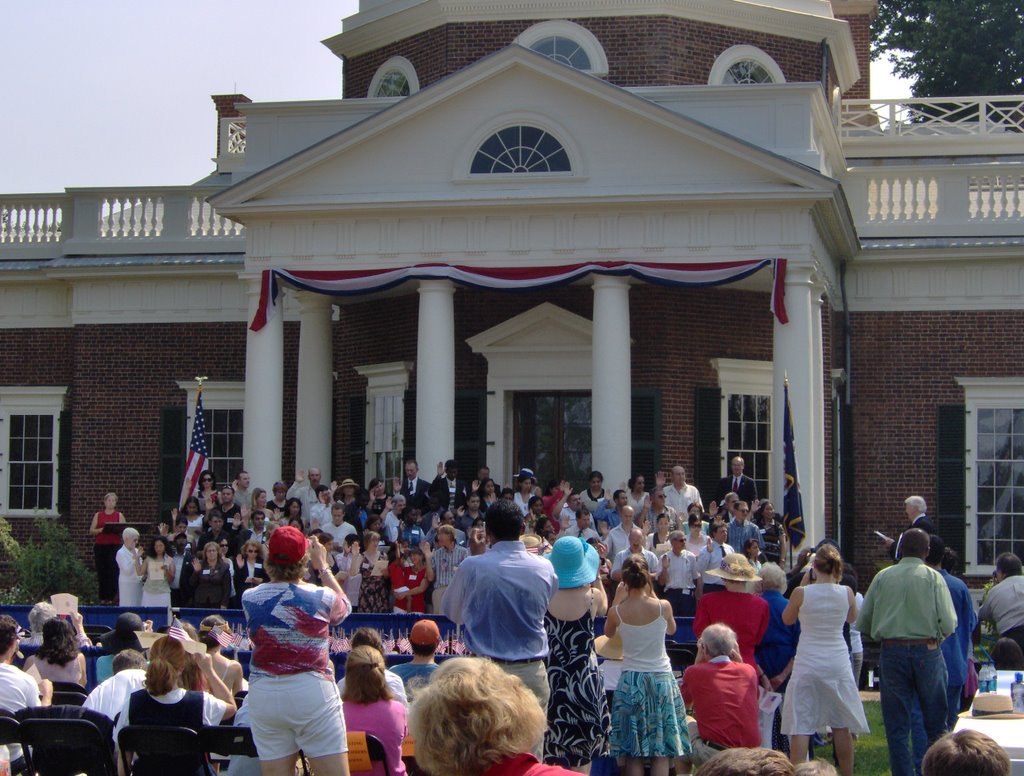
I hereby declare, on oath, that I absolutely and entirely renounce and abjure all allegiance and fidelity to any foreign prince, potentate, state, or sovereignty of whom or which I have heretofore been a subject or citizen; that I will support and defend the Constitution and laws of the United States of America against all enemies, foreign and domestic; that I will bear true faith and allegiance to the same; that I will bear arms on behalf of the United States when required by law; that I will perform noncombatant service in the Armed Forces of the United States when required by the law; that I will perform work of national importance under civilian direction when required by the law; and that I take this obligation freely without any mental reservation or purpose of evasion; so help me God.

In his own, brief remarks, Judge Jones evoked the memory of Judge James H. Michael, who presided over this ceremony for many years and who relished that role; as the Charlottesville Daily Progress noted in its report on his death last August:
One of Michael’s favorite duties, according to his family, was administering the oath of citizenship at Monticello each July Fourth.

“If I try to put my finger on Harry Michael, nothing better illustrates his philosophy or his notion of America than those annual nationalization ceremonies at Monticello,” said University of Virginia School of Law professor A.E. Dick Howard. “I found those talks very moving. There he was talking to newly minted American citizens about what brings us together, our common ground. I thought that . . . statement of Americanism to new citizens couldn’t be improved upon.”
Judge Jones then introduced Fourth Circuit Judge J. Harvie Wilkinson, who lives in Charlotttesville, who told the new citizens: "You refresh us and renew us and we just can't do without you."

"The great thing about America," Judge Wilkinson said, is that "it doesn't matter when your ancestors came. . . . You and I step forward as Americans and fellow citizens." Regardless of when our ancestors came or where they came from, "we're thinking about the future right now. We want an America where there is opportunity and not artificial obstacles."

Judge Wilkinson asked the newly naturalized to "think of how much you did to get here -- how many interviews you did, how many forms you filled out" and then noted that "today is a two-way street. It's not about us telling you, it's about you telling us what America means." He then joined Judge Jones in inviting the new citizens to come to the microphone to say a few words. Several did, almost all expressing pride in being U.S. citizens, with one woman saying she would "die for this country" and others going out of their way to give thanks for all the good things America does around the world. A few just barely choked back tears.

When the remarks ended, Judge Jones asked World War II veteran Earl V. Thacker, Jr., to lead the large crowd in the Pledge of Allegiance.

The ceremonies ended with the Charlottesville Municipal Band playing the "Star-Spangled Banner," under the baton of James W. Simmons, who is retiring this year after 60 years with the band.

As the crowd dispersed, many of the new citizens took the opportunity to register to vote at a table staffed by the Albemarle County office of voter registration. It turns out that the entire Charlottesville Electoral Board was also present, along with some of our City election officials. Fortunately, we evaded a breach of the state open meetings law because there was no time when all three of us were together and we did not discuss official business. (I didn't see any of the County Electoral Board members, though they might have been mingling with the throngs of new citizens and well-wishers.)

For anyone who is a citizen of the United States by birth rather than effort, attending a ceremony like this can be quite instructive. I recommend it as something to do at least once, if not annually.

"Thoughts" for Independence Day

From an Independence Day reflection written by anti-war activist Cindy Sheehan, as she flatly abandons principled dissent and replaces it with Chomskyite babbling:

The star-spangled banner, which I can now see whipping in the wind outside an airport terminal where I am writing this, does not fill me with pride: it fills me with shame, and that flag symbolizes sorrow and corruption to me right now. The flag represents so much lying, fixed elections, profiting by the war machine, high gas prices, spying on Americans, rapid erosion of our freedoms while BushCo literally gets away with murder, torture and extreme rendition, contaminating the world with depleted uranium, and illegal and immoral wars that are responsible for killing so many. A symbol that used to represent hope to so many around the world now fills so many with disgust.
Don't hold back, Cindy: Tell us what you really think.

The Declaration of Independence


What better way to begin Independence Day than with a reading of the Declaration of Independence? The text here was cribbed from the Cato Institute's web site. (Cato has published the Declaration, along with the U.S. Constitution, in a handy pocket-sized book. There are certain Members of Congress who claim to carry a copy of these documents with them at all times, though there is little evidence that they ever remove the booklets from their pockets in order to read them.)

In Charlottesville, a copy of the Declaration of Independence that was printed in Philadelphia on the evening of July 4, 1776 -- that is, one of the original copies -- is on display at the University of Virginia. The Richmond Times-Dispatch includes this exhibit in its round-up of July 4th events:

"Declaring Independence: Creating and Re-Creating America’s Document" at the Mary and David Harrison Institute for American History, Literature and Culture and the Albert and Shirley Small Special Collections Library on the University of Virginia campus. The exhibit features printings of the Declaration of Independence, letters, documents and a 13-minute documentary film regarding the history of America. Guided tours of the exhibit are available. Groups of 10 or more should call (434) 982-4548 for reservations. Runs 9 a.m. to 5 p.m.; admission is free and the event is open to the public.
Now, on with the Declaration:
The Declaration of Independence of the Thirteen Colonies

In CONGRESS, July 4, 1776

The unanimous Declaration of the thirteen United States of America,

When in the Course of human events, it becomes necessary for one people to dissolve the political bands which have connected them with another, and to assume among the powers of the earth, the separate and equal station to which the Laws of Nature and of Nature's God entitle them, a decent respect to the opinions of mankind requires that they should declare the causes which impel them to the separation.

We hold these truths to be self-evident, that all men are created equal, that they are endowed by their Creator with certain unalienable Rights, that among these are Life, Liberty and the pursuit of Happiness. --That to secure these rights, Governments are instituted among Men, deriving their just powers from the consent of the governed, --That whenever any Form of Government becomes destructive of these ends, it is the Right of the People to alter or to abolish it, and to institute new Government, laying its foundation on such principles and organizing its powers in such form, as to them shall seem most likely to effect their Safety and Happiness. Prudence, indeed, will dictate that Governments long established should not be changed for light and transient causes; and accordingly all experience hath shewn, that mankind are more disposed to suffer, while evils are sufferable, than to right themselves by abolishing the forms to which they are accustomed. But when a long train of abuses and usurpations, pursuing invariably the same Object evinces a design to reduce them under absolute Despotism, it is their right, it is their duty, to throw off such Government, and to provide new Guards for their future security. --Such has been the patient sufferance of these Colonies; and such is now the necessity which constrains them to alter their former Systems of Government. The history of the present King of Great Britain [George III] is a history of repeated injuries and usurpations, all having in direct object the establishment of an absolute Tyranny over these States. To prove this, let Facts be submitted to a candid world.

He has refused his Assent to Laws, the most wholesome and necessary for the public good.

He has forbidden his Governors to pass Laws of immediate and pressing importance, unless suspended in their operation till his Assent should be obtained; and when so suspended, he has utterly neglected to attend to them.

He has refused to pass other Laws for the accommodation of large districts of people, unless those people would relinquish the right of Representation in the Legislature, a right inestimable to them and formidable to tyrants only.

He has called together legislative bodies at places unusual, uncomfortable, and distant from the depository of their public Records, for the sole purpose of fatiguing them into compliance with his measures.

He has dissolved Representative Houses repeatedly, for opposing with manly firmness his invasions on the rights of the people.

He has refused for a long time, after such dissolutions, to cause others to be elected; whereby the Legislative powers, incapable of Annihilation, have returned to the People at large for their exercise; the State remaining in the mean time exposed to all the dangers of invasion from without, and convulsions within.

He has endeavoured to prevent the population of these States; for that purpose obstructing the Laws for Naturalization of Foreigners; refusing to pass others to encourage their migrations hither, and raising the conditions of new Appropriations of Lands.

He has obstructed the Administration of Justice, by refusing his Assent to Laws for establishing Judiciary powers.

He has made Judges dependent on his Will alone, for the tenure of their offices, and the amount and payment of their salaries.

He has erected a multitude of New Offices, and sent hither swarms of Officers to harass our people, and eat out their substance.

He has kept among us, in times of peace, Standing Armies without the consent of our legislatures.

He has affected to render the Military independent of and superior to the Civil power.

He has combined with others to subject us to a jurisdiction foreign to our constitution and unacknowledged by our laws; giving his Assent to their Acts of pretended Legislation:

For Quartering large bodies of armed troops among us:

For protecting them, by a mock Trial, from punishment for any Murders which they should commit on the Inhabitants of these States:

For cutting off our Trade with all parts of the world:

For imposing Taxes on us without our Consent:

For depriving us, in many cases, of the benefits of Trial by Jury:

For transporting us beyond Seas to be tried for pretended offences:

For abolishing the free System of English Laws in a neighbouring Province, establishing therein an Arbitrary government, and enlarging its Boundaries so as to render it at once an example and fit instrument for introducing the same absolute rule into these Colonies:

For taking away our Charters, abolishing our most valuable Laws, and altering fundamentally the Forms of our Governments:

For suspending our own Legislatures, and declaring themselves invested with power to legislate for us in all cases whatsoever.

He has abdicated Government here, by declaring us out of his Protection and waging War against us.

He has plundered our seas, ravaged our Coasts, burnt our towns, and destroyed the lives of our people.

He is at this time transporting large Armies of foreign Mercenaries to compleat the works of death, desolation and tyranny, already begun with circumstances of Cruelty and perfidy scarcely paralleled in the most barbarous ages, and totally unworthy the Head of a civilized nation.

He has constrained our fellow Citizens taken Captive on the high Seas to bear Arms against their Country, to become the executioners of their friends and Brethren, or to fall themselves by their Hands.

He has excited domestic insurrections amongst us, and has endeavoured to bring on the inhabitants of our frontiers, the merciless Indian Savages, whose known rule of warfare, is an undistinguished destruction of all ages, sexes and conditions.

In every stage of these Oppressions We have Petitioned for Redress in the most humble terms: Our repeated Petitions have been answered only by repeated injury. A Prince whose character is thus marked by every act which may define a Tyrant, is unfit to be the ruler of a free people.

Nor have We been wanting in attentions to our British brethren. We have warned them from time to time of attempts by their legislature to extend an unwarrantable jurisdiction over us. We have reminded them of the circumstances of our emigration and settlement here. We have appealed to their native justice and magnanimity, and we have conjured them by the ties of our common kindred to disavow these usurpations, which, would inevitably interrupt our connections and correspondence. They too have been deaf to the voice of justice and of consanguinity. We must, therefore, acquiesce in the necessity, which denounces our Separation, and hold them, as we hold the rest of mankind, Enemies in War, in Peace Friends.

We, therefore, the Representatives of the united States of America, in General Congress, Assembled, appealing to the Supreme Judge of the world for the rectitude of our intentions, do, in the Name, and by the Authority of the good People of these Colonies, solemnly publish and declare, That these United Colonies are, and of Right ought to be Free and Independent States; that they are Absolved from all Allegiance to the British Crown, and that all political connection between them and the State of Great Britain, is and ought to be totally dissolved; and that as Free and Independent States, they have full Power to levy War, conclude Peace, contract Alliances, establish Commerce, and to do all other Acts and Things which Independent States may of right do. And for the support of this Declaration, with a firm reliance on the protection of divine Providence, we mutually pledge to each other our Lives, our Fortunes and our sacred Honor.

Idi Amin and the Raid on Entebbe

Aside from being the 230th anniversary of American independence, the Fourth of July this year marks the thirtieth anniversary of the raid on Entebbe airport by Israeli commandos, who rescued some 100 Jewish hostages from an Air France passenger jet that had been hijacked by Palestinian and German terrorists. The Ugandan government, then under the control of strongman Idi Amin, assisted the hijackers by allowing them to land the plane at the Entebbe airport, not far from Uganda’s capital city, Kampala, and offering the protection of the army.

In a pre-dawn operation, as recalled by the BBC, “Ugandan soldiers and the hijackers were taken completely by surprise when three Hercules transport planes landed after a 2,500-mile trip from Israel. About 200 elite troops ran out and stormed the airport building. During a 35-minute battle, 20 Ugandan soldiers and all seven hijackers died along with three hostages.”

Although at the time much of the attention focused on the drama of the lighting-quick raid, it also had long-term political implications, because the raid embarrassed and ultimately undermined the dictatorial regime of Idi Amin, who did not so much govern Uganda as reign over it through cruelty and terror. Ugandans had an expression in those days, saying that Amin “ruled by helicopter.” That is, whenever someone in a village somewhere in the country did something that displeased him, he sent helicopters to destroy the village and kill all those who lived in it. Over time, Amin murdered more than a million Ugandans, sent countless others into exile, and destroyed the country’s economic vitality and infrastructure.

The raid on Entebbe showed Idi Amin to be a sham as well as a coddler of terrorists. As Charles Onyango-Obbo wrote in a 1997 article in The East African newspaper, the “raid was a personal humiliation for Amin, and a defeat for his hated army. For a country which had resigned itself to Amin ruling as long as he wished, July 4, 1976, shattered his aura of invincibility. Nothing Amin did after that could rebuild his grip on the country.”

Ten years after Amin was finally deposed, I wrote a review of a book about him and two other African dictators who also lost their thrones in 1979. The review ran in the New York City Tribune, a now-defunct sister publication of the Washington Times. During the 1980s, I wrote a lot of articles for that paper. In fact, while I was in graduate school, weekly articles and book reviews provided me with a meager amount of pocket money that allowed me to continue to buy theatre tickets and restaurant meals as my stipend drained away.

I dug up a copy of that book review as I recalled today’s anniversary of the raid on Entebbe, because I thought its capsule summary of Amin’s reign of terror deserved a bit of remembrance.

From the New York City Tribune, March 6, 1989:

Tales of Three African Dictators That Spin a Cautionary Lesson

Psychoses of Power: African Personal Dictatorships, by Samuel Decalo, Westview Press, 197 pp., $29.95.

“Solitary, poor, nasty, brutish, and short,” were the words Thomas Hobbes used to describe life in the “state of nature,” which he also called a “war of all against all.” Hobbes, writing in the 17th century, was probably remembering the not-so-distant history of Europe in the Middle Ages. In the absence of strong central government, anarchy ruled the land. Feudal barons, ready to feed their own venal appetites, warred against each other, against the king, against the Church. Each generation experienced at least one war that, through battle or disease, cut down large fractions of the population.

That is all in the past. Or is it? Psychoses of Power, three frightening case studies by Samuel Decalo, currently visiting professor of comparative African government at the University of Natal, reveals that the 20th century does not lack Hobbesian anarchy. Neither are the subjects of his study – Francisco Macias Nguema of Equatorial Guinea, Idi Amin of Uganda, and Jean-Bedel Bokassa of the Central African Republic – necessarily anomalies. The germ of economic decay and political disarray that grew into their monstrous personal dictatorships exists in other African countries, ready to sprout under the right conditions.

These personal dictatorships differ substantially from merely authoritarian or autocratic regimes elsewhere in Africa (and elsewhere in the Third World, as well). Authoritarian dictators see fit to delegate power when necessary. Although they may be corrupt and dispense patronage for their own financial benefit, they do allow others to make policy decisions and exercise the authority granted them by the dictator. Personal dictators like Nguema, Amin, and Bokassa insist on excercising total authority, making all decisions, and dispensing all patronage. Chaos results.

In the case of Nguema and Amin, and partially in the case of Bokassa, men fundamentally unprepared to hold responsible public office became leaders of strife-ridden former colonies. Amin was totally illiterate and found policy discussions among Cabinet ministers boring and irrelevant. Nguema was a sycophant and drug addict who hated knowledge and success. Bokassa, although by all accounts a courageous and competent soldier, was greedy and lacked judiciousness.

Although the rise to power of these three men was largely accidental, the parallels are startling.

Amin started as a cook’s assistant in the Ugandan colonial army; the British, anxious to Africanize the services, on several occasions overlooked bad reviews of Amin’s suitability and promoted him. He eventually became chief of staff, the post that allowed him to lead the coup that ousted Milton Obote when Obote’s economic policies failed and he began to lose political legitimacy.

Nguema began as a petty local bureaucrat. The Spanish colonial rulers and Spanish expatriate businessmen liked him, because unlike his fellow Fang tribesmen, he supported Spanish interests. With the support of his relatives, he became the most bloodthirsty dictator in recent African history.

Bokassa, as noted, was a brave soldier. He fought in the French army in Vietnam and was decorated for valor. The French authorities respected Bokassa and named him to head the Central African Republic’s army upon independence. Economic and social confusion under the president of the CAR made it apparent that a new regime might sack Bokassa. To forestall that, he led a coup on New Year’s Eve in 1965, and installed himself as dictator.

Although the least known of the three, Nguema was probably the bloodiest. He exterminated all of his subjects who had better than a third-grade education. Refugees from Equatorial Guinea flooded neighboring countries. Nguema personally ruined the country’s economy, keeping all foreign (and much domestic) currency in suitcases in his bedroom. He retreated into sorcery, threatening any opposition that upon his death he would return as a vicious tiger to destroy them.

Amin’s story is better known, perhaps because he became an international joke. His buffoonery, however, resulted in genocide. Because he lacked interest in public policy, no genuine policies were made during his reign. One significant decision, however, did have substantial impact on Uganda’s future. In 1973, he expelled all Asians from the country. In one fell swoop, Uganda’s entrepreneurial class left. Shops, factories, and services ended, as did exports and imports. Although politically popular for racist reasons, this decision destroyed the Ugandan economy, and recovery is unlikely in our lifetimes.

Bokassa made world headlines in 1977 when he proclaimed himself emperor of the Central African Empire. Modeling his coronation after Napoleon’s, he crowned himself when the Pope declined to do the job. At first the French supported him, but even they could no longer be relied upon after Bokassa himself clubbed to death schoolchildren who in 1979 protested the mandatory wearing of school uniforms with Bokassa’s image on them. French paratroopers moved in, deposing Bokassa. Several thousand French troops remain today, making the Central African Republic a virtual French colony, despite the rhetoric of independence.

Life has not improved for the residents of these African countries since their dictators were deposed. In Equatorial Guinea and Uganda, new dictators came to power. In Equatorial Guinea, Nguema’s own henchmen ousted him when he became too unpredictable. They remain in power and continue the terror. In Uganda, Milton Obote returned and after presiding over the genocide of as many as 400,000 Ugandans, he was again overthrown. Tyranny has been tempered by the French presence in the CAR, but there is little hope for the future.

The lessons of these three case studies are not clear. Certainly the three dictators were idiosyncratic, maladjusted, and just plain mad. But other dictators remain in Africa, even if slightly more benign: Kenneth Kaunda in Zambia, Mobutu Sese Seko in Zaire, Kamuzu Banda in Malawi. Yet it is frightening to note that while heads of state, Nguema, Amin, and Bokassa each retained a measure of respectability within the international community.

Their crimes were ignored for raison d’etat. An eerily similar respectability was granted Hitler, Mussolini, and Stalin in their time, and the international community pays little attention to what goes on in places like Zambia, Zaire, and Malawi today.

Psychoses of Power deserves whatever attention it gets from policymakers, human rights activists, and international bureaucrats. I fear that too many readers will look at it as an interesting case study of political freaks with little to say about the present or future. They should look more carefully at current conditions in the Third World and ask themselves: Are these personal dictatorships really so strange?

Richard Sincere is a research associate at the Ethics and Public Policy Center in Washington, D.C.

The Citizenship Test

ImNotEmeril has a link to an online citizenship test that asks some of the same questions that immigrants seeking naturalization have to answer. Not surprisingly, he passed with flying colors. Or, as he puts it, "I get to stay."

Me, too.

How well will you do?

You Passed the US Citizenship Test

Congratulations - you got 10 out of 10 correct!

Frankly, the questions seemed a bit simplistic. So I have to wonder if the test is an authentic example of what candidates for naturalization actually face.

Don't forget to visit ImNotEmeril if you're thinking about attending the Blogs United conference in Martinsville in August. He notes that registration is open and has a link to the conference web site, Blogs United in Martinsville for Free Speech.

Speaking of naturalization, I'm planning to attend the annual Independence Day ceremony to swear in new citizens at Monticello this morning. I have been to several previous ceremonies -- my first time, in 2000, Secretary of State Madeleine Albright was the speaker, and in subsequent years I've heard author Frank McCourt, USA Today founder Al Neuharth, and last year's guest speaker, architect I.M. Pei.

This year's featured speakers are environmental artists Christo and Jeanne-Claude. If I'm able to do so, I'll report on the event later today.

Monday, July 03, 2006

Mask & Bauble at the Georgetown Reunion


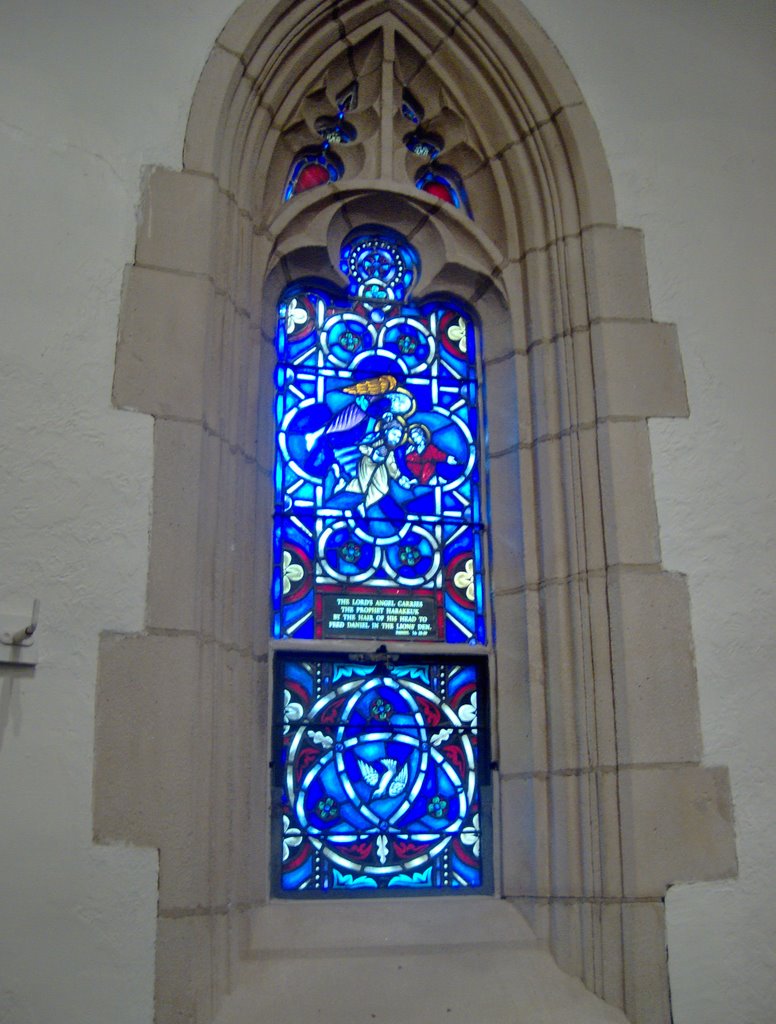
The image to your left is a stained-glass window in St. Thomas Aquinas Church in Charlottesville, Virginia, which serves the students of the University of Virginia as well as the wider community. (The parish is so large that it has to hold its Easter Sunday service at University Hall, the former basketball arena.)

Why, you may ask, does a window dedicated to St. Genesius begin a post entitled "Mask & Bauble at the Georgetown Reunion"? It's really rather simple. I took that picture some time ago because, as a Mask & Bauble alumnus, I remembered that our annual Jenny Awards -- the M&B equivalent of the Tonys or Oliviers -- were named for St. Genesius, the patron saint of actors. I knew that eventually I'd be able to put that photograph to use.

According to legend, as found in the Catholic Encylopedia, St Genesius was:

A comedian at Rome, martyred under Diocletian in 286 or 303. Feast, 25 August. He is invoked against epilepsy, and is honoured as patron of theatrical performers and of musicians. The legend (Acta SS., Aug., V, 119) relates: Genesius, the leader of a theatrical troupe in Rome, performing one day before the Emperor Diocletian, and wishing to expose Christian rites to the ridicule of his audience, pretended to receive the Sacrament of Baptism. When the water had been poured upon him he proclaimed himself a Christian. Diocletian at first enjoyed the realistic play, but, finding Genesius to be in earnest, ordered him to be tortured and then beheaded. He was buried on the Via Tiburtina. His relics are said to be partly in San Giovanni della Pigna, partly in S. Susanna di Termini and in the chapel of St. Lawrence. The legend was dramatized in the fifteenth century; embodied in later years in the oratorio "Polus Atella" of Löwe (d. 1869), and still more recently in a work by Weingartner (Berlinn 1892). The historic value of the Acts, dating from the seventh century, is very doubtful, though defended by Tillemont (Mémoires, IV s. v. Genesius). The very existence of Genesius is called into question, and he is held to be a Roman counterpart of St. Gelasius (or Gelasinus) of Hierapolis (d. 297). He was venerated, however, at Rome in the fourth century: a church was built in his honour very early, and was repaired and beautified by Gregory III in 741.
This post is long overdue. Persistent computer problems early in the month delayed it unmercifully. At one point, I had completed the entire composition, only to lose it due to faulty equipment (or a bad internet connection) at FedEx Kinko's. (The manager kindly returned the money I had paid for the hour-long session.) So, I am trying one more time, in the hopes that I can get these photos on-line precisely one month after the event. So here goes.

During the Georgetown Reunion weekend of June 1-4, some 30 M&B alumni from the Class of 1981 (and chronologically close classes) met on the fringe of the official reunion activities. Early Saturday evening, Dave Lewis and his wife, Cheryl, hosted a cocktail party for us at the Four Seasons hotel in Georgetown before we went back up to the Hilltop for the official class party in O'Donovan Hall.

I snapped a few photos at the M&B party -- fewer than I should have, but we were all too busy having a good time and engaging in conversation (and drinking and reminiscing) to take pictures.

"Mingling with that old-time crowd..."


Joe Banno, Elizabeth Robelen, and Scott Pilarz


Marguerite Conrad, Pete Doragh, Todd Bernhardt


Our host, Dave Lewis, in the center, with Jim Hemelt partially obscured and Karin Hammer in the background; Carolyn Patterson's profile is in the foreground


Rick Lombardo makes a point


Not technically M&B: Later in the evening, I ran into some old friends from the Arts Hall Project -- Dawn Mancuso, Virginia McGrane (who had been at the M&B cocktail party, too), Vincent Santiago, and Victoria Robinson


Since I started with a stained-glass window from Charlottesville, I thought I'd end this piece with a couple of examples of stained glass from Georgetown.

On Saturday afternoon, the Class of 1981 gathered in St. William's Chapel in Copley Hall (once the home of the famed "Freeze's Breeze") for Mass. On the day we graduated in 1981, the homilist at our Baccalaureate Mass that day was the Reverend Otto Hentz, S.J. He concelebrated the Mass on June 3 this year with the Reverend Scott Pilarz, S.J. (see above, out of uniform). Music was provided by a group that Scott called "the Mask & Bauble Choir" consisting of Wendy Campagna, Marguerite Conrad, Trish Sullivan, and myself. After Mass, I snapped a few shots of some of the gothic-style decorations in the chapel, including this crucifix:


... and these stained-glass windows behind the altar:


Wednesday, June 28, 2006

Flag Fetishization Fails


Shame on the United States Senate! On Tuesday, the world's greatest deliberative body came within one vote of amending the U.S. Constitution to permit Congress to ban flag burning and other forms of flag desecration.

Thanks to the votes of two principled conservatives -- Republican Senators Robert Bennett of Utah and Mitch McConnell of Kentucky -- the amendment failed to get the necessary two-thirds majority to be forwarded to the states for ratification

Still, with 66 votes in favor, that means that 14 Democrats and 52 Republicans have so little respect for the Bill of Rights that they are willing to amend it for rancidly demagogic, election-year gain.

The "conservative" case for flag-burning bans -- laws that would put the United States in the rarefied company of Communist China, Castro's Cuba, theocratic Iran, and Iraq before the overthrow of Saddam Hussein -- rests on the thin reed that flag desecration is disrespectful to U.S. armed forces who fought for freedom in foreign wars.

Balderdash! The most effective and poignant arguments against the amendment come from battle-scarred veterans. For instance, notes Charles Babington in today's Washington Post:

Flag burning "is obscene, painful and unpatriotic," Sen. Daniel K. Inouye (D-Hawaii), who lost an arm in World War II, said in a floor speech yesterday. "But I believe Americans gave their lives in the many wars to make certain that all Americans have a right to express themselves -- even those who harbor hateful thoughts."
After noting the opposition to the amendment of his own father, who flew 33 combat missions over Nazi Germany, Jonathan Alter writes in Newsweek of two other prominent veterans:
Our understandable outrage at flag burning shouldn’t turn our brains to mush. “I feel the same sense of outrage, but I would not amend that great shield of democracy [the Constitution] to hammer a few miscreants,” Colin Powell said when the issue last came up (his position has not changed). “The flag will be flying proudly long after they have slunk away.” Powell argues that a constitutional ban on flag burning is a sign of weakness and fear. Note: The other countries that have banned flag burning include Cuba, China, Iran and Saddam Hussein’s Iraq.

John Glenn, another of the thousands of combat veterans against the amendment (they have banded together in a group called Veterans Defending the Bill of Rights), notes that “those 10 amendments we call the Bill of Rights have never been changed or altered by one iota, not by one word, not a single time in all of American history. There was not a single change during any of our foreign wars, and not during recessions or depressions or panics. Not a single change when we were going through times of great emotion and anger like the Vietnam era, when flag after flag was burned or desecrated. There is only one way to weaken our nation. The way to weaken our nation would be to erode the freedom that we all share.”
I have written about this issue before, most recently last month, when I cited stories (by Nat Hentoff and libertarian Republican Tom Walls) about veterans who oppose the flag-burning amendment. In that post, I linked the proposed amendment to other attempts by Congress and the Bush administration to circumscribe our First Amendment right to free speech.

In a blogpost last year (when the amendment was being considered by the House of Representatives), John Scalzi described how an anti-flag-burning law could be circumvented, noting:
"Protecting" the flag with a Constitutional Amendment won't solve the not-at-all pressing problem of people burning flags for political protest. They'll still do it. They'll simply do it in ways that will now additionally mock the stupidity of those who love the symbol of American freedoms more than they love actual American freedoms. And no matter how expansively Congress defines "the American Flag" there will always be something that is not the flag, but is close enough in its shape and structure to feel just like the flag. And there will be the people who will use that not-quite-flag-like object to protest.
In an article originally written for the libertarian publication, The Freeman, blogger Doug Mataconis of Below the Beltway cut to the logical core of the flag-burning "debate":

In adopting the position of the opponents of the Supreme Court decision, one would have to accept the seemingly contradictory idea that in order to protect the symbol of a nation founded on individual liberty, one must restrict individual liberty. Taking this position also leads one into dangerous territory in relation to other areas of action or thought and the effect that they might have on the rest of society. After all, if flag burning can be banned because a majority of the public are offended by an attack on what they believe to be a sacred symbol, then why not extend the ban into other areas where an individual’s actions might be offensive to others? If we ban flag burning, then why not ban movies or books that depict in an offensive way religious figures or other subjects considered to be sacred? Why not ban magazines, films, or groups that offend the sensibilities of women, blacks, Jews, or any other minority group?

A person who opposes flag burning may argue that he would not extend his logic as far as that in the above examples. But the reasoning behind these examples and that behind flag burning are of the same majoritarian parentage: the belief that if a sufficiently large number of people find an activity offensive then they can use the coercive power of the state to regulate or, preferably, to ban that activity.

The problem, then, with taking the position that the flag should be protected even at the expense of individual liberty is not that flag burning or any other activity deemed to be offensive has some sort of redeeming value, or that symbols such as the flag are unimportant, but that in banning these activities, one is accepting a principle that is ultimately destructive of a free society. By accepting this principle, we are allowing for the creation of a society wherein appropriate expressions of patriotism, appropriate forms of artistic expression, and appropriate activities are decided by a process of majority rule that, rather than minimizing conflict in society, heightens it to a dangerous degree.

Mitch McConnell has proven to be a real hero to those who value the First Amendment, even while so many of his Senate colleagues regard it with contempt. McConnell spearheaded the drive to defeat the McCain-Feingold campaign finance reform law, which places limits on political speech. (Oddly, Senator John McCain voted for the speech limitations of the flag burning amendment, while Senator Russ Feingold voted against it. No one has accused politicians of consistency in their lack of principle.)

I am glad that I am writing about the amendment's defeat today. That is one less bit of political pandering we have to worry about in the future. That is, until the next federal election year.

Tuesday, June 27, 2006

Twin Carnivals

Jason Kenney hosts this week's Virginia Blog Carnival, presenting it in a carnival-barker style that compels you to look behind the side-show curtain to take a peak at the freaks.

A couple of excerpts:

That guy who isn't that chef Emeril (but still makes a kick ass chicken and veggie dish from what I hear) has some thoughts on the Gay Marriage Amendment. If those don't tickle your fancy, consider this: If you take the tile of his post "My Thoughts On The Gay Marriage Amendment" and translate it to French using AltaVista's BabelFish and then translate it back into English, it becomes "My Thoughts On The Merry Amendment Of Marriage". So just by using the title and translations, we can all assume that he and everyone else who speaks of this "Gay Marriage Amendment" think it's a merry thing to do. Or so the French would have us believe. On a side note (because I've been staying on topic up to now), I'm Not Emeril's favorite Beatle is the recently late Billy Preston....

Kilo ventures into the great unknown and pulls back the curtain on the bearded lady we all know and love as Zogby Interactive.

Ghana knocked the US out of the World Cup tourney on Thursday and nobody in Virginia really cared....

Gasp in shock and horror as Rick Sincere recounts his lunchtime escapade with the one and only Dick Cheney!
Eerily and chillingly, Jason reveals the secret identity of well-known pseudonymous blogger The Jaded JD but mentions that next week's Virginia Blog Carnival host is so secret that not even a pseudonym is known. (Details about how the VBC works are posted at Commonwealth Conservative.)

Jason also notes that there is a special-edition carnival rounding up all of the postings about this month's Virginia bloggers' summit in Charlottesville. This is hosted by Semi-Truths, and it turns out that there were more reports on the conference posted than I thought. (I count 23 or 24 separate entries -- maybe more.) That Sorensen Institute: it motivates people!

While we're on the subject of writing on the Internet, let me close with a bit of doggerel I found in Ernest Lefever's new book, Liberating the Limerick. This is attributed to Maynard Kaplan:
A third grader who lives in Bucyrus
Has unleashed a computerized virus
That endangers us all
In large countries and small,
Excepting those still using papyrus.

Thursday, June 22, 2006

Karen Hospital Revisited

To my surprise, one of the more popular posts on this blog has been my collection of photographs of Karen Hospital near Nairobi, which I took a couple of weeks before the hospital opened.

In the Congressional Record this week, Representative Edolphus Towns (D-New York) pays tribute to the Karen Hospital, which he asserts should be receiving more attention from the MSM. (It certainly seems that the first new hospital built in Kenya in some 50 years would be newsworthy, especially since the project was completed largely using private funds and donations of equipment.)

Here is Congressman Towns' speech, as it appears in the Congressional Record of June 20:

KAREN HOSPITAL -- (Extensions of Remarks - June 20, 2006)
---

SPEECH OF
HON. EDOLPHUS TOWNS
OF NEW YORK
IN THE HOUSE OF REPRESENTATIVES
TUESDAY, JUNE 20, 2006

Mr. TOWNS. Mr. Speaker, a few months ago, there was an historic moment that was, sadly, underreported by the news media in this county and in much of the rest of the world. It is only recently that I came to learn of it and I wish to bring it to the attention of this House.

On March 31, outside of Nairobi, Kenya, there was a dedication ceremony for the Karen Hospital, which is the first full-service hospital opened in Kenya since the colonial era, before that country became an independent state within the community of nations.

Karen Hospital is located in the Nairobi suburb of Karen, which many will recognize as the setting for the movie, ``Out of Africa,'' which told the story of author Isak Dinesen, who used the pen name Karen Blixen, and who lived and worked in Kenya and wrote about that country and her love for it.

The opening of Karen Hospital has important implications for health care in Kenya and throughout East Africa. This state-of-the-art facility will provide opportunities for teaching health-care professionals--not just doctors, but nurses, administrators, orderlies, and others--who will bring their knowledge and skills into cities and villages across the region.

When Karen Hospital was opened formally, its chief executive officer, Dr. Betty Gikonyo--who received her medical education in the United States--made a speech, in the presence of President Mwai Kibaki, that reflected the pride and hard work of bringing this hospital from a mere conception to a full-fledged operating unit serving the people of Kenya.

Mr. Speaker, if there is no objection, I would like to place excerpts of the address by Dr. Gikonyo in the CONGRESSIONAL RECORD. Such a historic occasion deserves to be paid much more attention than it has so far received.

EXCERPTS FROM A SPEECH BY DR. BETTY GIKONYO, CHIEF EXECUTIVE OFFICER, THE KAREN HOSPITAL, FRIDAY, MARCH 31, 2006


We have gathered here to celebrate a special day, which will form a milestone in the history of The Karen Hospital. 21 years ago a dream was born, nurtured over the years and now realized. Over the last 10 years we have gone through a process of feasibility studies, consultation, intense planning resulting in a business plan for the Karen Hospital. The search for a financier was not an easy one and it took us over 5 years to convince financial institutions that a medical business is a viable option. We kept on knocking at their doors. Nevertheless some doors were open. We received some offers from both regional and local banks. In consultation with our financial advisers opted for a loan in Kenya Shillings that could finance the two major components of the project which are including building and acquisition of medical equipment. Your Excellency Sir, please, allow us to thank the Kenya Commercial Bank, for believing in our vision and trusting the business plan of a local investor. Kenya Commercial Bank took the risk and proudly partnered with us in undertaking a project of this magnitude. To the KCB Board of Directors and Management Asanteni Sana. You have worked closely with in the formation of this project to see it conclude successfully.

Medical equipment are an expensive undertaking and we wish to recognize Philips Medical Systems Netherlands and Frescenius Renal Supplies of Germany who entered into equipment financing credit plans to enable us to equip the hospital with ultra modem state of the art equipment in all departments as Your Excellency has had an opportunity to see.

This has been achieved through hardwork, commitment and consistency of purpose by a team of financial consultants, medical consultants, hospital engineers and building and civil engineers and a dedicated contractor and sub-contractors. By following the clearly laid out rules we were able to import clear all equipment in good time for installation.

The hospital building comprises of 4 floors each with four wings thoughtfully planned to ensure all services are accessed with minimum effort and maximum convenience to our patients and staff.......

The Karen Hospital is a world class ultra modern health facility bringing quality healthcare not only to Kenyans but also to Eastern and Central Africa but beyond.

The 102 bed hospital serves patients with general ailments alongside specialized medical and surgical interventions. It has the newest ultra modern state-of-the art equipment, cardiac diagnosis, interventions and surgery, intensive care, kidney dialysis, Laparoscopic surgery, video Endoscopy and physiotherapy.......

[A] Hospital is however not made of building and equipment. Our most important resource is the highly trained and experienced personnel in all departments. Through competitive selection of the best qualified personnel Karen Hospital has been manned by the best Kenya can offer in all our departments both medical and non-medical. This includes our permanent staff as well highly experienced team of medical consultants who form the large panel of over 100 admitting doctors of different areas of specialization.

Your Excellency Sir, I am happy to inform you that we have been able to attend to 634 patients in our Accident and Emergency department. Some with major injuries including bullet assault cases and road traffic accidents. Additionally we have performed a number of surgeries, endoscopies and cardiac catheterizations and as you have seen a full wing of inpatients with varying ailments ranging from major surgeries to medical conditions are recuperating in our Sagana Ward. This confirms that Kenyans have already come to know, trust and use this facility in the last one month. We look forward to a full house in 6 months time. The performance so far has been very impressive and we are encouraged and grateful for the support Kenyans have given this facility at its inception.......

The City of Nairobi has been the hub of specialized medical services for the entire country as well as for the Eastern and Central Africa region. Indeed this has been realized in the month of March, as we have admitted referred patients from Tanzania (Daresalam), DRC Congo, Sudan (Khartoum), and Burundi (Bujumbura).

Referrals from the region not only is testimony to the high standard medical services available in Kenya but also affords us an opportunity to boost our inflow of foreign currency to enhance our economic growth. This is an area that can be expanded further by the establishment of highly specialized medical services in the private sector that would see greater number of referral from this population of over 100 million that forms the Eastern Africa community. We at The Karen Hospital has addressed this very specifically by incorporating in our hospital a cardiology program that spans from diagnosis to interventional non-evasive procedures and to heart surgery. We believe that more patients will be diverted from the exodus that sees patient travel to India, South Africa and Europe to seek some of these specialized services. As a new centre of medical excellence, we plan to market our services effervescently to the region and make Kenya a preferred destination for medical services.......

This will provide a forum for many to channel their energies, experiences, resources and to harness these positively towards our mission statement. I believe that many of us are cognizant of the benefits that come along with the integrated teaching and referral facility globally.

We at The Karen Hospital wish to compliment and be active participants in the implementation of the government policy of providing promotive, preventive and curative services. We believe there is room for the private sector to provide specialist tertiary medical institutions to compliment those existing in the government and indeed these are not in competition but rather in partnership. More facilities like Karen Hospital are needed in our countries especially in cities Like Mombasa Kisumu and Eldoret and also in the East African cities.

On behalf of the Board of Directors, Management, Staff of The Karen Hospital, may once again, thank you for joining us during this auspicious occasion.

In closing, allow me to quote Our Mentor and Teacher Dr. Sam Mwinzi, a renowned neurologist who is with us today and had this immortalized in our visitors book when he visited Karen Hospital, "May the portals of this magnificent edifice forever remain open and overflowing with those that seek better health as well as those that have the gift of giving it."

Wednesday, June 21, 2006

Yet Another Carnival of Liberty Is Up


So many carnivals, so little time.

The 50th installment of the Carnival of Liberty is now available to read at TuCents, which has quite an extensive selection of articles from around the freedom-loving portion of the blogosphere. Topics include free speech, personal responsibility, global warming, anarchy and natural rights, and airport security, among other issues of the day. My own piece on Dick Cheney at the National Press Club also made the cut.

Dave of TuCents notes:


Next week, the 51st Carnival of Liberty will be at Below The Beltway.
We'll be watching for it.

Tuesday, June 20, 2006

Breaking News from the Gay Games


Somehow I got put on a press list for Gay Games VII, which are taking place this year in Chicago. I just opened up my email box and found a news release that the games organizers felt was important enough to embargo until 6:00 p.m. CDT. Since it's nearly that time now, I figured I'd help them out by releasing it to my readers at the stroke of 7:00 p.m. EDT.

Unfortunately, I won't be attending the Gay Games -- which is the gay equivalent of the Olympics, though a Supreme Court case involving the Olympic trademark prevents the Gay Games from making that claim -- but I have lots of friends in Chicago who will probably join in the festivities.

Here is the news release as I received it (with the contact information removed):

MAYOR DALEY ANNOUNCES GATORADE® & ESPN® WILL SPONSOR GAY GAMES® CHICAGO 2006

ERASURE'S ANDY BELL TO PERFORM AT 15 JULY OPENING CEREMONY AT SOLDIER FIELD


CHICAGO - The City of Chicago announced today that British pop superstar Andy Bell of Erasure would perform at the July 15 Opening Ceremony for the 2006 Gay Games and that two of the world's most recognized brands - Gatorade and ESPN - had joined as major sponsors which now number more than 300 corporations and agencies signing to support the international event.

The announcement was made at the Mayor's annual Pride Reception, before more than 500 representatives of the lesbian, gay, bisexual & transgender (LGBT) community at the Chicago Cultural Center.

* Chicago-based QTG (Quaker/Tropicana/Gatorade) joins as a Global Gay Games Sponsor. Gatorade will be the Official Sports Drink of the 2006 Gay Games and will provide sideline hydration at all Gay Games sports. Tropicana and Quaker will be feeding the athletes and volunteers nutritious and wholesome breakfasts and snacks throughout the week.

* Erasure's Andy Bell will perform at the July 15 Opening Ceremony at Chicago's historic Soldier Field. Bell is just the latest star in the incredible lineup for the Gay Games VII Opening and Closing Ceremonies. Chicago organizers have previously announced performers include Cyndi Lauper, Margaret Cho, Megan Mullally, Jody Watley, Greg Louganis, M People's Heather Small, Kristine W, Star Trek's George Takei, Holly Near, Tony Award-winning Avenue Q, and dozens more talented performers and legends. Tickets are available online at Tickets.GayGamesChicago.org.

* ESPN, the leading international multimedia sports entertainment company, also joins in support of the Opening Ceremony, becoming the official sponsor of the Opening Ceremony Fireworks. The spectacular display will be visible throughout the Chicagoland area and will be videotaped by cameras aboard the MetLife blimp that will fly overhead. "ESPN respects the values that are intrinsic to athletic competition, and we are pleased to be a sponsor of this year's Gay Games," said John Skipper, ESPN Executive Vice President, Content.


About QTG (Quaker-Tropicana-Gatorade)
QTG (Quaker Tropicana Gatorade) is a division of PepsiCo, one of the world's largest consumer beverage and packaged goods companies. QTG brands rank among some of the most highly regarded and recognizable consumer products including: Quaker Oatmeal, Tropicana Pure Premium not-from-concentrate juices; Gatorade Thirst Quencher and Propel Fitness Water; Cap'n Crunch and Life ready-to-eat cereals; Rice-A-Roni and Near East side dishes; and Aunt Jemima pancake mixes and syrups.


About Gatorade®
Gatorade® Thirst Quencher, the nation's leading sports drink, is backed by 40 years of research. Gatorade is scientifically formulated and athletically proven to quench thirst, replace fluids and electrolytes and provide carbohydrate energy to enhance athletic performance. Gatorade is the official sports drink of the NFL, NBA, WNBA, AVP, NHL, Major League Baseball, Major League Soccer, and numerous professional, collegiate and amateur teams and events throughout the world. For more information, please visit www.gatorade.com.


About Andy Bell
Legendary U.K. synth pop pioneers Erasure, comprised of vocalist Andy Bell and keyboard wizard Vince Clarke, is among the most successful pop duos ever, selling more than 20 million albums and charting some of the most memorable hits of the last twenty years. The group got its start when Bell responded to a 1985 blind ad in a British music weekly seeking a singer that had been placed by Clarke, a founding member of the influential electronic groups Depeche Mode and Yaz. One of the first openly gay stars in pop, Bell's gender-bending performances, brilliant theatricality and soaring falsetto vocals have earned Erasure a special place in the heart and soul of its devoted fans. Bell recently released his first-ever solo CD, Electric Blue, which was soon followed by the release of Erasure's critically-acclaimed Union Street, its first-ever entirely acoustic album. Erasure has just completed a sold out tour of the U.K. and U.S. and plans to release and tour a new album next spring.


About ESPN®
ESPN, Inc. is the world's leading multinational, multimedia sports entertainment company featuring a portfolio of over 50 multimedia sports assets. The company is comprised of seven domestic television networks (ESPN, ESPN2, ESPN Classic, ESPNEWS, ESPN Deportes, ESPNU, ESPN Today), ESPN and ESPN2 HD simulcast services, ESPN Regional Television, ESPN International (networks, syndication, radio, web sites), ESPN Radio, ESPN.com, ESPN The Magazine, ESPN Enterprises, ESPN Zones (sports-themed restaurants), and other growing new businesses including ESPN360 (Broadband), Mobile ESPN, ESPN on Demand, ESPN Interactive and ESPN PPV. Based in Bristol, Ct., ESPN is 80 percent owned by ABC, Inc., which is an indirect subsidiary of The Walt Disney Company. The Hearst Corporation holds a 20 percent interest in ESPN.


About Gay Games VII
Gay Games VII Sports and Cultural Festival will take place 15-22 July 2006. Over 12,000 athletes from more than 70 countries will compete in 30 sports ranging from softball to dancesport, swimming to tennis. The weeklong event will include band, cheerleading and color guard performances, chorus, an ancillary arts festival, and a series of community-organized social events and parties. The opening ceremony is scheduled for 15 July at Soldier Field, the lakefront home stadium of American-style football's Chicago Bears. Closing ceremony will be 22 July at Wrigley Field, the home of Major League Baseball's Chicago Cubs, located in the heart of Chicago's largest LGBT neighborhood. Tickets are available at Tickets.GayGamesChicago.org.


Global sponsors of Gay Games VII include Lexiva; Logo; PlanetOut/Gay.com; Walgreens; Centaur Entertainment; Fleishman Hillard International Communications; Orbitz; McKnight Kurland Baccelli; The New York Times; Olivia Cruises & Resorts; Windy City Media Group; Absolut Vodka; American Airlines; Athletico; Chicago Free Press; Chicago Sun-Times; Ernst & Young; GLAAD; Genre; Human Rights Campaign; Lambda Legal Defense; QTG-Quaker/Tropicana/Gatorade; Sydney New Mardi Gras; Mate Magazine; Pink Magazine; RCN; Roosevelt University; and more than 270 additional business sponsors.


About The Gay Games
The Gay Games was conceived by Dr. Tom Waddell, an Olympic decathlete, and was first held in San Francisco in 1982 with 1,350 participants. Subsequent Gay Games have been held in San Francisco (1986; 3,500 participants), Vancouver (1990; 7,300 participants), New York (1994; 12,500 participants), Amsterdam (1998; 13,000 participants), and Sydney (2002; 11,000 participants).

The Federation of Gay Games is the international governing body that perpetuates the quadrennial Gay Games and promotes the event's founding principles of Participation, Inclusion, and Personal Best(tm). For more information, visit www.GayGames.org.

Chicago Games, Inc. is the host of Gay Games VII and is led by experienced civic leaders from Chicago's business, sports and non-profit sectors. For information about how to sponsor or participate in Gay Games VII in Chicago, visit www.GayGamesChicago.org, e-mail info@GayGamesChicago.org, or phone (773) 907-2006.
Unsolicited news releases: The lazy blogger's path to more content.

Monday, June 19, 2006

My Lunch with Dick Cheney

Through a confluence of happy accidents, I ended up spending a couple of hours today at the National Press Club, where Vice President Dick Cheney spoke at a luncheon honoring the recipients of the annual Gerald R. Ford Journalism Prizes. Cheney, you'll recall, served as Ford's White House Chief of Staff before serving in Congress and both Bush administrations.

Longtime readers of this blog will remember that I am an admirer of President Ford, who I rank with Ronald Reagan and Calvin Coolidge as among the most liberty-minded presidents of the 20th century, as all three aimed at restraining and shrinking the size and scope of government.

After lunch, I ran into Mark Rozell, a professor at George Mason University, who was one of the judges for the journalism prizes. I used to be a guest lecturer for Rozell when he taught at American University. While we were chatting near the elevators, former Secretary of State Henry Kissinger walked up to us. I extended my hand and said, "Dr. Kissinger, you probably don't remember me, but I was in your class at Georgetown 25 years ago." He seemed pleased to see me -- what teacher isn't glad to see a former student -- but the gentleman with him one-upped me. "I took his class 40 years ago!," he said, with a wink.

My table at the lunch was no more than 20 or 25 feet from the Vice President, so I got a few good photos. I was sitting between Senator Jon Kyl's press secretary and two gentlemen from the Red Chinese embassy, who were scribbling rapidly to take down as many of Cheney's words as possible.

I scribbled a few notes myself, which I turned into an article for this week's Metro Herald. To wit:

Cheney Speaks Out on War on Terror, Iraq, Government Secrecy
Rick Sincere
Special to the Metro Herald

(WASHINGTON) --- Vice President Dick Cheney was the featured speaker on Monday, June 19, at a National Press Club awards ceremony. In response to questions from the audience, Cheney spoke out on the war on terror, the war in Iraq, and government secrecy.

Cheney spoke at the annual luncheon ceremony, sponsored by the Gerald R. Ford Foundation, for the presentation of two journalism prizes named for the former president. The award recipients were Tom DeFrank of the New York Daily News, for his reporting on the presidency, and Mark Mazzetti of the New York Times, for his reporting on national defense issues while working for the Los Angeles Times.

National Press Club president Jonathan Salant introduced Cheney as “pinch-hitting for Gerald Ford,” since Ford, who will turn 93 on July 14, was unable to attend the luncheon.

Cheney began his remarks by noting that his own history with President Ford goes back to 1974, when Donald Rumsfeld became Ford’s chief of staff and Cheney was Rumsfeld’s deputy. Later, when Rumsfeld became Ford’s Secretary of Defense, Cheney was promoted to White House Chief of Staff – later serving 10 years in Congress, a term as Secretary of Defense, as CEO of Halliburton, and today as vice president.

The Vice President noted that Ford served a short term – only 29 months – but because of the turbulent times, the “pace of activity was enough to fill an eight-year presidency.”

Paying tribute to Ford, Cheney said that “through all of this, America was extremely fortunate to have a steady hand at the wheel.”

“In every respect,” he said, “Gerald Ford labored hard at his job and he was good at it,” adding: “Gerald Ford is the kind of person whose good qualities appear on first impression and are only confirmed when you spend time with him.”

Joking with the audience, which consisted largely of members of the Washington press corps, Cheney continued: “President Ford is a patient and forgiving man, so naturally he has a high regard for the news media.” (This reference may not be so tongue-in-cheek. In his 2005 book, Gerald Ford and the Challenges of the 1970s, Dowling College historian Yanek Mieczkowski reports that Ford had unusually good relations with the press in comparison to other presidents of the late 20th century.)

Following his remarks about the former President, who was as much honored at the luncheon as the reporters who received crystal figurines in his name, Cheney answered questions from the audience, filtered through moderator Salant.

Asked “Are we winning the war on terror?,” Cheney said, “I believe we are.”

Explaining that after 9/11 that the United States developed an “aggressive strategy,” Cheney said that the biggest threat we now face is an al-Qaeda cell armed with a nuclear weapon or some other weapon of mass destruction. Still, he continued, “a look at the broad sweep of events” shows that “several things stand out.” One of these is that the United States “cannot all by itself succeed in every place unless we have friends and allies,” pointing to the cooperation we have received in Afghanistan, Pakistan, and Iraq in rounding up and killing terrorists connected to al-Qaeda.

The biggest sign of success, Cheney said, is that “it’s been nearly five years now and we haven’t been hit again,” though he qualified this by noting that “nobody can promise that we won’t be hit again” by al-Qaeda or “al-Qaeda wannabes.”

Cheney asserted that two of the reasons for success were the USA PATRIOT Act and the terrorist surveillance program – both of which, he acknowledged, have been controversial. He insisted, in regard to the surveillance program, that “it clearly is legal and consistent with the Constitution.” The program, he said, is “reviewed by the President every 45 days and he is assured by the Attorney General that it complies with the laws of the land.”

“The fact of the matter,” Cheney said, “is we’ve been safe and secure at home and that is no accident.”

Another questioner asked if Cheney had underestimated the strength of the insurgency in Iraq. Cheney replied that “nobody anticipated the level of violence we encountered.” He attributed this misjudgment to how the Bush administration “underestimated the effect of 30 years of Saddam’s rule.” There was a huge transition to make from dictatorship to democracy, he said, and he personally “underestimated the extent to which Iraqi society had been damaged by the Saddam regime.”

Asked if there will be a return to military conscription, Cheney flatly answered no. “I’m a big believer in the all-volunteer force,” he said, and although the structures for a military draft are maintained for the eventuality that certain extreme conditions might require it, “I don’t foresee the development of those conditions.”

As one might expect from a gathering of working journalists, there was a question about how the Bush administration is reacting to leaks, particularly leaks of national security information. Cheney said that he believes “there need to be secrets. There are things the federal government does in the national security arena that need to be kept secret.”

“One of the frustrations of this debate,” Cheney added, “is that you can’t talk about current operations to explain why” certain information has to be kept classified. He gave as an example of how reports of communications interception technology tipped off al-Qaeda that they should change their means of communicating with each other. He also noted that when U.S. secrets are compromised, “other intelligence services find it difficult to work with us.”

Just before he had to leave, Cheney was offered a light-hearted question: With the President celebrating his 60th birthday on July 6, what gift does Cheney plan to give to him?

Cheney pondered his answer for a moment, noting that the two of them do not usually exchange birthday presents, but only Christmas presents. Pausing to think, he smiled and said, “This is one of those things that need to be secret.”

* * * * * * * * * * * * * *

Rick Sincere covers political and cultural events for the Metro Herald.

-30-
For more information about the Gerald R. Ford journalism prizes, visit the Gerald R. Ford Foundation. A transcript of today's event can be obtained through the National Press Club, and C-SPAN recorded the luncheon speeches for broadcast. The Associated Press also has a report on the lunch.

Sunday, June 18, 2006

More on the Virginia Bloggers' Summit

You didn't think I would limit my discussion of the second annual Summit on Blogging and Democracy in the Commonwealth with just a few comments and a few more photos, did you?

After reviewing my notes -- mostly from the plenary sessions -- I realized I had enough material for an article that I could submit to the Metro Herald in Alexandria. So I drafted it and, a few minutes ago, I emailed it to the publisher along with some of the photos I took. (Don't worry, James, yours was not among them -- but I'll have them print it in the newspaper if you ask.)

So here is what I wrote. Comments are always welcome.

Political Bloggers Convene in Charlottesville
Rick Sincere
Special to the Metro Herald

(CHARLOTTESVILLE) – Democratic Senate candidate Jim Webb gained “a movement of volunteers and benefited from national attention that was blog-driven,”Jerome Armstrong, an Alexandria-based blogger (MyDD.com) and political consultant, told the second annual Sorensen Institute Summit on Blogging and Democracy in the Commonwealth.

Armstrong, co-author of Crashing the Gate: Netroots, Grassroots, and the Rise of People-Powered Politics, was pointing to Topic A of the informal discussion among the nearly 100 bloggers, consultants, and political activists who gathered at the University of Virginia during the weekend of June 16-17. Was Jim Webb's primary victory on June 13 due to the influence of Virginia's extensive political blogosphere?

Robert Holsworth, a political scientist from Virginia Commonwealth University, echoed the question when he opened his own remarks about the 2006 Senate race by noting that “bloggers are taking credit for the Webb nomination.”

If attendance by leading political figures is any indication, the influence of bloggers on politics is being taken quite seriously. Three members of the House of Delegates – Kris Amundson of Fairfax County, Bob Brink of Arlington County, and Brian Moran of Alexandria – attended the conference, as did two statewide officeholders.

Virginia Attorney General Bob McDonnell (who won a close race in November 2005 against state Senator Creigh Deeds, with results known only after a recount), gave the opening speech at the conference.

McDonnell, who admitted his own unfamiliarity with the medium by saying he was “just figuring out how to use a PC and email,” seemed far more comfortable addressing legal issues like defamation and copyright protection than he did in discussing the technology of blogging. His discomfort showed itself when, while reading from a prepared script he mispronounced the name of Waldo Jaquith, one of the most prominent Virginia bloggers, and the word “netroots” as “neat roots.”

Still, McDonnell – or his speechwriters – acknowledged the growing importance of blogging as a form of information technology, telling the conferees: “You are at the cutting edge of a new medium” and “an important part of the political equation.”

McDonnell singled out liberal blogger Kenton Ngo – a 15-year-old high school student from Fairfax County – as an example of how “blogging is a great way to empower youth.” As McDonnell put it: “He can't vote, he can't drink, but he can blog.” He then made a special effort to take a photograph of himself with Kenton (whose blog is called “750 Volts”), who had recently reported that he had just taken a picture of himself with Massachusetts Senator John Kerry.

Lieutenant Governor Bill Bolling, McDonnell's chief rival for the 2009 Republican nomination for governor, spoke to the conference on its second day. Tongue-in-cheek, Bolling offered some praise: “Bob McDonnell is doing a great job as Attorney General – so much so that I hope the people demand that he serve at least eight years!”

For his part, Bolling seemed much more familiar and comfortable with the subject of blogging and using internet technology as a political tool. He admitted that “a year ago, I didn’t even know what a blog was, and now I’m looking at blogs and reading blogs and I’m worrying about whether you are saying nice things or nasty things about me on blogs,” adding that he is now doing blog interviews.

Bolling said that while blogging is “a great tool to communicate with voters and citizens,” it also can be used to “hold elected officials responsible for doing the things we say we're going to do” during the course of a campaign. Blogging, he said, “can be used to keep campaigns honest.”

In his own remarks, VCU professor Bob Holsworth offered analysis of the state budget crisis, the 2006 Senate campaign, and the prospect of two former governors (Mark Warner and George Allen) running for president in 2008.

On the 2006 budget crisis, Holsworth said it differed from the situation in 2004 (when Warner was still governor and 17 Republicans in the House of Delegates crossed party lines to support his budget proposals) because the issues are different.

In 2004, he said, the budget priority was education, something that brought apparent benefits to all localities, so all Delegates and Senators could go home and justify to their votes to raise taxes to their constituents.

In 2006, the top priority is transportation, which has limited regional benefits for Northern Virginia and Hampton Roads. Legislators in other parts of the state have difficulty explaining to their voters that they are raising their taxes so that other people, elsewhere, can benefit from them.

Moreover, he said, Hampton Roads and Northern Virginia have different economic situations, with Northern Virginia having a higher-than-average household income while Hampton Roads' is just below average. Northern Virginians, therefore, have both the means and, to a certain extent, the will to pay higher taxes to get better roads. Taxpayers in Hampton Roads do not share that affluence, even though their transportation challenges are similar.

Finally, even though Governor Tim Kaine won by a greater margin than his predecessor, even winning more votes in what used to be largely Republican parts of the state, he did not campaign on transportation so much as he did on education issues, for which he has a passion. Thus Kaine does not have a mandate from the voters to act on transportation, leading to a dearth of leadership and a protracted budget negotiation.

In regard to the 2006 Senate race, Holsworth said that Democratic candidate Webb faces “an uphill challenge” while incumbent George Allen is a “first-rate campaigner.” Allen, he said, “loves” to campaign; “he enjoys it.”

The Democrats, Holsworth explained, made a strategic choice in voting for a candidate whom they felt best stood a chance to beat the incumbent. They nominated someone, he said, “who looks great as a concept, but can he translate that concept into an actual candidacy?” Put another way, “Can he translate a virtual candidacy into a practical candidacy?”

Predicting the course of the campaign, Holsworth said that Webb will run a “national campaign” on issues like the war in Iraq, while Allen will “localize” his campaign, running “on what he has done for the Commonwealth and portraying Webb as an outsider who happens to live in Virginia.” He made a comparison to 1994, when Oliver North was a candidate known nationally who happened to live in Virginia, running against an incumbent with deep Virginia roots, Chuck Robb.

George Allen's name came up again in Holsworth's discussion of the 2008 presidential race, in which he and former Governor Mark Warner are both considered potential candidates for their respective parties.

The leading candidate for the Democratic nomination now is Senator Hillary Rodham Clinton, who, because she has a strong base of support within her party, would like to see a lot of challengers who will split the vote during the primary and caucus season.

Warner, said Holsworth, has to “fine-tune his message to get beyond the strategic orientation” (of who can win the general election against a Republican candidate), since much of the appeal of Warner's potential candidacy is in his background as a Democratic governor in a Republican-leaning Southern state, with a reputation for moderation and pragmatism. Democratic primary voters, on the other hand, may be looking for a liberal standard-bearer, such as Wisconsin Senator Russ Feingold, who is challenging Clinton from the left.

Holsworth explained that, to win the nomination over someone like Senator Clinton, Warner has to “appeal to the Democratic heart as well as the Democratic head.”

Allen does not face that sort of challenge with Republican voters. Holsworth said that George Allen's message already appeals to the Republican base, but the GOP primary voters will still be looking for a candidate who can win in November, which is why Arizona Senator John McCain is still touted as a frontrunner. The major question for Allen now is whether he can overcome the name recognition of McCain, former New York Mayor Rudy Giuliani, and others who may join the field.

Democratic activist and author Jerome Armstrong argues that there will be a strong anti-McCain movement among conservative bloggers. He believes, he said, that George Allen and Arkansas Governor Mike Huckabee are the two potential Republican presidential candidates who can best “tap into the evangelicals on the 'Net,” who already have a strong, well-organized presence.

Armstrong predicted that, during the 2008 campaign, we will see “local bloggers covering the campaigns,” particularly in key states like Iowa and New Hampshire, which will result in those states famous “retail politics” gaining a national focus. These bloggers, Armstrong predicted, “will be ahead of reporters” and little will occur locally in the primary states without acquiring national interaction among bloggers and other commentators.

Other speakers at the conference included Washington Post correspondent Michael Shear, editorial writer Gordon Morse of the Newport News Daily Press, Josh Wheeler of the Thomas Jefferson Center for the Protection of Free Expression, campaign finance experts Chris Piper of the State Board of Elections and Claire Guthrie Gastañaga of the Commonwealth Coalition, and Daniel Glover of Technology Daily.

The Sorensen Institute for Political Leadership sponsored the bloggers’ summit, which was partially underwritten by Verizon. For more information, visit www.vablog.org.

* * * * * * * * * * * *

Rick Sincere, a frequent contributor to The Metro Herald, blogs about politics, arts, and culture at www.RickSincere.com.

-30-

For more on the bloggers' summit, Bob Gibson, who attended the conference start-to-finish, has a report in the Sunday Daily Progress, as does Philip Stewart on WCAV-TV Channel 19.