Monday, July 16, 2012

Frank Kameny: Not a Star but an Asteroid

Alex Knepper & Frank Kameny
Until last week, I had never known anyone who had had a planet named for him.

Now I have. The late Franklin Kameny, a Harvard-trained astronomer who became a civil-rights pioneer, now has a namesake planet -- a minor planet, to be sure, which is a technical term for asteroid, but still a planet.

Frank Kameny, a World War II combat veteran, died last October at the age of 86.  His career in gay-rights advocacy began in 1957 when he was fired from his federal government job (as a civilian astronomer for the U.S. Army) for no reason other than that he was gay.  In the 1960s, he and other early movement leaders organized the first pickets of the White House and the Pentagon by gay and lesbian activists.  

LGBTQNation identifies the asteroid as "minor planet 40463." An Associated Press report published in the Washington Post places the asteroid as between Mars and Jupiter. Its name is "Frankkameny" (one word, no spaces).

Jean Ann Esselink explains at The New Civil Rights Movement:
It was Canadian astronomer Gary Billings who initiated the request to name an asteroid after Dr. Kameny. When Billings read Dr. Kameny’s obituary, he sought out other astronomers to join him in a petition to name an asteroid Billings had discovered after the gay rights legend. The asteroid was officially dedicated July 3...
The Minor Planet Center's technical publication Minor Planet Circulars reported the asteroid's new nomenclature in its July 3 edition:
(40463) Frankkameny = 1999 RE44
Discovered 1999 Sept. 15 by G. W. Billings at Calgary.
Frank L. Kameny (1925–2011) trained as a variable star astronomer in the 1950s, but joined the Civil Rights struggle. His contributions included removing homosexuality from being termed a mental disorder in 1973 and shepherding passage of the District of Columbia marriage equality law in 2009.
Other recently discovered minor planets reported in the same edition were named for Wilhelm Brűggentihies, a biographer of astronomers; Molleigh Elena Struble, who passed away at age 16 after helping to design the Yerkes Astrophysics Academy for Young Scientists; Robert Grosseteste, a 13th-century English theologian; radio astronomer Osamu Kameya; 19th-century Czech philanthropist Vojta Náprstek; Slovak ice-hockey player Pavol Demitra; and a 15th-century Grand Duke of Lithuania, Vytautas Didysis the Great, among others.


Be sure to visit my CafePress store for gifts and novelty items!
Read my blog on Kindle!
Follow my tweets on Twitter! 

Tuesday, July 03, 2012

Marking Independence Day with John Quincy Adams and Ronald Reagan

At the Reagan Library
Twenty-six years ago, during the twin celebrations of Independence Day and the re-dedication of the Statue of Liberty on the occasion of its centenary, President Ronald Reagan made a series of speeches about American history and American values.

On Saturday, July 5, 1986, in his pre-recorded weekly radio address, President Reagan mentioned two issues -- immigration and taxes -- that remain salient today (and one name that he probably could not have predicted would still be in the news nearly three decades later):
The immigrant story has been repeated millions of times, stories such as that of one man who passed through Ellis Island years ago. A 15-year-old Italian immigrant who spoke not a word of English. Little did he imagine that his son, Antonin Scalia, would be appointed to the highest court in the land, there to uphold and protect our Constitution, the guardian of all our freedoms. Just one of many stories that shows us that every time we swear in a new citizen, America is rededicating herself to the cause of human liberty.

In these last couple of weeks we have rededicated ourselves to liberty in other important ways, too. Recently, the Congress has passed two landmark pieces of legislation that I'm sure put a smile on the face of our Statue of Liberty. The first was our historic effort to reform our nation's tax code, to make it simpler and fairer, to bring tax rates down, and to give families a long-overdue break. Throughout human history, taxes have been one of the foremost ways that governments intrude on the rights of citizens. In fact, as we all learned in school, our democratic American Revolution began with a tax revolt. Our forefathers knew that if you bind up a man's economic life with taxes, tariffs, and regulations, you deprive him of some of his most basic civil rights. They have a wonderful phrase describing economic liberty in the Declaration of Independence. They call it "the pursuit of happiness." Well, with tax reform, we're going to make that pursuit a lot easier for all Americans.
The night before, speaking from the deck of the U.S.S. John F. Kennedy in New York Harbor on Independence Day, Reagan remembered two of his predecessors:
All through our history, our Presidents and leaders have spoken of national unity and warned us that the real obstacle to moving forward the boundaries of freedom, the only permanent danger to the hope that is America, comes from within. It's easy enough to dismiss this as a kind of familiar exhortation. Yet the truth is that even two of our greatest Founding Fathers, John Adams and Thomas Jefferson, once learned this lesson late in life. They'd worked so closely together in Philadelphia for independence. But once that was gained and a government was formed, something called partisan politics began to get in the way. After a bitter and divisive campaign, Jefferson defeated Adams for the Presidency in 1800. And the night before Jefferson's inauguration, Adams slipped away to Boston, disappointed, brokenhearted, and bitter.

For years their estrangement lasted. But then when both had retired, Jefferson at 68 to Monticello and Adams at 76 to Quincy, they began through their letters to speak again to each other. Letters that discussed almost every conceivable subject: gardening, horseback riding, even sneezing as a cure for hiccups; but other subjects as well: the loss of loved ones, the mystery of grief and sorrow, the importance of religion, and of course the last thoughts, the final hopes of two old men, two great patriarchs, for the country that they had helped to found and loved so deeply. "It carries me back," Jefferson wrote about correspondence with his cosigner of the Declaration of Independence, "to the times when, beset with difficulties and dangers, we were fellow laborers in the same cause, struggling for what is most valuable to man, his right to self-government. Laboring always at the same oar, with some wave ever ahead threatening to overwhelm us and yet passing harmless . . . we rowed through the storm with heart and hand . . . ." It was their last gift to us, this lesson in brotherhood, in tolerance for each other, this insight into America's strength as a nation. And when both died on the same day within hours of each other, that date was July 4th, 50 years exactly after that first gift to us, the Declaration of Independence.

My fellow Americans, it falls to us to keep faith with them and all the great Americans of our past. Believe me, if there's one impression I carry with me after the privilege of holding for 5-1/2 years the office held by Adams and Jefferson and Lincoln, it is this: that the things that unite us -- America's past of which we're so proud, our hopes and aspirations for the future of the world and this much-loved country -- these things far outweigh what little divides us. And so tonight we reaffirm that Jew and gentile, we are one nation under God; that black and white, we are one nation indivisible; that Republican and Democrat, we are all Americans. Tonight, with heart and hand, through whatever trial and travail, we pledge ourselves to each other and to the cause of human freedom, the cause that has given light to this land and hope to the world.
That last sentence echoed the words of another president, John Quincy Adams, who as Secretary of State had addressed the U.S. House of Representatives on July 4, 1821. (It's hard to believe today, but Congress in those days did not go home for a district work period to mark Independence Day with their constituents.)

The second President Adams took this opportunity to define America's role in the world in words that should be taken to heart today. The United States, he said,
has, in the lapse of nearly half a century, without a single exception, respected the independence of other nations while asserting and maintaining her own.

She has abstained from interference in the concerns of others, even when conflict has been for principles to which she clings, as to the last vital drop that visits the heart.
Then he added these admonitions and warnings:
Wherever the standard of freedom and Independence has been or shall be unfurled, there will her heart, her benedictions and her prayers be.

But she goes not abroad, in search of monsters to destroy.

She is the well-wisher to the freedom and independence of all.

She is the champion and vindicator only of her own.

She will commend the general cause by the countenance of her voice, and the benignant sympathy of her example.

She well knows that by once enlisting under other banners than her own, were they even the banners of foreign independence, she would involve herself beyond the power of extrication, in all the wars of interest and intrigue, of individual avarice, envy, and ambition, which assume the colors and usurp the standard of freedom.

The fundamental maxims of her policy would insensibly change from liberty to force....

She might become the dictatress of the world. She would be no longer the ruler of her own spirit....

[America’s] glory is not dominion, but liberty. Her march is the march of the mind. She has a spear and a shield: but the motto upon her shield is, Freedom, Independence, Peace. This has been her Declaration: this has been, as far as her necessary intercourse with the rest of mankind would permit, her practice.
As we Americans celebrate our independence this week, we would do well to remember the words of Presidents Adams and Reagan.

(Cross-posted to Bearing Drift.)
Be sure to visit my CafePress store for gifts and novelty items!
Read my blog on Kindle!
Follow my tweets on Twitter! 

Sunday, July 01, 2012

Mini-Review: 'Snoopy!!! The Musical'

Last night I had an opportunity to see the Four County Players' production of Snoopy: The Musical, the follow-up to the much more successful (and familiar) 1967 off-Broadway hit, You're a Good Man, Charlie Brown, which had a short-lived Broadway revival in 1971 and was revived again on Broadway in 1999.

Despite running only 149 performances, that 1999 production was nominated for a best-musical-revival Tony Award, with Kristin Chenoweth as Sally and Roger Bart as Snoopy winning their own Tonys in the "best featured" category. (That cast also included Anthony Rapp as Charlie Brown and B.D. Wong as Linus.)

Snoopy: The Musical lacks such a storied history, although it does have cast recordings from San Francisco (1975) and London (1983), and an animated movie version available on VHS but not DVD or Blu-ray. (Twin trivia: The San Francisco production was Pamela Myers' follow-up to Company. Her career never really recovered. The animated film, meanwhile, includes in its cast Growing Pains' Jeremy Miller as Linus.)

As sequels go, this could be worse -- but not by much. Fortunately the exuberant young actors ignored the show's mediocrity and gave it their all, so the evening was entertaining enough to justify the cost of the tickets and the 30-minute drive to Barboursville from Charlottesville.

None of the cast of seven is past high school age (even if you include one Princeton-bound recent graduate), and a couple have not yet reached junior high, but all of them show talents that could be put to more effective use with better material.

Simply put, the score of Snoopy: The Musical lacks any of the wit and tunefulness of its predecessor. Frankly, there's not a memorable song in the piece.

While there are attempts by the songwriters (Larry Grossman and Hal Hackady) to ape some of Clark Gesner's successful Charlie Brown numbers, they don't come close to "My Blanket and Me," "Suppertime," or "Book Report (on Peter Rabbit)," not to mention the big hit, "Happiness."

Snoopy's score is second-rate through-and-through, although there seems to be a Raffi-like sense that the writers intend their audience to be elementary-school children rather than adults.  (More trivia:  Grossman was the composer of five original Broadway musicals, including Minnie's Boys and Grind, none of which had runs longer than three months.  Lyricist Hackady was his collaborator on two of them; those plus two other shows also failed to run longer than three months.)

As for the book, one of the co-writers is "Charles M. Schulz Creative Associates." Enough said about that?

How distant this opening show of the Four County Players' 40th season is in quality from the musical that will close it, Into the Woods. That's something to look forward to. especially if one of the three young male actors in this show's cast -- Peter Balcke (Snoopy), Daniel Neale (Charlie Brown), or Aaron Cohen (Linus) -- ends up playing Jack. Any of them could do it, really.

If you've got kids, feel free to take them to see Snoopy: The Musical. Even if you're disappointed, they won't be.

Snoopy: The Musical continues through July 8 (evening performances at 8:00 p.m. on July 5, 6, and 7; matinees at 2:30 p.m. on July 1 and 8) at the Barboursville Community Center, 5256 Governor Barbour Street in Barboursville, Virginia. All tickets are $12. Call 540-832-5355 for ticket information.

Be sure to visit my CafePress store for gifts and novelty items!
Read my blog on Kindle!
Follow my tweets on Twitter! 

Friday, June 22, 2012

Pollster Scott Rasmussen Addresses RightOnline Conference: Video

Scott Rasmussen
Three previous posts this week featured videos of presentations at the 2012 RightOnline conference in Las Vegas, which took place on June 15 and 16 at the Venetian Hotel.

The first post was about former Alaska governor and 2008 GOP vice presidential candidate Sarah Palin and current Nevada Third District Congressman Joe Heck.

The second one included speeches by two highly-rated talk-radio hosts, Lars Larson and Rusty Humphries.

The third had speeches by authors S.E. Cupp and Jonah Goldberg, as well as a panel discussion with the two of them plus Larson.

This entry in the series features a dinner address by Scott Rasmussen, founder and president of the Rasmussen Reports public opinion polling firm (and also co-founder of ESPN, but that's just a historical tidbit).

A few hours before his speech, I had an opportunity to interview Rasmussen about the polling business.  Here's an excerpt:
Rasmussen has also noted a change in attitudes over the past twenty years since he began doing public opinion surveys, when issues like gay marriage were not even being discussed.

Beginning with a caveat that he did not “want to overstate this in a political sense,” he pointed out that “the biggest change is that, as a younger generation comes along,” there are more apparent “libertarianish attitudes.”

What this means, Rasmussen explained, is that “people believe they have the right to make decisions for their own lives and they’re very comfortable with that. They get pretty offended when somebody tries to tell them they can’t do something.”

That attitude, he said, “would apply to something like same-sex marriage or to a whole range of other cultural and social issues coming up.”
Rasmussen's post-dinner speech covered a wide range of issues. It's best to let it speak for itself:


Scott Rasmussen is the author, most recently, of The People's Money: How Voters Will Balance the Budget and Eliminate the Federal Debt. His other books include In Search of Self-Governance, A Better Deal : Social Security Choice, and (with Douglas Schoen) Mad As Hell: How the Tea Party Movement Is Fundamentally Remaking Our Two-Party System.


Be sure to visit my CafePress store for gifts and novelty items!
Read my blog on Kindle!
Follow my tweets on Twitter! 

S.E. Cupp and Jonah Goldberg at RightOnline 2012: Videos

Jonah Goldberg and S.E. Cupp
In two previous posts that featured videos from the RightOnline conference held in Las Vegas last weekend, I included speeches by former Alaska Governor Sarah Palin and Nevada Congressman Joe Heck, and by radio talk-show hosts Lars Larson and Rusty Humphries.

The three videos below feature political commentators S.E. Cupp and Jonah Goldberg.  In the last one, Lars Larson joins them for a panel discussion moderated by Americans for Prosperity vice president Tracy Henke.

Cupp is known for her appearances on various cable news outlets, including Fox News and MSNBC. More recently, she has been a commentator for Glenn Beck's on-line venture, GBTV. She is also the author of Losing Our Religion: Why the Liberal Media Want to Tell You What to Think, Where to Pray, and How to Live and co-author (with Brett Joshpe) of Why You're Wrong About the Right: Behind the Myths: The Surprising Truth About Conservatives.

As was true for most of the RightOnline speakers, Cupp talked about the importance of online, citizen journalism and the use of social media to advance conservative ideas, but she also discussed how conservatives can more fully participate in popular culture.

Here is S.E. Cupp's address, on video:


Jonah Goldberg is a columnist for National Review Online (NRO) and the author of Liberal Fascism: The Secret History of the American Left, From Mussolini to the Politics of Meaning and, more recently, of The Tyranny of Cliches: How Liberals Cheat in the War of Ideas. (I also interviewed Goldberg about his new book. A podcast of that interview should be posted this weekend on Bearing Drift and an article based upon it will be published soon on Examiner.com.)

Goldberg describes himself, "in Internet years, as Methuselah," because he's been using social media since 1998, when he would stay up late at night exchanging instant messages with Andrew Breitbart.

Here are Goldberg's introductory comments:


Following their individual comments, Cupp, Goldberg, and Larson retook the stage to engage in a panel discussion.

Here's that panel:


Still more videos to come.


Be sure to visit my CafePress store for gifts and novelty items!
Read my blog on Kindle!
Follow my tweets on Twitter! 

Wednesday, June 20, 2012

Lars Larson and Rusty Humphries at RightOnline: Video

As noted in my last post, this past weekend I was in Las Vegas for the fifth annual RightOnline conference sponsored by Americans for Prosperity.  That post featured videos of speeches by Sarah Palin and Nevada Congressman Joe Heck.

My handy digital video camera also recorded several other notable speakers, including two syndicated talk-radio hosts.

Lars Larson is based in Portland, Oregon, but his show is heard here in Charlottesville on WCHV-AM from 7:00 to 10:00 o'clock each evening.  According to Talkers magazine, his show is heard by a weekly audience of more than 1.5 million listeners and it is the 11th most popular talk-radio show in the country (tied with Dennis Prager).

Larson spoke briefly at lunchtime on Saturday, June 16, and later joined a panel discussion with Jonah Goldberg and S.E. Cupp (see future post for that video).


During Saturday's dinner program, another talk-radio host, Rusty Humphries, addressed the RightOnline participants. Talkers magazine ranks Humphries as the 8th-most-popular radio talk-show host, tied with five others (Alan Colmes, Thom Hartmann, Dennis Miller, Stephanie Miller, and Ed Schultz) and heard by more than 3.25 million people each week. His show is broadcast on 250 stations as well as XM and Sirius satellite radio. Only one station in Virginia carries his show, however -- WTNT-AM in Alexandria.

In his speech, Humphries told his audience they should not be shy, that they should feel free to make a lot of noise. Judge for yourself as to whether they followed his advice.


There are still more videos to come.


Be sure to visit my CafePress store for gifts and novelty items!
Read my blog on Kindle!
Follow my tweets on Twitter! 

Sarah Palin and Joe Heck at RightOnline 2012: Video

Sarah Palin at RightOnline
RightOnline is an annual conference sponsored by Americans for Prosperity that brings together political leaders, political pundits, political bloggers, and others involved in the free-market movement to meet each other, talk about issues, and learn about techniques to improve communication in the online world of both journalism and social media.

This year RightOnline took place at the Venetian hotel in Las Vegas.

The the featured speaker on the opening night of the conference, June 15, was former Alaska Governor Sarah Palin, who was also the 2008 Republican nominee for Vice President.  In the years since Palin resigned mid-term as Alaska's chief executive, she has become a political commentator for Fox News and has also raised a stir with her talent for using social media (particularly Facebook) for promoting her views.

I caught Palin's speech on video and posted it to YouTube after I returned home to Charlottesville from Sin City. Including a brief introduction by AFP president Tim Phillips, the address lasts just about 35 minutes.
The next afternoon, because the conference was occurring in Las Vegas, the local Member of Congress -- U.S. Representative Joe Heck, a physician and Iraq War veteran -- addressed the lunchtime crowd. Congressman Heck spoke about the use of social media by his colleagues (he mentioned the Republican New Media Caucus, which is co-chaired by First District Virginia Representative Rob Wittman).

Here's the video of Joe Heck's speech. He is introduced by AFP vice president Tracy Henke.
Watch this blog for more video from RightOnline 2012.


Be sure to visit my CafePress store for gifts and novelty items!
Read my blog on Kindle!
Follow my tweets on Twitter! 

Wednesday, May 23, 2012

Interview Series on Ron Paul with Author Brian Doherty


Last week at the Cato Institute, I had the opportunity to interview Reason magazine senior editor Brian Doherty about his new book, Ron Paul's rEVOLution: The Man and the Movement He Inspired.

The interview ended up serving as the material for four separate articles on Examiner.com.

Please feel free to check them out:

Libertarian author Brian Doherty compares Ron Paul and Gary Johnson

Journalist Brian Doherty foretells GOP's post-Ron Paul political future

Historian Brian Doherty examines the unprecedented Ron Paul phenomenon

Author Brian Doherty explains Ron Paul’s ambivalence on gay issues
The audio of the interview is available as a podcast on the Virginia conservative web site, Bearing Drift.

Be sure to visit my CafePress store for gifts and novelty items!
Read my blog on Kindle!
Follow my tweets on Twitter! 

Monday, May 21, 2012

Senate Candidate E.W. Jackson Contradicts Himself

E.W. Jackson (r) with George Allen
U.S. Senate candidate E.W. Jackson, a charismatic clergyman and fiery orator who has caught the attention of Virginia's political class, is clear on where he stands on the issues.  There is no question about what he is for and what he is against.

One thing he is against is gay marriage.  Another thing he is against is appointing openly gay judges, according to a report today in a blog at the Washington Post web site.

But in inveighing against gay people, Jackson has found himself caught up in a contradiction.

Per Laura Vozzella's report in the Post:
“Private sexual behavior, unless it is against the law, should remain private,” Jackson said.
Jackson does not follow his own admonition, however.

A look at the biography he has posted on his campaign web site reveals this statement:
He and his wife have been married for forty years, have 3 children and have resided in Chesapeake for 13 years.
The photograph accompanying that biography clearly shows Jackson wearing a prominent wedding ring.

It looks to me that, when it comes to not displaying sexual behavior in public, Jackson can talk the talk but not walk the walk.

If Jackson, as a candidate for the U.S. Senate, can openly talk about his spouse, than so can candidates for judicial positions -- even gay candidates.

For my interviews with E.W. Jackson, look here and here.

Finally, note that if one follows the logic of Jackson's statement -- "Unless it is against the law, private sexual behavior should remain private" -- then illegal sexual behavior should be made public, not private.  That is a bizarre position for a clergyman to take.


Be sure to visit my CafePress store for gifts and novelty items!
Read my blog on Kindle!
Follow my tweets on Twitter! 


Monday, April 30, 2012

Virginia Senate Candidates Talk About Gay Marriage

One of the questions posed to the four candidates seeking the Republican nomination to succeed Democrat Jim Webb in the U.S. Senate concerned DOMA, the Defense of Marriage Act.

The panelist asked the candidates -- George Allen, E.W. Jackson, Bob Marshall, and Jamie Radtke -- whether they supported DOMA and whether the law has a constitutional basis.

Here is a video of the four candidates' answers. The first to respond is Jackson, followed by Marshall -- author of the Marshall-Newman Amendment, which bans gay marriage in Virginia -- Radtke, and finally former Senator Allen, who seems eager to give a perfunctory "yes" answer to the question and then quickly switch to a topic he prefers to talk about, energy and gasoline prices.

After the debate, I was able to ask Bishop Jackson how his position on gay marriage is consistent with a broader position he holds, namely that the government should not interfere with the private, moral decisions of individuals. (Jackson had explained that position to me in an interview a few weeks ago, when he made a campaign appearance in Charlottesville.)

The full interview is available as a podcast on Bearing Drift, and the portion dealing with same-sex marriage is excerpted on Examiner.com. Here is part of what he said:
E.W. Jackson in Charlottesville
Jackson conceded that he would not call himself a libertarian and added that “I don’t know that libertarians would call me a libertarian,” but that what he had said previously is that “libertarians like me because they know I lean very strongly into keeping government out of the lives of people.”

With regard to gay marriage, he added, “you’ve got to remember, what is really happening there is that people who want homosexual marriage are inviting the government to put its imprimatur on what they want to do and to change 6,000 years of human history and 200 years of American policy. So in my view, they’re the ones who are trying to use the government to intrude upon those of us who believe that marriage as it is is just fine.”

The next question was how Jackson would be affected if the gay couple next door were to get married.

“I’m talking about it affecting society, affecting our culture in the long term,” he answered.

“I would turn the question around and say, if you’re going to upend 6,000 years of human history, it is incumbent upon you to prove to me that somehow we’re going to be better off with that.”

Be sure to visit my CafePress store for gifts and novelty items!
Read my blog on Kindle!
Follow my tweets on Twitter! 

Sunday, April 15, 2012

How Squirrels Potty-Train

Did I really need to know this?

In his column ending "Squirrel Week" today, Washington Post Metro section columnist John Kelly reports on how baby squirrels learn to defecate.  It doesn't just come naturally, it seems:

This fascinating bit of information came from Don Moore, associate director of animal care sciences at the National Zoo. Earlier in his career, Don worked in Syracuse, N.Y., rehabilitating baby squirrels. Squirrels are among species — deer are another — where the mother uses her mouth to carry her offspring’s poo and pee away from the nest. This is to protect her litter from predators.
“Evolutionarily, that’s a great strategy,” Don said. “The mother’s removing the only thing that can give [the baby] a scent: the pee and poo.” With no scent to follow, predators can’t find the defenseless baby.
The mother’s selfless act is so hard-wired in a squirrel’s very being that babies can urinate and defecate only after being stimulated by the mother licking around . . . down there.
Orphaned squirrels raised by humans risk becoming constipated and bloated. “The gut stops moving,” Don said. “You don’t want that to happen, so you stimulate them. In fact, you have to start stimulating them just to get them to feed.”
Squirrel moms provide stimulation with their tongues. “We don’t recommend that,” Don said. “We would use a warm, damp washcloth.”
Baby squirrels must have their nether regions stimulated at every feeding from birth to about five weeks of age, when their eyes are open and their fur is coming in.
“It’s a wonderful day when they start doing it themselves,” Don said.
My life could have gone on without knowing that, but it's bound to be a conversation-starter. (Or -stopper?)

Thursday, April 12, 2012

FDR Visits Charlottesville, April 1942


Seventy years ago this week, President Franklin Delano Roosevelt and a few of his closest advisors made a private trip to Charlottesville to relax and do some brainstorming in the midst of the first full year of the Second World War.

Law professor John Q. Barrett of St. John's University sends out periodic snapshots of the life of Robert Jackson, who served as FDR's Attorney General and was later appointed by Roosevelt to the U.S. Supreme Court. Jackson also served as chief prosecutor at the Nazi war crimes trials in Nuremberg after the war. Taken altogether, these "Jackson list" postings are a biography of Jackson, though in the form of an anecdotal mosaic.

In his latest note (not yet online but in email form), Barrett writes:

On Saturday, April 11, 1942, Justice Robert H. Jackson arrived, by invitation, at the White House. That afternoon, he was driven, along with President Franklin D. Roosevelt, his press secretary Stephen Early, Postmaster General Frank Walker and presidential physician Dr. Ross McIntire, to Charlottesville, Virginia.

In those early months of United States military involvement in World War II, the President was getting away from Washington to relax with current and former assistants. They spent that Saturday might at the Charlottesville home of President Roosevelt’s appointments secretary, U.S. Army Major General Edwin M. (“Pa”) Watson. They probably played some cards and had a drink or two.
Among the items that came up for discussion was an incipient idea of Roosevelt's that he should appoint a White House counsel, a lawyer inside the West Wing who could provide him with legal advice.

Jackson was not too keen on that proposal. He thought that the job of legal counsel to the President belonged to the Attorney General and that, as he recalled later, "A White House counsel between the President and the Attorney General was a bad thing likely to lead to conflict and I wouldn’t want it if I were Attorney General." If the President didn't like the advice he was getting from the Attorney General, Jackson said, he should appoint a new Attorney General, not a separate White House counsel.

Subsequent presidents have, of course, appointed their own White House counsels. In the Nixon administration, for instance, John Dean was White House counsel and John Mitchell was Attorney General. Both ended up in prison.

Jackson and Roosevelt also discussed the progress of the war, and the prospects of a post-war settlement. As Jackson recalled their conversation, he turned out to be more prescient than the president:
We discussed many phases of the conflict and the problems that it was going to raise in the future. Some of them we had discussed before. The proposition came up as to the future of Germany. We all assumed, of course, that there was no question that eventually the United States, with its allies, would win. How long it would take no one was in a position to say. The President long before that had said to me what he now repeated—that he thought Germany would have to be broken up to its pre-Bismarckian small states. I had argued against that. It seemed to me that peace in the world could never be advanced by atomizing large units, but would rather come by consolidating them and reducing the occasions for friction. During our week-end trip the President again was back on that thesis that Germany ought to be broken up. We discussed that at some length.
Roosevelt, Jackson, and the others returned from Charlottesville to Washington on April 12. Three years later on that date, as Barrett points out, Roosevelt died.

Those interested in learning more may want to look at a book edited by John Barrett, a memoir of Robert H. Jackson about FDR called That Man:  An Insider's Portrait of Franklin D. Roosevelt.


Be sure to visit my CafePress store for gifts and novelty items!
Read my blog on Kindle!
Follow my tweets on Twitter! 

Friday, March 30, 2012

Why Can't I Stop Laughing?

This afternoon I was listening to Science Friday on NPR, which was featuring its annual April Fools' Day jokes show.  A good number of the jokes were amusing enough to make me smile, but I keep thinking about this one and laugh out loud each time I remember it:

Schrödinger is driving with Heisenberg in a car when Heisenberg says, "I think we just ran over a cat."

"Is it dead?" asks Schrödinger.

Heisenberg replies: "I can't be certain."
Why does that make me LOL so much? Even as I typed it, I had to stifle a chuckle.

Be sure to visit my CafePress store for gifts and novelty items!
Read my blog on Kindle!
Follow my tweets on Twitter! 

Monday, February 13, 2012

Ambiguity Reigns in Signature Theatre’s New Play, 'Really Really'

When Haley, the sister of the protagonist in Signature Theatre’s new drama, Really Really, first arrives at the beginning of the second act, it’s as if a window has been opened to allow fresh air to blow across the stage.

No: A more accurate analogy is that a cork has been popped on a bottle of soda that was all shook up, because Haley, plainspoken to the point of being (really, really) offensive, stands in stark contrast to the other characters, who are each tightly wound and waspish, even the ostensible slacker of the group. Haley relieves the pressure that has been building for the first hour.

Even the names of the guys on the rugby team suggest old-moneyed uptightness. Cooper (Evan Casey), Davis (Jake Odmark), and Johnson (Paul James) are either surnames, or last names used as first names, but in any case seem to be WASP-y prep-school holdovers. Only Leigh’s boyfriend, Jimmy (Danny Gavigan), has an unmistakable first name. (Suffice it to say that Grace [Lauren Culpepper] turns out to lack it.)

After Haley (played by Kim Rosen) blows in, we find it hard to believe that she and Leigh (Bethany Anne Lind) are sisters. Despite Haley’s claims to the contrary, the two look nothing alike: Haley dark and buxom, Leigh willowy and flaxen.

Neither, it seems, do they have much in common in terms of character traits. Leigh, we gather, is a diligently studious college student who has distanced herself from a dysfunctional and poor family, while Haley embraces the trailer-trash lifestyle. (She’s living, she says, in a Super 8 motel outside Waterbury, Connecticut, with a guy named “Rico” and all that implies.)

Bethany Anne Lind (Photo: Scott Suchman)
Leigh prefers to keep tight control over her circumstances while sister Haley likes to snoop around and interfere, as long as her own aims can be advanced in the process.

As events unfold, however, we find that the two are not so different as they wish to appear.

Haley’s cubic zirconium entrance into a diamond-studded, ivy-covered world breathes life into the story, which up to that point has been merely a conventional he said/she said exposition of the two sides of a story about what might or might not have been a date rape at an off-campus party.

By coincidence, Really Really, written by first-time playwright and New York University graduate Paul Downs Colaizzo, had its premiere in the same week that New York University law professor Richard Epstein wrote about how the U.S. Department of Education has issued rules that skew the due process rights of college students accused of sexual assault.

Writing in reference to the recent case of Yale University football star Patrick Witt, who seems to have withdrawn from consideration for a Rhodes Scholarship because of anonymous accusations of sexual assault, Epstein notes of recent rules promulgated by the Office of Civil Rights in the Department of Education:

“The entire matter is shrouded in secrecy; the internal investigation cannot be postponed until the criminal charges, if any, are resolved; and the question of proof of guilt or innocence should be decided by the ‘preponderance of evidence’ standard. That standard puts a far lower burden on the complainant than the 'beyond a reasonable doubt' standard used in criminal cases or the 'clear and convincing evidence' standard used in many legal disputes (including defamation cases brought against the press by public officials) where some important constitutional right is at stake.”

Considering that the playwright began the first draft of Really Really in 2007, it is mere coincidence that the world premiere occurred even as the very real topic of sexual assault on campus, and the presence or absence of due process for the accused, was in the headlines. It means that Really Really is not just an entertaining and provocative dramatic work, but also a cultural artifact of contemporary relevance.

Jake Odmark, Evan Casey. Photo: Scott Suchman.
Comparisons of Colaizzo’s new play will be made with John Patrick Shanley’s Doubt, David Mamet’s Oleanna, and Rebecca Gilman’s Spinning Into Butter. Each comparison is apt, though, despite some similarities in subject matter and stylistics, there is no direct parallel for any of them with Really Really.  What they all have in common is an ambiguous answer to the question, Who is guilty?

Colaizzo, 26 years old, has a sharp ear and a knack for writing dialogue. He recognizes, and hence expresses, how 20-somethings in 2012 actually talk. While each of his characters starts off superficially as little more than party boys (and girls) with few distinguishing characteristics, by the final tableau we realize that each of them is siloed into his or her own, distinct personality – for better or for worse.

It’s difficult to describe what happens in Really Really because so much turns on what we learn in the last ten or so minutes of the play. To reveal too many details of the plot would be like telling a friend that Haley Joel Osment sees dead people and that’s why he can see Bruce Willis.

Suffice it to say that, within a running time of two hours, Colaizzo stuffs his play with highly charged accusations of sexual assault (already noted), class warfare, sibling rivalry, manipulative behavior, homophobic banter, unrequited lesbian lust, drunkenness, hangovers, and the potential for McCarthy-like guilt by association. It’s enough to fill a full day of Lifetime movies.

Director Matthew Gardiner keeps the action at a steady pace and he is ably served by a set, designed by Misha Kachman, divided into two living rooms that represent feminine order and masculine chaos.

There is nothing black or white about Really Really. It thrives on shades of grey and is built on uncertainty.

Audiences will find plenty to talk about during the ride home from the theatre, and there is enough disagreement on offer that couples may find themselves not talking about it at the breakfast table the next morning.

Performances of Really Really continue through March 25 in the ARK at Signature Theatre, with show times at 7:30 p.m. on Tuesdays and Wednesdays, 8:00 p.m. on Thursdays and Fridays, and Saturdays at 2:00 and 8:00 p.m. and Sundays at 2:00 and 7:00 p.m. Ticket prices range from $56 to $80 and are available by calling Ticketmaster at 703-573-7328 or visiting www.signature-theatre.org.

Really Really contains strong language and explicit situations and is recommended for mature audiences.


Be sure to visit my CafePress store for gifts and novelty items!
Read my blog on Kindle!
Follow my tweets on Twitter! 

Thursday, February 09, 2012

Interview with Actress Bethany Anne Lind

Bethany Anne Lind at Signature Theatre
Bethany Anne Lind is an Atlanta-based actress who plays the role of “Leigh” in Signature Theatre’s world premiere production of Really Really.

When asked in an interview to describe Leigh, Lind demurs by looking toward playwright Paul Downs Colaizzo and saying, “I don’t know what I’m allowed to say.”

The producers of Really Really, it seems, are trying to keep a lid on what the play is really, really about, though rumors have circulated that it is loosely based on the 2006 Duke lacrosse incident. Colaizzo himself prefers to talk about the theme of the play rather than the plot, although he grants permission to Lind to “talk about who she is.”

Leigh, she finally says, is “a person who has grown up with nothing and always has had to fight to get where she is, as opposed to most of the other characters who have been handed their educations and their places in life. She has had to work and fight to get there, so she has a very clear goal of what she wants out of life and she is going to do whatever she has to do to get it.”

Lind herself seems unusually demure to play a hardscrabble role like that, but her own life story indicates a determination to achieve, even if it was generated in a more genteel environment.

Homeschooled in North Carolina, Lind started acting in church plays and in the living room and backyard.

“I did a lot of making up plays with my siblings and my cousins and my neighbors,” she said, and her parents “fostered a very creative atmosphere, so we were always pretending and making stuff up.”

Eventually, she went to college at Campbell University, a small, liberal-arts school.

After she graduated, Lind moved to Atlanta “and did a couple of educational shows and the little things you’ve got to do to start out” in the acting business. She chose Atlanta instead of New York or Los Angeles because she did not want to “get lost in the sea of billions of actors who are already there.”

In Atlanta, she “found a great theatre community and artistic home.” She has lived there for about five years, getting film and television work in Atlanta and traveling to New York “every now and then” to audition for shows like Really Really.

Among Lind’s credits on stage are August: Osage County and Steel Magnolias. On screen, she has been in Mean Girls 2 and the forthcoming films Flight and Crackerjack, and the TV series, Army Wives.

The way she won the role of Leigh (described to me elsewhere as “pivotal”) hinged on a local connection.

“I have extended family in Northern Virginia,” she said, “and I check the Equity web site frequently for auditions for things and had seen a call for this particular role. I didn’t really know anything about the play. I just saw a character description and thought, ‘that sounds interesting.’”

Since she was going to be in Northern Virginia for Thanksgiving, she sent an email to Really Really’s director, Matthew Gardiner, even though she didn’t know him, and asked if she could read for him.

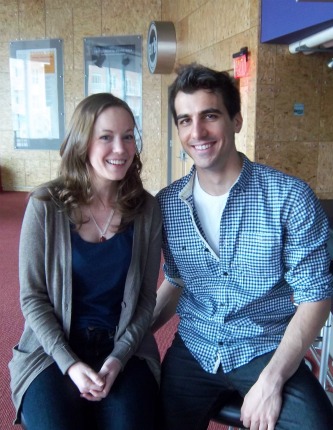
Bethany Anne Lind with Paul Downs Colaizzo
Lind hadn’t heard from him but, just before she was to return to Atlanta, she “just emailed him one more time just to see, and he said, ‘We’re actually having auditions in New York on Monday. We can see you there if you can come.’”

So, Lind explained, “I took the bus up to New York, read the script on the way there, just loved it and auditioned -- and here I am.”

Colaizzo, who wrote the play, interjected to point out that the character of Leigh was transformed once he and Gardiner saw Lind audition.

“We may have thought we knew who the character of Leigh was, before Bethany came in to audition,” the playwright said, “but she also taught us who the character was, in an audition that was magnetic.”

That magnetism, he explained, “has transferred into her work in this play.”

Lind appreciates being part of a world premiere.

“It’s always fun working on it with the playwright in the room,” she said. “I feel like we inform each other on the character. It’s just exciting to be part of that part of the development of the play and the character.”

Performances of Really Really run through March 25, 2012. Show times are Tuesdays and Wednesdays at 7:30 pm, Thursdays and Fridays at 8:00 pm, Saturdays at 2:00 pm and 8:00 pm, and Sundays at 2:00 pm and 7:00 pm.

Tickets range from $56 - $80 and are available by calling Ticketmaster at 703-573-SEAT (7328) or visiting www.signature-theatre.org. Student discount tickets are $30 and must be purchased the week of the performance. For more information please visit www.signature-theatre.org.
Be sure to visit my CafePress store for gifts and novelty items!
Read my blog on Kindle!
Follow my tweets on Twitter!