Showing posts with label Catholic Church. Show all posts

Saturday, March 17, 2018

Guest Post: 10 things to know about the real St. Patrick


Lisa Bitel, University of Southern California – Dornsife College of Letters, Arts and Sciences

On March 17, people around the world will celebrate St. Patrick’s Day by parading in green hats, sporting images of shamrocks and leprechauns – tiny, grinning, fairy men – pinned to their lapels. Patrick’s picture will adorn greeting cards: an aged, bearded bishop in flowing robes, grasping a bishop’s staff and glaring at a coil of snakes.

The icon refers to one of Patrick’s legendary miracles in which he is said to have prayed to banish all snakes from Ireland. However, as a historian of medieval Ireland, I can assure you that the real St. Patrick, who lived and worked in the fifth century, never saw a snake or wore a shamrock.
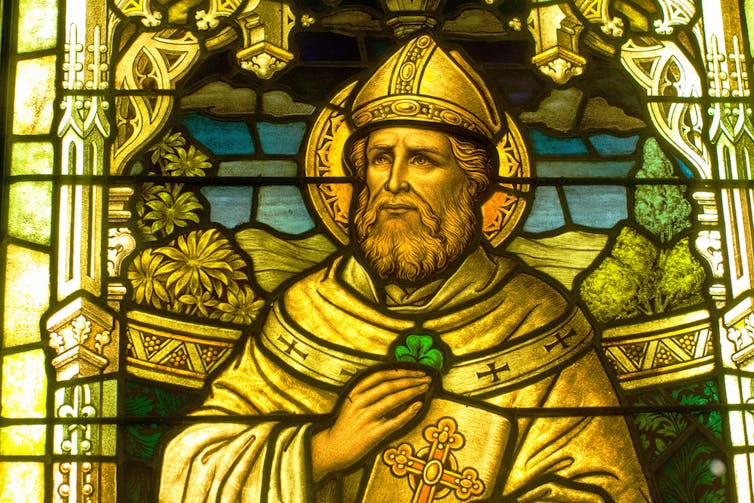


St Patrick of Ireland

Saint Patrick.
Thad Zajdowicz


Patrick’s own writings and early accounts of the saint’s career reveal many interesting details about the life of this patron saint of Ireland. Here are 10 things you may not know about St. Patrick.

1. Patrick was not Irish


Patrick was born around 450 A.D., just when Roman troops withdrew from Britain. His father was a gentleman and a Christian deacon who owned a small estate in a place called Bannavem Taburniae.

Scholars aren’t sure where this place was – it was probably on the west coast around Bristol, near the southern border of modern Wales and England.

2. Patrick was a slave


Irish slave traders sailed the waters off that same coast, and one day they came ashore to capture the teenage Patrick and his neighbors, to sell back in Ireland. Patrick spent six years tending sheep in the west of Ireland.

3. Patrick heard voices


While chasing sheep on the hills, Patrick prayed a hundred times a day, in all kinds of weather. It paid off. One night a mysterious voice called to him, saying, “Look, your ship is ready!” Patrick knew he wasn’t hearing sheep. The time was right for his escape.

4. Patrick refused to ‘suck a man’s breasts’
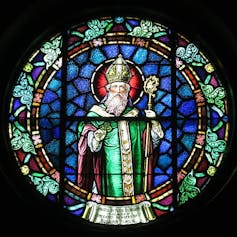


 St. Patrick Catholic Church, Ohio

St. Patrick Catholic Church, Ohio.
Nheyob (Own work)., CC BY-SA


Patrick made his way to Ireland’s east coast and sought passage on a ship bound for Britain. The captain, a pagan, didn’t like the look of him and demanded that Patrick “suck his breasts,” a ritual gesture symbolizing acceptance of the captain’s authority. Patrick refused – instead he tried to convert the crew.

For some reason, the captain still took him aboard.

5. Patrick had visions


One night Patrick dreamed that Satan tested his faith by dropping an enormous rock on him. He lay crushed by its weight until dawn broke, when he called out, “Helias! Helias!” – the name of the Greek sun god. The rock disappeared. Patrick took it as a kind of epiphany. He later wrote:

“I believe that I was helped by Christ the Lord.”

Patrick had other peculiar visions, too. Back home at Bannavem Taburniae, he was visited by an angel with a message from the Irish: “We beg you, Holy Boy, to come and walk again among us.” He trained as a bishop and went back to Ireland.

6. Patrick did something unmentionable


Years into his mission, someone, it seems, told a dirty secret about Patrick to his fellow bishops. “They brought up against me after thirty years something I had already confessed … some things I had done one day - rather, in one hour, when I was young,” he wrote.

Patrick did not tell us what he did – worship idols? Engage in a forbidden sexual practice? Take gifts from converts?

Whatever it was, Patrick retrospectively understood his zealous Irish mission to be penance for his youthful sins. While he spread Christianity around Ireland, he was often beaten, put in chains or extorted. “Every day there is the chance that I will be killed, or surrounded, or taken into slavery,” he complained.

7. Patrick duelled with druids


Two centuries after his death, Irish believers wanted more exciting stories of Patrick’s life than the saint’s own account.

One legend (written 700 A.D.) described Patrick’s contest with native religious leaders, the druids. The druids insulted Patrick, tried to poison him and engaged him in magical duels – much like students of Harry Potter’s Hogwarts – in which they competed to manipulate the weather, destroy each other’s sacred books and survive raging fires.

When one druid dared to blaspheme the Christian God, however, Patrick sent the druid flying into air – the man dropped to the ground and broke his skull.

8. Patrick made God promise


Another legend from around the same time tells how Patrick fasted for 40 days atop a mountain, weeping, throwing things, and refusing to descend until an angel came on God’s behalf to grant the saint’s outrageous demands. These included the following: Patrick would redeem more souls from hell than any other saint; Patrick, rather than God, would judge Irish sinners at the end of time; and the English would never rule Ireland.

We know how that last one worked out. Perhaps God will keep the other two promises.

9. Patrick never mentioned a shamrock



St Patrick's Day shamrock

St. Patrick’s Day shamrock.
Maiconfz, CC BY


None of the early Patrician stories featured the shamrock – or Irish seamróg – which is a word for common clover, a small plant with three leaves. Yet children in Catholic schools still learn that Patrick used a shamrock as a symbol of the Christian Trinity when he preached to the heathen Irish.

The shamrock connection was first mentioned in print by an English visitor to Ireland in 1684, who wrote that on Saint Patrick’s feast day, “the vulgar superstitiously wear shamroges, 3 leav’d grass, which they likewise eat (they say) to cause a sweet breath.” The Englishman also noted that “very few of the zealous are found sober at night.”

10. Patrick did not drive the snakes out of Ireland


As for the miraculous snake-charming attributed to Patrick, it could not have happened because there were no snakes in pre-modern Ireland. Reptiles never made it across the land bridge that prehistorically linked the island to the European continent.

Most likely, the miracle was plagiarized from some other saint’s life and eventually added to Patrick’s repertoire.

Party-goers on March 17 need not worry about ancient historical details, though. Whatever the truth of Patrick’s mission, he became one of the three patrons of Ireland, along with Sts. Brigit and Columba– the latter two were born in Ireland.

The ConversationWishing you “Lá fhéile Pádraig sona dhaiobh” – Happy Saint Patrick’s Day.


Lisa Bitel, Professor of History & Religion, University of Southern California – Dornsife College of Letters, Arts and Sciences

This article was originally published on The Conversation. Read the original article.
Wednesday, February 14, 2018

Guest Post: Was the 'real' St. Valentine a patron of love?

Lisa Bitel, University of Southern California – Dornsife College of Letters, Arts and Sciences

On Feb. 14, sweethearts of all ages will exchange cards, flowers, candy, and more lavish gifts in the name of St. Valentine. But as a historian of Christianity, I can tell you that at the root of our modern holiday is a beautiful fiction. St. Valentine was no lover or patron of love.

Valentine’s Day, in fact, originated as a liturgical feast to celebrate the decapitation of a third-century Christian martyr, or perhaps two. So, how did we get from beheading to betrothing on Valentine’s Day?


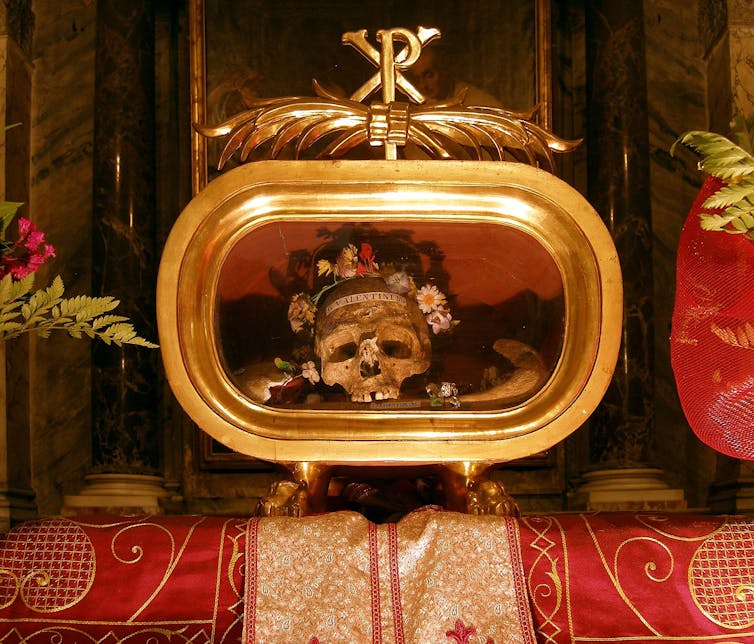
 Relics of St. Valentine of Terni at the basilica of Saint Mary in Cosmedin.

Relics of St. Valentine of Terni at the basilica of Saint Mary in Cosmedin.
Dnalor 01 (Own work) , CC BY-SA


Early origins of St. Valentine


Ancient sources reveal that there were several St. Valentines who died on Feb. 14. Two of them were executed during the reign of Roman Emperor Claudius Gothicus in 269-270 A.D., at a time when persecution of Christians was common.

How do we know this? Because, an order of Belgian monks spent three centuries collecting evidence for the lives of saints from manuscript archives around the known world.

They were called Bollandists after Jean Bolland, a Jesuit scholar who began publishing the massive 68-folio volumes of “Acta Sanctorum,” or “Lives of the Saints,” beginning in 1643.

Since then, successive generations of monks continued the work until the last volume was published in 1940. The Brothers dug up every scrap of information about every saint on the liturgical calendar and printed the texts arranged according to the saint’s feast day.

The Valentine martyrs


The volume encompassing Feb. 14 contains the stories of a handful of “Valentini,” including the earliest three of whom died in the third century.


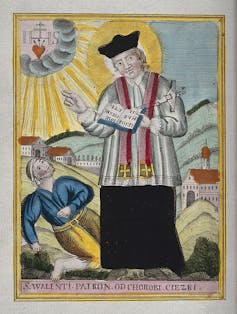
 St. Valentine blessing an epileptic.

St. Valentine blessing an epileptic.
Wellcome Images, CC BY


The earliest Valentinus is said to have died in Africa, along with 24 soldiers. Unfortunately, even the Bollandists could not find any more information about him. As the monks knew, sometimes all that the saints left behind was a name and day of death.

We know only a little more about the other two Valentines.

According to a late medieval legend reprinted in the “Acta,” which was accompanied by Bollandist critique about its historical value, a Roman priest named Valentinus was arrested during the reign of Emperor Gothicus and put into the custody of an aristocrat named Asterius.

As the story goes, Asterius made the mistake of letting the preacher talk. Father Valentinus went on and on about Christ leading pagans out of the shadow of darkness and into the light of truth and salvation. Asterius made a bargain with Valentinus: If the Christian could cure Asterius’s foster-daughter of blindness, he would convert. Valentinus put his hands over the girl’s eyes and chanted:

“Lord Jesus Christ, en-lighten your handmaid, because you are God, the True Light.”

Easy as that. The child could see, according to the medieval legend. Asterius and his whole family were baptized. Unfortunately, when Emperor Gothicus heard the news, he ordered them all to be executed. But Valentinus was the only one to be beheaded. A pious widow, though, made off with his body and had it buried at the site of his martyrdom on the Via Flaminia, the ancient highway stretching from Rome to present-day Rimini. Later, a chapel was built over the saint’s remains.

St. Valentine was not a romantic


The third third-century Valentinus was a bishop of Terni in the province of Umbria, Italy.


 St. Valentine kneeling

St. Valentine kneeling.
David Teniers III


According to his equally dodgy legend, Terni’s bishop got into a situation like the other Valentinus by debating a potential convert and afterward healing his son. The rest of story is quite similar as well: He too, was beheaded on the orders of Emperor Gothicus and his body buried along the Via Flaminia.

It is likely, as the Bollandists suggested, that there weren’t actually two decapitated Valentines, but that two different versions of one saint’s legend appeared in both Rome and Terni.

Nonetheless, African, Roman or Umbrian, none of the Valentines seems to have been a romantic.

Indeed, medieval legends, repeated in modern media, had St. Valentine performing Christian marriage rituals or passing notes between Christian lovers jailed by Gothicus. Still other stories romantically involved him with the blind girl whom he allegedly healed. Yet none of these medieval tales had any basis in third-century history, as the Bollandists pointed out.


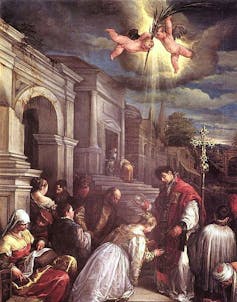
St. Valentine baptizing St. Lucilla. Jacopo Bassano (Jacopo da Ponte)

St. Valentine baptizing St. Lucilla.
Jacopo Bassano (Jacopo da Ponte)


In any case, historical veracity did not count for much with medieval Christians. What they cared about were stories of miracles and martyrdoms, and the physical remains or relics of the saint. To be sure, many different churches and monasteries around medieval Europe claimed to have bits of a St. Valentinus’ skull in their treasuries.

Santa Maria in Cosmedin in Rome, for example, still displays a whole skull. According to the Bollandists, other churches across Europe also claim to own slivers and bits of one or the other St. Valentinus’ body: For example, San Anton Church in Madrid, Whitefriar Street Church in Dublin, the Church of Sts. Peter and Paul in Prague, Saint Mary’s Assumption in Chelmno, Poland, as well as churches in Malta, Birmingham, Glasgow, and on the Greek isle of Lesbos, among others.

For believers, relics of the martyrs signified the saints’ continuing their invisible presence among communities of pious Christians. In 11th-century Brittany, for instance, one bishop used what was purported to be Valentine’s head to halt fires, prevent epidemics, and cure all sorts of illnesses, including demonic possession.

As far as we know, though, the saint’s bones did nothing special for lovers.

Unlikely pagan origins


Many scholars have deconstructed Valentine and his day in books, articles and blog postings. Some suggest that the modern holiday is a Christian cover-up of the more ancient Roman celebration of Lupercalia in mid-February.

Lupercalia originated as a ritual in a rural masculine cult involving the sacrifice of goats and dogs and evolved later into an urban carnival. During the festivities half-naked young men ran through the streets of Rome, streaking people with thongs cut from the skins of newly killed goats. Pregnant women thought it brought them healthy babies. In 496 A.D., however, Pope Gelasius supposedly denounced the rowdy festival.

Still, there is no evidence that the pope purposely replaced Lupercalia with the more sedate cult of the martyred St. Valentine or any other Christian celebration.

Chaucer and the love birds


The love connection probably appeared more than a thousand years after the martyrs’ death, when Geoffrey Chaucer, author of “The Canterbury Tales” decreed the February feast of St. Valentinus to the mating of birds. He wrote in his “Parlement of Foules”:

“For this was on seynt Volantynys day.
Whan euery bryd comyth there to chese his make.”

It seems that, in Chaucer’s day, English birds paired off to produce eggs in February. Soon, nature-minded European nobility began sending love notes during bird-mating season. For example, the French Duke of Orléans, who spent some years as a prisoner in the Tower of London, wrote to his wife in February 1415 that he was “already sick of love” (by which he meant lovesick.) And he called her his “very gentle Valentine.”

English audiences embraced the idea of February mating. Shakespeare’s lovestruck Ophelia spoke of herself as Hamlet’s Valentine.

In the following centuries, Englishmen and women began using Feb. 14 as an excuse to pen verses to their love objects. Industrialization made it easier with mass-produced illustrated cards adorned with smarmy poetry. Then along came Cadbury, Hershey’s, and other chocolate manufacturers marketing sweets for one’s sweetheart on Valentine’s Day.

Today, shops everywhere in England and the U.S. decorate their windows with hearts and banners proclaiming the annual Day of Love. Merchants stock their shelves with candy, jewelry and Cupid-related trinkets begging “Be My Valentine.” For most lovers, this request does not require beheading.

Invisible Valentines


It seems that the erstwhile saint behind the holiday of love remains as elusive as love itself. Still, as St. Augustine, the great fifth-century theologian and philosopher argued in his treatise on “Faith in Invisible Things,” someone does not have to be standing before our eyes for us to love them.

The ConversationAnd much like love itself, St. Valentine and his reputation as the patron saint of love are not matters of verifiable history, but of faith.

Lisa Bitel, Professor of History & Religion, University of Southern California – Dornsife College of Letters, Arts and Sciences

This article was originally published on The Conversation. Read the original article.


Guest Post: Why do Christians wear ashes on Ash Wednesday?


Michael Laver, Rochester Institute of Technology

This coming Wednesday many Christians will arrive at work with a black cross smudged on their foreheads; countless more will slip into a church or a chapel during their lunch break or after work to receive the sign that tells the arrival of Ash Wednesday, the traditional start of the Christian season of Lent.

As both a priest in the Episcopal Church as well as a historian of Christianity, I’ve come to appreciate many of the liturgies and practices that characterize the modern church and have their roots in ancient traditions. The practice of donning ashes is one of them.

Ashes in Bible stories


In the Bible we are told that when the prophet Jonah pronounced God’s wrath on the city of Nineveh for its “wickedness,” likely because of the worship of idols or “false” gods, the king, in an act of sincere penitence, put on sackcloth and sat in ashes.

God was moved by this genuine act of repentance and spared the city from destruction. This story was meant to demonstrate that God is merciful and heeds true remorse.

This spiritual dimension of ashes is emphasized all through the Bible. In the Gospel of Matthew, Jesus deplores the lack of concern for the poor and marginalized on the part of the establishment of the day, as he passes through some towns.

He called out the hypocrisy of religious leaders who taught righteousness on the one hand, but lived lives of luxury and wealth at the expense of the poor on the other. At one point Jesus condemned the religious leaders as “whitewashed tombs, which on the outside look beautiful, but inside they are full of the bones of the dead and of all kinds of filth.”

When pronouncing these judgments, Jesus makes reference to sackcloth and ashes as a form of penitence.

How the practice evolved


As early as the ninth century the church started to use ashes as a public demonstration of repentance for sins.


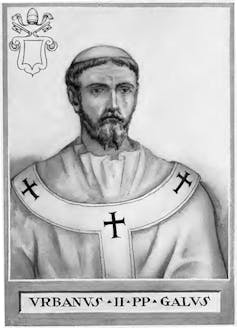
Pope Urban II by Artaud de Montor (1772–1849).

Pope Urban II.
Artaud de Montor (1772–1849).


It was only in 1091, however, that their use was ritualized. Pope Urban II decreed the use of ashes to mark the beginning of a 40-day season of Lent, a time when Christians imitate Christ’s 40-day period of fasting. This period is said to have prepared Christ for his three-year ministry that would culminate in his arrest, crucifixion and resurrection.

With the Protestant Reformation of the 16th century, the use of ashes generally fell out of favor in non-Catholic denominations. However, it returned in the 19th century when many Protestant churches entered into intentional dialogue with each other and with the Catholic Church, a phenomenon that is called the “ecumenical movement.”

Today most “mainline” denominations, including Catholics, Baptists, Episcopalians, Methodists, Presbyterians and others allow for the “imposition” (as called in Catholic and Episcopalian prayer books) of ashes during an Ash Wednesday service. In some churches, the ashes are obtained by burning the palms blessed in the previous year’s Palm Sunday service – a time for Christians to remember Christ’s triumphal entry into Jerusalem days before he was crucified. The resultant ash, depending on local practice, might then be mixed with oil to make them adhere more easily to the forehead.

Modern-day practice


In recent years several churches have put a new spin on the traditional Ash Wednesday service by providing what has been called “ashes to go.” In this new take on an ancient practice, a pastor stands in a very public, often busy, place and offers the ashes to any passersby who wishes to receive them, whether or not the person is Christian.

Stories abound of pastors providing “drive-through ashes” in which the penitent does not even have to get out of the car. A website called “ashes to go” provides not only a list of global sites at which one can receive ashes in this way, but also has an FAQ section containing advice for churches contemplating such a service.

For a supremely ironic twist on Ash Wednesday, one only has to observe that the Gospel reading appointed for the day is from Matthew, chapter 6. Here Jesus rails against religious hypocrisy by criticizing those whose religious piety is done mainly for show:

“Whenever you fast, do not look dismal, like the hypocrites, for they disfigure their faces so as to show others that they are fasting. Truly I tell you, they have received their reward. But when you fast, put oil on your head and wash your face, so that your fasting may be seen not by others but by your Father who is in secret; and your Father who sees in secret will reward you.”

The ConversationChristians bearing the sign of the cross on their forehead this Wednesday will be sharing a formal practice that dates back over a thousand years, and more than that – in a tradition that goes back much earlier.

Michael Laver, Department Chair, Associate professor, Rochester Institute of Technology

This article was originally published on The Conversation. Read the original article.

Monday, January 01, 2018

From the Archives - A Moral Argument for Civil Defense: Advice to America’s Catholic Bishops (1983)

This article appeared exactly 35 years ago today, in the January 1, 1983, issue of Crisis Magazine, a Catholic journal of opinion (previously known as Catholicism in Crisis).

CRISIS MAGAZINE - JANUARY 1, 1983
A Moral Argument for Civil Defense: Advice to America’s Catholic Bishops
RICHARD E. SINCERE, JR.

“Justice demands that those who do not make war not have war made upon them.” This is a central teaching of the Catholic Church that is repeated emphatically in the second draft of the National Conference of Catholic Bishops’ pastoral letter on peace and war. Just war doctrine demands discrimination in battle and both the United States and the Soviet Union in part meet this moral requirement in their strategic plans, which do not target nuclear weapons against civilian populations as such. However, to meet it fully, both nations must also protect civilian populations from the effects of enemy weapons.

The bishops do not adequately address the question of civil defense in their draft letter, nor is it likely that they will do so in the final version next May. In spite of that oversight, I would like to set forth here the moral principles which compel a government to protect its people from weapons of mass destruction, principles drawn in part from the bishops’ own document.

Moral Foundations: Just War and Vatican II
Gaudium et Spes, the Pastoral Constitution on the Church in the Modern World, condemned indiscriminate warfare by saying: “Any act of war aimed indiscriminately at the destruction of entire cities or of extensive areas along with their population is a crime against God and man himself. It merits unequivocal and unhesitating condemnation.” This moral judgment has obvious applications to gruesome examples of modern warfare: the obliteration bombings of Coventry and Tokyo, the blitz against London, the firebombings of Dresden and Hamburg, the use of chemical weapons in Afghanistan, Laos, and Kampuchea. By extension we can apply it to the extermination policies of Hitler, Stalin, and Mao — even though these were not acts of war in the conventional sense.

civil defense shelter 1960sA mistaken interpretation of the Council’s judgment maintains that any use of nuclear weapons would be “indiscriminate” and therefore damnable. Yet the evolution of modern technology made possible pinpoint attacks on purely military targets. Weapons such as the neutron bomb have been designed primarily with the principle of discrimination in mind: enhanced radiation warheads arrest the aggressive movement of tank forces without affecting innocent civilian populations nearby. Their lethal effects are short-lived and narrowly targeted.

However, intercontinental strategic weapons are still so destructive that even pinpoint bombings of missile silos can spread harmful radioactive fallout indiscriminately to civilian areas. Simple measures can be taken to protect against these effects. These must be examined in the light of moral reasoning.

Defense Against Nuclear Weapons
The American bishops write, contrary to the facts, that “the presumption exists that defense against a nuclear attack is not feasible.” They ignore extensive and presumably effective air defenses deployed by the Soviet Union, along with the available technology for ballistic missile defense (BMD) — whether in the form of antiballistic missiles (in place in the Soviet Union, abandoned by the United States), space-based laser — or conventional-BMD, or sophisticated anti-weapon weapons like particle beams. Moreover, the bishops all but overlook the possibility of passive civilian defenses — except in this passage:

“In discussing non-violent means of defense, some attention must be given to existing programs for civil defense against nuclear attack, including blast and fallout shelters and relocation plans. It is unclear in the public mind whether these are intended to offer significant protection against at least some forms of nuclear attack or are being put into place to enhance the credibility of the strategic deterrent forces by demonstrating an ability to survive attack.”

civil defense handbook 1940sThe bishops here unwittingly present two strong reasons to support civil defense: emphatically, significant protection against the effects of nuclear weapons is possible; secondarily, the ability to survive indeed increases the credibility of the deterrent strategy of the United States government. Clearly this is the most peaceful component of nuclear deterrence: it requires no weapons and possesses none of the moral ambiguity of nuclear weapons. If the bishops someday see fit to condemn the mere possession of nuclear weapons, they shall have no justification to condemn the peaceful means to protect innocent civilians against an aggressor.

The bishops recommend that an independent panel of scientists, engineers, and physicians examine the feasibility of civil defense as a means to survive a nuclear war. Yet many such studies have been done over the past thirty years. The consensus is that nuclear war is indeed survivable and, in the words of one of the latest studies, “no insuperable barrier to recovery exists.” It would indeed be horrible, but preparations for the potentially horrible can significantly mitigate its consequences. If targeting civilian populations in your enemy’s territory is morally unjustifiable, acquiescing in the unnecessary death of innocents in your own country is morally repugnant. It deserves unhesitating condemnation.

Civil Defense: A Life or Death Issue
“Questions of war and peace,” write the bishops, “have a profoundly moral dimension which responsible Christians cannot ignore. They are questions of life and death.” War is evil not in itself but because it is the cause of human suffering and death. To alleviate suffering and prevent death is ipso facto a moral good. That is why an increased American commitment to civil defense is a moral imperative. Every reason exists for the bishops to express their support for such a commitment: (1) Above all, civil defense saves lives. Estimates vary, but in the event of nuclear war some civil defense will save more lives than no civil defense. (The Swiss have a slogan: “Better civil defense without nuclear war than nuclear war without civil defense.”) (2) As I argued earlier, civil defense is an integral component of a deterrent strategy, the only component that is objectively peaceful. It is also, many experts argue, the most effective part of a deterrent strategy. Soviet military planners and their leaders in the Kremlin are cautious. If they have no guarantee of victory — that is, if the United States can demonstrate an ability to survive, recover, and challenge Soviet hegemony — they will not be as ready to risk a strategic conflict.

Nuclear war would no doubt be the most tragic disaster ever to befall mankind. There is no need to make it any worse by ignoring its consequences. There are, of course, some problems with civil defense as it exists today: crisis relocation is far from perfect, shelters are not invulnerable, panic and confusion may still occur. Yet to refuse to plan for these contingencies is as sinful as launching a nuclear weapon in the first place.

Rabbi Abraham Joshua Heschel wrote that “it is the concrete individual who lends meaning to the human race. We do not think that a human being is valuable because he is a member of the race; it is rather the opposite: the human race is valuable because it is composed of human beings.” The responsibility of the nation is to preserve and protect as many human beings as possible. To neglect that responsibility reveals a moral turpitude worse than the Nazi Holocaust, worse than the Stalinist purges, indeed worse than any conceivable use of nuclear weapons. To commit ourselves to civil defense is to reaffirm a choice God made available to us several thousand years ago: “I set before you life or death, a blessing or curse. Choose life then, so that you and your descendants may live in the love of Yahweh your god, obeying his voice, clinging to him; for in this your life consists …” (Deuteronomy 11:26)


Richard E. Sincere, Jr., is research assistant for church and society at the Ethics and Public Policy Center, a member of the visiting faculty of the Georgetown University School for Summer and Continuing Education, and president of the Washington, D.C. chapter of the American Civil Defense Association.


Wednesday, August 02, 2017

From the Archives: NRO’s Jonah Goldberg finds witch hunts and inquisitions ‘fascinating’

NRO’s Jonah Goldberg finds witch hunts and inquisitions ‘fascinating’
August 2, 2012 3:40 PM MST

In writing his new book about progressive ideology, National Review Online contributor Jonah Goldberg discovered some surprising facts about the inquisitions of the Middle Ages.

Jonah Goldberg witch hunt inquisition RightOnline Examiner.com Rick Sincere
While conducting research for The Tyranny of Clichés: How Liberals Cheat in the War of Ideas, Goldberg “became really fascinated with the history of the inquisitions and the witch hunts in medieval Europe.”

His book, a follow-up to the 2008 best-seller Liberal Fascism, includes a lengthy, four-part chapter on the Catholic Church, a result of what he uncovered.

Until he began looking into the topic more deeply, Goldberg said, he had “had no idea how incredibly screwed up our popular understanding of what the witch hunts were about and what the inquisitions were about.”

Misunderstanding witch hunts
Goldberg spoke to the Charlottesville Libertarian Examiner about his research during a break at the RightOnline conference in Las Vegas in June.

He noted that recognizing our misunderstanding of the nature of witch hunts is “not to say the witch hunts were good or the inquisitions were good, but they were far less the tragedies and travesties that the Left or the popular culture makes them out to be."

Moreover, he added, "the role the Catholic Church in these things was far different than what I had realized.”

Church as check
Jonah Goldberg Rick Sincere RightOnline Americans for Prosperity Las Vegas witches
Jonah Goldberg
What Goldberg learned is that “the Catholic Church was a check on [the worst of] these things. The real problems were with the people themselves -- the masses, They were constantly wanting to lynch people for being witches.”

At the same time, taking advantage of the peasants’ illiteracy “local, secular aristocrats and lords were constantly pandering to the mob and the Church would come in and say, ‘Calm down everybody, let’s figure out if this person is really a witch or not.’ and often, very often, would say, ‘You guys are nuts, leave this poor woman alone.’”

Pointing to an image from popular culture, Goldberg explained that “the role of the Catholic Church we get from Monty Python, ‘Nobody expects the Spanish Inquisition’, is a much more complicated story. I found that fascinating and that’s why I have such a huge chapter on the Catholic Church” in The Tyranny of Cliches.

An audio version of the complete interview with Jonah Goldberg is available on Bearing Drift radio, "The Score."

Publisher's note: This article was originally published on Examiner.com on August 2, 2012. The Examiner.com publishing platform was discontinued July 1, 2016, and its web site went dark on or about July 10, 2016.  I am republishing this piece in an effort to preserve it and all my other contributions to Examiner.com since April 6, 2010. It is reposted here without most of the internal links that were in the original.

Sunday, April 16, 2017

Guest Post: Why Easter is called Easter

by Brent Landau, University of Texas at Austin

This Sunday, April 16, Christians will be celebrating Easter, the day on which the resurrection of Jesus is said to have taken place. The date of celebration changes from year to year. The Conversation

The reason for this variation is that Easter always falls on the first Sunday after the first full moon following the spring equinox. So, in 2018, Easter will be celebrated on April 1, and on April 21 in 2019.

I am a religious studies scholar specializing in early Christianity, and my research shows that this dating of Easter goes back to the complicated origins of this holiday and how it has evolved over the centuries.

Easter is quite similar to other major holidays like Christmas and Halloween, which have evolved over the last 200 years or so. In all of these holidays, Christian and non-Christian (pagan) elements have continued to blend together.

Easter as a rite of spring


Most major holidays have some connection to the changing of seasons. This is especially obvious in the case of Christmas. The New Testament gives no information about what time of year Jesus was born. Many scholars believe, however, that the main reason Jesus’ birth came to be celebrated on December 25 is because that was the date of the winter solstice according to the Roman calendar.


Easter eggs Easter bunny religious traditions spring festival

What is the origin of Easter eggs?
Katie Morrow, CC BY-NC-ND


Since the days following the winter solstice gradually become longer and less dark, it was ideal symbolism for the birth of “the light of the world” as stated in the New Testament’s Gospel of John.

Similar was the case with Easter, which falls in close proximity to another key point in the solar year: the vernal equinox (around March 20), when there are equal periods of light and darkness. For those in northern latitudes, the coming of spring is often met with excitement, as it means an end to the cold days of winter.

Spring also means the coming back to life of plants and trees that have been dormant for winter, as well as the birth of new life in the animal world. Given the symbolism of new life and rebirth, it was only natural to celebrate the resurrection of Jesus at this time of the year.

The naming of the celebration as “Easter” seems to go back to the name of a pre-Christian goddess in England, Eostre, who was celebrated at beginning of spring. The only reference to this goddess comes from the writings of the Venerable Bede, a British monk who lived in the late seventh and early eighth century. As religious studies scholar Bruce Forbes summarizes:

“Bede wrote that the month in which English Christians were celebrating the resurrection of Jesus had been called Eosturmonath in Old English, referring to a goddess named Eostre. And even though Christians had begun affirming the Christian meaning of the celebration, they continued to use the name of the goddess to designate the season.”

Bede was so influential for later Christians that the name stuck, and hence Easter remains the name by which the English, Germans and Americans refer to the festival of Jesus’ resurrection.

The connection with Jewish Passover


It is important to point out that while the name “Easter” is used in the English-speaking world, many more cultures refer to it by terms best translated as “Passover” (for instance, “Pascha” in Greek) – a reference, indeed, to the Jewish festival of Passover.

In the Hebrew Bible, Passover is a festival that commemorates the liberation of the Jewish people from slavery in Egypt, as narrated in the Book of Exodus. It was and continues to be the most important Jewish seasonal festival, celebrated on the first full moon after the vernal equinox.

At the time of Jesus, Passover had special significance, as the Jewish people were again under the dominance of foreign powers (namely, the Romans). Jewish pilgrims streamed into Jerusalem every year in the hope that God’s chosen people (as they believed themselves to be) would soon be liberated once more.

On one Passover, Jesus traveled to Jerusalem with his disciples to celebrate the festival. He entered Jerusalem in a triumphal procession and created a disturbance in the Jerusalem Temple. It seems that both of these actions attracted the attention of the Romans, and that as a result Jesus was executed around the year A.D. 30.

Some of Jesus’ followers, however, believed that they saw him alive after his death, experiences that gave birth to the Christian religion. As Jesus died during the Passover festival and his followers believed he was resurrected from the dead three days later, it was logical to commemorate these events in close proximity.


stained glass window resurrection Easter Sunday

Resurrection.
Fr Lawrence Lew, O.P., CC BY-NC-ND


Some early Christians chose to celebrate the resurrection of Christ on the same date as the Jewish Passover, which fell around day 14 of the month of Nisan, in March or April. These Christians were known as Quartodecimans (the name means “Fourteeners”).

By choosing this date, they put the focus on when Jesus died and also emphasized continuity with the Judaism out of which Christianity emerged. Some others instead preferred to hold the festival on a Sunday, since that was when Jesus’ tomb was believed to have been found.

In A.D. 325, the Emperor Constantine, who favored Christianity, convened a meeting of Christian leaders to resolve important disputes at the Council of Nicaea. The most fateful of its decisions was about the status of Christ, whom the council recognized as “fully human and fully divine.” This council also resolved that Easter should be fixed on a Sunday, not on day 14 of Nisan. As a result, Easter is now celebrated on the first Sunday after the first full moon of the vernal equinox.

The Easter bunny and Easter eggs


In early America, the Easter festival was far more popular among Catholics than Protestants. For instance, the New England Puritans regarded both Easter and Christmas as too tainted by non-Christian influences to be appropriate to celebrate. Such festivals also tended to be opportunities for heavy drinking and merrymaking.

The fortunes of both holidays changed in the 19th century, when they became occasions to be spent with one’s family. This was done partly out of a desire to make the celebration of these holidays less rowdy.


Easter egg hunt spring children

Children on an egg hunt.
Susan Bassett, CC BY-NC-ND


But Easter and Christmas also became reshaped as domestic holidays because understandings of children were changing. Prior to the 17th century, children were rarely the center of attention. As historian Stephen Nissenbaum writes,

“…children were lumped together with other members of the lower orders in general, especially servants and apprentices – who, not coincidentally, were generally young people themselves.”

From the 17th century onward, there was an increasing recognition of childhood as as time of life that should be joyous, not simply as preparatory for adulthood. This “discovery of childhood” and the doting upon children had profound effects on how Easter was celebrated.

It is at this point in the holiday’s development that Easter eggs and the Easter bunny become especially important. Decorated eggs had been part of the Easter festival at least since medieval times, given the obvious symbolism of new life. A vast amount of folklore surrounds Easter eggs, and in a number of Eastern European countries, the process of decorating them is extremely elaborate. Several Eastern European legends describe eggs turning red (a favorite color for Easter eggs) in connection with the events surrounding Jesus’ death and resurrection.

Yet it was only in the 17th century that a German tradition of an “Easter hare” bringing eggs to good children came to be known. Hares and rabbits had a long association with spring seasonal rituals because of their amazing powers of fertility.

When German immigrants settled in Pennsylvania in the 18th and 19th centuries, they brought this tradition with them. The wild hare also became supplanted by the more docile and domestic rabbit, in another indication of how the focus moved toward children.

As Christians celebrate the festival this spring in commemoration of Jesus’ resurrection, the familiar sights of the Easter bunny and Easter eggs serve as a reminder of the holiday’s very ancient origins outside of the Christian tradition.

Brent Landau, Lecturer in Religious Studies, University of Texas at Austin

This article was originally published on The Conversation. Read the original article.