Showing posts with label Christianity. Show all posts

Thursday, March 15, 2018

Guest Post: Who was Mary Magdalene? Debunking the myth of the penitent prostitute

Dorothy Ann Lee, University of Divinity

Who was Mary Magdalene? What do we know about her? And how do we know it? These questions resurface with the release of a new movie, Mary Magdalene, starring Rooney Mara in the titular role.

Mary Magdalene Yvonne de CarloThe question of how we know about her is a relatively simple one. She appears in a number of early Christian texts associated with the ministry of Jesus.

These texts comprise Gospels written in the first and second century of the Common Era (CE). The earliest of them are included in the New Testament, where Magdalene plays a significant role. She also appears in later Gospels, which were not included in the Bible and come from a later period in early Christianity.

The answer about who she was and what we know of her is more complex. In Western art, literature and theology, Mary Magdalene is portrayed as a prostitute who meets Jesus, repents of her sins, and pours oil on his feet in a gesture of humility, penitence and gratitude. She is sometimes depicted kneeling at the foot of the cross, hair unbound, emphasising the sinful past from which she can never quite escape, despite being declared a saint.

The tradition of the penitent prostitute has persisted in the Western tradition. Institutions that cared for prostitutes from the 18th century onwards were called “Magdalenes” to encourage amendment of life in the women who took refuge in them. The word came into English as “maudlin”, meaning a tearful sentimentality. It is not a flattering description.
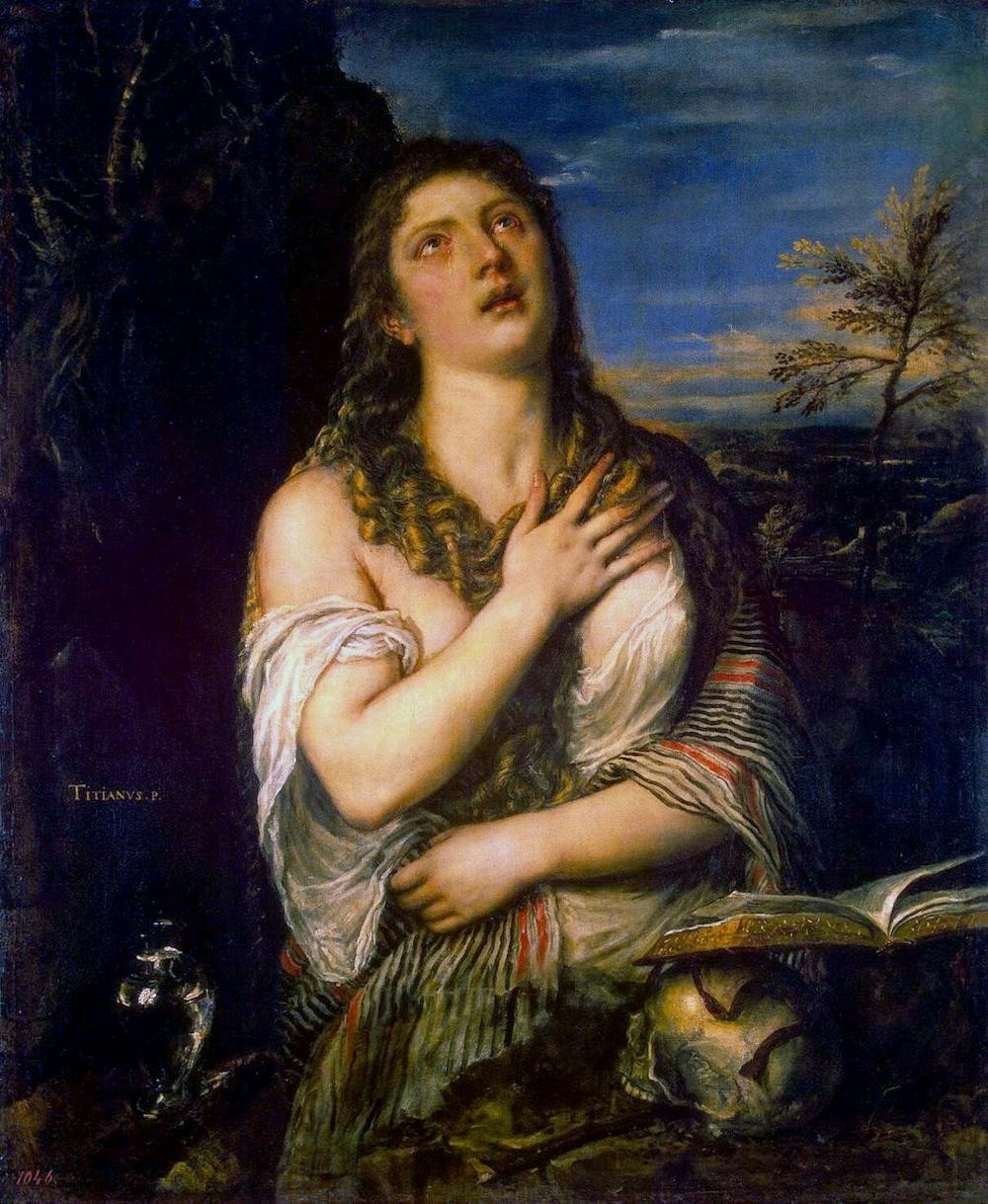


Titian Penitent Magdalene, circa 1565

Titian’s Penitent Magdalene, circa 1565.
Wikimedia Commons


Artistic depictions continued to emphasise Magadelene’s sexuality in various ways, under a facade of piety. In another twist on the same theme, she is presented as the wife of Jesus, most notably in Dan Brown’s The Da Vinci Code (2003).

The tradition of Mary Magdalene as the archetypal penitent whore, whose sexuality somehow manages to persist beyond her conversion, can be dated to a sermon preached by Gregory the Great in the sixth century CE.


Read more:
Weighing up the evidence for the 'Historical Jesus'


Admittedly, there are a confusing number of women called “Mary” in the Gospels and we might assume Pope Gregory was tired of distinguishing between them. He reduced them to two: on the one hand, Mary, the mother of Jesus, perpetual virgin, symbol of purity and goodness, and, on the other, Mary Magdalene, promiscuous whore, symbol of feminine evil from which the world must be redeemed.

A disciple of Jesus


Yet nowhere in the Gospels is Mary Magdalene associated either overtly or covertly with sexuality. The four Gospels of the New Testament present her in two significant roles.

In the first place, she is a disciple of Jesus: one among a band of women and men from Galilee who believed in his message of love and justice and followed him in his ministry.

Secondly, Magdalene is a primary witness in the Gospels to the resurrection of Jesus from the dead. Unlike many of the other disciples, she does not flee when Jesus is arrested. She remains at the cross when he dies and later visits his tomb to find it empty, with a vision of angels declaring his resurrection.

Mark’s Gospel, which we now know to be the earliest Gospel to be written, speaks of Magdalene as a disciple of Jesus who has followed him from Galilee along with other women, but it does not mention her until the crucifixion. These women disciples now stand near the cross, despite the danger in being present at the execution of a dissident.

Three of them, including Magdalene, visit the tomb on Easter morning where they meet an angel who informs them that Jesus has risen from the dead (Mark 16:1-8). The women’s subsequent departure from the tomb is ambiguous, and they leave in fear and silence, which is where the manuscript of Mark’s Gospel abruptly ends. An ending added later makes mention of the risen Jesus making an appearance first to Magdalene.

In Matthew’s Gospel, Magdalene meets the risen Christ as she leaves the tomb, this time with only one other female companion, who is also called “Mary” (Matt 28:1-10). In Luke’s account, Magdalene appears at the cross and at the empty tomb to hear the angel’s words, but she and her female companions are not believed when they convey the message of the resurrection to the apostles (Luke 24:1-11).
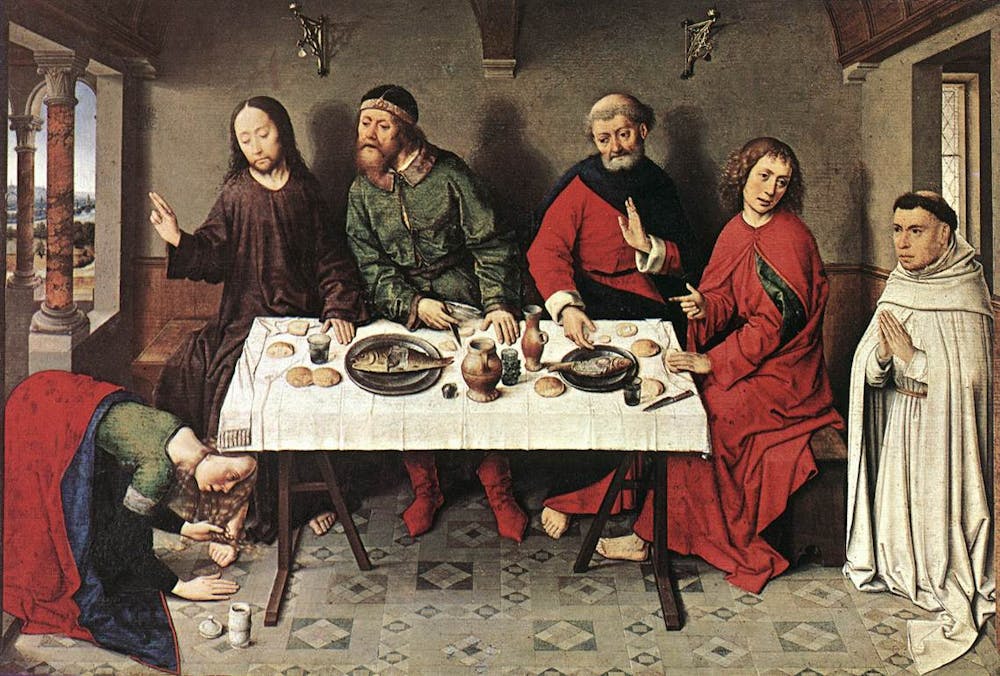


 Mary Magdalene anoints Christ’s feet in Dieric Bouts’ Christ in the House of Simon

Mary Magdalene anoints Christ’s feet in Dieric Bouts’ Christ in the House of Simon (circa 1420–1475).
Wikimedia Commons


In Luke, there is an earlier mention of Magdalene in Jesus’s ministry where she is present, along with other women, as a disciple and supporter of Jesus (Luke 8:1-3). She is described as having had seven demons cast from her. This description might lead to the conclusion, in some minds, that the many “demons” refer to her unfettered sexuality.

But that would be erroneous. Exorcisms — the casting out of evil spirits — are common in the first three Gospels. Those suffering demonic possession are never described as sinful but rather are victims of external evil.

These days, we would associate their symptoms with physical maladies such as epilepsy or mental illness. Magdalene, in other words, has been the victim of a serious illness and Jesus has healed her.


Read more:
How the Bible shapes contemporary attitudes to rape and sexual assault


Furthermore, the description is unusual here in that she is not described in relation to a male figure, as other women at the time generally were: father, husband, brother. She is simply referred to as “the Magdalene”, that is, the woman from Magdala, a Jewish village in Galilee.

We might well assume, from Luke’s description, that she is an independent woman of some means, who is well able to fund, as well as participate in, the movement around Jesus.

Her most significant role


John’s Gospel, however, gives Magdalene her most significant role. Once again, she does not appear until the crucifixion. In the narrative that follows, she comes alone to the tomb on Easter morning, finds it empty, tries unsuccessfully to gain help from two other prominent disciples, and eventually meets the risen Christ himself in the garden (20:1-18). He is alive and commissions her to proclaim the message of his resurrection.

On the basis of John’s story, later tradition gave Magdalene the title of “apostle to the apostles” and recognised something of her significance for Christian faith, witness and leadership. A tragic consequence is that her role as witness to the resurrection was later overshadowed by the apparently more alluring but inaccurate picture of her as the penitent whore.
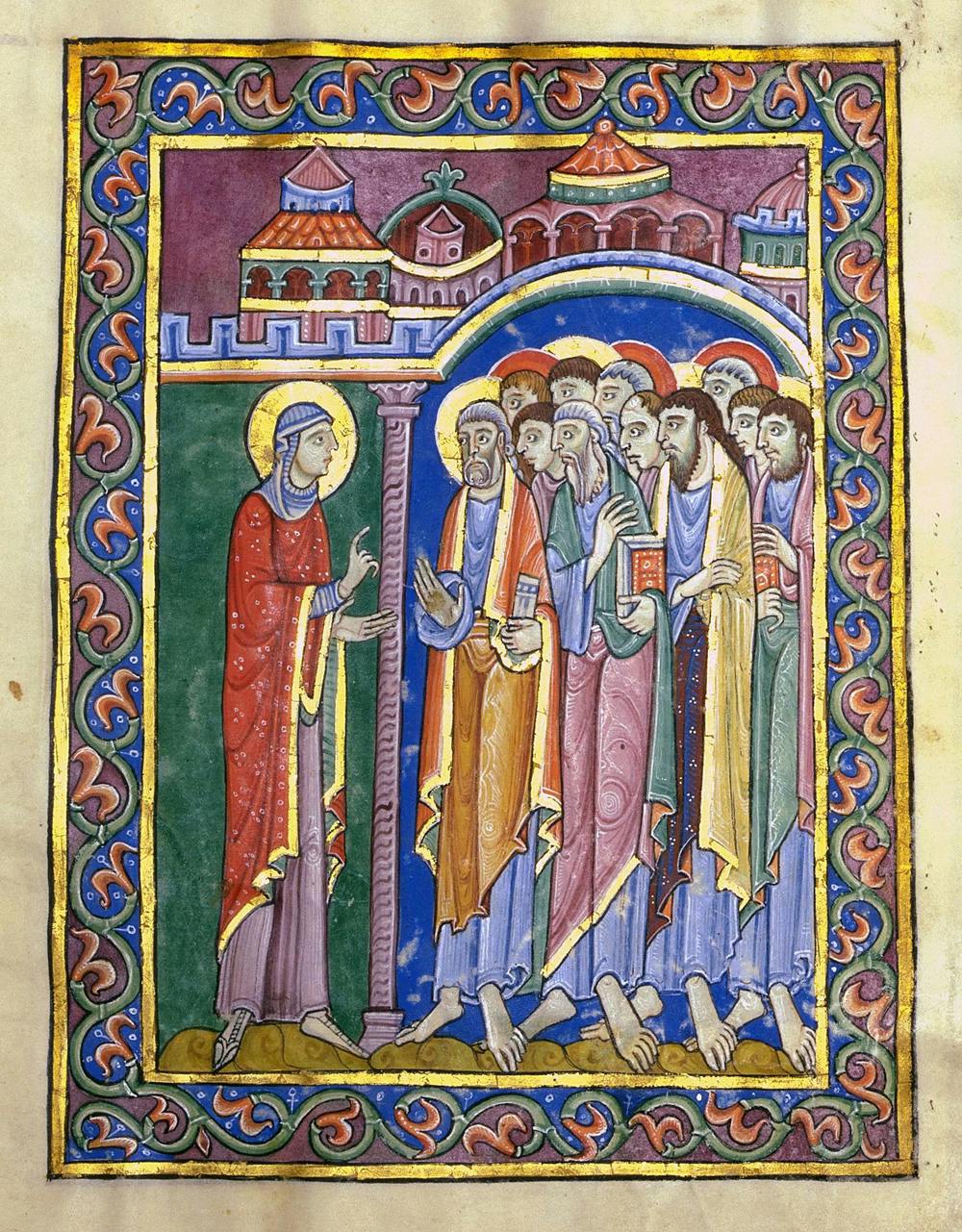


Mary Magdalene St Albans Psalter

A more accurate portrayal of Mary Magdalene announcing the risen Christ from the 12th-century English illuminated manuscript St Albans Psalter.
Wikimedia Commons


The later Gospels, beyond the New Testament, also emphasise Magdalene’s importance as a disciple of Jesus and witness to the resurrection. The manuscript of the Gospel of Mary, which describes her discussions with the risen Christ, is unfortunately damaged and the central section is missing. In this and other similar Gospels, however, Magdalene is presented as the favoured disciple. This situation leads to some tension with the other disciples, who are jealous of her closeness to Jesus and the teaching she alone is given.

One Gospel speaks of Jesus kissing her, but the imagery in the Gospel of Philip is metaphorical and refers to a spiritual union with Christ. In response to the objection by the other disciples, Jesus asks why he does not kiss them in the same way, implying that they do not as yet possess the same degree of spiritual knowledge.

No evidence of Magdalene anointing Jesus


There is no evidence, incidentally, that Magdalene ever anointed Jesus.

There are three anointing traditions in the Gospels. In one, an unnamed woman anoints Jesus’s head in prophetic recognition of his identity (Gospels of Mark & Matthew). In another, a named and known disciple, Mary of Bethany, who is a model disciple, anoints Jesus’s feet in gratitude for his raising her brother Lazarus from the dead (Gospel of John). In the third, a “sinful woman”, who is not explicitly identified as a prostitute, anoints Jesus’s feet in a gesture of repentance, gratitude and hospitality. None of these three figures is associated in any way with Mary Magdalene in the texts.

The movie Mary Magdalene, directed by Garth Davis, is a significant portrayal of this early Christian figure in the light of evidence from the earliest texts. The screenwriters, Helen Edmundson and Philippa Goslett, are quite clear that Mary is not to be associated with Jesus through her sexuality, either as harlot or wife. On the contrary, she is depicted as a faithful and deeply insightful disciple of Jesus, on whom he draws for his message of love, mercy and forgiveness.


Magdalene is beautifully portrayed in the movie, which draws on traditions from the earlier and later Gospels. She possesses an intense and compelling presence, which does much to restore her character from its later distortions.

It is true that the film makes somewhat erratic use of the New Testament, both in its presentation of Magdalene and of other characters in the story. Towards the end, for example, there is an implication that Magdalene and the church stand on opposite sides, the one in sympathy with Jesus’s teaching and the other anxious to build a self-glorifying edifice on his assumed identity.

This is unfortunate, as the New Testament itself is quite clear about the priority and identity of Magdalene as a key disciple, witness and leader in the early church, without seeing her in opposition to others.

Indeed, those who campaigned in a number of Christian churches for the ordination of women in the 20th century used precisely the example of Mary Magdalene from the New Testament as “apostle to the apostles” to support their case for women’s equality and leadership.

The recent installation of Kay Goldsworthy as Archbishop of the Anglican Diocese of Perth — the first woman in this country and across the world to be given this title — is the true heir of Magdalene as she is portrayed in the earliest Christian writings.


The ConversationThe film Mary Magdalene opens in Australian cinemas on March 22.

Dorothy Ann Lee, Frank Woods Professor of New Testament, Trinity College, University of Divinity

This article was originally published on The Conversation. Read the original article.
Wednesday, February 14, 2018

Guest Post: Why do Christians wear ashes on Ash Wednesday?


Michael Laver, Rochester Institute of Technology

This coming Wednesday many Christians will arrive at work with a black cross smudged on their foreheads; countless more will slip into a church or a chapel during their lunch break or after work to receive the sign that tells the arrival of Ash Wednesday, the traditional start of the Christian season of Lent.

As both a priest in the Episcopal Church as well as a historian of Christianity, I’ve come to appreciate many of the liturgies and practices that characterize the modern church and have their roots in ancient traditions. The practice of donning ashes is one of them.

Ashes in Bible stories


In the Bible we are told that when the prophet Jonah pronounced God’s wrath on the city of Nineveh for its “wickedness,” likely because of the worship of idols or “false” gods, the king, in an act of sincere penitence, put on sackcloth and sat in ashes.

God was moved by this genuine act of repentance and spared the city from destruction. This story was meant to demonstrate that God is merciful and heeds true remorse.

This spiritual dimension of ashes is emphasized all through the Bible. In the Gospel of Matthew, Jesus deplores the lack of concern for the poor and marginalized on the part of the establishment of the day, as he passes through some towns.

He called out the hypocrisy of religious leaders who taught righteousness on the one hand, but lived lives of luxury and wealth at the expense of the poor on the other. At one point Jesus condemned the religious leaders as “whitewashed tombs, which on the outside look beautiful, but inside they are full of the bones of the dead and of all kinds of filth.”

When pronouncing these judgments, Jesus makes reference to sackcloth and ashes as a form of penitence.

How the practice evolved


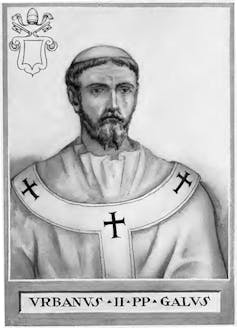
As early as the ninth century the church started to use ashes as a public demonstration of repentance for sins.


Pope Urban II by Artaud de Montor (1772–1849).

Pope Urban II.
Artaud de Montor (1772–1849).


It was only in 1091, however, that their use was ritualized. Pope Urban II decreed the use of ashes to mark the beginning of a 40-day season of Lent, a time when Christians imitate Christ’s 40-day period of fasting. This period is said to have prepared Christ for his three-year ministry that would culminate in his arrest, crucifixion and resurrection.

With the Protestant Reformation of the 16th century, the use of ashes generally fell out of favor in non-Catholic denominations. However, it returned in the 19th century when many Protestant churches entered into intentional dialogue with each other and with the Catholic Church, a phenomenon that is called the “ecumenical movement.”

Today most “mainline” denominations, including Catholics, Baptists, Episcopalians, Methodists, Presbyterians and others allow for the “imposition” (as called in Catholic and Episcopalian prayer books) of ashes during an Ash Wednesday service. In some churches, the ashes are obtained by burning the palms blessed in the previous year’s Palm Sunday service – a time for Christians to remember Christ’s triumphal entry into Jerusalem days before he was crucified. The resultant ash, depending on local practice, might then be mixed with oil to make them adhere more easily to the forehead.

Modern-day practice


In recent years several churches have put a new spin on the traditional Ash Wednesday service by providing what has been called “ashes to go.” In this new take on an ancient practice, a pastor stands in a very public, often busy, place and offers the ashes to any passersby who wishes to receive them, whether or not the person is Christian.

Stories abound of pastors providing “drive-through ashes” in which the penitent does not even have to get out of the car. A website called “ashes to go” provides not only a list of global sites at which one can receive ashes in this way, but also has an FAQ section containing advice for churches contemplating such a service.

For a supremely ironic twist on Ash Wednesday, one only has to observe that the Gospel reading appointed for the day is from Matthew, chapter 6. Here Jesus rails against religious hypocrisy by criticizing those whose religious piety is done mainly for show:

“Whenever you fast, do not look dismal, like the hypocrites, for they disfigure their faces so as to show others that they are fasting. Truly I tell you, they have received their reward. But when you fast, put oil on your head and wash your face, so that your fasting may be seen not by others but by your Father who is in secret; and your Father who sees in secret will reward you.”

The ConversationChristians bearing the sign of the cross on their forehead this Wednesday will be sharing a formal practice that dates back over a thousand years, and more than that – in a tradition that goes back much earlier.

Michael Laver, Department Chair, Associate professor, Rochester Institute of Technology

This article was originally published on The Conversation. Read the original article.

Friday, December 08, 2017

Guest Post: Did early Christians believe that Mary was a teenager?

Christopher A. Frilingos, Michigan State University

On Nov. 13, a fifth Alabama woman came forward to accuse Roy Moore, former judge and current GOP Senate candidate, of sexual assault when she was 16. Condemnation of Moore has been widespread, but Moore himself vehemently denies these allegations. He has backing from many in Alabama.

One of his most controversial statements of support came from Alabama State Auditor Jim Ziegler, who declared: “there’s nothing immoral or illegal here…Maybe just a little unusual.” Ziegler went on to appeal to the Christian story of Mary and Joseph:

“Take Joseph and Mary. Mary was a teenager and Joseph was an adult carpenter. They became parents of Jesus.”

I find the allegations against Moore repulsive. But, in addition, as a scholar of early Christianity, Ziegler’s remarks took my breath away. As most Christians would know, an important tenet of Christian theology is that Jesus was born of a virgin mother.


File 20171114 26420 1txgrhj.jpg?ixlib=rb 1.1

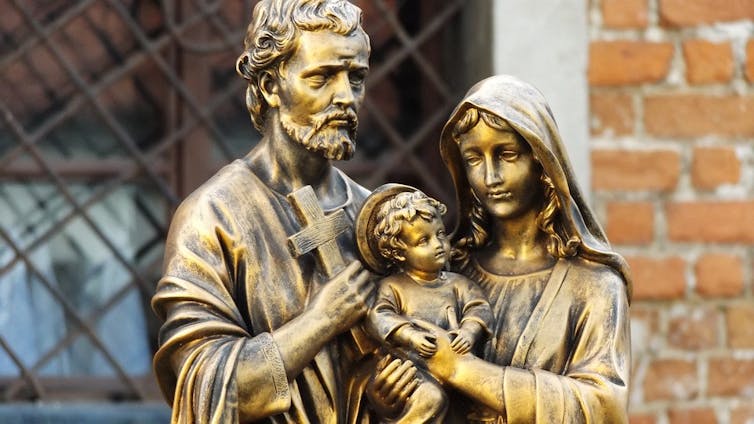
The holy family.
CC BY


However, there are many other little-known details in early Christian storytelling about the relationship between Mary and Joseph that I learned while researching my book, Jesus, Mary, and Joseph: Family Trouble in the Infancy Gospels. Early Christians believed that Mary and Joseph did not have sex, but there was much more that was worth learning from that relationship.

Listen up, Jim Ziegler.

The gospel narratives


The Christian Bible includes four gospels, or narratives, of the life of Jesus. Two of them, the Gospel of Matthew and the Gospel of Luke, include accounts of Jesus’s birth. These two versions of the “Christmas story” supply almost all of the details about Mary and Joseph that can be found in the Christian Bible.

In Matthew 1-2, readers learn about the birth of Jesus in Bethlehem, the visit of the Magi or “wise men” to see the newborn and the flight of the holy family to Egypt in order to escape King Herod’s killing of infants. Luke 1-2 describes the birth of John (the cousin of Jesus), an imperial census under the Roman Emperor Augustus and the appearance of angels celebrating the birth of Jesus in the skies above Bethlehem.

Both the gospels seem to agree that Mary conceived by supernatural means, not through sexual intercourse. Meanwhile, whatever Zeigler claims, neither the Gospel of Matthew nor the Gospel of Luke specifies the ages of Mary and Joseph.

The Proto-gospel of James


The earliest source to mention ages is another ancient Christian gospel: the Proto-gospel of James. This gospel is a prequel to the more familiar stories of the first Christmas found in the Christian Bible. It was written in the second century A.D., a hundred years or so after the gospels of the Christian New Testament. Critically, it is mostly unknown to Christians because it is not found in their Bibles.

Even so, the Proto-gospel of James is an important witness to the things that mattered to early Christians. The relationship of Mary and Joseph is one of them.

The Proto-gospel of James tends to fill in gaps left by the Gospels of Matthew and Luke. This, for example, is where readers can learn about the parents of Mary – Joachim and Anna – and about the divine intervention that leads to Anna’s conception of Mary.

This gospel also recounts the story of when Mary met Joseph, details absent from the Gospels of Matthew and Luke. In this telling, Joseph, an elderly widower, is chosen by lottery to take care of Mary, who is 12 years old at the time.

Like the Gospels of Matthew and Luke, the Proto-gospel of James reports that Mary does not conceive through sexual intercourse. She receives news from the angel Gabriel that she will become pregnant and bear a son, Jesus. But the Proto-gospel of James’s account adds a new wrinkle: Mary forgets about her encounter with the angel. When she realizes that she’s pregnant, she’s overcome with fear and confusion. Joseph is likewise confused by Mary’s pregnancy. He nevertheless remains loyal and protects the 12-year-old girl. He takes her to a cave outside of Bethlehem. Soon there is a blinding flash of light. As it recedes, a child appears.

Jesus has arrived.

Familiar and unfamiliar


Some of these details will be familiar to readers of the New Testament: the town of Bethlehem, for example, and the angelic announcement to Mary – the Annunciation – that she will become pregnant.

Other details, however, will come as a surprise: Wasn’t Jesus born in Bethlehem, and not, as the Proto-gospel of James reports, outside of Bethlehem in a cave? And what about the story of how Mary met Joseph? The Proto-gospel of James adds to and changes elements of the earlier accounts of Matthew and Luke.

And then there are details that some Christians know from their religion that other Christians do not. Most Orthodox and Roman Catholics, for example, know the names of Anna and Joachim, the parents of Mary, even though they do not include the Proto-gospel of James in their Bibles. Most Protestant Christians, by contrast, will be unfamiliar with these figures.

In fact, the Proto-gospel of James is just one example of a wide range of gospels and other early Christian writings that are not included in the Christian Bible. The storytelling about the holy family alone could fill a bookshelf: There is the Infancy Gospel of Thomas, the Gospel of Pseudo-Matthew and the History of Joseph the Carpenter. Written at different times in different places, these accounts reflect the early Christian fascination with the household of Jesus, Mary and Joseph.

Love is not predatory


One final observation that is relevant to Jim Ziegler’s comments: The Proto-gospel of James goes a step further than the Gospels of Matthew and Luke in making the point that there was no sexual contact between Mary and Joseph.


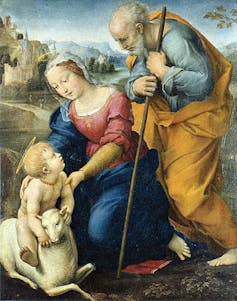
Holy family with the lamb.
Raphael via Wikimedia Commons


In the Gospel of Matthew, Joseph overcomes personal anxiety about Mary’s pregnancy. In the Proto-gospel of James, the pregnancy of Mary becomes a matter of public scrutiny: Both Mary and Joseph must drink the “water of refutation,” a life-and-death ordeal designed to test the truth of their claims of not having had sex with one another. Both pass the test.

But the Proto-gospel of James is not just a story about the virginity of Mary, nor is it just about Joseph’s lack of involvement in the conception of Jesus. Mostly, it is a story about two people being swept up in events that they do not understand.

Together, Mary and Joseph risk everything despite not knowing what it all means. Amid the chaos, they learn to lean on each other. While Mary and Joseph do not, according to the Proto-gospel of James, have a physical relationship, they do love one another.

The ConversationAnd love should not be compared to the predatory behavior alleged against Roy Moore.
Christopher A. Frilingos, Associate Professor in the Department of Religious Studies, Michigan State University

This article was originally published on The Conversation. Read the original article.


Tuesday, December 05, 2017

Guest Post: Jesus as a sausage roll echoes the Gospel of John

M J C Warren, University of Sheffield

With more than 1,000 outlets across the length and breadth of the United Kingdom, Greggs the baker is a national institution. It’s not uncommon for queues to form in some towns and cities as the daily doughnuts, cheese and onion pasties and steak bakes come out of the ovens. But it is the sausage roll that is the star turn.

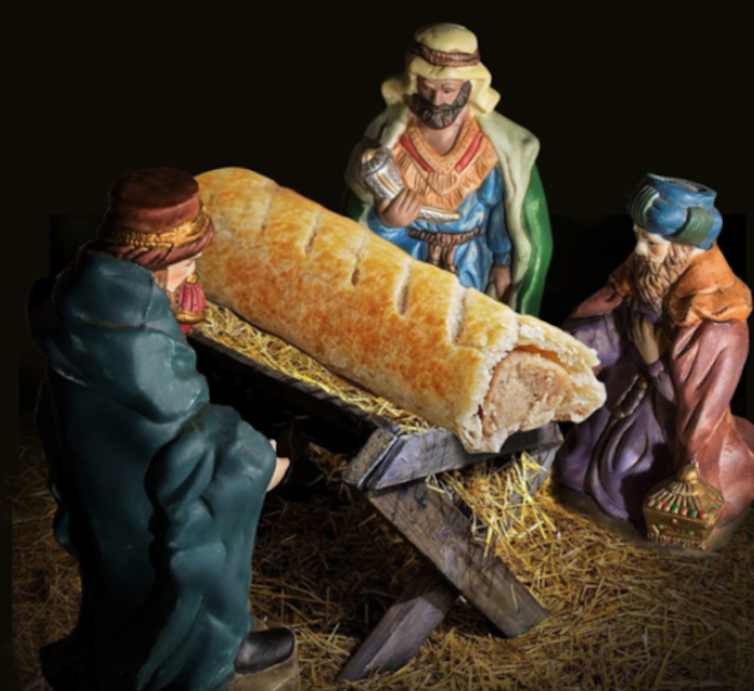
Now though, it seems it is the star that Greggs took too far. For Britain’s biggest bakery has had to apologise after it replaced the traditional baby Jesus in the manger with its famed product in a nativity scene. The image was used to promote its advent calendar and, the company says, wasn’t meant to cause offence.


File 20171116 15410 yqfi5r.png?ixlib=rb 1.1

It’s big, but it might not feed 5,000.
Greggs


Well, regardless of intentions, the image, with three wise men reverently surrounding a golden sausage roll in a manger, caused quite an uproar.

Many Christian Twitter users were at the forefront of this backlash against the image, tapping into the false narrative of the persecution of Christians in Western countries including the UK and US, and the idea that there is a “war on Christmas”.

While many of the “war on Christmas” debates focus on the secularisation of the winter holiday, in this instance the attention was on a private company supposedly making light of the baby Jesus for profit.

One organisation, the right-wing pressure group the Freedom Association, led by Simon Richards, called for a boycott of Greggs as a result of the image.


The viral growth of the hashtag #boycottGreggs has prompted the bakery to issue a formal apology. “We’re really sorry to have caused any offence, this was never our intention,” said a spokesperson.

My flesh is meat indeed


However, what might not be apparent at first glance is just how appropriate this debate about Jesus-as-sausage-roll is in light of the Gospels – and the Gospel of John in particular. Although the Gospel of John doesn’t describe the nativity scene that we find in Luke and Matthew, it is a Gospel intent on describing Jesus as a food.

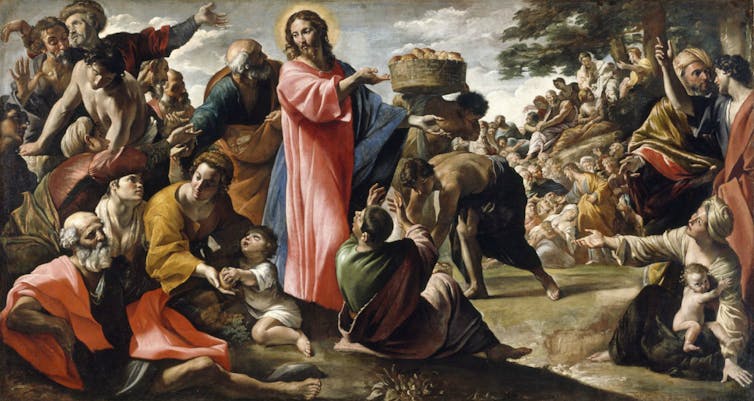
In one well-known scene, after he has fed the 5,000 on the shores of the Sea of Galilee, Jesus launches into a speech known as the “Bread of Life Discourse”. John’s Gospel uses several metaphors to describe Jesus here, including both bread and meat – and scholars have argued that Jesus means what he says.


Giovanni Lanfranco, Miracle of the Bread and Fish (1620-1623).
Wikimedia Commons


First Jesus declares: “I am the living bread.” Those listening to him are understandably confused, since they don’t see a loaf of bread in front of them but “Jesus, the son of Joseph, whose father and mother we know.” When Jesus hears them doubting his claims, he repeats his claim three times, finally stating explicitly that “the bread … is my flesh”.

After this conversation, Jesus makes a second claim about his body, this time that it is flesh to be eaten. In the King James Version, Jesus emphatically declares: “My flesh is meat indeed.” Even if we accept a metaphorical reading of Jesus’s words, there is no question that John the Evangelist understood Jesus in edible terms.

Offence and the Gospels


If Jesus as bread and meat is biblical in its origins, it might be surprising to see that the outrage over these claims is not unique to the current uproar around the Greggs advert.

The Gospel of John first describes people’s disbelief of what Jesus says – they doubt he is the bread he claims to be. But the real outrage comes when Jesus declares that he’s made of meat, and that people should be eating him. Even his followers, his disciples, have trouble with this: “When many of his disciples heard it, they said, ‘This teaching is difficult; who can accept it?’” Jesus, seeing that what he’s said has offended them, doubles down on his claims – and some of his (nameless) disciples decide to leave him.

Not unlike the current furore over Jesus the Sausage Roll, the Gospel of John depicts uproar and offence at Jesus being compared to food. It seems that comparing Jesus to food has a long history of causing outrage, then, but that doesn’t mean that it’s wrong – the Bible itself recognises both the comparison and the ensuing offence.

War on Christmas


Paradoxically, then, Greggs has actually provided a scripture-inspired vision of the nativity that Christians often complain is increasingly absent in the run-up to Christmas.


The ConversationWhile there is no real war on Christmas, those anxious about what they perceive as a lack of Jesus in the advent season should take another look at the Greggs ad, which places a biblical understanding of Jesus right in the centre.

M J C Warren, Lecturer in Biblical and Religious Studies, University of Sheffield

This article was originally published on The Conversation. Read the original article.

Sunday, April 16, 2017

Guest Post: Why Easter is called Easter

by Brent Landau, University of Texas at Austin

This Sunday, April 16, Christians will be celebrating Easter, the day on which the resurrection of Jesus is said to have taken place. The date of celebration changes from year to year. The Conversation

The reason for this variation is that Easter always falls on the first Sunday after the first full moon following the spring equinox. So, in 2018, Easter will be celebrated on April 1, and on April 21 in 2019.

I am a religious studies scholar specializing in early Christianity, and my research shows that this dating of Easter goes back to the complicated origins of this holiday and how it has evolved over the centuries.

Easter is quite similar to other major holidays like Christmas and Halloween, which have evolved over the last 200 years or so. In all of these holidays, Christian and non-Christian (pagan) elements have continued to blend together.

Easter as a rite of spring


Most major holidays have some connection to the changing of seasons. This is especially obvious in the case of Christmas. The New Testament gives no information about what time of year Jesus was born. Many scholars believe, however, that the main reason Jesus’ birth came to be celebrated on December 25 is because that was the date of the winter solstice according to the Roman calendar.


Easter eggs Easter bunny religious traditions spring festival

What is the origin of Easter eggs?
Katie Morrow, CC BY-NC-ND


Since the days following the winter solstice gradually become longer and less dark, it was ideal symbolism for the birth of “the light of the world” as stated in the New Testament’s Gospel of John.

Similar was the case with Easter, which falls in close proximity to another key point in the solar year: the vernal equinox (around March 20), when there are equal periods of light and darkness. For those in northern latitudes, the coming of spring is often met with excitement, as it means an end to the cold days of winter.

Spring also means the coming back to life of plants and trees that have been dormant for winter, as well as the birth of new life in the animal world. Given the symbolism of new life and rebirth, it was only natural to celebrate the resurrection of Jesus at this time of the year.

The naming of the celebration as “Easter” seems to go back to the name of a pre-Christian goddess in England, Eostre, who was celebrated at beginning of spring. The only reference to this goddess comes from the writings of the Venerable Bede, a British monk who lived in the late seventh and early eighth century. As religious studies scholar Bruce Forbes summarizes:

“Bede wrote that the month in which English Christians were celebrating the resurrection of Jesus had been called Eosturmonath in Old English, referring to a goddess named Eostre. And even though Christians had begun affirming the Christian meaning of the celebration, they continued to use the name of the goddess to designate the season.”

Bede was so influential for later Christians that the name stuck, and hence Easter remains the name by which the English, Germans and Americans refer to the festival of Jesus’ resurrection.

The connection with Jewish Passover


It is important to point out that while the name “Easter” is used in the English-speaking world, many more cultures refer to it by terms best translated as “Passover” (for instance, “Pascha” in Greek) – a reference, indeed, to the Jewish festival of Passover.

In the Hebrew Bible, Passover is a festival that commemorates the liberation of the Jewish people from slavery in Egypt, as narrated in the Book of Exodus. It was and continues to be the most important Jewish seasonal festival, celebrated on the first full moon after the vernal equinox.

At the time of Jesus, Passover had special significance, as the Jewish people were again under the dominance of foreign powers (namely, the Romans). Jewish pilgrims streamed into Jerusalem every year in the hope that God’s chosen people (as they believed themselves to be) would soon be liberated once more.

On one Passover, Jesus traveled to Jerusalem with his disciples to celebrate the festival. He entered Jerusalem in a triumphal procession and created a disturbance in the Jerusalem Temple. It seems that both of these actions attracted the attention of the Romans, and that as a result Jesus was executed around the year A.D. 30.

Some of Jesus’ followers, however, believed that they saw him alive after his death, experiences that gave birth to the Christian religion. As Jesus died during the Passover festival and his followers believed he was resurrected from the dead three days later, it was logical to commemorate these events in close proximity.


stained glass window resurrection Easter Sunday

Resurrection.
Fr Lawrence Lew, O.P., CC BY-NC-ND


Some early Christians chose to celebrate the resurrection of Christ on the same date as the Jewish Passover, which fell around day 14 of the month of Nisan, in March or April. These Christians were known as Quartodecimans (the name means “Fourteeners”).

By choosing this date, they put the focus on when Jesus died and also emphasized continuity with the Judaism out of which Christianity emerged. Some others instead preferred to hold the festival on a Sunday, since that was when Jesus’ tomb was believed to have been found.

In A.D. 325, the Emperor Constantine, who favored Christianity, convened a meeting of Christian leaders to resolve important disputes at the Council of Nicaea. The most fateful of its decisions was about the status of Christ, whom the council recognized as “fully human and fully divine.” This council also resolved that Easter should be fixed on a Sunday, not on day 14 of Nisan. As a result, Easter is now celebrated on the first Sunday after the first full moon of the vernal equinox.

The Easter bunny and Easter eggs


In early America, the Easter festival was far more popular among Catholics than Protestants. For instance, the New England Puritans regarded both Easter and Christmas as too tainted by non-Christian influences to be appropriate to celebrate. Such festivals also tended to be opportunities for heavy drinking and merrymaking.

The fortunes of both holidays changed in the 19th century, when they became occasions to be spent with one’s family. This was done partly out of a desire to make the celebration of these holidays less rowdy.


Easter egg hunt spring children

Children on an egg hunt.
Susan Bassett, CC BY-NC-ND


But Easter and Christmas also became reshaped as domestic holidays because understandings of children were changing. Prior to the 17th century, children were rarely the center of attention. As historian Stephen Nissenbaum writes,

“…children were lumped together with other members of the lower orders in general, especially servants and apprentices – who, not coincidentally, were generally young people themselves.”

From the 17th century onward, there was an increasing recognition of childhood as as time of life that should be joyous, not simply as preparatory for adulthood. This “discovery of childhood” and the doting upon children had profound effects on how Easter was celebrated.

It is at this point in the holiday’s development that Easter eggs and the Easter bunny become especially important. Decorated eggs had been part of the Easter festival at least since medieval times, given the obvious symbolism of new life. A vast amount of folklore surrounds Easter eggs, and in a number of Eastern European countries, the process of decorating them is extremely elaborate. Several Eastern European legends describe eggs turning red (a favorite color for Easter eggs) in connection with the events surrounding Jesus’ death and resurrection.

Yet it was only in the 17th century that a German tradition of an “Easter hare” bringing eggs to good children came to be known. Hares and rabbits had a long association with spring seasonal rituals because of their amazing powers of fertility.

When German immigrants settled in Pennsylvania in the 18th and 19th centuries, they brought this tradition with them. The wild hare also became supplanted by the more docile and domestic rabbit, in another indication of how the focus moved toward children.

As Christians celebrate the festival this spring in commemoration of Jesus’ resurrection, the familiar sights of the Easter bunny and Easter eggs serve as a reminder of the holiday’s very ancient origins outside of the Christian tradition.

Brent Landau, Lecturer in Religious Studies, University of Texas at Austin

This article was originally published on The Conversation. Read the original article.


Saturday, December 24, 2016

Guest Post: How did we come to celebrate Christmas?


by Bronwen Neil, Australian Catholic University

Christmas is literally “the mass for Christ”, the day on which Christians celebrate the birth of Jesus.

Pope Leo - Christmas
Pope Leo I
The western date for Jesus’ birth is quite arbitrary. It was chosen by Pope Leo I, bishop of Rome (440-461), to coincide with the Festival of the Saturnalia, when Romans worshipped Saturn, the sun god. This was the day of the solar equinox, the shortest day of the year in the northern hemisphere, which officially marked the halfway point of winter.

Leo thought it would distract his Roman congregation from sun worship by celebrating the feast of Christ’s birth on the same day. He described Jesus as the “new light”; an image of salvation, but timely in that the days began to lengthen from 25 December onwards.

The date of the feast varies within Christian denominations. Western Christians celebrate the Nativity on a fixed date, 25 December. Some Eastern Orthodox Christians celebrate it on 6 January together with Epiphany, the revelation of the infant Jesus to three wise men. The Greek and Russian Orthodox celebrate Christmas on 7 January and Epiphany on 19 January.

Where did Christmas traditions originate?


It is true to say that the western Christmas began as a Christianized pagan feast. The Christmas tree is also a pagan symbol of fertility.

In northern countries, when the nights are long and cold, the feast of Christmas traditionally gave Christian people something to look forward to: rich food (reindeer if you are in Sweden, pork and lamb if you are in Greece), lots of candles, Catholic Mass at midnight or Protestant services on Christmas morning. Fir trees were brought inside and lit with candles as a symbol of the hope that spring would return with new crops and plentiful food.


Fir trees were brought inside to symbolise the return of spring, new crops, and plentiful food. It’s also a pagan symbol of fertility.
Ievgenii Meyer/www.shutterstock.com


The early church also celebrated Christ’s Resurrection in spring, the season of new life, since it coincided with the Jewish Passover feast on 14 Nisan, a date that depended on when the first full moon occurred in March or April. Many of our Easter symbols, like the bunny and the egg, are ancient fertility symbols. No one knows how chocolate got dragged in!

It is also an interesting coincidence that the Jewish Festival of Lights, Hanukkah, falls in November or December each year, and is celebrated with the lighting of the candelabra (menorah), traditional foods, games and gifts.

Where did Santa Claus come from?


The Santa Claus myth (spoiler alert: don’t read any further if you are under 10!) came from the legend of Saint Nicholas. Nicholas was a bishop in the city of Myra (in modern Turkey), who wanted to help poor young women get husbands. He left bags of money of the doorsteps of their family homes in secret, an anonymous gift to the poor to be used as a dowry.

A 1950s Coca-Cola advertisement

For this he became known as the patron saint of virgins and children. Over time, his generosity was remembered by people giving gifts to children in secret on the feast of St Nicholas, celebrated on December 6 (in western Christian countries) and 19 December (in the eastern churches). His name in English became Clause, after the Dutch Sinterklaas. Dutch children and others in western Europe leave food out in a shoe or a clog for Nicholas’ horse on the eve of 6 December, and receive presents on the day of the feast.

Our modern image of Santa Claus as a rotund gentleman of a certain age dressed in a red-and-white suit and matching hat comes from an incredibly successful marketing campaign by Coca-Cola in the 1930s. Since then, suburban Santas always dress in the image created by the Coke brand.

But this image comes from an earlier depiction of Father Christmas who had nothing to do with the American Santa Claus until the 1850s.

Until the Victorian era, when childhood was recognised as a separate stage of life, and the Christmas feast came to centre around children, Father Christmas, or Lord Christmas as he was also known, was the personification of a mid-winter feast of merrymaking for adults – and he brought no presents. He was useful as a symbol for Catholic-sympathising writers in the early 17th century who wanted to defend Christmas from attacks by the Puritans, radical Protestants who intended to ban the feast.

(For a Jewish perspective on the Wars of Religion, see Stephen Feldman’s book, Please Don’t Wish Me a Merry Christmas: A Critical History of the Separation of Church and State (1997).)

Tuck Postcard, Photo Oilette Series, 1919.
From the 1850s onwards, the English Father Christmas was depicted as a bearded old man wearing a long red robe trimmed with white fur and a pointed red hat, who brought gifts to good children. This image can be seen on English postcards from the early 20th century.

Christmas in the modern era

A lot of the significance of the original feast is lost when we in the southern hemisphere celebrate it in the middle of summer. A family barbecue at the beach cannot really capture the atmosphere of a cold and dark mid-winter.

This seems to be the main reason for the emergence of the alternative “Christmas in July”. Today we give presents to adults as well as kids on the eve or day of 25 December, and usually not anonymously. It would be interesting to see what would change if none of our gifts had name tags attached – Secret Santa at the office is based on the same concept.

Our gifts are also reminiscent of the tributes that the three Magi – who symbolise, according to tradition, the non-Jewish peoples – gave to the infant Jesus.

Incidentally, according to two of the four Gospels, Jesus was born in Bethlehem, but given the lack of corroborating evidence for a census there that year, it is now thought that Jesus was more likely born in Galilee, where he grew up. Bethlehem was significant for the Gospel writers as being the birthplace of King David 1,000 years earlier, and a royal city for the Jews.

The Magi gave Jesus gold, frankincense and myrrh, when they understood that the baby they were looking at was both human and the son of God. That mystery at least remains intact.

The Conversation

Bronwen Neil, Associate professor, Australian Catholic University

This article was originally published on The Conversation. Read the original article.