Showing posts with label church history. Show all posts

Saturday, March 17, 2018

Guest Post: Was St Patrick Welsh? An expert reviews the evidence

Simon Rodway, Aberystwyth University

I wandered the streets of Galway, on St Patrick’s Day 2002, wearing a t-shirt which stated “St Patrick: he’s Welsh, you know”. It was intended, and received, as friendly banter, in the context of a resounding Irish victory over Wales in the Six Nations rugby tournament a fortnight previously. But is it true?
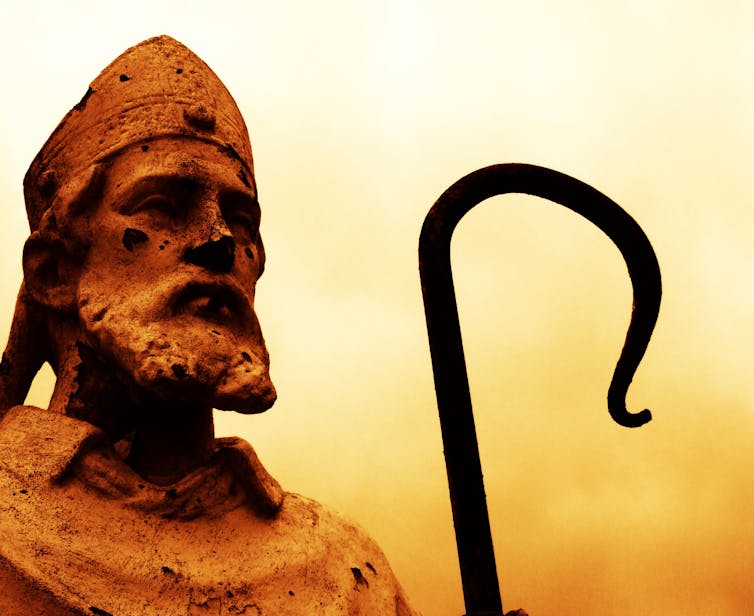


St. Patrick statue

St Patrick.
Jaqian/Flickr, CC BY-SA


The answer should be pretty straightforward. After all, Patrick tells us, in one of the two Latin works of his that have survived, where he was from: a town named Banna Venta Berniae. Unfortunately, we don’t know where that was, except that it was somewhere in Britain. As he was captured there by Irish raiders, it must have been reasonably close to the west coast of Britain. So it is quite possibly, but by no means necessarily, somewhere in Wales.

Perhaps its precise location doesn’t really matter. In Patrick’s lifetime (some time in the fifth century AD), Wales, as we know it, did not exist. The inhabitants of the various kingdoms which made up the geographical area which we now call Wales called themselves “Britons”, as indeed did many other people in the part of Britain south of Hadrian’s Wall – the old Roman province of Britannia.

But those Britons who spoke the British Celtic language known as Brittonic (the ancestor of Welsh, Cornish and Breton) began, in the same century, to use another name for themselves?, Combrogī – “fellow countrymen”. This term is the ancestor of the English place name Cumbria, and of the word the Welsh use today to describe themselves: Cymry (in the Middle Ages, this term was also used for the country of Wales, which is now spelled Cymru). Whether or not this term was in use in the fifth century, however, is impossible to say.

By this time, Germanic-speaking kingdoms were forming in the south and east of the island of Britain. They were the forerunners of what historian, and later saint, Bede, in the eighth century would call the “gens Anglorum”, “the English people”. These people were not Britons, either to themselves, or to their neighbours to the west, who, then and now, called them “Saxons” (Welsh “Saeson”, Gaelic “Sasanaigh”). They, in turn, called the Britons, “Wealas”, the origin of the word “Welsh”. So from a contemporary English point of view at least, Patrick would have been Welsh.

Language and literature


It has been claimed, by scholars both medieval and modern, that St Patrick spoke Brittonic. We know that he could write good Latin, but he called it lingua aliena, “a foreign language”. It was not his native tongue, but, as a high status language with a venerable literary tradition, and the lingua franca of the church, it was the obvious choice for him to write in. Without any further evidence, we could quite confidently deduce that Brittonic would be his native tongue (Irish, English and Pictish are much less likely candidates for a native of western Britannia at this time). But perhaps we can go further than this.

In the seventh century, an Irish monk named Muirchú wrote a Life of St Patrick in Latin. In it, the few historical facts about Patrick recoverable from his own writings are almost completely obscured by the numerous miracles that were de rigeur in medieval writings on the lives of saints, and the blatant propaganda of the ambitious church of Armagh, which was in the process of appropriating Patrick for itself.
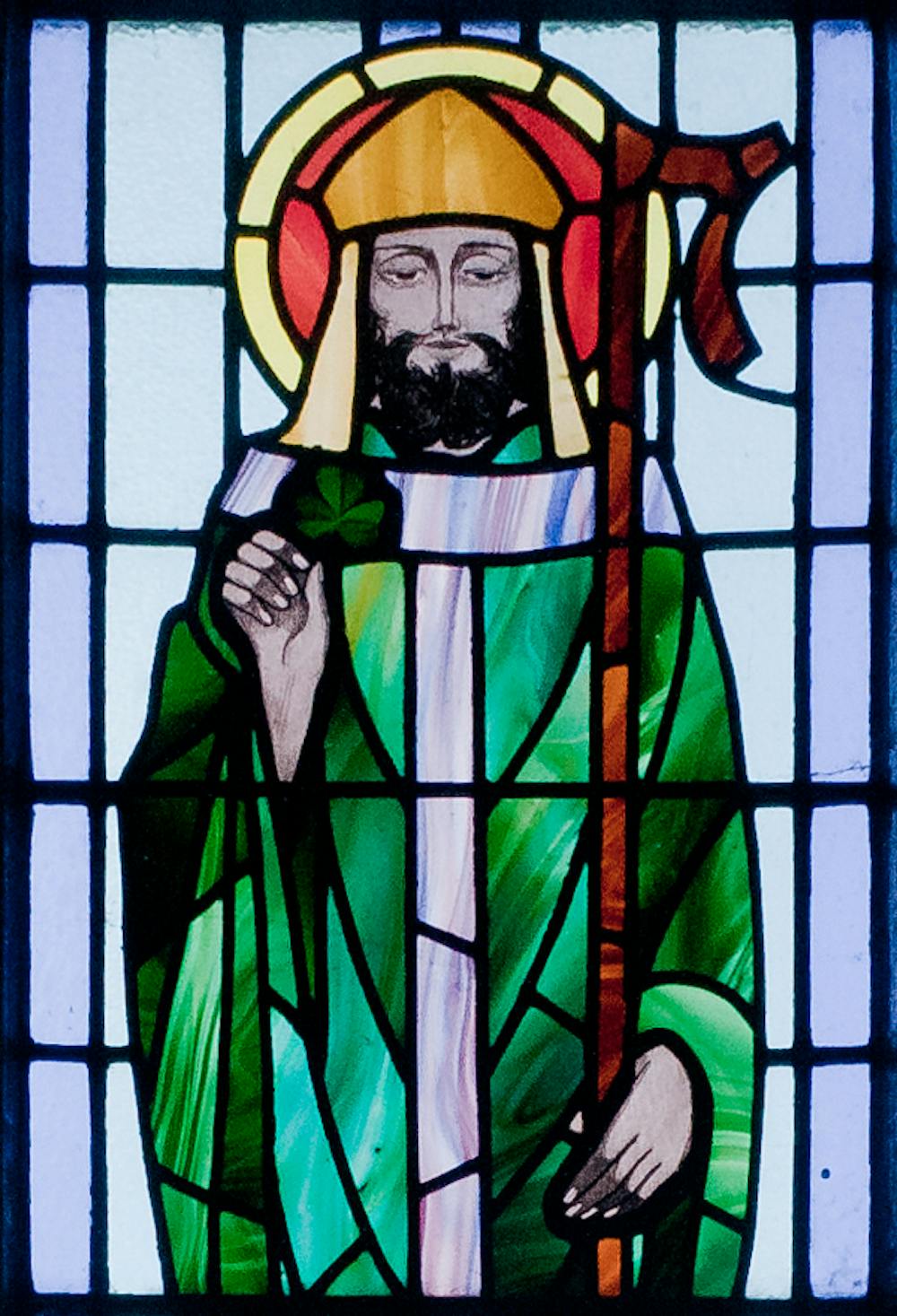


St Patrick stained glass St Benin’s Church, County Galway.

St Patrick depicted in stained glass at St Benin’s Church, County Galway.
Andreas F. Borchert/WIkimedia, CC BY-SA


Nonetheless, Muirchú records verbatim two of Patrick’s sayings: “modebroth” and “gra(t)zacham”. Muirchú does not tell us what language these utterances are in, but both were interpreted as being in Brittonic by a ninth-century Irish lexicographer, Cormac mac Cúilennáin, the bishop-king of Cashel.

Modebroth, he claimed, is a corrupt form of the Welsh “myn duw brawd” – “by the god of judgement”. This could be right, but gra(t)zacham derives ultimately from the Latin “gratias agam” (“let me give thanks”), or gratias agamus (“let us give thanks”).

Cormac seems to have interpreted it as Brittonic on the eminently reasonable ground that Patrick was a Briton, and that anything he is reported to have said which was not obviously Irish or Latin must have been Brittonic. So if he was wrong about gra(t)zacham, he may have been wrong about modebroth, too, which may, in fact, have been an Irish phrase meaning “divine judgment”, subjected to the sort of modification common in religious oaths (see, for instance, the English “gosh” and “jeepers” instead of “God” and “Jesus”). At any rate, there is no very compelling reason to believe that Muirchú really did have access to the exact words which Patrick had uttered 200 years previously.

So what’s the verdict? Patrick may very well have been born in present-day Wales. He was certainly born in the west of Britain. He may have thought of himself as a Cymro, and the English would doubtless have classified him as Welsh. His first language was almost certainly the ancestor of Welsh. And yet, we know that he chose Ireland over the land of his birth. He is a footnote in the history of Wales, but utterly central to that of Ireland.

The ConversationIn the game of rugby which inspired my St Patrick’s Day t-shirt, one of the (many) try scorers for Ireland was a certain Ronán O’Gara, born San Diego, California. When it comes to identity, place of birth isn’t everything.

Simon Rodway, Lecturer in Celtic Studies, Aberystwyth University

This article was originally published on The Conversation. Read the original article.
Guest Post: 10 things to know about the real St. Patrick


Lisa Bitel, University of Southern California – Dornsife College of Letters, Arts and Sciences

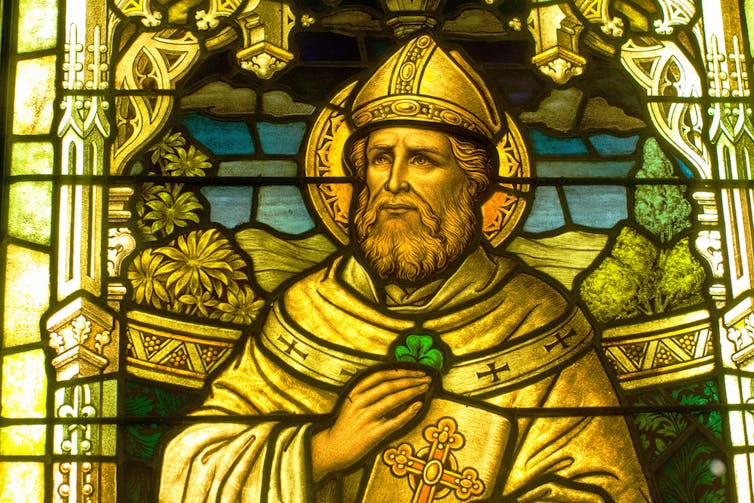
On March 17, people around the world will celebrate St. Patrick’s Day by parading in green hats, sporting images of shamrocks and leprechauns – tiny, grinning, fairy men – pinned to their lapels. Patrick’s picture will adorn greeting cards: an aged, bearded bishop in flowing robes, grasping a bishop’s staff and glaring at a coil of snakes.

The icon refers to one of Patrick’s legendary miracles in which he is said to have prayed to banish all snakes from Ireland. However, as a historian of medieval Ireland, I can assure you that the real St. Patrick, who lived and worked in the fifth century, never saw a snake or wore a shamrock.


St Patrick of Ireland

Saint Patrick.
Thad Zajdowicz


Patrick’s own writings and early accounts of the saint’s career reveal many interesting details about the life of this patron saint of Ireland. Here are 10 things you may not know about St. Patrick.

1. Patrick was not Irish


Patrick was born around 450 A.D., just when Roman troops withdrew from Britain. His father was a gentleman and a Christian deacon who owned a small estate in a place called Bannavem Taburniae.

Scholars aren’t sure where this place was – it was probably on the west coast around Bristol, near the southern border of modern Wales and England.

2. Patrick was a slave


Irish slave traders sailed the waters off that same coast, and one day they came ashore to capture the teenage Patrick and his neighbors, to sell back in Ireland. Patrick spent six years tending sheep in the west of Ireland.

3. Patrick heard voices


While chasing sheep on the hills, Patrick prayed a hundred times a day, in all kinds of weather. It paid off. One night a mysterious voice called to him, saying, “Look, your ship is ready!” Patrick knew he wasn’t hearing sheep. The time was right for his escape.

4. Patrick refused to ‘suck a man’s breasts’


 St. Patrick Catholic Church, Ohio

St. Patrick Catholic Church, Ohio.
Nheyob (Own work)., CC BY-SA


Patrick made his way to Ireland’s east coast and sought passage on a ship bound for Britain. The captain, a pagan, didn’t like the look of him and demanded that Patrick “suck his breasts,” a ritual gesture symbolizing acceptance of the captain’s authority. Patrick refused – instead he tried to convert the crew.

For some reason, the captain still took him aboard.

5. Patrick had visions


One night Patrick dreamed that Satan tested his faith by dropping an enormous rock on him. He lay crushed by its weight until dawn broke, when he called out, “Helias! Helias!” – the name of the Greek sun god. The rock disappeared. Patrick took it as a kind of epiphany. He later wrote:

“I believe that I was helped by Christ the Lord.”

Patrick had other peculiar visions, too. Back home at Bannavem Taburniae, he was visited by an angel with a message from the Irish: “We beg you, Holy Boy, to come and walk again among us.” He trained as a bishop and went back to Ireland.

6. Patrick did something unmentionable


Years into his mission, someone, it seems, told a dirty secret about Patrick to his fellow bishops. “They brought up against me after thirty years something I had already confessed … some things I had done one day - rather, in one hour, when I was young,” he wrote.

Patrick did not tell us what he did – worship idols? Engage in a forbidden sexual practice? Take gifts from converts?

Whatever it was, Patrick retrospectively understood his zealous Irish mission to be penance for his youthful sins. While he spread Christianity around Ireland, he was often beaten, put in chains or extorted. “Every day there is the chance that I will be killed, or surrounded, or taken into slavery,” he complained.

7. Patrick duelled with druids


Two centuries after his death, Irish believers wanted more exciting stories of Patrick’s life than the saint’s own account.

One legend (written 700 A.D.) described Patrick’s contest with native religious leaders, the druids. The druids insulted Patrick, tried to poison him and engaged him in magical duels – much like students of Harry Potter’s Hogwarts – in which they competed to manipulate the weather, destroy each other’s sacred books and survive raging fires.

When one druid dared to blaspheme the Christian God, however, Patrick sent the druid flying into air – the man dropped to the ground and broke his skull.

8. Patrick made God promise


Another legend from around the same time tells how Patrick fasted for 40 days atop a mountain, weeping, throwing things, and refusing to descend until an angel came on God’s behalf to grant the saint’s outrageous demands. These included the following: Patrick would redeem more souls from hell than any other saint; Patrick, rather than God, would judge Irish sinners at the end of time; and the English would never rule Ireland.

We know how that last one worked out. Perhaps God will keep the other two promises.

9. Patrick never mentioned a shamrock


St Patrick's Day shamrock

St. Patrick’s Day shamrock.
Maiconfz, CC BY


None of the early Patrician stories featured the shamrock – or Irish seamróg – which is a word for common clover, a small plant with three leaves. Yet children in Catholic schools still learn that Patrick used a shamrock as a symbol of the Christian Trinity when he preached to the heathen Irish.

The shamrock connection was first mentioned in print by an English visitor to Ireland in 1684, who wrote that on Saint Patrick’s feast day, “the vulgar superstitiously wear shamroges, 3 leav’d grass, which they likewise eat (they say) to cause a sweet breath.” The Englishman also noted that “very few of the zealous are found sober at night.”

10. Patrick did not drive the snakes out of Ireland


As for the miraculous snake-charming attributed to Patrick, it could not have happened because there were no snakes in pre-modern Ireland. Reptiles never made it across the land bridge that prehistorically linked the island to the European continent.

Most likely, the miracle was plagiarized from some other saint’s life and eventually added to Patrick’s repertoire.

Party-goers on March 17 need not worry about ancient historical details, though. Whatever the truth of Patrick’s mission, he became one of the three patrons of Ireland, along with Sts. Brigit and Columba– the latter two were born in Ireland.

The ConversationWishing you “Lá fhéile Pádraig sona dhaiobh” – Happy Saint Patrick’s Day.


Lisa Bitel, Professor of History & Religion, University of Southern California – Dornsife College of Letters, Arts and Sciences

This article was originally published on The Conversation. Read the original article.
Thursday, March 15, 2018

Guest Post: Who was Mary Magdalene? Debunking the myth of the penitent prostitute

Dorothy Ann Lee, University of Divinity

Who was Mary Magdalene? What do we know about her? And how do we know it? These questions resurface with the release of a new movie, Mary Magdalene, starring Rooney Mara in the titular role.

Mary Magdalene Yvonne de CarloThe question of how we know about her is a relatively simple one. She appears in a number of early Christian texts associated with the ministry of Jesus.

These texts comprise Gospels written in the first and second century of the Common Era (CE). The earliest of them are included in the New Testament, where Magdalene plays a significant role. She also appears in later Gospels, which were not included in the Bible and come from a later period in early Christianity.

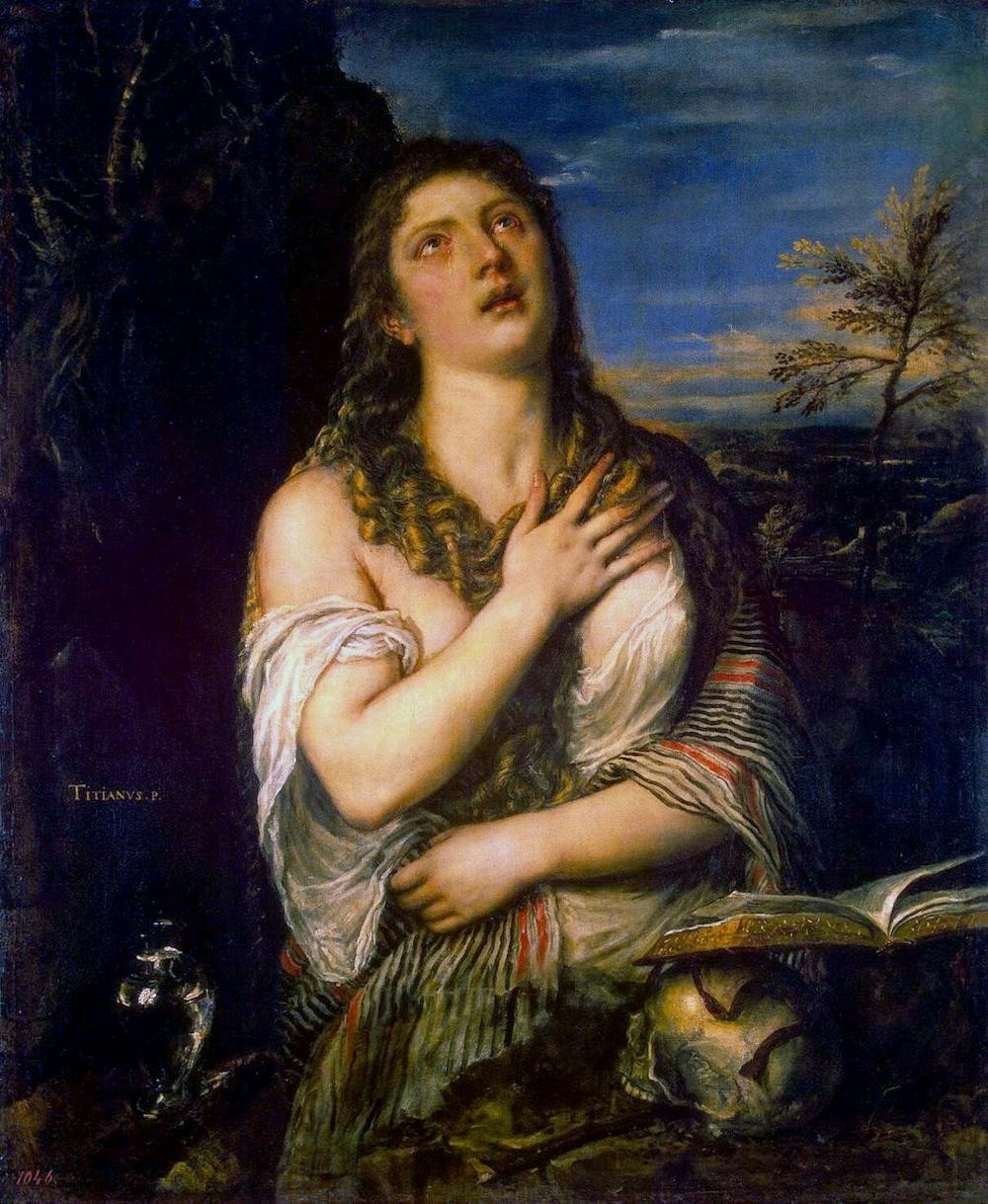
The answer about who she was and what we know of her is more complex. In Western art, literature and theology, Mary Magdalene is portrayed as a prostitute who meets Jesus, repents of her sins, and pours oil on his feet in a gesture of humility, penitence and gratitude. She is sometimes depicted kneeling at the foot of the cross, hair unbound, emphasising the sinful past from which she can never quite escape, despite being declared a saint.

The tradition of the penitent prostitute has persisted in the Western tradition. Institutions that cared for prostitutes from the 18th century onwards were called “Magdalenes” to encourage amendment of life in the women who took refuge in them. The word came into English as “maudlin”, meaning a tearful sentimentality. It is not a flattering description.


Titian Penitent Magdalene, circa 1565

Titian’s Penitent Magdalene, circa 1565.
Wikimedia Commons


Artistic depictions continued to emphasise Magadelene’s sexuality in various ways, under a facade of piety. In another twist on the same theme, she is presented as the wife of Jesus, most notably in Dan Brown’s The Da Vinci Code (2003).

The tradition of Mary Magdalene as the archetypal penitent whore, whose sexuality somehow manages to persist beyond her conversion, can be dated to a sermon preached by Gregory the Great in the sixth century CE.


Read more:
Weighing up the evidence for the 'Historical Jesus'


Admittedly, there are a confusing number of women called “Mary” in the Gospels and we might assume Pope Gregory was tired of distinguishing between them. He reduced them to two: on the one hand, Mary, the mother of Jesus, perpetual virgin, symbol of purity and goodness, and, on the other, Mary Magdalene, promiscuous whore, symbol of feminine evil from which the world must be redeemed.

A disciple of Jesus


Yet nowhere in the Gospels is Mary Magdalene associated either overtly or covertly with sexuality. The four Gospels of the New Testament present her in two significant roles.

In the first place, she is a disciple of Jesus: one among a band of women and men from Galilee who believed in his message of love and justice and followed him in his ministry.

Secondly, Magdalene is a primary witness in the Gospels to the resurrection of Jesus from the dead. Unlike many of the other disciples, she does not flee when Jesus is arrested. She remains at the cross when he dies and later visits his tomb to find it empty, with a vision of angels declaring his resurrection.

Mark’s Gospel, which we now know to be the earliest Gospel to be written, speaks of Magdalene as a disciple of Jesus who has followed him from Galilee along with other women, but it does not mention her until the crucifixion. These women disciples now stand near the cross, despite the danger in being present at the execution of a dissident.

Three of them, including Magdalene, visit the tomb on Easter morning where they meet an angel who informs them that Jesus has risen from the dead (Mark 16:1-8). The women’s subsequent departure from the tomb is ambiguous, and they leave in fear and silence, which is where the manuscript of Mark’s Gospel abruptly ends. An ending added later makes mention of the risen Jesus making an appearance first to Magdalene.

In Matthew’s Gospel, Magdalene meets the risen Christ as she leaves the tomb, this time with only one other female companion, who is also called “Mary” (Matt 28:1-10). In Luke’s account, Magdalene appears at the cross and at the empty tomb to hear the angel’s words, but she and her female companions are not believed when they convey the message of the resurrection to the apostles (Luke 24:1-11).


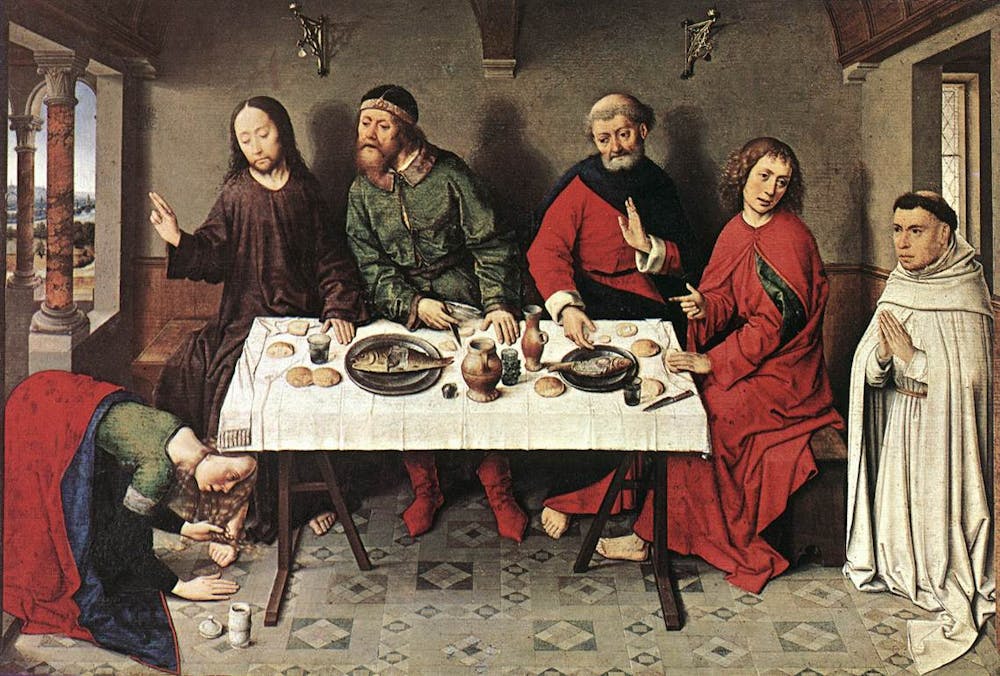
 Mary Magdalene anoints Christ’s feet in Dieric Bouts’ Christ in the House of Simon

Mary Magdalene anoints Christ’s feet in Dieric Bouts’ Christ in the House of Simon (circa 1420–1475).
Wikimedia Commons


In Luke, there is an earlier mention of Magdalene in Jesus’s ministry where she is present, along with other women, as a disciple and supporter of Jesus (Luke 8:1-3). She is described as having had seven demons cast from her. This description might lead to the conclusion, in some minds, that the many “demons” refer to her unfettered sexuality.

But that would be erroneous. Exorcisms — the casting out of evil spirits — are common in the first three Gospels. Those suffering demonic possession are never described as sinful but rather are victims of external evil.

These days, we would associate their symptoms with physical maladies such as epilepsy or mental illness. Magdalene, in other words, has been the victim of a serious illness and Jesus has healed her.


Read more:
How the Bible shapes contemporary attitudes to rape and sexual assault


Furthermore, the description is unusual here in that she is not described in relation to a male figure, as other women at the time generally were: father, husband, brother. She is simply referred to as “the Magdalene”, that is, the woman from Magdala, a Jewish village in Galilee.

We might well assume, from Luke’s description, that she is an independent woman of some means, who is well able to fund, as well as participate in, the movement around Jesus.

Her most significant role


John’s Gospel, however, gives Magdalene her most significant role. Once again, she does not appear until the crucifixion. In the narrative that follows, she comes alone to the tomb on Easter morning, finds it empty, tries unsuccessfully to gain help from two other prominent disciples, and eventually meets the risen Christ himself in the garden (20:1-18). He is alive and commissions her to proclaim the message of his resurrection.

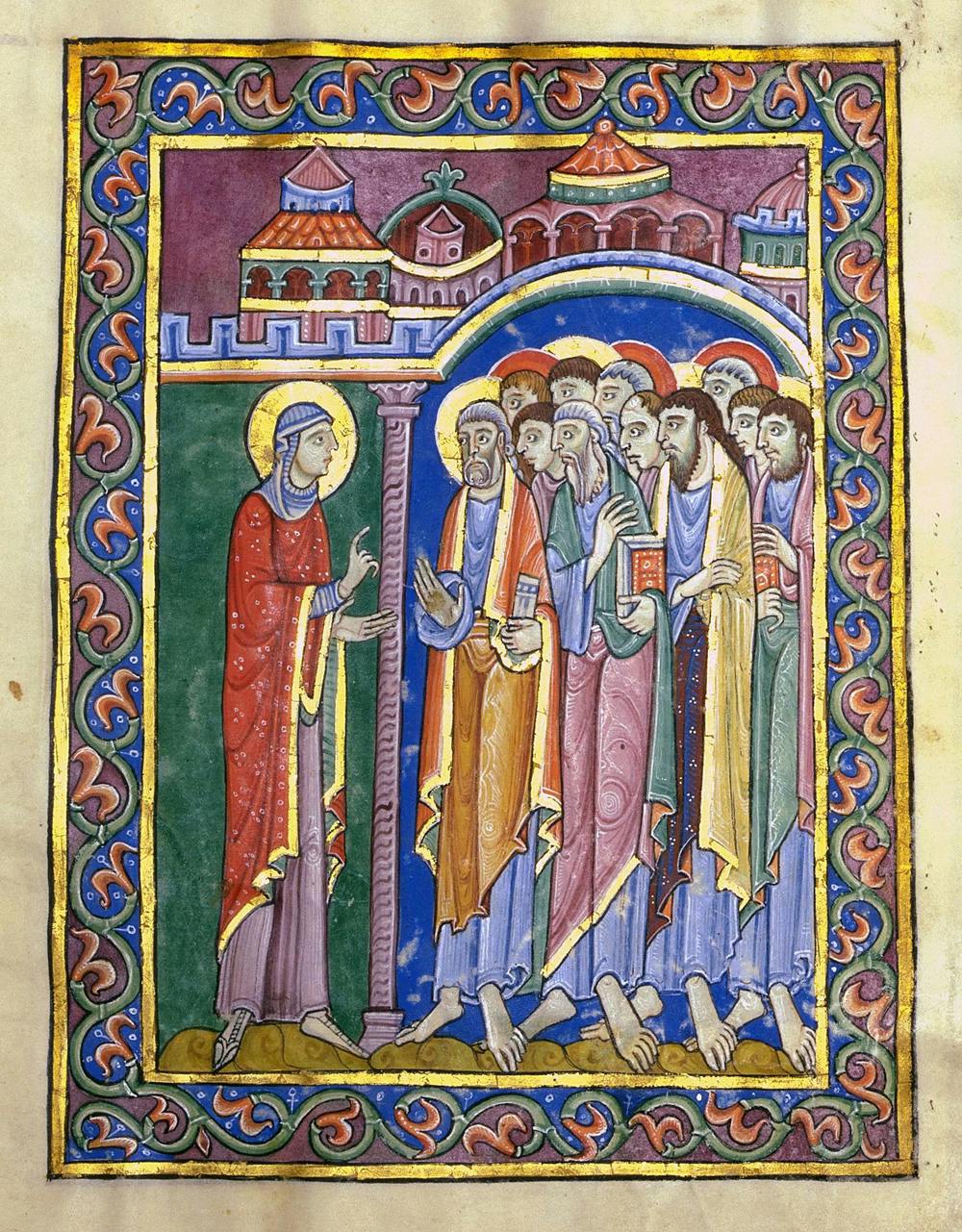
On the basis of John’s story, later tradition gave Magdalene the title of “apostle to the apostles” and recognised something of her significance for Christian faith, witness and leadership. A tragic consequence is that her role as witness to the resurrection was later overshadowed by the apparently more alluring but inaccurate picture of her as the penitent whore.


Mary Magdalene St Albans Psalter

A more accurate portrayal of Mary Magdalene announcing the risen Christ from the 12th-century English illuminated manuscript St Albans Psalter.
Wikimedia Commons


The later Gospels, beyond the New Testament, also emphasise Magdalene’s importance as a disciple of Jesus and witness to the resurrection. The manuscript of the Gospel of Mary, which describes her discussions with the risen Christ, is unfortunately damaged and the central section is missing. In this and other similar Gospels, however, Magdalene is presented as the favoured disciple. This situation leads to some tension with the other disciples, who are jealous of her closeness to Jesus and the teaching she alone is given.

One Gospel speaks of Jesus kissing her, but the imagery in the Gospel of Philip is metaphorical and refers to a spiritual union with Christ. In response to the objection by the other disciples, Jesus asks why he does not kiss them in the same way, implying that they do not as yet possess the same degree of spiritual knowledge.

No evidence of Magdalene anointing Jesus


There is no evidence, incidentally, that Magdalene ever anointed Jesus.

There are three anointing traditions in the Gospels. In one, an unnamed woman anoints Jesus’s head in prophetic recognition of his identity (Gospels of Mark & Matthew). In another, a named and known disciple, Mary of Bethany, who is a model disciple, anoints Jesus’s feet in gratitude for his raising her brother Lazarus from the dead (Gospel of John). In the third, a “sinful woman”, who is not explicitly identified as a prostitute, anoints Jesus’s feet in a gesture of repentance, gratitude and hospitality. None of these three figures is associated in any way with Mary Magdalene in the texts.

The movie Mary Magdalene, directed by Garth Davis, is a significant portrayal of this early Christian figure in the light of evidence from the earliest texts. The screenwriters, Helen Edmundson and Philippa Goslett, are quite clear that Mary is not to be associated with Jesus through her sexuality, either as harlot or wife. On the contrary, she is depicted as a faithful and deeply insightful disciple of Jesus, on whom he draws for his message of love, mercy and forgiveness.


Magdalene is beautifully portrayed in the movie, which draws on traditions from the earlier and later Gospels. She possesses an intense and compelling presence, which does much to restore her character from its later distortions.

It is true that the film makes somewhat erratic use of the New Testament, both in its presentation of Magdalene and of other characters in the story. Towards the end, for example, there is an implication that Magdalene and the church stand on opposite sides, the one in sympathy with Jesus’s teaching and the other anxious to build a self-glorifying edifice on his assumed identity.

This is unfortunate, as the New Testament itself is quite clear about the priority and identity of Magdalene as a key disciple, witness and leader in the early church, without seeing her in opposition to others.

Indeed, those who campaigned in a number of Christian churches for the ordination of women in the 20th century used precisely the example of Mary Magdalene from the New Testament as “apostle to the apostles” to support their case for women’s equality and leadership.

The recent installation of Kay Goldsworthy as Archbishop of the Anglican Diocese of Perth — the first woman in this country and across the world to be given this title — is the true heir of Magdalene as she is portrayed in the earliest Christian writings.


The ConversationThe film Mary Magdalene opens in Australian cinemas on March 22.

Dorothy Ann Lee, Frank Woods Professor of New Testament, Trinity College, University of Divinity

This article was originally published on The Conversation. Read the original article.

Wednesday, February 14, 2018

Guest Post: Was the 'real' St. Valentine a patron of love?

Lisa Bitel, University of Southern California – Dornsife College of Letters, Arts and Sciences

On Feb. 14, sweethearts of all ages will exchange cards, flowers, candy, and more lavish gifts in the name of St. Valentine. But as a historian of Christianity, I can tell you that at the root of our modern holiday is a beautiful fiction. St. Valentine was no lover or patron of love.

Valentine’s Day, in fact, originated as a liturgical feast to celebrate the decapitation of a third-century Christian martyr, or perhaps two. So, how did we get from beheading to betrothing on Valentine’s Day?


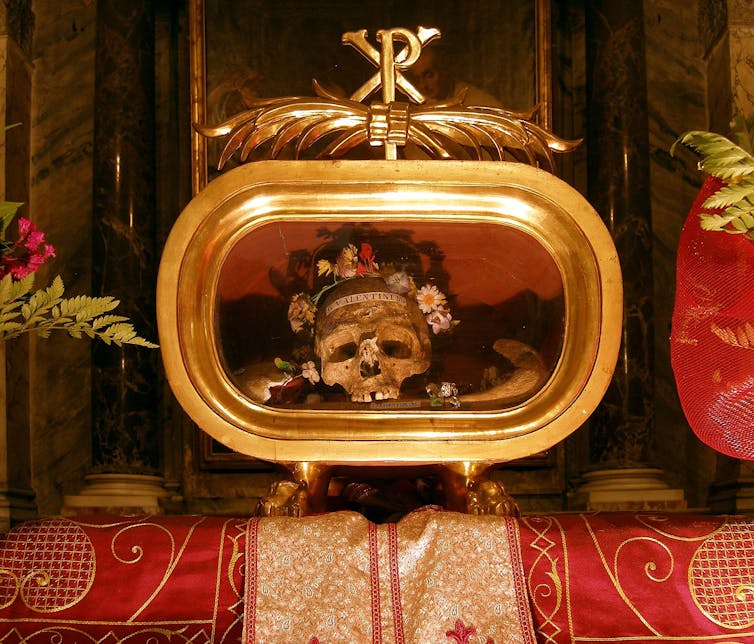
 Relics of St. Valentine of Terni at the basilica of Saint Mary in Cosmedin.

Relics of St. Valentine of Terni at the basilica of Saint Mary in Cosmedin.
Dnalor 01 (Own work) , CC BY-SA


Early origins of St. Valentine


Ancient sources reveal that there were several St. Valentines who died on Feb. 14. Two of them were executed during the reign of Roman Emperor Claudius Gothicus in 269-270 A.D., at a time when persecution of Christians was common.

How do we know this? Because, an order of Belgian monks spent three centuries collecting evidence for the lives of saints from manuscript archives around the known world.

They were called Bollandists after Jean Bolland, a Jesuit scholar who began publishing the massive 68-folio volumes of “Acta Sanctorum,” or “Lives of the Saints,” beginning in 1643.

Since then, successive generations of monks continued the work until the last volume was published in 1940. The Brothers dug up every scrap of information about every saint on the liturgical calendar and printed the texts arranged according to the saint’s feast day.

The Valentine martyrs


The volume encompassing Feb. 14 contains the stories of a handful of “Valentini,” including the earliest three of whom died in the third century.


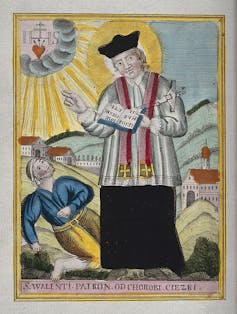
 St. Valentine blessing an epileptic.

St. Valentine blessing an epileptic.
Wellcome Images, CC BY


The earliest Valentinus is said to have died in Africa, along with 24 soldiers. Unfortunately, even the Bollandists could not find any more information about him. As the monks knew, sometimes all that the saints left behind was a name and day of death.

We know only a little more about the other two Valentines.

According to a late medieval legend reprinted in the “Acta,” which was accompanied by Bollandist critique about its historical value, a Roman priest named Valentinus was arrested during the reign of Emperor Gothicus and put into the custody of an aristocrat named Asterius.

As the story goes, Asterius made the mistake of letting the preacher talk. Father Valentinus went on and on about Christ leading pagans out of the shadow of darkness and into the light of truth and salvation. Asterius made a bargain with Valentinus: If the Christian could cure Asterius’s foster-daughter of blindness, he would convert. Valentinus put his hands over the girl’s eyes and chanted:

“Lord Jesus Christ, en-lighten your handmaid, because you are God, the True Light.”

Easy as that. The child could see, according to the medieval legend. Asterius and his whole family were baptized. Unfortunately, when Emperor Gothicus heard the news, he ordered them all to be executed. But Valentinus was the only one to be beheaded. A pious widow, though, made off with his body and had it buried at the site of his martyrdom on the Via Flaminia, the ancient highway stretching from Rome to present-day Rimini. Later, a chapel was built over the saint’s remains.

St. Valentine was not a romantic


The third third-century Valentinus was a bishop of Terni in the province of Umbria, Italy.


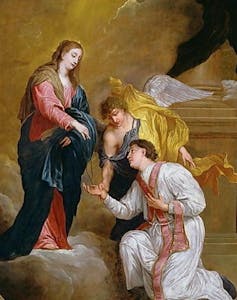
 St. Valentine kneeling

St. Valentine kneeling.
David Teniers III


According to his equally dodgy legend, Terni’s bishop got into a situation like the other Valentinus by debating a potential convert and afterward healing his son. The rest of story is quite similar as well: He too, was beheaded on the orders of Emperor Gothicus and his body buried along the Via Flaminia.

It is likely, as the Bollandists suggested, that there weren’t actually two decapitated Valentines, but that two different versions of one saint’s legend appeared in both Rome and Terni.

Nonetheless, African, Roman or Umbrian, none of the Valentines seems to have been a romantic.

Indeed, medieval legends, repeated in modern media, had St. Valentine performing Christian marriage rituals or passing notes between Christian lovers jailed by Gothicus. Still other stories romantically involved him with the blind girl whom he allegedly healed. Yet none of these medieval tales had any basis in third-century history, as the Bollandists pointed out.


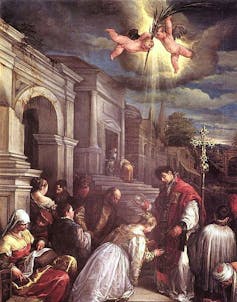
St. Valentine baptizing St. Lucilla. Jacopo Bassano (Jacopo da Ponte)

St. Valentine baptizing St. Lucilla.
Jacopo Bassano (Jacopo da Ponte)


In any case, historical veracity did not count for much with medieval Christians. What they cared about were stories of miracles and martyrdoms, and the physical remains or relics of the saint. To be sure, many different churches and monasteries around medieval Europe claimed to have bits of a St. Valentinus’ skull in their treasuries.

Santa Maria in Cosmedin in Rome, for example, still displays a whole skull. According to the Bollandists, other churches across Europe also claim to own slivers and bits of one or the other St. Valentinus’ body: For example, San Anton Church in Madrid, Whitefriar Street Church in Dublin, the Church of Sts. Peter and Paul in Prague, Saint Mary’s Assumption in Chelmno, Poland, as well as churches in Malta, Birmingham, Glasgow, and on the Greek isle of Lesbos, among others.

For believers, relics of the martyrs signified the saints’ continuing their invisible presence among communities of pious Christians. In 11th-century Brittany, for instance, one bishop used what was purported to be Valentine’s head to halt fires, prevent epidemics, and cure all sorts of illnesses, including demonic possession.

As far as we know, though, the saint’s bones did nothing special for lovers.

Unlikely pagan origins


Many scholars have deconstructed Valentine and his day in books, articles and blog postings. Some suggest that the modern holiday is a Christian cover-up of the more ancient Roman celebration of Lupercalia in mid-February.

Lupercalia originated as a ritual in a rural masculine cult involving the sacrifice of goats and dogs and evolved later into an urban carnival. During the festivities half-naked young men ran through the streets of Rome, streaking people with thongs cut from the skins of newly killed goats. Pregnant women thought it brought them healthy babies. In 496 A.D., however, Pope Gelasius supposedly denounced the rowdy festival.

Still, there is no evidence that the pope purposely replaced Lupercalia with the more sedate cult of the martyred St. Valentine or any other Christian celebration.

Chaucer and the love birds


The love connection probably appeared more than a thousand years after the martyrs’ death, when Geoffrey Chaucer, author of “The Canterbury Tales” decreed the February feast of St. Valentinus to the mating of birds. He wrote in his “Parlement of Foules”:

“For this was on seynt Volantynys day.
Whan euery bryd comyth there to chese his make.”

It seems that, in Chaucer’s day, English birds paired off to produce eggs in February. Soon, nature-minded European nobility began sending love notes during bird-mating season. For example, the French Duke of Orléans, who spent some years as a prisoner in the Tower of London, wrote to his wife in February 1415 that he was “already sick of love” (by which he meant lovesick.) And he called her his “very gentle Valentine.”

English audiences embraced the idea of February mating. Shakespeare’s lovestruck Ophelia spoke of herself as Hamlet’s Valentine.

In the following centuries, Englishmen and women began using Feb. 14 as an excuse to pen verses to their love objects. Industrialization made it easier with mass-produced illustrated cards adorned with smarmy poetry. Then along came Cadbury, Hershey’s, and other chocolate manufacturers marketing sweets for one’s sweetheart on Valentine’s Day.

Today, shops everywhere in England and the U.S. decorate their windows with hearts and banners proclaiming the annual Day of Love. Merchants stock their shelves with candy, jewelry and Cupid-related trinkets begging “Be My Valentine.” For most lovers, this request does not require beheading.

Invisible Valentines


It seems that the erstwhile saint behind the holiday of love remains as elusive as love itself. Still, as St. Augustine, the great fifth-century theologian and philosopher argued in his treatise on “Faith in Invisible Things,” someone does not have to be standing before our eyes for us to love them.

The ConversationAnd much like love itself, St. Valentine and his reputation as the patron saint of love are not matters of verifiable history, but of faith.

Lisa Bitel, Professor of History & Religion, University of Southern California – Dornsife College of Letters, Arts and Sciences

This article was originally published on The Conversation. Read the original article.


Guest Post: Why do Christians wear ashes on Ash Wednesday?


Michael Laver, Rochester Institute of Technology

This coming Wednesday many Christians will arrive at work with a black cross smudged on their foreheads; countless more will slip into a church or a chapel during their lunch break or after work to receive the sign that tells the arrival of Ash Wednesday, the traditional start of the Christian season of Lent.

As both a priest in the Episcopal Church as well as a historian of Christianity, I’ve come to appreciate many of the liturgies and practices that characterize the modern church and have their roots in ancient traditions. The practice of donning ashes is one of them.

Ashes in Bible stories


In the Bible we are told that when the prophet Jonah pronounced God’s wrath on the city of Nineveh for its “wickedness,” likely because of the worship of idols or “false” gods, the king, in an act of sincere penitence, put on sackcloth and sat in ashes.

God was moved by this genuine act of repentance and spared the city from destruction. This story was meant to demonstrate that God is merciful and heeds true remorse.

This spiritual dimension of ashes is emphasized all through the Bible. In the Gospel of Matthew, Jesus deplores the lack of concern for the poor and marginalized on the part of the establishment of the day, as he passes through some towns.

He called out the hypocrisy of religious leaders who taught righteousness on the one hand, but lived lives of luxury and wealth at the expense of the poor on the other. At one point Jesus condemned the religious leaders as “whitewashed tombs, which on the outside look beautiful, but inside they are full of the bones of the dead and of all kinds of filth.”

When pronouncing these judgments, Jesus makes reference to sackcloth and ashes as a form of penitence.

How the practice evolved


As early as the ninth century the church started to use ashes as a public demonstration of repentance for sins.


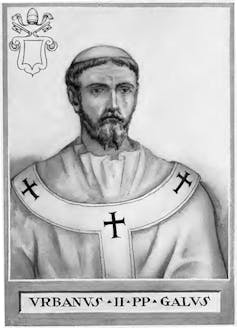
Pope Urban II by Artaud de Montor (1772–1849).

Pope Urban II.
Artaud de Montor (1772–1849).


It was only in 1091, however, that their use was ritualized. Pope Urban II decreed the use of ashes to mark the beginning of a 40-day season of Lent, a time when Christians imitate Christ’s 40-day period of fasting. This period is said to have prepared Christ for his three-year ministry that would culminate in his arrest, crucifixion and resurrection.

With the Protestant Reformation of the 16th century, the use of ashes generally fell out of favor in non-Catholic denominations. However, it returned in the 19th century when many Protestant churches entered into intentional dialogue with each other and with the Catholic Church, a phenomenon that is called the “ecumenical movement.”

Today most “mainline” denominations, including Catholics, Baptists, Episcopalians, Methodists, Presbyterians and others allow for the “imposition” (as called in Catholic and Episcopalian prayer books) of ashes during an Ash Wednesday service. In some churches, the ashes are obtained by burning the palms blessed in the previous year’s Palm Sunday service – a time for Christians to remember Christ’s triumphal entry into Jerusalem days before he was crucified. The resultant ash, depending on local practice, might then be mixed with oil to make them adhere more easily to the forehead.

Modern-day practice


In recent years several churches have put a new spin on the traditional Ash Wednesday service by providing what has been called “ashes to go.” In this new take on an ancient practice, a pastor stands in a very public, often busy, place and offers the ashes to any passersby who wishes to receive them, whether or not the person is Christian.

Stories abound of pastors providing “drive-through ashes” in which the penitent does not even have to get out of the car. A website called “ashes to go” provides not only a list of global sites at which one can receive ashes in this way, but also has an FAQ section containing advice for churches contemplating such a service.

For a supremely ironic twist on Ash Wednesday, one only has to observe that the Gospel reading appointed for the day is from Matthew, chapter 6. Here Jesus rails against religious hypocrisy by criticizing those whose religious piety is done mainly for show:

“Whenever you fast, do not look dismal, like the hypocrites, for they disfigure their faces so as to show others that they are fasting. Truly I tell you, they have received their reward. But when you fast, put oil on your head and wash your face, so that your fasting may be seen not by others but by your Father who is in secret; and your Father who sees in secret will reward you.”

The ConversationChristians bearing the sign of the cross on their forehead this Wednesday will be sharing a formal practice that dates back over a thousand years, and more than that – in a tradition that goes back much earlier.

Michael Laver, Department Chair, Associate professor, Rochester Institute of Technology

This article was originally published on The Conversation. Read the original article.