Showing posts with label liturgy. Show all posts

Wednesday, December 12, 2018

Guest Post: An archaeological dig in Israel suggests how feasting became an important ritual


Natalie Munro, University of Connecticut

This holiday season millions of families will come together to celebrate their respective festivals and engage in myriad rituals. These may include exchanging gifts, singing songs, giving thanks, and most importantly, preparing and consuming the holiday feast.


Archaeological evidence shows that such communally shared meals have long been vital components of human rituals. My colleague Leore Grosman and I discovered the earliest evidence of a ritual feast at a 12,000-year-old archaeological site in northern Israel and learned how feasts came to be integral components of modern-day ritual practice.


First, what are rituals?


Rituals involve meaningful, often repeated actions. In modern-day practices they are expressed through rites such as the hooding of a doctoral student, birthdays, weddings or even sipping wine at Holy Communion or lighting Hanukkah candles.
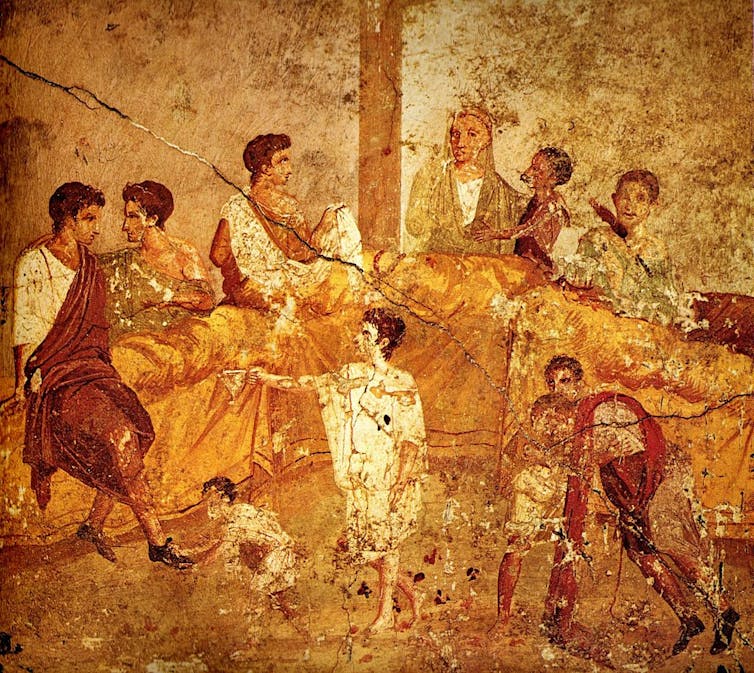


Pompeii family feast painting Naples

Pompeii family feast painting, Naples.
Unknown painter before 79 AD, via Wikimedia Commons


Ritual practice may have emerged along with other early modern human behaviors more than 100,000 years ago. However, proving this with material evidence is a challenge. For example, researchers have found that both Neanderthals and early modern humans buried their dead, but scholars weren’t certain whether this was for spiritual or symbolic reasons and not for something more mundane like maintaining site hygiene. Likewise, the discovery of 100,000-year-old symbolic artifacts like pierced shell ornaments and decorated chunks of red ochre in caves in South Africa, was not sufficient to prove that they were part of any ritual activities.

It was only when archaeologists found these artifacts, placed in graves going back 40,000-20,000 years, that it was confirmed they were part of ritual practice.

The first feasts


We had a similar experience during our research. When Leore Grosman and I first embarked on the excavations at Hilazon Tachtit in the late 1990s, we were only hoping to document the activities of the last hunter-gatherers in Israel, at what appeared to be a small campsite. It was only over several seasons of excavation that it slowly became clear to us that this was not a site where people had lived. Rather it was a site for rituals.
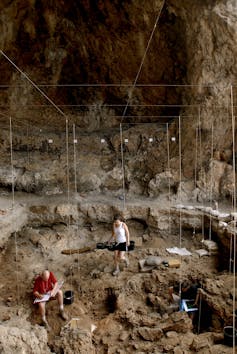


Hilazon Tachtit cave interior. Naftali Hilger

Hilazon Tachtit cave interior.
Naftali Hilger, CC BY-NC-ND


No houses, fireplaces or cooking areas were recovered. Instead the cave yielded the skeletal remains of at least 28 individuals interred in three pits and two small structures.

One of these structures contained the complete skeleton of an older woman, who we interpreted as a shaman based on her special treatment at death. Her grave stood apart due to its fine construction – the walls were plastered with clay and inset with flat stone slabs. Even more remarkable was the eclectic array of animal body parts buried alongside of her. The pelvis of a leopard, the wing tip of an eagle, the skulls of two martens and many other unusual body parts surrounded her skeleton.

The butchered remnants of more than 90 tortoises buried in the grave and the leftovers of at least three wild cattle deposited in a second adjacent depression excavated in the cave floor represent the remains of a funeral feast.
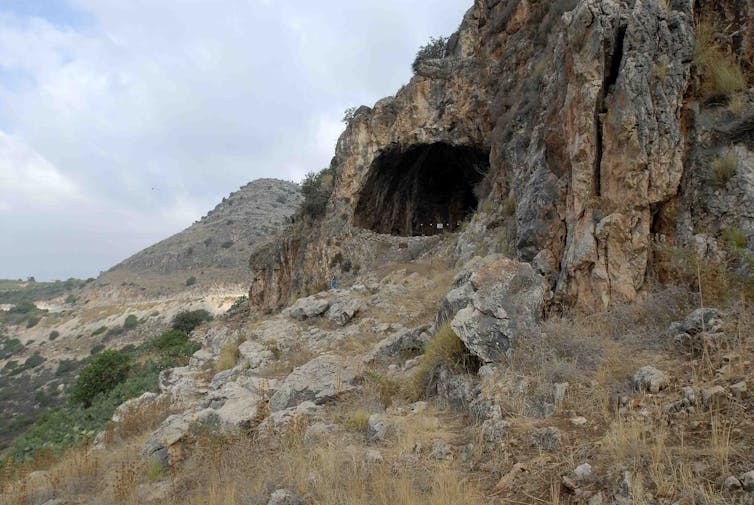


Hilazon Tachtit cave. Naftali Hilger

Hilazon Tachtit cave.
Naftali Hilger, CC BY-NC-ND


The outstanding preservation of the grave enabled us to detect multiple phases of a ritual performance that included the consumption of the feast, the burial of the woman, and the filling of the grave in several stages, including the intentional deposition of garbage from the feast.

Feasting at the beginning of agriculture


Archaeologists have found other sites that show evidence of ritual feasting. Many of these date to the time when humans were beginning to farm.
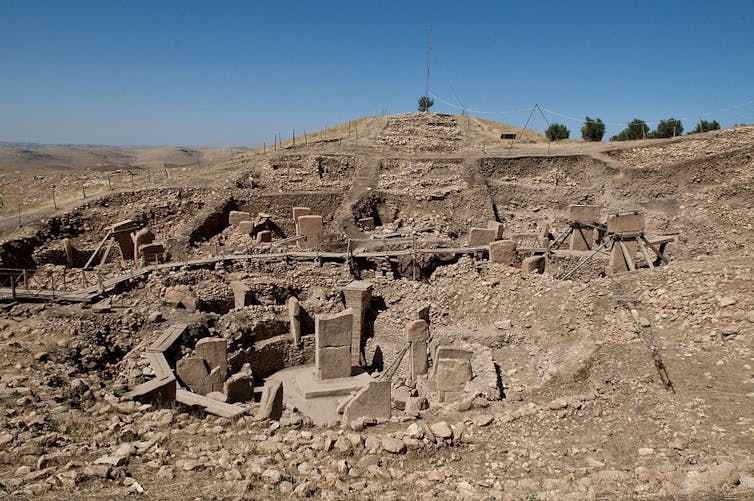


Site of Göbekli Tepe. Teomancimit

Site of Göbekli Tepe.
Teomancimit (Own work) , via Wikimedia Commons, CC BY-SA


One of the most striking is the site of Göbekli Tepe in southeastern Turkey, dating slightly later than Hilazon Tachtit. It includes multiple large structures adorned with benches and giant stone slab carved with exquisite animal depictions in relief dating to 11-12,000 years ago. Perhaps, these were very early communal buildings. The archaeologists who excavated Göbekli Tepe argue that massive quantities of animal bones associated with the structures represent the remains of feasts.

Twelve thousand years ago humans were still hunter-gatherers, subsisting entirely on wild foods. Nevertheless, these people differed from those who went before – they were sitting on the brink of the transition to agriculture, one of the most significant economic, social and ideological transformations in human history.

Sickle blades and grinding stones used to harvest and process cereal grains are found at Hilazon Tachtit and other contemporary archaeological sites. These findings indicate that these ritual feasts started around the same time that people adopted agriculture. When people began to rely more heavily on wild cereals like wheat and barley, they became increasingly tethered to landscapes that were ever more crowded and began to settle into more permanent communities. In other words, feasting became a part of their life, once they moved away from nomadic life.

Rituals that bind


These feasts had an important role to play. Adapting to village life after hundreds of millennia on the move was no simple act. Research on modern hunter-gatherer societies shows that closer contact between neighbors dramatically increased social tensions. New solutions to avoid and repair conflict were critical.

The simultaneous appearance of feasting, communal structures and specialized ritual sites suggest that humans were seeking to solve this problem by engaging the community in ritual practice.

One of the central functions of ritual in these communities was to provide a kind of social glue that bound community members by promoting social cohesion and solidarity. Feasts generate loyalty and commitment to the community’s success. Sharing food is intimate and it builds trust.

Communal rituals would have provided a shared sense of identity at a time when social circles were increasing in scale and permanence. They reinforced new ideologies that emerged out of a dramatic reorganization of economic and social life.

Role of feasts today

Feasting plays the same essential role today. Like the earliest feasts, our holiday celebrations are replete with actions that are repeated year after year.

The holiday feast today builds family traditions. By cooking and sharing food together, telling stories of past holidays and exchanging intergenerational wisdom, holiday rituals bond extended families and give them a shared identity.The Conversation

Natalie Munro, Professor, University of Connecticut

This article is republished from The Conversation under a Creative Commons license. Read the original article.


Wednesday, February 14, 2018

Guest Post: Why do Christians wear ashes on Ash Wednesday?


Michael Laver, Rochester Institute of Technology

This coming Wednesday many Christians will arrive at work with a black cross smudged on their foreheads; countless more will slip into a church or a chapel during their lunch break or after work to receive the sign that tells the arrival of Ash Wednesday, the traditional start of the Christian season of Lent.

As both a priest in the Episcopal Church as well as a historian of Christianity, I’ve come to appreciate many of the liturgies and practices that characterize the modern church and have their roots in ancient traditions. The practice of donning ashes is one of them.

Ashes in Bible stories


In the Bible we are told that when the prophet Jonah pronounced God’s wrath on the city of Nineveh for its “wickedness,” likely because of the worship of idols or “false” gods, the king, in an act of sincere penitence, put on sackcloth and sat in ashes.

God was moved by this genuine act of repentance and spared the city from destruction. This story was meant to demonstrate that God is merciful and heeds true remorse.

This spiritual dimension of ashes is emphasized all through the Bible. In the Gospel of Matthew, Jesus deplores the lack of concern for the poor and marginalized on the part of the establishment of the day, as he passes through some towns.

He called out the hypocrisy of religious leaders who taught righteousness on the one hand, but lived lives of luxury and wealth at the expense of the poor on the other. At one point Jesus condemned the religious leaders as “whitewashed tombs, which on the outside look beautiful, but inside they are full of the bones of the dead and of all kinds of filth.”

When pronouncing these judgments, Jesus makes reference to sackcloth and ashes as a form of penitence.

How the practice evolved


As early as the ninth century the church started to use ashes as a public demonstration of repentance for sins.


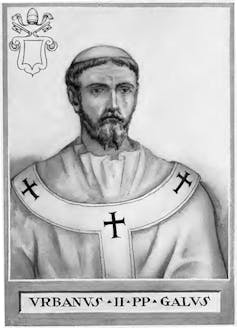
Pope Urban II by Artaud de Montor (1772–1849).

Pope Urban II.
Artaud de Montor (1772–1849).


It was only in 1091, however, that their use was ritualized. Pope Urban II decreed the use of ashes to mark the beginning of a 40-day season of Lent, a time when Christians imitate Christ’s 40-day period of fasting. This period is said to have prepared Christ for his three-year ministry that would culminate in his arrest, crucifixion and resurrection.

With the Protestant Reformation of the 16th century, the use of ashes generally fell out of favor in non-Catholic denominations. However, it returned in the 19th century when many Protestant churches entered into intentional dialogue with each other and with the Catholic Church, a phenomenon that is called the “ecumenical movement.”

Today most “mainline” denominations, including Catholics, Baptists, Episcopalians, Methodists, Presbyterians and others allow for the “imposition” (as called in Catholic and Episcopalian prayer books) of ashes during an Ash Wednesday service. In some churches, the ashes are obtained by burning the palms blessed in the previous year’s Palm Sunday service – a time for Christians to remember Christ’s triumphal entry into Jerusalem days before he was crucified. The resultant ash, depending on local practice, might then be mixed with oil to make them adhere more easily to the forehead.

Modern-day practice


In recent years several churches have put a new spin on the traditional Ash Wednesday service by providing what has been called “ashes to go.” In this new take on an ancient practice, a pastor stands in a very public, often busy, place and offers the ashes to any passersby who wishes to receive them, whether or not the person is Christian.

Stories abound of pastors providing “drive-through ashes” in which the penitent does not even have to get out of the car. A website called “ashes to go” provides not only a list of global sites at which one can receive ashes in this way, but also has an FAQ section containing advice for churches contemplating such a service.

For a supremely ironic twist on Ash Wednesday, one only has to observe that the Gospel reading appointed for the day is from Matthew, chapter 6. Here Jesus rails against religious hypocrisy by criticizing those whose religious piety is done mainly for show:

“Whenever you fast, do not look dismal, like the hypocrites, for they disfigure their faces so as to show others that they are fasting. Truly I tell you, they have received their reward. But when you fast, put oil on your head and wash your face, so that your fasting may be seen not by others but by your Father who is in secret; and your Father who sees in secret will reward you.”

The ConversationChristians bearing the sign of the cross on their forehead this Wednesday will be sharing a formal practice that dates back over a thousand years, and more than that – in a tradition that goes back much earlier.

Michael Laver, Department Chair, Associate professor, Rochester Institute of Technology

This article was originally published on The Conversation. Read the original article.

Saturday, April 15, 2017

Guest Post: Easter Symbolizes a New Hope for Life and Liberty


by Jeffrey A. Tucker

Easter morning is filled with delight: bright colors, delicious foods, happy scenes of bunnies, and egg hunts. Above all, for those who are Christian, we are called to celebrate the joy of the resurrection of Christ from death to new life. The contrast between Good Friday and Easter could not be starker: with the quick turn of the calendar, we move from desperate sadness to unmitigated celebration.

It was not this way in the ancient Christian liturgy. Easter was the beginning of a process of discerning a new reality in the world. It was an entire season lasting five weeks, during which time the dramatic realization of what happened and what it implies for the world unfolds in stages, like spring itself. You can see it in the texts of liturgy and hear it in the chanted music from the first millennium. 

Spring Dawns Slowly
Initially, on Easter morning, there is not unmitigated joy, but rather an awe that approaches a kind of fear: the man who was dead is said to be alive again, which seems to lend credibility to those who said he was not a false prophet but rather the son of God. 

Listen to the melody of the Easter morning entrance song from the old liturgy, which isn’t celebratory but awe-struck and slightly frightened. 


What does this imply about the crucifixion itself, and what does this ask of those who stood aside as Jesus was put to death at the bloody hands of the civic authorities? 

In the second week after Easter, the ancient liturgy observes people’s dawning realization of the truth they have witnessed, and are thereby drawn by a sense of awe to a new faith, brought into the community of believers one person at a time. In the third week, you experience the first cries of joy, and in the fourth, the celebrations consist of new songs, songs that depart from tradition and introduce a new age. By the fifth, the experience of elation is completely unleashed and proclaimed to all the world. 

Life Moves Fast
But in modern times, the entire experience is put on fast-forward. Traditionalists regret this, but it is a defensible change that keeps track of the dramatic cultural shifts between the first millennium and the second. In the first, very few people experienced anything like what we call material progress today. The population barely grew and life was characterized by an unchanging tedium of survival. 

In the second millennium, over the course of hundreds of years, humanity experienced the first signs of the possibility of life improvement, longer and better lives even within a single generation, and modernity dawned with the gradual unfolding of freedom and the accumulation of material capital. Sickness and death gave way to health and life as a reasonable expectation. 

So, in this sense, it makes sense that stories about ourselves and even the past would speed up as well. Whatever it is today, we want it now and in the most time-efficient form of delivery possible. A website that sticks is abandoned. A book that is too long is not read. Even a sermon in church that drags on tempts people to leave their pews and find a better way to spend the hour. 

We have come to believe that life is about more than preparing our souls for eternity; it is about finding great experiences within the structure of time itself. Hardly anyone even questions this notion today. We carry it with us constantly. Our impatience with tedium is palpable.

This is a cultural change in us wrought by capitalism, and it is nothing to regret. The existence of “time preferences” – that we want to have what we desire sooner than later – is what might be called a Kantian category of action. It is baked into our choices as human beings. The material world either accommodates us or it does not. With the advent of capitalism, humanity experienced a realization of dreams that had been materially inaccessible throughout most of history. We are today surrounded by its blessings in ways we don’t fully appreciate.

It Needs to Happen Now
Let me just relay a story from this morning, which you might find trivial but is actually glorious.
I woke this morning determined to get my oil changed. Now, when my father was my age, he had to do it himself. There were no places where you can go and be in and out in 10 minutes. I, on the other hand, know that this is possible now, without fuss and without an appointment.

So I started driving, letting my mobile app guide me to the closest place and with full confidence that I could achieve my goal. I got my oil changed for $39 and they added fluid for my power steering, which fixed a whirling sound I’d been hearing. Then I got my car washed and the guy fixed my glove compartment that kept falling open. Somehow he just knew what to do, and he did it just to be nice.
Then I went to a car parts store and got some wipes that made my car smell great, and also some touch-up paint – yes, they happened to have the right color – that took away some scrapes on the paint. I did all this just by driving around and meeting nice people and engaging in beautiful commerce all designed to make my life better. I met fascinating, talented people and saw my life improve in real ways through human labor, courtesy, and commercial activity.

This is the way mornings should be. But of all the mornings in world history, it has only become possible to live this way in 0.00000009% percent of them (not scientific, but you get the point). But instead of celebrating how easy our lives are, what do most people do? They grumble about the traffic. They complain that they had to do this at all. They get upset that they are not otherwise at the office or languishing at home or huffing and puffing at the gym.

No matter how much we get, and however soon we get it, there is still something in us that aches for more. This too is a defensible impulse because it is that longing in us that causes us to act to make the world a better place through entrepreneurship, risk-taking, working hard, saving, and generally having the option as consumers to buy what it is that capitalists are selling us. So long as we are free in action and choice, our disgruntlement becomes a motivating force for improving the world. 

Politics Is a Different Matter
And yet, there is one space in life where wanting more sooner does not redound to our benefit. It is within the political sphere. We listen to candidates sell their nostrums and go to the voting booth to buy what they are selling. Then we are shocked when it turns out that they cannot and will not deliver on what they say. Then we do the same thing two years and four years later, never learning the lesson that the political marketplace doesn’t really exist to serve us but rather to serve an institution that, in so many ways, exists outside the sphere of social action. The state is different, radically different, from the marketplace. 

Because of this tendency to want more as soon as possible and to speed up life to accommodate our wishes, people tend to fall for charlatans in political life. Some dude comes along promising to make us great and we go for it, even if what he says makes no sense. Another person says he will deliver justice, equality, fairness, and goodness through taxing, regulating, spending, and war, and people figure that they will “spend” their vote and take the chance that it is true. 

Growing in Liberty
True maturity in political action requires two mental steps. First, we have to decide what it is we want. The burden of the liberal tradition has long been to convince people that the best possible world for us comes through voluntary action within a social setting we create for ourselves, and not from the imposition of someone else’s plan from the top down. Second, we have to cultivate patience that working for the long-term goal of humanity requires commitment, slow growth of intellectual communities, the persuasion of public intellectuals, and deep investment in an idea.

This is the only way it can work. Liberty is not something you can buy. It is something you must build through intellectual courage and hard work. It cannot be granted to you by a politician. It doesn’t even come from politics alone. The work of liberty is a cultural act, extended from the sphere you can control and working outwards to change the intellectual fabric of society. 

The work of liberty unfolds over time like the dawn of spring itself, or the unfolding of Easter in the ancient Christian liturgy. What is possible in this world is a slow realization, born first of awe, then turning to a new consciousness, unfolding in gradual celebration, and culminating in a message to the entire world. Liberty is what allows us all to cast off the old world of authority and imposition and sing a new song of freedom the world over.


Jeffrey A. Tucker FEE.org Easter liberty freedom
Jeffrey A. Tucker is Director of Content for the Foundation for Economic Education. He is also Chief Liberty Officer and founder of Liberty.me, Distinguished Honorary Member of Mises Brazil, research fellow at the Acton Institute, policy adviser of the Heartland Institute, founder of the CryptoCurrency Conference, member of the editorial board of the Molinari Review, an advisor to the blockchain application builder Factom, and author of five books. He has written 150 introductions to books and many thousands of articles appearing in the scholarly and popular press.


This article was originally published on FEE.org. Read the original article.


Tuesday, April 15, 2008

The Pope Comes to Washington

Pope Benedict XVI arrives today in Washington, marking his first trip to the United States since he was elected as the 264th successor to St. Peter almost exactly three years ago. I have twice written about Pope Benedict -- most recently just over a year ago, in reference to his old-fashioned view of economics, and previously just after his election, when I looked into his choice of a papal name.

Today's arrival also marks the first time in nearly 30 years since a reigning Catholic pope has visited the U.S. capital. Pope John Paul II (often designated "the Great") came to D.C. rather early in his papacy, in October 1979. He met at the White House with President Jimmy Carter (the first pope to do so) and presided over an open-air mass on the National Mall. Fourteen years earlier, Pope Paul VI offered Mass at Yankee Stadium, an event memorialized in the play The House of Blue Leaves, by Georgetown alumnus John Guare.

I was fortunate enough to be one of the singers in the massed choir that sang at that October 1979 Mass. The musical selections that Sunday included familiar hymns like "All Creatures of Our God and King," with original lyrics by St. Francis of Assisi and Mozart's "Ave Verum Corpus," but also the premiere public performance of contemporary composer Tom Parker's "Praise the Lord, My Soul." (We were singing that one off photocopies of the manuscript.)

The "Gloria" and "Agnus Dei" were sung in Latin and drawn from Anton Bruckner's Mass in E Minor, which was written in the mid-19th century with a woodwind accompaniment designed specifically for performance outdoors, where stringed instruments tend not to carry well and pipe organs are unavailable.

The song for the preparation of the gifts was Randall Thompson's haunting "Alleluia." Harvard Magazine, in a 2001 biographical sketch of the composer (who taught at the University of Virginia but was also a Harvard alumnus), noted the origins of that piece:

To many music lovers, the name Randall Thompson '20 brings first to mind the lofty sounds of his most famous anthem, based on the single word "alleluia"--whether heard in church service, choral concert, or academic ceremony such as Harvard Commencement.

The work was commissioned by Serge Koussevitsky and the trustees of the Boston Symphony Orchestra in the spring of 1940 for the opening exercises of the new Berkshire Music Center at Tanglewood. The head of the center's choral department was Thompson's future Harvard colleague G. Wallace Woodworth '24. Koussevitsky wanted "Woody" to lead the entire student body in the new anthem to symbolize the center's mission: the performance of music.

The date for the opening was July 8. Thompson had been preoccupied with another commission, but from July 1 to July 5 he was able to turn to Koussevitsky's request. Woody had his large chorus ready to rehearse, but opening day approached and no music arrived. On July 8, with 45 minutes to go, it appeared. Woody got his first look at the score and reassured his charges, "Well, text at least is one thing we won't have to worry about." The performance successfully launched a tradition: to this day Alleluia is performed each summer at the center's opening.

The anthem's tempo mark of lento was very important to the composer. France had just fallen to the Nazis, and Thompson later explained, "The music in my particular Alleluia cannot be made to sound joyous...here it is comparable to the Book of Job, where it is written, 'The Lord gave and the Lord has taken away. Blessed be the name of the Lord.'"

Other songs included "Gift of Finest Wheat," which had been composed for the Eucharistic Congress held in Philadelphia during the U.S. Bicentennial of 1976, and the traditional German hymn, "Holy God, We Praise Thy Name." Other parts of the Mass included Clarence Joseph Rivers memorial acclamation ("Christ Has Died"), representing the African-American gospel tradition, and Alexander Peloquin's "Great Amen" from his oft-heard Mass of the Bells.

I have not yet seen the programs for Pope Benedict's masses at Nationals Park in Washington and Yankee Stadium in New York, but I suspect they will include hymns, anthems, and responses from a wider range of ethnic traditions, especially recognizing the greater number of Hispanic-American Catholics who make up the fastest-growing segment of the Church in the United States. (If one looks at the program of the October 1979 papal Mass on the Mall -- see images below -- the most striking thing about it is the absence of music from the Spanish-speaking Catholic communities, or any acknowledgment of their presence at all.)

Robert Thomson, who writes the "Dr. Gridlock" column for the Washington Post, noted some other changes in the scene in an article on Sunday, in this case in the area of transportation:

Back then, transportation planners were worried about whether there would be enough gas for the spectators and worshipers driving to see Pope John Paul II.

That was October 1979. The region was smaller, and so was its transit system.

The gas shortage had passed its crisis level, but, in that auto-dependent environment, the planners made sure 35 service stations on major routes received extra fuel.

Metrorail had opened in 1976 but was a scrawny version of today's robust 106-mile, 86-station system. For a Sunday afternoon papal Mass on the Mall, Metro stayed open from 6 a.m. until midnight and suspended the Farecard system, asking instead that riders throw 50 cents into barrels.

Passengers heading for Pope Benedict XVI's Mass at the new Nationals Park on Thursday will be riding to a station that didn't exist in 1979. Many will pay their fare with a $9 commemorative Metrorail Mass Pass.

So is our bigger, more sophisticated transportation system ready for the new pope? I think so, but it will require the public as well as the planners to pay attention.

The 1979 visit was on a holiday weekend. This time, the pope will be in the capital on four weekdays.

That weekend -- Columbus Day weekend, as it happened -- was exciting. Hundreds of thousands of people gathered on the Mall to see the Pope (perhaps fewer than were anticipated, as the weather turned overcast and chilly in the afternoon, despite a gloriously sunny morning); a week later, the Mall would host tens of thousands of gay-rights activists in the first-ever national march for gay and lesbian rights. No doubt the papal gathering gave the Park Police and other law-enforcement agencies practice for crowd control seven days later -- not that either crowd caused much trouble. (Ironically, given my later history, I attended the October 7 event but not the one on October 14 -- but what happened the weekend of the march is a story for another day.)

I had a primitive camera with me that day. Because of the location of the choir, the angle of the shots I took is rather odd, but I was able to snap one photo that actually includes Pope John Paul in it. Most of the others are pictures of large groups of priests and musicians.


Here you can see part of the crowd gathered along the street for a glimpse of the Pope, pre-Popemobile.


You can see how the wind had picked up in the mid-afternoon in this sole photo I took of the Pope himself; he is wearing green vestments (the Mass was in Ordinary Time) and has an elliptical line drawn around him. (Click to embiggen.)


Hundreds of priests concelebrated the Mass, and many dozens of seminarians (or more) participated as acolytes.


Here you can see some of the priests who were on the stage, which had a specially-constructed altar built just for this occasion.


It was easier for me to photograph the orchestra than other members of the choir, given the way we were perched off to the right of the stage.

Thousands of programs for the Mass on the Mall were produced. How many of them survived? At least one, the one I have kept for nearly three decades, and which I scanned a couple of hours ago in order to make this documentary artifact available for examination by my dear readers. Call me a pack rat, but here it is:


Sadly, in this post-9/11 era, the chances of there ever being another papal Mass on the Mall are increasingly slim. The logistics of searching and x-raying every person in attendance are just too daunting.