Showing posts with label Georgetown University. Show all posts

Saturday, April 07, 2018

From the Archives - 'Teaching Geography: A Valuable Enterprise' (1997)

I first wrote about this topic in the late 1980s. This article appeared in the Norfolk Virginian-Pilot on April 7, 1997, under the headline "Teaching Geography: A Valuable Enterprise."

- - - - - - - - - - - -

Lord Chesterfield, the 18th century English statesman, once remarked: "The world can doubtless never be well known by theory: practice is absolutely necessary; but surely it is of great use to a young man, before he sets out for that country, full of mazes, windings and turnings, to have at least a general map of it, made by some experienced traveller.''

Healy Tower Georgetown University Rick Sincere teaching geography
Healy Tower, Georgetown University
When I was a child in elementary school, my teachers insisted that my classmates and I draw maps of all the major countries and regions of the world. Being all thumbs when it comes to handling a crayon or pencil, my grades were always low, mostly Cs. Nonetheless, I learned geography: I learned where things are and the relationship of one thing to another.

Today's students are apparently not being taught where things are. The serious teaching of geography in the schools seems to have disappeared. This is distressing.

For example, a few years ago at the School of Foreign Service of Georgetown University - America's premier institution for the teaching of international affairs, alma mater of President Bill Clinton - almost a third of the brightest and most competitive freshmen in the school's history failed a basic geography test, even after taking a one-credit course in the subject. Earlier, of the 225 students who tried to test out of the course, only 23 passed, and of those, 16 were not U.S. citizens.

The questions on this exam were not difficult, but basic: What is the capital of China? Where is the Persian Gulf? Who are the two main ethnic groups of Cyprus? Through what countries does the Danube River flow?

Other, similar tests and surveys show similarly disturbing results. Many high school students tested a couple of years ago could not find the United States on a world map, a good fraction pointed to Brazil as the answer.

The consequences of this ignorance are grave. As Georgetown Dean Charles E. Pirtle put it, "How can we expect our students to understand news reports out of the Persian Gulf when they don't know where it is, much less where Kuwait, Bahrain and the Straits of Hormuz are?''

Former U.S. Ambassador to the United Nations Jeane Kirkpatrick notes that "many of our most bitter foreign-policy disputes are a direct consequence of the fact that Americans decided sometime not to study geography anymore. It is impossible to think sensibly about foreign affairs without knowing what is where.''

Jeane Kirkpatrick teaching Geography Rick Sincere
Jeane Kirkpatrick photo by Rick Sincere
Ambassador Kirkpatrick explains: "In foreign policy, geography is destiny. What gives the U.S. a vastly different stake in Nicaragua than in, say, Burundi? Burundi is my example of a very remote place. I have been there, and I can testify that it is a very remote place. I do not think we should be indifferent to the hardships of its people, but I do believe that Burundi is less important to us than Nicaragua. The difference is rooted in geography.''

Knowledge about the static facts of geography - as real estate brokers say, "location, location, location'' - is important because other social factors can be so fluid and dynamic. When Ambassador Kirkpatrick commented on the differences between Nicaragua and Burundi, a Marxist regime in Nicaragua was threatening the security of the United States and its allies in the Western Hemisphere. Today, Nicaragua is free (if still troubled) while Burundi is amidst a maelstrom of conflict and pestilence that includes refugee flows, civil war in neighboring Zaire and Rwanda and endemic ethnic violence. Yet without knowing the facts about these countries - territorial size, population, economic products and neighbors - we cannot wisely judge the importance of recent changes and coming trends. As citizens, we cannot make well-grounded decisions about U.S. policy toward these places.

The new standards of learning and standards of accreditation for Virginia schools include a renewed emphasis on geography (among the other social sciences). The new standards suggest strongly that geography be taught in grade 10, although the Arlington public schools have a nationally recognized, model program that requires geography in grade 8. The Arlington sequence is more logical than the state's version, because teaching geography in eighth grade girds students with the conceptual tools and facts they need to learn world history, economics and other high school subjects. Every Arlington student I have encountered remembers the geography course fondly, and all agree that it definitely prepared them for future studies.

The task of other Virginia schools is clear: Reintroduce geography teaching as a separate discipline with an emphasis on facts. Children should be able to name the state capitals at an early age, the capitals of foreign countries soon afterward, and by high school should be able to fill in the blanks on a world map, naming oceans and rivers, mountain ranges and islands, cities and nations. Should we expect less?

Memo: Richard Sincere is co-chair of the Social Studies Advisory Committee for Arlington Public Schools.

Wednesday, December 13, 2017

From the Archives: 'School Training for Civil Defense' (1981)

Some background may shed light on this 1981 article, retrieved from my paper archives.  Fortunately the story behind it has already been told, in a remembrance of celebrated debate coach James J. Unger, which I posted in April 2008:

The high school debate topic the previous year (1981-82) was "Resolved: That the federal government should establish minimum educational standards for elementary and secondary schools in the United States." I came up with the idea, based upon research I was doing in the real world -- if the world of Washington think tanks can be described as "real" -- that we should write a case about civil defense education in elementary and secondary schools.

The problem with this idea was that there was little, if any, information available about civil defense education. (There was some material from the 1960s, but nothing recent and little that was usable by debaters.) But I was convinced this could be a winning case.

So I asked Professor Unger, "What do you do when something is topical but so obscure that there is nothing written about it that you can use as evidence for inherency?" He replied that there was not much to do in that situation, other than to intensify your research and find the evidence you need.

My solution: since I had already had one article published on the topic of civil defense -- appearing in the Washington Star on October 10, 1980, months after I submitted it and based on research I did during the summer 1980 forensics institute -- and had subsequently become an officer in the American Civil Defense Association, I could just write another one, with a focus on education, that could be used as evidence to support our case.

And that's what I did. I submitted the article to several newspapers, and it was published in the New York Tribune (a sister newspaper to The Washington Times), just days before the institute tournament. We inserted the appropriate quotations into the case (not citing me by name), held others in reserve for second affirmative and rebuttals, and moved forward.

The case was relatively successful, with two of my teams making it into the elimination rounds. After the last round that one of the teams lost, they told me that my qualifications as a source had become an issue in the debate. The judge from that round added: "Your boys defended you valiantly, but they lost on other issues."

This is a long tale meant to be background of something that happened a couple of years later. As it was told to me, late one night while preparing for a tournament, members of the Georgetown debate team had hit a brick wall, unable to find the evidence they needed to complete a brief they were working on. Professor Unger popped up and said, "Well, why don't we just pull a Rick Sincere?" -- meaning, why not write an article and get it published in a reputable newspaper or journal? I don't think they ever followed through on that suggestion, but just the idea that my name became associated with a new debate tactic was enough to warm my ego.

This article was published in The News World, a New York City daily newspaper (later called the New York City Tribune), on July 28, 1981:

Richard Sincere
School Training for Civil Defense

Perhaps no aspect of the strategic competition between the United States and the Soviet Union is ignored more than civil defense and emergency preparedness. Americans waste too much effort in debates which obfuscate strategic issues by statistical manipulation of throw-weights, megatonnages, and MIRV capabilities. Public and policymakers alike are blind to the reality of the strategic balance: Deterrence of nuclear war depends as much on the willingness and ability to survive such a conflict as it does on the technical capacity to fight the battle.

News World School Training for Civil Defense 1981
Soviet political and military policies do not reflect a frightened belief in the universal destruction of nuclear war. Instead, they maintain that nuclear weapons are instruments for war-fighting. In many ways, Soviet leaders view nuclear weapons as extensions of conventional war-fighting techniques; Soviet military literature categorizes war by who does the fighting, not by the weapons which they use. Most importantly, Soviet military strategy is fundamentally a survival-oriented strategy.

One result of this thinking has been the establishment of a nationwide civil defense network. The chief of Soviet civil defense is an army general, filling an office equivalent to our own secretary of the Army. The Soviets treat civil defense as a co-equal branch of the military. On the other hand, in the United States responsibility for civil defense lies buried in an obscure bureau of the Department of Commerce called the Federal Emergency Management Agency. Which country takes its self-protection more seriously?

In accord with the principle of protecting their people from the ravages of nuclear war, the Soviets have launched an extensive training program in all public schools from elementary to university levels, and as continuing education industrial plants and communities. Towns and villages celebrate “civil defense days” as holidays, with sports competitions and games geared toward teaching the citizens survival techniques. And if some Soviet citizens scoff at these methods, they will at least have some skills to draw on in an emergency.

Soviet Civil Defense
A widely-circulated Soviet civil defense manual state: “Civil defense training in the public schools occupies an important place in preparing the people of our country for protection against weapons of mass destruction.” In contrast, the editor of the Journal of Civil Defense told me recently that “civil defense education has been badly neglected in the United States in the past few years. With no initiative from the higher levels, it apparently has fallen off to almost zero.”

This attitude seems unlikely to change. The shame of this neglect is that civil defense survival methods are so easy to teach. Generally, Soviet schools spend no more than 15-20 minutes each week on it, mostly in conjunction with sportsmanlike competition. One civil defense game involves nearly 20 million children each summer. The final match of this game, called “Summer Lightning,” is played in Leningrad as an object of intense national interest.

In the United States, inaccessibility to civil defense literature is the greatest obstacle to survival training. A good beginning for civil defense instruction in America’s public schools would be for the Department of Education to sponsor distribution of survival handbooks (such as Dr. Cresson Kearny’s “Nuclear War Survival Skills,” published in 1979) to all school libraries. Such a minimum requirement would allow individual school districts to expand civil defense education as much as they like, especially if assistance from the Department of Defense and FEMA were available.

Civil defense education will immeasurably increase the maintenance of a peaceful deterrent to nuclear war. As long as no civil defense training is available to United States citizens, our country remains a willing hostage to Soviet weapons with little hope of survival or recovery. Survival plays a major role in Soviet strategy and plays almost no role in our own. To neglect such a vital aspect of the strategic nuclear balance is to assure our own destruction.

Richard Sincere is research assistant for church and society at the Ethics and Public Policy Center in Washington, D.C. A member of the American Civil Defense Association, he also holds a degree in international affairs from Georgetown University.

Subsequent to this and other newspaper articles on civil defense, I testified on the topic before a subcommittee of the House Armed Services Committee, discussed it on many television and radio shows, and published a journal article that was reprinted in pamphlet form by the Ethics and Public Policy Center, which included a foreword by actor Lorne Greene. It was a central focus of my professional life in the 1980s but faded into the background after I finished my master's degree at the LSE and the Cold War came to an end. Civil defense and nuclear weapons policy took a back seat to Africa policy.

As an added bonus, here is a 1950s-era government training (propaganda?) video about school-based civil defense education.


Despite the jokes about it, civil defense in the schools was much more than "duck and cover."


Tuesday, November 28, 2017

From the Archives: 'A Measure of Human Frailty'

The cascade of allegations, accusations, apologies, and resignations that has followed news reports about Harvey Weinstein, Kevin Spacey, Al Franken, Charlie Rose, Roy Moore, and many other powerful and celebrated men may suggest to a visitor from Mars that sexual harassment is a concept with its origins in the 21st century. Far from it, as this 20th century review of a 16th century play will show. Whether William Shakespear's Measure for Measure is the first dramatic piece about sexual harassment to be performed may be up for dispute, but it surely is the one with the greatest longevity.

This review of Mask & Bauble's production of Measure for Measure was originally published in The Metro Herald in October 1995.


- - - - - - - - - - - - - - - - -

A Measure of Human Frailty
(Review of Shakespeare's Measure for Measure at Georgetown University)
Rick Sincere
Metro Herald Entertainment Editor

In the 1960s, before the professional theatre scene in Washington blossomed to the extent we now know it, the Mask & Bauble Dramatic Society at Georgetown University (M&B) was the Capital's premier venue for classical and modern drama. Mask & Bauble members were invited to perform at the White House by First Lady Jacqueline Kennedy. Mask & Bauble alumni of that era include Tony-award winning director Jack Hofsiss (The Elephant Man) and Tony-winning playwright John Guare (The House of the Blue Leaves).

William Shakespeare Measure for MeasureWith the opening of the Kennedy Center, Georgetown University Theatre lost some of its lustre relative to the new works available on the banks of the Potomac, and with the Kennedy Center as their furrow, newer and more ambitious theatres sprouted around town. Yet the student actors, directors, and technicians at M&B -- the oldest continuously operating, student-run theatre society in America -- still plow forward.

To open its 143rd season, Mask & Bauble offers William Shakespeare's comedy, Measure for Measure. "Comedy" is used here in a broad technical sense, because despite a few bawdy and funny moments, this is a serious play in which the the threat of death and dishonor hangs over the characters throughout. It is a comedy in that all the protaganists remain alive at the closing curtain and there is, in a sense, a "happy ending." The path to reach that ending is no primrose lane, however. Rather, it forces the audience to consider eternal questions of right and wrong, of tyranny and justice, of mercy and legal precision.

Producer Philip Hammack told the Metro Herald that he and director Jack Shay were drawn to Measure for Measure because of its theme of "human frailty" and its requirement of "self-reflection in the light of self-deception." To convey this theme graphically, the play takes place on an austerely decorated set, which consists largely of blocks of wood, dappled with drab grey and embedded with shards of mirrors. A full-length, two-way mirror predominates upstage, so that surreal actions can take place behind it and explain off-stage elements of the story wordlessly.

The plot, in a nutshell, is this: The Duke of Vienna takes leave of his subjects and places responsibility for government, in his absence, in the hands of Lord Angelo. Angelo begins to enforce some of the stricter moral codes that the lenient Duke has ignored during the previous 14 years of his reign. Caught in this new legalism is Claudio, imprisoned and sentenced to death for fornication. Claudio's sister, Isabella, about to become a nun, pleads with Angelo for clemency for her brother. Angelo refuses to commute Claudio's sentence -- unless Isabella has sex with him. With no witnesses to this callous request, Isabella knows that no one will believe her if she tells them that the upright Angelo has behaved like this. She goes to Claudio in prison and tells him she cannot sin to save his life. At the same time, the Duke, who has disguised himself as an ordinary priest, finds out what has happened. He arranges for Angelo's jilted former fiancée to substitute herself for Isabella. Then he returns without his disguise and tricks Angelo into admitting his calumny. He commutes Claudio's death sentence -- but orders him to marry the woman Claudio had impregnated -- allows Angelo to marry the woman he mistakenly seduced, and asks Isabella to be his wife.

William Shakespeare Measure for Measure 1957The overriding theme is one of whether and how mercy can temper justice. In this, it is carried over from some of Shakespeare's other works, notably The Merchant of Venice. Superimposed on this is, for modern audiences, a potent political message. It asks: What happens when a liberal government -- one that does not enforce severe and strict laws addressing personal morality -- is replaced by a more puritanical one? Indeed, what role does government have in using its coercive power, even the threat of death, to make its people virtuous?

Virtue, of course, cannot be coerced. Otherwise it is not virtue, because virtue must be freely chosen. Shakespeare surely recognizes this. The evidence is the contrasting characters of the Duke and his deputy, Angelo.

Angelo is a prig who becomes a hypocrite. The Duke is a liberal-minded ruler with a "live and let live" philosophy. He is righteous without being self-righteous. From the very first scene, we know the Duke is modest and lacks ambition for himself. He genuinely cares for his subjects. Angelo, in contrast, cares more for the letter of the law than for its spirit. He cares less for his people than for justice most narrowly defined. He cannot, in the Duke's words, "condemn the fault" without also condemning "the actor of it."

The student actors convey these themes with strength and understanding. Claudio, played by Andrew Owiti, breathes pure desperation as he begs Isabella (Leila Howland) to forsake her own -- and her family's -- honor to save his head from the hangman. Angelo (Patrick McFadden) reeks self-righteousness, but falls short in making us believe he has fallen in love with Isabella; his stolid emotions do not vary from before and after their first meeting; he is indeed a stoical puritan. Jason Heffron as Elbow provides strong comic relief, and Henry S. deGuchi as Claudio's friend, Lucio, presents a convincing "man-about-town" who finds himself participating in a life-and-death dilemma.

The theme of sexual harassment is not something recently discovered by the likes of Michael Crichton (last year's hit movie, Disclosure) or David Mamet (his play, Oleanna). Shakespeare was writing about it 400 years ago. In the bard's own words, there is "nothing new under the sun." And so we continue to wrestle with our own frailties, our own inclination to deceive ourselves and our fellows.

Measure for Measure continues through October 21 at Stage III, Poulton Hall, 37th and P Streets, N.W. Tickets are $5 for students and $8 for general admission. For reservations, call 202-687-6783.


Monday, September 25, 2017

From the Archives: Hoyas for Liberty, promoting libertarian ideas at Georgetown University

Hoyas for Liberty, promoting libertarian ideas at Georgetown University
September 25, 2010 12:02 AM MST

While Georgetown University lacks the reputation of producing libertarian scholars and activists that adheres, for instance, to nearby George Mason University in Virginia, its list of liberty-oriented alumni is not insubstantial.

That list includes 2008 Libertarian Party presidential nominee Bob Barr; Cato Institute vice president Gene Healy; syndicated columnist Deroy Murdock; Goldwater Institute president Darcy Olsen; and investment advisor Doug Casey, who graduated from Georgetown in 1968 with classmate Bill Clinton. In addition, the president and co-founder of Students for Liberty, Alexander McCobin, is currently a doctoral student in philosophy at Georgetown.

‘Community for pro-liberty students’

Hoyas for Liberty Georgetown University libertarians students
When Hoyas for Liberty hosted a lecture by Muslim libertarian scholar Imad-ad-Dean Ahmad on September 11, the Charlottesville Libertarian Examiner spoke with the group’s president, Preston Mui, about libertarians on campus at the oldest Catholic university in the United States.

Mui, a double-major in political economy and mathematics, explained that Hoyas for Liberty was begun during the last academic year but just received official university recognition this year. The group’s advisor is business school professor Phillip Swagel, who served in the George W. Bush administration as assistant secretary of the Treasury for economic policy.

“The goal of Hoyas for Liberty,” said Mui, “is to create a community for pro-liberty students and connect them with the rest of the D.C. and national pro-liberty community.”

Lectures and films
To do this, the group sponsors lectures for students with speakers who “talk about the ideas of liberty.”

Past speakers have included Fox News commentator Tucker Carlson and Chief Deputy U.S. Marshal Matthew Fogg of Law Enforcement Against Prohibition, who addressed “racism and the drug war, on 4/20.” Next month, he said, “we’re going to have Lloyd Cohen, a professor at GMU law [school], speaking on kidney markets.”

Hoyas for Liberty also hosts movie screenings. The next film scheduled, on September 28, is the award-winning documentary, The Lottery, about the failures of the public school system and the attempts by parents to escape it. Other films come from the Moving Picture Institute catalog.

Outreach plans
Hoyas for Liberty officers Robert Kaminski, Preston Mui, and Stephen Wooten
Robert Kaminski, Preston Mui, and Stephen Wooten
The group has also reached out to other student organizations, such as cosponsoring a panel discussion on gay marriage last spring with GU Pride, “the LGBTQ student organization on campus,” and inviting a libertarian speaker to participate on the panel.

Outreach like that is part of Hoyas for Liberty’s plan to improve reception on a campus best known for conventional views about politics and government.

“We’re testing the waters” now, said Mui. “We really don’t know how we’ll be received but I think as long as we stay respectful and above the fray and really [take] the high ground, we’ll do OK. We plan on reaching out to other student groups and I think that will really help.”

Hoyas for Liberty is also cooperating with the Liberty Society at George Washington University, which helped bring Imad-ad-Dean Ahmad to campus, and “going to things like the Students for Liberty conferences” and to social events in the D.C. area for libertarian students, such as monthly student-focused lectures and receptions at the Cato Institute.

For maximum accessibility, Hoyas for Liberty has both a Facebook page and a web site.

Publisher's note: This article was originally published on Examiner.com on September 25, 2010. The Examiner.com publishing platform was discontinued July 1, 2016, and its web site went dark on or about July 10, 2016.  I am republishing this piece in an effort to preserve it and all my other contributions to Examiner.com since April 6, 2010. It is reposted here without most of the internal links that were in the original.

Monday, September 11, 2017

From the Archives: On 9/11, Muslim libertarian scholar Imad-ad-Dean Ahmad addresses religious freedom at Georgetown U

On 9/11, Muslim libertarian scholar Imad-ad-Dean Ahmad addresses religious freedom at Georgetown U
September 11, 2010 10:29 PM MST

At the invitation of Hoyas for Liberty, a libertarian student group at Georgetown University, Imad-ad-Dean Ahmad made a presentation on September 11, 2010, on the topic “Freedom of Religion and Speech: We can, but should we?”

Just before he took to the lectern, Dr. Ahmad, the president of the Minaret of Freedom Institute, spoke briefly with the Charlottesville Libertarian Examiner about the topic he was to address and the mission of his Maryland-based organization.

Sensitive to Others

9/11 September 11 Islam Muslims Minaret of Freedom Hoyas for Liberty Georgetown University
The topic, he said, poses “the question that, because America is unique in allowing any religion and any kind of speech, does that mean that we should always employ, should we not be sensitive to the feelings of others?”

He would also, he continued, “try to answer that question with regard to a number of topical issues going on right now.”

Ahmad used his presentation to “show how attempts to draw parallels in applying this question between, for example, the Manhattan Islamic center on the one hand and the burning of Qurans on the other, [are] rather misguided.”

'A provocative act'
Why is this? Because, he explained, “certainly the burning of Qurans” – such as the action threatened by Florida Pastor Terry Jones – “is a provocative act, deliberately intended to insult another people, whereas the building of the Islamic center in New York has as its intention to adopt the model of the Jewish community center there, which is to build a bridge between a minority community and the larger society.”

As for the Minaret of Freedom Institute, Ahmad noted that it “was founded in 1993 with a fourfold mission: to counter the distortions about Islam, to show the origin of certain modern values that came out of the Islamic civilization, to educate both Muslims and non-Muslims on the importance of liberty and free markets, and to advance the status of Muslims (whether they live in the east or the west).”

To advance this mission, he said, “we write papers for refereed academic journals, we do op-ed pieces for the mass press, we have educational programs, and we have a web site and a blog. On our web site, minaret.org, you’ll find virtually all our academic papers and links to about half of our op-ed pieces.”

Answering Skeptics
Imad ad Dean Ahmad Minaret of Freedom Institute
Acknowledging that there might be some skeptics who will say that as admirable as the mission of the Minaret of Freedom is, it’s an outlier and it’s not really representative of Islamic culture, politics, or economics, Ahmad said he would “first grant them a point in that, in the degree to which we are passionately devoted to the cause of liberty we are not in the mainstream, in the same way that the libertarian movement in America is not the mainstream of America.”

With that said, however, he added that, “if you look at the mainstream of the Muslim society, you will find that it is very compatible with our views, they’re just not as consistent as we are, in the same way as American society is very inclined towards liberty but just not consistent about it.”

Ahmad pointed out that he and his colleagues at the Minaret of Freedom Institute do not look for easy answers.

“The issues we deal with, we deal with in a nuanced manner,” he said. “We do not try to make things simple, bipolar, yes-or-no.”

Keeping that in mind, he concluded, he would encourage Examiner.com readers “to go to our web site and get an opportunity to study the nuances.”


Publisher's note: This article was originally published on Examiner.com on September 11, 2010. The Examiner.com publishing platform was discontinued July 1, 2016, and its web site went dark on or about July 10, 2016.  I am republishing this piece in an effort to preserve it and all my other contributions to Examiner.com since April 6, 2010. It is reposted here without most of the internal links that were in the original.


Sunday, March 19, 2017

Guest Post: The home microwave oven turns 50

by Timothy J. Jorgensen, Georgetown University

The year 2017 marks the 50th anniversary of the home microwave oven. The ovens were first sold for home use by Amana corporation in 1967, but they had actually been used for commercial food preparation since the 1950s. It wasn’t until 1967, however, that technology miniaturization and cost reductions in manufacturing made the ovens small enough and cheap enough (a still steep US$495; US$3,575 in 2017 dollars) for use in the kitchens of the American middle class. Now, it would be hard to find a U.S. home without a microwave. The Conversation


microwave oven Amana Radarange 1960s cooking history

It will be quick and it will be hot.
1967 promotional image for the Amana Radarange


Amana, a subsidiary of Raytheon corporation, actually called their first model the “Radarange” – a contraction of radar and range (as in stove). What do microwave ovens have to do with radar?

Radar is an acronym for “radio detection and ranging.” Developed prior to World War II, the technology is based on the principle that radio waves can bounce off the surfaces of large objects. So if you point a radio wave beam in a certain direction, some of the radio waves will come bouncing back to you, if they encounter an obstruction in their path.

By measuring the bounced-back radio waves, distant objects or objects hidden from view by clouds or fog can be detected. Radar can detect planes and ships, but early on it was also found that rainstorms caused interference with radar detection. It wasn’t long before the presence of such interference was actually utilized to track the movement of rainstorms across the landscape, and the age of modern radar-based weather forecasting began.


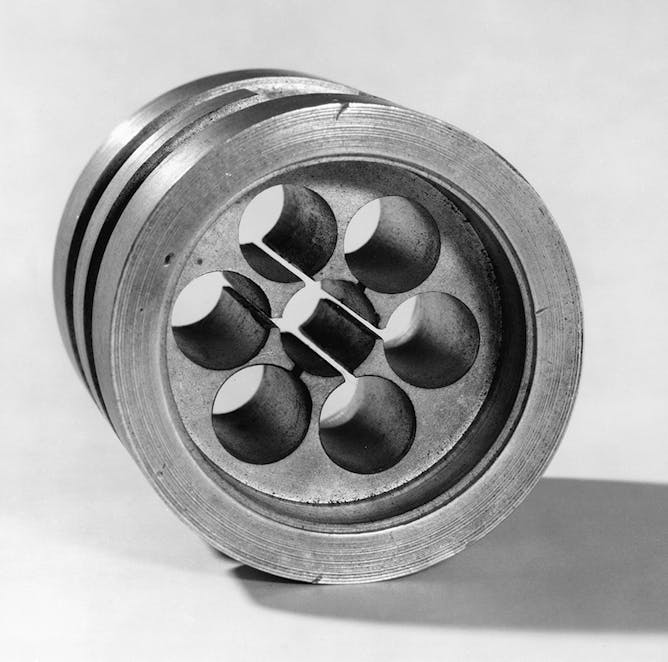
radar cavity magnetron

Original cavity magnetron as used to develop radar.
Mrjohncummings, CC BY-SA


At the heart of radar technology is the “magnetron,” the device that produces the radio waves. During World War II, the American military couldn’t get enough magnetrons to satisfy their radar needs. So Percy Spencer, an engineer at Raytheon, was tasked with ramping up magnetron production. He soon redesigned the magnetron so that its components could be punched out from sheet metal – like sugar cookies are cut from dough – rather than each part needing to be individually machined. This allowed mass production of magnetrons, raising wartime production from just 17 to 2,600 per day.

One day, while Spencer was working with a live magnetron, he noticed that a candy bar in his pocket had started to melt. Suspecting that the radio waves from the magnetron were the cause, he decided to try an experiment with an egg. He took a raw egg and pointed the radar beam at it. The egg exploded from rapid heating. Another experiment with corn kernels showed that radio waves could quickly make popcorn. This was a remarkably lucky find. Raytheon soon filed for a patent on the use of radar technology for cooking, and the Radarange was born.


Amana Radarange commercial from 1976.


As time passed and other companies got into the business, the trademarked Radarange gave way to more generic terminology and people started calling them “microwave ovens,” or even just “microwaves.” Why microwaves? Because the radio waves that are used for cooking have relatively short wavelengths. While the radio waves used for telecommunications can be as long as a football field, the ovens rely on radio waves with wavelengths measured in inches (or centimeters); so they are considered “micro” (Latin for small), as far as radio waves go.

Microwaves are able to heat food but not the paper plate holding it because the frequency of the microwaves is set such that they specifically agitate water molecules, causing them to vibrate rapidly. It is this vibration that causes the heat production. No water, no heat. So objects that don’t contain water, like a paper plate or ceramic dish, are not heated by microwaves. All the heating takes place in the food itself, not its container.

Microwaves have never completely replaced conventional ovens, despite their rapid speed of cooking, nor will they ever. Fast heating is not useful for certain types of cooking like bread-baking, where slow heating is required for the yeast to make the dough rise; and a microwaved steak is no taste match for a broiled one. Nevertheless, as the fast-paced American lifestyle becomes increasingly dependent upon processed foods, reheating is sometimes the only “cooking” that’s required to make a meal. Microwave ovens’ uniform and rapid heating make them ideal for this purpose.

Over the years, there have been many myths associated with microwave cooking. But the truth is that, no, they don’t destroy the food’s nutrients. And, as I explain in my book “Strange Glow: The Story of Radiation,” you don’t get cancer from either cooking with a microwave oven or eating microwaved food. In fact, the leakage standards for modern microwave ovens are so stringent that your candy bar is safe from melting, even if you tape it to the outside of the oven’s door.


What’s the deal with metal in the microwave?


Nevertheless, you should be careful about microwaving food in plastic containers, because some chemicals from the plastic can leach into the food. And, yes, you shouldn’t put any metal in the microwave, because metallic objects with pointed edges can interact with the microwaves from the magnetron in a way that can cause electrical sparking (arcing) and consequently damage the oven or cause a fire.

The microwave oven has definitely transformed the way most of us cook. So let’s all celebrate the 50th anniversary of the home microwave and the many hours of kitchen drudgery it has saved us from. But if you want to mark the date with an anniversary cake, best not to cook it in your microwave – you’d likely end up with just a very hot and unappetizing bowl of sweet mush.

Timothy J. Jorgensen, Director of the Health Physics and Radiation Protection Graduate Program and Associate Professor of Radiation Medicine, Georgetown University

This article was originally published on The Conversation. Read the original article.

Monday, December 26, 2016

From the Archives: Georgetown philosophy professor Jason Brennan explores ethics of voting

Publisher's note: This article was originally published on Examiner.com on July 31, 2011. The Examiner.com publishing platform was discontinued July 1, 2016, and its web site went dark on or about July 10, 2016. I am republishing this piece in an effort to preserve it and all my other contributions to Examiner.com since April 6, 2010. It is reposted here without most of the internal links that were in the original.

Georgetown philosophy professor Jason Brennan explores ethics of voting

“Every day you see the same message: ‘get out the vote, get out the vote, get out the vote,’” says philosophy professor Jason Brennan.

“What if all the sentiments underlying that were just wrong?” he asks. What if they “could be shown to be wrong pretty easily?”

According to Brennan, his new book, The Ethics of Voting, shows those underlying sentiments to be, in fact, wrong.

Brennan, an assistant professor of business and philosophy at Georgetown University, summarized his book at a Cato Institute forum on July 21. After his presentation, he spoke with the Charlottesville Libertarian Examiner about what motivated him to write The Ethics of Voting, how the book has been received by academics, and his new research on private behavior and the common good.

Brennan has long been interested in the topic of the ethics of voting.

Is voting special?

“Growing up,” he said, “I kept hearing, over and over again, the American civic religion [says] that voting is special, that political participation is special, that serving in the military makes you an especially good person.”

These claims were not satisfying to Brennan, he explained.

“I never found myself gripped by that,” he said. “I always wondered: What were the grounds underlying that? Why did people believe it?”

He also discovered, he continued, that “at the same time, there’s a kind of interesting philosophical question about what you should do in situations where we as a group are doing something bad but that your individual input doesn’t make a difference. That happens a lot in politics.”

Those two different but related things brought him to this topic.

Is voting rational?

He had read some of the literature about voter behavior but George Mason University economist Bryan Caplan’s 2008 book, The Myth of the Rational Voter, provided extra stimulus to write his own book.

“After reading that, I asked myself, suppose he’s right that voters are irrational. What does that mean about what they should do?”

The answer is not simple, he said. One cannot simply say, “Well, if they’re rational they shouldn’t vote, because individual votes don’t make a difference.” Instead, “it’s actually a real philosophical puzzle as to why it would even matter at all [with regard to] what an individual does and why they should vote well or not.”

Caplan’s book, Brennan said, was “like the last straw” in how it “pushed me over the edge to have to write something more about the philosophy behind” the ethics of voting.

Reaction from scholars

Brennan has received feedback from other academic philosophers, as well as from political scientists. Most of it has been positive.

Jason Brennan at Cato Institute, July 2011
The reaction he has had from philosophers, he said, “has been overwhelmingly very positive. Even if they disagree with the conclusions -- and many of them do -- what they’ve tended to like about it is that it takes on common sense. What it does is start with rather simple, plausible premises and leads to counterintuitive results. Philosophers tend to like that.”

Moreover, he added, “what a lot of philosophers have recognized, too, is that there are just a lot of unfounded assumptions about how politics works and what we should do. At the very least, I’m being a devil’s advocate in challenging” those assumptions, and that challenge makes philosophers “recognize that common sense [claims] about voting need to be justified, if they are justified” at all.

The reaction of political scientists, he said, “has largely been the same,” but faculty in political science departments who do political theory, “which is sort of philosophy but done in political science,” have a tendency “to be more skeptical because they tend to have a much more strongly emotional attachment to democracy than philosophers do.”

Private behavior as a public good

Brennan is now conducting new research on how private behavior contributes to the public good, something “that ended up being a major premise even in this book.”

He explained that “we can express civic virtue anywhere: by running a good business that helps people [and] makes them richer, by coming up with inventions, by making art, and so on.”

All these things, he said, help “promote the common good. They’re doing as much good as politics is doing, perhaps even more.”

The practical effect of this for individuals is that, “if you’re a person who is publicly spirited and you want to promote the common good, that doesn’t mean you have to get out of the market and go to the forum,” Brennan explained. “It might instead mean you should stay in the market and work there.”

Giving two prominent examples, Professor Brennan pointed out that “Thomas Edison did a lot more for us with his inventions than he ever would have done as a voter. Michelangelo did a lot more with his art than he ever would have done as a voter.”

He concluded by noting that “private civil society is really important for promoting the common good. If civic virtue is about promoting the common good, then private civil society might be the way to do it.”

Brennan wrote The Ethics of Voting while he taught at Brown University; it was published in April by Princeton University Press.

Thursday, September 11, 2014

Does Georgetown University Have the World's Smallest Athletic Facility?

As an alumnus of Georgetown University, today I received an email alert that tomorrow there will be a live webcast of the groundbreaking ceremony for a new athletic structure on campus.

According to the email,

This exciting milestone marks a historic moment in Georgetown’s tradition of athletic excellence.

The new four-story, 144-square-foot facility is named for legendary Hoyas men’s basketball coach John R. Thompson Jr., and is supported through the generous philanthropy of Georgetown’s alumni, friends and donors.
Imagine that! A four-story building that has only 144 square feet of space. Twelve feet by twelve feet, spread out over four floors. A handful of study carrels for grad students are bigger than that.

Is this a dollhouse or a miniature gymnasium?

Just in case a corrected email goes out that says the John R. Thompson, Jr., Intercollegiate Athletic Center is not intended for dwarf bowling tournaments, I have attached a screenshot below:


Hoya Saxa!


Tuesday, December 03, 2013

Georgetown's Mask & Bauble Launches Fundraising Drive to Light Stage III

Just in time for #GivingTuesday (which follows #BlackFriday, #SmallBusinessSaturday, and #CyberMonday), the Mask & Bauble Dramatic Society at Georgetown University has announced a fundraising drive to purchase new lighting equipment.

Now in its 162nd season, Mask & Bauble claims to be the oldest continuously-operating student theatre troupe at any U.S. college or university -- and, even if it's not the oldest, it certainly is in the top three or five.

Mask & Bauble's storied history includes putting on shows at the White House during the Kennedy administration, helping to create the legend of Camelot that was revisited so extensively last month. It launched the careers of Tony-winning playwright John Guare, Tony-winning director Jack Hofsiss, and Oscar-nominated actor Bradley Cooper, among many other theater professionals too numerous to name.

According to an email sent to M&B alumni and a post on the group's web site:
Our current lighting system in Stage III is on its last leg, and needs to be replaced. As many alumni can attest, the current dimming system in Stage III has been a problem for the past several years, with many productions suffering from flickering lights and spontaneous blackouts. In order to keep the electrics in Stage III in show-ready condition, we are officially launching our "Keep the Lights On!" campaign to raise the funds necessary to purchase and install a new lighting system for Stage III!
I know the current lighting system at Stage III in Poulton Hall is far more modern than the one in use during my years as a lighting technician and designer there. I remember how we used to have to jump into a pit below the tech booth and grab live electrical cables to switch them from one circuit to another. It's statistically incredible that nobody was turned into a human lightning rod.

The M&B email continues:
Replacing this system, which is about fifteen years old, will cost an estimated $33,000. Mask & Bauble has already committed $5,000 to the project, and we are hoping to secure an additional $5,000 through Georgetown funding outlets.

That leaves us with $23,000 to raise, and together, we can make that happen!

Please consider making a tax-deductible donation to Mask & Bauble today by clicking the button below. For larger gifts, feel free to make arrangements with the Department of Performing Arts' Administrative Director, Ron Lignelli. All donors will be acknowledged via Mask & Bauble's standard tiered gift recognition structure, with two additional tiers*.

Sponsor: $50+ (your name appears in our program, newsletters and notices)
Benefactor: $150+ (a season subscription for 2)
Name Your Dimmer!: $700 will purchase a whole dimmer for M&B!
Angels: $1,000+ (complimentary invitation to our annual Banquet and Awards Ceremony)
Name Your Dimmer Rack!: $8000 will purchase an entire dimmer rack for M&B!

All donations large and small are very greatly appreciated, and every little bit will help us reach our goal. All donors over $700 will be acknowledged on a plaque that will be hung in Stage III.
To contribute something to this campaign to bring light to the stage, visit this secure donations web site:

https://www.vendini.com/donation-software.html?d=34861356102ed9f0a76fab4ab0c92dbf&t=donation

If that URL is too long, try this one: http://bit.ly/18WFBBw


Sunday, May 22, 2011

May 24, 1981

Five years ago, in anticipation of my 25-year college reunion at Georgetown University, I wrote a blog post called "May 29, 1981," which began like this:

May 29, 1981 -- the Sunday before Memorial Day, hazy in the morning in the Nation's Capital and unseasonably hot (with temperatures eventually reaching the 90s). It was Bob Hope's 78th birthday, it would have been John F. Kennedy's 64th, and it was the anniversary of Wisconsin's 1848 admission as a state in the Union and Rhode Island's ratification of the Constitution.

A Chorus Line was in its seventh year of a record-breaking Broadway run, but Cats (which would eventually overtake that record) had opened in London but not yet in New York. "Bette Davis Eyes" by Kim Carnes was the Number 1 song hit. Jonny Lang was precisely four months old and Britney Spears would come along nearly six months later.

The Falklands War was a year away, John Belushi was still alive, and virtually no one had ever telephoned a friend to ask, "Where are you now?"

May 29, 1981, was also a day of significance for me. It was the day I was graduated from Georgetown University.
At the reunion a week or so later, I received a handful of compliments from classmates about the post, and gratitude that I had done the research to supplement their own memories.

Nobody noticed that the premise was wrong.

That is, I had the wrong date. May 29 was not the "Sunday before Memorial Day," because Memorial Day that year was on May 25. Our graduation, as a glance at my diploma on the wall would have told me, was on May 24, 1981.

I've waited five years to correct the record.

Sunday, May 24, 1981, was the birthday of documentary film maker Nic Hill (Truth in Numbers? Everything, According to Wikipedia and Ray Charles America) and of Czech model and actress Markéta Jánská (Swingtown). It was the day that the "Toastmaster General of the United States," George Jessel, passed away.

That weekend saw the opening of several new movies: Outland, with Sean Connery and Peter Boyle; Death Hunt, with Lee Marvin and Charles Bronson; The Legend of the Lone Ranger, with Klinton Spilsbury, Michael Horse and Christopher Lloyd; The Four Seasons, with Alan Alda, Carol Burnett, Sandy Dennis, and Len Cariou; and Bustin' Loose, with Richard Pryor and Cicely Tyson.  (Of those, the only one I remember seeing is The Four Seasons.  Maybe I thought it was a documentary about Vivaldi, or a concert film with Frankie Valli.)

The night before, Jill St. John and Jim Stafford guest starred on Fantasy Island, in an episode called "Paquito's Birthday."  Sunday evening's TV shows included the perennial 60 Minutes, as well as Archie Bunker's Place, One Day at a Time, Alice, and The Jeffersons (all on CBS); NBC offered Disney's Wonderful World, CHiPs, and The Big Event, while ABC had its Sunday night movie.  Fox did not yet exist, and cable was not nearly pervasive in American homes as it would be just a few years later.

The New York Times best-seller lists published that day had Noble House, by James Clavell, at the top of the fiction list, followed by Gorky Park, by Martin Cruz Smith, in second place.  The number one non-fiction best-seller was The Lord God Made Them All, but James Herriot, with George Gilder's influential Wealth and Poverty at number five.  (Number six was a biography of Maria Callas by Arianna Stassinopoulos.  You may know her as the founder of The Huffington Post under her married name.)

In the music world, the number one U.S. single, according to Billboard, was "Bette Davis Eyes," by Kim Carnes; according to Cashbox, it was "Being With You," by Smokey Robinson.  In Canada, the top hit was "Angel in the Morning," by Juice Newton.  In continental Europe, the number one single was "Making Your Mind Up," by Eurovision winner Bucks Fizz.  In the UK, however, the chart-topping single was "Stand and Deliver," by Adam and the Ants, and in Ireland, it was "You Drive Me Crazy," by Shakin' Stevens.

Not that many of us at graduation on the Hilltop were paying close attention to these statistics.  We had more monumental things on our mind.

Let me note that my original 2006 post, despite the wrong date, is still worth reading, if for nothing else than for the excerpts from Ambassador Jeane Kirkpatrick's commencement address.

At least I had the date for my high school graduation right, when I posted memories on the occasion of its thirtieth anniversary a year later than my misdirected college reunion reminiscence.


Be sure to visit my CafePress store for gifts and novelty items!
Read my blog on Kindle!
Follow my tweets on Twitter!