Showing posts with label Hanukkah. Show all posts

Monday, December 10, 2018

Guest Post: How to survive annoying relatives this holiday season

Jamie Gruman, University of Guelph

Social allergies are a lot like seasonal allergies. They’re annoying, exhausting and hard to avoid. They’re also especially common around the holidays. That’s because the holidays put you at a high risk of exposure. Swap the dander and flourishing ragweed for your not-so-favourite acquaintances and intolerable relatives and there you have it — a full-blown case of social allergies.

Merry Christmas Polish Poland ornamentsSocial allergens are the revolting, repetitive habits of our friends and family members that rub us the wrong way and drive us crazy.

Maybe it’s the way your aunt constantly complains about frivolous things. Or perhaps it’s how your father-in-law smacks his lips and wipes his mouth with the back of his hand when he eats. Or could it be the way your cousin can’t have a conversation without droning on about himself?

All of us have allergies to people whose seemingly inconsequential behaviour repulses us. The emotional and physical symptoms these social allergens produce arise within minutes of exposure, making us want to immediately evacuate the toxic environment.

The holiday season social allergy


Like seasonal allergies, social allergies are sometimes inescapable. Triggers include the many obligatory get-togethers that come with the holidays. For many, the season, beginning with American Thanksgiving, is supposed to be a time to recharge our batteries: recover from the unreasonable deadlines, numerous pressures and other demands we face on a daily basis. Social allergies can interfere with that plan.

During the holiday season, we are faced with numerous social commitments and in some cases this means spending time with people who grate on our nerves and hinder us from refuelling. Rather than having a few days off to decompress, we spend our time away from work filled with dread, anxiety and exasperation because we have to endure people we are allergic to.

Although we can get out of some noxious social situations, there are others that are almost mandatory.

So, what are the social antihistamines that will help us cope?

Limit exposure


One effective way to prevent a social allergic reaction is to limit your exposure. In the same way a person allergic to cats should avoid snuggling up in bed with a pride of domestic felines, a person with social allergies should avoid staying in an environment full of social allergens.

By minimizing the amount of time you are in contact with the allergens, you attack the problem directly, fostering resilience and recovery by reducing your exposure to a hazardous situation.

This means leave early or come late. Have a strategy to restrict the amount of time you spend surrounded by your social allergens. While you are at the gathering, be strategic about the social situations you place yourself in. When finding a spot at the dinner table, don’t sit next to Cousin So-and-so or Aunt M and definitely don’t sit in full view of your lip-smacking father-in-law. Find a place setting that allows you to have a break from your social allergens.


Validate


We have the power to exert some control over many social allergens.

For example, when speaking with a self-centred toxic relative, she’s looking for a certain type of reaction from you. In many cases, the wanted reaction is simple: it’s support and validation.

While you may want to shut off the stream coming out of auntie’s mouth, this will not actually help calm your allergic reaction. But if you spend some time to first provide the validation she seeks, you could potentially satisfy her craving and extinguish the behaviour you find repellent.

Give feedback


If you can no longer tolerate seeing scraps of food on the back of your father-in-law’s hand, consider speaking to him about his eating habits. But remember that conversations not only convey information, they also have implications for relationships and identities.

Make it clear that you want to help him avoid embarrassing himself and that you’re speaking to him about this because you love him. And see if you can bring up the topic indirectly so that you don’t come across as intrusive. Giving feedback to people often fails to change their behaviour if we’re not sensitive about how it might be received.

Mindfulness


If giving feedback to your father-in-law doesn’t seem like the best idea, you can instead try practising mindfulness. Mindfulness is a non-judgmental state of present moment awareness.

When social allergens start bothering you, pay attention to your own internal irritation without evaluating it. Don’t cling to it and don’t push it away. Just follow it. Watching the ebbs and flows of your experience has a way of putting distance between you and your reactions through a process called reperceiving.

Mindfulness won’t necessarily prevent the allergen from bothering you, but it will help you control how much it annoys you and how quickly you recover from its effects.

Social allergies can burn you out and change a relaxing holiday into a stressful test of endurance. To get a boost during holiday time, you need to make sure that you spend your time with people who recharge and revitalize you.

Also, mitigate your averse reaction to people’s annoying habits. A few simple steps can transform your holiday into one that lets you enjoy a happy, healthy break, instead of having to contend with social allergies.

The author thanks Deirdre Healey’s assistance with this article.The Conversation

Jamie Gruman, Professor of Organizational Behaviour, University of Guelph

This article is republished from The Conversation under a Creative Commons license. Read the original article.


Wednesday, December 05, 2018

Guest Post: How Hanukkah came to America


Dianne Ashton, Rowan University

Hanukkah may be the best known Jewish holiday in the United States. But despite its popularity in the U.S., Hanukkah is ranked one of Judaism’s minor festivals, and nowhere else does it garner such attention. The holiday is mostly a domestic celebration, although special holiday prayers also expand synagogue worship.

So how did Hanukkah attain its special place in America?

Hanukkah’s back story


The word “Hanukkah” means dedication. It commemorates the rededicating of the ancient Temple in Jerusalem in 165 B.C. when Jews – led by a band of brothers called the Maccabees – tossed out statues of Hellenic gods that had been placed there by King Antiochus IV when he conquered Judea. Antiochus aimed to plant Hellenic culture throughout his kingdom, and that included worshipping its gods.

Legend has it that during the dedication, as people prepared to light the Temple’s large oil lamps to signify the presence of God, only a tiny bit of holy oil could be found. Yet, that little bit of oil remained alight for eight days until more could be prepared. Thus, each Hanukkah evening, for eight nights, Jews light a candle, adding an additional one as the holiday progresses throughout the festival.

Hanukkah’s American story


Dianne Ashton Hanukkah in America Chanukah historyToday, America is home to almost 7 million Jews. But Jews did not always find it easy to be Jewish in America. Until the late 19th century, America’s Jewish population was very small and grew to only as many as 250,000 in 1880. The basic goods of Jewish religious life – such as kosher meat and candles, Torah scrolls, and Jewish calendars – were often hard to find.

In those early days, major Jewish religious events took special planning and effort, and minor festivals like Hanukkah often slipped by unnoticed.

My own study of American Jewish history has recently focused on Hanukkah’s development.

It began with a simple holiday hymn written in 1840 by Penina Moise, a Jewish Sunday school teacher in Charleston, South Carolina. Her evangelical Christian neighbors worked hard to bring the local Jews into the Christian fold. They urged Jews to agree that only by becoming Christian could they attain God’s love and ultimately reach Heaven.

Moise, a famed poet, saw the holiday celebrating dedication to Judaism as an occasion to inspire Jewish dedication despite Christian challenges. Her congregation, Beth Elohim, publicized the hymn by including it in their hymnbook.

This English language hymn expressed a feeling common to many American Jews living as a tiny minority. “Great Arbiter of human fate whose glory ne'er decays,” Moise began the hymn, “To Thee alone we dedicate the song and soul of praise.”

It became a favorite among American Jews and could be heard in congregations around the country for another century.

Shortly after the Civil War, Cincinnati Rabbi Max Lilienthal learned about special Christmas events for children held in some local churches. To adapt them for children in his own congregation, he created a Hanukkah assembly where the holiday’s story was told, blessings and hymns were sung, candles were lighted and sweets were distributed to the children.

His friend, Rabbi Isaac M. Wise, created a similar event for his own congregation. Wise and Lilienthal edited national Jewish magazines where they publicized these innovative Hanukkah assemblies, encouraging other congregations to establish their own.

Lilienthal and Wise also aimed to reform Judaism, streamlining it and emphasizing the rabbi’s role as teacher. Because they felt their changes would help Judaism survive in the modern age, they called themselves “Modern Maccabees.” Through their efforts, special Hanukkah events for children became standard in American synagogues.

20th-century expansion


By 1900, industrial America produced the abundance of goods exchanged each Dec. 25. Christmas’ domestic celebrations and gifts to children provided a shared religious experience to American Christians otherwise separated by denominational divisions. As a home celebration, it sidestepped the theological and institutional loyalties voiced in churches.

For the 2.3 million Jewish immigrants who entered the U.S. between 1881 and 1924, providing their children with gifts in December proved they were becoming American and obtaining a better life.

But by giving those gifts at Hanukkah, instead of adopting Christmas, they also expressed their own ideals of American religious freedom, as well as their own dedication to Judaism.

After World War II, many Jews relocated from urban centers. Suburban Jewish children often comprised small minorities in public schools and found themselves coerced to participate in Christmas assemblies. Teachers, administrators and peers often pressured them to sing Christian hymns and assert statements of Christian faith.

From the 1950s through the 1980s, as Jewish parents argued for their children’s right to freedom from religious coercion, they also embellished Hanukkah. Suburban synagogues expanded their Hanukkah programming.

As I detail in my book, Jewish families embellished domestic Hanukkah celebrations with decorations, nightly gifts and holiday parties to enhance Hanukkah’s impact. In suburbia, Hanukkah’s theme of dedication to Judaism shone with special meaning. Rabbinical associations, national Jewish clubs and advertisers of Hanukkah goods carried the ideas for expanded Hanukkah festivities nationwide.

In the 21st century, Hanukkah accomplishes many tasks. Amid Christmas, it reminds Jews of Jewish dedication. Its domestic celebration enhances Jewish family life. In its similarity to Christmas domestic gift-giving, Hanukkah makes Judaism attractive to children and – according to my college students – relatable to Jews’ Christian neighbors. In many interfaith families, this shared festivity furthers domestic tranquility.

In America, this minor festival has attained major significance.The Conversation

Dianne Ashton, Professor of Religion, Rowan University

This article is republished from The Conversation under a Creative Commons license. Read the original article.

Tuesday, December 12, 2017

Guest Post: Hanukkah's true meaning is about Jewish survival


Alan Avery-Peck, College of the Holy Cross

Beginning on the evening of Dec. 12, Jews will celebrate the eight-day festival of Hanukkah, perhaps the best-known and certainly the most visible Jewish holiday.

While critics sometimes identify Christmas as promoting the prevalence in America today of what one might refer to as Hanukkah kitsch, this assessment misses the social and theological significance of Hanukkah within Judaism itself.

Let’s consider the origin and development of Hanukkah over the past more than 2,000 years.

Early history


Though it is 2,200 years old, Hanukkah is one of Judaism’s newest holidays, an annual Jewish celebration that does not even appear in the Hebrew Bible.

The historical event that is the basis for Hanukkah is told, rather, in the post-biblical Books of the Maccabees, which appear in the Catholic biblical canon but are not even considered part of the Bible by Jews and most Protestant denominations.


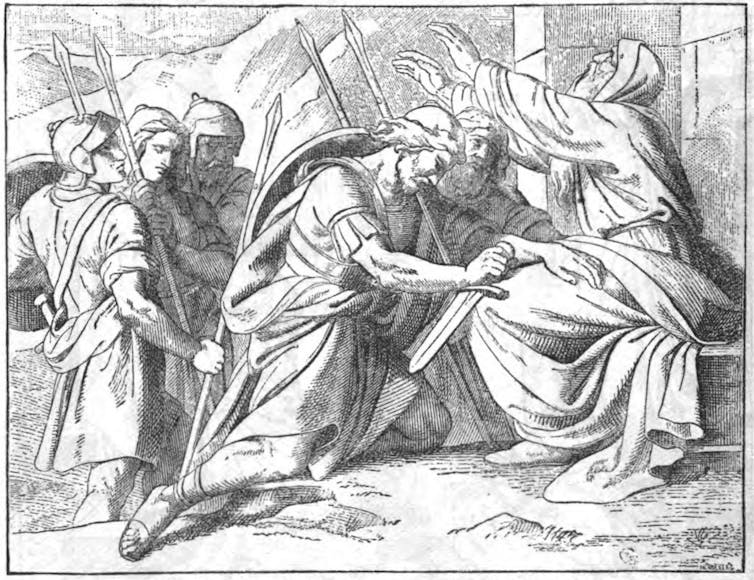
Maccabees Hanukkah Chanukah Jewish history

The Maccabees receive their father’s blessing.
The Story of the Bible from Genesis to Revelation via Wikimedia Commons.


Based on the Greco-Roman model of celebrating a military triumph, Hanukkah was instituted in 164 B.C. to celebrate the victory of the Maccabees, a ragtag army of Jews, against the much more powerful army of King Antiochus IV of Syria.

In 168 B.C., Antiochus outlawed Jewish practice and forced Jews to adopt pagan rituals and assimilate into Greek culture.

The Maccabees revolted against this persecution. They captured Jerusalem from Antiochus’s control, removed from the Jerusalem Temple symbols of pagan worship that Antiochus had introduced and restarted the sacrificial worship, ordained by God in the Hebrew Bible, that Antiochus had violated.

Hanukkah, meaning “dedication,” marked this military victory
with a celebration that lasted eight days and was modeled on the festival of Tabernacles (Sukkot) that had been banned by Antiochus.

How Hanukkah evolved


The military triumph, however, was short-lived. The Maccabees’ descendants – the Hasmonean dynasty – routinely violated their own Jewish law and tradition.

Even more significantly, the following centuries witnessed the devastation that would be caused when Jews tried again to accomplish what the Maccabees had done. By now, Rome controlled the land of Israel. In A.D. 68-70 and again in A.D. 133-135, the Jews mounted passionate revolts to rid their land of this foreign and oppressing power.


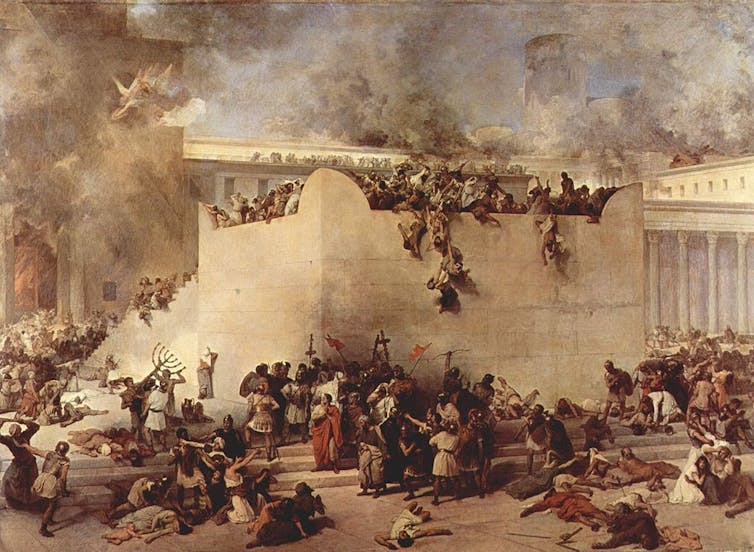
Second Temple Jerusalem Jewish history Hanukkah

The destruction of the Temple of Jerusalem.
Francesco Hayez, via Wikimedia Commons


The first of these revolts ended in the destruction of the Second Jerusalem Temple, the preeminent center of Jewish worship, which had stood for 600 years. As a result of the second revolt, the Jewish homeland was devastated and countless Jews were put to death.

War no longer seemed an effective solution to the Jews’ tribulations on the stage of history.

In response, a new ideology deemphasized the idea that Jews should or could change their destiny through military action. What was required, rabbis asserted, was not battle but perfect observance of God’s moral and ritual law. This would lead to God’s intervention in history to restore the Jewish people’s control over their own land and destiny.

In this context, rabbis rethought Hanukkah’s origins as the celebration of a military victory. Instead, they said, Hanukkah should be seen as commemorating a miracle that occurred during the Maccabees’ rededication of the temple: The story now told was how a jar of temple oil sufficient for only one day had sustained the temple’s eternal lamp for a full eight days, until additional ritually appropriate oil could be produced.

The earliest version of this story appears in the Talmud, in a document completed in the sixth century A.D. From that period on, rather than directly commemorating the Maccabees’ victory, Hanukkah celebrated God’s miracle.

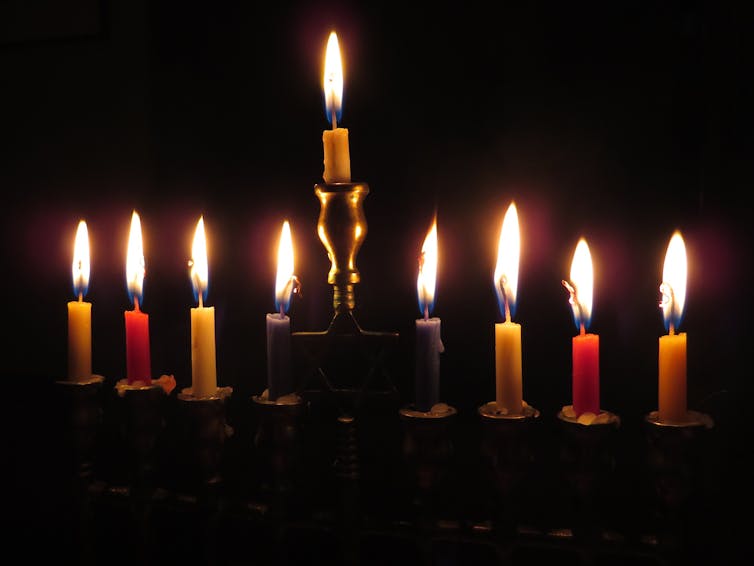
This is symbolized by the kindling of an eight-branched candelabra (“Menorah” or “Hanukkiah”), with one candle lit on the holiday’s first night and an additional candle added each night until, on the final night of the festival, all eight branches are lit. The ninth candle in the Hanukkiah is used to light the others.

Throughout the medieval period, however, Hanukkah remained a minor Jewish festival.

What Hanukkah means today


How then to understand what happened to Hanukkah in the past hundred years, during which it has achieved prominence in Jewish life, both in America and around the world?


Hanukkah menorah candles holidays Christmas Chanukah

Hanukkah today responds to Jews’ desire to see their history as consequential.
Pixabay.com/en, CC BY


The point is that even as the holiday’s prior iterations reflected the distinctive needs of successive ages, so Jews today have reinterpreted Hanukkah in light of contemporary circumstances – a point that is detailed in religion scholar Dianne Ashton’s book, “Hanukkah in America.”

Ashton demonstrates while Hanukkah has evolved in tandem with the extravagance of the American Christmas season, there is much more to this story.

Hanukkah today responds to Jews’ desire to see their history as consequential, as reflecting the value of religious freedom that Jews share with all other Americans. Hanukkah, with its bright decorations, songs, and family- and community-focused celebrations, also fulfills American Jews’ need to reengage disaffected Jews and to keep Jewish children excited about Judaism.

Poignantly, telling a story of persecution and then redemption, Hanukkah today provides a historical paradigm that can help modern Jews think about the Holocaust and the emergence of Zionism.

In short, Hanukkah is as powerful a commemoration as it is today because it responds to a host of factors pertinent to contemporary Jewish history and life.

The ConversationOver two millennia, Hanukkah has evolved to narrate the story of the Maccabees in ways that meet the distinctive needs of successive generations of Jews. Each generation tells the story as it needs to hear it, in response to the eternal values of Judaism but also as is appropriate to each period’s distinctive cultural forces, ideologies and experiences.

Alan Avery-Peck, Kraft-Hiatt Professor in Judaic Studies, College of the Holy Cross

This article was originally published on The Conversation. Read the original article.