Showing posts with label Thanksgiving. Show all posts

Monday, December 10, 2018

Guest Post: How to survive annoying relatives this holiday season

Jamie Gruman, University of Guelph

Social allergies are a lot like seasonal allergies. They’re annoying, exhausting and hard to avoid. They’re also especially common around the holidays. That’s because the holidays put you at a high risk of exposure. Swap the dander and flourishing ragweed for your not-so-favourite acquaintances and intolerable relatives and there you have it — a full-blown case of social allergies.

Merry Christmas Polish Poland ornamentsSocial allergens are the revolting, repetitive habits of our friends and family members that rub us the wrong way and drive us crazy.

Maybe it’s the way your aunt constantly complains about frivolous things. Or perhaps it’s how your father-in-law smacks his lips and wipes his mouth with the back of his hand when he eats. Or could it be the way your cousin can’t have a conversation without droning on about himself?

All of us have allergies to people whose seemingly inconsequential behaviour repulses us. The emotional and physical symptoms these social allergens produce arise within minutes of exposure, making us want to immediately evacuate the toxic environment.

The holiday season social allergy


Like seasonal allergies, social allergies are sometimes inescapable. Triggers include the many obligatory get-togethers that come with the holidays. For many, the season, beginning with American Thanksgiving, is supposed to be a time to recharge our batteries: recover from the unreasonable deadlines, numerous pressures and other demands we face on a daily basis. Social allergies can interfere with that plan.

During the holiday season, we are faced with numerous social commitments and in some cases this means spending time with people who grate on our nerves and hinder us from refuelling. Rather than having a few days off to decompress, we spend our time away from work filled with dread, anxiety and exasperation because we have to endure people we are allergic to.

Although we can get out of some noxious social situations, there are others that are almost mandatory.

So, what are the social antihistamines that will help us cope?

Limit exposure


One effective way to prevent a social allergic reaction is to limit your exposure. In the same way a person allergic to cats should avoid snuggling up in bed with a pride of domestic felines, a person with social allergies should avoid staying in an environment full of social allergens.

By minimizing the amount of time you are in contact with the allergens, you attack the problem directly, fostering resilience and recovery by reducing your exposure to a hazardous situation.

This means leave early or come late. Have a strategy to restrict the amount of time you spend surrounded by your social allergens. While you are at the gathering, be strategic about the social situations you place yourself in. When finding a spot at the dinner table, don’t sit next to Cousin So-and-so or Aunt M and definitely don’t sit in full view of your lip-smacking father-in-law. Find a place setting that allows you to have a break from your social allergens.


Validate


We have the power to exert some control over many social allergens.

For example, when speaking with a self-centred toxic relative, she’s looking for a certain type of reaction from you. In many cases, the wanted reaction is simple: it’s support and validation.

While you may want to shut off the stream coming out of auntie’s mouth, this will not actually help calm your allergic reaction. But if you spend some time to first provide the validation she seeks, you could potentially satisfy her craving and extinguish the behaviour you find repellent.

Give feedback


If you can no longer tolerate seeing scraps of food on the back of your father-in-law’s hand, consider speaking to him about his eating habits. But remember that conversations not only convey information, they also have implications for relationships and identities.

Make it clear that you want to help him avoid embarrassing himself and that you’re speaking to him about this because you love him. And see if you can bring up the topic indirectly so that you don’t come across as intrusive. Giving feedback to people often fails to change their behaviour if we’re not sensitive about how it might be received.

Mindfulness


If giving feedback to your father-in-law doesn’t seem like the best idea, you can instead try practising mindfulness. Mindfulness is a non-judgmental state of present moment awareness.

When social allergens start bothering you, pay attention to your own internal irritation without evaluating it. Don’t cling to it and don’t push it away. Just follow it. Watching the ebbs and flows of your experience has a way of putting distance between you and your reactions through a process called reperceiving.

Mindfulness won’t necessarily prevent the allergen from bothering you, but it will help you control how much it annoys you and how quickly you recover from its effects.

Social allergies can burn you out and change a relaxing holiday into a stressful test of endurance. To get a boost during holiday time, you need to make sure that you spend your time with people who recharge and revitalize you.

Also, mitigate your averse reaction to people’s annoying habits. A few simple steps can transform your holiday into one that lets you enjoy a happy, healthy break, instead of having to contend with social allergies.

The author thanks Deirdre Healey’s assistance with this article.The Conversation

Jamie Gruman, Professor of Organizational Behaviour, University of Guelph

This article is republished from The Conversation under a Creative Commons license. Read the original article.

Friday, November 23, 2018

Guest Post: Why the Pilgrims were actually able to survive


Peter C. Mancall, University of Southern California – Dornsife College of Letters, Arts and Sciences

Sometime in the autumn of 1621, a group of English Pilgrims who had crossed the Atlantic Ocean and created a colony called New Plymouth celebrated their first harvest.

They hosted a group of about 90 Wampanoags, their Algonquian-speaking neighbors. Together, migrants and Natives feasted for three days on corn, venison and fowl.

In their bountiful yield, the Pilgrims likely saw a divine hand at work.

As Gov. William Bradford wrote in 1623, “Instead of famine now God gave them plenty, and the face of things was changed, to the rejoicing of the hearts of many, for which they blessed God.”

But my recent research on the ways Europeans understood the Western Hemisphere shows that – despite the Pilgrims’ version of events – their survival largely hinged on two unrelated developments: an epidemic that swept through the region and a repository of advice from earlier explorers.

A ‘desolate wilderness’ or ‘Paradise of all parts’?


Bradford’s “Of Plymouth Plantation,” which he began to write in 1630 and finished two decades later, traces the history of the Pilgrims from their persecution in England to their new home along the shores of modern Boston Harbor.


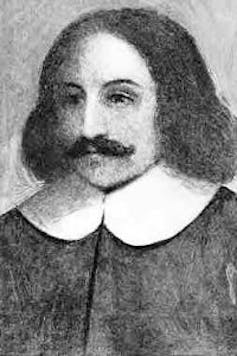
William Bradford Plymouth Plantation

William Bradford’s writings depicted a harrowing, desolate environment.


Bradford and other Pilgrims believed in predestination. Every event in their lives marked a stage in the unfolding of a divine plan, which often echoed the experiences of the ancient Israelites.

Throughout his account, Bradford probed Scripture for signs. He wrote that the Puritans arrived in “a hideous and desolate wilderness, full of wild beasts and wild men.” They were surrounded by forests “full of woods and thickets,” and they lacked the kind of view Moses had on Mount Pisgah, after successfully leading the Israelites to Canaan.

Drawing on chapter 26 of the Book of Deuteronomy, Bradford declared that the English “were ready to perish in this wilderness,” but God had heard their cries and helped them. Bradford paraphrased from Psalm 107 when he wrote that the settlers should “praise the Lord” who had “delivered them from the hand of the oppressor.”

If you were reading Bradford’s version of events, you might think that the survival of the Pilgrims’ settlements was often in danger. But the situation on the ground wasn’t as dire as Bradford claimed.


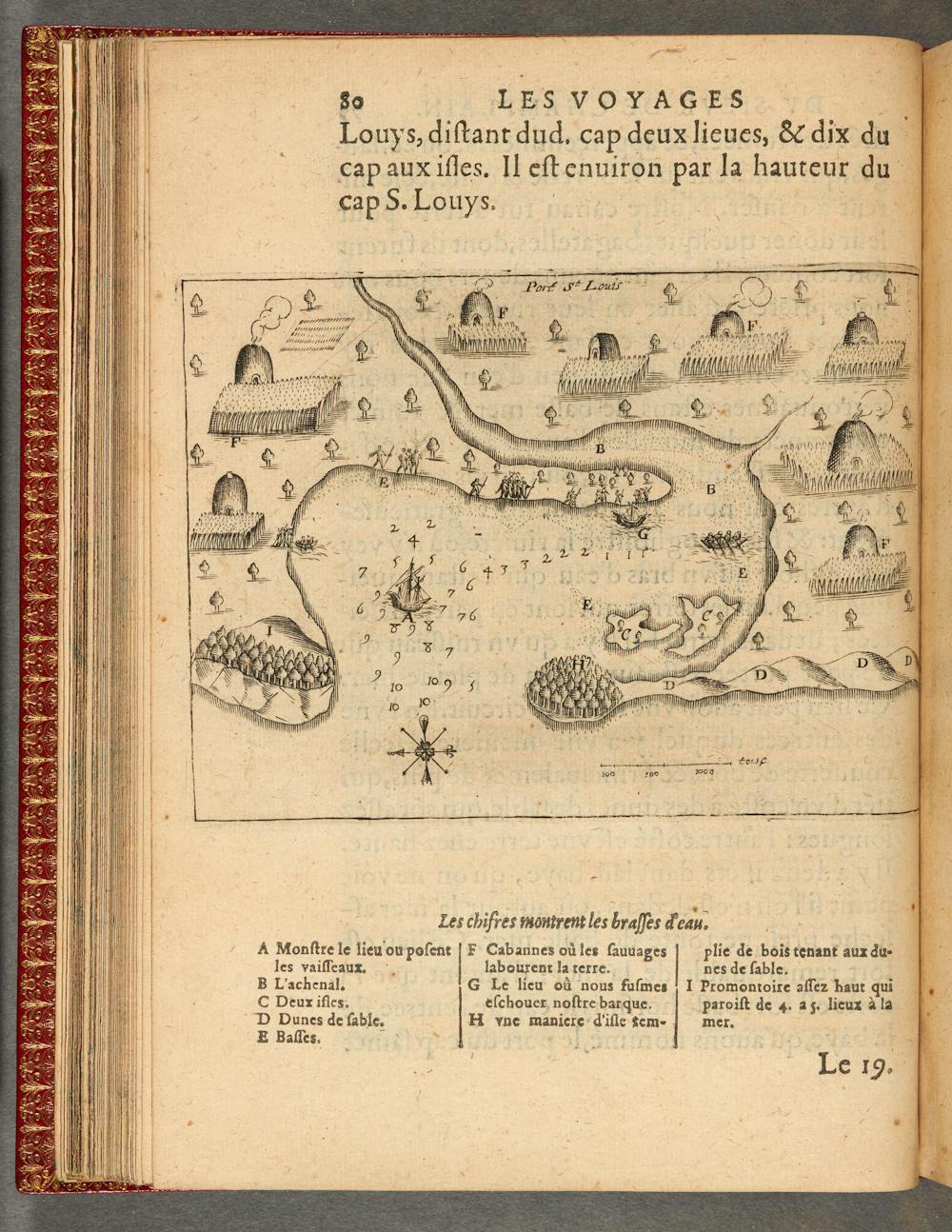
The French explorer Samuel de Champlain depicted Plymouth as a region that was eminently inhabitable.
Source., Author provided


Earlier European visitors had described pleasant shorelines and prosperous indigenous communities. In 1605, the French explorer Samuel de Champlain sailed past the site the Pilgrims would later colonize and noted that there were “a great many cabins and gardens.” He even provided a drawing of the region, which depicted small Native towns surrounded by fields.

About a decade later Captain John Smith, who coined the term “New England,” wrote that the Massachusetts, a nearby indigenous group, inhabited what he described as “the Paradise of all those parts.”

‘A wonderful plague’


Champlain and Smith understood that any Europeans who wanted to establish communities in this region would need either to compete with Natives or find ways to extract resources with their support.

But after Champlain and Smith visited, a terrible illness spread through the region. Modern scholars have argued that indigenous communities were devastated by leptospirosis, a disease caused by Old World bacteria that had likely reached New England through the feces of rats that arrived on European ships.

The absence of accurate statistics makes it impossible to know the ultimate toll, but perhaps up to 90 percent of the regional population perished between 1617 to 1619.

To the English, divine intervention had paved the way.

“By God’s visitation, reigned a wonderful plague,” King James’ patent for the region noted in 1620, “that had led to the utter Destruction, Devastacion, and Depopulation of that whole territory.”

The epidemic benefited the Pilgrims, who arrived soon thereafter: The best land had fewer residents and there was less competition for local resources, while the Natives who had survived proved eager trading partners.

The wisdom of those who came before


Just as important, the Pilgrims understood what to do with the land.

By the time that these English planned their communities, knowledge of the Atlantic coast of North America was widely available.

Those hoping to create new settlements had read accounts of earlier European migrants who had established European-style villages near the water, notably along the shores of Chesapeake Bay, where the English had founded Jamestown in 1607.

These first English migrants to Jamestown endured terrible disease and arrived during a period of drought and colder-than-normal winters. The migrants to Roanoke on the outer banks of Carolina, where the English had gone in the 1580s, disappeared. And a brief effort to settle the coast of Maine in 1607 and 1608 failed because of an unusually bitter winter.

Many of these migrants died or gave up. But none disappeared without record, and their stories circulated in books printed in London. Every English effort before 1620 had produced accounts useful to would-be colonizers.

The most famous account, by the English mathematician Thomas Harriot, enumerated the commodities that the English could extract from America’s fields and forests in a report he first published in 1588.

The artist John White, who was on the same mission to modern Carolina, painted a watercolor depicting the wide assortment of marine life that could be harvested, another of large fish on a grill, and a third showing the fertility of fields at the town of Secotan. By the mid-1610s, actual commodities had started to arrive in England too, providing support for those who had claimed that North American colonies could be profitable. The most important of these imports was tobacco, which many Europeans considered a wonder drug capable of curing a wide range of human ailments.

These reports (and imports) encouraged many English promoters to lay plans for colonization as a way to increase their wealth. But those who thought about going to New England, especially the Pilgrims who were kindred souls of Bradford, believed that there were higher rewards to be reaped.

Bradford and the other Puritans who arrived in Massachusetts often wrote about their experience through the lens of suffering and salvation.

But the Pilgrims were better equipped to survive than they let on.The Conversation

Peter C. Mancall, Andrew W. Mellon Professor of the Humanities, University of Southern California – Dornsife College of Letters, Arts and Sciences

This article is republished from The Conversation under a Creative Commons license. Read the original article.

Thursday, November 22, 2018

Guest Post: Sweet potatoes, Donald Trump – and the Special Relationship


Rebecca Earle, University of Warwick

Two days after the US presidential election, The Independent reported that “Donald Trump has spoken with nine world leaders but has yet to call Theresa May, throwing her claim of a ‘special relationship’ into tatters.”

Eventually, the phone call was made. “Concerns over ‘special relationship’ allayed as Trump calls May,” read the headline in The Guardian a few days later. Time magazine reassured US readers that “Donald Trump and Britain’s Theresa May Affirm ‘Special Relationship’.”

It seems especially apt, as people in the US gather to celebrate Thanksgiving, to ponder the nature of the relationship between the two countries. After all, Thanksgiving forms part of an origin myth about how English settlers began the slow process of transforming themselves into Americans. The holiday commemorates the 1621 celebrations held at the Puritan settlement in Plymouth, which included, apparently, a large meal, some parading and a short religious service.

Scholars (and cartoonists) have deconstructed the holiday comprehensively, noting the invented nature of many of its core elements, its sporadic celebration before the 20th century, its erasure of European violence towards Native Americans and many other aspects. Overall, it’s clear that this holiday, like all national holidays, is an invented tradition based not only on collective remembering but also collective forgetting.

At the same time, while Thanksgiving masks a range of troubling and enduring aspects of US history, one feature merits some serious celebration: the sweet potato. Sweet potatoes in some form or another are now a structural element in the canonical Thanksgiving menu.

The authoritative New York Times cookery section recommends 14 different sweet potato side dishes, from classic maple-candied sweet potatoes to less traditional takes such as roasted sweet potatoes with horseradish butter. And that’s not even starting on sweet potato pies and puddings. This year, I plan to bake Paul Prudhomme’s sweet potato pecan pie. (After that, I will hibernate for an entire year while my digestive system processes the 4m calories it has ingested.)


A tart that is courage


The sweet potato is in fact part of a transatlantic food alliance that predates the original Thanksgiving feast. Sweet potatoes originated in the Americas, and formed a staple of the diets of Caribbean islanders. Columbus had never seen anything like them when he landed in the Bahamas in 1492. He compared them to African yams; others thought they tasted like turnips or chestnuts.

Once introduced into Europe, however, sweet potatoes quickly spread. By the late 16th century, they were grown on a commercial scale in the area around Malaga, Spain, and were considered “a good thing to eat” – in the words of one Spanish Jesuit.

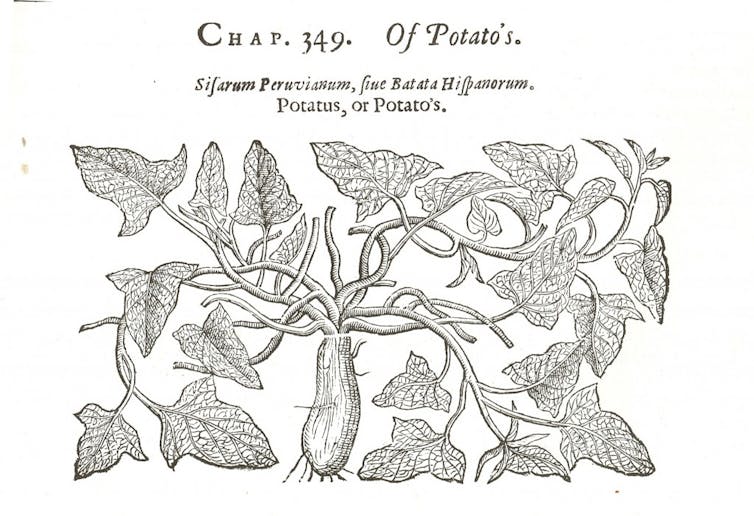
But when did the sweet potato reach the British Isles? The English herbalist John Gerard included an illustration in his 1597 Herball. “Howsoever they bee dressed, they comfort, nourish, and strengthen the body”, he reported enthusiastically. Sweet potatoes quickly became popular in England, and many of the earliest recipes for “potatoes” may in fact refer to sweet potatoes. They were even grown at Hampton Court, for the delectation of Henry VIII, who reportedly learned to enjoy their honeyed delights from the ill-fated Catherine of Aragon.


 Sweet potatoes: ‘they comfort, nourish, and strengthen the body’. John Gerard's 'Herball' (1596)

Sweet potatoes: ‘they comfort, nourish, and strengthen the body’.
John Gerard's 'Herball' (1596)


After their marriage disintegrated, Henry had to rely on home-grown sweet potatoes, rather than Spanish imports. Gardeners at Hampton Court have recently demonstrated that sweet potatoes grow perfectly well in our scarcely tropical climate. The first printed recipe containing sweet potato is probably the description of how to make “a tart that is a courage to a man or woman”, which appeared in the Good Huswife’s Jewell, a cookbook published in London in 1596.

Before NATO … the sweet potato


Ironically, while Henry VIII enjoyed sweet potatoes in Tudor England, pilgrims in 1621 New England almost certainly did not feast on maple-candied sweet potatoes, or any sweet potatoes at all. Early records of the settlement make no mention of them and they were not native to the chilly shores of the north Atlantic. The oldest documents in the US that refer to sweet potatoes are actually from England.

Washington’s Folger Library, which holds a major collection of Shakespeariana, has recently unearthed an early recipe for sweet potato pudding from … Warwickshire! The pudding calls for potatoes (sweet or ordinary), eggs, sugar and a good dose of sherry. So new world sweet potatoes have been criss-crossing the Atlantic since the 16th century, forming a special relationship of eaters and growers that long predates NATO.

But what about Donald Trump? Does he have anything to do with this long history? Not really, although the internet is replete with images of sweet potatoes that resemble the president-elect and critics have called him a “xenophobic sweet potato”. Will Trump tuck into a traditional sweet potato pie or candied sweet potatoes for his Thanksgiving dinner? I don’t know and I certainly don’t care. But the sweet potato, unlike Trump, is unquestionably one of the new world’s gifts to Britain – and the world.

A recipe for sweet potato tart from Charles Carter, The Complete Practical Cook (London, 1730).

POTATOE TORT.

TAKE a Pound and half Spanish Potatoes [sweet potatoes]; boil them and blanch them, and cut them in Slices, not thin; sheet a Dish with Puff-paste, lay some Citron in the Bottom, lay over your Potatoes, and season them with Ginger, Cinnamon, Nutmeg, and Sugar; then take the Marrow of two Bones, cut it into Pieces as big as Walnuts, roll it in Yolks of Eggs, and season it as the Potatoes; lay it on them, and between the Lumps of Marrow lay Citron and Dates slic’d, and Eringoe Roots [I’d use candied angelica], sprinkle over some Sack and Orange-flower Water; then draw up a Quart of Cream boil’d with the Yolks of ten Eggs, and pour all over, bake it, and stick over some Citron, and serve it.
The Conversation

Rebecca Earle, Professor of HIstory, University of Warwick

This article is republished from The Conversation under a Creative Commons license. Read the original article.

Wednesday, November 21, 2018

Guest Post: The Lesser Known History of Thanksgiving in America

For a time, peace and plenty resulted not in a grateful America but in a complacent one.

by James R. Harrigan

On October 3, 1789, George Washington signed the first Thanksgiving Proclamation of the newly constituted American Republic. He called upon the American people to enjoy “a day of Public Thanksgiving and Prayer, to be observed by acknowledging with grateful hearts the many and signal favors of Almighty God.”

The Early Days of Giving Thanks
It had been a long and difficult road to Independence, and America was still reeling from the failed Articles of Confederation and the fight to adopt the new Constitution. Washington had seen the struggle first-hand, and he knew, perhaps more than anyone, that America was nothing less than a series of miracles. And he saw to it that the nation gave thanks.

Sarah Hale Thanksgiving historyThis was not the first celebration of Thanksgiving in America; the Pilgrims’ 1621 celebration with the Wampanoag in Plymouth holds that honor. Nor was this even Washington’s first Thanksgiving; he had proclaimed a Thanksgiving in December 1777 in the wake of the Continental Army’s victory over the British at Saratoga. This was, though, the first Thanksgiving of the American Republic. It was the first national Thanksgiving.

Washington went on to declare another observance in 1795, and his successor, John Adams, followed suit in 1798 and 1799. But as America’s position in the world was steadily established, and as the debate on the separation of church and state began to take shape, Thanksgiving was all but forgotten on the national stage.

A condition of peace and plenty resulted not in a grateful America but in a complacent one. The War of 1812, though, reminded Americans that their collective place in the world was more tenuous than they had realized. And at the close of the war in 1814 James Madison proclaimed “a day of public humiliation and fasting and of prayer to Almighty God for the safety and welfare” of the United States. Madison declared another Thanksgiving in 1815.

And then nearly half a century passed.

The Birth of Thanksgiving As We Know It
Thanksgiving historyOnce again things were calm, and once again national Thanksgiving observances fell by the wayside. The Founding Generation, America’s finest generation, had passed, and with them the possibility of a national gratefulness seemed to pass as well. Just as the War of 1812 had reminded the nation of its precariousness, though, the Civil War shattered the illusion of American harmony. Abraham Lincoln had warned the nation in 1858 that “A house divided against itself cannot stand,” and by 1863 the divided country was indeed in danger of falling.

Americans turned to Lincoln, and Lincoln turned to God. Even in the midst of the bloodiest war ever fought on American soil, Lincoln saw America’s blessings. “The year that is drawing toward its close,” he said, “has been filled with the blessings of fruitful fields and healthful skies. To these bounties, which are so constantly enjoyed that we are prone to forget the source from which they come, others have been added which are of so extraordinary a nature that they can not fail to penetrate and soften even the heart which is habitually insensible to the ever-watchful providence of Almighty God.”

At America’s lowest ebb, the nation’s most dedicated servant chose to give thanks rather than bemoan his own, and America’s collective, lot, and there were indeed reasons to be thankful. As Lincoln said,

Peace has been preserved with all nations, order has been maintained, the laws have been respected and obeyed, and harmony has prevailed everywhere, except in the theater of military conflict, while that theater has been greatly contracted by the advancing armies and navies of the Union.”
And this was the birth of Thanksgiving as we have come to know it. In the worst of times, in conditions so dire that the continued existence of the Republic was unsure, Lincoln taught us to look beyond ourselves…to be truly thankful for the blessings that we have received. And so it has been for 143 years.

As we celebrate Lincoln’s holiday on the last Thursday in November, take a moment to contemplate the series of miracles that brings and keeps us together. Take a cue from Washington and sense the magnitude of the achievement of the generation that built this country, oftentimes through little more than force of will. Take a cue from Lincoln and appreciate the blessings that we do enjoy rather than pining for things we don’t. Take a cue from the best America has produced and say a prayer of thanks.

Happy Thanksgiving!

Reprinted from Vision and Values.

James R. Harrigan Thanksgiving FreedomTrust

James R. Harrigan is CEO of FreedomTrust.


This article was originally published on FEE.org. Read the original article.


Monday, November 19, 2018

Guest Post: How Communism Almost Ruined The First Thanksgiving

The Plymouth Pilgrims progressed from the false dream of communism to the sound realism of capitalism.

by Richard M. Ebeling

This time of the year, whether in good economic times or bad, Americans gather with their families and friends and enjoy a Thanksgiving meal together. It marks a remembrance of those early Pilgrim Fathers who crossed the uncharted ocean from Europe to make a new start in Plymouth, Massachusetts. What is less appreciated is that Thanksgiving is also a celebration of the birth of free enterprise in America.

The English Puritans, who left Great Britain and sailed across the Atlantic on the Mayflower in 1620, were not only escaping from religious persecution in their homeland. They also wanted to turn their back on what they viewed as the materialistic and greedy corruption of the Old World.

Plymouth Colony Planned as Collectivist Utopia
thanksgiving table food turkeyIn the New World, they wanted to erect a New Jerusalem that would not only be religiously devout but be built on a new foundation of communal sharing and social altruism. Their goal was the communism of Plato’s Republic, in which all would work and share in common, knowing neither private property nor self-interested acquisitiveness.

What resulted is recorded in the diary of Governor William Bradford, the head of the colony. The colonists collectively cleared and worked the land, but they brought forth neither the bountiful harvest they hoped for, nor did it create a spirit of shared and cheerful brotherhood.

The less industrious members of the colony came late to their work in the fields and were slow and easy in their labors. Knowing that they and their families were to receive an equal share of whatever the group produced, they saw little reason to be more diligent in their efforts. The harder working among the colonists became resentful that their efforts would be redistributed to the more malingering members of the colony. Soon they, too, were coming late to work and were less energetic in the fields.

Collective Work Equaled Individual Resentment
As Governor Bradford of the Plymouth Colony explained in his old English (though with the spelling modernized):

For the young men that were able and fit for labor and service did repine that they should spend their time and strength to work for other men’s wives and children, without recompense. The strong, or men of parts, had no more division of food, clothes, etc. than he that was weak and not able to do a quarter the other could; this was thought injustice. The aged and graver men to be ranked and equalized in labor, and food, clothes, etc. with the meaner and younger sort, thought it some indignant and disrespect unto them. And for men’s wives to be commanded to do service for other men, as dressing their meat, washing their clothes, etc. they deemed it a kind of slavery, neither could husbands brook it.”
Because of the disincentives and resentments that spread among the population, crops were sparse and the rationed equal shares from the collective harvest were not enough to ward off starvation and death. Two years of communism in practice left alive only a fraction of the original number of the Plymouth colonists.

Private Property as Incentive to Industry
Realizing that another season like those that had just passed would mean the extinction of the entire community, the elders of the colony decided to try something radically different: the introduction of private property rights and the right of the individual families to keep the fruits of their own labor.

As Governor Bradford put it:
And so assigned to every family a parcel of land, according to the proportion of their number for that end . . . This had a very good success; for it made all hands very industrious, so as much more corn was planted then otherwise would have been by any means the Governor or any other could use, and saved him a great deal of trouble, and gave far better content. The women now went willingly into the field, and took their little-ones with them to set corn, which before would a ledge weakness, and inability; whom to have compelled would have been thought great tyranny and oppression.”
The Plymouth Colony experienced a great bounty of food. Private ownership meant that there was now a close link between work and reward. Industry became the order of the day as the men and women in each family went to the fields on their separate private farms. When the harvest time came, not only did many families produce enough for their own needs, but also they had surpluses that they could freely exchange with their neighbors for mutual benefit and improvement.

In Governor Bradford’s words:
By this time harvest was come, and instead of famine, now God gave them plenty, and the face of things was changed, to the rejoicing of the hearts of many, for which they blessed God. And the effect of their planting was well seen, for all had, one way or other, pretty well to bring the year about, and some of the abler sort and more industrious had to spare, and sell to others, so as any general want or famine hath not been amongst them since to this day.”

Rejecting Collectivism for Individualism
Hard experience taught the Plymouth colonists the fallacy and error in the ideas that since the time of the ancient Greeks had promised paradise through collectivism rather than individualism. As Governor Bradford expressed it:
The experience that was had in this common course and condition, tried sundry years, and that amongst the Godly and sober men, may well convince of the vanity and conceit of Plato’s and other ancients; -- that the taking away of property, and bringing into a common wealth, would make them happy and flourishing; as if they were wiser than God. For this community (so far as it was) was found to breed confusion and discontent, and retard much employment that would have been to their benefit and comfort.”
Was this realization that communism was incompatible with human nature and the prosperity of humanity to be despaired or be a cause for guilt? Not in Governor Bradford’s eyes. It was simply a matter of accepting that altruism and collectivism were inconsistent with the nature of man and that human institutions should reflect the reality of man’s nature if he is to prosper. Said Governor Bradford:
Let none object this is man’s corruption, and nothing to the curse itself. I answer, seeing all men have this corruption in them, God in his wisdom saw another course fitter for them."
The desire to “spread the wealth” and for government to plan and regulate people’s lives is as old as the utopian fantasy in Plato’s Republic. The Pilgrim Fathers tried and soon realized its bankruptcy and failure as a way for men to live together in society.

They, instead, accepted man as he is: hardworking, productive, and innovative when allowed the liberty to follow his own interests in improving his own circumstances and that of his family. And even more, out of his industry result the quantities of useful goods that enable men to trade to their mutual benefit.

Giving Thanks for the Triumph of Freedom
Thanksgiving traditionsIn the wilderness of the New World, the Plymouth Pilgrims progressed from the false dream of communism to the sound realism of capitalism. At a time of economic uncertainty and growing political paternalism, it is worthwhile recalling this beginning of the American experiment and experience with economic freedom.

This is the lesson of the First Thanksgiving. This year, when we, Americans sit around our dining table with family and friends, we should also remember that what we are really celebrating is the birth of free men and free enterprise in that New World of America.

The true meaning of Thanksgiving, in other words, is the triumph of Capitalism over the failure of Collectivism in all its forms.

Richard M. Ebeling


Richard M. Ebeling is BB&T Distinguished Professor of Ethics and Free Enterprise Leadership at The Citadel in Charleston, South Carolina. He was president of the Foundation for Economic Education (FEE) from 2003 to 2008.


This article was originally published on FEE.org. Read the original article.


Thursday, November 23, 2017

Guest Post: Why Black Friday leads shoppers to behave badly

Jaeha Lee, North Dakota State University

The manic nature of Black Friday has at times led shoppers to engage in fistfights and other misbehavior in their desperation to snatch up the last ultra-discounted television, computer or pair of pants.

What is it about the day after Thanksgiving – a day meant to celebrate togetherness and shared feasting – that inspires consumers to misbehave?

Fellow researchers Sharron Lennon, Minjeong Kim, Kim Johnson and I have in recent years been exploring the causes of consumer misbehavior on Black Friday, historically one of the busiest shopping days of the year. Our latest research shows how our emotions affect our likelihood to misbehave, as well as a significant difference between men and women.


A fight breaks out in a Walmart in 2016.


Black Friday mayhem


The term “Black Friday” first appeared in the journal Factory Management and Maintenance in 1951. It signals the beginning of the Christmas shopping season, when many retailers finally go “in the black” – that is, they become profitable for the year.

More recently, Black Friday has become a setting for consumer misbehavior as shoppers compete for deeply discounted products. Fighting, pepper-spraying, dumping merchandise, ransacking stores, robberies and shootings have all been reported on Black Friday. The Occupational Safety and Health Administration has even issued guidelines to retailers about how to avoid injuries and deaths.

In the U.S., the most shocking example of misbehavior occurred in 2008 when a Walmart worker was trampled and killed as shoppers rushed to enter the store.

So what causes some consumers to behave so badly?

It starts with the unique characteristics of Black Friday sales promotions and the frantic retail environment they create. Retailers heavily promote their most desirable items at deeply discounted prices in order to encourage more foot traffic. Demand for those precious few items naturally exceeds supply. That imbalance can lead to aggressive consumer behavior.

But another key ingredient is sleep deprivation, which results from the very timing of the sales, which may begin at midnight or early in the morning and require eager customers to camp outside a store all night. That means many Black Friday shoppers aren’t functioning at their best, resulting in grumpy moods and bad decisions.


Impact of crowded stores


Research my colleagues and I conducted in 2014 examined how two situational variables – large crowds and the rude, argumentative behavior of fellow shopper – affected the likelihood that otherwise jovial consumers would become Black Friday miscreants.

We created a questionnaire based on past research of the topic and asked several hundred students at four universities located in different regions of the country to fill them out. We analyzed only results from the 260 participants who reported to have shopped on Black Friday in the past and completed the survey.

On the whole, we found the large crowds that congregate on Black Friday actually had positive effects on consumer behavior, reducing dissatisfaction and aggression and thus errant activity as well. That is, as long as the shoppers were expecting to have to navigate very crowded stores.

All it takes is one bad seed, however, to ruin the experience for others. Being unable to purchase the advertised product seems unfair, leading to misbehavior and in turn making others more likely to follow suit.

Since an expectation of crowds seemed to make it less likely that shoppers would perceive inequities, posting signs at entrances or in advertisements reminding shoppers to bear with Black Friday’s crowded conditions may help keep customers civil.


Emotional shoppers


In our latest study, published in June, we examined how our emotions and personality traits influence consumers and whether there are differences between women and men.

Black Friday, Northern Virginia, 2013 (c) Rick Sincere
We designed an online survey in which participants – 411 students who indicated they had previously shopped on Black Friday – were randomly assigned to read one of three scenarios involving a customer trying to buy a discounted item the day after Thanksgiving.

In two of the scenarios, the customer went home empty-handed after not being able to make a desired purchase, either because the retailer ran out of the product or because the promotion had ended. In the third one, the participant read about a customer who managed to successfully snare the desired product – either a smartphone or clothing – at the greatly reduced price.

After reading the assigned scenario, participants completed a series of scales that assessed their emotions such as anger and thrill, their personality traits and their likelihood to misbehave on Black Friday.

Our findings showed that participants – both men and women – who had an emotional response to the scenarios, whether negative or positive, were more likely to be willing to engage in consumer misbehavior.

As for differences between the sexes, we found that men’s capacity for self-control was the primary trait that determined whether they were likely to behave badly on Black Friday.

In other words, possessing more self-control mitigated any anger that might lead to misbehavior. For women, self-control was irrelevant. What mattered for them was public self-consciousness – that is, how others viewed them. And surprisingly, women deemed to have a high degree of public self-consciousness were more likely to misbehave if they got angry.


Battle of the fittest


Black Friday creates a competitive environment since not all shoppers can get what they want. Thus, this competitive environment causes both positive and negative emotions. Consumers are thrilled when they get what they want and frustrated when they do not.

For retailers, Black Friday is meant explicitly to attract these large crowds in hopes of ringing in more sales. But besides leading to minor misbehavior, more people jostling over a small number of deeply discounted items can also lead to injuries or even wrongful death lawsuits. Retailers need to balance making more money and the safety of their customers and workers.

In general, reducing the number of unpleasant customers would improve the shopping experience for other shoppers as well as for store employees. Rather than ignoring or accommodating such shoppers, retailers should be proactive by clearly communicating store policies and quickly reacting to signs of aggression by removing the bad actors. Other steps retailers could take include adding checkout lanes to speed up traffic and putting more employees on the sales floor to improve responsiveness to shopper concerns.

Ultimately, customers are responsible for their own behavior. When shoppers behave responsibly, the Black Friday experience isn’t spoiled for their fellow customers and everyone is able to buy their digital goods and clothes in a safe and relatively stress-free environment.

The ConversationThis article incorporates elements of a piece written by the same author and published on Nov. 28, 2014.
Jaeha Lee, Associate Professor of Apparel, Design and Hospitality Management, North Dakota State University

This article was originally published on The Conversation. Read the original article.


Guest Post: Turkey doesn't make you sleepy – but it may incite more trust

Kevin Bennett, Pennsylvania State University

‘Tis the season for giblets, wattles and snoods – oh my. On Thanksgiving and Christmas, Americans consume about 68 million turkeys – one for about every five of us. In fact, 29 percent of all turkeys gobbled down in the U.S. are consumed during the holidays.

And where turkey is being eaten, there is inevitably talk of tryptophan – a naturally occurring chemical found in turkey and other foods. This building block of protein often takes the blame for eaters feeling sleepy soon after the Thanksgiving meal.

Science has cleared tryptophan, though – it’s not the culprit when it comes to drowsiness after the feast. There are far more important factors leading to those post-turkey comas, not least of which is my Uncle Clarence’s story about parking at the airport. Add that to free-flowing booze combined with a load of carbohydrates followed by plenty more booze and you have a foolproof recipe for dozing off on the couch. Turkey, chicken, lamb and beef all contain roughly the same amount of tryptophan – ranging from 0.13-0.39 grams per 100 grams of food – yet the sleepiness myth has never surrounded those other foods.


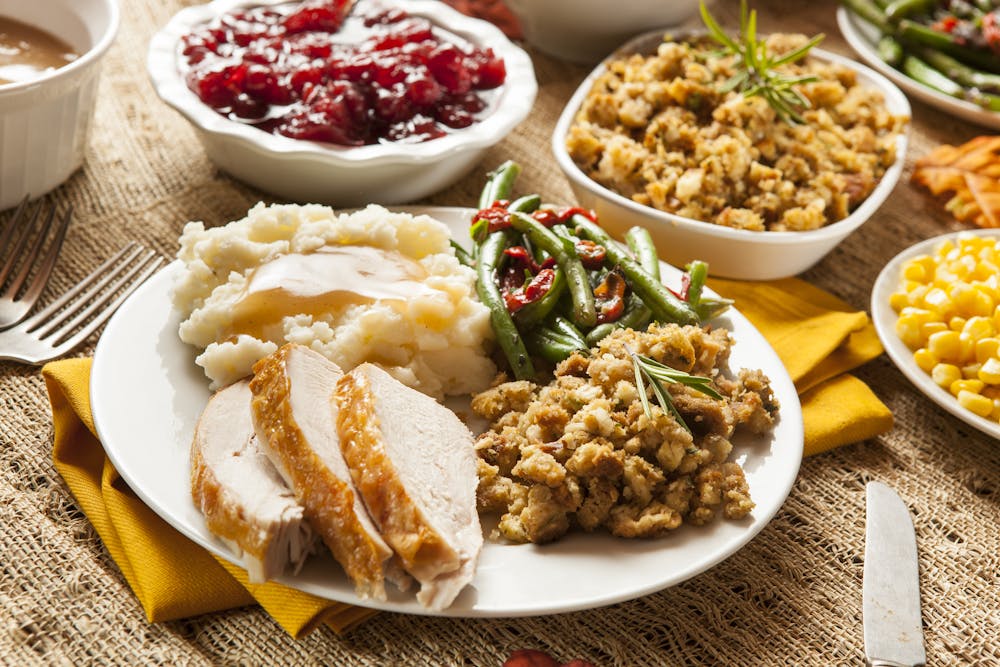
turkey dinner Thanksgiving tryptophan

Overeating and drinking are more likely at the root of your post-feast nap.
Brent Hofacker/Shutterstock.com


So tryptophan is off the snooze-inducing hook. But researchers in the Netherlands suggest it does have a different psychological effect: They’ve discovered that doses of tryptophan (chemically known as L-tryptophan and abbreviated TRP) can promote interpersonal trust – that feeling you get when you look somebody in the eye, shake her hand and think, “I can cooperate with this person and she would reciprocate.”

In a study published in the journal Psychological Science, pairs of volunteers were each given an oral dose of 0.8g of TRP or a placebo. For comparison, a 100g standard serving of turkey about the thickness of a deck of playing cards contains about 0.31g of tryptophan.

Each duo then sat in separate cubicles and played a game where one person (the truster) was given US$7 and had to decide how much to transfer to the other person. The transferred money was then multiplied by three and the trustee could give back part of the tripled money.

The more money you’re willing to give away in the first place, the greater your return in the end – but you have to trust the other person to cooperate. A very simple and profitable game if played right.

The researchers found that the TRP group gave $4.81 on average and the placebo group offered only $3.38. This is a sizable 42 percent increase in transferred money between the two groups.

So what’s going on? Here’s the brain science behind how the tryptophan-trust connection works.

TRP is an essential amino acid found in many foods including eggs, soybeans, chocolate, cheeses, fish, nuts and, of course, turkey. The brain region associated with interpersonal trust – known as the medial prefrontal cortex – is powered by the neurotransmitter serotonin. Neurotransmitters are chemical messengers found throughout the body that transmit signals from one nerve cell to another.

Our bodies synthesize many neurotransmitters from simple amino acids which are readily available in our food and can be quickly converted in a small number of biosynthetic steps. The neurotransmitter serotonin is controlled in part by the release of TRP. This means that as you increase levels of TRP you’re able to release serotonin in the brain region specially designed to process trust. Think of a flashing neon sign that reads “trust this person, trust this person.”


turkey dinner Thanksgiving tryptophan

A plate of turkey won’t convince you to buy into Cousin Gerald’s pyramid scheme.
Rawpixel.com/Shutterstock.com


Keep in mind, however, that our decisions to trust or not to trust do not rely solely on ingesting TRP. In the real world we take into account personality factors, how well we know someone, previous cooperation with that person, tone of voice, eye contact, body language and so on. These all have a hand in shaping the conscious and unconscious rules that govern our pro-social behavior and trust preferences.

The ConversationSo this holiday season, eat your turkey (or salmon or cashews or cottage cheese or chocolate) and remember that few things are more pleasurable than the joy that comes from sharing a holiday meal with loved ones. Science shows us that tryptophan can promote social bonding, but there still is no substitute for giving thanks. Trust me.
Kevin Bennett, Assistant Teaching Professor of Psychology, Pennsylvania State University

This article was originally published on The Conversation. Read the original article.

Tuesday, November 21, 2017

From the Archives: Virginia Governor Bob McDonnell issues annual Thanksgiving proclamation

Virginia Governor Bob McDonnell issues annual Thanksgiving proclamation
November 21, 2011 11:41 PM MST

On Wednesday morning in Richmond, Virginia Governor Bob McDonnell will preside over the annual ceremony at which the Commonwealth’s Indian tribes pay tribute to the colonial overlords who arrived beginning in 1607. In return for the taking of their land by the English settlers, the Native Americans pay the Virginia governor duty in the form of wild game, animal skins, and weapons.

Examiner.com Bob McDonnell Powhatan Indians Thanksgiving 2011
Richmond History Examiner Karen Graham writes that the “tribes are paying their yearly tribute to the government of the Commonwealth” in a ceremony that goes back nearly 400 years.

Graham explains that the “first time a tribute was paid was due to a treaty signed in 1646. This treaty ended the Anglo-Indian War.The words of the treaty required the Powhatan Indians to pay a tribute of 20 beaver pelts to the colonial government yearly. In return, they would be protected from their enemies.”

In advance of the ceremony and the nation’s annual celebration of Thanksgiving Day, Governor McDonnell on Monday issued his official Thanksgiving proclamation, which says in part:

“… to show their appreciation for the colony’s success and to take stock and give thanks for their own gifts and blessings, and in spite of tremendous adversity, the settlers in Virginia found time to celebrate the first Thanksgiving in America at Berkeley Plantation on December 4, 1619…

“… while reflecting upon the actions taken by the colonists at the first Thanksgiving, we also honor the Indian peoples, for without their presence, the survival of the colonists would have been ever more difficult; and…

“… it is a Virginia tradition for our citizens to come together in unity on Thanksgiving Day and give thanks for the great level of serenity, harmony and abundance with which we, as citizens of a free nation, have been blessed; the rule of law by which we peaceably govern ourselves and by which our civil and religious liberties are guaranteed; and the brave servicemen and women of our armed forces who risk their lives to defend the freedoms and blessings we cherish; …

“… I encourage all Virginians to give thanks to our Creator for our plentiful blessings, including the rights to life, liberty and the pursuit of happiness as well as the unwavering strength of our families and communities.”

According to Governor McDonnell’s official schedule, he and First Lady Maureen McDonnell will participate in the annual tax tribute ceremony on the grounds of the State Capitol and the Executive Mansion at 10:00 a.m. on Wednesday, November 23.


Publisher's note: This article was originally published on Examiner.com on November 21, 2011. The Examiner.com publishing platform was discontinued July 1, 2016, and its web site went dark on or about July 10, 2016.  I am republishing this piece in an effort to preserve it and all my other contributions to Examiner.com since April 6, 2010. It is reposted here without most of the internal links that were in the original.

Monday, November 20, 2017

Guest Post: What the first Thanksgiving dinner actually looked like

Julie Lesnik, Wayne State University

Most Americans probably don’t realize that we have a very limited understanding of the first Thanksgiving, which took place in 1621 in Massachusetts.

Indeed, few of our present-day traditions resemble what happened almost 400 years ago, and there’s only one original account of the feast.

As an anthropologist who specializes in reconstructing past diets, I can say that even though we don’t have a definitive account of the menu at the first Thanksgiving, letters and recorded oral histories give us a pretty good idea of what they probably ate. And we know for a fact that it didn’t include mashed potatoes and pumpkin pie.


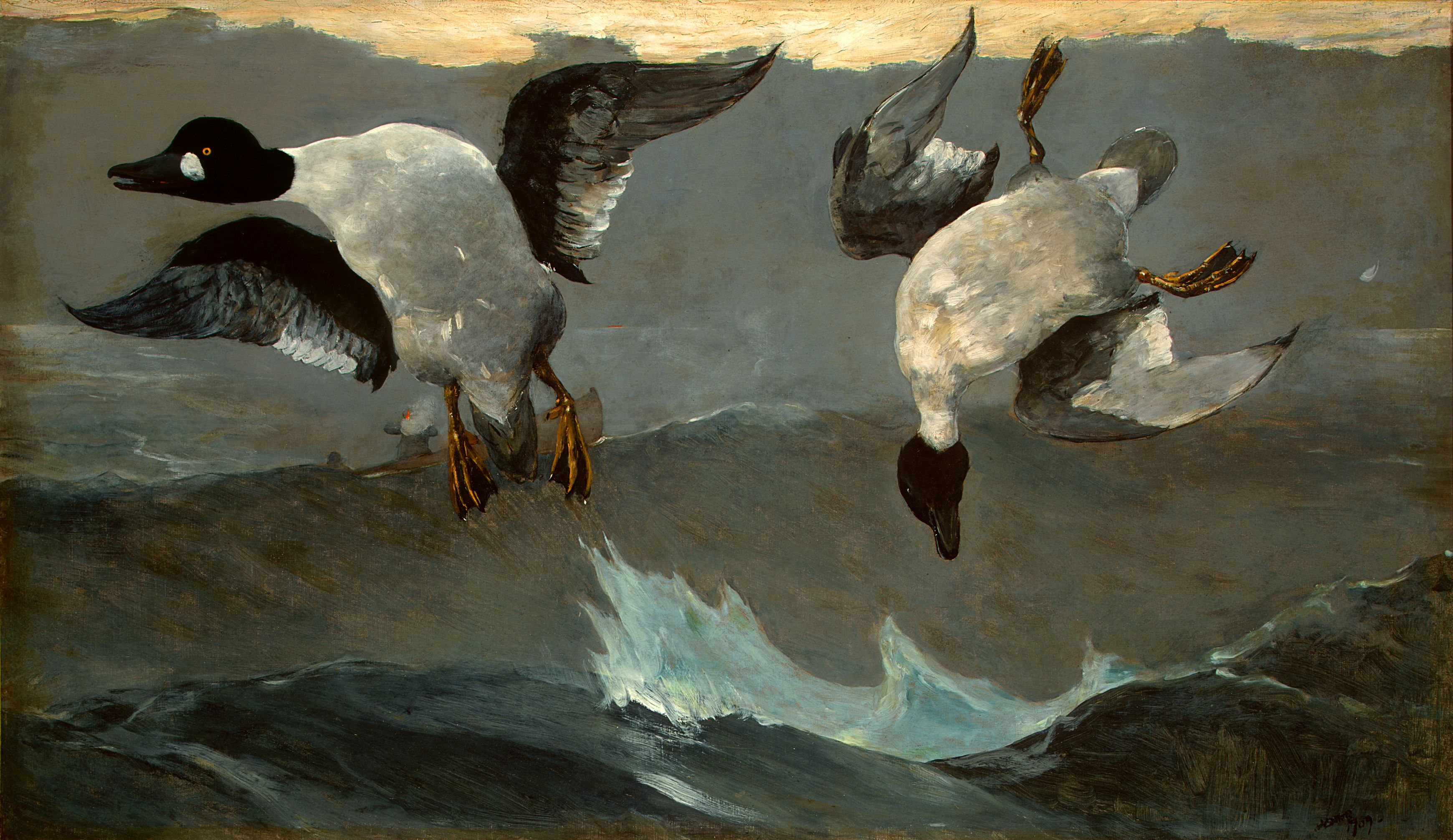
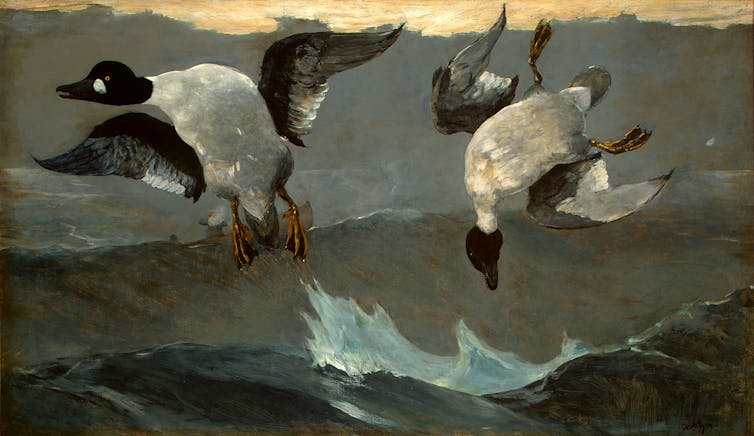
waterfowl Winslow Homer Thanksgiving

Waterfowl – not turkey – would have been the main course.
Winslow Homer, 'Right and Left' (1909), National Gallery of Art


A main course of waterfowl and venison


The main course is the one scholars can speak about with certainty.

The only eyewitness account of the first Thanksgiving comes from a letter written by Edward Winslow on Dec. 11, 1621. In it, he describes how the Puritans, after utilizing fertilization methods imparted by Tisquantum (also known as “Squanto”), had their first successful harvest. To celebrate, Governor William Bradford “sent four men on fowling” and they returned later that day with enough food to feed the colony for almost a week. Since waterfowl was plentiful in the Massachusetts Bay area, it’s widely accepted that they were eating goose and duck rather than turkey.

The letter also recounts that the Wampanoag leader Massasoit Ousamequin was present, along with “some ninety men,” and that they gifted five deer to the governor. Therefore, venison likely had a prominent place alongside waterfowl on the first Thanksgiving table.

Not cranberry sauce, but sobaheg stew


The natural bogs of the the region contained wild cranberries that could be dried and used all winter to bring variety and vitamin C into the diets of the Wampanoags. They even have their own holiday, Cranberry Day, that resembles our Thanksgiving.

However, there’s no account of cranberries at the first Thanksgiving, nor is there any mention of cranberries in other records of foods introduced to people who arrived on the Mayflower.

This may be due, in part, to the location of Plymouth Plantation relative to the boggy regions of Massachusetts, which are several miles away.

If bogs were not in the immediate area, then the fruit may not have been as readily used by the Wampanoags of this region as they were in other places with Wampanoag settlements, like Martha’s Vineyard.

Instead, for a side dish to the main course, a stew called sobaheg was most likely served. An easy way to make use of seasonal ingredients, the stew often included a mixture of beans, corn, poultry, squash, nuts and clam juice. All are used in the traditional dish today, and all would have been available in 1621. In fact, clams, fish and other seafood were abundant in the area, so they were probably present in some form, whether in sobaheg or another dish.

For carbs, look to cornbread, not potatoes


Historians attribute the first New England crop of potatoes to Derry, New Hampshire in 1722, so there’s no way mashed potatoes could have made an appearance during the first Thanksgiving.

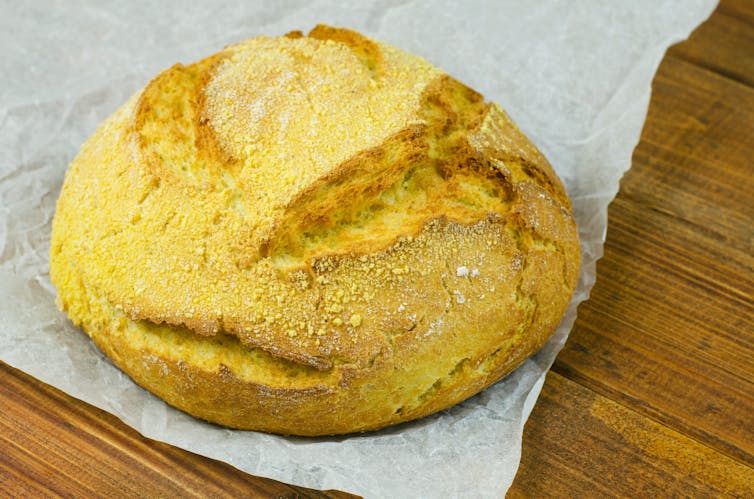
Corn, on the other hand, was the staple starch of the time, and in the published notes of William J. Miller on the Wampanoag tribe, he indicates that among the foods introduced to them, the corn bread, called maizium, was “kind.” European settlers didn’t often speak favorably of indigenous food, so mazium stands out as a recipe that likely made it onto the table at this first feast.


Thanksgiving cornbread

Potatoes weren’t around in 17th-century New England, but corn was plentiful.
Natalija Sahraj


A ‘green sauce’ gravy


Although the settlers may have made a gravy out of the drippings from the meats procured for the feast, a common staple for these early colonizers was a dish known simply as “green sauce.”

Although the best accounts of this sauce come from later records when households had their own gardens of European crops, recipes also utilized crops introduced to them by the Wampanoag. In addition to the corn (and barley) mentioned in Winslow’s letter, the harvest of 1621 likely included beans, squash, onions, turnips and greens such as spinach and chard. All could have been cooked at length to create a pulpy sauce that later became a staple in early New England homes.

What about dessert?


A regular supply of sugar or maple syrup wasn’t available in the area until much later. Sugar, which was the major export of Caribbean plantations, didn’t become popular in New England until the 18th century.

As for maple syrup, Native Americans of the Northeast are credited as the first to procure it; however, it’s believed that European settlers didn’t begin harvesting it until 1680.

The ConversationAlthough it is tough to think of Thanksgiving without decadent sweets, at least the first attendees were spared the awkwardness of having to refuse dessert after such a large feast.

Julie Lesnik, Assistant Professor of Anthropology, Wayne State University

This article was originally published on The Conversation. Read the original article.