Showing posts with label Judaism. Show all posts

Wednesday, December 12, 2018

Guest Post: An archaeological dig in Israel suggests how feasting became an important ritual


Natalie Munro, University of Connecticut

This holiday season millions of families will come together to celebrate their respective festivals and engage in myriad rituals. These may include exchanging gifts, singing songs, giving thanks, and most importantly, preparing and consuming the holiday feast.


Archaeological evidence shows that such communally shared meals have long been vital components of human rituals. My colleague Leore Grosman and I discovered the earliest evidence of a ritual feast at a 12,000-year-old archaeological site in northern Israel and learned how feasts came to be integral components of modern-day ritual practice.


First, what are rituals?


Rituals involve meaningful, often repeated actions. In modern-day practices they are expressed through rites such as the hooding of a doctoral student, birthdays, weddings or even sipping wine at Holy Communion or lighting Hanukkah candles.
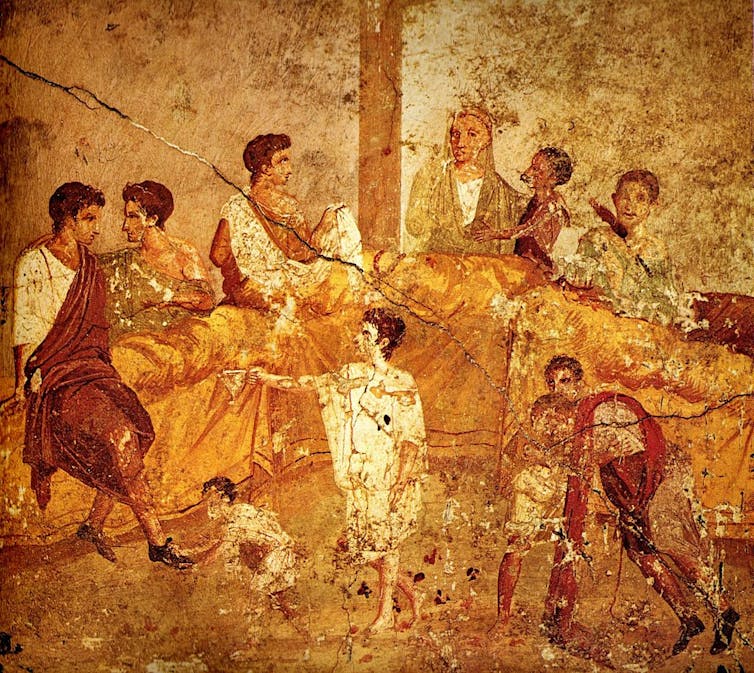


Pompeii family feast painting Naples

Pompeii family feast painting, Naples.
Unknown painter before 79 AD, via Wikimedia Commons


Ritual practice may have emerged along with other early modern human behaviors more than 100,000 years ago. However, proving this with material evidence is a challenge. For example, researchers have found that both Neanderthals and early modern humans buried their dead, but scholars weren’t certain whether this was for spiritual or symbolic reasons and not for something more mundane like maintaining site hygiene. Likewise, the discovery of 100,000-year-old symbolic artifacts like pierced shell ornaments and decorated chunks of red ochre in caves in South Africa, was not sufficient to prove that they were part of any ritual activities.

It was only when archaeologists found these artifacts, placed in graves going back 40,000-20,000 years, that it was confirmed they were part of ritual practice.

The first feasts


We had a similar experience during our research. When Leore Grosman and I first embarked on the excavations at Hilazon Tachtit in the late 1990s, we were only hoping to document the activities of the last hunter-gatherers in Israel, at what appeared to be a small campsite. It was only over several seasons of excavation that it slowly became clear to us that this was not a site where people had lived. Rather it was a site for rituals.
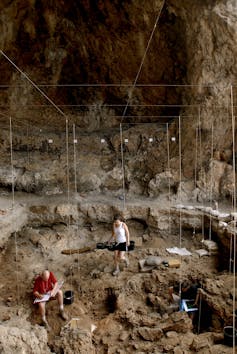


Hilazon Tachtit cave interior. Naftali Hilger

Hilazon Tachtit cave interior.
Naftali Hilger, CC BY-NC-ND


No houses, fireplaces or cooking areas were recovered. Instead the cave yielded the skeletal remains of at least 28 individuals interred in three pits and two small structures.

One of these structures contained the complete skeleton of an older woman, who we interpreted as a shaman based on her special treatment at death. Her grave stood apart due to its fine construction – the walls were plastered with clay and inset with flat stone slabs. Even more remarkable was the eclectic array of animal body parts buried alongside of her. The pelvis of a leopard, the wing tip of an eagle, the skulls of two martens and many other unusual body parts surrounded her skeleton.

The butchered remnants of more than 90 tortoises buried in the grave and the leftovers of at least three wild cattle deposited in a second adjacent depression excavated in the cave floor represent the remains of a funeral feast.
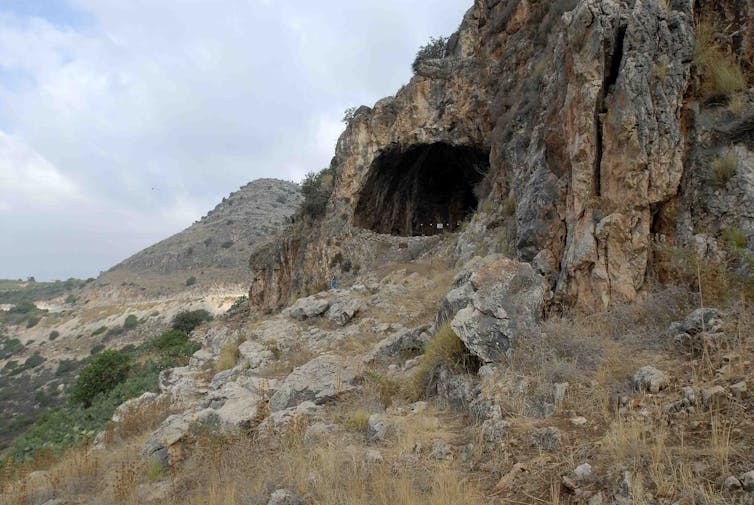


Hilazon Tachtit cave. Naftali Hilger

Hilazon Tachtit cave.
Naftali Hilger, CC BY-NC-ND


The outstanding preservation of the grave enabled us to detect multiple phases of a ritual performance that included the consumption of the feast, the burial of the woman, and the filling of the grave in several stages, including the intentional deposition of garbage from the feast.

Feasting at the beginning of agriculture


Archaeologists have found other sites that show evidence of ritual feasting. Many of these date to the time when humans were beginning to farm.
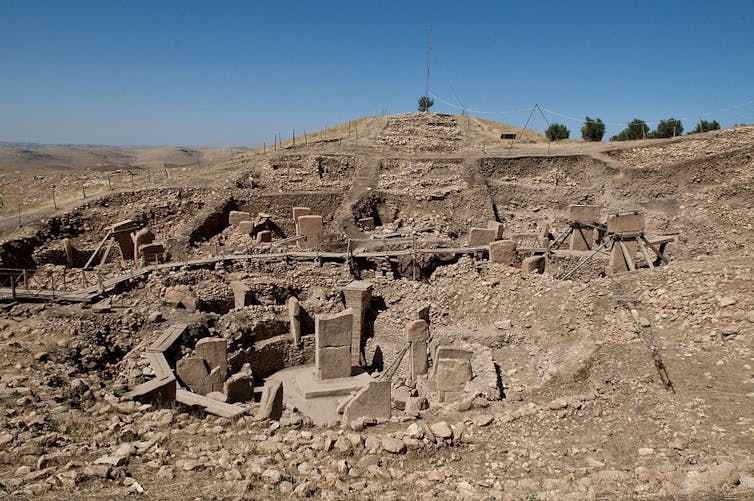


Site of Göbekli Tepe. Teomancimit

Site of Göbekli Tepe.
Teomancimit (Own work) , via Wikimedia Commons, CC BY-SA


One of the most striking is the site of Göbekli Tepe in southeastern Turkey, dating slightly later than Hilazon Tachtit. It includes multiple large structures adorned with benches and giant stone slab carved with exquisite animal depictions in relief dating to 11-12,000 years ago. Perhaps, these were very early communal buildings. The archaeologists who excavated Göbekli Tepe argue that massive quantities of animal bones associated with the structures represent the remains of feasts.

Twelve thousand years ago humans were still hunter-gatherers, subsisting entirely on wild foods. Nevertheless, these people differed from those who went before – they were sitting on the brink of the transition to agriculture, one of the most significant economic, social and ideological transformations in human history.

Sickle blades and grinding stones used to harvest and process cereal grains are found at Hilazon Tachtit and other contemporary archaeological sites. These findings indicate that these ritual feasts started around the same time that people adopted agriculture. When people began to rely more heavily on wild cereals like wheat and barley, they became increasingly tethered to landscapes that were ever more crowded and began to settle into more permanent communities. In other words, feasting became a part of their life, once they moved away from nomadic life.

Rituals that bind


These feasts had an important role to play. Adapting to village life after hundreds of millennia on the move was no simple act. Research on modern hunter-gatherer societies shows that closer contact between neighbors dramatically increased social tensions. New solutions to avoid and repair conflict were critical.

The simultaneous appearance of feasting, communal structures and specialized ritual sites suggest that humans were seeking to solve this problem by engaging the community in ritual practice.

One of the central functions of ritual in these communities was to provide a kind of social glue that bound community members by promoting social cohesion and solidarity. Feasts generate loyalty and commitment to the community’s success. Sharing food is intimate and it builds trust.

Communal rituals would have provided a shared sense of identity at a time when social circles were increasing in scale and permanence. They reinforced new ideologies that emerged out of a dramatic reorganization of economic and social life.

Role of feasts today

Feasting plays the same essential role today. Like the earliest feasts, our holiday celebrations are replete with actions that are repeated year after year.

The holiday feast today builds family traditions. By cooking and sharing food together, telling stories of past holidays and exchanging intergenerational wisdom, holiday rituals bond extended families and give them a shared identity.The Conversation

Natalie Munro, Professor, University of Connecticut

This article is republished from The Conversation under a Creative Commons license. Read the original article.


Wednesday, December 05, 2018

Guest Post: How Hanukkah came to America


Dianne Ashton, Rowan University

Hanukkah may be the best known Jewish holiday in the United States. But despite its popularity in the U.S., Hanukkah is ranked one of Judaism’s minor festivals, and nowhere else does it garner such attention. The holiday is mostly a domestic celebration, although special holiday prayers also expand synagogue worship.

So how did Hanukkah attain its special place in America?

Hanukkah’s back story


The word “Hanukkah” means dedication. It commemorates the rededicating of the ancient Temple in Jerusalem in 165 B.C. when Jews – led by a band of brothers called the Maccabees – tossed out statues of Hellenic gods that had been placed there by King Antiochus IV when he conquered Judea. Antiochus aimed to plant Hellenic culture throughout his kingdom, and that included worshipping its gods.

Legend has it that during the dedication, as people prepared to light the Temple’s large oil lamps to signify the presence of God, only a tiny bit of holy oil could be found. Yet, that little bit of oil remained alight for eight days until more could be prepared. Thus, each Hanukkah evening, for eight nights, Jews light a candle, adding an additional one as the holiday progresses throughout the festival.

Hanukkah’s American story


Dianne Ashton Hanukkah in America Chanukah historyToday, America is home to almost 7 million Jews. But Jews did not always find it easy to be Jewish in America. Until the late 19th century, America’s Jewish population was very small and grew to only as many as 250,000 in 1880. The basic goods of Jewish religious life – such as kosher meat and candles, Torah scrolls, and Jewish calendars – were often hard to find.

In those early days, major Jewish religious events took special planning and effort, and minor festivals like Hanukkah often slipped by unnoticed.

My own study of American Jewish history has recently focused on Hanukkah’s development.

It began with a simple holiday hymn written in 1840 by Penina Moise, a Jewish Sunday school teacher in Charleston, South Carolina. Her evangelical Christian neighbors worked hard to bring the local Jews into the Christian fold. They urged Jews to agree that only by becoming Christian could they attain God’s love and ultimately reach Heaven.

Moise, a famed poet, saw the holiday celebrating dedication to Judaism as an occasion to inspire Jewish dedication despite Christian challenges. Her congregation, Beth Elohim, publicized the hymn by including it in their hymnbook.

This English language hymn expressed a feeling common to many American Jews living as a tiny minority. “Great Arbiter of human fate whose glory ne'er decays,” Moise began the hymn, “To Thee alone we dedicate the song and soul of praise.”

It became a favorite among American Jews and could be heard in congregations around the country for another century.

Shortly after the Civil War, Cincinnati Rabbi Max Lilienthal learned about special Christmas events for children held in some local churches. To adapt them for children in his own congregation, he created a Hanukkah assembly where the holiday’s story was told, blessings and hymns were sung, candles were lighted and sweets were distributed to the children.

His friend, Rabbi Isaac M. Wise, created a similar event for his own congregation. Wise and Lilienthal edited national Jewish magazines where they publicized these innovative Hanukkah assemblies, encouraging other congregations to establish their own.

Lilienthal and Wise also aimed to reform Judaism, streamlining it and emphasizing the rabbi’s role as teacher. Because they felt their changes would help Judaism survive in the modern age, they called themselves “Modern Maccabees.” Through their efforts, special Hanukkah events for children became standard in American synagogues.

20th-century expansion


By 1900, industrial America produced the abundance of goods exchanged each Dec. 25. Christmas’ domestic celebrations and gifts to children provided a shared religious experience to American Christians otherwise separated by denominational divisions. As a home celebration, it sidestepped the theological and institutional loyalties voiced in churches.

For the 2.3 million Jewish immigrants who entered the U.S. between 1881 and 1924, providing their children with gifts in December proved they were becoming American and obtaining a better life.

But by giving those gifts at Hanukkah, instead of adopting Christmas, they also expressed their own ideals of American religious freedom, as well as their own dedication to Judaism.

After World War II, many Jews relocated from urban centers. Suburban Jewish children often comprised small minorities in public schools and found themselves coerced to participate in Christmas assemblies. Teachers, administrators and peers often pressured them to sing Christian hymns and assert statements of Christian faith.

From the 1950s through the 1980s, as Jewish parents argued for their children’s right to freedom from religious coercion, they also embellished Hanukkah. Suburban synagogues expanded their Hanukkah programming.

As I detail in my book, Jewish families embellished domestic Hanukkah celebrations with decorations, nightly gifts and holiday parties to enhance Hanukkah’s impact. In suburbia, Hanukkah’s theme of dedication to Judaism shone with special meaning. Rabbinical associations, national Jewish clubs and advertisers of Hanukkah goods carried the ideas for expanded Hanukkah festivities nationwide.

In the 21st century, Hanukkah accomplishes many tasks. Amid Christmas, it reminds Jews of Jewish dedication. Its domestic celebration enhances Jewish family life. In its similarity to Christmas domestic gift-giving, Hanukkah makes Judaism attractive to children and – according to my college students – relatable to Jews’ Christian neighbors. In many interfaith families, this shared festivity furthers domestic tranquility.

In America, this minor festival has attained major significance.The Conversation

Dianne Ashton, Professor of Religion, Rowan University

This article is republished from The Conversation under a Creative Commons license. Read the original article.

Tuesday, December 12, 2017

Guest Post: Hanukkah's true meaning is about Jewish survival


Alan Avery-Peck, College of the Holy Cross

Beginning on the evening of Dec. 12, Jews will celebrate the eight-day festival of Hanukkah, perhaps the best-known and certainly the most visible Jewish holiday.

While critics sometimes identify Christmas as promoting the prevalence in America today of what one might refer to as Hanukkah kitsch, this assessment misses the social and theological significance of Hanukkah within Judaism itself.

Let’s consider the origin and development of Hanukkah over the past more than 2,000 years.

Early history


Though it is 2,200 years old, Hanukkah is one of Judaism’s newest holidays, an annual Jewish celebration that does not even appear in the Hebrew Bible.

The historical event that is the basis for Hanukkah is told, rather, in the post-biblical Books of the Maccabees, which appear in the Catholic biblical canon but are not even considered part of the Bible by Jews and most Protestant denominations.


Maccabees Hanukkah Chanukah Jewish history

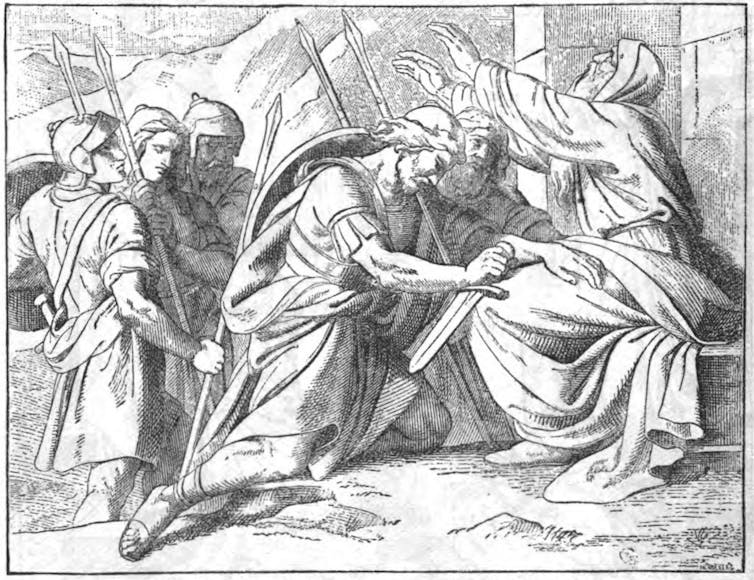
The Maccabees receive their father’s blessing.
The Story of the Bible from Genesis to Revelation via Wikimedia Commons.


Based on the Greco-Roman model of celebrating a military triumph, Hanukkah was instituted in 164 B.C. to celebrate the victory of the Maccabees, a ragtag army of Jews, against the much more powerful army of King Antiochus IV of Syria.

In 168 B.C., Antiochus outlawed Jewish practice and forced Jews to adopt pagan rituals and assimilate into Greek culture.

The Maccabees revolted against this persecution. They captured Jerusalem from Antiochus’s control, removed from the Jerusalem Temple symbols of pagan worship that Antiochus had introduced and restarted the sacrificial worship, ordained by God in the Hebrew Bible, that Antiochus had violated.

Hanukkah, meaning “dedication,” marked this military victory
with a celebration that lasted eight days and was modeled on the festival of Tabernacles (Sukkot) that had been banned by Antiochus.

How Hanukkah evolved


The military triumph, however, was short-lived. The Maccabees’ descendants – the Hasmonean dynasty – routinely violated their own Jewish law and tradition.

Even more significantly, the following centuries witnessed the devastation that would be caused when Jews tried again to accomplish what the Maccabees had done. By now, Rome controlled the land of Israel. In A.D. 68-70 and again in A.D. 133-135, the Jews mounted passionate revolts to rid their land of this foreign and oppressing power.


Second Temple Jerusalem Jewish history Hanukkah

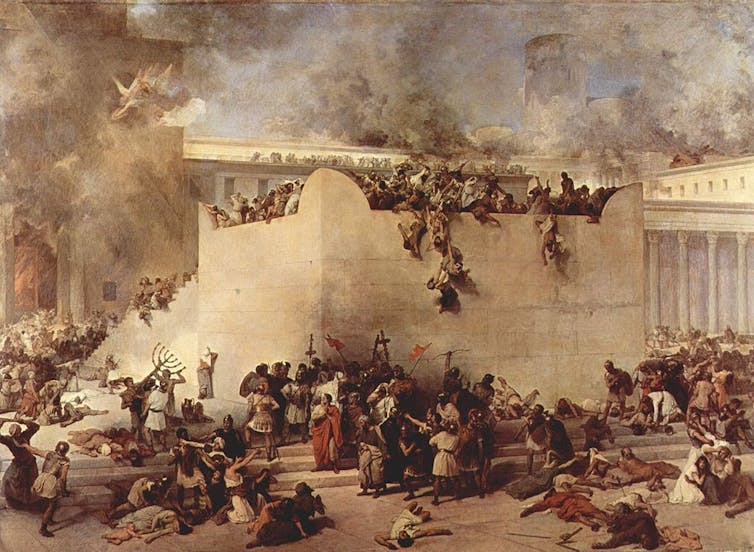
The destruction of the Temple of Jerusalem.
Francesco Hayez, via Wikimedia Commons


The first of these revolts ended in the destruction of the Second Jerusalem Temple, the preeminent center of Jewish worship, which had stood for 600 years. As a result of the second revolt, the Jewish homeland was devastated and countless Jews were put to death.

War no longer seemed an effective solution to the Jews’ tribulations on the stage of history.

In response, a new ideology deemphasized the idea that Jews should or could change their destiny through military action. What was required, rabbis asserted, was not battle but perfect observance of God’s moral and ritual law. This would lead to God’s intervention in history to restore the Jewish people’s control over their own land and destiny.

In this context, rabbis rethought Hanukkah’s origins as the celebration of a military victory. Instead, they said, Hanukkah should be seen as commemorating a miracle that occurred during the Maccabees’ rededication of the temple: The story now told was how a jar of temple oil sufficient for only one day had sustained the temple’s eternal lamp for a full eight days, until additional ritually appropriate oil could be produced.

The earliest version of this story appears in the Talmud, in a document completed in the sixth century A.D. From that period on, rather than directly commemorating the Maccabees’ victory, Hanukkah celebrated God’s miracle.

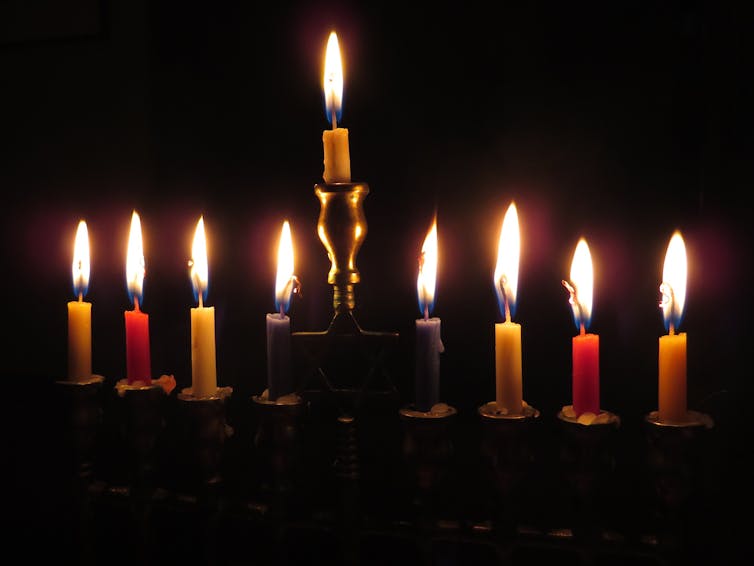
This is symbolized by the kindling of an eight-branched candelabra (“Menorah” or “Hanukkiah”), with one candle lit on the holiday’s first night and an additional candle added each night until, on the final night of the festival, all eight branches are lit. The ninth candle in the Hanukkiah is used to light the others.

Throughout the medieval period, however, Hanukkah remained a minor Jewish festival.

What Hanukkah means today


How then to understand what happened to Hanukkah in the past hundred years, during which it has achieved prominence in Jewish life, both in America and around the world?


Hanukkah menorah candles holidays Christmas Chanukah

Hanukkah today responds to Jews’ desire to see their history as consequential.
Pixabay.com/en, CC BY


The point is that even as the holiday’s prior iterations reflected the distinctive needs of successive ages, so Jews today have reinterpreted Hanukkah in light of contemporary circumstances – a point that is detailed in religion scholar Dianne Ashton’s book, “Hanukkah in America.”

Ashton demonstrates while Hanukkah has evolved in tandem with the extravagance of the American Christmas season, there is much more to this story.

Hanukkah today responds to Jews’ desire to see their history as consequential, as reflecting the value of religious freedom that Jews share with all other Americans. Hanukkah, with its bright decorations, songs, and family- and community-focused celebrations, also fulfills American Jews’ need to reengage disaffected Jews and to keep Jewish children excited about Judaism.

Poignantly, telling a story of persecution and then redemption, Hanukkah today provides a historical paradigm that can help modern Jews think about the Holocaust and the emergence of Zionism.

In short, Hanukkah is as powerful a commemoration as it is today because it responds to a host of factors pertinent to contemporary Jewish history and life.

The ConversationOver two millennia, Hanukkah has evolved to narrate the story of the Maccabees in ways that meet the distinctive needs of successive generations of Jews. Each generation tells the story as it needs to hear it, in response to the eternal values of Judaism but also as is appropriate to each period’s distinctive cultural forces, ideologies and experiences.

Alan Avery-Peck, Kraft-Hiatt Professor in Judaic Studies, College of the Holy Cross

This article was originally published on The Conversation. Read the original article.

Thursday, June 03, 2010

Review of 'Sycamore Trees' at Arlington's Signature Theatre

Here is my review of Sycamore Trees, now having its world premiere at Signature Theatre in Arlington.

Unhappy Families Are All Alike:
Signature Theatre’s 'Sycamore Trees' Needs Trimming
Rick Sincere
Metro Herald Entertainment Editor

Sycamore Trees comes within a hair’s breadth of upending Leo Tolstoy’s dictum that “Happy families are all alike; every unhappy family is unhappy in its own way.” Not quite, but nearly so.

Sycamore Trees is a musical play having its world premiere at Signature Theatre in Arlington, part of that troupe’s American Musical Voices Project, which has commissioned four new musicals (including last season’s adaptation of Edna Ferber’s Giant by Michael John LaChiusa). The songs are by composer-lyricist Ricky Ian Gordon, who co-wrote the book with Nina Mankin. The production is directed by Tina Landau.

How does Sycamore Trees turn Tolstoy’s observation on its head? By treading on such well-trod territory, as it examines the dysfunction in a post-war, Jewish, American, suburban, neurotic, angst-ridden, middle-class family from the 1940s through the 1990s, the play simply repeats so much of what we have heard before, whether in Alan King’s standup comedy of the 1950s, Portnoy’s Complaint in the 1960s, the films of Woody Allen, or Sarah Silverman’s mishegoss today.

We’ve seen this all on confessional television like Maury Povich and Jerry Springer. It’s just not new.

Sycamore Trees focuses on the family of Sydney and Edie Sylvan, who meet and fall in love at Grossinger’s (are we stepping near stereotypes here?), where Edie is a Borscht Belt songstress, just before Sydney goes off to fight World War II in Europe. The first of their three daughters, Myrna, is born in his absence. After he returns, Myrna is joined in rather quick succession by Theresa, Ginnie (Virginia), and Andrew.

The children are named for the actors from their parents’ favorite movie, The Best Years of Our Lives: Myrna Loy, Teresa Wright, Virginia Mayo, and Dana Andrews. (“Why didn’t you name me Dana?” Andrew asks. “Because Dana is a girl’s name,” answers Sidney. The exchange sets the tone for the father-son relationship.)

Sydney is shaken but not stirred by his wartime experience. He returns as a stolid man who will not talk about what he did or saw, and coldly (at least, that’s what the playwrights want us to believe) focuses on nothing more than earning a living and raising his family as another duty. Edie (Diane Sutherland) indulges him and sheds her own personality to live in his shadow.

Naturally, the three sisters and their gay brother each grow up to rebel against this repressively bourgeois existence in their own ways: alcohol, drugs, teen pregnancy, dating “bad boys,” becoming poets, musicians, and artists.

To reveal how these rebellions turn out would be to reveal too much for those who go to see this play with fresh eyes.

I will, however, throw the spotlight on one terrific line. After Theresa (Judy Kuhn) delivers a breathless anti-Reagan rant (during the 1980s segment), Ginnie (Farah Alvin) stops her in her tracks by saying, “Who is going to care about you when all you do is get on everybody’s nerves?” The line is not only unexpected, given the trajectory of the scene, it sets up an epiphany for Ginnie as she suddenly finds a new grounding in her life.

Ricky Ian Gordon’s score is the best part of Sycamore Trees. It is rich, tuneful, and drives the action forward.

Each song reflects the time of its setting – for example, “Ours,” a lighthearted love duet for Edie and Sydney, could have been lifted wholly from a 1940s Broadway musical revue – or, even better, reflects the inner thoughts of the characters.

The most fully realized of these may be Sydney’s interior monologues, “Pigeons” (in which he expresses his bittersweet thoughts about leaving densely-populated New York for a new life in the Long Island suburbs) and “Father’s Song” (in which he laments, “I never meant to be an ogre,” saying credibly that he is not a rotten father no matter what his neurotic kids may believe).

The success of these numbers is due in no small part to Marc Kudisch, whose Sydney is the rock on which Sycamore Trees is anchored. He plays Sydney as an organic, three-dimensional character in a show that is overtly theatrical, with the artifice made so bare that when the actors take the stage, one’s first thought is that this looks like “Seven Characters in Search of an Author.”

Another perfectly placed number is “Self Help,” a patter song in which the characters complain about their addictions. It provides much needed comic relief in a second act that otherwise tumbles toward a glum conclusion. That Theresa leads the song and eggs on the audience with a microphone in her hand (much like the aforementioned Povich and Springer) demonstrates that the director is not perturbed by irony, even if it is fleetingly utilized.

One of the major problems with Sycamore Trees is the tendency of the creators to ladle on too many effects to achieve a single emotion or idea.

For instance, we know within the first 30 seconds of the show that Andrew is gay, signaled with a subtle gesture. Do we really need to hear the story about the elementary school seducer who ruined his reputation at an early age?

Not to pick on Andrew (Tony Yazbeck), but his second-act monologue about the death of his partner, David (Matthew Risch), is nearly interminable. It could be cut by a third or more without losing its emotional impact.

Director Landau also inserts characters into scenes where they do not belong, such as when Myrna (Jessica Molaskey) hovers around Sydney during his “Father’s Song” soliloquy at the foot of the stage.

It seems that Landau never fails to use two gestures or images or expressions when one will do the job.

The source of these annoyances may be that co-writer Nina Mankin also served as the production’s dramaturg.

For those unfamiliar with the term, a dramaturg is a person whose job it is to advise the director (and sometimes the playwright) about, for instance, questions of authenticity in a period piece (regarding costumes or language). The dramaturg should also be free to critique the play’s text and direction and thus should be detached from the initial product or project.

A co-bookwriter simply cannot have the kind of detachment that a dramaturg – and a playwright and director – deserve. She (or he) lacks the capacity to step to the side and look at the production autonomously.

It’s as though a novelist acted as his own editor.

With some trimming – mostly of the book, not of the score – Sycamore Trees could emerge as a major new work of musical theatre.

Sycamore Trees runs through June 13 at Signature Theatre, 4200 Campbell Avenue in Arlington, Virginia. Show times are Tuesday and Wednesday at 7:30 p.m., Thursday and Friday at 8:00 p.m., Saturday at 2:00 p.m. and 8:00 p.m., and Sunday at 2:00 p.m. and 7:00 p.m. Tickets for Sycamore Trees range from $52 to $76 and are available by calling Ticketmaster at 703-573-7328 or visiting www.signature-theatre.org. Group discounts are available for parties of ten or more by contacting Jackie Carl at carlj@signature-theatre.org.

Wednesday, March 17, 2010

Interview with Zal Owen

When I found out that Fiddler on the Roof would be playing at the National Theatre in April and May, I made a special request of the show's publicist: Could I interview the actor who plays Motel Kamzoil? My reason was that, just about 30 years ago, I played that role in a community theatre production of Fiddler and, as a result, I have a particular affection for it.

In a happy coincidence, a new actor has just joined the cast, taking over the role of Motel from Erik Liberman, who would be known to Washington-area audiences for playing Charley Kringas in Signature Theatre's production of Merrily We Roll Along a couple of seasons ago.

I interviewed Zal Owen just a few days after he joined the national touring company of Fiddler on the Roof, which stars Harvey Fierstein as Tevye.

Interview with Zal Owen
Young Actor Plays ‘Motel’ in Fiddler on the Roof
Rick Sincere
Metro Herald Entertainment Editor

Actor Zal Owen is caught up in a welcome whirlwind. More than a year after auditioning for the role of the tailor, Motel Kamzoil, in the national tour of Fiddler on the Roof, the show’s casting director called Owen, saying they had to replace the actor playing the part and that Owen was among the people chosen to fill the role.

Speaking to The Metro Herald from Fort Worth, Texas, on the morning after his third performance as Motel, one could tell, even over the telephone, that Owen was beaming with delight at his good fortune.

As Owen tells the story, “I first auditioned for the show a year and a half ago. There were over 2,500 actors who auditioned for this production. I had several callbacks and was in the final four but didn’t get the part at that time. About three weeks ago, I got a call from the casting director who said there was a need for an immediate replacement. I had several callbacks and it paid off in the end.”

With little more than a week between his first rehearsal and his first performance, Owen had to dive into the development of his character (Motel) within the context of a production that was already ongoing. Luckily for him, he said, “When I first joined the company, they let me know that I didn’t have to work with what the previous actor had done, and that I could develop the character for myself even in the week and a half” that he had available for rehearsals.

“Even now in performances,” Owen continued, “I am playing more and rehearsing more, I am getting that lovely opportunity to rehearse and perform at the same time. This is a new opportunity for me, because I’ve never joined a show in the middle of the run.”

As one might expect under these circumstance, Owen explained that “it’s challenging in having to believe in yourself and your ability. At the same time, it’s fun because you can relax on stage saying to yourself, ‘I know what I need to do but let me try some new things.’ At some point, however, “you are able to say, ‘This is the performance I like and maybe this is what I’ll stick to on the rest of the run.’”

The role of Motel, he says, offers him the chance to play “the lovable underdog that everyone can relate to. It’s such a pleasure to find that for myself and bring it to the audience. Through [the song] ‘Miracle of Miracles’ he finds his courage and is able to stand up to Tevye.”

This national tour of Fiddler on the Roof is not Owen’s first brush with Motel Kamzoil. He understudied the role and played Mendel, the rabbi’s son, in a 2008 production starring Sally Struthers and Eddie Mekka at the Ogunquit Playhouse (“America’s Foremost Summer Theatre”) in Maine.

Owen began his professional acting career as a child. He saw his first Broadway show, Joseph & the Amazing Technicolor Dreamcoat, at the age of five. He knew right away that performing was what he wanted to do, and he persuaded his parents to let him take acting classes.

It was while studying at the Papermill Playhouse in New Jersey – not far from his home town of Westfield – that 10-year-old Zal was cast as “Young Hindley” in a 1999 world-premiere adaptation of Emily Brontë’s Wuthering Heights, directed by Robert Johanson. That was followed by community theatre and middle- and high-school productions before Owen matriculated in the musical theatre program at the University of Cincinnati’s College-Conservatory of Music (or CCM).

After college, Owen continued his acting studies through two branches of the Stanislavski Method family: with William Esper, who follows Sanford Meisner, and at the Stella Adler Studio of Acting.

Asked how the two methods differ in their approach, Owen says that “basically, both Stella Adler and Meisner agreed with the concept of using your imagination in terms of acting. Adler looks at context of the play. Meisner looks at living moment to moment with the other actors.” Both approaches, he says, “helped me be grounded with my partner in the scene, or the other actors if it’s an ensemble piece.” He appreciates both approaches, as well as scene study classes, where “I don’t have to worry about getting it right away but just be comfortable with the character.”

To put a better lens on Owen’s training, in a recent interview with The Big Think, acting teacher James Lipton (best known as host of the long-running TV series, Inside the Actors Studio) explained:

Stella Adler, Harold Clurman, Robert Lewis, Sanford Meisner, these were the great exponents of the later work of Stanislavski’s life. The action, the objective, the super-objective, which is that overall action that takes you through the play, and the devotion to given circumstances. Both sides emphasize concentration. You have to concentrate in a way that normal people don’t…. I would add to that the fact that all of these great teachers, Strasberg, Stella, Meisner, Lewis, Clurman, all of them, they emphasize listening.

“…When you speak to me, I am listening to you. In life we listen to other people. Listen with varying degrees of concentration and attention, right? Actors must learn to listen in a different way. Alan Alda, who really understands these things very well, I think, on our stage ‘Inside the Actors Studio,’ said, ‘The way to understand listening, the act and art of listening is the following: if what you hear changes you in any way, you’ve heard it, you listened….’”

When asked how he adjusted to traveling on the road with Fiddler on the Roof, Owen admitted that he hadn’t found his own routine yet. “There are other actors on the tour who do have a routine worked out. Being on tour, many actors find they can maintain their lifestyle,” with regard to diet (he mentioned “vegans”) and exercise (he noted some go to the gym each day).

Owen pointed out that a touring company is “really a family you end up being with for the time of the tour, not just co-workers.” So far, however, since he’s so new to the production, his routine – such as it is – has been hard work: “Last week I had rehearsals during the day and at night I went to see the show. I was memorizing lines, rehearsing, memorizing lines. Tonight will be my fourth show,” he said.

When Fiddler on the Roof arrives in Washington on April 13, it will not be Owen’s first visit to the Nation’s Capital.

“I visited Washington last year,” he said. “My best friend was in The Civil War at Ford’s Theatre. So I went to see him and stay with him for a few days.” That visit just whetted his appetite, however, because, he says, he looks forward “to really doing some sightseeing. I have not been to the White House, and I want to visit the Holocaust Museum. We’ll be at the National Theatre for a month and I look forward to seeing the Capitol.”

What’s more, he added, “in D.C. there are so many theatres. I want to see Sweeney Todd at Signature,” which has a one-week overlap of the end of its run with the beginning of Fiddler’s engagement at the National. “I would love to see some of the theatre that D.C. has to offer, as well as some movies. There is so much live theatre. Part of being in this art is observing other performances as well as doing my own.”

On his famous co-star, Harvey Fierstein, who plays Tevye, Owen said, “His dressing room has an open-door policy. Whether he’s in there or not, you’re allowed to go in there and relax. He’s such a loving soul, and he was so welcoming when I came into the production, and finding new things from his performance. He’s an incredible talent and person as well.”

From Fort Worth, the national tour continues to Atlanta to the Cobb Energy Performing Arts Centre, where it opens March 16. Owen said that this is “a new theater that’s only a year old,” so his cast mates have not yet performed there and it will be a new experience for all of them. Then, he said, “we have a three-week layover for Passover,” because the tour takes a brief hiatus during the Jewish holidays, and “then we’re in D.C.”

After that, “it’s Appleton, Wisconsin; Denver, Colorado; Seattle; Cleveland, and a stop in Toronto was just added. We’re booked up through the end of June.” Some of these engagements are just a week long; others, like the one in Washington, last for as long as a month.

Owen said that “it’s really exciting to get to see the country as well as to perform in such a timeless musical. It’s a real blessing to explore the country and bring the show to different audiences.”

He added: “Fiddler is such an enduring, timeless, ageless musical that spans so many cultures. The songs in the show – everyone knows these songs. It’s one of the best American musicals. Everyone who comes to see it loves it. It’s an incredible piece of theatre.”

Fiddler on the Roof with Harvey Fierstein and Zal Owen plays at the National Theatre in Washington from April 13 through May 9, 2010.Tickets, starting at $51.50, are on sale now at the National Theatre Box Office and through Telecharge at www.telecharge.com or by calling (800) 447-7400. For groups of 15 or more, call (866) 276-2947. For more information, call (202) 628-6161 or visit www.NationalTheatre.org.

Photo credit: Harvey Fierstein as Tevye; photo by Joan Marcus. Courtesy of National Theatre.


Be sure to visit my CafePress store for gifts and novelty items!
Read my blog on Kindle!
Follow my tweets on Twitter! 


Saturday, February 13, 2010

News from the Book Review World

Jordan Michael Smith reports in this week's Jewish Daily Forward that a new book review journal will be launched next week (with February 15 the scheduled publication date).  The new periodical will be called the Jewish Review of Books, and, from the illustration that accompanies the Forward article, it looks like its format and appearance will be much like the New York Review of Books.

Smith writes:

A quarterly magazine devoted to Jewish literary and political affairs, the JRB boasts heavy hitters on its editorial board, such as Michael Walzer, Leon Wieseltier and Ruth Wisse. An oversized, stapled newsprint magazine like the New York Review of Books and The Times Literary Supplement, the JRB will open with an issue that features contributions from Ron Rosenbaum, Adam Kirsch and Harvey Pekar....

Abraham Socher, the editor ... took a leave from his spot as chair of the Jewish studies program at Oberlin College’s department of religion to launch the JRB. He’s both optimistic about the future of journals of ideas and opinions and well aware of the pitfalls that await any print publication in the 21st century.

“Magazines of ideas, which are willing to address a subject at as much length as is called for, which are willing to let writers be writerly, can remain print publications,” Socher said. Those readers attracted to long-form writing prefer to read their lengthier articles in print and are willing to pay for the privilege, Socher believes. “The great threat to print may be a far greater threat to newspapers and news magazines than it is to literary journals, journals of opinions and policy journals,” he said. The print JRB will be complemented by a Web presence before the end of February.
Given today's unsteady, uncertain environment for print media, launching a new publication -- especially a journal of ideas rather than, say, a gossip, sports, or entertainment magazine -- requires a large measure of bravery and even more confidence.  Not to say chutzpah.

(Cross-posted from Book Reviews by Rick Sincere)

Wednesday, February 03, 2010

Harvey Fierstein Coming to D.C. as Tevye

A news release came across my desk recently.  It announces that the national tour of Fiddler on the Roof, starring Tony® Award-winning actor and playwright Harvey Fierstein, will be arriving at Washington's National Theatre in April.

The last time I saw Fiddler on the Roof in Washington, it featured Herschel Bernardi as Tevye at the Warner Theatre.  I think this was in 1980 or 1981.

Bernardi (who also starred in Zorba on Broadway and as "Arnie" on the eponymous TV series in the early 1970s) had taken over the role in the original New York run from the peripatetic and unpredictable Zero Mostel, who despite a brilliant performance in the lead, had a habit of breaking character and, for instance, announcing football scores to the audience in the middle of a show.  (I don't think the New York Giants played a lot of games in Tsarist Russia.)

I was also fortunate to have seen Harvey Fierstein in his first big hit, Torch Song Trilogy, on Broadway.  Matthew Broderick had already left the cast, but Fisher Stevens had taken over the role of David, the gay teenager needing an accepting home, which Fierstein's Arnold provides for him.  (Interestingly, I also saw Stevens on Broadway in Brighton Beach Memoirs, after he had taken over the role of Eugene, originated by -- wait for it -- Matthew Broderick.)

All this, plus my experience of having performed in Fiddler on the Roof in community theatre in 1979, will bring warm waves of nostalgia, coinciding with the arrival of the cherry blossoms.   Nice timing.

Here is the text of the news release about Fiddler on the Roof in Washington:
WASHINGTON, D.C. (January 21, 2010) Tradition is back! Harvey Fierstein reprises his Broadway role as Tevye in the North American Tour of the Tony® Award-winning musical FIDDLER ON THE ROOF, playing the National Theatre April 13 through May 9, 2010.

Tickets for FIDDLER ON THE ROOF, starting at $51.50, go on sale Sunday, February 14, at 12 noon at the National Theatre Box Office and through Telecharge at www.telecharge.com or by calling (800) 447-7400. For groups of 15 or more, call (866) 276-2947. For more information, call (202) 628-6161 or visit www.NationalTheatre.org.

Mr. Fierstein starred as the iconic milkman Tevye in the critically acclaimed Broadway revival. Audiences now have the rare opportunity to see the Tony® Award-winner embrace one of his favorite roles in this Jerome Robbins-inspired production. Mr. Fierstein has won four Tony® Awards, including Best Play and Best Actor in a Play for Torch Song Trilogy. His most recent win was in 2003 for Best Actor in a Musical for Hairspray. He also won for La Cage aux Folles (Best Book), the upcoming Broadway revival of which opens this April. Mr. Fierstein was most recently seen on Broadway in A Catered Affair, for which he also wrote the book.

FIDDLER ON THE ROOF has captured the hearts of people all over the world with its universal appeal and timeless message. The North American Tour continues the tradition of the 1964 Jerome Robbins Broadway production, for which Robbins garnered twin Tonys® for direction and choreography. In this National Tour, both are faithfully recreated by Director Sammy Dallas Bayes, choreographer of the Broadway Revival.

When FIDDLER ON THE ROOF opened in the United States in 1964, it was a time of change and crumbling traditions in this country. Perhaps the explanation for its worldwide success in the '60s and '70s was that the play illustrated the universality of such issues as the “generation gap,” youthful dissent, revolutionary doctrine, and the oppression of minorities. Students of the time identified with the rebellious Perchik, and strongly related to the breaking of hallowed traditions. Tevye and others of his time struggled with these same issues in 1905, and emerged triumphant, offering the hope and promise of reconciliation to a turbulent society. Today, FIDDLER ON THE ROOF is as relevant as ever.

Now, in the midst of a new millennia, in a world fraught with anxiety and fear, the one constant humanity can rely on is the strength of family and of its traditions that will ultimately sustain it through its own trials and tribulations. Forty-five years later, new audiences can identify and take heart as they experience the tradition in great musical theatre that is FIDDLER ON THE ROOF.
It might just be coincidence, or an ill portent, that this production of Fiddler opens on the 145th anniversary of another notable event in a Washington theater:  the assassination of Abraham Lincoln at Ford's, just a few blocks from the National Theatre.

Be sure to visit my CafePress store for gifts and novelty items!
Read my blog on Kindle!
Follow my tweets on Twitter!

Monday, July 28, 2008

If It's Monday ...

On Monday and Tuesday evenings at around 10:30 p.m. (EDT), this blog begins to get a spike of visitors, nearly all searching for Hunter Parrish with one modifier or another. This corresponds to the weekly broadcast of a new episode of Weeds, the dark Showtime comedy that features Parrish as Silas Botwin, the elder son of Mary-Louise Parker's character, Nancy Botwin, a suburban drug dealer in southern California.

Parrish is so popular here, in fact, that searches for his name add up to at least 22.2 percent of all visits to this blog. (Technically, 22.2 percent of the last 4,000 visits -- a big chunk by any estimation.)

This is odd because a Google Trends analysis shows that the name Hunter Parrish -- as talented and studly as he might be -- barely registers:


This low level of interest is demonstrated in relative terms when one compares the popularity of searches for "Hunter Parrish" with a celebrity of similar age and attractiveness, actor William Moseley of the Narnia movies:


So it must be something about this blog, in particular, in which interest in Hunter Parrish converges with other topics that results in disproportionate popularity. (Among "cute guys," the next most popular searches that lead here are Josh Hutcherson and Tyler Whitney -- one a movie actor, the other a political activist. Aaron Carter used to be a rival but his popularity has dissipated.)

It seems that the number one question on the mind of those searching for Hunter Parrish is this: Is Hunter Parrish gay? The secondary concern seems to be a desire to see him either shirtless or nude.

I don't have any shirtless or nude pictures of Hunter Parrish, but I do know of a video with him whistling. It's a promotional clip from Showtime in which the network was challenging fans to whistle "Little Boxes," the song that served as the theme of Weeds during its first three seasons.


I have no doubt that seekers of Hunter Parrish will be pleased to learn of the next step in his career. He'll be starring in a Broadway musical:
The producers of Spring Awakening announce “Weeds” Star Hunter Parrish will join Broadway’s groundbreaking musical hit in the central role of Melchior, the brilliant young radical, on August 18. Featured in Vanity Fair’s cover feature “Hollywood’s New Wave-The Hottest Kids in Hollywood" spread (August issue), on newsstands July 9, Hunter can currently be seen as Silas, the rabble-rousing older son of Mary-Louise Parker on the highly acclaimed Showtime series WEEDS. The show’s 4th season premiered last month. Moviegoers can next see Parrish on the big screen in “17 Again” opposite Zac Efron and Matthew Perry. Other screen roles include “Freedom Writers” with Hilary Swank and Patrick Dempsey, and Barry Sonnefeld’s comedy “RV” playing the son of Jeff Daniels and Kristen Chenoweth.

I have always hoped that my passion for the theatre would eventually lead me to Broadway, says Parrish. "Spring Awakening is a truly one-of-a-kind show with its timeless story, commanding music and innovative imagery. I am elated to have the opportunity to become a part of it."
As it happens, the Jewish Daily Forward last week featured an article about Weeds that took issue with the portrayal of some of the Jewish characters in the show.

Written by Adam Wilson, whose other recent work appears in a book entitled Dirty Words: A Literary Encyclopedia of Sex, the article begins:
Who were the first Jewish potheads? The Old Testament seems filled with early precursors: Daniel, the interpreter of colorful dreams; Ezekiel, with his visions of flying chariots; perhaps even David, whose tunes of ethereal majesty were conceivably inspired by some seriously bitter herbs. Other scholars might go back to Genesis — Adam and Eve in that ripe, green pleasure-palace, hungry enough to eat forbidden apples. And then there’s slightly more recent history: Allen Ginsberg extolled the virtues of marijuana in pulsing, desperate verse, and Leonard Michaels wrote short stories about Jews on New York City’s Lower East Side getting stoned with sweet-smiling shiksas and then devouring leftover kugel sent over by their own mothers.

So perhaps it should come as no surprise that Showtime’s series “Weeds,” a quasi-sitcom about an attractive, widowed suburbanite who sells marijuana in order to support her family and her addiction to iced lattes, is filled with Jews, half-Jews and attractive women married — or once married — to Jews. Over its first three seasons, “Weeds,” more than any other show, has created Jewish characters that defy stereotype. Andy Botwin, the brother-in-law/partner-in-pot-dealing of our protagonist, Nancy, is a blue-eyed, fair-haired Jewish man with toned triceps and a fierce slacker wit. His only talent is his ability to create delightfully unkosher gourmet meals. Andy’s brother — Nancy’s deceased husband, Judah, who we see in dream sequences and in home movies — is played by Jeffrey Dean Morgan, the muscle-bound heartthrob who captured the loins of Katherine Heigl and plenty of American women in his role as Denny Duquette on ABC’s “Grey’s Anatomy.” Then there’s Dean Hodes, a Jewish lawyer more interested in getting stoned than in making money. As we learn in one episode, he is anatomically very well endowed.
Wilson expresses dismay at a recent turn in the plot and character presentation of Weeds:

These characters are exciting because they both play on and contradict our expectations about Jewish types. They are not old yiddlers munching gefilte fish, or nebbished-out neurotic nerds (like Larry David), or money-hungry misanthropes (like Larry David). Instead, the Jews on “Weeds” come from a contemporary Jewish America in which some Jews have blue eyes, some yeshiva employees are into S&M and some Semitic men have large penises.

All of which is why it is so disappointing that the show’s fourth season, which premiered in early June, has introduced a totally uninteresting Jewish character who lives up to every negative stereotype there is about Jews.

Wilson is especially perturbed by the character of Lenny, played by Albert Brooks, who is "a creep and a jerk":
What irks me about Lenny is not that he is a creep and a jerk — the world is filled with Jewish creeps and jerks, and it would be unfair to ask that all Jewish characters have redeeming qualities — but that his creepiness and his jerkiness seem directly tied to his Jewishness. (When Lenny plays Bubbe’s concentration camp numbers in the lottery, it’s hard not to see it as reiterating the stereotype that Jews exploit their tragedies for financial gain.)
Wilson will no doubt be happy to learn -- if he hasn't already -- that Lenny's character arc ended after the first four episodes of Weeds' new season. Albert Brooks has left the building.

But Hunter Parrish is still there. And for that I am grateful, since it brings new eyes here -- even if they don't find the shirtlessness they are looking for.

Update, July 31, 10:00 p.m.: The numbers keep rising. Searches for "Hunter Parrish" (including various spellings) amount to a minimum of 26.9 percent of visitors to this blog. And I don't even offer any actual nude or shirtless pictures of him!


Thursday, May 31, 2007

Jesus, the Pope, and a Rabbi

Jesus, the Pope, and a rabbi walk into a bar.

The bartender looks up and says, "What is this, a joke?"
A scholarly variation on that gag can be discerned from an article in Friday's edition of The Forward, a Jewish newspaper based in New York.

In the article, Rabbi Jacob Neusner, a professor of the history and theology of Judaism at Bard College, explains how a 14-year-old book of his ended up playing a central role in a new book by Pope Benedict XVI called Jesus of Nazareth.

Rabbi Neusner writes:

In my 1993 book “A Rabbi Talks With Jesus,” I imagined being present at the Sermon on the Mount, when Jesus taught Torah like Moses on Sinai. I explained why, for good and substantial reasons based in the Torah, I would not have followed Jesus but would have remained true to God’s teaching to Moses. Much to my surprise, Pope Benedict XVI, in his new book “Jesus of Nazareth,” devotes much of his chapter on the Sermon on the Mount to discussing my book.

“More than other interpretations known to me, this respectful and frank dispute between a believing Jew and Jesus, the son of Abraham, has opened my eyes to the greatness of Jesus’ words and to the choice that the gospel places before us,” the pope writes.

He ties this exchange of ideas to a lamentably lost tradition of disputation between religions, a tradition that was lively in the Middle Ages but began to decline during the Renaissance and nearly disappeared during and after the Enlightenment, when theories of religious tolerance gained ground (a good thing in comparison to the persecutions and pogroms that preceded it).

Says Rabbi Neusner:
In ancient and medieval times, disputations concerning propositions of religious truth defined the purpose of dialogue between religions, particularly Judaism and Christianity. Judaism made its case vigorously, amassing rigorous arguments built upon the facts of Scripture common to both parties to the debate. Imaginary narratives, such as Judah Halevi’s “Kuzari,” constructed a dialogue among Judaism, Christianity and Islam, a dialogue conducted by a king who sought the true religion for his kingdom. Judaism won the disputation before the king of the Khazars, at least in Judah Halevi’s formulation. But Christianity no less aggressively sought debate partners, confident of the outcome of the confrontation. Such debates attested to the common faith of both parties in the integrity of reason and in the facticity of shared Scriptures.

Disputation went out of style when religions lost their confidence in the power of reason to establish theological truth. Then, as in Gotthold Ephraim Lessing’s “Nathan the Wise,” religions were made to affirm a truth in common, and the differences between religions were dismissed as trivial and unimportant.

Disputations between religions lost their urgency. The heritage of the Enlightenment, with its indifference to the truth-claims of religion, fostered religious toleration and reciprocal respect in place of religious confrontation and claims to know God. Religions emerged as obstacles to the good order of society. Judeo-Christian dialogue came to serve as the medium of a politics of social conciliation, not religious inquiry into the convictions of the other. Negotiation took the place of debate, and to lay claim upon truth on behalf of one’s own religion violated the rules of good conduct.

Of course, religious toleration is a good thing. In the Middle Ages, after all, disputations often were not conducted in an atmosphere of civility. Jews frequently faced persecution, rather than respectful theological debate.

Rabbi Neusner views his interlocution with the Pope with optimism:
What we have done is to revive the disputation as a medium of dialogue on theological truth. In this era of relativism and creeping secularism, it is an enterprise that, I believe, has the potential to strengthen Judaism and Christianity alike.
Given this, wouldn't it be a marvel to be a fly on the wall when Jesus, the Pope, and a rabbi walk into a bar?