Showing posts with label The Beatles. Show all posts

Tuesday, December 26, 2017

Guest Post: 'Magical Mystery Tour' paved the way for Monty Python


Adam Behr, Newcastle University

The 50th anniversary of Sergeant Pepper’s Lonely Hearts Club Band was much celebrated in 2017. But this Christmas also marks 50 years since the release of another Beatles production that received much less critical acclaim – the Magical Mystery Tour film.

Much of the music within it was produced during a particularly fecund period (even by the Beatles’ standards) and is, or course, peerless – from the music hall echoes of Your Mother Should Know through the plaintive, melodic Fool on the Hill to the boundary breaking I Am the Walrus.
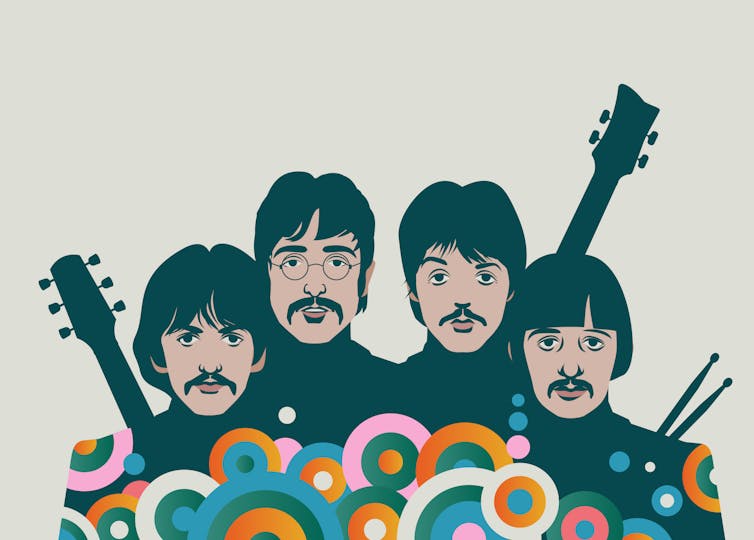


Beatles Magical Mystery Tour fiftieth anniversary


Shutterstock/Anita Ponne


Unfortunately the film itself fell far short of that artistic bar. First broadcast on Boxing Day 1967, it is, to put it mildly, seriously flawed. Incoherent, sexist, technically shaky and verging on boring, history hasn’t been kind to its cinematic qualities.

Contemporary reviews and audience responses were also so generally scathing that Paul McCartney was moved to issue an apology of sorts to the television broadcast’s 20m viewers. He said in a hastily convened interview:

We don’t say it was a good film. It was our first attempt. If we goofed, then we goofed. It was a challenge and it didn’t come off. We’ll know better next time.


Matters weren’t helped by the Beatles’ psychedelic, colourful exploration being broadcast in black and white on BBC1. A repeat on BBC2 (then the only colour TV service) a few days later did little to redress the situation, if only because there were fewer than 200,000 colour sets in the UK at the time.

Pushing institutional boundaries


For all the defensiveness of McCartney’s response (“You could hardly call the Queen’s speech a gasser”) they do point towards some retrospectively mitigating aspects of the Magical Mystery Tour film.

The film’s distinctly British surrealism and cavalcade of barking sergeant majors, fat aunts, dolly birds, wacky racers and midgets clearly prefigured Monty Python’s explosion of absurdity into mainstream television.

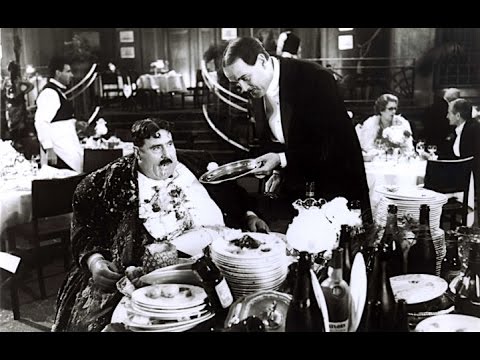
Indeed, George Harrison said later on that he saw Monty Python as a continuation of the spirit of the Beatles. He also funded some of their films, including The Meaning of Life – whose notorious Mr Creosote sketch has visual echoes of a scene in Magical Mystery Tour where John Lennon, dressed as a waiter, serves pasta to Ringo’s fictional Aunt Jessie by the spade full.

What the Pythons added to the mix were sharply honed scripts. Magical Mystery Tour, by contrast, was almost entirely ad-libbed from a one-page diagram. The Beatles’ skill as writers and arrangers was poured into their music instead.

Something else the Pythons had, and which the Beatles lacked, was the benefit of Oxbridge educations. Magical Mystery Tour’s sensibility was more rooted in working class entertainment and tropes than the Pythons’ Oxbridge-infused references.

The very concept of a coach journey – albeit one largely filmed at a decommissioned RAF base – was based on the “charabanc” trips (group bus excursions) of the band members’ childhoods.

The film evokes the past – both a British past in general and, more specifically, as filtered through the Beatles’ own histories. It certainly shows them pushing the boundaries of what a rock band of four Liverpudlians (whose post-school education essentially took place in the nightclubs of Hamburg) could attempt, both artistically and institutionally. Their commercial and creative clout allowed them to broadcast the film during a key annual peak slot for British television viewing.

Prime time


Magical Mystery Tour occupied a particular space in the history of mass entertainment – from the “end of the pier” shows, through the Donald McGill postcards that George Orwell defended against artistic snobbery, to the anarchic weirdness of the likes of Mr Blobby on Saturday night TV.

The Beatles infused that particular strand of entertainment with the forward looking experimentalism of their music, while retaining a characteristic, widely recognisable Britishness. It was this that paved the road for Python and others to follow.

That Magical Mystery Tour was their first real failure since breaking through into the mainstream was also partly a matter of practicalities. While still flowering creatively, they were logistically rudderless after the death earlier that year of their manager Brian Epstein.


Their lack of understanding of the demands of editing a film foreshadowed their later business-related shortcomings, notably the Apple boutique and record label. If the latter of these was revived to become the familiar Beatles brand of today, it was initially a costly failure that contributed to the band’s demise.

But while the film may have overreached, it still demonstrates a clear broadening of mainstream creative boundaries. Popular music fans were certainly receptive to their successful experiments. And even if the broader television public was less ready for a caustic, psychedelic vision of Britain in prime time during the Christmas holidays, Magical Mystery Tour still stands as a useful cultural document.

The ConversationThe Beatles being what they ultimately became, there’s much to be gleaned from their falls as well as their flights.

Adam Behr, Lecturer in Popular and Contemporary Music, Newcastle University

La version originale de cet article a été publiée sur The Conversation.

Wednesday, August 31, 2016

From the Archives: Civil liberties lawyer John Whitehead recalls Beatles' social, political impact

Publisher's note: This article was originally published on Examiner.com on February 13, 2014. The Examiner.com publishing platform was discontinued July 1, 2016, and its web site was scheduled to go dark on or about July 10, 2016.  I am republishing this piece in an effort to preserve it and all my other contributions to Examiner.com since April 6, 2010. It is reposted here without most of the internal links that were in the original.

Civil liberties lawyer John Whitehead recalls Beatles' social, political impact

Sunday, February 9, will mark the 50th anniversary of the Beatles' first appearance on American television. That evening in 1964, the Fab Four – John, Paul, George, and Ringo – were guests on The Ed Sullivan Show. In the studio audience were hundreds of screaming teenagers but across the country, 73 million viewers tuned in, almost twice as many as had previously watched a single television broadcast.

Charlottesville civil liberties attorney John Whitehead reminisced on February 7 about that night and what followed that decade in an interview on WCHV-FM's “Inside Charlottesville.” On Friday afternoon's program, host Coy Barefoot asked him to recall the beginnings of Beatlemania and its subsequent impact on society.

Taken by surprise
Whitehead, founder of the Rutherford Institute, began by noting that, according to their photographer, when the Beatles landed in New York on February 7, 1964, “and they heard all this yelling and stuff, they thought the President had landed, or some dignitary. They didn't realize [until] they went down the ramp that all those 5,000 teenagers” who crowded the runway “were there for them. They were taken totally by surprise.”

They should not have been so surprised, however, because the Beatles' popularity had preceded them to America.

“They had the top five tunes in the Top 40” in February 1964, Whitehead explained. “No one's ever duplicated that, which is amazing. I think that seven out of the top 10 songs were Beatles songs when they landed in the country.”

So many people were indoors that Sunday to watch the band on Ed Sullivan, he said, the country experienced its lowest crime rate in something like ten years. George Harrison later quipped that “even the Kremlin was tuned in,” Whitehead recalled. “It was amazing.”

The Sixties begin
Reflecting on the Beatles' later impact on politics and society, he suggested that “the Sixties, in my opinion, started that night on The Ed Sullivan Show.”

That performance began “all that upheaval” that continued with the worldwide broadcast over the BBC of “All You Need Is Love” (with 400 million viewers) and culminated with “the summer of love” and Sgt. Peppers Lonely Hearts Club Band in 1967.

The Beatles, he said, “captivated the world with peace, harmony, and love, which was their great message.”

He added that John Lennon “took off on his own and started his worldwide campaign for peace, and anti-war.” In reaction to that, he said, “the FBI went after him, collected 400 pages” of intelligence on Lennon's activities “and tried to intimidate him and get him deported. Richard Nixon considered John Lennon his number one enemy at that time. It was really weird.”

Horrified parents
Asked by Barefoot where he was that night 50 years ago, Whitehead recalled that he “watched the show” and his “parents were horrified.”

Years later, he continued, shortly before his mother passed away, “I asked her, what was the worst thing that ever happened to America? She looked at me and said 'The Beatles.'”

His mother was not alone. He also remembered attending a conference in “1983 or 1984” when a prominent minister took the stage and said to the audience of 10,000, “I want to tell you what has really destroyed America: The Beatles.”

Whitehead looked around at the young people around him and they all had the same puzzled looks on their faces. The minister “never explained what he meant” but he was probably referring to “the youth rebellion” of the 1960s.

That rebellion, Whitehead went on, “was focused.” It “brought down a crooked president” and the protesters “stopped the Vietnam War.”

Youth in rebellion
He expressed his admiration for the youth rebellion of that era.

“I'd like to see all that again, folks. I've often said, if you've got a picket sign and you're out there active, I don't care what you believe. I may not like what you're saying, [but] I'll go to my death to defend it," Whitehead said. "I just like activism."

John Lennon, he pointed out, “epitomized” the spirit of youthful rebellion and was even vilified by some on the Left for his idealism.

When Lennon released the song “Revolution” (on The White Album) and said “if you want destruction, count me out,” Whitehead remembered, “The Village Voice actually criticized him for being too peaceful.” Lennon's response was along the lines of, “What do you want to do, kill people? Why would we destroy anyone if we want peace?”

It's that kind of idealism that Whitehead would “like to see all that again but I don't see a lot of it.”

Expressing some frustration, he added: “Here's the thing. A guy like Lennon, the other Beatles -- they took their fame and tried to advance an agenda, a very positive agenda, but I'm looking around for entertainers today like that. Justin Bieber? I don't know.”

John Whitehead, author of A Government of Wolves, has also published an essay, “50 Years After the Beatles: Isn’t It Time for Another Political & Cultural Revolution?,” on the Rutherford Institute's web site.

SUGGESTED LINKS

Charlottesville civil liberties lawyer assesses 2012-13 Supreme Court term
Rutherford Institute asks local lawmakers to speak out against drones
Charlottesville lawyers compile rules against ‘politically correct’ Xmas
Rutherford Institute endorses Charlottesville marijuana resolution
Attorney General Cuccinelli calls Charlottesville ABC sting operation 'overkill'

Original URL: http://www.examiner.com/article/civil-liberties-lawyer-john-whitehead-recalls-beatles-social-political-impact

Wednesday, December 08, 2010

The Subversive Power of John Lennon

Five years ago in this space, I posted my own recollections of learning about the murder of John Lennon on December 8, 1980.

Today the New York Times printed the memories of readers, some of whom were much younger than I was and who remember much more about their parents' reaction to the news than their own.

Two of the readers' responses to the Times query jumped out at me as particularly pertinent.

"Andrea" remembers:

We learned about John’s death in then Communist Czechoslovakia by way of Radio Luxembourg. I was 9, and I remember my parents, especially my mom, being sad. Soon after, students started painting a particular wall in Prague’s old town with images of John Lennon and his message of peace. The authorities did not like it and painted the “Lennon wall,” as everyone knew it, over. It was always renewed within hours.
And this, from "busilak":
I was in a detention cell south Manila; my captors broke the news. The violence abated as everyone took in the loss of part of their life. Then the radio began churning out Beatles songs. I was 21 then, thinking that my future was over. … The songs permeated my dreams, gave consolation in my despair. Thirty years later, I am now part of the government I rebelled against, still struggling to find solutions to my people’s problems.
How are these mini-memoirs relevant today?

The Guardian reported yesterday that one of the things learned from the Wikileaks "Cablegate" revelations of U.S. diplomatic cables that portrayals of American popular culture seen on television in Saudi Arabia are an effective brake against jihadism and extremist elements in Saudi culture.

This should come as no surprise, since we know from Cold War experience (see "Andrea," above) that East Germans who watched West German TV and Estonians who captured Finnish TV and radio through their rooftop antennae had independent sources of news, information, and entertainment that served as a counterbalance to Soviet propaganda and gave them hope for a better day, which eventually came after the Berlin Wall fell in 1989.  American books were passed around as samizdat, and -- as Vaclav Havel and Tom Stoppard have attested -- vinyl recordings of American rock-and-roll music were circulated as treasures in Russia and the Eastern European serf-states of Moscow.

What American diplomats in Jeddah learned is an important lesson. Here, in part, is what the Guardian says:
Satellite broadcasts of the US TV shows Desperate Housewives and Late Show With David Letterman are doing more to persuade Saudi youth to reject violent jihad than hundreds of millions of dollars of US government propaganda, informants have told the American embassy in Jeddah.

Broadcast uncensored and with Arabic subtitles alongside sitcoms such as Friends on Saudi Arabia's MBC 4 channel, the shows are being allowed as part of the kingdom's "war of ideas" against extremist elements. According to a secret cable titled "David Letterman: Agent of Influence", they have been proving more effective than Washington's main propaganda tool, the US-funded al-Hurra TV news channel....

Diplomats said they believed the allure of actors such as Eva Longoria, Jennifer Aniston and David Schwimmer meant commercial TV had a far greater impact than al-Hurra which, according to one report, has cost US taxpayers up to $500m (£316m).

"It's still all about the war of ideas here, and the American programming on MBC and Rotana [a channel part-owned by Rupert Murdoch's News Corporation] is winning over ordinary Saudis in a way that al-Hurra and other US propaganda never could," two Saudi media executives told a US official in a meeting at a Jeddah branch of Starbucks. "Saudis are now very interested in the outside world and everybody wants to study in the US if they can. They are fascinated by US culture in a way they never were before," the May 2009 cable says.
We now know the principle. The practical question is, how do we deploy Harry Potter, Justin Bieber, Lady Gaga, and Glee as potent weapons against terrorist jihad?

Be sure to visit my CafePress store for gifts and novelty items!
Read my blog on Kindle!
Follow my tweets on Twitter! 

Thursday, December 08, 2005

Where Were You?

Each generation of young adults has its own touchstone moment in which nearly every person, when posed with the question, "Where were you when you heard that [blank] happened?", will be able to answer with vivid and precise detail.

For my grandparents' generation, that moment was the Japanese attack on Pearl Harbor, commemorated yesterday. And for most of that generation, the death of President Franklin Roosevelt nearly four years later is nearly as prominent.

For my parents and their cohort, the date November 22, 1963, is forever embedded in their memories, and not because that was the day C. S. Lewis, author of The Chronicles of Narnia, died. No, on that day the assassination of President John F. Kennedy became the stuff of legend (and unending theories of paranoid conspiracy).

Today's generation, of course, remembers the terrorist attacks of September 11, 2001, with the same precision. The generation 10 to 15 years older may think back to the Challenger explosion in January 1986.

For my generation, those who were teenagers in the late 1960s or the 1970s, that touchstone moment came on December 8, 1980, that is, 25 years ago tonight. That was when we heard that John Lennon had been murdered in cold blood outside his apartment building, the Dakota, in Manhattan.

I was pulling an all-nighter when I heard the news, typing a research paper for the course "Case Studies in American Diplomacy," taught by Professor Henry Kissinger. (Whatever became of him?) At the time, I was working for the Ethics and Public Policy Center, and I was using my boss's IBM Selectric that night because he had a radio in his office. So I was listening to a local D.C. rock station, when the disc jockey (this was before all music stations were totally automated) came on the air to say: "I have grave news. We have just learned that John Lennon was shot and killed earlier this evening in New York. The news just came across the wire. Repeat: Ex-Beatle John Lennon is dead."

Shocked, I paused in my typing and immediately telephoned my friend, David Murphy, in Milwaukee. (David was really the first great crush of my young life, and he was also a devoted fan of the Beatles and all Beatles wannabes, such as The Knack.) I asked, "Did you hear the news?" He had. In his case, he learned it from Don Meredith or Howard Cosell, who reported the news during the ABC Monday Night Football game.

We commiserated but I had to return to my work: I still had to type a paper of nearly 100 pages (including endnotes and appendices) in order to turn it in the next morning. (I did get an "A," by the way.)

The next few days were filled with news of Lennon's murder by disaffected fan, Mark David Chapman. We learned that Yoko Ono witnessed the murder at close range; that Lennon had been returning home from a recording session; that Chapman had stalked him earlier and even got an autograph. It slowly sank in that the long-awaited Beatles reunion would never take place.

When Lennon's "official" memorial service took place at Strawberry Fields in Central Park in New York (a location shown and discussed in the new but sparsely distributed film, Little Manhattan, a sweet treatment of first love and childhood on the Upper West Side), we had our own memorial at Georgetown University's Dahlgren Chapel, led by Father Jerome Hall, S.J., who both sang bass and played the bass cello in the chapel choir. We then drifted to Healy Lawn while people sang "Imagine" and then we had a moment of silence before dispersing.

Lennon's murder was followed quickly on its heels with the attempted assassinations of President Reagan, in March, and Pope John Paul II, in May 1981. But, perhaps because those attempts were unsuccessful, they lack the quality of memory that Lennon's death and similar incidents possess.

Our culture is resilient, however, and it wasn't long before the Lennon murder (combined with the failed Reagan assassination attempt) became fodder for comedy, in the famous Saturday Night Live sequence about the murder of Buckwheat. Who can forget Joe Piscopo's supercilious anchorman saying over and over, "Let's go to the video"? This became a catchphrase: "I repeat: Buckwheat is dead."

Tragic events come and go; in fact, they occur every day, somewhere in the world. Sad things happen to individuals and families, but few of them are shared by the nation. Sometimes the experience can be both intimate and shared more broadly (as it was by those people featured in the AP article, "John Lennon's Death Lingers for Witnesses"). The broadly-shared few are the memorable moments that can be conversation-starters -- not at the time, or soon thereafter, but years later.

So, I ask those of my generation: Where were you when you heard that John Lennon was killed?