Showing posts with label commerce. Show all posts

Thursday, November 22, 2018

Guest Post: How advertising shaped Thanksgiving as we know it

Samantha N. N. Cross, Iowa State University

I have always been intrigued by Thanksgiving – the traditions, the meal, the idea of a holiday that is simply about being thankful.

For my family, Thanksgiving is all about the food. Some foods, like turkey and mashed potatoes, may be familiar. But there are a few twists. Since I grew up in the Caribbean, I’m allowed a Caribbean dish or two. The reliability of the menu – with a little flexibility sprinkled in – seems to unite us as a family while acknowledging our different cultural backgrounds.
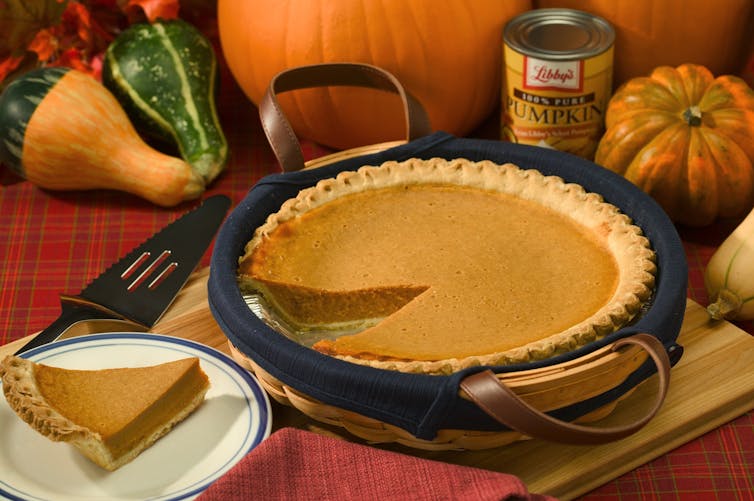


Pumpkin pie Thanksgiving

Libby’s continues to fiercely compete with pumpkin pie peddlers Borden’s, Snowdrift and Mrs. Smith’s for a place on the Thanksgiving table.
Jean Beaufort


Chances are you and your family have similar traditions. Filipino-American families might include pancit. Russian-American families might serve a side dish of borscht. That’s what makes Thanksgiving unique. It’s a holiday embraced by people regardless of their religion or ethnicity.

Yet despite this adaptability, there’s a core part of the meal that almost everyone embraces. How did this come to be? Although few appreciate it, advertisers have shaped the meal as much as family tradition.

A uniquely broad appeal


When Sarah Josepha Hale, the editor of Godey’s Lady’s Book, first advocated for Thanksgiving as a national holiday in 1846, she argued that it would unify the country. In our research, my colleagues and I have been able to show that Hale’s vision for the holiday has been largely fulfilled: Inclusivity of people and traditions has been Thanksgiving’s hallmark quality.

A reason for its broad appeal is that it lacks any association with an institutionalized religion. As one interviewee told us, “There is no other purpose than to sit down with your family and be thankful.” And after interviewing a range of people – from those born in the U.S. to immigrants from countries like South Africa, Australia and China – it became obvious that the principles and rituals they embraced during the holiday were universal no matter the culture: family, food and gratitude.

But as a relatively new holiday – one not tied to a religious or patriotic tradition – a shared understanding of the celebration and the meal is crucial to ensure its long-term survival.

While there might be subtle variations, the Thanksgiving meal is the lodestone of the holiday, the magnet that brings people together. Today, familiar items constitute the meal: turkey, cranberry sauce, stuffing, gravy, alcohol, salad, apple pie and pumpkin pie. Many of our interviewees tended to serve some version of this list.

But why these items and not others? What makes turkey, cranberry sauce and pumpkin pie so special? My colleagues and I studied 99 years of Thanksgiving ads in Good Housekeeping magazine to find out.

Marketing a ritual


Starting with Thanksgiving’s early champion, Sarah Josepha Hale, the history of Thanksgiving is rooted in marketing. Marketers not only helped create many of the rituals and cultural myths associated with the Thanksgiving meal, but they also legitimized and maintained them.
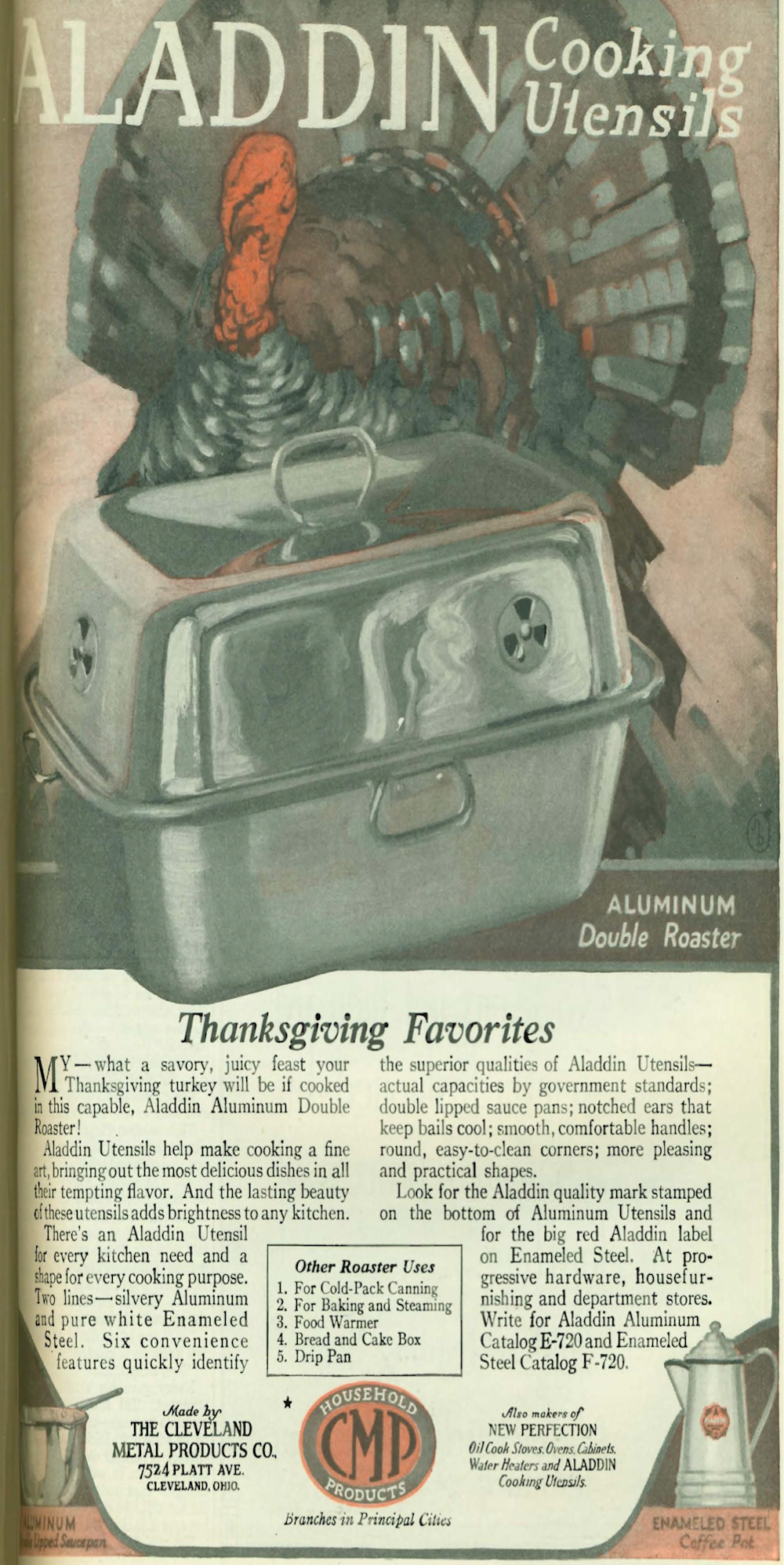


Aladdin Cooking Utensils advertises its double roaster in a 1920 issue of Good Housekeeping.

Aladdin Cooking Utensils advertises its double roaster in a 1920 issue of Good Housekeeping.
Good Housekeeping


Initially, the Thanksgiving turkey competed with other meats, like duck, chicken and goose, for centerpiece at the Thanksgiving table.

But by the 1920s, turkey had become the only meat advertised. Early ads would focus on how to prepare and present the perfect bird, promoting branded tools like roasters, ranges, pop-up thermometers and oven-cooking bags.

Iconic Swift’s Premium turkey ads focused on the sacredness of the meal by featuring families at prayer, giving thanks before the meal begins. The importance of the turkey to the Thanksgiving celebration dominates, helping to perpetuate the Thanksgiving turkey tradition.

Meanwhile, early ads for the Eatmor Cranberry Company positioned their whole cranberries as a perfect complement to any and all Thanksgiving meat dishes. This brand dominated until the 1930s when another brand, Ocean Spray, entered with its canned gelatin cranberry sauce.
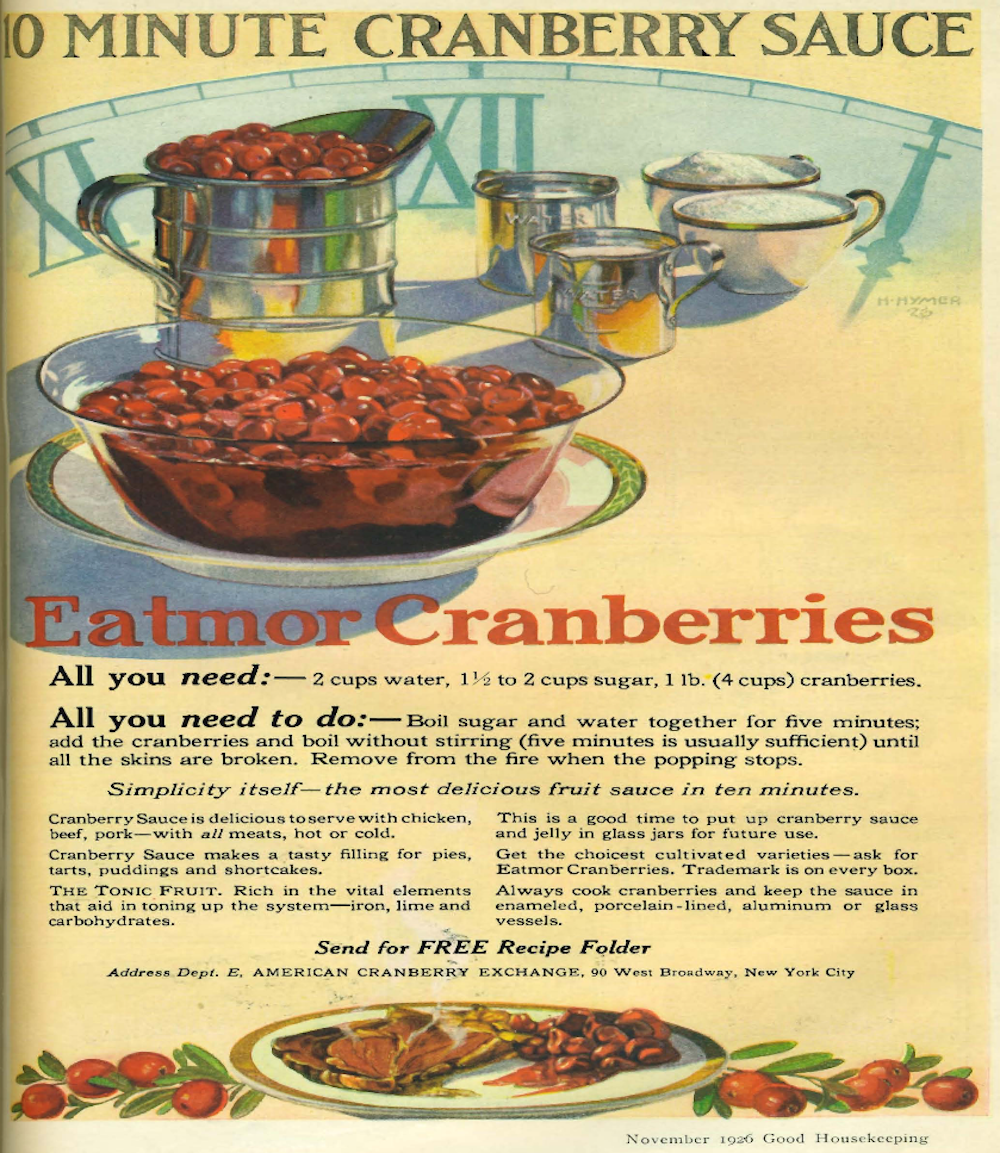


Eatmor Cranberries Thanksgiving advertising

Eatmor Cranberries – which used to be the king of Thanksgiving cranberry sauce – advertises in a November 1926 issue of Good Housekeeping.
Good Housekeeping


Ads for both brands implied that cranberry sauce has been around since the first Thanksgiving dinner, which was highly unlikely. However, the brand positioning war successfully promoted cranberry sauce as the natural condiment for the Thanksgiving turkey. Ocean Spray would triumph and, to this day, promotes whole cranberries and canned gelatin.

Considered by many to be the quintessential Thanksgiving dessert, pumpkin pie also wasn’t present at the first Thanksgiving meal. (The Pilgrims lacked the butter, wheat flour and sugar to make the pastry.) Nonetheless, beginning as early as 1925, a range of brands – for example, Borden’s, Snowdrift, Mrs. Smith’s and Libby’s – have competed fiercely to connect pumpkin pie to the season, the holiday and the meal. It’s a rivalry that continues to this day.

The role of the consumer


Not every product category or brand succeeded in becoming a core part of the Thanksgiving meal.
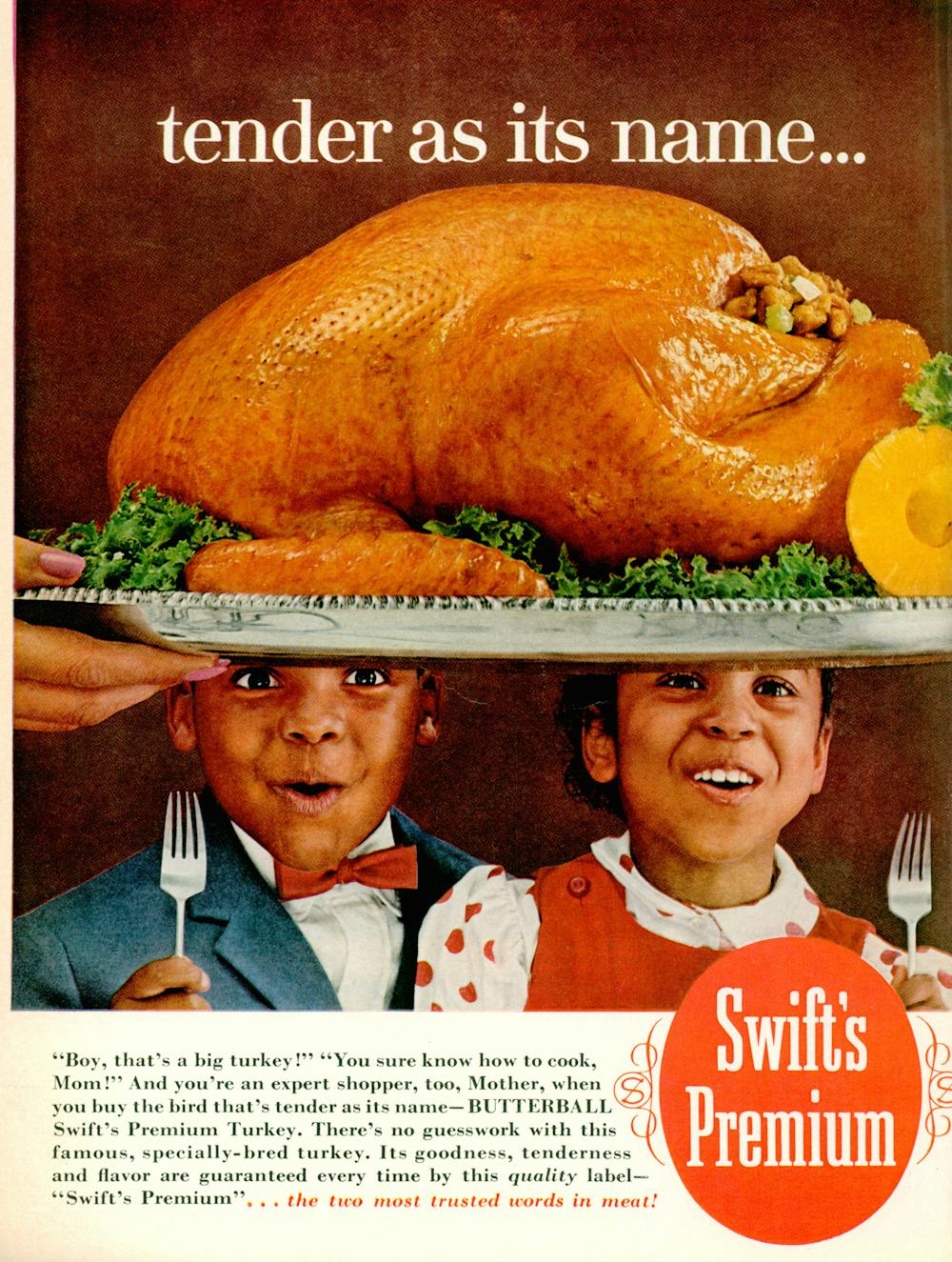


A Swift’s Premium Turkey ad from 1964.

A Swift’s Premium Turkey ad from 1964.
Wishbook


A Welch’s ad from the 1960s implies that the first Thanksgiving meal included juice made from grapes. In 1928, Diamond marketed their walnuts as an accessory to dress up Thanksgiving dishes. Despite vociferous ad campaigns, few associate Welch’s grape juice or Diamond walnuts with Thanksgiving today.

But those early 20th-century ads for turkey clearly resonated: Today, nearly 88 percent of U.S. households have turkey on Thanksgiving, and approximately 20 percent of the turkeys consumed in any given year are consumed at Thanksgiving. This is a testament to the enduring influence of marketing on the holiday. For brands like Butterball (formerly Swift’s Premium), Thanksgiving is big business.

Whether you’re a turkey fan or not, prefer apple pie to pumpkin pie, enjoy canned gelatin over whole cranberry sauce, by celebrating Thanksgiving, you play a role as well. Marketers may have shaped many of the rituals of the holiday. But all Americans – from all backgrounds – certainly do their part to maintain them.

The ConversationAfter all, brands need customers to survive.

Samantha N. N. Cross, Associate Professor of Marketing, Iowa State University

This article was originally published on The Conversation. Read the original article.

Friday, January 05, 2018

Guest Post: The Freedoms at Stake in the Gay Wedding Cake Case

by Marian L. Tupy

On December 5, 2017, the Supreme Court of the United States heard the case of Masterpiece Cakeshop v Colorado Civil Rights Commission. It’s a case that raises important questions about freedom of speech and of association that even the most fervent supporters of equality for gay people ought to take to heart.

gay wedding cake topperIn July 2012, Charlie Craig and David Mullins, a same-sex couple, visited Masterpiece Cakeshop in Denver to order a custom wedding cake to celebrate their nuptials. Jack Phillips, the shop’s owner and a practicing Christian, was happy to sell the couple any of the goods in the store, but he refused to create a bespoke cake for a gay wedding, arguing that it would contravene his religious beliefs.

Craig and Mullins bought their wedding cake from a different bakery and went ahead with their happy event. The couple also filed a complaint with the Colorado Civil Rights Commission that oversees the enforcement of the Colorado Anti-Discrimination Act – a law prohibiting businesses open to the public from discriminating against their customers on the basis of race, religion, gender, or sexual orientation.

A lower court ruling decided in favor of the plaintiffs. The bakery was ordered to provide cakes for same-sex marriages and to “change its company policies, provide ‘comprehensive staff training’ regarding public accommodations discrimination, and provide quarterly reports for the next two years regarding steps it has taken to come into compliance and whether it has turned away any prospective customers”.

The Cato Institute, where I work, has been at the forefront of the fight for gay equality, submitting amici curiae briefs in favor of the gay community in such ground-breaking cases as Lawrence v Texas, which decriminalized sodomy in the United States in 2003, and Obergefell v Hodges, which legalised gay marriage throughout the country in 2015. In Masterpiece Cakeshop v Colorado Civil Rights Commission, we have taken Phillips’s side.

There is no inconsistency here. Just as we would support a gay baker’s right to decline to convey a homophobic message, we support this Christian baker’s right to decline to celebrate a same-sex wedding. That is because Masterpiece isn’t really about religious liberty – apart from claims that the Colorado Civil Rights Commission itself treats the religious and nonreligious differently, something that concerned the swing Justice Anthony Kennedy at oral argument – but about freedom of speech.

As my learned colleagues wrote, the Supreme Court has repeatedly held “that what the First Amendment protects is a ‘freedom of the individual mind’, which the government violates whenever it tells a person what she must or must not say. Forcing a baker to create a unique piece of art violates that freedom of mind…

“Although making cakes may not initially appear to be speech to some, it is a form of artistic expression and therefore constitutionally protected… Indeed, the Supreme Court has long recognized that the First Amendment protects artistic as well as verbal expression, and that protection should likewise extend to this sort of baking – even if it’s not ideological and even if done to make money.”

gay wedding cake two men silhouetteNo matter which side wins, the final decision in Masterpiece Cakeshop v Colorado Civil Rights Commission is likely to reverberate for many years to come. That’s because the case does not deal with government discrimination, which everyone abhors, but with private discrimination, which is, in some fashion, unavoidable. Each day, all of us discriminate against things (which car to buy), actions (where to eat) and people (who to go out with).

The law says that private discrimination is fine so long as it does not involve a business, which ought to be open to everyone. That’s a perfectly fine legal distinction, but not a logical or moral one. Consider the following scenario:

Suppose that you operate a private dining club – such as the one described by Dana Bate in her superb 2013 book Girls’ Guide to Love and Supper Clubs. You rent a space where you can indulge your passion for cooking and choose from a list of paying gourmands in accordance with your preference for, exempli gratia, straight people. Is that discrimination? No court has ruled so. Yet, Bate’s supper club is basically a business, except for incorporation. Were you to incorporate, you would be guilty of discrimination. Without it, you are free to do as you please.

So, private discrimination is not cut and dried. As one of the pioneers of gay marriage, the British-born writer Andrew Sullivan, noted, advocates of gay equality ought to acquire some perspective. “I think it was a prudential mistake to sue the baker,” he wrote. “Live and let live would have been a far better response.” That’s where Cato stands as well.

Reprinted from CapX.

Marian L. Tupy gay wedding cake


Marian L. Tupy is the editor of HumanProgress.org and a senior policy analyst at the Center for Global Liberty and Prosperity.


This article was originally published on FEE.org. Read the original article.


Monday, December 18, 2017

Guest Post: No, Capitalism Is Not Ruining Your Christmas Market

by Bill Wirtz

Glowing Christmas lights fill the cold streets of medieval European cities with little wooden booths selling steaming hot wine and cinnamon biscuits. However, the traditional look and idyllic atmosphere seem to be threatened by the evil of modern-day capitalism. That is, at least, the common saying of visitors of these markets. But are big companies actually ruining your favorite winter experience?

All We Want for Christmas Is... Sales
Your local Christmas market is a money-making machine regardless of it selling candles or car insurance. 

Christmas Xmas Barcelona 1980s
Christmas market, Barcelona, 1986
First off: Christmas markets are, at least in Europe, a billion euro industry. In 2014, the largest sales were counted in Germany with almost €2.5 billion ($2.9 billion) in revenue, followed by France with €820 million ($965 million). In a more detailed analysis on Christmas markets in the UK, researchers found that in the example of the city of Manchester, an average stall at a Christmas market generated £3,500 ($4,600) per day.

They add that if you also account for the tourism factor — as large amounts of visitors are either from abroad or coming from a different city and staying overnight — you're seeing spending of £10 million ($13.3 million). Christmas markets in Brussels, Belgium, and Strasbourg, France count between 1.5 and 2 million visitors. The Christmas market on Paris' Champs-Elysées counts over 200 booths and over a staggering 15 million visitors each year.

Your local Christmas market is a money-making machine regardless of it selling candles or car insurance. Claiming that the hot wine salesman in his wooden booth isn't as interested in making a profit as Coca-Cola which is giving out free samples would mean being blinded by emotion.

It's Beginning to Look a Lot Like... Prosperity
When presented with the choice of living under socialism or free-market capitalism, even those who preach socialism choose the latter. 

The Christmas spirit is supposed to advocate for empathy and compassion, as the biblical stories describe Jesus, a poor man, who preached charity despite receiving very little of it in return. These days, most "charity" is in the hands of the government through welfare programs. The reasons to oppose the welfare state are numerous, but outside of the inefficiency and cost of government bureaucracy, both government spending on welfare and charity fail to create value.

World Bank and UN reports celebrate a global success story: between 1990 and 2008, the world cut by half the share of the world’s poor, those living on less than $1.25 a day. The United Nations also points out that 2.6 billion people have gained access to improved drinking water while the number of hungry people has declined by 20 percent in the last 20 years. 

The origin of development is, of course, the wealth created by entrepreneurs and large businesses which have not only provided jobs in areas in which there were none before but whose reduced production costs have made high-end goods accessible to all. 

Compare this to socialism, the likes of which create starvation in Venezuela and North Korea or unclean drinking water in Cuba, not to speak of the massive injustices and infractions on people's individual liberty. When presented with the choice of living under authoritarian socialism or living under free-market capitalism, even those who preach socialism choose the latter.

Who Do We Celebrate?
Next time you see a large coffee machine retailer, think of the people whose lives were made better through these companies. 

Christmas decorations, Oxford Street, London, 1986
We are aware that the success stories of free-market capitalism improving the living conditions of the poorest of the poor through reducing living costs and improving access to quality good and services. However, they fail to be the ones who are actually celebrated around Christmas for providing these essential opportunities to people. We worship those who give handouts to the poor, but we hold those who enable poor people to rise and improve their living conditions in utter disdain.

When there is a large company selling their products on a traditional Christmas market, many see a greedy company ruining the flair of the Christmas spirit. It doesn't occur to them that millions of people are able to put food on the table and buy gifts for their children: something that prior to the emergence of free-market capitalism was a privilege reserved for the very few. All it takes to see this is to think of the millions of people oppressed by socialism, like those in Venezuela, who will, this year, spend among the worst Christmas Eves they have ever witnessed.

Next time you see a large coffee machine retailer or a booth advertising cleaning products at your local Christmas market, think of the people whose lives were made better through these companies.

The greatest gifts aren't wrapped in paper, but stats about poverty reduction.


Bill Wirtz


Bill Wirtz is a Young Voices Advocate. His work has been featured in several outlets, including Newsweek, Rare, RealClear, CityAM, Le Monde and Le Figaro. He also works as a Policy Analyst for the Consumer Choice Center.


This article was originally published on FEE.org. Read the original article.


Wednesday, December 06, 2017

Guest Post: Old Man Potter Lived a Wonderful Life

by Tom Mullen

December is upon us and that means plentiful opportunities to watch the enduring classic, It’s a Wonderful Life. Unfortunately, the overwhelming majority of viewers completely misinterpret Frank Capra’s dystopian nightmare as a heartwarming Christmas tale.

The emotional appeal of angels getting their wings is undeniable. Crying out for correction, however, are the vicious slanders regarding the film’s real hero, Henry Potter.

Lionel Barrymore It's a Wonderful Life We first hear of Potter from George Bailey’s father, Peter Bailey, who badmouths Potter with the usual falsehoods about businessmen. But during Bailey’s envious rant, we learn something important: Henry Potter is a board member of the building and loan. We later learn Potter is, in fact, a stockholder.

That puts a somewhat different light on his subsequent motion to liquidate the business upon Peter Bailey’s death. Yes, we hear George Bailey repeating the familiar socialist tropes his father did: that Potter only wants to close the building and loan because he “can’t get his hands on it” and considers the little people cattle, etc. 

But Potter responds with some rather inconvenient facts: the building and loan has been making bad business decisions, providing what we’d now call subprime loans to people who can’t pay them back.


Potter the Stockholder
The Baileys squander their investors’ money on a do-gooder, subprime loan scheme to make everyone a homeowner.

We don’t know how Potter became a stockholder, but the Bailey Building and Loan does not appear to be a publicly traded company. The most likely explanation is Peter Bailey asked Potter for capital, just as George Bailey does later in the film, in between rounds of disparaging Potter as a greedy capitalist. That would be perfectly consistent with today’s “progressives,” who rail against capitalists out of one side of their mouths while sucking up to them for money out of the other.

But regardless of how Potter became a stockholder, Peter Bailey has a fiduciary duty to him to run the business for maximum profit, providing Potter and the other stockholders a return on their investments, something George Bailey confirms they never intended to do. Instead, the Baileys squander their investors’ money on a do-gooder, subprime loan scheme to make everyone a homeowner. It worked out in fictional Bedford Falls about as well as it did in early 2000s America.

Meanwhile, the Baileys constantly slander Potter’s rental houses as “overpriced slums.” These are the same Baileys whose housing opportunities are more expensive than Potter’s.


But People Like Potter’s Houses
Their accusations constantly beg the question: If Potter’s houses are so bad, why do so many people choose to live in them? It’s constantly implied Potter’s customers have no other choice, but what exactly does that mean? Why has no one else, including any of the businessmen on the board of the Bailey Building and Loan, developed rental properties that are higher in quality, lower in price, or both?

The inescapable truth is Potter is wealthy because he provides a product that most satisfies his customers’ preferences for quality and price. If there were an opportunity to provide a higher quality product at a lower price than Potter was charging, a competitor would do so and take market share away from Potter, until Potter either raised his quality, lowered his price, or both.

The Baileys burn with resentment that so many residents of Bedford Falls prudently choose to live in Potter’s less expensive housing than buy a house they can’t afford, financed by the Baileys’ Ponzi scheme. Thus, even after shirking their fiduciary duty to run the business properly, the Baileys spend decades assaulting Potter’s character in a transparent attempt to lure away his customers.


Potter the Rescuer
When the Depression hits and the Bailey Building and Loan is exposed for the fractional reserve fraud it is, Potter offers to come to the rescue with a generous offer to buy out its customers. It is noteworthy there is a run on the Bailey Building and Loan and the local bank, but Potter is financially secure enough to save them both, proving once again he is the only honorable businessman in the film.

But we must give the devil his due. George Bailey, the ultimate huckster, saves the building and loan without Potter’s help, convincing the yokel mob making a run on his business to keep their money tied up in his fundamentally insolvent confidence game.

That brings us to the one regrettable act Potter is guilty of, which is concealing the $8,000.00 the incompetent Billy Bailey inadvertently handed him while attempting to make a deposit. It’s true this was an underhanded act, although not unprovoked.

We don’t know how much Potter had invested in the Building and Loan to become a stockholder, but suspect it was a lot more than $8,000. One could make the case he was merely getting back some of the money the Baileys had previously defrauded him of, but there are courts for such matters and Potter should have sought their help if he had a case.


Smearing Potter
Nevertheless, two generations of Baileys had led a decades-long assault on Potter’s good name, resulting in most townspeople disliking him, even though he has quite literally saved their lives on numerous occasions. Without him, a large portion of Bedford Falls would be unemployed, have nowhere to live, or both. It is not an exaggeration to say that without Henry Potter, Bedford Falls would cease to exist. Yet, thanks to the Baileys, he is the most hated man in town.

Jimmy Stewart It's a Wonderful Life Donna ReedCompare Potter’s vindictive reaction when George Bailey crawls to him for help after the $8,000.00 is lost to Potter’s reaction at the board meeting at the beginning of the movie. At the board meeting, Potter dismisses George’s unhinged attack upon him and redirects the discussion to the subject of the meeting: what is best for Bedford Falls. By the latter confrontation, Potter tries to have George arrested for embezzling.

Potter’s dastardly act is totally out of character with the Potter of the earlier scene or any other event we know of in Potter’s life. As far as we know, he has always been a hard-nosed, unsentimental businessman, but has never committed a crime or held a grudge, as he does now. Everything we know about Potter up to this point tells us his vindictive attempt to have George Bailey prosecuted is precisely the kind of emotional decision-making Potter has avoided for most of his life. That is why he is so wealthy at the beginning of the film.


Potter’s Breaking Point
Everyone has a breaking point. Potter had evidently reached his. Had he been prosecuted for keeping the $8,000.00, which may have been tricky from a legal standpoint, given that Billy Bailey had handed the money to him, he could easily have plead temporary insanity caused by years of psychological warfare waged against him by the Baileys.

We’ll never know, because before Potter has any opportunity to allow his passion to cool and clear up the misunderstanding, George Bailey sets off on his suicide melodrama, followed by a long, self-aggrandizing hallucination about angels and how Bedford Falls would be worse without him. By the time he concludes his childish escape from reality, the same yokels he previously conned during the Depression are now bailing him out once again, foreshadowing so many future bailouts of dishonest financiers whose assets should have been turned over to better management in bankruptcy court.


The Triumph of Evil
In one of the darkest moments of the film, George Bailey’s Christmas tree is jostled and one of the bells adorning it rings. George Bailey, now confident he and his fraudulent real estate scheme are safe, suggests the bell signifies an angel has earned his wings, as if his dishonest business dealings and ruthless defamation of legitimate competitors had divine sanction.

Nothing more is heard of Henry Potter, the man without whom Bedford Falls would not exist. He is left friendless and without the one thing he could cling to before George Bailey, the Devil incarnate, wrested it from his grasp: his honor. As the credits roll, evil has triumphed. The economic fallacies inherent in Baileyism become accepted truth, resulting in disaster after disaster, including the most recent in 2008.

Tom Mullen It's a Wonderful Life

Tom Mullen is the author of Where Do Conservatives and Liberals Come From? And What Ever Happened to Life, Liberty and the Pursuit of Happiness? and A Return to Common  Sense: Reawakening Liberty in the Inhabitants of America. For more information and more of Tom's writing, visit www.tommullen.net.


This article was originally published on FEE.org. Read the original article.


Sunday, December 03, 2017

Guest Post: In-store shopping still matters this holiday season


Kelli Hollinger, Texas A&M University

It surprises most millennials to learn that only about 10 percent of all retail purchases are actually made online. Each semester, when I ask hundreds of undergraduate business students to estimate, they consistently guess that between a quarter and half of all retail spending happens on the internet. But this holiday shopping season, as ever in the past, the overwhelming majority of purchases will still happen within four physical walls of a store.

This should encourage the thousands of retailers anchored in strip malls, lifestyle centers and mixed use developments. The National Retail Federation expects holiday retail sales – not counting car, gas and restaurant purchases – in November and December this year to increase up to 4 percent over last year, to as much as US$682 billion.

Stores will need the money in order to avoid being added to 2017’s record-breaking roster of retail bankruptcies, store closures and layoffs, which included landmark brands like Toys R Us and RadioShack.


A reason to visit


Traditional retailers must give consumers good reasons to visit their stores, beyond product selection and good value. Joe Pine and James Gilmore’s 1999 book “The Experience Economy” foretold how savvy companies, like Apple and American Girl, excel by staging compelling experiences that teach, entertain or inspire customers.

The main asset of a physical store in a digital world is human staffing. Even if a shopper doesn’t want help, a smile acknowledging his or her presence encourages connection. Front-line employees can ask customers about their kids, in-laws or Thanksgiving meal planning. That can lead to an authentic personal connection through which employees can discover a shopper’s unique wants and respond with products on the shelves, or ordered and shipped for free to the customer’s home. An in-person encounter can become a seamless blend of the online and physical worlds.

Even Walmart, America’s largest retailer, is moving to a more experiential model. In hopes of boosting sales, its 4,700 stores will host 20,000 parties with Santa before the New Year. Customers will be able to take pictures, test out toys and get tots excited.

The company has another advantage over online sellers, too: nine in 10 Americans live within 15 minutes of a Walmart store. A thousand Walmarts now let customers drive up to the storefront to pick up online grocery orders the same day they’re purchased, at no additional charge. That rivals Amazon’s Fresh grocery service, which comes at an extra cost and often doesn’t deliver until the next day.

Emotional connection in a digital age


Holiday Christmas shoppers Black Friday 2013
Holiday shoppers (c) Rick Sincere 2013
Beyond face-to-face service, successful companies today must develop a deeper connection with their customers, whether online or off. Store-based retailers can show their values in ways that at times can take on a very personal meaning for shoppers and store owners alike. I have been a loyal customer of Gallery Furniture in Houston for years. Owner Jim McIngvale, known as “Mattress Mack,” is a marketing maverick known for his decades of zany TV commercials pledging to “Save you money!

After the devastation of Hurricane Harvey, he opened his stores to anyone in need of a place to stay. Some came by boat, with only the clothes they were wearing. McIngvale welcomed thousands of Houstonians to sleep on his inventory of mattresses. He sheltered, fed and prayed for flood victims.

On Halloween, McIngvale flew 50 first responders to Game 6 of the World Series in Los Angeles, giving those lucky Astros fans a once-in-a-lifetime experience and emotional lift in the wake of natural disaster.

Like other retailers gearing up for the holidays, Gallery Furniture is promoting “monster sales.” But with the floodwaters gone and the Astros crowned as baseball’s world champions, McIngvale’s community spirit seems to have positioned his chain as more than a brand, destination or store. Beyond capturing market share, Gallery Furniture may have an advantage in customer sentiment.

Best Buy is buzzing again


Community involvement isn’t the only way retailers can regain strength. National electronics chain Best Buy has ridden a roller coaster over the last 20 years: In 2004 it was recognized by Forbes magazine as “Company of the Year.” By 2012 it was dismissed as a real-world showroom for cheaper online retailers. In August 2017, though, its stock price hit an all-time high.

As Amazon grew, Best Buy defended itself, becoming a top 10 retailer in sales by matching competitors’ prices and investing in personal services like Geek Squad. The company also trained workers to help customers understand technology: Product descriptions can list a camera’s functions, but a knowledgeable employee can explain how it works with lenses, editing software or with other devices. That allows the company to take advantage of the ever-increasing number of tech-connected items in smart homes, from Nest thermostats to 4K TVs – which require more instruction to set up and operate than their analog predecessors.

The ConversationIn the face of online competition, brick-and-mortar retailers must give consumers unique in-store experiences that build emotional connections with shoppers. Black Friday promos on toasters or iPads won’t cut it. They have to provide heartfelt feelings like surprise, delight and excitement – and actual help and useful advice. Shopping on a couch via a mobile app is efficient, but a store can be magical and memory-making.

Kelli Hollinger, Director, Center for Retailing Studies; Lecturer of Marketing, Texas A&M University

This article was originally published on The Conversation. Read the original article.

Friday, November 24, 2017

Guest Post: Economic Localism Is No Better than Economic Nationalism

The best path toward enriching everyone is allowing everyone to trade with everyone else.

by Steven Horwitz

As Black Friday has continued to expand in recent years, one response to its orgy of discounts and deals has been to promote the following day as “Small Business Saturday.” The idea is to encourage people to shop at their local stores rather than at national chains or big-box stores, or perhaps on the Internet. Doing so, argue its proponents, is both moral and good for the local economy, as it keeps jobs and money in “our communities” rather than, presumably, in the hands of faceless and distant corporate masters.

Let’s ignore the irony that the sponsor of this movement is the international corporation known as American Express. Is there a moral or economic case for shopping local, whether on the Saturday after Thanksgiving or in general?

There is not. Many of the same arguments made by progressives in favor of shopping local are the same as those made by Trump and his supporters in favor of what they call “economic nationalism.” For the same reasons that shopping local isn’t morally or economically superior to buying from chains and big boxes, neither is buying “Made in the USA.” The most moral and economic choice is to buy from whomever you want based on your preferences about price, service, or any other number of factors.

Big Boxes Employ Locally
If we only shopped from locally-owned businesses, we would be paying higher prices and overall employment and incomes would be lower.  The moral and economic cases against buying local are intertwined. Consider the argument that buying local is better because buying from Walmart or Target doesn’t keep money and jobs in the local community. This argument ignores that the average Walmart Supercenter employs around 400 people and the numbers are similar for Target. Those jobs continue to exist because people shop at those stores. The hundreds employed at any given big box store are just as much members of the local community as are the owners of the small business that compete with the big boxes. 


To the extent that the prices at the big box stores are cheaper, they enable those who shop there to have income left over to spend on other goods and services, including things from locally-owned businesses, creating jobs that would not exist otherwise. If we only shopped from locally-owned businesses, we would be paying higher prices and overall employment and incomes would be lower. Plus, consumers would not have access to the variety of goods available at chain and big box stores, forcing them to not only spend more but get less value for it.

Buy National?
The same logic applies to international trade. Those imploring us to “buy local” are falling for the same sorts of fallacies that Trump, and many who voted for him, implicitly accept when they argue for raising barriers to international trade. “Economic localism” is nothing more than a smaller scale version of the “economic nationalism” of Steve Bannon and other Trump advisors.

Increasing duties on imports, thereby forcing more Americans to buy “local” in terms of the global economy, does nothing to create jobs or improve the economic standing of Americans. “Keeping the money in the USA,” like “keeping the money in the community,” harms those it is intended to help, and does so for the same reasons.

Forcing Americans to buy only, or predominantly, American-made products means we will spend more to get less, and the net effect on jobs will be zero at best. Globalized trade certainly shifts the mix of jobs in the US economy, as we have shifted in relative terms from manufacturing to hi-tech or services for example, but does not reduce the total number of jobs. One need only look at the data on overall job growth, and the increased variety of cheaper and better goods available to even the poorest Americans, over the last 30 years to see this.

The moral case for buying local is similarly weak. It’s best seen by making the moral case for buying globally.

The promoters of buying local often argue that buying from international corporations is problematic because so many of their products are bought from China or other parts of the world where wages are low and working conditions are bad. The belief is that by buying from those firms, consumers are supporting the exploitation of workers in those countries, making such purchases morally questionable.

Here is where the economics entangles with the morality: large firms are morally suspect because of the supposed negative economic effects they create. But are those negative economic effects real? Without an extended discussion of so-called “sweatshops” (but do see Ben Powell’s excellent book), two quick points are in order.

How Wages Rise
That Chinese workers have factory jobs that pay as well as they do, compared to the other options available to them, is a result of firms like Walmart buying the products those factories create. Wages depend on the productivity of workers (and the capital they use) along with the value of what they create. When the demand for those Chinese products goes up, thanks to us buying at Walmart, wages for the workers in those factories rise. And the evidence is clear that rising wages and the pressure of large Western firms are key drivers of improved working conditions.

Buying Chinese made products at Walmart not only doesn’t further exploit Chinese workers; it is of positive help to them.

Geography and Morality

It is not clear why people more near to us geographically should have moral weight than those further away. Given the choice between helping a middle-class small businesswoman in our neighborhood or increasing the chances of better employment at a higher wage for much poorer men and women in China, why should we believe that the former is necessarily morally superior? 


If human beings deserve our moral consideration by virtue of their humanity, and if those who are worse off economically are deserving of more such consideration, then it would seem that if there is a moral case for anything, it’s for buying in ways that help the least well-off, regardless of their nationality or ethnicity.

Certainly most of the progressive proponents of shopping local do not imagine themselves to be guilty of the same prejudices as Steve Bannon and other partisans of Trump’s economic nationalism, but the underlying logic is the same. The best path toward enriching everyone is allowing everyone to trade with everyone else.

Buy Wherever
To be clear, my argument is not that buying local is somehow wrong. It’s not. But it’s also not morally or economically superior to buying from Walmart or Target or even Amazon. Many local businesses offer better products or superior service, or perhaps fill a unique niche that large stores cannot. They also provide better opportunities to socialize with friends and neighbors. Those are all good reasons to buy from local businesses.

But don’t fool yourself into thinking that you are somehow benefiting your local economy or doing something that’s morally superior. You’re just doing what globalized markets with a range of alternatives allow you to do: deciding what elements of your economic activity matter to you and choosing accordingly. Restricting those alternatives, whether through well-intentioned progressive “economic localism” or the darker, reactionary forces of “economic nationalism,” harms people, and often those who can ill-afford worsening poverty.

Steven Horwitz

Steven Horwitz is the Schnatter Distinguished Professor of Free Enterprise in the Department of Economics at Ball State University, where he also is a Fellow at the John H. Schnatter Institute for Entrepreneurship and Free Enterprise. He is the author of Hayek’s Modern Family: Classical Liberalism and the Evolution of Social Institutions. and is a Distinguished Fellow at FEE and a member of the FEE Faculty Network.


This article was originally published on FEE.org. Read the original article.