Showing posts with label advertising. Show all posts

Thursday, November 22, 2018

Guest Post: How advertising shaped Thanksgiving as we know it

Samantha N. N. Cross, Iowa State University

I have always been intrigued by Thanksgiving – the traditions, the meal, the idea of a holiday that is simply about being thankful.

For my family, Thanksgiving is all about the food. Some foods, like turkey and mashed potatoes, may be familiar. But there are a few twists. Since I grew up in the Caribbean, I’m allowed a Caribbean dish or two. The reliability of the menu – with a little flexibility sprinkled in – seems to unite us as a family while acknowledging our different cultural backgrounds.
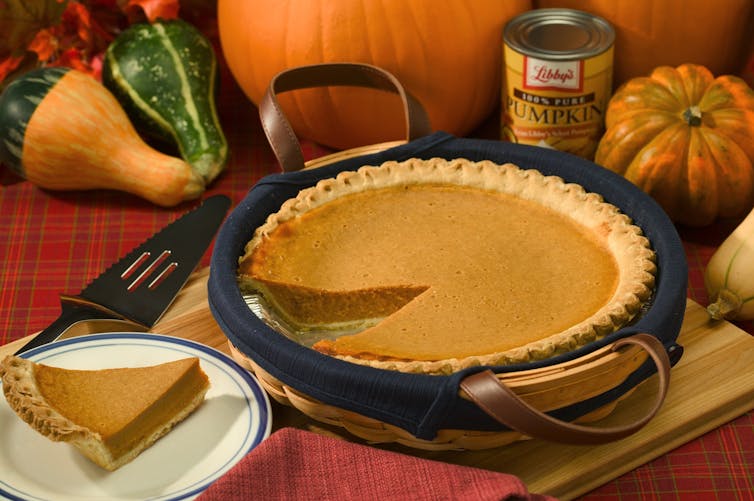


Pumpkin pie Thanksgiving

Libby’s continues to fiercely compete with pumpkin pie peddlers Borden’s, Snowdrift and Mrs. Smith’s for a place on the Thanksgiving table.
Jean Beaufort


Chances are you and your family have similar traditions. Filipino-American families might include pancit. Russian-American families might serve a side dish of borscht. That’s what makes Thanksgiving unique. It’s a holiday embraced by people regardless of their religion or ethnicity.

Yet despite this adaptability, there’s a core part of the meal that almost everyone embraces. How did this come to be? Although few appreciate it, advertisers have shaped the meal as much as family tradition.

A uniquely broad appeal


When Sarah Josepha Hale, the editor of Godey’s Lady’s Book, first advocated for Thanksgiving as a national holiday in 1846, she argued that it would unify the country. In our research, my colleagues and I have been able to show that Hale’s vision for the holiday has been largely fulfilled: Inclusivity of people and traditions has been Thanksgiving’s hallmark quality.

A reason for its broad appeal is that it lacks any association with an institutionalized religion. As one interviewee told us, “There is no other purpose than to sit down with your family and be thankful.” And after interviewing a range of people – from those born in the U.S. to immigrants from countries like South Africa, Australia and China – it became obvious that the principles and rituals they embraced during the holiday were universal no matter the culture: family, food and gratitude.

But as a relatively new holiday – one not tied to a religious or patriotic tradition – a shared understanding of the celebration and the meal is crucial to ensure its long-term survival.

While there might be subtle variations, the Thanksgiving meal is the lodestone of the holiday, the magnet that brings people together. Today, familiar items constitute the meal: turkey, cranberry sauce, stuffing, gravy, alcohol, salad, apple pie and pumpkin pie. Many of our interviewees tended to serve some version of this list.

But why these items and not others? What makes turkey, cranberry sauce and pumpkin pie so special? My colleagues and I studied 99 years of Thanksgiving ads in Good Housekeeping magazine to find out.

Marketing a ritual


Starting with Thanksgiving’s early champion, Sarah Josepha Hale, the history of Thanksgiving is rooted in marketing. Marketers not only helped create many of the rituals and cultural myths associated with the Thanksgiving meal, but they also legitimized and maintained them.
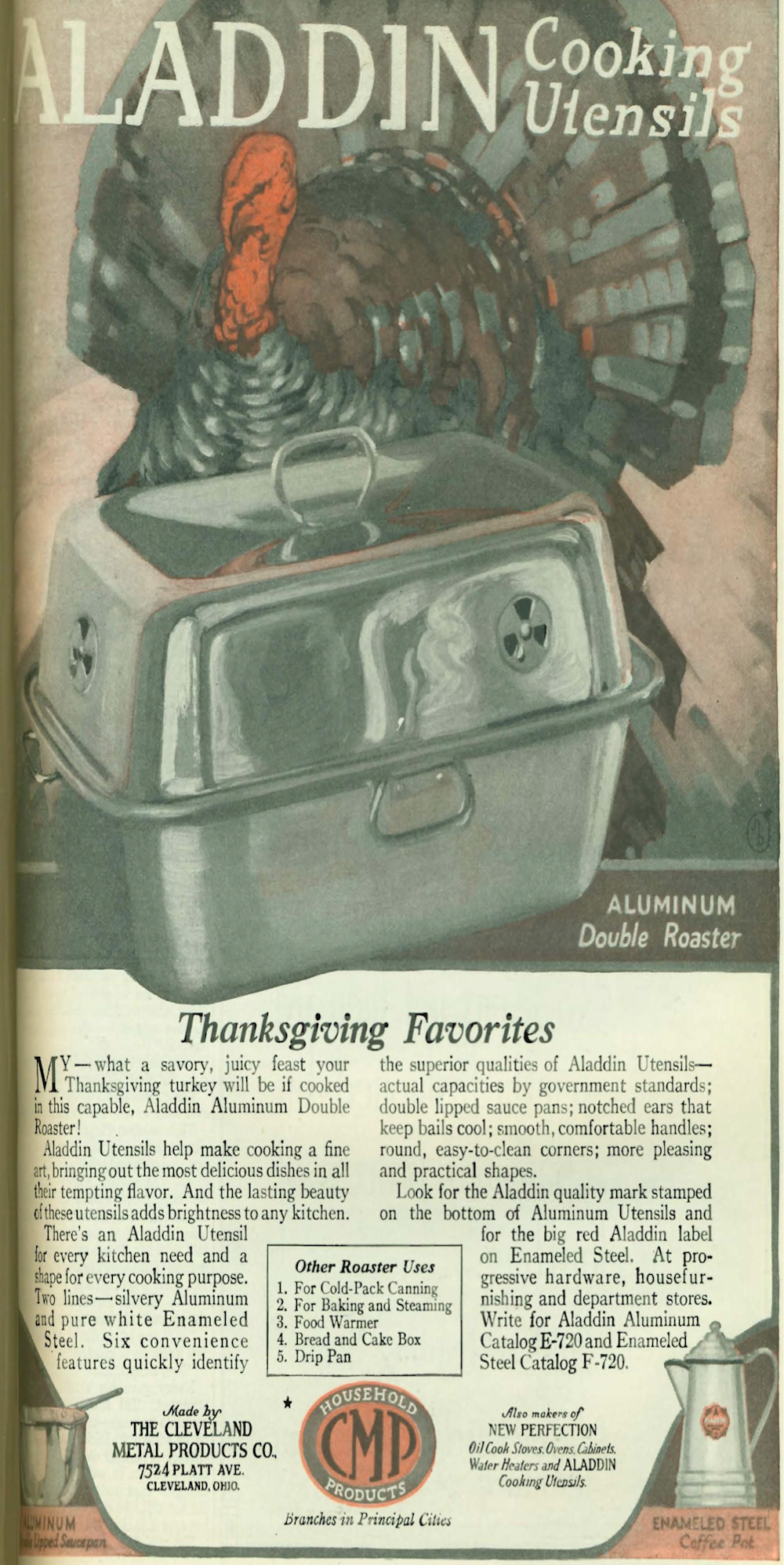


Aladdin Cooking Utensils advertises its double roaster in a 1920 issue of Good Housekeeping.

Aladdin Cooking Utensils advertises its double roaster in a 1920 issue of Good Housekeeping.
Good Housekeeping


Initially, the Thanksgiving turkey competed with other meats, like duck, chicken and goose, for centerpiece at the Thanksgiving table.

But by the 1920s, turkey had become the only meat advertised. Early ads would focus on how to prepare and present the perfect bird, promoting branded tools like roasters, ranges, pop-up thermometers and oven-cooking bags.

Iconic Swift’s Premium turkey ads focused on the sacredness of the meal by featuring families at prayer, giving thanks before the meal begins. The importance of the turkey to the Thanksgiving celebration dominates, helping to perpetuate the Thanksgiving turkey tradition.

Meanwhile, early ads for the Eatmor Cranberry Company positioned their whole cranberries as a perfect complement to any and all Thanksgiving meat dishes. This brand dominated until the 1930s when another brand, Ocean Spray, entered with its canned gelatin cranberry sauce.
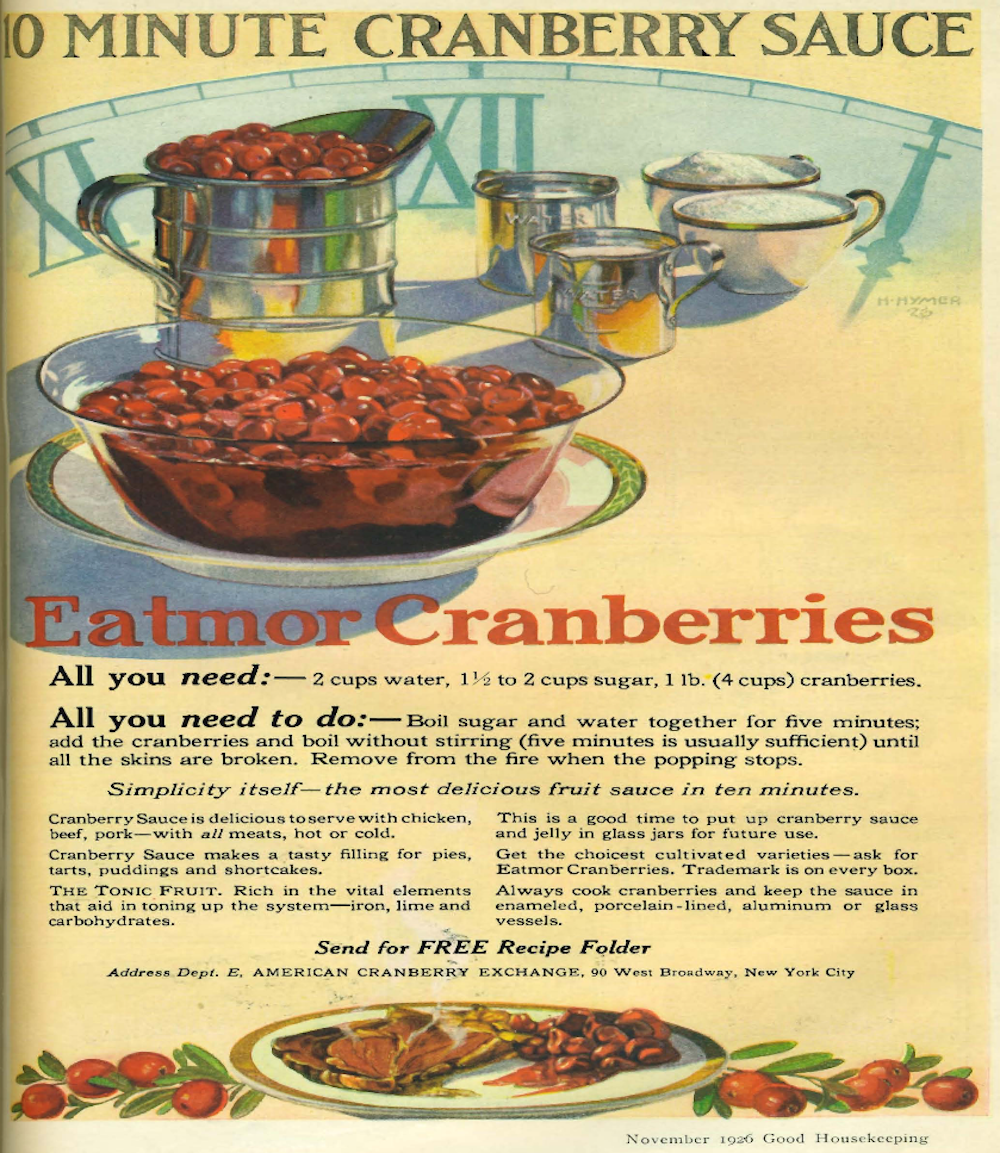


Eatmor Cranberries Thanksgiving advertising

Eatmor Cranberries – which used to be the king of Thanksgiving cranberry sauce – advertises in a November 1926 issue of Good Housekeeping.
Good Housekeeping


Ads for both brands implied that cranberry sauce has been around since the first Thanksgiving dinner, which was highly unlikely. However, the brand positioning war successfully promoted cranberry sauce as the natural condiment for the Thanksgiving turkey. Ocean Spray would triumph and, to this day, promotes whole cranberries and canned gelatin.

Considered by many to be the quintessential Thanksgiving dessert, pumpkin pie also wasn’t present at the first Thanksgiving meal. (The Pilgrims lacked the butter, wheat flour and sugar to make the pastry.) Nonetheless, beginning as early as 1925, a range of brands – for example, Borden’s, Snowdrift, Mrs. Smith’s and Libby’s – have competed fiercely to connect pumpkin pie to the season, the holiday and the meal. It’s a rivalry that continues to this day.

The role of the consumer


Not every product category or brand succeeded in becoming a core part of the Thanksgiving meal.
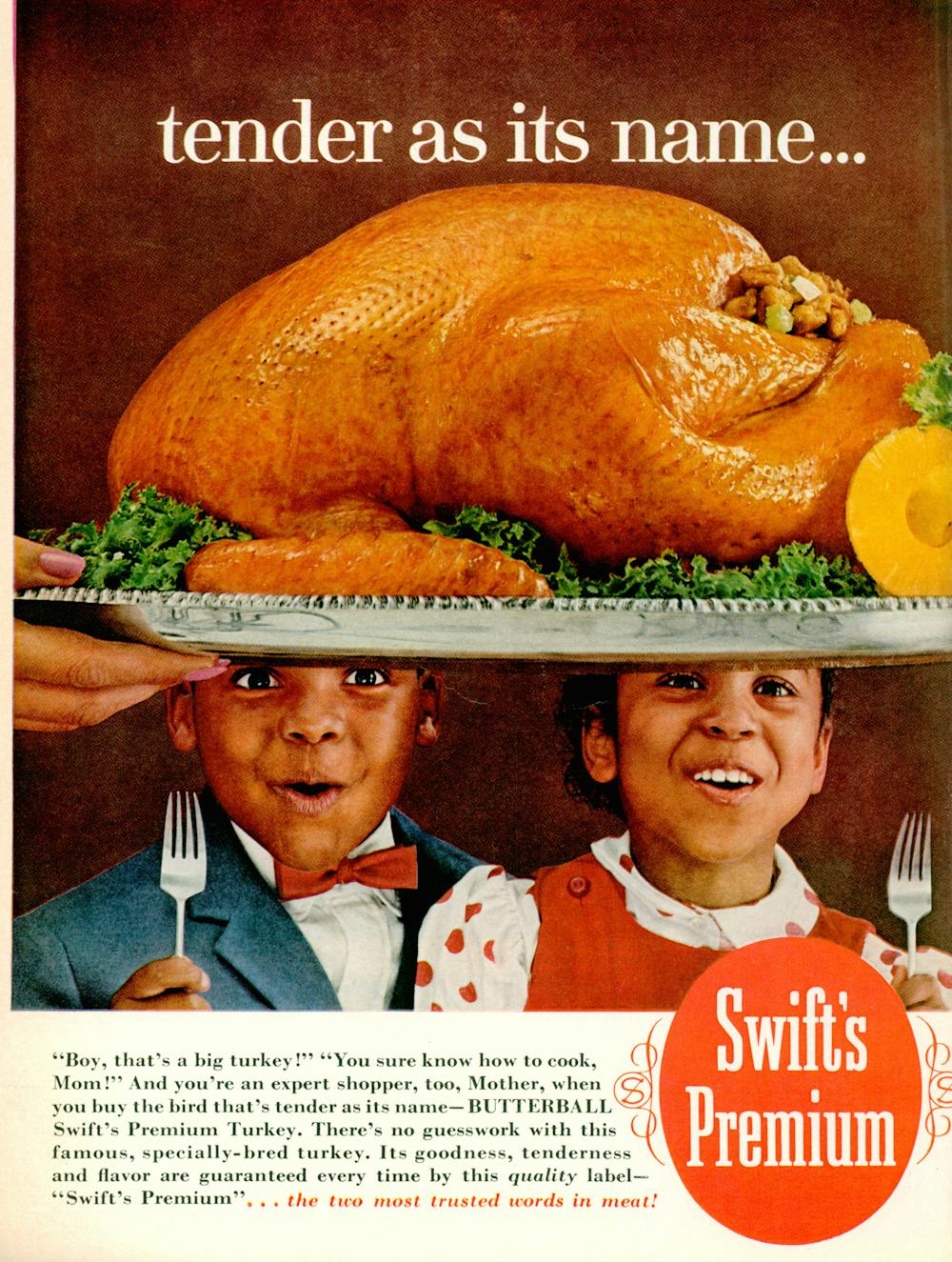


A Swift’s Premium Turkey ad from 1964.

A Swift’s Premium Turkey ad from 1964.
Wishbook


A Welch’s ad from the 1960s implies that the first Thanksgiving meal included juice made from grapes. In 1928, Diamond marketed their walnuts as an accessory to dress up Thanksgiving dishes. Despite vociferous ad campaigns, few associate Welch’s grape juice or Diamond walnuts with Thanksgiving today.

But those early 20th-century ads for turkey clearly resonated: Today, nearly 88 percent of U.S. households have turkey on Thanksgiving, and approximately 20 percent of the turkeys consumed in any given year are consumed at Thanksgiving. This is a testament to the enduring influence of marketing on the holiday. For brands like Butterball (formerly Swift’s Premium), Thanksgiving is big business.

Whether you’re a turkey fan or not, prefer apple pie to pumpkin pie, enjoy canned gelatin over whole cranberry sauce, by celebrating Thanksgiving, you play a role as well. Marketers may have shaped many of the rituals of the holiday. But all Americans – from all backgrounds – certainly do their part to maintain them.

The ConversationAfter all, brands need customers to survive.

Samantha N. N. Cross, Associate Professor of Marketing, Iowa State University

This article was originally published on The Conversation. Read the original article.
Tuesday, December 05, 2017

Guest Post: Jesus as a sausage roll echoes the Gospel of John

M J C Warren, University of Sheffield

With more than 1,000 outlets across the length and breadth of the United Kingdom, Greggs the baker is a national institution. It’s not uncommon for queues to form in some towns and cities as the daily doughnuts, cheese and onion pasties and steak bakes come out of the ovens. But it is the sausage roll that is the star turn.

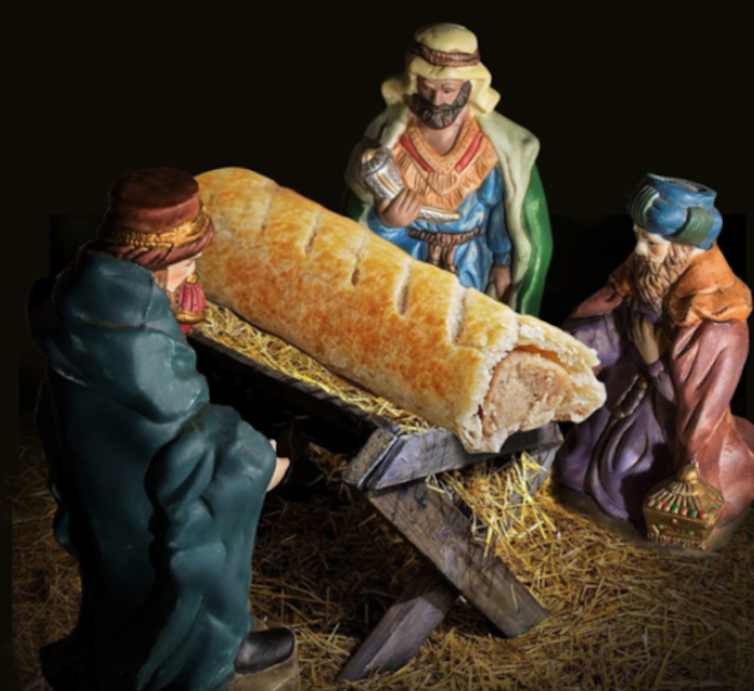
Now though, it seems it is the star that Greggs took too far. For Britain’s biggest bakery has had to apologise after it replaced the traditional baby Jesus in the manger with its famed product in a nativity scene. The image was used to promote its advent calendar and, the company says, wasn’t meant to cause offence.


File 20171116 15410 yqfi5r.png?ixlib=rb 1.1

It’s big, but it might not feed 5,000.
Greggs


Well, regardless of intentions, the image, with three wise men reverently surrounding a golden sausage roll in a manger, caused quite an uproar.

Many Christian Twitter users were at the forefront of this backlash against the image, tapping into the false narrative of the persecution of Christians in Western countries including the UK and US, and the idea that there is a “war on Christmas”.

While many of the “war on Christmas” debates focus on the secularisation of the winter holiday, in this instance the attention was on a private company supposedly making light of the baby Jesus for profit.

One organisation, the right-wing pressure group the Freedom Association, led by Simon Richards, called for a boycott of Greggs as a result of the image.


The viral growth of the hashtag #boycottGreggs has prompted the bakery to issue a formal apology. “We’re really sorry to have caused any offence, this was never our intention,” said a spokesperson.

My flesh is meat indeed


However, what might not be apparent at first glance is just how appropriate this debate about Jesus-as-sausage-roll is in light of the Gospels – and the Gospel of John in particular. Although the Gospel of John doesn’t describe the nativity scene that we find in Luke and Matthew, it is a Gospel intent on describing Jesus as a food.

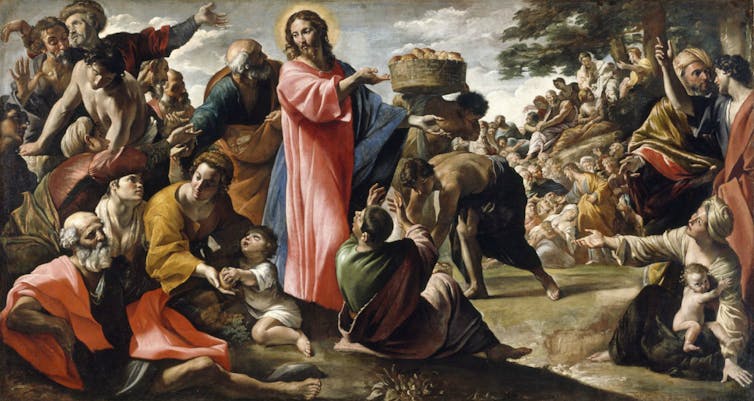
In one well-known scene, after he has fed the 5,000 on the shores of the Sea of Galilee, Jesus launches into a speech known as the “Bread of Life Discourse”. John’s Gospel uses several metaphors to describe Jesus here, including both bread and meat – and scholars have argued that Jesus means what he says.


Giovanni Lanfranco, Miracle of the Bread and Fish (1620-1623).
Wikimedia Commons


First Jesus declares: “I am the living bread.” Those listening to him are understandably confused, since they don’t see a loaf of bread in front of them but “Jesus, the son of Joseph, whose father and mother we know.” When Jesus hears them doubting his claims, he repeats his claim three times, finally stating explicitly that “the bread … is my flesh”.

After this conversation, Jesus makes a second claim about his body, this time that it is flesh to be eaten. In the King James Version, Jesus emphatically declares: “My flesh is meat indeed.” Even if we accept a metaphorical reading of Jesus’s words, there is no question that John the Evangelist understood Jesus in edible terms.

Offence and the Gospels


If Jesus as bread and meat is biblical in its origins, it might be surprising to see that the outrage over these claims is not unique to the current uproar around the Greggs advert.

The Gospel of John first describes people’s disbelief of what Jesus says – they doubt he is the bread he claims to be. But the real outrage comes when Jesus declares that he’s made of meat, and that people should be eating him. Even his followers, his disciples, have trouble with this: “When many of his disciples heard it, they said, ‘This teaching is difficult; who can accept it?’” Jesus, seeing that what he’s said has offended them, doubles down on his claims – and some of his (nameless) disciples decide to leave him.

Not unlike the current furore over Jesus the Sausage Roll, the Gospel of John depicts uproar and offence at Jesus being compared to food. It seems that comparing Jesus to food has a long history of causing outrage, then, but that doesn’t mean that it’s wrong – the Bible itself recognises both the comparison and the ensuing offence.

War on Christmas


Paradoxically, then, Greggs has actually provided a scripture-inspired vision of the nativity that Christians often complain is increasingly absent in the run-up to Christmas.


The ConversationWhile there is no real war on Christmas, those anxious about what they perceive as a lack of Jesus in the advent season should take another look at the Greggs ad, which places a biblical understanding of Jesus right in the centre.

M J C Warren, Lecturer in Biblical and Religious Studies, University of Sheffield

This article was originally published on The Conversation. Read the original article.
Monday, August 01, 2016

From the Archives: Monique Luiz, 'Daisy Girl' from controversial 1964 campaign ad, speaks at UVA

Publisher's note: This article was originally published on Examiner.com on October 15, 2014. The Examiner.com publishing platform was discontinued July 1, 2016, and its web site was scheduled to go dark on or about July 10, 2016.  I am republishing this piece in an effort to preserve it and all my other contributions to Examiner.com since April 6, 2010. It is reposted here without most of the internal links that were in the original.

Monique Luiz, 'Daisy Girl' from controversial 1964 campaign ad, speaks at UVA

On September 7, 1964, Lyndon Johnson's presidential campaign bought time during NBC's “Monday Night at the Movies” for a 60-second ad that showed a little girl plucking the petals off a flower, followed by a nuclear mushroom cloud and an excerpt from one of Johnson's speeches.

Long known as the “Daisy Girl” ad (although the flower was a dandelion, not a daisy), the spot – for which NBC charged $24,000 – was produced by the Madison Avenue firm of Doyle Dane Bernbach (DDB), which had not previously done political ad-making. It was tremendously controversial and, along with other DDB ads that aired in 1964, changed the style and substance of campaign advertising.

The little girl in the ad was 3-year-old Monique Corzilius, who had earlier appeared in print ads but had not acted on film. (She later went on to perform in commercials for products like Kool Pops and SpaghettiOs.)

Now known as Monique Luiz, the “Daisy Girl” participated in a panel discussion hosted by the University of Virginia Center for Politics on October 15, along with Robert Mann, author of Daisy Petals and Mushroom Clouds: LBJ, Barry Goldwater, and the Ad That Changed American Politics, and veteran journalist Sid Davis, who was a White House correspondent in the early 1960s, covered the 1964 campaign, and was present at President John F. Kennedy's assassination in 1963.

Red hair stands out
After the panel, Luiz answered a few questions posed by the Charlottesville Libertarian Examiner about her role as the “Daisy Girl” and the reactions to it.

For more than four decades, Luiz did not acknowledge that she was the girl in the ad. In 2009, however, she discovered that another woman was claiming to be her and was trying to capitalize on the TV spot's notoriety. Luiz came forward with documentation that she was the authentic “Daisy Girl” and subsequently was interviewed by Mann for his book, which is how she came to appear at UVA this week.

When she auditioned for the part, neither she nor her parents knew that DDB was making a political ad. She stood out among the many little girls who tried out because of her red hair, and also because her father was persistent.

“I think it was my father who sold them” on the idea “that I could do it,” she recalled. “He pretty much said, 'I can't guarantee anything but she'll try.'”

Listening closely to her in the commercial, one can hear exasperation in little Monique's voice. That was, in part, because the final cut was taken from the 27th take in a long day of filming.

Surprise
Even after filming, Monique's parents did not know how the footage would be used. They found out by seeing the ad on TV.

Their reaction, as she remembered it, was: “'Oh my gosh, it's Monique! She's in a political ad!'”

After the ad appeared on TV for the first time, and it was repeated on news shows in the days that followed, there was a negative reaction, coming from the general public, causing her grandmother, in particular, to become “very concerned about it.”

As she was growing up, Luiz chose not to reveal her association with the ad, and she ended her modeling career at age 7 or 8, preferring to focus on school and normal girlhood.

“I knew about [the controversy] and I just avoided it. I remember my grandmother saying, 'Don't say you're the Daisy Girl! Don't say you're in that ad!' So I grew up not wanting to talk about it.”

For all the publicity that surrounded the “Daisy Girl” ad, Monique Corzilius was paid just one hundred dollars for appearing in it – which seemed pretty substantial in 1964.

As Luiz recalls now, with a smile, “I remember my parents saying, 'Wow! You made a lot of money.'”

The “Daisy Girl” ad is available in several forms on YouTube. Here is a link to one of them.

SUGGESTED LINKS

UVA Center for Politics commemorates 1960 Kennedy-Nixon debates
Larry Sabato discusses Cuccinelli, McAuliffe, Sarvis in 2013 election
Lee Harvey Oswald colleague recalls aftermath of Kennedy assassination
Witness to 1963 Kennedy assassination speaks at Virginia Film Festival
JFK was 'cautious, conservative' says UVA political scientist Larry Sabato

Original URL: http://www.examiner.com/article/monique-luiz-daisy-girl-from-controversial-1964-campaign-ad-speaks-at-uva

Thursday, November 27, 2014

'How Many Shopping Days Until Christmas?'

If you landed here because you asked your search engine, "How many shopping days until Christmas?," the answer as this went to press was "27."  If you've landed here after November 27, you can check out this handy countdown clock to find out the accurate answer.

The reason for the headline is more to explore the origin of the phrase "only x shopping days until Christmas."

The conventional story of the origin of "shopping days until Christmas" is that the phrase was coined by Wisconsin-born retailer Harry Gordon Selfridge, founder of Selfridge and Company in Oxford Street (London).  There is renewed interest in Selfridge's life and work due to a popular British TV series about him, starring Jeremy Piven, that has also been broadcast on public television in the United States.

It is clear from both factual and fictionalized portrayals of Selfridge that he was an innovative merchant, but research I have done suggests that he is unlikely to have been the coiner of the now-ubiquitous countdown phrase.

According to Selfridge's Wikipedia entry, which lacks a citation for the point,

While at Marshall Field, Selfridge was the first to promote Christmas sales with the phrase "Only _____ Shopping Days Until Christmas", a catchphrase that was quickly picked up by retailers in other markets. Either he or Marshall Field is also credited with popularizing the phrase "The customer is always right."
The UK-based web site "The Phrase Finder," citing the Encyclopedia of Word and Phrase Origins, repeats the same information:
American retailer H. Gordon Selfridge (1856-1947) coined this expression - " __ shopping days until Christmas" while working for Marshall Field & Co. in Chicago. Later he coined the slogan "the customer is always right" when he opened Selfridge's in London.
An Australian web site, WordBooks.com.au, acknowledges that Selfridge may have heard the phrase somewhere else before he used it in marketing his own store's products. Writer Michelle Holland cites another book (Who Said That First?, by Max Cryer) as her source:
The idea of reminding people how much shopping time is left before Christmas is not new. On 19 December 1900 the Los Angeles Times displayed a reminder: ‘There are only (counting today) five more shopping days till Christmas.’ Four days later the Washington Post took up the cry: ‘Only one more shopping day until Christmas.’

At the time Gordon Selfridge was working with Marshall Field and Company in Chicago. He may have picked up the idea from the newspapers mentioned, but certainly he soon instructed his staff to drive the same slogan, which put a real sense of urgency into the shopping lead-up to Christmas. Before long it was used worldwide.
A careful search on NewspaperArchive.com turns up several uses of the phrase several years before the 1900 citations from the Los Angeles Times and Washington Post. The earliest usage I can find was in 1891 but it was frequently used in the 1890s in locations as various as Boston and Cedar Rapids and in various small towns in the Midwest (Oshkosh, Wisconsin, and Mansfield, Ohio, for instance).

The earliest example I can find from Gordon Selfridge himself comes from 1909, the first Christmas season that Selfridges was open:

London Standard, December 16, 1909
Yet I was not able to find any uses of the phrase in Chicago newspapers during the time that Selfridge worked for Marshall Field. The earliest instance appears to be from the front page of the Chicago Heights Star on December 17, 1908 -- about two years after Selfridge had moved to London to build his own department store.
Chicago Heights Star, December 17, 1908
One Illinois newspaper used the phrase in 1897 -- but that was in Jacksonville, a central Illinois city some 235 miles southwest of Chicago and unlikely to be familiar to Selfridge.

Jacksonville (Ill.) Daily Journal, December 8, 1897
Four years earlier, a Massachusetts merchant, Hollander Bradshaw Folsom, used the phrase in a large advertisement for a variety of products it had on offer:

Boston Sunday Post, December 10, 1893
That Boston Sunday Post advertisement may be the first time the phrase "only __ shopping days before Christmas" appeared in print.

Two years before that, the same retailer posted this reminder in the Boston Globe: "NOTICE--Please bear in mind that only 16 SHOPPING DAYS now intervene to Christmas, and that during the last ten days all of our floors are jammed."

Boston Sunday Globe, December 6, 1891
I believe that Boston Sunday Globe ad is the earliest use in print of anything close to "shopping days until Christmas," although it is expressed in more flowery language.

In 1894, the Herms Dry Goods Company advertised in the Portsmouth (Ohio) Daily Times, admonishing readers to "Do Your Xmas Shopping Now" because there were "Only 18 Shopping Days Before Christmas."
The Daily Times (Portsmouth, Ohio), December 4, 1894
On the same page in that same newspaper was the beginning of the serialization of Stephen Crane's novel, The Red Badge of Courage, up to chapter III. The Daily Times was one of 200 small town dailies that serialized Crane's story that month and helped establish his fame as a writer. Now a high-school lit-class staple, The Red Badge of Courage wasn't published in book form until the following year. (Charlottesville connection: Crane's handwritten manuscript is preserved in the Albert and Shirley Small Special Collections Library at the University of Virginia.)

Advertising in the Boston Sunday Globe in 1895, Jordan, Marsh, & Co. claimed to have "the Grandest Aggregation of Holiday Goods in New England" and reminded readers there were "Only 8 More Shopping Days Before Christmas":

Boston Sunday Globe, December 15, 1895
By the turn of the century, the phrase was ubiquitous. Here are some examples:

The Daily Northwestern (Oshkosh, Wisc.), December 11, 1899

Mansfield (Ohio) News, December 12, 1899

Cedar Rapids (Iowa) Republican, December 23, 1900


Washington Post, November 27, 1904
That last example, published exactly 110 years ago today, is puzzling in that it warns about "only 24 shopping days until Christmas," when it should be 27 days.  The advertiser, Galt & Bro. Jewelers, was at one time the oldest continuously operating business in Washington, D.C.  It closed in March 2001 after nearly two centuries of operation.  It was once managed by Edith Galt, who became the second Mrs. Woodrow Wilson and effectively president after her husband's debilitating stroke.

To summarize:  The claim that Harry Gordon Selfridge coined the phrase "___ shopping days until Christmas" rests on flimsy ground.  Knowing that Selfridge was a notorious self-promoter, the assertion that he first used it while he was at Marshall Field & Co. in Chicago in the late 19th century may originate with him in one of his expansive chats with journalists (like this 1932 interview with The Milwaukee Journal, in which he lays claim to "the customer is always right").

The earliest near-usage I was able to find was in the Boston Globe in 1891.  (I searched as far back as 1860.)  The earliest precise phrasing I found was two years later, in the Boston Sunday Post. The phrase became common in the 1890s in New England and the Midwest but I found no evidence of Selfridge using it before 1909, even in Chicago newspapers that would have published ads for Marshall Field. That doesn't mean no evidence exists -- just that I could not find it.  If anyone can find an earlier usage attributed to Selfridge, I welcome feedback.


Thursday, October 31, 2013

Rebublican Political Action Committee Needs Proofreader

Yesterday evening, I saw an independent pro-Cuccinelli TV ad on the NBC29 5 o'clock news in Charlottesville.

Produced by something called the "Conservative Campaign Committee," it praises gubernatorial candidate Ken Cuccinelli as a "Conservative Rebublican."

You read that right: "REBUBLICAN."

Rebublican
With friends like these, who needs Purple PAC?

You can see the video here.

(Cross-posted, in slightly different form, from Bearing Drift.)


Monday, October 18, 2010

Are Lindsay Lohan and Justin Bieber Necessary?

It turns out that writing about Justin Bieber's alleged assault of a 12-year-old boy who (allegedly) called him a "faggot," Lindsay Lohan's choices of nail polish and her evolving mug shots, Paris Hilton's cocaine arrest, or Perez Hilton's oscillating mean spirits is no longer necessary to attract money-earning Web traffic -- if it was ever necessary at all.

Celebrity stories may raise the numbers of visitors, but those visitors are less likely to buy anything, or even look at advertising on a web site or blog.  It's as if a passerby noticed Shia LaBeouf at a sidewalk cafe in Dupont Circle but didn't bother to stroll into the place and order an espresso and a muffin.

The New York Times reports that an analysis by Perfect Market, a media consulting company, finds that hard news stories attract the most profitable traffic to newspaper web sites (and, I would hazard to extrapolate, to news-and-opinion blogs, as well).

According to the Times:

Using data from newspapers including The Chicago Tribune, The Los Angeles Times, The San Francisco Chronicle and The Orlando Sentinel, Perfect Market found that the most profitable articles were the ones readers were most engaged with. Topics like unemployment, the egg recall and mortgage rates topped the list.

The reason, Perfect Market analysts explained, was that advertising is more effective when it is paired with news content that is relevant to the product, especially when the subject of the news is something in which readers have a personal interest.
Reporting on the same story, with the alliterative headline "Lindsay Lohan Less Lucrative for News Sites Than Hard News," Advertising Age added:
Newspaper websites get more ad revenue from articles about serious stuff like the Gulf oil spill than from traffic bait like stories on celebrity scandals, according to an analysis by Perfect Market, a company that aims to help publishers become more visible and profitable on the web.
Advertising Age's Nat Ives explained why celebrity-driven stories lack the profit potential of nuts-and-bolts, bread-and-butter topics.
A lot of the difference had to do with automated text ads that are keyed to the content on a page, ads that can be overshadowed by the big display units that newspapers' sales teams typically sell directly. Articles about immigration, for example, are magnets for text ads promoting immigration lawyers.

"The rates paid by advertisers on Google AdSense for immigration-related terms are higher than the celebrity-related stuff like Lindsay Lohan," said Robertson Barrett, chief strategy officer at Perfect Market. Mortgage lenders want to put text ads in front of people reading about mortgages, he said, but there aren't as many advertisers trying to sell celebrity memorabilia.
Jeremy W. Peters in the New York Times offered some actual numbers that demonstrate the profitability of stories about the economy and other "kitchen table" issues.
Perfect Market measured revenue per page view and found that articles about Social Security were the most valuable, generating an average of $129 for 1,000 page views. Articles about mortgage rates made $93 for every 1,000 page views. On other topics, values for every 1,000 page views were $28 for items about unemployment, $33 for articles on jobs, $20 for articles on the egg recall and $26 for pieces on immigration reform.
To be perfectly candid, I still haven't made a dime from Google AdSense in the nearly six years I've been blogging. But at least I know now that I don't have to make gratuitous references to Lady Gaga in order to increase my traffic volume and click-through rates.  (I'll still Tweet about Glee, even though there's no profit in it.)

To my readers, however: please feel free to click on the ads below. Google and I will both be grateful (me more than the Big G).

Be sure to visit my CafePress store for gifts and novelty items!
Read my blog on Kindle!
Follow my tweets on Twitter! 

See my articles on Examiner.com!

Friday, July 17, 2009

Smoke Gets in Your Eyes

One morning earlier this week, as I was preparing to leave for the Tuesday Morning Group Coalition monthly meeting in Richmond, I became aware of the presence of several emergency vehicles in and near my cul de sac: fire trucks, an ambulance, and at least one police car.

At first I thought there was a fire, but it turned out to be something different -- an idling car had escaped its parking brake and crashed into a nearby house.

While both the car and home owner must have been grateful that the damage was not significant (and that nobody was hurt), the incident flashed a memory of mine.

During my first year as a blogger, I wrote about the time my house nearly burned down. That was 34 years ago today: July 17, 1975. The fire was big enough that it landed on the first page of the local newspaper on July 24 (the Wauwatosa News-Times, founded in 1898 but now, as far as I know, defunct) -- with not one but two photographs.


One picture appeared above the fold.


The caption reads:

In the Line of Duty

PARAMEDIC JESSE MORENO (right) ministered to a fellow-paramedic, Acting Lieutenant Jim Filber, who suffered from smoke inhalation while serving at the scene of a residence fire July 17. Awaiting treatment, Lt. John Accola mirrored the exhaustion of local firemen who fought the $50,000 blaze. Also on the scene was Reserve Policeman Grant Schmidt, one of several members of the Police and Fire Reserves who aided at the scene. Moreno and five other firemen also were treated later for smoke inhalation. Story on Pg. 3. (Photo by Arthur C. Hombsch)
The second picture appeared below the fold, but in the prominent lower right-hand corner.


Its caption reads:
Fire-Call Figures

LEAVING THE SCENE of a major fire last Thursday night, Wauwatosa Fire Chief Byard Sheldon (in white coat) followed Jim Washcovick, on-duty assistant chief, as the two left the Richard Sincere home at 1503 N. 70th St. The fire had just been brought under control after having been fought for almost three hours. Eight Tosa firemen were treated for smoke inhalation from the blaze which caused an estimated $50,000 damage to the residence and its contents. (Photo by Arthur C. Hombsch)
The story on page 3 provided a few more details than the captions on page 1 did.


The text reads:
Nine Tosa Firemen Treated after $50,000 Blaze

Three Wauwatosa firemen were taken to hospitals and six more treated for smoke inhalation at the scene of a $50,000 blaze at 1503 N. 70th St. July 17, according to the latest Wauwatosa Fire Department report.

The fire began when wiring in a pinball machine short-circuited. The fire quickly spread from its origin in a basement recreation room through air ducts to other portions of the house. Damage was estimated at $35,000 to the house and $15,000 to contents.

Three firemen suffering from smoke inhalation were transported to hospitals. Firefighter Larry Tesch was taken to County General and Firefighters Peter Ernst and Lee Werner were taken to St. Luke’s.

Among those treated at the scene were Asst. Chief James Washcovick, who strained some shoulder and arm muscles moving a hose to the second floor; Lts. John Accola and Frank Jankowski, and Firefighters Jesse Moreno, George Polly and James Filber. Filber also sustained a burn on his leg and Jankowski was treated for a cut hand.

One of the interesting things about finding the Wauwatosa News-Times report on my family's personal adversity was seeing some of the items in the paper that put the event in historical context. For instance, there was this photo/story about the new Bicentennial coins being produced by the U.S. Mint:


The caption says:
'Change' of Design

A BIG CHANGE IN SMALL CHANGE will appear when these new Bicentennial coins start circulating throughout the nation and, of course, in Wauwatosa. The quarter, half-dollar and dollar shown here will bear the same head but the dates 1776-1976 will be stamped underneath. On the tails of the three coins are a colonial drummer on the quarter; Independence Hall on the half-dollar; and the Liberty Bell and moon on the dollar. The Federal Reserve System will start distributing the Bicentennial half-dollar to financial institutions July 7. The other two coins will be released by the U.S. Mint before the end of the year.
What really demonstrates the historical context are the advertisements scattered throughout the newspaper. For instance, these two restaurant ads (fish fry with a free stein of beer $2.65! prime rib dinner $5.95!) would make anyone's mouth water, Pavlov-dog style:


Then there are the ads that remind us how much technology (and our expectations and familiarity of it) has changed.

Remember typewriters? And typewriter shops?


Remember when people paid to have a television repaired, rather than just buying a new one?


Now here's something I don't remember: Businesses offering lessons in how to use a microwave oven. Did anyone reading this ever take a class like this?


By coincidence, I just bought a new microwave the other day. I paid $39.00 at Walmart to replace one that I bought just about three years ago at Target. That one shorted out. The microwave oven I had before that lasted more than 20 years: I bought it in 1984 at Sears for about $400, which was a lot of money back then.

Oh, for the good ol' days!

Post script: That same issue of the Wauwatosa News-Times also included a feature article about St. Bernard's Studio Theatre's summer production of Hello, Dolly!


Be sure to visit my CafePress store for gifts and novelty items!
Read my blog on Kindle!

Saturday, June 27, 2009

Four Decades After Stonewall

This weekend marks the 40th anniversary of the Stonewall Riots, considered a critical moment in the gay rights movement.

The riots did not, contrary to popular mythology, start the gay rights movement. They did not even mark the first time that gay bar patrons had fought back against a raid by corrupt police in a major city. (There was a similar event at the Black Cat Tavern in Los Angeles two years earlier.)

Moreover, groups of gay men and lesbians had been organizing around the country for some forty years. The Mattachine Society and the Daughters of Bilitis each had active chapters in various cities, including Los Angeles, San Francisco, and Washington, D.C. (This history has been chronicled in many places, notably in the documentary film, Before Stonewall.) As Dale Carpenter put it in a post on the Independent Gay Forum this week,

The liberationists who gave us Stonewall hastened us down a path (already begun long before them) that has brought us to the edge of unprecedented respect and acceptance.
To demonstrate the differences between today and 1969, one need only take a look at how the mainstream media covered the incidents at the Stonewall Inn and compare it to how they might do it today.

As an example of how far mainstream acceptance has come, Conan O'Brien made an inoffensive joke in his monologue on The Tonight Show on Friday about a news item he had seen about a gay senior citizens group. Their slogan, he said, was "We're here; we're queer; we can't hear you." Well, maybe elderly people might take offense at that -- but not gay people.

In 1996, Edward Alwood wrote a comprehensive history of how the news media has covered gay issues and events in a fascinating book published by the Columbia University Press (with copious illustrations and photographs and accessibly readable despite its academic origin), Straight News: Gays, Lesbians, and the News Media. Here is some of what he wrote about the coverage in June and July 1969 of the Stonewall Riots (excerpted from pages 84-88 of Straight News, footnotes omitted). He begins with coverage after the first night of the riots:
The six-paragraph, single-column story ran on page thirty-three of the [New York] Times on Sunday, June 29. It carried no byline, indicating that the author was a junior writer. The small article was classic New York Times. In sterile language it described the clash in terms of the problems faced by the police. It mentioned nothing about the recent rash of arrests at gay bars or the history of police harassment. Readers were left to figure out for themselves the reasons for the uprising. The story began,
4 POLICEMEN HURT IN ‘VILLAGE’ RAID
MELEE NEAR SHERIDAN SQUARE FOLLOWS ACTION AT BAR

Hundreds of young men went on a rampage in Greenwich Village shortly after 3 A.M. yesterday after a force of plainclothes men raided a bar that police said was well known for its homosexual clientele.Thirteen persons were arrested and four policemen were injured. The young men threw bricks, bottles, garbage, pennies and a parking meter at the policemen, who had a search warrant authorizing them to investigate reports that liquor was sold illegally at the bar, the Stonewall Inn, 53 Christopher Street, just off Sheridan Square.
The tone of the article and its placement deep inside the newspaper came as no surprise to homosexuals. “I didn’t expect it to be on the front page because the Times didn’t cover gay stuff,” recalled Martha Shelley, then president of the New York chapter of Daughters of Bilitis. “I knew that if there had been that many black people rioting in Manhattan, the story would have been front page news.”

Reporter Dennis Eskow took a similar approach in his story in the New York Daily News, 3 COPS HURT AS BAR RAID RILES CROWD. It was accompanied by a three-column photograph showing police talking to a group of smiling young men outside the bar, hike the Times story, Eskow’s was buried on page thirty. It began, “A predawn police raid on a reputed Greenwich Village homosexual hangout, the second raid within a week, touched off a two-hour melee yesterday as customers and villagers swarmed over the plainclothes cops. Before order was restored, the cops were the targets of thrown coins, cobblestones and uprooted parking meters, windows were smashed, a police van was nearly overturned and the front of the raided bar, the Stonewall Inn, was fire-bombed.”
The spontaneous demonstrations did not end immediately. They were renewed the next day, after the Stonewall Inn reopened. The newspapers again reported on the events. Their placement and tone suggest (in retrospect) an utter lack of understanding of what was happening and what would follow (including the first gay pride parade in New York exactly one year later, on June 28, 1970). Some of the reports displayed outright bigotry with regard to the gay men who had reacted to decades of police oppression, blackmail, and extortion. Alwood continues:
The Times reported the Saturday night outbreak in a second article. Again, the single column, ten-paragraph article was buried on page twenty-two. It began,
POLICE AGAIN ROUT “VILLAGE” YOUTHS
Heavy police reinforcements cleared the Sheridan Square area of Greenwich Village again yesterday morning when large crowds of young men, angered by a police raid on an inn frequented by homosexuals, swept through the area. . . . A number of people who did not retreat fast enough were pushed and shoved along, and at least two men were clubbed to the ground.
Only reporter Jay Levin of the New York Post was able to put the uprising in a context that would enable the average reader to understand the events, despite the condescending tone of the article. His story ran on July 8, more than a week after the riots erupted. Headlined THE GAY ANGER BEHIND THE RIOTS, the story began,
“People are beginning to realize,” said the doorman at the Stonewall Inn, “that no matter how ‘Nelly’ or how ‘fem’ a homosexual is, you can only push them so far.” With a battle cry of “gay power,” the Nellies, fems, gay boys, queens—all those who flaunt their homosexuality -- have been demonstrating that they have indeed been pushed too far."
Although most of the city’s newspapers underplayed the riots, two others sensationalized them beyond extremes. The worst offender was the Daily News, the irreverent paper of the city’s working class. Headlined HOMO NEST RAIDED, QUEEN BEES ARE STINGING MAD, the article by Jerry Lisker appeared on July 6, nearly a week after the riots, on the first page of the local news section:
She sat there with her legs crossed, the lashes of her mascara-coated eyes beating like the wings of a humming bird. She was angry. She was so upset she hadn’t bothered to shave. A day old stubble was beginning to push through the pancake makeup. She was a he. A queen of Christopher Street. Last weekend the queens had turned commandos and stood bra_strap to-bra-strap against an invasion of the helmeted Tactical Patrol Force. The elite police squad had shut down one of their private gay clubs, the Stonewall Inn at 17 Christopher St., in the heart of a three-block homosexual community in Greenwich Village.
In mocking, denigrating descriptions that ran throughout the article, Lisker described gays as “Queen Bees,” “princesses and ladies-in-waiting,” “Florence Nightingales,” and “honeys turned Madwomen of Chaillot.” “Queen power reared its bleached blonde head in revolt ,“ the article said. He referred to the Stonewall Inn as “a gay mecca” and a “homosexual beachhead .“ In one section he wrote,
The whole proceedings took on the aura of a homosexual Academy Awards Night. The Queens pranced out to the street blowing kisses and waving to the crowd. A beauty of a specimen named Stella wailed uncontrollably while being led to the sidewalk in front of the Stonewall by a cop. She later confessed that she didn’t protest the manhandling by the officer, it was just that her hair was in curlers and she was afraid her new beau might be in the crowd and spot her. She didn’t want him to see her this way, she wept.
Written in an entertaining and dramatic fashion, the story evoked the days of yellow journalism, when newspapers put a premium on telling a story rather than finding the facts or providing the truth.

The July 3 edition of the Village Voice struck a similar tone in two front page articles that provided the most extensive coverage of all. By coincidence the Voice’s editorial offices were located on Christopher Street, only a few doors from the Stonewall Inn. When the riot began on the first night, reporter Lucian Truscott IV was in the Lion’s Head, a favorite drinking spot for journalists, and darted outside to see what had happened. As a result he wrote GAY POWER COMES TO SHERIDAN SQUARE, the lead article on the front page of the next edition:
Sheridan Square this weekend looked like something from a William Burroughs novel as the sudden specter of “gay power” erected its brazen head and spat out a fairy tale the likes of which the area has never seen. The forces of faggotry, spurred by a Friday night raid on one of the city’s largest, most popular, and longest lived gay bars, the Stonewall Inn, rallied Saturday night in an unprecedented protest against the raid and continued Sunday night to assert presence, possibility, and pride until the early hours of Monday morning.
Like the article in the Daily News, Truscott’s contained a liberal dose of prejudiced characterizations ranging from “fags” to “blatant queens.” “The stars were in their element,” he wrote, capturing the drama of the moment but ignoring and trivializing legitimate complaints about oppressive police tactics. He referred to the “limp wrists and primed hair” of the gays but described the police as “the city’s finest.”
Fast-forward forty years. So much has happened in that time it boggles the mind. (Who, in 1969, would have imagined that gay and lesbian citizens would be lobbying for equal marriage rights and that they would have achieved them in several foreign countries and six states? That an openly gay man would be heading the U.S. civil service, which once excluded homosexuals from government employment? Or that a majority of Americans approve the idea of gay men and lesbians serving openly in the military?) Gays are no longer disdained: they are courted by politicians (President Barack Obama panders to gay voters almost weekly) and targeted by merchants.

As an example of the latter, consider this article in the June 2009 issue of O'Dwyer's PR Report, a (subscription-only) newsletter for public relations professionals, by Matt Tumminello, president of Target 10 in New York.

Tumminello notes:
In 1969, gay visibility was practically non-existent and only a handful of individuals were willing to stand up and he counted. Today, gay visibility has exploded and the community has become a thriving market segment that holds a wealth of opportunity for major companies and consumer brands.
Gently chiding his PR colleagues and competitors for underserving the gay market, Tumminello lists a few salient facts:
About six to seven percent of the population is gay or lesbian. In urban areas, that percentage can exceed 10 or 12 percent.

The per capita buying power of gay consumers is estimated at $45,300, with a total market estimated at $712 billion.

Gay consumers are concentrated and easy to reach through targeted media, resulting in an efficient use of marketing dollars.

In research we’ve conducted. 73% of gay men and lesbians strongly agree that gay-targeted marketing positively impacts purchasing decisions. This market is extremely brand loyal.

Gay consumers influence trends, styles and tastes beyond their own community. Call it “The Queer Eye effect.”

Gay consumers are early adopters and there are many categories where gays over-index, such as travel, grooming, personal care products, technology and entertainment.

Gay research capabilities have become first-rate in the last five years. The results of a marketing program can be tracked and measured with great precision.
Tumminello concludes by reminding his readers that the gay market is not just a 21st century phenomenon, but it started slowly and is now maturing:
The gay market is not something new or just starting to emerge. It’s been growing up and all around us. A look at the last ten years of pop culture shows how far we’ve come. It’s been more than a decade since we first met Will & Grace. The Queer Eye guys finished giving America a makeover in 2007 after a successful four-year run. And last year, Ellen DeGeneres married her wife the same month she signed on to be the face of Cover Girl cosmetics. Today we even have LOGO, the gay TV network owned by MTV that reaches into more than 30 million homes.

Most recently, marriage equality has found a groundswell of support. Gay couples are now marrying in five states - probably six, by the time this magazine hits your desk. It may have seemed impossible a generation ago, but many of us now believe we won’t have to wait a lifetime to see it happen in all 50 states.
Ten years from now, as historians and activists mark half a century since the Stonewall Riots brought the struggle for gay and lesbian civil rights to public attention, what will they be marveling about? For my money, the most remarkable thing about this progress is the short span it took to get from there to here. While the boys and men who fought back at Stonewall might have stimulated, initially, a left-wing movement, the surprise is that it is the free market, encompassing both commerce and popular culture -- something valued more by the right than the left -- has been the strongest motivator, protector, and stimulant for gay liberation.