Showing posts with label Anglo-Saxon. Show all posts

Tuesday, January 02, 2018

Guest Post: The gods behind the days of the week

Margaret Clunies Ross, University of Sydney

The origins of our days of the week lie with the Romans. The Romans named their days of the week after the planets, which in turn were named after the Roman gods:

  • dies Solis “the day of the sun (then considered a planet)”
  • dies Lunae “the day of the moon”
  • dies Martis, “the day of Mars”
  • dies Mercurii, “the day of Mercury”
  • dies Iovis, “the day of Jupiter”
  • dies Veneris, “the day of Venus”
  • dies Saturni, “the day of Saturn”

When the Germanic-speaking peoples of western Europe adopted the seven-day week, which was probably in the early centuries of the Christian era, they named their days after those of their own gods who were closest in attributes and character to the Roman deities.

It was one of those peoples, the Anglo-Saxons, that brought their gods and language (what would become English) to the British Isles during the fifth and sixth centuries AD.
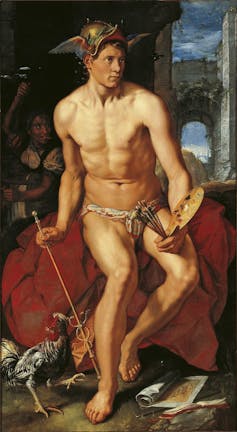


Hendrik Goltzius, Mercury, oil on canvas (1611)

Hendrik Goltzius, Mercury, oil on canvas (1611). Wikimedia Commons


In English, Saturday, Sunday and Monday are named for Saturn, the sun and moon respectively, following the Latin.

The remaining four days (Tuesday, Wednesday, Thursday and Friday) are named for gods that the Anglo-Saxons probably worshipped before they migrated to England and during the short time before they converted to Christianity after that.

Tuesday is named for the god Tiw, about whom relatively little is known. Tiw was probably associated with warfare, just like the Roman god Mars.

Wednesday is named for the god Woden, who is paralleled with the Roman god Mercury, probably because both gods shared attributes of eloquence, the ability to travel, and the guardianship of the dead.

Thursday is Thunor’s day, or, to give the word its Old English form, Thunresdæg “the day of Thunder”. This sits beside the Latin dies Iovis, the day of Jove or Jupiter. Both of these gods are associated with thunder in their respective mythologies.

You may recognise a similarity here with the name of the famous Norse god Thor. This may be more than coincidence. Vikings arrived in England in the ninth century, bringing their own very similar gods with them. Anglo-Saxons were already Christian by this time, but may have recognised the similarity between the name of their ancestors’ deity Thunor and the Norse god. We don’t know, but the word Thor does appear in written texts from the period.

Friday is the only weekday named for a female deity, Frig, who is hardly mentioned anywhere else in early English. The name does appear, however, as a common noun meaning “love, affection” in poetry. That is why Frig was chosen to pair with the Roman deity Venus, who was likewise associated with love and sex, and was commemorated in the Latin name for Friday.

Of gods and weekdays

The concept of the week, that is, a cycle of seven numbered or named days with one of them (usually Sunday or Monday) fixed as the first, was originally probably associated with the Jewish calendar. This was complicated by the fact that early medieval Europe inherited its idea of the week from imperial Rome, via the Christian church.

In early Christianity the reckoning of time was crucial to the proper celebration of the church’s feast days and holidays, especially the variable feast of Easter.

We find day names similar to English in related European languages, like Dutch, German, and all the Scandinavian or Norse languages. Gods with comparable names, like Tyr, Othinn, Thor and Frigg, were certainly known to the Scandinavians and gave their names to weekdays in Scandinavian languages (compare Modern Danish tisdag, onsdag, torsdag, fredag).

The ConversationThe Latin names for the days of the week, and the Roman gods for which they were named, still live on in all the European Romance languages, like French, Spanish and Italian. Think of French lundi, mardi, mercredi, jeudi and vendredi, for example, and you will find the Latin Luna, Mars, Mercurius, Iovis and Venus hidden behind them.


Margaret Clunies Ross, Eneritus Professor of English Language and Early English Literature, University of Sydney

La version originale de cet article a été publiée sur The Conversation.
Saturday, December 30, 2017

Guest Post: The myth that the English have a common Anglo-Saxon origin

Duncan Sayer, University of Central Lancashire

The idea that there is a common Anglo-Saxon ancestry based on biology is gaining currency among some right-wing and religious groups in the UK and US.

In the UK, the new leader of the UK Independence Party, Henry Bolton, suggested in a radio interview in October that “in certain communities the indigenous Anglo-Saxon population is nowhere to be seen.”


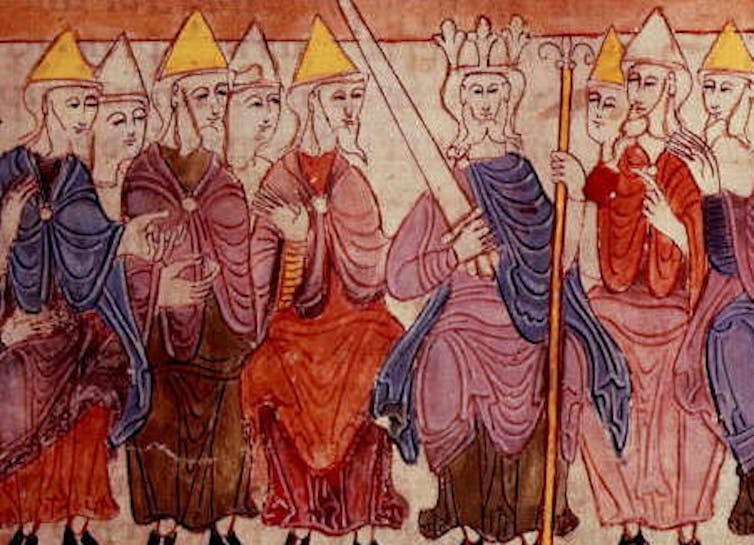
Witan hexateuch via Wikimedia Commons

A diverse history.
Witan hexateuch via Wikimedia Commons


In August, a religious group called the Odinist Fellowship wrote to the Church of England demanding two churches as reparations for a “spiritual genocide” which it claims began in the seventh century AD.

The Odinists use old Icelandic texts to reconstruct the “indigenous” religion of the Anglo-Saxons which they claim was oppressed with the arrival of Christianity. The Anglo-Saxons are commonly believed to have migrated into Briton in the fifth and sixth century AD. Iceland by contrast was inhabited in the ninth century by Viking settlers. In the US, this mixed up medievalism is associated with the white supremacist alt-right who use Anglo-Saxon and Viking motifs.

But archaeological research, which examines ancient DNA and artefacts to explore who these “indigenous” Anglo-Saxons were, shows that the people of fifth and sixth century England had a mixed heritage and did not base their identity on a biological legacy. The very idea of the Anglo-Saxon ancestor is a more recent invention linked closely with the English establishment.


Listen: The Anthill podcast episode on myths includes a segment on myths about race


The Anthill 20: Myths.
CC BY-ND38,2 Mo (download)


What DNA evidence shows


For decades, archaeologists and geneticists have sought to identify Anglo-Saxons in England. An early attempt in 2002 relied on modern DNA with a study of the male Y chromosome suggesting there had been a 95% population replacement of Britons by the Anglo-Saxons, comprised of different people from Northern Europe. But another study, based on mitochondrial DNA which is inherited from the mother, found no evidence of significant post-Roman migration into England. A third paper suggested that the genetic contribution of the Anglo-Saxons in south-eastern England was under 50%.

The discrepancies between the findings are because these three papers used modern DNA and worked backwards. Work my colleagues and I have undertaken looked at the question from the other direction – by working with ancient DNA.

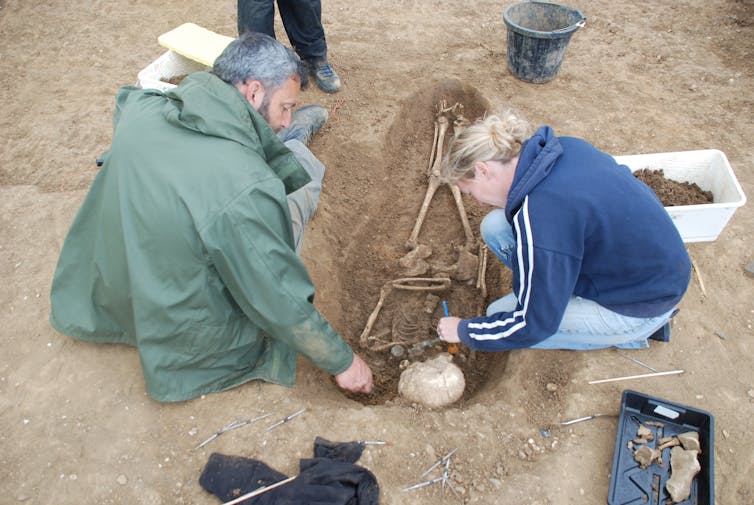
The results from our recent study were published in Nature Communications and included evidence from an Anglo-Saxon site I excavated in Oakington, Cambridgeshire. In total ten skeletons were investigated. These included seven early medieval graves dating to between the fifth and eighth century – four from Oakington and three from Hinxton – and three earlier Iron Age graves from Cambridgeshire, dating to between the second century BC and the first century AD, to provide the genome of the antecedent inhabitants of Briton.

We used a novel method called “rarecoal” to look at ancestry based on the sharing of rare alleles, which are the building blocks of genes. Our research concluded that migrants during what’s now thought of as the Anglo-Saxon period were most closely related to the modern Dutch and Danish – and that the modern East English population derived 38% of its ancestry from these incomers. The rest of Britain, including today’s Scottish and Welsh, share 30% of their DNA with these migrants.


Excavating at Oakington. Duncan Sayer

Excavating at Oakington.
Duncan Sayer, Author provided


The analysis of DNA of four individuals from the Oakington Anglo-Saxon cemetery identified that one of them was a match with the Iron Age genome, two were closest to modern Dutch genomes, and one was a hybrid of the two. Each of these burials was culturally Anglo-Saxon because they were buried in the same way, in the same cemetery. In fact, the richest assemblage of Anglo-Saxon artefacts came from the individual with the match for Iron Age genetic ancestry, and so was not a migrant at all.

It shows that these ancient people did not distinguish biological heritage from cultural association. In other words, someone who lived and died in the fifth or sixth century Anglo-Saxon village of Oakington could have been biologically related to an earlier inhabitant of England, a recent migrant from continental Europe or a descendent of either or both – they were all treated the same in death.

Writing Anglo-Saxons into history


Biologically then these people were a mixed group who shared what we consider Anglo-Saxon culture. But they did not think of themselves as Anglo-Saxons.

The idea of the Anglo-Saxon is a romanticised and heavily politicised notion. When Gildas, a sixth century Monk wrote De Excidio et Conquestu Britanniae (On the Ruin and Conquest of Britain) he referred only to Saxons. Writing 200 years later, the Venerable Bede used the word “Anglorum” in his ecclesiastical history to describe a people unified under the church. In the ninth century, Alfred the Great used the term Anglo-Saxon to describe the extent of his realm – but this description did not persist.

It was not until the 16th century that pre-Norman people were consistently described as Anglo-Saxons. Previously, stories like the 1485 Le Morte d'Arthur, by Thomas Malory, romanticised Arthurian antagonists who defended Britain from invading Saxons. This origin story was important enough to late medieval Englishness that Henry VIII installed a round table in Winchester castle.


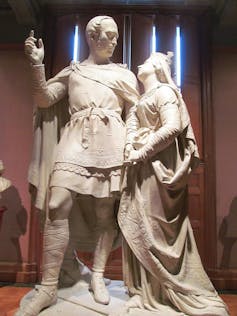
 Victoria and Albert: Anglo-Saxon style.

Victoria and Albert: Anglo-Saxon style.
David Holt London/flickr, CC BY


It was not until the 19th century that Anglo-Saxon poems such as Beowulf, the Seafarer and the Wanderer were translated into English as interest in Anglo-Saxons grew. In London’s National Portrait Gallery, there is a statue of Queen Victoria and Prince Albert of Saxe-Coburg and Gotha dressed as Anglo-Saxon monarchy – a commission that equated their Germanic descent with that of their subjects. This Anglo-Saxon origin story has its roots in politics, downplayed when anti-German sentiment during World War I prompted the royals to change their name from Saxe-Coburg-Gotha to Windsor in 1917.

A convenient, but inaccurate label


The people of the fifth, sixth and seventh century certainly did not think of themselves as Anglo-Saxons and would not have understood the description. Migration into the UK took place in deep prehistory, throughout the Roman and post-Roman periods – a fact which the Classicist Mary Beard was lambasted for defending on Twitter in August.

Migration then continued with Viking settlement in the ninth and eleventh centuries. Dutch and European migration into England was present throughout the middle ages and particularly pronounced in the 16th and 17th century as Flemish weavers fled religious persecution.

Today, the term Anglo-Saxon is a convenient label for those opposed to future immigration. While it collectively describes some post-Roman and early medieval culture, it has never accurately described a biological ethnicity nor an indigenous people. The DNA evidence points to an integrated people of mixed ancestry who lived side by side.

Anglo-Saxon ancestry is a modern English myth – the English are not descended from one group of people, but from many and that persists in our culture and in our genes.


The ConversationTo hear more on myths about race, listen to the December episode of The Anthill podcast on myths, featuring an interview with Duncan Sayer.

Duncan Sayer, Reader in Archaeology, University of Central Lancashire

La version originale de cet article a été publiée sur The Conversation.