Showing posts with label archeology. Show all posts

Wednesday, December 12, 2018

Guest Post: An archaeological dig in Israel suggests how feasting became an important ritual


Natalie Munro, University of Connecticut

This holiday season millions of families will come together to celebrate their respective festivals and engage in myriad rituals. These may include exchanging gifts, singing songs, giving thanks, and most importantly, preparing and consuming the holiday feast.


Archaeological evidence shows that such communally shared meals have long been vital components of human rituals. My colleague Leore Grosman and I discovered the earliest evidence of a ritual feast at a 12,000-year-old archaeological site in northern Israel and learned how feasts came to be integral components of modern-day ritual practice.


First, what are rituals?


Rituals involve meaningful, often repeated actions. In modern-day practices they are expressed through rites such as the hooding of a doctoral student, birthdays, weddings or even sipping wine at Holy Communion or lighting Hanukkah candles.
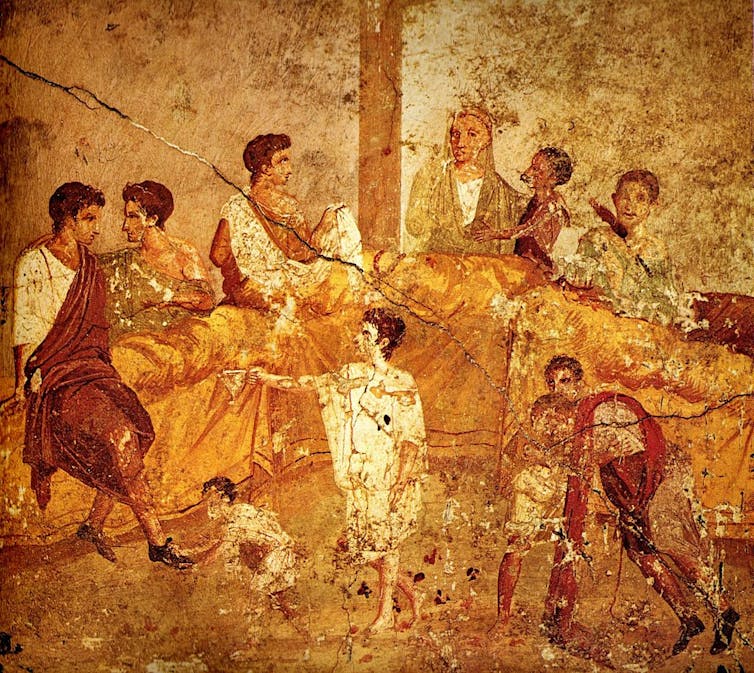


Pompeii family feast painting Naples

Pompeii family feast painting, Naples.
Unknown painter before 79 AD, via Wikimedia Commons


Ritual practice may have emerged along with other early modern human behaviors more than 100,000 years ago. However, proving this with material evidence is a challenge. For example, researchers have found that both Neanderthals and early modern humans buried their dead, but scholars weren’t certain whether this was for spiritual or symbolic reasons and not for something more mundane like maintaining site hygiene. Likewise, the discovery of 100,000-year-old symbolic artifacts like pierced shell ornaments and decorated chunks of red ochre in caves in South Africa, was not sufficient to prove that they were part of any ritual activities.

It was only when archaeologists found these artifacts, placed in graves going back 40,000-20,000 years, that it was confirmed they were part of ritual practice.

The first feasts


We had a similar experience during our research. When Leore Grosman and I first embarked on the excavations at Hilazon Tachtit in the late 1990s, we were only hoping to document the activities of the last hunter-gatherers in Israel, at what appeared to be a small campsite. It was only over several seasons of excavation that it slowly became clear to us that this was not a site where people had lived. Rather it was a site for rituals.
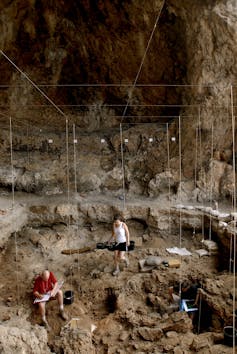


Hilazon Tachtit cave interior. Naftali Hilger

Hilazon Tachtit cave interior.
Naftali Hilger, CC BY-NC-ND


No houses, fireplaces or cooking areas were recovered. Instead the cave yielded the skeletal remains of at least 28 individuals interred in three pits and two small structures.

One of these structures contained the complete skeleton of an older woman, who we interpreted as a shaman based on her special treatment at death. Her grave stood apart due to its fine construction – the walls were plastered with clay and inset with flat stone slabs. Even more remarkable was the eclectic array of animal body parts buried alongside of her. The pelvis of a leopard, the wing tip of an eagle, the skulls of two martens and many other unusual body parts surrounded her skeleton.

The butchered remnants of more than 90 tortoises buried in the grave and the leftovers of at least three wild cattle deposited in a second adjacent depression excavated in the cave floor represent the remains of a funeral feast.
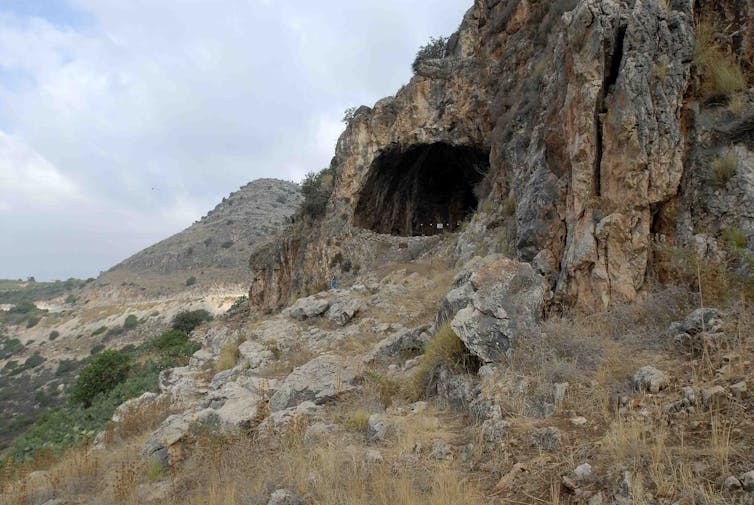


Hilazon Tachtit cave. Naftali Hilger

Hilazon Tachtit cave.
Naftali Hilger, CC BY-NC-ND


The outstanding preservation of the grave enabled us to detect multiple phases of a ritual performance that included the consumption of the feast, the burial of the woman, and the filling of the grave in several stages, including the intentional deposition of garbage from the feast.

Feasting at the beginning of agriculture


Archaeologists have found other sites that show evidence of ritual feasting. Many of these date to the time when humans were beginning to farm.
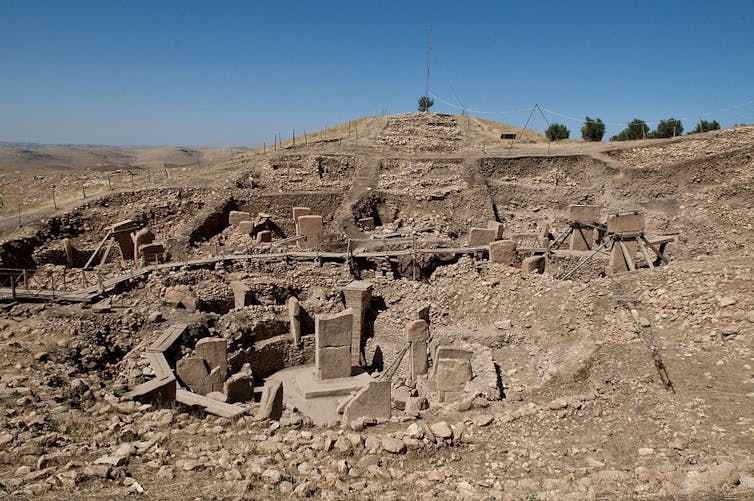


Site of Göbekli Tepe. Teomancimit

Site of Göbekli Tepe.
Teomancimit (Own work) , via Wikimedia Commons, CC BY-SA


One of the most striking is the site of Göbekli Tepe in southeastern Turkey, dating slightly later than Hilazon Tachtit. It includes multiple large structures adorned with benches and giant stone slab carved with exquisite animal depictions in relief dating to 11-12,000 years ago. Perhaps, these were very early communal buildings. The archaeologists who excavated Göbekli Tepe argue that massive quantities of animal bones associated with the structures represent the remains of feasts.

Twelve thousand years ago humans were still hunter-gatherers, subsisting entirely on wild foods. Nevertheless, these people differed from those who went before – they were sitting on the brink of the transition to agriculture, one of the most significant economic, social and ideological transformations in human history.

Sickle blades and grinding stones used to harvest and process cereal grains are found at Hilazon Tachtit and other contemporary archaeological sites. These findings indicate that these ritual feasts started around the same time that people adopted agriculture. When people began to rely more heavily on wild cereals like wheat and barley, they became increasingly tethered to landscapes that were ever more crowded and began to settle into more permanent communities. In other words, feasting became a part of their life, once they moved away from nomadic life.

Rituals that bind


These feasts had an important role to play. Adapting to village life after hundreds of millennia on the move was no simple act. Research on modern hunter-gatherer societies shows that closer contact between neighbors dramatically increased social tensions. New solutions to avoid and repair conflict were critical.

The simultaneous appearance of feasting, communal structures and specialized ritual sites suggest that humans were seeking to solve this problem by engaging the community in ritual practice.

One of the central functions of ritual in these communities was to provide a kind of social glue that bound community members by promoting social cohesion and solidarity. Feasts generate loyalty and commitment to the community’s success. Sharing food is intimate and it builds trust.

Communal rituals would have provided a shared sense of identity at a time when social circles were increasing in scale and permanence. They reinforced new ideologies that emerged out of a dramatic reorganization of economic and social life.

Role of feasts today

Feasting plays the same essential role today. Like the earliest feasts, our holiday celebrations are replete with actions that are repeated year after year.

The holiday feast today builds family traditions. By cooking and sharing food together, telling stories of past holidays and exchanging intergenerational wisdom, holiday rituals bond extended families and give them a shared identity.The Conversation

Natalie Munro, Professor, University of Connecticut

This article is republished from The Conversation under a Creative Commons license. Read the original article.
Saturday, December 30, 2017

Guest Post: The myth that the English have a common Anglo-Saxon origin

Duncan Sayer, University of Central Lancashire

The idea that there is a common Anglo-Saxon ancestry based on biology is gaining currency among some right-wing and religious groups in the UK and US.

In the UK, the new leader of the UK Independence Party, Henry Bolton, suggested in a radio interview in October that “in certain communities the indigenous Anglo-Saxon population is nowhere to be seen.”


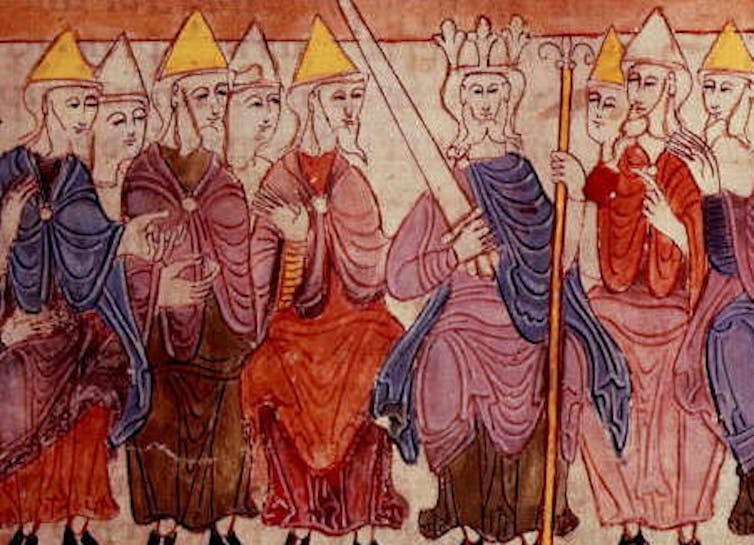
Witan hexateuch via Wikimedia Commons

A diverse history.
Witan hexateuch via Wikimedia Commons


In August, a religious group called the Odinist Fellowship wrote to the Church of England demanding two churches as reparations for a “spiritual genocide” which it claims began in the seventh century AD.

The Odinists use old Icelandic texts to reconstruct the “indigenous” religion of the Anglo-Saxons which they claim was oppressed with the arrival of Christianity. The Anglo-Saxons are commonly believed to have migrated into Briton in the fifth and sixth century AD. Iceland by contrast was inhabited in the ninth century by Viking settlers. In the US, this mixed up medievalism is associated with the white supremacist alt-right who use Anglo-Saxon and Viking motifs.

But archaeological research, which examines ancient DNA and artefacts to explore who these “indigenous” Anglo-Saxons were, shows that the people of fifth and sixth century England had a mixed heritage and did not base their identity on a biological legacy. The very idea of the Anglo-Saxon ancestor is a more recent invention linked closely with the English establishment.


Listen: The Anthill podcast episode on myths includes a segment on myths about race


The Anthill 20: Myths.
CC BY-ND38,2 Mo (download)


What DNA evidence shows


For decades, archaeologists and geneticists have sought to identify Anglo-Saxons in England. An early attempt in 2002 relied on modern DNA with a study of the male Y chromosome suggesting there had been a 95% population replacement of Britons by the Anglo-Saxons, comprised of different people from Northern Europe. But another study, based on mitochondrial DNA which is inherited from the mother, found no evidence of significant post-Roman migration into England. A third paper suggested that the genetic contribution of the Anglo-Saxons in south-eastern England was under 50%.

The discrepancies between the findings are because these three papers used modern DNA and worked backwards. Work my colleagues and I have undertaken looked at the question from the other direction – by working with ancient DNA.

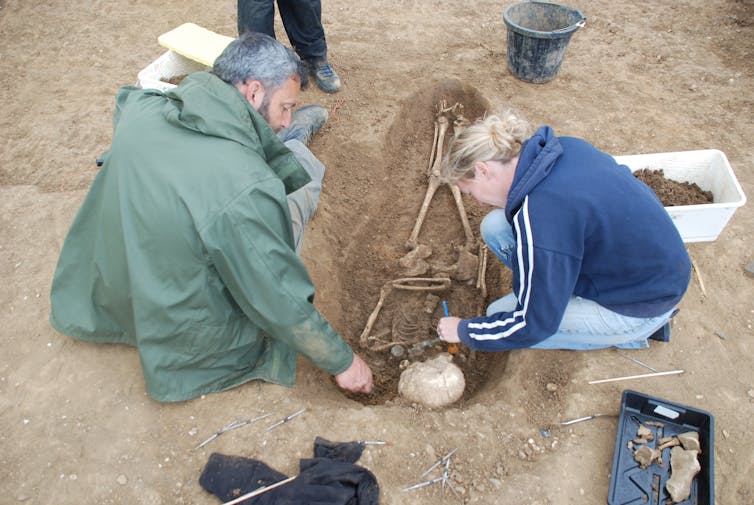
The results from our recent study were published in Nature Communications and included evidence from an Anglo-Saxon site I excavated in Oakington, Cambridgeshire. In total ten skeletons were investigated. These included seven early medieval graves dating to between the fifth and eighth century – four from Oakington and three from Hinxton – and three earlier Iron Age graves from Cambridgeshire, dating to between the second century BC and the first century AD, to provide the genome of the antecedent inhabitants of Briton.

We used a novel method called “rarecoal” to look at ancestry based on the sharing of rare alleles, which are the building blocks of genes. Our research concluded that migrants during what’s now thought of as the Anglo-Saxon period were most closely related to the modern Dutch and Danish – and that the modern East English population derived 38% of its ancestry from these incomers. The rest of Britain, including today’s Scottish and Welsh, share 30% of their DNA with these migrants.


Excavating at Oakington. Duncan Sayer

Excavating at Oakington.
Duncan Sayer, Author provided


The analysis of DNA of four individuals from the Oakington Anglo-Saxon cemetery identified that one of them was a match with the Iron Age genome, two were closest to modern Dutch genomes, and one was a hybrid of the two. Each of these burials was culturally Anglo-Saxon because they were buried in the same way, in the same cemetery. In fact, the richest assemblage of Anglo-Saxon artefacts came from the individual with the match for Iron Age genetic ancestry, and so was not a migrant at all.

It shows that these ancient people did not distinguish biological heritage from cultural association. In other words, someone who lived and died in the fifth or sixth century Anglo-Saxon village of Oakington could have been biologically related to an earlier inhabitant of England, a recent migrant from continental Europe or a descendent of either or both – they were all treated the same in death.

Writing Anglo-Saxons into history


Biologically then these people were a mixed group who shared what we consider Anglo-Saxon culture. But they did not think of themselves as Anglo-Saxons.

The idea of the Anglo-Saxon is a romanticised and heavily politicised notion. When Gildas, a sixth century Monk wrote De Excidio et Conquestu Britanniae (On the Ruin and Conquest of Britain) he referred only to Saxons. Writing 200 years later, the Venerable Bede used the word “Anglorum” in his ecclesiastical history to describe a people unified under the church. In the ninth century, Alfred the Great used the term Anglo-Saxon to describe the extent of his realm – but this description did not persist.

It was not until the 16th century that pre-Norman people were consistently described as Anglo-Saxons. Previously, stories like the 1485 Le Morte d'Arthur, by Thomas Malory, romanticised Arthurian antagonists who defended Britain from invading Saxons. This origin story was important enough to late medieval Englishness that Henry VIII installed a round table in Winchester castle.


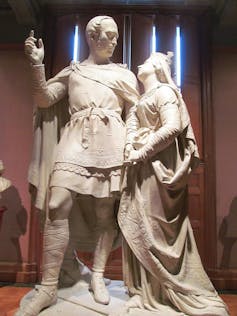
 Victoria and Albert: Anglo-Saxon style.

Victoria and Albert: Anglo-Saxon style.
David Holt London/flickr, CC BY


It was not until the 19th century that Anglo-Saxon poems such as Beowulf, the Seafarer and the Wanderer were translated into English as interest in Anglo-Saxons grew. In London’s National Portrait Gallery, there is a statue of Queen Victoria and Prince Albert of Saxe-Coburg and Gotha dressed as Anglo-Saxon monarchy – a commission that equated their Germanic descent with that of their subjects. This Anglo-Saxon origin story has its roots in politics, downplayed when anti-German sentiment during World War I prompted the royals to change their name from Saxe-Coburg-Gotha to Windsor in 1917.

A convenient, but inaccurate label


The people of the fifth, sixth and seventh century certainly did not think of themselves as Anglo-Saxons and would not have understood the description. Migration into the UK took place in deep prehistory, throughout the Roman and post-Roman periods – a fact which the Classicist Mary Beard was lambasted for defending on Twitter in August.

Migration then continued with Viking settlement in the ninth and eleventh centuries. Dutch and European migration into England was present throughout the middle ages and particularly pronounced in the 16th and 17th century as Flemish weavers fled religious persecution.

Today, the term Anglo-Saxon is a convenient label for those opposed to future immigration. While it collectively describes some post-Roman and early medieval culture, it has never accurately described a biological ethnicity nor an indigenous people. The DNA evidence points to an integrated people of mixed ancestry who lived side by side.

Anglo-Saxon ancestry is a modern English myth – the English are not descended from one group of people, but from many and that persists in our culture and in our genes.


The ConversationTo hear more on myths about race, listen to the December episode of The Anthill podcast on myths, featuring an interview with Duncan Sayer.

Duncan Sayer, Reader in Archaeology, University of Central Lancashire

La version originale de cet article a été publiée sur The Conversation.