Thursday, September 07, 2006

Slow News Day

It must be a slow news day at the Jewish Daily Forward, a venerable New York-based newspaper.

Here are two of the five headlines on Friday's front page:


and


Meanwhile, buried on page three is a story about political pressures that may force Hamas to join forces with its rival party in the Palestinian authority, Fatah, or face a total collapse.

The first article noted above, written by reporter Rebecca Spence, is about the owners of a barbecue restaurant in Rockaway Beach, Missouri. (Talk about "far Rockaway"!) Rockaway Beach was once a thriving tourist resort but in recent years has fallen on hard times due to competition from the far glitzier nearby town of Branson (where, Tim Hulsey tells me, one can see Anita Bryant perform early in the morning -- early enough so you can skip breakfast in an effort not to lose it during her stage show).

Spence reports:
Branson counts about 10 million visitors in a year. So when two men, known to have catered food for The Oak Ridge Boys, arrived from Branson and set up a barbecue restaurant that attracted some 500 people Saturday nights for live music and dancing, many town residents credited them with helping to revive their flagging economy.

But the pair’s presence also generated a flurry of controversy. According to the two men, a handful of local figures, including the mayor and the president of the Chamber of Commerce, have tried — with little success — to drive them out of town. One member of the barbecuing duo, Ron Mangum, had a Jewish father and retains a strong Jewish identity, which he suggests is one factor in the opposition he faces. But he says the issue has more to do with the fact that he and his business partner, Brian Mellott, are also partners after hours.

At a recent party to celebrate a developer’s bid to build a casino in Rockaway Beach, population 600, the mayor was reported to have been crystal clear in expressing his sentiments about Mangum — who is also the publisher of the Oklahoma-based gay newspaper the Gay Guardian — and his partner, Mellott. According to witnesses, Mayor Tom Strom said that he was “tired of the two faggots down the street, and if I don’t start getting the support of the ones here, I am going to resign.”

Seven of the 16 residents who attended the gathering, including the hostess, Susan Riggs, one of the town’s four aldermen, have signed notarized affidavits attesting to the mayor’s inflammatory remarks.
Nice mayor. Maybe he should move to Branson to be close to the orange juice queen.

The second article, by Nathaniel Popper, begins:
The evening of August 30 was a dark one for the kosher food ndusry.

First, a group of rabbis in New York discovered boxes upon boxes of nonkosher meat in the warehouse of a major kosher meat distributor. At roughly the same time, in Pennsylvania, federal agents seized 726 pounds of marijuana at a kosher slaughterhouse.

The drug bust occurred in Birdsboro at the G & G Poultry facility, which produces kosher chicken under the strictest rabbinic supervision. According to an affidavit from a federal customs agent, the authorities tracked the movement of marijuana in and out of the factory’s parking lot for more than a week before moving in.
I can see the listing on Amazon.com now: The Alice B. Toklas Kosher Cookbook.

Wednesday, September 06, 2006

'The Elephant in the Room'


Today the Cato Institute in Washington hosted a forum on New York Post columnist Ryan Sager's new book, The Elephant in the Room: Evangelicals, Libertarians, and the Battle to Control the Republican Party. Sager, who also writes at RealClearPolitics.com, made a brief presentation about the book, followed by comments from U.S. News and World Report political analyst Michael Barone and questions from the audience.

The F.A. Hayek Auditorium was filled to capacity, with extra chairs brought in and more than a dozen audience members watching on a TV monitor in an overflow room. There was clearly a lot of interest in this book's topic.

Sager, who once interned at the Cato Institute and also served as a research assistant to Cato executive vice president David Boaz, began by noting that "as Republican-controlled Washington looks more and more like Animal Farm, the Cato Institute is our own slice of The Fountainhead," which brought chuckles from the largely libertarian audience.

On the surface, Sager suggested, the Republican Party looks quite successful, with control of many statehouses as well as the White House and both houses of Congress. But the GOP, he said, tends to "mistake winning for actual victory." While part of the problem is George W. Bush, there is something deeper the Republicans must be concerned with, "a tear in the fabric of the conservative movement."

"This isn't a 2006 crisis," he said, referring to anticipated losses at the polls this coming November, "it's an existential crisis of the conservative movement."

Sager referred to the conservative movement's past, and directed his audience specifically to look at the writings of Frank Meyer in the 1950s, whose theory of "fusionism" brought together disparate elements in the conservative movement -- what today we call libertarians and social conservatives, but who were then known as libertarians and traditionalists.

The big issue then was the Cold War, with both libertarians and "trads" opposing communism -- libertarians because communism was anti-liberty, traditionalists because communism was "godless."

There was a formulation at play, which stated that "traditionalist ends could be achieved through libertarian means." This allowed the two factions to work together for common purposes despite differences in approach and philosophy.

Meyer's theory of fusionism was applied successfully when the factions coalesced to support Barry Goldwater for president in 1964. Although Goldwater lost the election, a new movement was born that eventually resulted in the election of Ronald Reagan, who also effectively held together the factions within the conservative movement. Sager describes the Reagan presidency as "the height of fusionism."

When the Cold War ended during the Bush I administration and George H.W. Bush broke his "no new taxes" pledge, the glue that held the conservative movement dissipated. Then the Clinton administration came along to reunite the conservative movement, with the result being the Newt Gingrich-led, successful effort of the GOP to retake control of Congress for the first time in four decades.

All this leads to the question, How did we end up with George W. Bush? Sager's answer is that the Republican party began believing its own bad press, and thought that it had to overcome a reputation for meanness. Thus we got "'compassionate conservatism' instead of 'conservatism.'" Sager said it was unclear whether Bush's intentions were truly conservative or if he misled voters to believe he was a conservative when, in fact, he was not.

Speaking aphoristically, Sager concluded: "Bush lied, conservatism died."

Bush's defenders, Sager said, like to blame the growth of government during the last six years on a response to 9/11. But that "doesn't add up," he said, since most of the growth in government has nothing to do with the war on terror, listing as examples No Child Left Behind, the Medicare drug boondoggle, the transportation pork bill, the anti-First Amendment McCain-Feingold campaign finance "reform" law, and other non-defense related expansions in the federal government and violations of civil liberties.

Sager warned that, although the Republicans have still been winning elections while all this has been going on, "a reckoning is on its way." He said that 2008 is the year in which we will see where the party is going, specifically whether it will return to the traditional, pre-Bush emphasis on small-government conservatism.

Sager then shifted gears a bit to look at a regional divide in the American political landscape. He pointed out that the South, where the GOP has a lot of its electoral base, is more heavily social conservative, while the interior West (that is, the western states excluding California, Oregon, and Washington) is more heavily libertarian. He noted that, while most press reports after the 2004 election looked at the closeness of the outcome in Ohio (which, I might add, John Kerry is still whining about), the White House could also have gone to the Democrats if 70,000 votes in Colorado, Nevada, and New Mexico had shifted from red to blue.

The Democrats, he said, are beginning to understand the opportunity they face in the West. They have elected four governors there in recent years and are beginning to formulate a message that appeals to small-government-oriented, leave-me-alone voters in that region.

Sager concluded his remarks by suggesting that a return to fusionism will save the GOP. He said there are two major areas of common ground that need to be pursued: (1) a renewal of the commitment to school choice, which both libertarians and social conservatives value, if for different reasons; and (2) taking on the mantle of cultural federalism and "dropping the national crusade against gays." If Massachusetts or Vermont or Connecticut want gay marriage, he said, the federal government should not stand in their way.

Ending with a quotation from Frank Meyer, Sager said that "truth withers when freedom dies, however righteous the authority that kills it; and free individualism uninformed by moral value rots at its core and soon brings about conditions that pave the way for surrender to tyranny."

For his part, Michael Barone said that, although he largely agrees with Sager, he wanted to focus on his disagreements, starting with a disagreement with the statement that "Bush lied, conservativism died." Barone said "there is a certain anger in this book, which is a young man's book. In 40 years, we'll see a mellower Ryan."

Barone argued that the "current state of polarization of the parties is in part an accidental matter of candidates."

He noted that both Bill Clinton and George W. Bush were born in 1946, the first year of the baby boom, and both graduated from high school in 1964, which was the high-water mark for SAT scores. Both, he pointed out, ran for president with a platform that promised they would be moderate but both ended up as polarizing figures. Using these as examples, he said, a lot of political alignment is actually "artifacts of candidates."

By 2008, Barone said, we will have a different set of characters, and he referred the audience to his column in this week's U.S. News and World Report, which compares several of the leading candidates for president in both parties.

The leading candidates for the Republicans, Rudy Giuliani and John McCain, he said, are not pure libertarians, but both have aspects that appeal to libertarian voters. McCain, for instance, "would veto some spending bills." He also noted a recent poll that indicated a Giuliani-McCain ticket would beat a Clinton-Gore ticket, with a concentration of votes in the interior West, the region Sager identifies as most libertarian-leaning.

Barone was critical of Sager for tending to "concentrate too much on national politics." He assumes the "Franklin Roosevelt model" that says nothing happens unless Congress passes a bill to address it. Reform, however, "is bubbling up from states and localities." In mid-century America, he said, the country was centralizing. "We have moved to a more decentralized, market-oriented country."

He gave as an example education. "School choice is bottom-up," he said, starting in places like Milwaukee and Cleveland. In the District of Columbia, 24 percent of government school students are enrolled in charter schools.

"I see No Child Left Behind as a federal attempt to accelerate the process against the institutionalized opposition" to education reform, Barone said, mentioning teachers' unions and education schools as the chief opponents.

"The biggest difference I have" with Sager, Barone said, is that it is "less important to shrink government and more important to promote choice and accountability."

The book forum on The Elephant in the Room: Evangelicals, Libertarians, and the Battle to Control the Republican Party is available in a webcast at the Cato Institute's web site.

Carnivals of Liberty and Virginia

Two more blog carnivals are up, both referring readers to my post last week on "Property Rights and Human Rights."

This week's Virginia Blog Carnival is rather thinly populated, but Rocinante shoulders its burdens nobly (as one might expect). Despite the low number of submissions, it's worth a look.

Quotulaciousness
(say that five times fast) hosts this week's Carnival of Liberty, which he divides taxonomically under quasi-academic categories: political science, philosophy, economics, sports, legal, environmental, war, and "it doesn't fit anywhere."

As I mentioned last week, I will be hosting the Carnival of Liberty on September 12, and I invite blog-writing readers (or readers who blog) to submit their best posts of this week within that broad category. Deadline for submissions will be around 6:00 p.m. (EDT) on Monday, September 11. There is a form to submit entries at Conservative Cat.

Tuesday, September 05, 2006

Wilkinson: Keep Marriage Out of Constitutions


A highly respected conservative jurist who sits on the Fourth Circuit Court of Appeals in Richmond has put himself on the record in opposition to amending constitutions -- whether federal or state constitutions -- to define marriage.

Charlottesville resident and University of Virginia alumnus (he graduated from the Law School in 1972 and later taught there) Judge J. Harvie Wilkinson, who was nominated to his current position by President Ronald Reagan in 1984, has an op-ed piece in today's Washington Post that outlines his argument against "constitutionalizing" marriage.

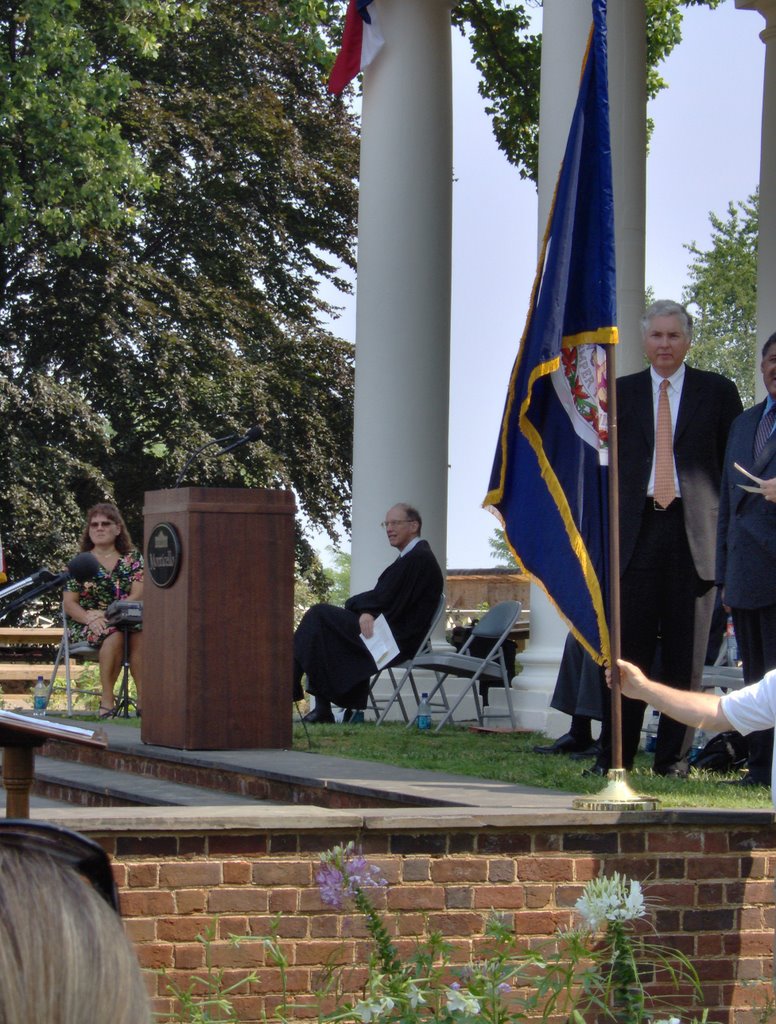
In "Hands Off Constitutions: This Isn't the Way to Ban Same-Sex Marriage," Wilkinson (pictured, seated at Mr. Jefferson's house at Monticello, in the photo on your right) writes:

The Framers meant our Constitution to establish a structure of government and to provide individuals certain inalienable rights against the state. They certainly did not envision our Constitution as a place to restrict rights or enact public policies, as the Federal Marriage Amendment does.

Ordinary legislation -- not constitutional amendments -- should express the community's view that marriage "shall consist only of the union of a man and a woman." To use the Constitution for prescriptions of policy is to shackle future generations that should have the same right as ours to enact policies of their own. To use the Constitution as a forum for even our most favored views strikes a blow of uncommon harshness upon disfavored groups, in this case gay citizens who would never see this country's founding charter as their own.

Wilkinson, who was widely touted as a potential successor to Sandra Day O'Connor upon her retirement from the U.S. Supreme Court, notes -- correctly, in my opinion -- that proposals to insert marriage into constitutions are not in keeping with either federal or state constitutional and legal traditions:

To constitutionalize matters of family law is to break with state traditions. The major changes in family law in the 19th and 20th centuries, such as the recognition of married women's property rights and the liberalization of divorce, occurred in most states at the statutory level. Even the infamous bans on interracial marriage were adopted nonconstitutionally by 35 states, and by constitutional amendment in only six.

Where is the threat that justifies so radical a break with our constitutional heritage? State courts in Georgia, New York and Washington have recently rejected invitations to follow Massachusetts and find a right to same-sex marriage in their constitutions. The great majority of state court judges -- more than 80 percent by some counts -- are subject to election in some form and unlikely to overturn state legislatures on so volatile a matter as same-sex marriage. States have numerous tools that enable them to reject objectionable marriages from other jurisdictions -- tools that have long been the basis for refusing to recognize marriages involving polygamy, incest, and underage or mentally incompetent parties.

While Judge Wilkinson does not say so outright, it seems fair to infer from his concluding paragraph that he, like hundreds of thousands of other Virginians, plans to vote "no" on the proposed Ballot Question #1 in this November's election. (That ballot measure does much more than simply define marriage. Its complexity can be read in full at the State Board of Elections web site.) Wilkinson ends his article by saying:
Is it too much to ask that judges and legislatures acknowledge the difficulty of this debate by leaving it to normal democratic processes? In fact, the more passionate an issue, the less justification there often is for constitutionalizing it. Constitutions tempt those who are way too sure they are right. Certainty is, to be sure, a constant feature of our politics -- some certainties endure; others are fated to be supplanted by the certainties of a succeeding age. Neither we nor the Framers can be sure which is which, but the Framers were sure that we should debate our differences in this day's time and arena. It is sad that the state of James Madison and John Marshall will in all likelihood forsake their example of limited constitutionalism this fall. Their message is as clear today as it was at the founding: Leave constitutions alone.
Conservatives -- particularly conservative Republicans, like Lieutenant Governor Bill Bolling and Attorney General Bob McDonnell, who have been rather vocal (if not particularly persuasive) in their support of the proposed Marshall/Newman Amendment to George Mason's Virginia Bill of Rights -- will have to come to grips with Judge Wilkinson's principled argument against constitutionalizing marriage law. They might sputter out a response, but they are unlikely to match his deliberateness and erudition. Other conservatives and Republicans have already shown their willingness to listen to reason on this issue.

In his article, Judge Wilkinson goes a long way toward answering the question that good, solid conservatives ask every time they are confronted with a serious issue of public policy: "What would Ronald Reagan do?" I hope that voters on November 7 ask themselves the same question before they push the "Cast Ballot" button.


Update: As one might expect, Judge Wilkinson's article is eliciting a lot of commentary among bloggers. Some posts I have seen (and there are surely others) include comments from Vivian Paige, Dale Carpenter at the Volokh Conspiracy, Delta Mike at the Virginia Progressive, and J. Sarge at New Dominion, F. T. Rea at SlantBlog, Steve Minor at the SW Virginia Law Blog, A Shot of Southern Comfort, The Midwestern Gentleman, and Glenn Reynolds at Instapundit. Meanwhile, somehow I missed an op-ed in yesterday's Richmond Times-Dispatch by a former Republican legislator on the economic consequences of the proposed amendment.

Another Update: GayPatriotWest, traveling in the great American Southwest, links to this post and mentions his own personal acquaintance with Judge Wilkinson while he (GPW) was a student at UVa Law School. Milwaukee-based blogger and law student Steve at Eminent Domain also has a comment, as does Andrew Sullivan, who calls Wilkinson's article "sane and smart."

Friday, September 01, 2006

Property Rights and Human Rights


In a letter to the editor of the Charlottesville Daily Progress, which appeared on Thursday, Uriah J. Fields of Albemarle County uses the complaint of one-time state legislative candidate Rich Collins against a local property owner to assert that Collins' First Amendment rights were violated.

I have written about the Collins case before, shortly after it hit the news ("Candidate Rich Collins Arrested," May 15, 2005, and "Update on Trespasser Rich Collins," May 24, 2005). Mr. Fields' letter made me want to revisit the issue, because he shows in his writing how widely the concept of property rights is misunderstood.

Fields writes
:

... since it is the public who patronizes shopping centers and makes it possible for them to exist, they should not be designated as private property. Shopping centers are “property in common” and should be designated as such.

Much too often property rights are allowed to trump human rights. This must cease.

The deprivatization of shopping centers needs to become a priority issue for politicians in Virginia who have been elected by the people to, among other things, safeguard their First Amendment free-speech right.

Whether Fields actually believes that shopping centers should be owned by the government is somewhat beside the point. He may be a socialist, or he may not be. He can try to defend his views in favor of that failed political and economic system if he likes.

What I want to focus on is his statement that "property rights are allowed to trump human rights," as though he is talking about two separate and incompatible categories.

The fact is, human rights do not exist in the absence of private property. Property rights are human rights because the rights we are talking about in the phrase "property rights" do not inhere to the property (whether real estate, intellectual property, capital goods, or the clothes on one's back) but to the human beings who own that property.

As UCLA economics professor Armen A. Alchian has noted in The Concise Encylopedia of Economics:
One of the most fundamental requirements of a capitalist economic system—and one of the most misunderstood concepts—is a strong system of property rights. For decades social critics in the United States and throughout the Western world have complained that "property" rights too often take precedence over "human" rights, with the result that people are treated unequally and have unequal opportunities. Inequality exists in any society. But the purported conflict between property rights and human rights is a mirage—property rights are human rights....

Private property rights do not conflict with human rights. They are human rights. Private property rights are the rights of humans to use specified goods and to exchange them. Any restraint on private property rights shifts the balance of power from impersonal attributes toward personal attributes and toward behavior that political authorities approve. That is a fundamental reason for preference of a system of strong private property rights: private property rights protect individual liberty. [Emphasis added]
As it happens, George Mason University economist Walter Williams addresses this issue (from a somewhat different angle) in one of his most recent syndicated columns. Dr. Williams invokes one of the Founders to conclude his column:
John Adams warned, "The moment the idea is admitted into society that property is not as sacred as the laws of God, and there is not a force of law and public justice to protect it, anarchy and tyranny commence. Property must be sacred or liberty cannot exist."
I could continue by citing John Locke and other notable philosophers about the importance of private property to liberty, but I thought this remark of poet e. e. cummings (which I found in a handy reference on my shelf, 20,000 Quips & Quotes, compiled by Evan Esar) put it nicely:
Private property began the instant somebody had a mind of his own.
That's what it's all about: the autonomy of the individual against the all-encompassing state or tribe. Private property is not opposed to human rights; it is what makes respect for human rights possible and their protection mandatory.

Thursday, August 31, 2006

A Judicial Precedent for Georgetown Protestants


As an alumnus of Georgetown University, my eye is often drawn to stories about the school, especially when they appear somewhere besides the sports pages. (Georgetown, I gather, has historically had a pretty good basketball program -- not that I've paid much attention.)

So when the Washington Times and Washington Post both reported last week that the University had effectively banned Protestant organizations that are not affiliated with the official campus ministry from operating on campus, my interest was piqued.

Michelle Boorstein reported last week in the Post:

Protestant groups that have been ministering to Georgetown University students on campus for years say they are stunned that the Catholic university has decided to eject outside ministries from campus, a decision that affects only Protestant organizations.

Georgetown's Protestant chaplaincy, part of the office of Campus Ministry, told the six outside Protestant groups Aug. 17 that they would no longer be allowed to reserve rooms for weekly meetings, use Georgetown's name or organize on campus without an invitation from a student. Between 100 and 300 students are active in the groups, which include Chi Alpha Christian Fellowship and InterVarsity Christian Fellowship, national organizations.

Reporters Gary Emerling and Michael Hunsberger explained in the August 26 edition of the Washington Times:
In a letter last week to leaders of the campus's Affiliated Ministries, the Rev. Constance C. Wheeler, a Georgetown Protestant chaplain, said that "as a result of our new direction for the upcoming academic year, we have decided not to renew any covenant agreements" with the groups.

The decision -- which affects a few hundred students belonging to six Christian groups -- forbids the ministries from having any "activity or presence" on campus, including worship services, retreats or helping students move into their dorms.

The groups also are prohibited from using the Georgetown name in publicity.
While the initial news articles indicated that members of the affected organizations were "stunned" (as the Post reported) and disappointed, today's papers suggest that the situation has escalated and the groups are seeking redress.

The headline on Gary Emerling's article in Thursday's Washington Times, "Barred ministries push back," tells the story succinctly. His article begins:
Members of several outside Protestant ministries recently barred from the campus of Georgetown University yesterday began a petition drive appealing the decision by school administrators.

"We're not trying to be hostile in any way," said Matt Bjonerud, a Georgetown senior and a leader of InterVarsity Christian Fellowship, one of six ministries banned from having an official presence at the Catholic school. "We're simply letting people know we think we're an important and vital part of the Georgetown community."

About 15 members of affected ministries -- all Protestant groups, although some, such as InterVarsity, also have Catholic members -- began passing out fliers to students in Georgetown's Red Square at 10 a.m. yesterday, the first day of classes.
Similarly, Michelle Boorstein's follow-up article in Thursday's Post notes:
... students and officials with the private ministry groups said the Campus Ministry in recent years has become more controlling and concerned about evangelizing. The groups were required to sign statements saying they would not proselytize, said Kevin Offner, who runs the InterVarsity group at Georgetown for graduate students.

InterVarsity has retained the services of a legal center that works to protect the on-campus rights of evangelicals. David French, who runs the Center for Academic Freedom, said yesterday that in recent years, "dozens of schools" across the country have tried to eject private evangelical groups that have conservative views on social issues.
If the evangelical students do take recourse to the courts, they may find a precedent to assist them -- if they choose to invoke it.

Nearly 20 years ago, in a decision handed down from the Court of Appeals for the District of Columbia, Georgetown was admonished for failing to provide equal access to gay and lesbian students' organizations. As explained by Lawrence Biemiller in the Chronicle of Higher Education on August 7, 1985 ("Homosexual Groups at Georgetown U. Get Court Backing"):
A three-judge panel of the District of Columbia's Court of Appeals last week reversed a trial court's ruling and ordered Georgetown University to grant official recognition to two organizations for homosexual students.

The judges, citing the Supreme Court's 1983 decision in Bob Jones University v. United States, ruled that the District's 1977 Human Rights Act established an "overriding governmental interest" in ending discrimination against homosexuals that is strong enough to justify some infringement on the Roman Catholic university's religious freedom. Georgetown had argued that granting recognition to the two groups might be interpreted as an endorsement of homosexual activity, which Catholic doctrine prohibits.
The panel's decision was later upheld by the full Court of Appeals, in a 5-2 decision issued on November 20, 1987. The case is cited frequently in legal scholarship as Gay Rights Coalition v. Georgetown University – 536 A. 2d 1 (D.C. App. 1987).

In his Chronicle of Higher Education article, Biemiller quotes the panel's majority opinion:
Further undermining Georgetown's case, the panel said, were the university's previous decisions to grant recognition to other student groups whose philosophies or activities at times contradict Roman Catholic doctrine, including the Jewish Students Association and the Women's Rights Collective, which has distributed literature on birth control and abortion.

The university had argued, the judges said, that the city government was unconstitutionally prohibited from infringing on "the university's right to interpret -- and apply -- its religious tenets as it sees fit, however illogical its religious line-drawing may appear to others."

"While we agree," the opinion continued, "that it is not for this court to interpret the Catholic faith -- nor are we doing so -- we cannot agree that Georgetown's particular application of unquestioned religious tenets has absolute priority here."

"A balancing test," the judges said, "is still required -- one that does not merely pit the District against Georgetown but, more broadly, accounts for the conflict of individual rights at issue here." Were the university to prevail in the case, they said, "the district's interest in enforcing nondiscriminatory treatment under the [Human Rights] Act on behalf of an ostracized class of individuals would be wholly frustrated."
Whether the evangelical students and off-campus groups constitute "an ostracized class of individuals" in this case is a question for another day. But it should not go unnoted how many different categories are covered by the D.C. Human Rights Act, which begins:
It is the intent of the Council of the District of Columbia, in enacting this chapter, to secure an end in the District of Columbia to discrimination for any reason other than that of individual merit, including, but not limited to, discrimination by reason of race, color, religion, national origin, sex, age, marital status, personal appearance, sexual orientation, gender identity or expression familial status, family responsibilities, matriculation, political affiliation, genetic information, disability, source of income, and place of residence or business. [emphasis added]
Georgetown University chose not to appeal the November 1987 decision, although many expected -- and others urged -- an appeal to the U.S. Supreme Court. Father Timothy S. Healy, S.J., who was then the university's president, sent a letter to alumni and faculty explaining the board of trustee's decision not to appeal, which was quoted in an article in the National Catholic Register (May 15, 1988):
"[The] Appeals Court had granted us what we claimed was our principal interest, the freedom to refuse official recognition to these groups."

Healy said in his letter that the board determined its case was very weak, and therefore decided not to appeal to the Supreme Court.

"In order to make a successful appeal, we were advised that we would have to attack the statute itself [a District of Columbia ordinance called the Human Rights Act], as well as plead our right of free exercise and free speech," Healy wrote. "The board felt that a Catholic institution would have difficulty attacking the statute, which, while it was perhaps over-inclusive, at the same time addressed a real problem and constituted a reasonable exercise of the District's police powers."
So it seems the evangelical groups might have a case based on Gay Rights Coalition v. Georgetown University. I would add a couple of caveats, however.

One is that, in reaction to the Georgetown case, Congress passed what is known as the "Armstrong Amendment" (named for its principal sponsor, then-Colorado Senator William Armstrong), which forced the D.C. Council to amend the Human Rights Act to exempt religious and political institutions from certain aspects of the Act. The clause that was added because of the Armstrong Amendment reads:
Nothing in this chapter shall be construed to bar any religious or political organization, or any organization operated for charitable or educational purposes, which is operated, supervised or controlled by or in connection with a religious or political organization, from limiting employment, or admission to or giving preference to persons of the same religion or political persuasion as is calculated by the organization to promote the religious or political principles for which it is established or maintained.
Now, the exemption was intended to let anti-gay discrimination continue, but it equally applies to "religion or political persuasion."

I should note that Georgetown decided, despite the change in the law, to continue to grant equal access to gay students organizations, which operate openly to this day. On the main campus, the name of the undergraduate LGBTQ group is now GU Pride. So far as I know, the gay students -- as individuals and as organized groups -- are fully integrated into campus life and their presence is barely noted, and hardly the stuff of newspaper headlines, as they were in the 1970s and 1980s.

My second caveat relates to the U.S. Supreme Court's 2000 decision in Boy Scouts of America v. Dale (which I have written about in the past). To summarize very roughly, the Dale decision says that organizations may discriminate against those whose viewpoints differ from their own. (In this case, the Boy Scouts expelled an openly gay Scoutmaster, who sued to be reinstated and eventually lost his suit.)

Put together, the Armstrong Amendment and the Dale decision may override the Gay Rights Coalition v. Georgetown University precedent, which therefore may not be helpful to the evangelical students and their outside organizations.

Still, I relish the possibility of evangelical Protestants citing a case that benefited gay and lesbian students as a reason to overturn Georgetown's decision to bar their activities on campus.


Katrina: One Year Later

The past couple of days have seen a burst of commentary and reportage on the anniversary of Hurricane Katrina.

In the Washington Post business section, for instance, one article looked at how Katrina has affected insurance providers and buyers of insurance policies:

Struggles ... are going on across the Gulf Coast, where more than a million policyholders have turned to their insurers for payment on homeowner's, commercial and other insurance claims. Battles over claims have clogged state and federal courts here and spilled into state legislatures.

Reeling from the scale of the disaster, most carriers have stopped writing new policies along the Gulf of Mexico, forcing policyholders into state-backed insurers of last resort. Earlier this summer, Allstate Insurance Co. of Northbrook, Ill., tried to renounce wind and hail coverage on 30,000 existing policies in Louisiana, a move it is reconsidering after the state insurance commissioner threatened legal action. Rates, meanwhile, are soaring. In Mississippi, the state-backed insurer of last resort asked this year for rate increases of nearly 400 percent, an amount that Insurance Commissioner George Dale cut to 90 percent.

Another article in the Post's national news section reported on the solemn commemoration of the hurricane's victims, attended by President Bush and other dignitaries in New Orleans:
Church bells pealed at 9:38 a.m. here Tuesday, the moment floodwaters breached the city's levees a year ago, as the anniversary of Hurricane Katrina cast a funereal pall over this half-empty city.

On his 13th trip to the Gulf Coast since the storm, President Bush joined residents in commemorating the losses with a particularly New Orleans flavor. Local dignitaries, emergency workers and politicians wended their way from the Convention Center to the Louisiana Superdome in a traditional jazz funeral procession, while during a remembrance Mass attended by Bush at the St. Louis Cathedral a clarinetist poured out a soulful version of "Just a Closer Walk With Thee."

The Washington Times, meanwhile, pointed out how the names given to tropical storms have changed in recent years, reflecting more acceptance of the ethnic and linguistic diversity North America, Central America, and the Caribbean:
Ernesto will have a little ethnic company in upcoming years. Humberto, Pablo and Cristobal are on future name rosters for hurricanes and tropical storms in the Atlantic -- not to mention Chantal, Nana, Gaston, Omar and Henri.

"Over the years, the names started out primarily Anglo-Saxon for Atlantic hurricanes. Now they reflect the diversity of the affected regions, with names originating from English, Spanish, French and Dutch, primarily," said Frank Lepore, spokesman for the Florida-based National Hurricane Center (NHC) yesterday.

Roughly a quarter of the 21 official names, which are assigned when weather patterns become tropical storms, have some international underpinnings. The practice has been in place since 1977, when a new "naming protocol" went into operation, Mr. Lepore said. Male names were alternated with female names, and the roster was tweaked to acknowledge other countries.
When Katrina hit last year, I posted three articles related to the story that was dominating headlines and airwaves:

"On the Radio" (September 8) reported how ShipCom, an Alabama-based radio service, had provided emergency frequencies to the Coast Guard and other agencies in the aftermath of the hurricane.

"Pearl of Africa" (also September 8) noted how foreign countries that usually receive U.S. economic and humanitarian assistance were coming to the aid of affected regions along the Gulf Coast. It referred back to Gordon Sinclair's famous radio commentary from the early 1970s, "The Americans: A Canadian's Opinion" for its prescience.

"Everything Old Is New Again" (September 23) allowed me to reach back into my experience as an advocate for civil defense and emergency management in the 1980s to point out that complaints about FEMA's competence are neither recent nor unique.

I will let others comment on what has happened in the intervening 12 months since Katrina made landfall and the levees broke. I invite you, the reader, to take a look at what I wrote last year. Comments, as always, are welcome.

This Week's Blog Carnivals


The Virginia Blog Carnival is hosted at CatHouse Chat this week. It includes a special section of reports from the Blogs United Conference in Martinsville (which, I regret to say, I was unable to attend).

Speaking of Virginia bloggers, Shaun Kenney and Lowell Feld were guests on Coy Barefoot's show on WINA-AM in Charlottesville on Wednesday. Most of the discussion was about the George Allen-Jim Webb campaign, and what might be the eventual fallout from Macacagate. Waldo Jaquith was Coy's guest on Tuesday, with an extended discussion about dental care in Virginia.

Matt Barr at the Socratic Rhythm Method hosts the 60th weekly Carnival of Liberty in a creative format that is unlikely to be surpassed. Alex Trebek fans will appreciate it.

By the way, I will be hosting the Carnival of Liberty here during the week of September 11. (It will be posted on Tuesday, September 12 [I hope].) I expect there will be a number of submissions related to the fifth anniversary of the 9/11 terrorist attacks. Submissions can be made through the form at Conservative Cat. Alternatively, there is also a Carnival of Liberty submission page at BlogCarnival.com. I invite my readers who blog to submit an article to the Carnival of Liberty that week.

Free Constitution is hosting the fourth Second Amendment Carnival. The interests of those who read the Carnival of Liberty and those who read the Second Amendment Carnival often overlap, of course.

Tuesday, August 29, 2006

News from the Kennedy Center

The John F. Kennedy Center for the Performing Arts today announced the all-star line-up of performers who will be honoring playwright Neil Simon when he receives the Mark Twain Prize in October:

Press Release

FOR IMMEDIATE RELEASE:
August 29, 2006

Leading American Entertainers
Jason Alexander, Richard Dreyfus, Nathan Lane,
Cyndi Lauper, Robert Redford, Paul Reiser, Mercedes Ruehl, Jonathan Silverman and others

Salute Kennedy Center “Mark Twain Prize" Recipient
Neil Simon
at the Kennedy Center Concert Hall
October 15, 2006

Program to be broadcast nationally on PBS
as part of WETA Washington, D.C.’s “The Kennedy Center Presents” series

WASHINGTON, D.C.— Leading American entertainers Jason Alexander, Richard Dreyfus, Nathan Lane, Cyndi Lauper, Robert Redford, Paul Reiser, Mercedes Ruehl, Jonathan Silverman and others to be announced will salute Kennedy Center Mark Twain Prize recipient Neil Simon in the Kennedy Center Concert Hall on Sunday, October 15 at 8 p.m. The program, to be taped for the sixth year by WETA Washington, D.C. as The Kennedy Center Presents: The 2006 Mark Twain Prize, will air on PBS stations nationwide on Mon., Nov. 20 at 9pm ET (check local listings). Tickets are on sale now for the general public.

Neil Simon, born in the Bronx on July 4, 1927, is America’s foremost playwright. For more than four decades, his plays have invigorated the stage with poignant stories and zany characters known for their family-based New York settings. He has authored more than 40 Broadway plays since 1961, ranging from humorous, lighthearted conceits (Barefoot in the Park, The Odd Couple) to deeper, autobiographical works (Chapter Two, the Eugene trilogy featuring Brighton Beach Memoirs, Biloxi Blues and Broadway Bound). Simon contributed librettos to such hit musical comedies as Sweet Charity; Promises, Promises and They’re Playing Our Song. As a screenwriter, he has had more than a dozen major motion pictures produced (including The Goodbye Girl, Lost in Yonkers). Perhaps his greatest contribution has been his extraordinary ability to create humor from the good things and bad in the lives of everyday people. He has been showered with more Academy and Tony nominations than any other writer, and is the only playwright to have four Broadway productions running simultaneously. His plays have been produced in dozens of languages and have been wildly popular from Beijing to Moscow. Simon is the recipient of three Tony Awards, a Pulitzer Prize, a Drama Desk Award, an American Comedy Award, a Golden Globe and the Kennedy Center Honors.

The Kennedy Center’s Mark Twain Prize focuses on those who create humor from their uniquely American experiences. The proceeds of the evening are used for the Kennedy Center Education Department’s programs. As recipient of the Mark Twain Prize, Simon will receive a copy of an 1884 bronze portrait bust of Mark Twain* sculpted by Karl Gerhardt (1853-1940). The bust and images of it are courtesy of the Mark Twain House and Museum, Hartford, Connecticut.

During the Concert Hall event, the Kennedy Center will present Simon with its Mark Twain Prize for American Humor, named after one of America’s, as well as the world’s, greatest humorists. As a social commentator, satirist and creator of characters, Samuel Clemens—the distinguished 19th century novelist and essayist also known as Mark Twain*—was a fearless observer of society who startled many while delighting and informing many more with his uncompromising perspective of social injustice and personal folly. He revealed the great truth of humor when he said, “against the assault of laughter nothing can stand.”

The event is a joint production of the Kennedy Center, Mark Krantz, Bob Kaminsky, Peter Kaminsky and Cappy McGarr. Executive Producers for The Kennedy Center Presents: The 2006 Mark Twain Prize are David S. Thompson and Dalton Delan of WETA Washington, D.C. and the John F. Kennedy Center for the Performing Arts.

The Kennedy Center Celebration of American Humor was instituted as an annual event in 1998. Recipients of the Kennedy Center Mark Twain Prize have been Richard Pryor (1998), Jonathan Winters (1999), Carl Reiner (2000), Whoopi Goldberg (2001), Bob Newhart (2002), Lily Tomlin (2003), Lorne Michaels (2004) and Steve Martin (2005).

Tickets can be purchased in person at the Kennedy Center Box Office or charged by phone at (202) 467-4600 or toll-free at (800) 444-1324 for people calling from outside the Washington area.

The Mark Twain Prize show and events are sponsored through the generosity of Merrill Lynch. Support for the Mark Twain Production is provided by American Airlines.
###
I have not been able to discern why, in two points in the news release, the name "Mark Twain" is immediately followed by an asterisk.

Thursday, August 17, 2006

'MacBird!' to Open TACT Season

The American Century Theatre (TACT), under the artistic direction of Jack Marshall, has announced its new season, to be performed in Arlington. The Washington Post has a listing of all of the company's shows for 2006-07, which include Eugene O'Neill's Desire Under the Elms, Jason Miller's That Championship Season, and an evening of Depression-era one-act plays. In addition, according to a press release received last month,

The theater also announced that its short-run “Rescues” production will be the Edna Ferber/George S. Kauffman back-stage pot-boiler Stage Door. “Rescues” is TACT’s staged reading series bringing to audiences the delights of great shows that have become nearly impossible to produce because of their cast size and technical requirements.
Opening the new season will be the 1960s-vintage satire Macbird!. Here's TACT's news release announcing Macbird:

American Century Theater Mounts New Production of
MacBird! The Controversial 1960’s Anti-War Satire: Opens September 8

No stage comedy in the past 50 years caused the uproar to compare to MacBird! Now, as international events, domestic unrest and a looming mid-term election are raising many of the same issues that inspired Barbara Garson to write her ground-breaking Viet Nam era comedy, the American Century Theater is bringing it back to its natural habitat: the Washington, D.C. area.

It was February 1967, before Saturday Night Live and The Daily Show, before The National Lampoon and “The Onion." Gentle satire like Vaughn Meader’s portrayal of the Kennedy’s was considered cutting edge; Bob Hope was still getting laughs talking about politicians’ golf games. Something was in the air and Garson saw it coming: a generation reeling from JFK’s assassination with lingering doubts about a cover-up, an increasingly politically energized population, and a hunger for rougher forms of humor.

The Viet Nam war and all the tumult of the ‘60’s was the catalyst for MacBird! Lyndon Baines Johnson’s landslide victory in 1964, propelled by the grand social agenda of the Great Society, had turned sour as the body count had risen. American college campuses were irrupting, pro and anti demonstrations being organized, and the public debate over Viet Nam getting louder, angrier, and more violent. Johnson himself was considered by too many a perfect subject for political theater…the drawl and the outsized features.

Johnson took the full brunt of satirist Garson’s murderous satire. With Stacy Keach in the starring role, MacBird! opened Off-Broadway to a chorus of boos from the establishment. Questioning a President’s integrity and humanity in the midst of a war? Implying that all parties and participants in the American political process are corrupt or corrupted?

MacBird! is a double satire, as Garson deftly mocked Shakespeare and his interpreters while transforming the tragedy of the Scottish king into a bitterly comic tale of treachery and ambition in LBJ’s Washington. MacBird! may strike the ear and eye differently today, its comedic tone, which seemed so harsh in 1967, may now be in tune with the riffs of Charles Black and Chris Rock.

Most of the Garson’s targets are firmly embedded in the nation’s historical memories: Ladybird Johnson, here styled as Lady MacBeth, the “Ken O’Dunc” brothers, John, Robert and Teddy, Earl Warren and Adlai Stevenson. And looming above them all, MacBird himself; the profane, conflicted, tragically flawed Lyndon Baines Johnson.

Director Ellen Dempsey (It Had to Be You) has cast two outstanding actors in the roles of the MacBirds. TACT stalwart Joe Cronin, outstanding in such productions as Mister Roberts, Moby Dick Rehearsed, The Seven Year Itch and others, tackles the mammoth role of “MacBird”. “Joe has all the tools for this role,” notes Dempsey. “The comic and satirical skills, the facility with dialects, the comfort with Shakespeare, and a savvy knowledge of history.” The part of “Lady MacBird” has been entrusted to Charlotte Akin, making her first appearance with the company. She has built a sterling reputation in the Capital area with her outstanding and varied work with the Keagan, Scena and Fountainhead Theaters in such roles as “Big Mama” in Cat on a Hot Tin Roof and Linda Loman in Death of a Salesman.

The large supporting cast includes: J.J. Area, Colby Codding, Joshua Drew, Brian Crane, Suzanne Edgar, Theo Hadjimichael, Steve McWilliams, Anne Nottage, Alex Perez, Robert Rector, Theodore M. Snead, Maura Stadem, Dwane Starlin and Jay Tilley.

Producer Rhonda Hill has put together a cracker-jack group of artisans including Tom Kennedy, set designer, Ayun Fedorcha, lighting designer, Matt Otto, sound designer, Jennifer Tardiff, costume designer and Eleanor Gomberg, props.

MacBird! runs September 8-October 7, 2006. Performances are Wednesday-Saturday evenings at 8 PM and 2:30 matinees on September 10, 17, 24, 30 and October 7. Performances are at Theater II, Gunston Arts Center, 2700 S. Lang Street, Arlington, VA 22206. Visit: www.americancentury.org or call 703-553-8782. Tickets are $23-29.

The American Century Theater is a 501(c)(3) professional nonprofit theater company dedicated to producing great, important, and neglected 20th Century American plays and playwrights. TACT is funded in part by the Arlington County Cultural Affairs Division of the Department of Parks, Recreation and Community Services, the Virginia Commission for the Arts and numerous foundations and many generous donors.
# # #
I am looking forward to seeing how a satire like MacBird! holds up after almost four decades, and whether its commentary is relevant to today's political and foreign policy situation.

Sunday, August 13, 2006

Shirtless and Circumcised

A curious thing happened when I returned to Charlottesville from a short trip to the beach a few weeks ago. When I posted comments and some photographs from my trip (see "Beach Blogging," July 21), I did not expect many people to be interested in them. But then I found a handful of Usenet newsgroups with names like alt.beach.culture and alt.binaries.pictures.candid.beach. On a whim, I decided to alert readers of those newsgroups about my photos.

Daniel Radcliffe shirtless circumcisedTo my surprise, this led to a flood of traffic to this blog. ("Flood," of course, being a relative term; it would barely constitute a dripping faucet for Daily Kos or InstaPundit.) And, for the first time, a blog entry of mine that had nothing to do with Dave Moffatt or Aaron Carter was the most popular destination for visitors -- and it remains so.

What will attract blog readers and casual visitors is unpredictable. Besides "Beach Blogging," the remaining posts among my top ten are: "More on The Moffatts" (March 6, 2005); "Karen Hospital Opens Near Nairobi" (April 4, 2006); "Aaron Carter: Pop-Star Pot-Smoker?" (March 11, 2005); "The Odd and the Inscrutable," (May 6, 2006); "Blog Summit Photoblog" (June 21, 2006); "Karen Hospital Revisited" (June 22, 2006); "Dave Moffatt's Huge Surge" (May 30, 2005); "My Lunch with Dick Cheney" (June 19, 2006); and "Gas Prices: How Much Is Too Much?" (July 26, 2006).

Of these, I would consider only the last two named to be serious pieces of blogojournalism. The others are fluff, either celebrity gossip or showcases for photographs. ("Karen Hospital Revisited" is, to be sure, a serious and wordy follow-up to an earlier photoblog, but it's primarily a reprint of a speech from the Congressional Record.)

As I use Site Meter and Google Analytics to find out who is visiting this blog and why, strange patterns emerge, some of which I have addressed in the past.

At one of the break-out sessions during the Sorensen Institute Bloggers' Summit in June, I mentioned, semi-facetiously, that the most popular search terms that bring people to my blog tend to be looking for "shirtless celebrities." Let me amend that: "shirtless and circumcised celebrities."

In the past two or three months, visitors have arrived here looking for shirtless photos of, among others: Joshua Bell, Daniel Bruhl, Aaron Carter, Jesse Eisenberg and Josh Hutcherson (who both starred in an excellent film, The Squid and the Whale), Jesse McCarthy (perhaps meaning Jesse McCartney), Bob Moffatt, Frankie Muniz (in addition to a request for him in "Boxerbriefs"), Rick Nelson, Julian Ovenden (who was also sought "nude" and "naked"), Hunter Parrish, Lou Taylor Pucci, Daniel Radcliffe, Rex Smith, Jeremy Sumpter, as well as the generic "shirtless teen idol." There were no searches for shirtless (or topless) female celebrities.

There seems to be a lot of curiosity out there, however, for whether certain public figures have gone under the knife. Aside from generic searches for "circumcised celebrities," "images of circumcised celebrities," "circumcised teens," and "young celebrities circumcised," there were specific searches for the circumcision status of Joshua Bell, Aaron Carter, Frankie Muniz, Daniel Radcliffe, Peter Sagal (host of NPR's "Wait, Wait ... Don't Tell Me"), Jeremy Sumpter, and someone named "Steve-O."

There are also frequent searches regarding whether Harry Potter star Daniel Radcliffe -- who will be appearing nude on stage in London's West End next year, in a revival of Equus, which may finally answer those questions about Daniel's genitals -- will be (or is) attending the University of Virginia. This is extremely odd because when I follow the Google searches, there appear to be no Internet rumors to this effect (except for this one, brief mention). Nor are there any legitimate news stories. (In fact, my blog -- for inscrutable reasons -- is usually near the top of the list of Google hits for this search.) If this isn't an Internet rumor, what is its source?

Besides these thematically-linked searches, there are also the simply screwy ones, such as:

canadian national anthem pig latin
find bitch in charlottesville
free gay sausage sex
how to grow dagga
is aaron carter into homosexuality
looking for a lesbian Bar in Tacoma, Wa.
merv griffin and entebbe raid
naked strip game article in Ann Landers around 1981
needlepoint canvasses the prince is sleeping
"sex with old lady"
The moffatts and political issues
tom stoppard npr interview book interstate highway
Truth about Gender of Dave Moffatt
unpainted plaster clown
was bastiat gay
wisemiller's funeral home in southern calf
All I can say is, What were they thinking?

More Like This: See Harry Potter, Shirtless.

Monday, August 07, 2006

Blogs and More Blogs

Sophrosyne at Nova Townhall Blog takes the bull by the horns and adds a few "best ofs..." to self-submitted selections in this week's Virginia Blog Carnival. Sophrosyne caught my entry about the Virginia sales tax holiday, which I neglected to submit to the Carnival on my own. (Thanks for the plug!)

One of the posts mentioned in the Carnival talks about using MySpace and other social networking sites as a campaign tool. In it, Jason Kenney writes:

On a broader scale, does an interactive internet presence really do anything for a candidate? Blogs have begun to play larger roles since the 2004 cycle and this year will really shows whether or not netroots activism really works. MySpace and other networking sites are just extensions of that, other tools at the netroots activist's disposal. The difference is the potential target audience. People that use MySpace and Facebook are primarily 15-25 year olds, a demographic that rarely determines the outcome of elections (which is a sad fact in and of itself). Blogs, on the other hand, have no set age demographic and are a lot more inviting to people seeking information on a candidate or campaign. They also go a lot farther in lending themselves to the "echo chamber" that drives some of the larger stories and get more traditional media attention.

Could having a MySpace presence hurt a candidate? Potentially. By using MySpace you associate yourself with MySpace's public image baggage. I'm sure MySpace loves campaigns using their site, it gives them a bit more credibility and standing. Perhaps it does more for MySpace than the candidates themselves in that respect.
Speaking of blogs and politics, the Christian Science Monitor reported a couple of weeks ago about a survey of bloggers that seems to show that politics is one of the least likely topics to motivate bloggers to blog.

The article, by Tom Regan, begins:
In the future, everyone will be famous for 15 people. When Scottish artist Momus used that phrase back in 1991, he might have had the blogosphere in mind. But even if he didn't, a new report on American bloggers released last Wednesday by the Pew Internet and American Life shows that he was right on the money.

The study indicates that the average American blogger is not a member of the so-called "pajamahudin" who furiously post a dozen or more comments a day expressing a particular political viewpoint. Instead, most bloggers are people who just want to share their everyday experiences with a relatively small group of family and friends, and perhaps a visitor or two who might surf by and find their writing enjoyable - an "audience of the willing," as head Pew researcher Amanda Lenhart describes it.

In other words, as one pundit put it, the average blogger is a 14-year-old girl writing about her cat.
Those bloggers who care about public policy and about influencing a large number of people are in a distinct minority, according to the Pew study:
Americans, it would seem, yearn to be creative, and blogging provides them with an outlet. Seventy-seven percent of the 233 bloggers who took part in the survey said they write a blog in order to have a place to express themselves creatively.

They are not, in fact, writing to attract a large following; 52 percent said they blog for themselves. Another 37 percent said they did it in order to keep up with family and friends. Most bloggers, 59 percent, said they only spend an hour or two a week on their blogs.
I suspect that a larger sample than 233 bloggers would come up with different conclusions. In fact, I think the reason people blog is a combination of the reasons given in the Pew study. Think about it: Why would somebody "blog for himself"? Someone who writes for him- or herself can simply keep a diary on paper. A blog is a public document. That doesn't mean that some bloggers don't write for an extremely limited audience (family and friends, for instance, or the Neighborhood Watch team). But blogs are by their nature not meant for their creators' eyes only.

At the same time, those of us who write entirely or largely about politics and public policy have to realize that we are, really, in the minority. Most people, for good or ill, simply don't care about the topics that animate us. That's no reason to end the conversation, however. For those of us who do care, talking about politics is educational, challenging, enlightening, and fun. We may be a minority, but we are a dedicated and close-knit one.

Update: The latest Carnival of Liberty is now online, too. The song-filled 57th entry in this series can be found at the Socratic Rhythm Method, explained thusly:
You're enjoying the new Socratic Rhythm Method, a new site from the proprietor of the former New World Man blog. The Socratic Method is a method of instruction involving questioning the student so that the student can arrive at the most defensible, persuasive elements of the truth. Often, Socratic instruction fosters an adversarial relationship between instructor and student, and there are hard feelings. That more or less sums up my relationship with readers. The Rhythm Method is the name of a drum solo by Neil Peart.
I never knew about that drum solo. My knowledge of the Rhythm Method dates to this joke, popular in my Catholic high school:
Q: What do you call people who use the Rhythm Method?
A: Parents.
Times change.

Sunday, August 06, 2006

That Sales Tax Holiday

In a few hours, Virginia's first-ever sales-tax holiday for back-to-school shoppers will come to an end. It began at 12:01 a.m. on Friday and continued through the weekend.

The "holiday" was welcomed by retailers. As the Washington Post reported today:

Virginia's first "no tax" holiday had area retailers hearing jingle bells on their cash registers this weekend, even though it was just a 5 percent discount.

"It's like Christmas in August," said Leah Belcher, Wal-Mart manager for Northern Virginia. "The back-to-school aisles are packed."

From Friday through today, Virginia waived sales tax on school supplies costing less than $20 and clothing or shoes priced below $100. It's the state's first experiment with the tactic, aimed at offering a break to families who face big back-to-school bills. It's also been a huge windfall to large retailers.

While we all should welcome any respite from taxes -- sales, income, or other -- could someone please explain why the General Assembly made the thing so damn complicated? Here's how the Staunton News Leader explained the program to its readers a few weeks ago:

Some of the items covered by the tax holiday under the heading of "school supplies" and "clothing" are a bit surprising. For example, Virginians can use the sales tax holiday to stock up on choir and altar clothing or clerical vestments. On the other hand, they can't buy fabric, thread or yarn to make their own clothing. Young dancers can buy leg warmers and leotards — but no tap or ballet shoes. Professional-looking students can exploit the sales tax holiday to pick up a book bag — but if they want a briefcase, they'll have to pay tax on it.

Go figure.

The list of what is tax-exempt this weekend and what is not reminds me of the old days of blue laws (laws against Sunday commerce), in which states carved out exceptions to a general rule of no-sales-on-Sunday. Noted Jeff Jacoby in the Boston Globe last November:

Ah, yes, the blue laws -- those rules and regulations imposed by New England's 17th-century Puritan theocrats to govern moral conduct and ensure proper observance of the Sabbath. The product of an era when ''witches" were hanged, blue laws dictated what people could wear, forbade travel on Sunday, and made it an offense to miss church. The Puritans ''carried their efforts to control private activities in the Massachusetts Bay Colony to extremes unknown elsewhere," notes the Family Encyclopedia of American History. For example, church doors were bolted during Sunday services to prevent restless congregants from leaving early.

It is hard to imagine how these laws could have survived the ratification of the Bill of Rights. But survive they did, some of them for centuries. In Massachusetts, Chapter 136 long barred most commercial activity on Sundays and legal holidays. Not even Cotton Mather would have been able to make sense of the anachronistic crazy quilt of definitions and loopholes that the law turned into over time. The same statute that barred shops and businesses from operating on ''common days of rest" also listed dozens of exceptions to the rule, including the sale of nitrogen, the operation of garden centers and public bathhouses, and the transportation of ice, bees, or Irish moss. Supermarkets weren't allowed to sell groceries, but convenience stores were. Buying a painting at an art gallery was OK. Buying paint at Home Depot was forbidden.

There used to be a section of the Virginia Code, 18.2-341, which was repealed only in 2004, which stated:
On the first day of the week, commonly known and designated as Sunday, no person shall engage in work, labor or business or employ others to engage in work, labor or business except in the following industries and businesses:
and then went on to exempt, in 22 sub-paragraphs, nearly every imaginable form of commercial activity (liquor sales in ABC stores remain forbidden on Sundays).

I'm reminded of this crazy-quilt of blue laws because of the bizarre list of items that qualify for the tax holiday this weekend. For instance, the list of exempt items includes:
• Binders
• Blackboard chalk
• Book bags
• Calculators
• Cellophane tape
• Clay and glazes
• Compasses
• Composition books
• Crayons
• Dictionaries and thesauruses
• Erasers
But it does not include -- this is 2006, remember, in the second half of the first decade of the 21st century -- computers or computer-related supplies. Here's a list of what is not acceptable:
• Computer storage media; diskettes; compact disks
• Handheld electronic schedulers
• Personal digital assistants
• Printers for computers; and
• Printer supplies for computers; printer paper, printer ink
It is my understanding that the House of Delegates bill that originated the tax holiday included computers and computer-supplies among tax-exempt items for the weekend, but the Senate, in its wisdom, deleted that clause. As the News Leader said: "Go figure."

Still, big-box stores and electronics supply houses are not letting that stand in their way. (See the photo, to your right, which I took today outside the Charlottesville Best Buy.) They are just eating the cost of the normal tax in order to give their customers a 5% discount. As Michael Shear and Sandhya Somashekhar reported last week in the Washington Post:
...the law allows merchants to absorb the cost of the sales tax for any item, making it appear tax-free to customers.

As a result, several of the state's largest retailers -- Circuit City and Wal-Mart, for example -- are expanding the sales tax break to entice customers during a normally slow time.

"We have decided to go ahead and not charge the sales tax for all products purchased in Virginia," said Bill Cimino, a spokesman for Circuit City, which is based in Richmond. "We've seen sales tax holidays in other states. We've seen the interest and the excitement generated by it."

It's good that the retailers are taking the initiative. But I still go back to my original question: Why did the General Assembly make this so complicated?

The easiest, most logical, most consumer- and business-friendly thing to do for the tax holiday would simply have been to decree that on this particular three-day weekend, all items with a retail price of $100 or less would be tax-exempt. That would be simple to program into stores' computers, and it would be simple for the average customer -- that is, taxpayer -- to understand.

Well, nobody ever accused legislators of being consumer-friendly -- or logical.


Update:
Check out the gift items I have designed at my CafePress shop, called (naturally) "Gifts from RickSincere.com."

Friday, August 04, 2006

Not Any More....

This headline appeared on the obituary page of today's Washington Post:


She must not have been very good at her job.

Wednesday, August 02, 2006

Blog Carnival Roundup

At least three blog carnivals this week are pointing their readers in this direction.

Carnival of Liberty LVI, posted by Michael Hampton at Homeland Stupidity, mentions my piece on gas prices, as does the latest Virginia Blog Carnival, assembled by James Martin on The Virginia Progressive.

Some highlights from the Carnival of Liberty:

Eminent domain abuse may be alive and well, but perhaps not for much longer. Doug Mataconis at The Liberty Papers examines the heartening decision from Ohio in Norwood v. Horney: A Crushing Blow To Kelo.

Recently the state of Maryland failed in a bid to punish Wal-Mart for being, well, Wal-Mart. Tom Anger at Liberty Corner explains why this isn’t good for liberty in The Bad News about Wal-Mart’s Victory in Maryland.

Michael Black at the No Angst zone cooks up some Mmmm, tasty government bacon in a virtual pork festival, highlighting yet another bridge to nowhere, this one in Nebraska.

When the Democratic Party is too socialist, the Republican Party is too fascist, and the Libertarian Party is too small, Doug Mataconis at The Liberty Papers asks What’s A Libertarian To Do?

And some highlights from this week's Virginia Blog Carnival:
Kenton Ngo refers to the House attempt to help combat online predators as “tilting at windmills” in “Deleting Online Predators Act Passes House: Still not impressed.” at 750 Volts. . . .

Waldo Jacquith does an amazing job charting the fate of bills that are introduced to the General Assembly. Go check it out at “2006 GA session stats“. . . .

Spank that Donkey goes after the Virginia General Assembly in a post entitled “Gov. & VA General Assembly: Screw the Poor” Do car tax penalties hurt the poor?. . . .

Not Larry Sabato does a great Regional breakdown of support for the Virginia Marriage Amendment in “I’m Perplexed- Updated“.


Meanwhile, the 12th edition of the Carnival of Family Life was kind enough to post a birth announcement, directing readers to my post, "I'm an Uncle!"

The next Carnival of Family Life will be hosted by The Pink Diary. The host of the next Virginia Blog Carnival is the NoVA Townhall Blog. And the next Carnival of Liberty will be found at Socratic Rhythm Method.

In other blogging news, in what might be a first, a federal court has cited a blog as an authoritative source in a legal opinion. Principled Discovery reports in a post titled "The Power of Blogging" that
a blog has been quoted in the dissenting opinion of a case voted not to be re-heard by the ninth-circuit court of appeals. Harper v Poway Unified School District is essentially about free speech in the classroom. In his dissent on page six, Judge O'Scannlain quotes the Volokh Conspiracy, a blog.
The relevant passage from the dissent goes like this:
A respected First Amendment scholar notes that the panel majority's decision constitutes
a dangerous retreat from our tradition that the First Amendment is viewpoint-neutral. It's an opening to a First Amendment limited by rights to be free from offensive viewpoints. It's a tool for suppression of one side of public debates (about same-sex marriage, about Islam, quite likely about illegal immigration, and more) while the other side reamains constitutionally protected and even encouraged by the government.
Eugene Volokh, Sorry, Your Viewpoint Is Excluded from First Amendment Protection April 20, 2006, http://volokh.com/posts/1145577196.shtml. No Supreme Court decision empowers our public schools to engage in such censorship nor has gone so far in favoring one viewpoint over another.
The dissent can be viewed here. The case deals with the question of whether a school district can refuse to allow a student to wear a t-shirt with an anti-gay slogan on it. (The opinions refer to whether the full Ninth Circuit should rehear the case, which had already been decided by a panel of three judges. The court refused the rehearing.)