Monday, January 30, 2006

Return to the Sausage Factory

I have seen the legislative process, and it works!

No, wait -- let me step back for a moment to refrain from generalization. Had I observed the legislative process without also seeing it achieve my objectives, I would hardly say "it works!"

But I'm getting ahead of myself. Let me start from the beginning.

Today the Senate Privileges and Elections Committee's Subcommittee on Campaigns and Elections met to consider several bills: S.B. 122, S.B. 150, S.B. 272, S.B. 424, S.B. 436, S.B. 607, S.B. 627, and S.B. 628.

There are four members of the subcommittee: Republicans Jay O'Brien (chairman) and Mark Obenshain, and Democrats Creigh Deeds and Phil Puckett.

The first bill to be considered by the subcommittee, S.B. 122, is a bill that was introduced by Senator O'Brien on behalf of Fairfax County. Its primary provision would bring the employees of General Registrars under civil service protection. After meeting with several local election officials, O'Brien agreed to carry over the bill until next year, so that some wrinkles can be ironed out. This is a bill that has caused a great deal of concern among registrars. As O'Brien put it, "I've heard from a lot of registrars, and not all the comments have been flattering."

State Senator Jeannemarie Devolites Davis was in attendance to present two bills she has patroned. Her first bill, S.B. 436, deals with campaign finance law; a similar bill, S.B. 628, was patroned by Senator Deeds and the two bills were rolled together for consideration by the subcommittee.

The purpose of the two bills was to address the role of out-of-state 527 organizations that give money to Virginia candidates and political committees. Davis and Deeds were both seeking to bring these organizations under the purview of Virginia campaign finance regulations. Chris Piper, the campaign-finance-law guru for the State Board of Elections, explained to me prior to the meeting that the easiest way to understand the impact of the proposed law is that, if a 527 does 75% of its "business" in Virginia, it will have to file as a political committee under Virginia law, regardless of whether it gives money to candidates, other political committees (including state party committees or political action committees), or referendum committees.

Senator Davis wanted to make a few adjustments to the bill, so the subcommittee agreed to pass it by for a week. She and Deeds will get together to agree on the language they want to insert, and the subcommittee will look at it again next Monday, the last time it meets to consider Senate-generated bills.

The next three bills were what brought me to the meeting today, all of them dealing with the recommendations of the Hugo Commission (formally known as the General Assembly's Joint Subcommittee to Study the Certification, Performance, and Deployment of Voting Equipment) in regard to my favorite topic: VVPAT, or voter-verifiable paper audit trails.

S.B. 424 (Devolites Davis) and S.B. 150 (Deeds) both aimed to mandate that all Virginia localities using DREs (direct recording electronic voting machines) adopt some form of VVPAT. S.B. 272 (patroned by Arlington Senator Mary Margaret Whipple) instead calls for the State Board of Elections to put together a pilot program to test the various types of equipment before deciding whether to make it a universal requirement.

Davis' bill, S.B. 424, has a number of problems, in part because it overreaches. For instance, the bill proposes this in regard to electronic pollbooks, which are not yet in use in Virginia but which are widely anticipated to be implemented within the next few years:

If the pollbook is provided in electronic form, it shall provide a paper copy record of the names of the voters and their associated identifying information on a contemporaneous and continuous basis as the voters are recorded. The election officers shall verify that the name printed on the paper copy record matches the voter's name on the electronic pollbook.
Now, the whole purpose of electronic pollbooks is to get rid of the paper pollbooks currently in use. This has several advantages, not least of which is the ability to include last-minute changes in the pollbook (such as the information that a registered voter has voted absentee prior to Election Day) that currently must be meticulously written in pen several days before the election and are therefore vulnerable to human error.

By requiring that the electronic pollbooks generate a paper print-out, this proposed law renders them pointless. If Senator Davis doesn't want us to use electronic pollbooks, why not just write a law that outlaws them?

But there's more. A few lines later, the bill says;
No direct recorded electronic voting machine, optical ballot tabulator, or other equipment used to enter or count votes shall have any form of wireless or power cable based electronic communication capability. Any device that is manufactured with a wireless or power cable based communication capability shall have that feature permanently and physically disabled before it may be used in any election. It shall not be sufficient to temporarily disable a wireless communication capability by a software configuration whether or not a cardkey is used to effect the disabling.
Set aside, for a moment, the language about wireless communications. The real problem here is the language about "power cable based electronic communication capability." It seems, in rather obscure language, to prohibit the Hart Intercivic eSlate system used by Charlottesville and the cities of Alexandria and Falls Church, as well as some other systems used by other localities.

To their credit, both Senator Deeds and Senator Obenshain raised questions about this provision, which raised some suspicions about whether one particular voting machine vendor had asked that the language be inserted into the bill as a means to disadvantage its rivals. There's no way to prove this suspicion, of course, but when I mentioned this provision to someone who is not particularly familiar with this topic, he immediately came to this conclusion.

The subcommittee agreed that this provision was problematic and deserved clarification.

Another troublesome provision is this:
No direct recorded electronic voting machine, optical ballot tabulator, or other equipment used to enter or count votes shall be certified for use in elections unless the vendor supplies in escrow with the State Board the source code for any software used to program the particular equipment for which certification is requested. The Board shall appoint technical experts with software engineering and computer security credentials and expertise to examine the source code and report to the Board prior to certification whether the software is likely to perform correctly and has appropriate security safeguards. The Board shall ensure that the technical experts have at least 30 days for the source code review and to report their findings. The Board shall make such reports available to the public. The Board shall consider the software review reports before certifying all voting systems and shall have the authority to deny certification of systems that receive negative reviews. The Board shall also make the source code available, if requested by any state political party chairman, for review by a committee of no more than three technical experts selected by the political party.
There is nothing particularly wrong with putting source code in escrow or even having it scrutinized by experts employed by the State Board of Elections. This should be part of the certification process as we seek assurances that the software is as secure and effective as the hardware it is designed to work with.

The problem comes with that last sentence, which says that political parties can appoint their own "experts" to examine the code. There is nothing that prevents the political parties from appointing someone from a competing company to review the source code of its rival. No wonder the vendors object to this provision! (A lobbyist for Hart Intercivic was present at the subcommittee meeting and brought this to the attention of the senators.)

This is where the meeting began to get contentious. The four subcommittee members went back and forth about the provisions of S.B. 424 and the similar S.B. 150, eventually agreeing to roll them together with a date of enactment of July 2009.

But they also voted to carry it over (essentially, to table it for a year) in favor of Senator Whipple's bill calling for a pilot project, which was the favored course of action by most of the people in the audience. (No one, except for Virginia Verified Voting's Alex Blakemore, who came along as Senator Davis' mouthpiece, spoke in favor of 424 and 150. Everyone else who rose to discuss it -- including myself, Norfolk Electoral Board Chairman Ed O'Neal, and Richmond General Registrar J. Kirk Showalter -- spoke against the Davis and Deeds bills and in favor of Whipple's bill, S.B. 272.)

I explained to the subcommittee that there is no demand by voters for immediate adoption of VVPAT. (I used similar arguments to what I used at the last 2005 meeting of the Hugo Commission, pointing out that, according to a survey we compiled, there were only about 26 complaints about the lack of VVPAT on or after Election Day last year.) I said that you wouldn't buy a car without taking it on a test drive, especially when the car might cost as much as $11 million.

When Davis saw the text of Whipple's bill, she complained mightily that the pilot project did not include all of the components of her own bill. And when the subcommittee voted down her bill and voted to recommend Whipple's bill, Davis was fuming. She looked like a character from a Popeye cartoon, with steam blowing out of her ears. She even said that it was a "mistake" for Virginia localities to have bought DREs in the first place, and if she had her way, she would pass a law that would require all localities to use optical-scan technology instead.

What really gored Davis' ox was that, when she and Blakemore, at separate times, made statements that were clearly untrue, the whole audience erupted spontaneously in cries of "No, no, no." This must have been embarrassing, to be caught in errors of fact on an issue pursued with such passion by the Senator.

I should point out that, during the course of the meeting, there was a lot of discussion by the subcommittee members and Senator Davis as to whether Congress is going to require some form of VVPAT in the near future. Senator Obenshain expressed the fear that we should not act too soon, because if the federal government passes a law that has different requirements, we might be caught with our pants down and have to spend millions of dollars twice within a few years. Senator Davis, who no doubt has special knowledge of what might be happening on Capitol Hill, said that she is "sure Congress will pass a requirement" and asked, "Do we want to start now or wait?"

The actuality is this: Bills in Congress to amend the Help America Vote Act (HAVA) of 2002 are non-starters. The debate about HAVA, and its implementation, were both perceived as a mess and Congress simply does not want to go through that again, and especially not so soon. There are enough diehard federalists in Congress to prevent consideration of neo-HAVA bills.

So here's the result of today's subcommittee meeting in regard to VVPAT: No statewide mandate, and a pilot program that will include Charlottesville. In fact, SBE Secretary Jean Jensen has asked that Charlottesville officials participate in the planning and design of the pilot project. We will have a place at the table from start to finish. We have been making that desire clear for at least a year now, and now we are in a position to take action.

Adopting the pilot program, as called for in Whipple's bill, makes perfect political sense. It addresses the paranoid concerns of the Virginia Verified Voting group without committing the state to a multi-million-dollar expenditure for equipment that may or may not be necessary. I have to say, when I lived in Arlington County and Senator Whipple was serving on the County Board, she and I often found ourselves at odds with each other on the issues of the day. Yet, as a member of the Hugo Commission and now in her larger role as a legislator, she has proved to be a voice of sanity when yielding to the Luddites would be the politically expedient position. She deserves our gratitude.

After all the excitement of the VVPAT bills, with Senator Devolites Davis storming out like a politician scorned, the remainder of the agenda was anticlimactic. Senators Louise Lucas and Creigh Deeds both had similar bills addressing the way recounts are conducted. The two bills, S.B. 607 and 627, were rolled together. They each would require that optical scan ballots be run through the machines again in case of a recount. This takes away some discretion from the recount court and actually returns the law to what it said prior to 2002. It eliminates a grey area and turns it into something that is clearly black or white. I don't expect this bill to be controversial as it moves through the full P&E Committee and the floor of the Senate.
Saturday, January 28, 2006

Photoblogging Ethiopia

One of the first things to strike a new visitor to Ethiopia is the pervasiveness of English. All the street signs, and the vast majority of billboards and storefront signs, are either in English only or in English and Amharic.

I asked about this and was told that, shortly after the Second World War, Emperor Haile Selassie ordered that English become the medium of instruction in all Ethiopian high schools. Since some 40 percent of the population attends at least some high school, learning English is common enough that it seems everyone understands it. After 60 years, the teaching and learning of English is embedded in Ethiopian life.

This has proved useful in uniting a country with about a dozen major ethnic groups, countless sub-groups and clans, and at least 45 major spoken languages and dialects (including Amharic, Tigrinya, Somali, and Oromo, to name just four). Government documents are issued in both Amharic and English, and sometimes in other vernacular languages, as well. Television news is broadcast in English. English-language newspapers report on local and world affairs. And this in a country that was never colonized by either Britain or the United States!

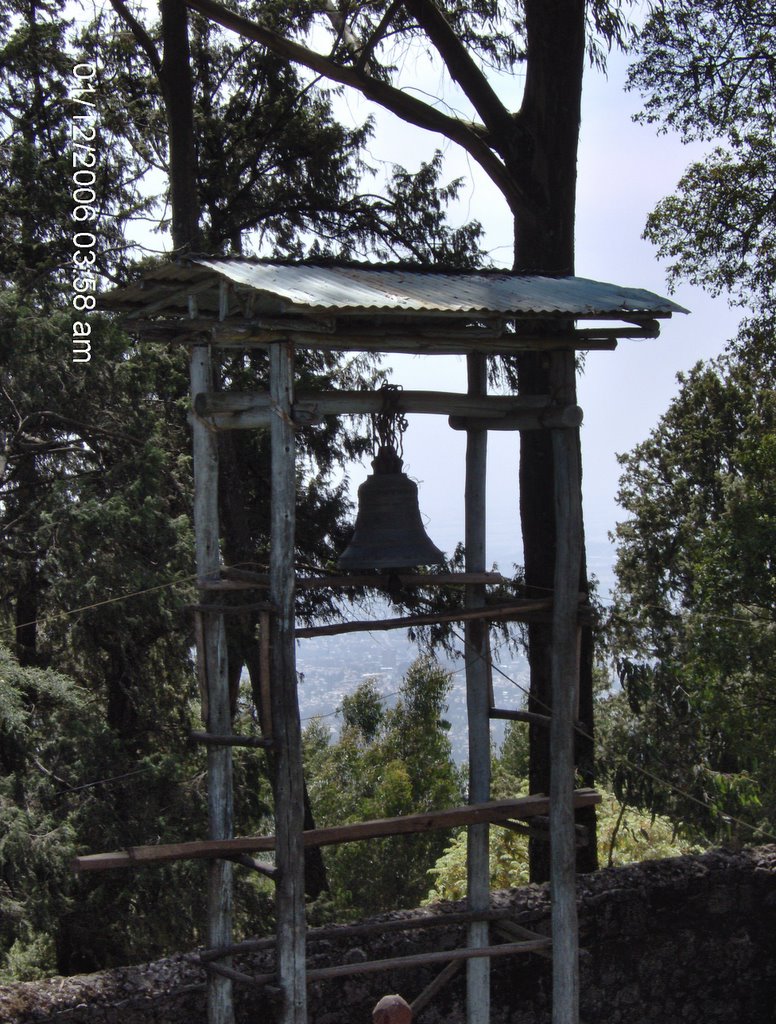
Here are some photographs I took while I was in Ethiopia earlier this month. Mind you, I was on a business trip, so sightseeing was not on the agenda. Consequently, most pictures I took were from my hotel room balcony, except for a few that I took while on Entoto, the 10,000-foot-above-sea-level mountain overlooking the 7,200-foot-above-sea-level plain where Addis Ababa is located. We had a few hours free one afternoon, and we were taken to see the two oldest churches in Addis Ababa.


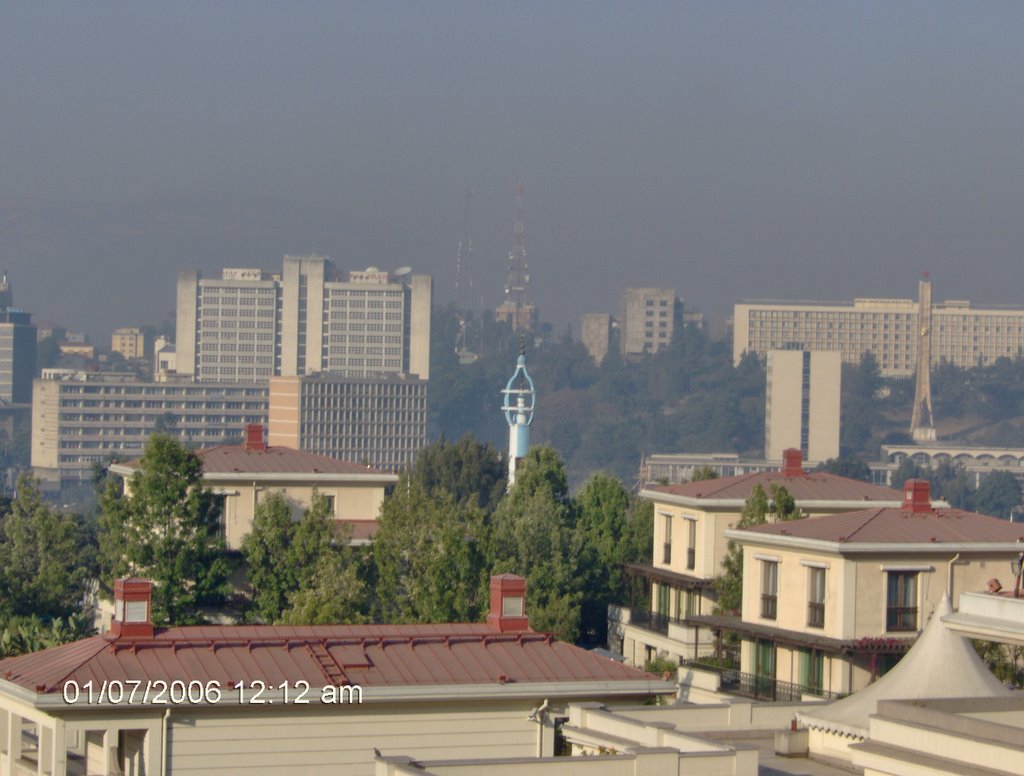
Upon waking up in Addis Ababa (and other African cities, for that matter), one immediately notices the acrid odor in the air. This comes from wood-burning fires that people use to cook their breakfasts. A heavy smog hangs over the city in the morning hours, but it dissipates during the late morning and afternoon, only to return in the evening as families cook their suppers. (In the middle distance, you can see the blue tower of a mosque.)

In Addis, the smoke takes on an added aroma in that it comes from the burning of blue eucalyptus, a non-native species of tree that was imported to provide firewood in the barren plateau. Today you can see old women coming down the mountain carrying heavy stacks of branches, more than twice as tall as the women themselves, to sell as firewood in the city. The lucky ones have donkeys but most of them use their own muscles and bent spines to do the job.


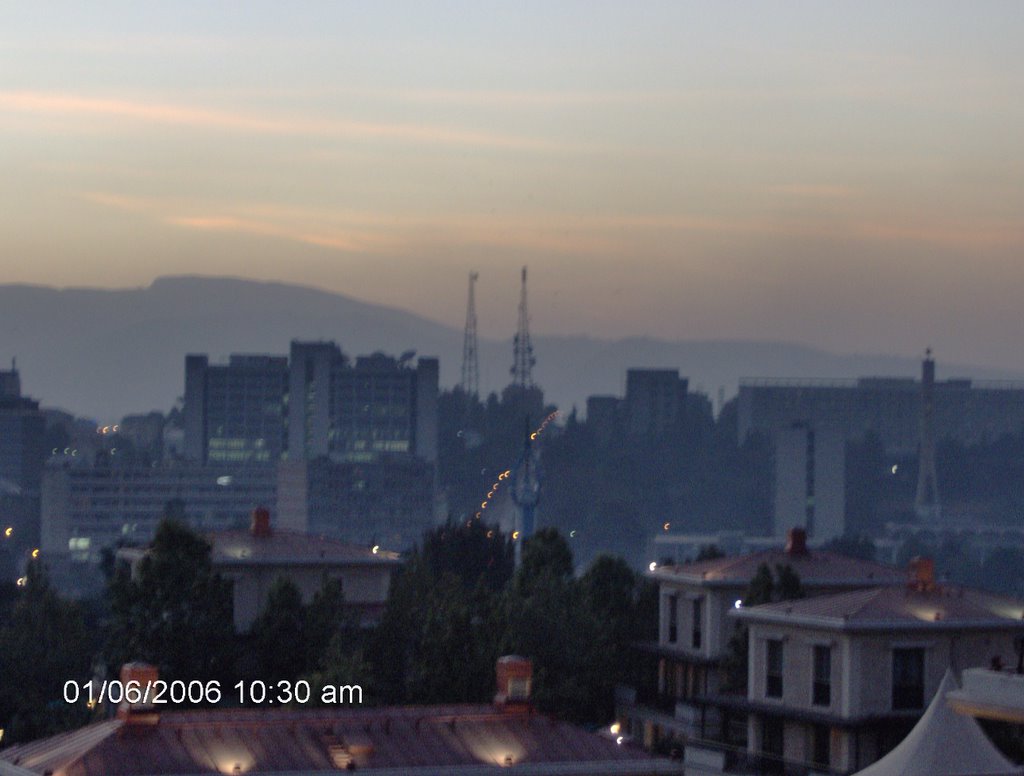
This view, from the same vantage point but a slightly different angle, shows the evening smog hanging over Addis Ababa.


Ethiopian history stretches back at least 3,000 years, so one might suppose that the capital city, Addis Ababa, is nearly that old. Not so -- it was founded only in 1886, about the same time as Johannesburg, South Africa.

King (later Emperor) Menelik II moved his court to Entoto, a mountain base in the center of Shoa (the region of central Ethiopia where Addis now is). A small city grew up along the road between two Ethiopian Orthodox churches.

Queen (later Empress) Taitu, however, did not like the cold weather in the mountains. She moved her camp to the side of a hot spring on the plain below. She sent a message to her husband that said, essentially, "If you ever want to get some from me again, you had better move here." So he did, taking his whole court down the mountain and establishing the city now known as Addis Ababa.

What you see above is the oldest church in Addis, only a bit over a 100 years old despite the culture's 3,000-year track record.


Besides Armenia, Ethiopia may be the oldest Christian nation in the world. (There are now a large number of Muslims in the country, too, but for centuries it was officially Christian in the sense that Russia and Greece are.)

There are differences, however, between Ethiopian Orthodoxy and other Orthodox and Latin churches. For one thing, the Ethiopian Orthodox Church is monophysite -- that is, it rejects the doctrine, adopted at the Council of Chalcedon, of the "dual nature " of Christ. That is, whereas other Christian churches believe that Jesus Christ is "fully human and fully divine," the Ethiopian Orthodox believe that he is only fully divine.

Another difference: Ethiopian Orthodox Christians adhere to Old Testament dietary restrictions. So there were no pork products available in any of the restaurants at the Sheraton Addis Hotel, explaining why I had my first taste of "veal bacon."


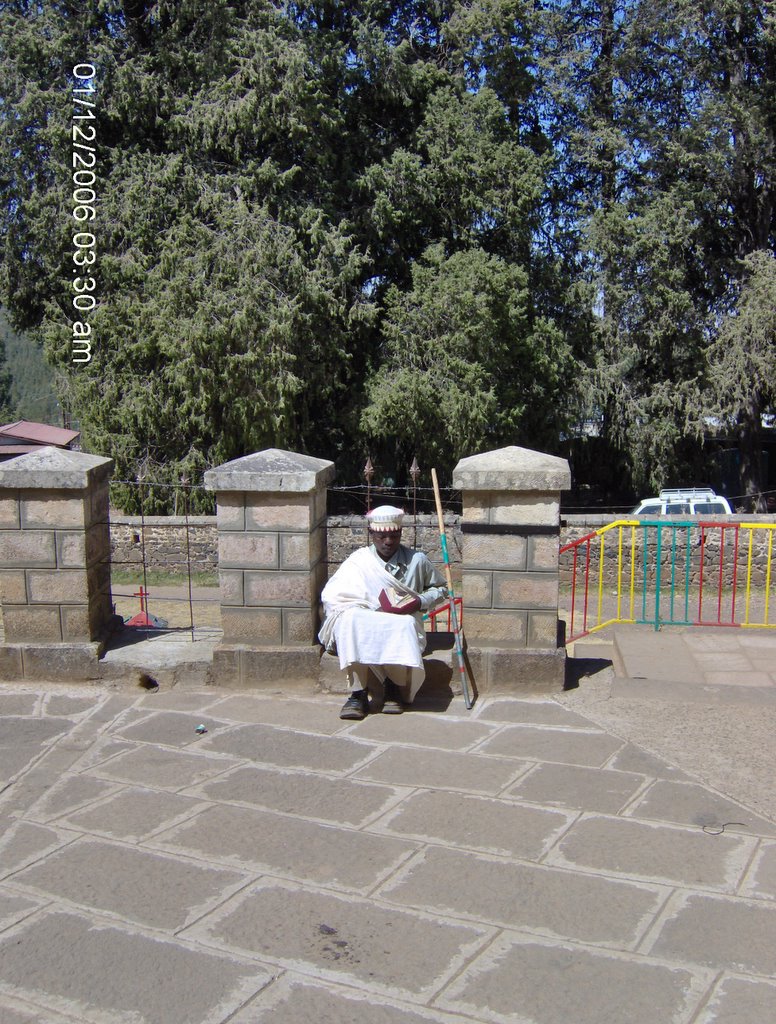
This deacon was studying his prayer book in the sunshine outside the church.


Meanwhile, some priests and deacons were conducting a service of some sort (it might have been a funeral) at the base of the church, not inside it.


Finally, for those of you who have been wondering what happened to all those ubiquitous red telephone booths in Britain, after British Telecom decided to get rid of them, at least some of them landed in Ethiopia, where they are still used by the many people unable to afford cellphone service:


If you are interested in learning more about the history of Ethiopia, I recommend a book by retired U.S. diplomat Paul Henze called Layers of Time: A History of Ethiopia. I bought a copy just before I left the country and read it on the plane on the way home, answering a lot of the questions that had come to mind during my stay.

Friday, January 27, 2006

Back in the Saddle Again

Hearing Waldo Jaquith this morning on WINA Radio's "Charlottesville Live" program, in which he discussed his blogging about "shiny" (but sometimes boring) General Assembly committee hearings, roused me from my torpor and persuaded me to end my weeks-long hiatus from writing.

I actually returned from my East African business trip more than a week ago, but after nearly two weeks away from the Blogger.com screen, it was hard to get started again. (In part, this stems from frustration that the most interesting elements of my trip were private and proprietary, requiring discretion, and therefore non-bloggable. It's the sort of thing to make any writer go "Argggggggh!")

Being out of the Virginia politics loop didn't help any. To tell you the truth, I haven't even looked at a political blog since January 3 -- Virginia- or non-Virginia-related.

While I was away, I missed all sorts of great stories: the fallout from the Jack Abramoff guilty plea, Tim Kaine's inauguration, the General Assembly's overwhelming vote to endorse an anti-marriage amendment to the Virginia Constitution.

But, sitting in my hotel room in Addis Ababa, watching the BBC, I was able to follow the news on Israeli Prime Minister Ariel Sharon's health. Meanwhile, on SkyNews, I could watch relentless reports about Charles Kennedy's resignation as leader of the Liberal Democrats in Britain. (Mr. Kennedy was "tired and emotional," as they say, that is, a wee bit tipsy.) As for SABC, I learned about the handful of former democratically-elected African leaders met in a summit in Maputo to discuss how they can put their elder-statesman status to good use. The simultaneous lead story on CNN International was the search-and-rescue operation in West Virginia for the 13 lost coal miners which, sadly, ended with 12 of them dead.

Speaking of "tired and emotional," while drinking tea in the lounge of the Serena Hotel in Nairobi, I read a side-splitting opinion piece in the Times of London, by Ben MacIntyre, entitled "From squiffy to blotto, a lexicon of lushes/A history of political partying." A representative excerpt:

Politicians have always drunk too much, and always lied about it. In 1957 Nye Bevan, Richard Crossman and Morgan Philips successfully sued The Spectator for claiming that they were drunk at a conference in Venice, which they were. Today the pressure not to drink, and thus the pressure to lie if you do, is greater than ever. New Labour has brought a strange whiff of Puritanism from the likes of Alastair Campbell (teetotal), Peter Mandelson (who is known to sip hot water at dinner parties) and Tony Blair (just a cup of tea, thanks awfully).

A more sober democratic process would probably be happier, and certainly healthier, but it might be even more tense and brittle, and surely less colourful. I suspect that the most famous George Brown drinking anecdote of all immeasurably improved our diplomatic relations with Peru.

At a grand reception in that country in the 1960s, the Labour Foreign Secretary tottered up to a figure resplendent in a fetching purple frock, and slurringly asked her for a dance. She turned him down with the response: “First, you are drunk. Second, this is not a waltz, it is the Peruvian national anthem. And third, I am not a woman, I am the Cardinal Archbishop of Lima.”
What was fun was watching obscure American TV sitcoms on M-Net, a South African-based satellite television service. Sure, they have "Will & Grace" and "The Simpsons." But who has ever heard of "Still Standing"? Or why would anyone want to see the disgraceful "Amish in the City" again? Seriously, does anyone remember "My Big Fat Greek Life"? (Of course, M-Net is reviving, at least for an African audience, the woefully underrated and too-soon canceled "Undeclared.")

It's a small world, after all.

Tuesday, January 03, 2006

Carnival

Smyth County Conservative is hosting the latest Virginia Blog Carnival, the first of the new year. It includes a reference to my post on the best movies of 2005.

Next week's Virginia Blog Carnival will be hosted by The (Not So) Daily Me.

My blogging over the next 10 to 14 days may be sporadic or non-existent, as I'm going to be traveling in East Africa and will have only limited access to computers and the Internet.

I'm sure I'll have plenty to write about upon my return.

Sunday, January 01, 2006

If You Go Away

In a column today, Richmond Times-Dispatch correspondent Carlos Santos offers some thoughts that reflect accurately the ambivalence that Charlottesville residents possess in regard to University vacation periods. When the students are away, our town has a completely different atmosphere, which has its positive and negative aspects.

It's Christmas vacation for University of Virginia students, and here in Charlottesville the absence of so many energetic men and women, many of whom are teenagers, makes everything a bit more mellow.

The city without students is like a 1970 Ford Pinto, which was the car I drove in college, with one of its four cylinders misfiring. The city moves to the slow lane, limping, unglamorous and a bit listless.

We become an outdated, older, underpowered little town of about 45,000 people, most of whom, I'm guessing, go to bed by 10 p.m. weeknights and 11 p.m. on weekends like I do.

Drive by downtown or up West Main Street, from Vinegar Hill to Rugby Road, and the silence is deafening now. The sidewalks are empty. The Lawn is desolate. The streets are iPodless.

The Corner, a student-intensive section of the city offering T-shirts, beer, bands, fast food, bad food and more beer, is ghostly, especially at night when it usually vibrates with a frenetic life that only the young can exude.
The most visible sign that students are not around is the availability of on-street parking. Santos' column is accompanied by a photograph of Rugby Road looking like a Hollywood backlot set up to film a movie about a ghost town. (You can nearly imagine the tumbleweeds blowing down the center of Rugby Road.) Nearer to where I live, Jefferson Park Avenue has more empty parking places than Pennsylvania Avenue in front of the White House does.

I suppose the businesses that cater to student customers suffer a bit at the cash register this time of year, but the breathing space and opportunity to do work in the storeroom and on the end-of-the-year accounting books must be welcome nonetheless.

Still, student absences are cyclical. They are gone for a few weeks, then back for a few months. This happens several times a year with banal regularity. As Santos notes:
But in the end, Charlottesville is U.Va. and U.Va. is students, both rowdy and serious, and it makes the city a unique place. Their energy, their dreams and their exuberance spill over, goosing those of us who might be a little more world-weary. I may not want to join a frat party as I drive by and hear the music boom through my car window and rattle my soul, but it still makes me smile. You only get to do that stuff for a short time.

So come mid-January when the Wahoos pile back into Charlottesville, cutting me off in their four-wheel-drive vehicles, hooting senselessly in the night on the Corner or backing up U.S. 29 on game days, I'll welcome them back. But Christmas break is nice for us, too.

Saturday, December 31, 2005

Hooray for Hollywood

It's the last day of the year, the time when film critics and cultural commentators name their best and worst experiences of the past 12 months.

Since I'm not a professional film critic, I don't get to see every movie that gets released. I see more movies than the average American. According to the National Association of Theatre Owners, "The average number of trips to the cinema in 1970 was 4.5 per person. In 2004, the average American went to the movies 5.2 times." I don't keep track, but my guess is that I go to the theatre to see movies at about 8 to 10 times that rate. (I saw 16 films over four days at the Virginia Film Festival in October, so it's not accurate to say I actually saw one movie per week.)

Still, I miss a few movies here and there. I haven't seen critically-praised movies like Crash or Capote yet, nor have I seen the end-of-the-year blockbuster from Peter Jackson, the remake of King Kong. And some films of 2005 simply haven't reached my local cinema yet and won't be viewable until January or February.

My ten-best list is limited to films released during the calendar year, otherwise I would have to say the best movie I saw was Otto Preminger's Anatomy of a Murder or George Cukor's My Fair Lady, two that I saw on the big screen (at, respectively, the Virginia Film Festival and the Paramount Theatre in downtown Charlottesville). In fact, I can list a whole collection of movies I saw in the past few months that are better than the movies that came out this year (All the President's Men, It's a Wonderful Life, The Man Who Shot Liberty Valance, Paths of Glory, to name four) but it's hard for any single year's output to match or exceed the classics that have stood the test of time.

I also exclude movies I saw on television or DVD. (I seldom watch movies on a small screen, anyway.)

So, with those caveats, here is my list of the ten best movies of 2005.

Downfall
Good Night, and Good Luck
Harry Potter and the Goblet of Fire
Ladies in Lavender
Mrs. Palfrey at the Claremont
The Producers
Sophie Scholl: The Last Days
Star Wars - Episode III: Revenge of the Sith
Steal Me
Thumbsucker
I've written about Downfall elsewhere, where I compared it to Star Wars - Episode III: Revenge of the Sith. Both are studies of evil -- Downfall of the consequences of evil, Sith of its origins.

Good Night, and Good Luck may be criticized for its politics, though it is hard to defend Joe McCarthy with a straight face. We know now that there were Communist agents who infiltrated the U.S. government in the early days of the Cold War. McCarthy was right about that, to be sure, in the sense that even a stopped clock is right twice a day, but his ham-handed, alcohol-soaked methods set back the anti-Communist movement by years.

My reason for putting Good Night, and Good Luck on this list is that director George Clooney has done such a marvelous job at evoking the era of the mid-1950s. Robert Elswit's black-and-white cinematography is virtual sculpture of light, shadow, and -- especially -- cigarette smoke.

If only someone would take on the task of filming the story told in The Lavender Scare, which demonstrates that far more people lost their jobs and had their lives and careers ruined by the government's relentless persecution of gay men and lesbians during the "McCarthy era" than did those pursued as Communists. Young filmmakers, take notice!

Harry Potter and the Goblet of Fire
does more than just continue the story of Harry and his friends (and foes) from the first three films in the series. It deepens the characterizations and darkens the plot and atmosphere. Director Mike Newell brings a different sensibility with him as he takes over from Chris Columbus and Alfonso Cuaron. The actors, too -- especially Daniel Radcliffe -- are developing a more profound understanding of their roles. These are no longer merely special-effects-laden action flicks for the pre-teen set; instead, they are beginning (like Downfall and Revenge of the Sith) to reflect on the meaning of evil's presence in our midst and how we must react.

Ladies in Lavender
and Mrs. Palfrey at the Claremont should be considered in tandem, since both star British actresses of a certain age who would not normally be considered for leading roles in romantic films, yet here they are. Ladies in Lavender may have been released too early in the year for consideration by the awards-givers, but both Maggie Smith and Judi Dench rate special recognition for their work as sisters living in an isolated seaside village in the mid-1930s. And any film with Daniel Brühl is worth seeing -- after making his mark with Good Bye, Lenin!, this German actor will soon become an international sensation. (Having Joshua Bell play Brühl's character's violin solos was a nice touch, too.)

In Mrs. Palfrey at the Claremont, Joan Plowright gives what will probably be the last major performance of her long and distinguished career. Like Ladies in Lavender, Mrs. Palfrey tells the story of an elderly woman's interaction with a young man who suddenly enters her life. It is romantic, but not in the sense one comes to expect from that term. It also introduces a future star in Rupert Friend, who plays Ludovic, Mrs. Palfrey's surrogate grandson. (Mrs. Palfrey also has a great backstory in terms of how it was made, with a script by an 85-year-old first-time screenwriter, Ruth Sacks.) Speaking of nice touches: Millicent Martin, among other Hotel Claremont eccentrics, sings along to "It's Never to Late to Fall in Love," a song she introduced on Broadway in Sandy Wilson's The Boy Friend.

Some have criticized the new musical version of The Producers of being too broad, suggesting that Nathan Lane and Matthew Broderick failed to tone down their on-stage personas for the hotter medium of film. I think those criticisms are wrong. Lane and Broderick are spot-on in recreating their Broadway roles, and Susan Stroman may have single-handedly revived the tradition of big, broad, colorful film musicals best exemplified by what came out of MGM in the 1940s and '50s. Unlike Rob Marshall (another first-time film director at the time), who reworked Chicago to make it more palatable to the naturalistic eye of movie audiences, Stroman returns to the film-musical conventions of what we thought was a bygone era, and she does it quite satisfactorily.

More than that, under the watchful eye of Mel Brooks, Stroman has, through set decoration as well as direction of her actors, virtually recreated a shot-by-shot replica of the non-musical scenes from the original version of The Producers. Broderick may be less convincingly hysterical than Gene Wilder, but he still comes across in a suitably manic manner.

It was somewhat disappointing to learn the film left out some of the musical numbers (notably "The King of Broadway", and shortening the "Springtime for Hitler" segment) but the overall experience is daffily satisfying.

One of the films I saw at the Virginia Film Festival is Germany's entry for Best Foreign Language Film for the 2005 Academy Awards, Sophie Scholl: Die letzten Tage (The Last Days). Based on recently uncovered transcripts of interrogations of White Rose dissident Sophie Magdalena Scholl by a Nazi investigator, this movie has a certain staginess to it that may be offputting to some viewers.

What Sophie Scholl does best is to juxtapose the normalcy of life in Germany in 1943, portrayed in deep colors (thanks to cinematographer Martin Langer), far from the front where the war was going on, while highlighting how the regime could engage in psychological brutality to deny basic human rights to the German people, including the due process rights of the accused in legal proceedings, which we take so much for granted.

The scenes in which Sophie verbally duels with her interrogator are fascinating and compelling. Who could expect that debates about political philosophy could take place in such a setting? Yet they did, far from an audience yet stirring nonetheless because one young woman was willing to stand up for her beliefs, even up to the moment of her certain death.

Sophie Scholl: The Last Days deserves wide distribution and should be seen in high-school classrooms across the country.

What can I say about Revenge of the Sith that has not already been said? In it, George Lucas provides the bridge between the two Star Wars trilogies, and answers all the unanswered questions we have had for nearly 30 years. Revisit my posting about it here for my immediate reaction.

Steal Me and Thumbsucker are unlikely to appear on many other ten-best lists this year, but they do not deserve to be overlooked.

Melissa Painter's Steal Me focuses on a 15-year-old drifter who insinuates himself into the lives of a typical middle-class family in small-town Montana. He's a kleptomaniac but he is also a keen judge of character, far more street-smart than anyone he meets in the family or the town, and oozes sexuality, leading to an affair with an older woman who lives nearby. Steal Me is also the most highly charged example of homoeroticism in filmmaking this year, exceeding even what one may find in the "gay cowboy" movie, Brokeback Mountain. Danny Alexander, in his first leading role, carries the film on his shoulders and succeeds without stumbling. We will be seeing more from him, as well as from Hunter Parrish, who plays his friend-rival-unspoken love interest, Tucker.

Thumbsucker, too, concerns a troubled teenager, this one in a typical middle-class household in Oregon. Tilda Swinton plays the mother, something of a dreamer who gets herself a job in a rehab facility so she can get closer to a soap-opera star she idolizes. Newcomer Lou Taylor Pucci plays Justin, whose life is transformed (for the better) when he begins to treat his ADHD with Ritalin. He hits his target for both the ADHD and post-ADHD Justin, and there's a realism at play when he chooses to stop medicating himself with the prescription drugs so that he can stand on his own two feet.

Thumbsucker also includes performances from Vince Vaughn, Keanu Reeves, and Vincent D'Onofrio as you've never seen them before.

My one quibble with Thumbsucker is with the way it portrays competitive, interscholastic, high school debate. No movie ever gets that right, so I won't complain too loud or too long. I'd rather just recommend this movie and let others judge for themselves.

Some honorable mentions:

The Aristocrats -- More laughs per minute than any other movie of the year. I wrote about it as soon as I saw it.

The Squid and the Whale
-- Jeff Daniels is turning into a fine character actor; his cold, calculating father in the midst of a divorce and custody battle in this film is miles away from his TV executive in Good Night, and Good Luck. But the center of this movie is Jesse Eisenberg, who will probably be able to play teenagers for the next 15 years, but with each turn -- he'll be compared here to his role in Rodger Dodger -- he ratchets up yet contains his emotional velocity. The intimacy and intensity of this movie may be too much to take for someone who has experienced an actual family break-up.

Brokeback Mountain -- The "gay cowboy" movie that's getting so much attention during the last weeks of the year was something of a disappointment to me. Ang Lee's direction and Rodrigo Prieto's cinematography are classic. But I had trouble buying the characters portrayed by Heath Ledger and Jake Gyllenhaal. (Gyllenhaal's Jack was easier for me to take than Ledger's Ennis.) Discussion of Brokeback Mountain is not going to end anytime soon, however -- WorldNetDaily calls the film "Rape of the Marlboro Man." (For an opinion that differs from mine, and from WND's, see Tim Hulsey, here.)

Little Manhattan -- A lighthearted companion piece to The Squid and the Whale, I can almost guarantee that you haven't seen this movie, which apparently has appeared on only about three dozen screens nationwide. Like The Squid and the Whale, the premise of this movie has divorcing parents (Bradley Whitford and Cynthia Nixon) and a child coming to terms with the new situation (Josh Hutcherson). Here, however, the focus is on the pre-teen's own first love, with an 11-year-old classmate. The best thing about this movie, though, is the way New York City is not just its setting, but a character all its own.

Kids in America -- This film has its civil libertarian heart in the right place, but its execution leaves a lot to be desired. It came and went quickly; the night I saw it, there were just three or four other people in the theatre. Some nice moments, though, and a strong anti-authoritarian message that should resonate well with high school students and others who have had their freedom of expression stifled.

Cry_Wolf -- I shouldn't let the year go by without a mention of this first feature by Charlottesville native Jeff Wadlowand his producing partner, Beau Bauman. Another near miss, this teen slasher flick shows a lot of promise for its creators. Had they had a larger budget -- they were hampered by the terms of the million-dollar Chrysler prize -- they might have achieved a better result. Jon Bon Jovi is terrific in a supporting role that carries some surprises with it. Bauman and Wadlow deserve special kudos for their mentoring of the teams of young filmmakers who compete in the Adrenaline Film Project at the Virginia Film Festival.

One dishonorable mention:

The Fever
, starring Vanessa Redgrave as a neo-Marxist bobblehead doll who romanticizes brutal totalitarian regimes that claim to stand for "the poor" and "the people" even as they put both under the heel of their hobnailed boots.

Friday, December 30, 2005

Everybody Gets a Second Chance

While Creigh Deeds may have missed narrowly in his quest to become Virginia's Attorney General, his performance in the general election last November may earn him a reward from Governor-elect Tim Kaine. The latest rumor in Richmond and Deeds' state Senate district is that Kaine is going to nominate his 2005 ticket-mate as the new Secretary of Transportation in his Cabinet.

This will open things up for a special election to be held in the oddly-shaped 25th Senate District in early or mid-February. Candidates have been lining up for months to replace Deeds, even before he won his party's nomination for Attorney General. (He initially had some opposition from state Senator John Edwards, who dropped out early to give Deeds an open field.)

The name bandied about most profligately is former Charlottesville City Councilor Meredith Richards, who ran for Congress in 2002 against veteran Virgil Goode (R-5CD). Richards might fare better in the safely Democratic 25th District (which was designed to be a sinecure for the late Emily Couric), although a Charlottesville-based liberal candidate might face some trouble in the more conservative western reaches of the district, such as Deeds' base in Bath County. So Richards shouldn't expect a free ride in obtaining the nomination.

On the Republican side, the most commonly mentioned potential candidate is Albemarle GOP unit chair Keith Drake, who has expressed interest in the seat. It is possible that one or more sitting GOP delegates whose districts overlap the 25th could be moved to run, but running for office during the General Assembly session might be seen as abdicating their responsibility toward their constituents in favor of furthering their personal political ambitions.

Thursday, December 29, 2005

Another Hundred People

Writing in today's Daily Progress, Liesel Nowak (who usually covers local courts) reports the discovery, by Waldo Jaquith, that there are now at least 100 blogs based in the Charlottesville area.

A list of local blogs that Jaquith has posted at cvilleblogs.com shows the variety of Web logs that are maintained by area residents. The subjects range from politics to computers to cooking.

A blog, as defined by [Merriam-]Webster, is "a Web site that contains an online personal journal with reflections, comments, and often hyperlinks provided by the writer."

"You'll find Republicans, Democrats, Libertarians and Greens talking about politics," Jaquith said. "You'll find food bloggers. You'll find people talking about local music. A lot of people are blogging about computer programs. Some are really boring. Some are really fascinating. Some are dedicated to an individual's life. Sometimes you don't know anything about their lives."
Nowak cites an opinion, shared by Waldo and me, that blogs have their greatest impact at the local level in bringing people together in the 21st century version of talking over the back fence, around the general store's wood stove, or at the barber shop.
"Linking in the local community is more important," Jaquith said. "I think blogs are really beneficial to the community because it forces readers to leave their traditional social circle," Jaquith said. "By reading [local] blogs we really see a pretty good cross section of Charlottesville."

Rick Sincere, a local freelance writer and public relations specialist, has been blogging for a year.

His blog, "Rick Sincere News and Thoughts: Political notes and cultural commentary from a gay, libertarian, Catholic, Republican author and theater critic," contains commentary on current events.

"My initial impulse was to use a blog to post articles I'd already written for other publications. It turned out to be very different," Sincere said.

In writing about local political and cultural events, Sincere has supplemented coverage by local media by covering events such as the Virginia Film Festival, and, as a member of the city's electoral board, hosting debates about electronic voting.

"I think that blogging has its greatest impact locally," Sincere said. "Blogs are replacing the cultural and political events that used to be covered by newspapers. We're the people who can go to a Chamber of Commerce breakfast. We are on the spot when [traditional media] can't be there. Blogs are quite valuable in bringing communities together."
Noting Waldo's desire to see many more local businesses with blogs to promote themselves and their products, Nowak quotes Jim Duncan, who runs a blog on real estate issues:
With his blog "Central VA real estate news, trends and opinions," Jim Duncan seems to be taking advantage of the idea that blogging can bring a local business success.

"I post anything that can remotely be related to real estate, land use, taxes, a lot of politics," Duncan said. "I focus as much as possible on local issues. It's where I live and where I can have an impact."
Many of us who write (mostly) about politics suffer from a sort of tunnel-vision that limits our view of the utility of blogging toward exchanges of ideas in the political sphere.

I agree with Waldo that the real potential of the blogosphere will be in transforming the marketplace, especially the local marketplace, by offering a forum that is a combination Yellow Pages-Better Business Bureau-advertising agency. A business firm's blog can offer so much more information than even a full-page ad in the Yellow Pages could. Unlike a traditional web site, a blog is not (or should not be) static. Local blogs, which might offer consumers a chance to offer their opinions about the firms they do business with, could serve the same function as yearly faculty evaluations do for university students -- and, in providing that kind of information to other consumers, give businesses the kind of feedback they need to improve their products and services.

We're in early days, folks. We have a lot to learn and a lot to try that hasn't even been imagined yet.

Saturday, December 24, 2005

We Wish You a Merry Christmas

Merry Christmas to all my readers and fellow bloggers!

A few of the articles I posted last year with Christmas themes are getting a lot of hits this year. It just goes to show how perennial Christmas themes are.

The most popular articles are these:


Charlottesville Christmas ornaments
Is There an Anti-Christmas Conspiracy?

OK, Perhaps the Anti-Christmas Attitude Has Gone Too Far


Return of Aluminum Christmas Trees?


Worst Christmas Song Ever?


and

A Moral Case for Christmas Commercialism
That last one seems to get a lot of attention, even a few comments. My point then and now is that complaints about the commercialization and commodification of Christmas are neither new nor warranted, and that we should celebrate the free enterprise system that allows us, in turn, to celebrate Christmas -- or Hanukkah, or Chrismukkah, or even Festivus -- the way each of us wishes to do so.

In any case (even though Neal Boortz says every time someone says this an elf dies), Happy Holidays, one and all!


Bridge Over Troubled Water

Congress has left Washington for a well-deserved recess. Not that they deserved it, but we did.

The irresponsibility and profligacy of the U.S. Congress are boundless. Shameless spenders of other peoples' money, the vast majority of our Representatives -- with a few key exceptions, such as Ron Paul, Jeff Flake, and Mike Pence -- had better find coal in their stockings tomorrow morning. If not, Santa Claus has not been checking his list once, much less twice.

The latest evidence for what Congress has done to us is chronicled by David Boaz in an article for Reason Online. Remember those "bridges to nowhere" in Alaska that were going to cost taxpayers millions of dollars, but that, in the aftermath of Katrina, were tabled? Well, they weren't tabled.

Writes Boaz:

Whether you’ve gotten a card or not, rest assured that Alaska thanks you for the $454 million Christmas present. Remember those “bridges to nowhere” that were finally taken out of the federal budget? Well, they’re back.
When Katrina hit and so many people were displaced, some members of Congress insisted on diverting money from pork-barrel projects to humanitarian assistance. The pressure was especially hard on the Alaska projects, since they were so transparently useless and larcenous.

Boaz continues:

It got so bad that Sen. Ted Stevens (R-Alaska), chairman of the Committee on Commerce, Science, and Transportation, roared, “If the Senate decides to discriminate against our state . . . I will resign from this body." Taxpayer advocates could only pray that he would keep his word.

And sure enough, Congress acted. Headlines across the country echoed this one in the New York Times: “Two 'Bridges to Nowhere' Tumble Down in Congress.” The Times story began, “Congressional Republicans decided Wednesday to take a legislative wrecking ball to two Alaskan bridge projects that had demolished the party's reputation for fiscal austerity."

Good news indeed. Except – Ted Stevens didn’t resign from Congress. Why not? Because it was all a show, just smoke and mirrors. Congress removed the requirement that Alaska use the money for the bridges to nowhere. But the state still got the money – a $454 million blank check.


Christmas Eve brings with it Currier-and-Ives images of snowy meadows on chilly nights. As a Christmas gift this year, Congress has given us quite a nice snow job.

Tuesday, December 20, 2005

Your Dream Is Somebody's Nightmare

Thanks to my one-time boss, Ernest Lefever, for alerting me to the publication of my letter to the editor in today's Washington Times.

I was responding to an opinion article that appeared last week, which called for the creation of a federal "Department of the American Family." No, really, that's what it said. Here are a couple of paragraphs from the article, "In support of marriage," by David Wilkinson and Chris Stevenson:

We suggest that the administration transform the well-meaning but impotent Healthy Marriage Initiative, currently buried in the Department of Health and Human Services, into a new cabinet level department, which could be named the Department of the American Family. Such a move will necessitate a federal definition of marriage. This will bring the issue into the limelight of public debate, where it deserves to be.

What will the department do? First, the fact that there is a Department of the American Family will be highly symbolic of America's belief in the traditional family and will draw a line in the sand. The secretary would advise the president on the status of American families, suggesting ways the president could secure its convalescence and long term health. Additionally, the department could assess the family's response to critical issues or events and the impact of them on the country's families; fund efforts to document the history and influence of the American family; sponsor public advertising campaigns endorsing marriage; and fund university research on the benefits of marriage.
The absurdity of the proposal didn't strike me as much as the irony of a conservative publication, The Washington Times, giving such drivel valuable space on the opinion page. So I wrote a response, which looked like this in this morning's paper:
Regulation, bureaucracy and the family

In their Friday Op-Ed column, "In support of marriage," David Wilkinson and Chris Stevenson offer a the kind of suggestion that usually comes from liberals for addressing a perceived social need: Throw money at it with a new government program.

Their idea of creating a new Department of the American Family smacks of the sort of social liberalism so effectively critiqued by President Reagan when he said, "The government's view of the economy can be summed up in a few short phrases: If it moves, tax it. If it keeps moving, regulate it. And if it stops moving, subsidize it."

Education did not improve with the creation of the federal Department of Education; it got worse. Massive federal welfare programs did not eliminate poverty but instead created generations of families dependent on the state. Amtrak is not superior to privately owned railways; it is more expensive, less reliable and a drain on taxpayers' pocketbooks.

Do Mr. Wilkinson and Mr. Stevenson want to see the American family destroyed through government paternalism?

Turning again to Mr. Reagan, we have to ask ourselves whether we believe "in our capacity for self-government or whether we abandon the American Revolution and confess that a little intellectual elite in a far-distant capital can plan our lives for us better than we can plan them ourselves."

Creating a new federal bureaucracy to deal with social problems, no matter how real those problems might be, demonstrates a lack of faith in our capacity for self-government. It abandons the values that Mr. Reagan articulated best but that also were held by conservatives such as Barry Goldwater, Gerald Ford and others before and since.

The Department of the American Family: liberal dream, conservative nightmare.
The authors of the original article, Wilkinson and Stevenson, probably think of themselves as conservatives. But conservatives, I thought, are people who believe the size and scope of government should be reduced, not expanded.

Unfortunately, it seems that too many self-described "conservatives" have confounded the true conservative legacy of Ronald Reagan in favor of the statist, pro-government faux conservatism of Rick Santorum. That may explain why federal spending has increased more under George W. Bush and a "Republican" Congress than it has at any time since Lyndon Johnson introduced the Great Society.

One, Two, Three

The recount for the Attorney General's race in Charlottesville went as smoothly as expected this morning, ending before 11:00 a.m. after beginning with a brief training session at just past 9:00 o'clock.

There were no changes to the totals announced at the post-election canvass, which did not come as a surprise. (The numbers differed from the unofficial totals of election night, as they should.)

We encountered some difficulty as the two teams of Recount Officials started with the first two precincts, but that was owing entirely to the unfamiliarity everyone had with the forms that needed to be filled out. Once it became clear what was required of us, the next eight precincts were finished up both quickly and thoroughly. (We have eight physical precincts in Charlottesville, plus a central absentee precinct and a provisional vote precinct; the latter two have paper ballots, but only the provisional vote precinct had paper ballots that needed to be recounted by hand, a grand total of 8 ballots -- 5 votes for Deeds, 3 for McDonnell.)

One of the Deeds observers raised a question about the high number of undervotes in Tonsler Precinct. We noted that Tonsler traditionally has a higher percentage of voters who choose not to vote in down-ticket races, and that while the undervote percentage in that precinct may seem out of the ordinary in comparison to other precincts, it was not unusual for Tonsler. That seemed to satisfy the observer, who did not insist that we rerun the totals on the tally computer -- an exercise that would have lengthened the time of the recount substantially only for us to find out that the numbers were the same as those reported in that precinct on Election Day.

Meanwhile, as we were cleaning up and waiting for a state trooper to pick up our results envelope to take to the Circuit Court in Richmond, we heard from Fairfax County that they were already making plans to order dinner, because it looks like they'll be recounting well into the evening. (Fairfax has nearly 25 times as many precincts as Charlottesville has.) And Dickenson County lost power and only had one working telephone line, which might cause some delays in reporting.

Chad Dotson has some scattered results from around the state, indicating that there are only a minuscule number of changes in the totals that have been reported since the election was certified on November 28.

Should there be changes resulting in the nine precincts that are hand-counting their optical scan ballots (one in Lynchburg and eight in Gloucester County), it seems to me that an aggrieved candidate could complain formally that the principle of Bush v. Gore -- that statewide recounts should be conducted with uniform procedures and rules in every voting jurisdiction -- has been violated. (Creigh Deeds would have benefited from a ruling that all optical scan and marksense paper ballots be recounted by hand, since those types of machines often miss votes that are indicated by light pencil or pen marks, or whose marks are somewhat askew.)

My prediction, however, is that because the results of the electronic voting machines are secure and unchanging, and because only a handful of paper ballots are being recounted by hand, Bob McDonnell can be confident that his certified election as Attorney General will remain just that -- certified -- and he can plan on being sworn into office next month.

One surprise about the recount in Charlottesville: Only one media outlet, WVIR-TV (Channel 29) felt this story was important enough to send a reporter to cover it. There was nobody there from the Daily Progress, The Hook, C-VILLE, or WINA radio. (Where was Chris Callahan? This is the sort of thing he revels in.)

Saturday, December 17, 2005

Anniversary Waltz

Today marks one year since I began writing this blog. How fast 365 days fly by!

It's been fun. It's been a challenge. It's been rewarding. When I go for a few days without blogging (as I have done since last Monday), I feel a bit neglectful, like I've forgotten to feed a puppy.

The fact is, the past ten days have been unusually hectic in regard to my job. (Yes, even bloggers have to pay their bills. We can't sit around all day long in our pajamas with computers set upon our laps.) The coming week promises much more of the same, particular with the recount for the Attorney General's race arriving on Tuesday. (I received a written notice via snail mail from the Clerk of the Circuit Court in Richmond ordering me to be at the court house in Charlottesville that morning -- or else.)

I promise to return to more frequent blogging toward the end of this week. Christmas brings a richness of writing topics, and I have to incorporate my end-of-the-year letter into my postings for the final week of 2005.

I would like to thank all of you readers (we surpassed 40,000 unique visitors about 4 days ago) for keeping this enterprise worthwhile. Most of you are anonymous as well as distributed throughout the United States and Canada and in farflung places across the globe -- Malaysia, Finland, Poland, Japan, the Philippines. And the farther you get from the United States, the more likely you're looking for dish on Dave Moffatt or Aaron Carter.

I would also like to thank all of my fellow bloggers, particularly Virginia bloggers inside and outside the Old Dominion Blog Alliance, who link to things I write and bring new readers here.

Chad Dotson, the elected blogger formerly known as John Behan, has sent more readers my way than any other single source (besides Google). Thanks, Chad! Commonwealth Conservative deserves the praise it gets. With any luck, perhaps four years from now we'll be recounting your votes in the statewide Attorney General's race.

Others who have extraordinarily helpful in the past year include Waldo Jaquith, the father of the Virginia blogosphere; Norm Leahy; Tim Hulsey; Dan Blatt at GayPatriot; and Steve Miller at the Independent Gay Forum.

Thanks, too, to the mainstream media representatives who covered this blog: Bob Gibson at the Daily Progress in Charlottesville, Coy Barefoot of radio station WINA, Lisa Provence and Courteney Stuart at The Hook, and Linton Weeks at the Washington Post. And the MSM deserves my gratitude for providing so much, so much grist for this mill.

But most of all, I have to thank the aforementioned Dave Moffatt and Aaron Carter. If it weren't for your legions of fans looking for shirtless pictures of you guys, I wouldn't have half the traffic I do now. Thanks, guys! I promise I'll buy -- not download -- your next CDs.

And, remember, please -- comments and tips are always welcome!

Monday, December 12, 2005

All Are Welcome

There has been a new and rapid expansion in the membership of the Old Dominion Blog Alliance, which you can observe in the sidebar to the left.

Spark It Up! has a description of each of the new members.

Meanwhile, liberal blogger Raising Kaine asks the question, "Are Virginia’s Conservative Blogs More Effective?," drawing on an article by Michael Crowley in Sunday's New York Times Magazine. There have already been responses to Raising Kaine from Chad Dotson, Norm Leahy, Jim Bacon, and Shaun Kenney.

Tomorrow, Norm, Shaun, and I will be empaneled to speak to the Tuesday Morning Group Coalition in Richmond about blogs and blogging. (And, Norm, I will be wearing a tie, even if you don't.) The TMG Coalition is promoting the Freedom & Prosperity Agenda for Virginia.

Final note on Virginia blogs: Below the Beltway is hosting this week's Virginia Blog Carnival. Next week it will be hosted at Sons of the Republic.

Thursday, December 08, 2005

Where Were You?

Each generation of young adults has its own touchstone moment in which nearly every person, when posed with the question, "Where were you when you heard that [blank] happened?", will be able to answer with vivid and precise detail.

For my grandparents' generation, that moment was the Japanese attack on Pearl Harbor, commemorated yesterday. And for most of that generation, the death of President Franklin Roosevelt nearly four years later is nearly as prominent.

For my parents and their cohort, the date November 22, 1963, is forever embedded in their memories, and not because that was the day C. S. Lewis, author of The Chronicles of Narnia, died. No, on that day the assassination of President John F. Kennedy became the stuff of legend (and unending theories of paranoid conspiracy).

Today's generation, of course, remembers the terrorist attacks of September 11, 2001, with the same precision. The generation 10 to 15 years older may think back to the Challenger explosion in January 1986.

For my generation, those who were teenagers in the late 1960s or the 1970s, that touchstone moment came on December 8, 1980, that is, 25 years ago tonight. That was when we heard that John Lennon had been murdered in cold blood outside his apartment building, the Dakota, in Manhattan.

I was pulling an all-nighter when I heard the news, typing a research paper for the course "Case Studies in American Diplomacy," taught by Professor Henry Kissinger. (Whatever became of him?) At the time, I was working for the Ethics and Public Policy Center, and I was using my boss's IBM Selectric that night because he had a radio in his office. So I was listening to a local D.C. rock station, when the disc jockey (this was before all music stations were totally automated) came on the air to say: "I have grave news. We have just learned that John Lennon was shot and killed earlier this evening in New York. The news just came across the wire. Repeat: Ex-Beatle John Lennon is dead."

Shocked, I paused in my typing and immediately telephoned my friend, David Murphy, in Milwaukee. (David was really the first great crush of my young life, and he was also a devoted fan of the Beatles and all Beatles wannabes, such as The Knack.) I asked, "Did you hear the news?" He had. In his case, he learned it from Don Meredith or Howard Cosell, who reported the news during the ABC Monday Night Football game.

We commiserated but I had to return to my work: I still had to type a paper of nearly 100 pages (including endnotes and appendices) in order to turn it in the next morning. (I did get an "A," by the way.)

The next few days were filled with news of Lennon's murder by disaffected fan, Mark David Chapman. We learned that Yoko Ono witnessed the murder at close range; that Lennon had been returning home from a recording session; that Chapman had stalked him earlier and even got an autograph. It slowly sank in that the long-awaited Beatles reunion would never take place.

When Lennon's "official" memorial service took place at Strawberry Fields in Central Park in New York (a location shown and discussed in the new but sparsely distributed film, Little Manhattan, a sweet treatment of first love and childhood on the Upper West Side), we had our own memorial at Georgetown University's Dahlgren Chapel, led by Father Jerome Hall, S.J., who both sang bass and played the bass cello in the chapel choir. We then drifted to Healy Lawn while people sang "Imagine" and then we had a moment of silence before dispersing.

Lennon's murder was followed quickly on its heels with the attempted assassinations of President Reagan, in March, and Pope John Paul II, in May 1981. But, perhaps because those attempts were unsuccessful, they lack the quality of memory that Lennon's death and similar incidents possess.

Our culture is resilient, however, and it wasn't long before the Lennon murder (combined with the failed Reagan assassination attempt) became fodder for comedy, in the famous Saturday Night Live sequence about the murder of Buckwheat. Who can forget Joe Piscopo's supercilious anchorman saying over and over, "Let's go to the video"? This became a catchphrase: "I repeat: Buckwheat is dead."

Tragic events come and go; in fact, they occur every day, somewhere in the world. Sad things happen to individuals and families, but few of them are shared by the nation. Sometimes the experience can be both intimate and shared more broadly (as it was by those people featured in the AP article, "John Lennon's Death Lingers for Witnesses"). The broadly-shared few are the memorable moments that can be conversation-starters -- not at the time, or soon thereafter, but years later.

So, I ask those of my generation: Where were you when you heard that John Lennon was killed?