The origins of our days of the week lie with the Romans. The Romans named their days of the week after the planets, which in turn were named after the Roman gods:
dies Solis “the day of the sun (then considered a planet)”
dies Lunae “the day of the moon”
dies Martis, “the day of Mars”
dies Mercurii, “the day of Mercury”
dies Iovis, “the day of Jupiter”
dies Veneris, “the day of Venus”
dies Saturni, “the day of Saturn”
When the Germanic-speaking peoples of western Europe adopted the seven-day week, which was probably in the early centuries of the Christian era, they named their days after those of their own gods who were closest in attributes and character to the Roman deities.
It was one of those peoples, the Anglo-Saxons, that brought their gods and language (what would become English) to the British Isles during the fifth and sixth centuries AD.
In English, Saturday, Sunday and Monday are named for Saturn, the sun and moon respectively, following the Latin.
The remaining four days (Tuesday, Wednesday, Thursday and Friday) are named for gods that the Anglo-Saxons probably worshipped before they migrated to England and during the short time before they converted to Christianity after that.
Tuesday is named for the god Tiw, about whom relatively little is known. Tiw was probably associated with warfare, just like the Roman god Mars.
Wednesday is named for the god Woden, who is paralleled with the Roman god Mercury, probably because both gods shared attributes of eloquence, the ability to travel, and the guardianship of the dead.
Thursday is Thunor’s day, or, to give the word its Old English form, Thunresdæg “the day of Thunder”. This sits beside the Latin dies Iovis, the day of Jove or Jupiter. Both of these gods are associated with thunder in their respective mythologies.
You may recognise a similarity here with the name of the famous Norse god Thor. This may be more than coincidence. Vikings arrived in England in the ninth century, bringing their own very similar gods with them. Anglo-Saxons were already Christian by this time, but may have recognised the similarity between the name of their ancestors’ deity Thunor and the Norse god. We don’t know, but the word Thor does appear in written texts from the period.
Friday is the only weekday named for a female deity, Frig, who is hardly mentioned anywhere else in early English. The name does appear, however, as a common noun meaning “love, affection” in poetry. That is why Frig was chosen to pair with the Roman deity Venus, who was likewise associated with love and sex, and was commemorated in the Latin name for Friday.
Of gods and weekdays
The concept of the week, that is, a cycle of seven numbered or named days with one of them (usually Sunday or Monday) fixed as the first, was originally probably associated with the Jewish calendar. This was complicated by the fact that early medieval Europe inherited its idea of the week from imperial Rome, via the Christian church.
In early Christianity the reckoning of time was crucial to the proper celebration of the church’s feast days and holidays, especially the variable feast of Easter.
We find day names similar to English in related European languages, like Dutch, German, and all the Scandinavian or Norse languages. Gods with comparable names, like Tyr, Othinn, Thor and Frigg, were certainly known to the Scandinavians and gave their names to weekdays in Scandinavian languages (compare Modern Danish tisdag, onsdag, torsdag, fredag).
The Latin names for the days of the week, and the Roman gods for which they were named, still live on in all the European Romance languages, like French, Spanish and Italian. Think of French lundi, mardi, mercredi, jeudi and vendredi, for example, and you will find the Latin Luna, Mars, Mercurius, Iovis and Venus hidden behind them.
This month, hundreds of thousands of people around the world will join gay pride marches in cities big and small. In many cities, pride marches are controversial. In some – like Moscow – they are even banned. But for many people in North America, parts of Europe, Latin America and elsewhere, attending the local pride march has become an unremarkable ritual of summer.
But such expressions of pride have faced another sort of opposition: from within the queer and trans communities themselves. One reason is that gay and trans rights doesn’t describe a single, unitary political movement.
I am a historian of queer and trans politics. My research, together with that of James Steakley, Katie Sutton, Robert Beachy and many others, shows that there are several traditions of gay and trans activism. These traditions have not always gotten along. And some of them hate what pride is all about.
A history of multiple movements
Gay and trans rights movements are quite old. For more than 100 years, political groups have been fighting on behalf of same-sex desires, gender nonconformity and transition from one gender to the other – although the terms “gay rights” and “trans rights” are relatively recent inventions.
By the late 1800s, a movement that called itself “homosexual emancipation” formed in Germany. It boomed after World War I and flourished in the 1920s under the democracy that existed before the Nazis took over. The movement included people who called themselves “transvestites.” Were they alive today, many would probably use the term transgender.
From the beginning, gay and transgender activists split into a dizzying array of factions. All were in favor of greater legal and social tolerance for same-sex relationships. But beyond that narrow common ground, they were a political hodgepodge.
Some were leftists. One prominent leader of a gay rights group was also an important player in Berlin’s communist party. Others were middle-of-the road, calling for the end of Germany’s law against sodomy but otherwise content with the status quo. There were even right-wing, explicitly racist gay rights activists.
The Nazi Party itself was zealously anti-gay. Once in power, the Nazis murdered thousands of men for the “crime” of male-male sex. Yet, the historical record shows that a small number of men quietly belonged to both the homosexual emancipation movement and the Nazi Party, though they were not open about their sexuality within the party. Historians are still debating the significance of homosexuality in the Nazi Party. The small faction of gay fascists lauded erotic relationships between manly, “Aryan” soldier types while loathing feminists, Jews and leftists.
As you might imagine, these different camps within the homosexual emancipation movement did not agree on lots of things.
A debate about discretion
One of their big disagreements was about discretion: Was it acceptable for same-sex couples and gender nonconformists to cavort in view of the straight public?
The 1972 film ‘Cabaret’ is set in Berlin prior to the Nazi seizure of power. The story deals with homosexuality and the rise of Nazism.
Not all advocates of gay rights, however, liked this public culture.
One man, a self-professed gay Nazi, wrote that Berlin’s clubs were “insalubrious” places where people surrendered to their animal lusts, and that “the general public inevitably gets the impression that it” – that is, the gay rights movement – “is all about sex.” This man wanted to celebrate homoerotic comradeship, a spiritual love, as he described it, as well as a physical one. However, he wanted to celebrate this manly love with maximum discretion, and certainly not in public. He wrote: “What two men do in the barracks,” by which he meant the barracks of the Nazi Party militia, “is no one’s business.”
To admit that one was homosexual or a transvestite in public in the 1920s was to court serious social and legal consequences. Activists of that era probably could not have imagined that one day people would march in large groups down public streets celebrating their homosexual and transgender selves.
‘We’re here, we’re queer’
In 1970, activists organized the first pride marches to mark the one-year anniversary of the Stonewall riots. Those riots occurred the summer before when people fought back against a police raid of a queer bar called the Stonewall Inn in New York’s Greenwich Village.
Pride exploded the old worries about discretion when it arrived in cities around the world in the 1970s.
Pride reveled in gaudy accessories. It had lots of scanty dress, too, from drag queens in slinky gowns to shirtless dykes with political slogans scrawled in marker across their chests. By bringing the party – along with the politics – into the streets in broad daylight, pride fought against homophobia. At the same time, it flatly rejected the old fears about overt public displays.
“We’re here, we’re queer, get used to it,” a favorite chant at pride, was not only directed at mainstream, straight society. It was also, in my opinion, an answer-back to the debate about discretion that had marked the long history of gay and trans activism.
More debates about pride
By the 1990s, pride marches had run into more controversy within activist circles. They were criticized as too commercial, too male-dominated, too devoid of a broader left-of-center political agenda and insufficiently inclusive of people of color – or indeed downright racist and Islamophobic. Alternative demonstrations cropped up, like Berlin’s Alternative Pride and New York City’s Dyke March. Debates about pride continue to this day.
Pride is in part what people make of it. A pride march can have a social justice agenda. Or it can have a pro-Trump agenda.
Yet pride’s history is a story of a radical break with right-wing and even middle-of-the-road gay and trans politics. Pride rejected respectability and discretion.
Traces of that history probably survive in your local pride march. Look for the people who are not worried about alarming the straights.
One of the World War I’s most enduring legacies is largely forgotten: It sparked the modern gay rights movement.
Gay soldiers who survived the bloodletting returned home convinced their governments owed them something – full citizenship. Especially in Germany, where gay rights already had a tenuous footing, they formed new organizations to advocate in public for their rights.
Though the movement that called itself “homosexual emancipation” began in the 19th century, my research and that of historian Jason Crouthamel shows that the war turned the 19th-century movement into gay rights as we know it today.
A death in Russia
In the winter of 1915, a German soldier died in a field hospital in Russia. The soldier, whose name is missing from the historical record, had been hit in the lower body by shrapnel when his trench came under bombardment. Four of his comrades risked their lives to carry him to the rear. There, he lay for weeks, wracked by pain in the mangled leg and desperately thirsty. But what troubled him most was loneliness. He sent letters to his boyfriend whenever he could manage it.
“I crave a decent mouthful of fresh water, of which there isn’t any here,” he wrote in his final letter. “There is absolutely nothing to read; please, do send newspapers. But above all, write very soon.”
German infantrymen aim machine guns from a trench near the Vistula River in 1916. AP-Photo
This soldier, who had to keep his relationship hidden from those around him, was just one of the approximately two million German men killed in World War I. His suffering is not unlike what many others experienced. What his loved ones made of that suffering, however, was different, and had enormous consequences.
His boyfriend, identified in surviving documents only as “S.,” watched the man he loved go off to serve in a war that he did not fully endorse, only to die alone and in pain as S. sat helplessly by hundreds of miles away. S. told their story in a letter to the Scientific Humanitarian Committee, which published it in April 1916.
The Scientific Humanitarian Committee was then the world’s leading homosexual emancipation group, boasting a membership of about 100 people. The soldier’s story took a cruel twist at its very end: S.‘s loving replies were lost in the chaos of the war and never reached the soldier.
“He died without any contact from me,” S. wrote.
Demanding the rights of citizens
After the war, many believed the slaughter had been for nothing. But S. saw a lesson in his partner’s suffering and death.
“He has lost his bright life … for the Fatherland,” wrote S. That Fatherland had a law on the books that banned sex between men. But the sodomy law was just the tip of the iceberg: S. and men like him generally could not reveal their love relationships in public, or even to family members. Homosexuality meant the loss of one’s job, social ostracism, the risk of blackmail and perhaps criminal prosecution.
S. called it “deplorable” that “good citizens,” soldiers willing to die for their country, had to endure the status of “pariahs.” “People who are by nature orientated toward the same sex … do their duty,” he wrote. “It is finally time that the state treated them like they treat the state.”
A new phase of gay rights
A magazine put out by the League for Human Rights in 1930. Author provided
Many veterans agreed with S. When the war ended, they took action. They formed new, larger groups, including one called the League for Human Rights that drew 100,000 members.
In addition, as I argue in my book, the rhetoric of gay rights changed. The prewar movement had focused on using science to prove that homosexuality was natural. But people like S., people who had made tremendous sacrifices in the name of citizenship, now insisted that their government had an obligation to them regardless of what biology might say about their sexuality.
They left science behind. They went directly to a set of demands that characterizes gay rights to this day – that gay people are upstanding citizens and deserve to have their rights respected. “The state must recognize the full citizenship rights of inverts,” or homosexuals, an activist wrote in the year after the war. He demanded not just the repeal of the sodomy law, but the opening of government jobs to known homosexuals – a radical idea at the time, and one that would remain far out of reach for many decades.
Respectable citizens
Ideas of citizenship led activists to emphasize what historians call “respectability.” Respectability consisted of one’s prestige as a correctly behaving, middle-class person, in contrast to supposedly disreputable people such as prostitutes. Throughout the 20th century, gay rights groups struggled for the right to serve openly in the military, a hallmark of respectability. With some exceptions, they shied away from radical calls to utterly remake society’s rules about sex and gender. They instead emphasized what good citizens they were.
In 1929, a speaker for the League for Human Rights told an audience at a dance hall, “we do not ask for equal rights, we demand equal rights!” It was, ironically, the ghastly violence and horrible human toll of the World War I that first inspired such assertive calls, calls that characterized gay rights movements around the world in the 20th century.
It would take nearly a century for these activists to achieve one of their central goals – the repeal of sodomy laws. Germany enjoyed a 14-year period of democracy after World War I, but the Nazis came to power in 1933 and used the sodomy law to murder thousands of men. A version of the law remained in force until the 1990s. The United States struck down its sodomy laws only in 2003.
In 1921, in a Munich beer hall, newly appointed Nazi party leader Adolf Hitler gave a Christmas speech to an excited crowd.
According to undercover police observers, 4,000 supporters cheered when Hitler condemned “the cowardly Jews for breaking the world-liberator on the cross” and swore “not to rest until the Jews…lay shattered on the ground.” Later, the crowd sang holiday carols and nationalist hymns around a Christmas tree. Working-class attendees received charitable gifts.
For Germans in the 1920s and 1930s, this combination of familiar holiday observance, nationalist propaganda and anti-Semitism was hardly unusual. As the Nazi party grew in size and scope – and eventually took power in 1933 – committed propagandists worked to further “Nazify” Christmas. Redefining familiar traditions and designing new symbols and rituals, they hoped to channel the main tenets of National Socialism through the popular holiday.
But under any totalitarian regime, there can be a wide disparity between public and private life, between the rituals of the city square and those of the home. In my research, I was interested in how Nazi symbols and rituals penetrated private, family festivities – away from the gaze of party leaders.
While some Germans did resist the heavy-handed, politicized appropriation of Germany’s favorite holiday, many actually embraced a Nazified holiday that evoked the family’s place in the “racial state,” free of Jews and other outsiders.
Redefining Christmas
One of the most striking features of private celebration in the Nazi period was the redefinition of Christmas as a neo-pagan, Nordic celebration. Rather on focus on the holiday’s religious origins, the Nazi version celebrated the supposed heritage of the Aryan race, the label Nazis gave to “racially acceptable” members of the German racial state.
According to Nazi intellectuals, cherished holiday traditions drew on winter solstice rituals practiced by “Germanic” tribes before the arrival of Christianity. Lighting candles on the Christmas tree, for example, recalled pagan desires for the “return of light” after the shortest day of the year.
Scholars have called attention to the manipulative function of these and other invented traditions. But that’s no reason to assume they were unpopular. Since the 1860s, German historians, theologians and popular writers had argued that German holiday observances were holdovers from pre-Christian pagan rituals and popular folk superstitions.
So because these ideas and traditions had a lengthy history, Nazi propagandists were able to easily cast Christmas as a celebration of pagan German nationalism. A vast state apparatus (centered in the Nazi Ministry for Propaganda and Enlightenment) ensured that a Nazified holiday dominated public space and celebration in the Third Reich.
But two aspects of the Nazi version of Christmas were relatively new.
A Christmas-themed stamp emphasizes light
First, because Nazi ideologues saw organized religion as an enemy of the totalitarian state, propagandists sought to deemphasize – or eliminate altogether – the Christian aspects of the holiday. Official celebrations might mention a supreme being, but they more prominently featured solstice and “light” rituals that supposedly captured the holiday’s pagan origins.
Second, as Hitler’s 1921 speech suggests, Nazi celebration evoked racial purity and anti-Semitism. Before the Nazis took power in 1933, ugly and open attacks on German Jews typified holiday propaganda.
Blatant anti-Semitism more or less disappeared after 1933, as the regime sought to stabilize its control over a population tired of political strife, though Nazi celebrations still excluded those deemed “unfit” by the regime. Countless media images of invariably blond-haired, blue-eyed German families gathered around the Christmas tree helped normalize ideologies of racial purity.
Open anti-Semitism nonetheless cropped up at Christmastime. Many would boycott Jewish-owned department stores. And the front cover of a 1935 mail order Christmas catalog, which pictured a fair-haired mother wrapping Christmas presents, included a sticker assuring customers that “the department store has been taken over by an Aryan!”
It’s a small, almost banal example. But it speaks volumes. In Nazi Germany, even shopping for a gift could naturalize anti-Semitism and reinforce the “social death” of Jews in the Third Reich.
The message was clear: only “Aryans” could participate in the celebration.
Taking the ‘Christ’ out of Christmas
According to National Socialist theorists, women – particularly mothers – were crucial for strengthening the bonds between private life and the “new spirit” of the German racial state.
Everyday acts of celebration – wrapping presents, decorating the home, cooking “German” holiday foods and organizing family celebrations – were linked to a cult of sentimental “Nordic” nationalism.
Christmas tree bulbs featuring the swastika were only one of a number of ways that Christmas became Nazified. Author provided
Propagandists proclaimed that as “priestess” and “protector of house and hearth,” the German mother could use Christmas to “bring the spirit of the German home back to life.” The holiday issues of women’s magazines, Nazified Christmas books and Nazi carols tinged conventional family customs with the ideology of the regime.
This sort of ideological manipulation took everyday forms. Mothers and children were encouraged to make homemade decorations shaped like “Odin’s Sun Wheel” and bake holiday cookies shaped like a loop (a fertility symbol). The ritual of lighting candles on the Christmas tree was said to create an atmosphere of “pagan demon magic” that would subsume the Star of Bethlehem and the birth of Jesus in feelings of “Germanness.”
Family singing epitomized the porous boundaries between private and official forms of celebration.
Sheet music for the popular carol Exalted Night of the Clear Stars
Propagandists tirelessly promoted numerous Nazified Christmas songs, which replaced Christian themes with the regime’s racial ideologies. Exalted Night of the Clear Stars, the most famous Nazi carol, was reprinted in Nazi songbooks, broadcast in radio programs, performed at countless public celebrations – and sung at home.
Indeed, Exalted Night became so familiar that it could still be sung in the 1950s as part of an ordinary family holiday (and, apparently, as part of some public performances today!).
While the song’s melody mimics a traditional carol, the lyrics deny the Christian origins of the holiday. Verses of stars, light and an eternal mother suggest a world redeemed through faith in National Socialism – not Jesus.
Conflict or consensus among the German public?
We’ll never know exactly how many German families sang Exalted Night or baked Christmas cookies shaped like a Germanic sun wheel. But we do have some records of the popular response to the Nazi holiday, mostly from official sources.
For example, the “activity reports” of the National Socialist Women’s League (NSF) show that the redefinition of Christmas created some disagreement among members. NSF files note that tensions flared when propagandists pressed too hard to sideline religious observance, leading to “much doubt and discontent.”
Religious traditions often clashed with ideological goals: was it acceptable for “convinced National Socialists” to celebrate Christmas with Christian carols and nativity plays? How could Nazi believers observe a Nazi holiday when stores mostly sold conventional holiday goods and rarely stocked Nazi Christmas books?
Meanwhile, German clergymen openly resisted Nazi attempts to take Christ out of Christmas. In Düsseldorf, clergymen used Christmas to encourage women to join their respective women’s clubs. Catholic clergy threatened to excommunicate women who joined the NSF. Elsewhere, women of faith boycotted NSF Christmas parties and charity drives.
Still, such dissent never really challenged the main tenets of the Nazi holiday.
Reports on public opinion compiled by the Nazi secret police often commented on the popularity of Nazi Christmas festivities. Well into the Second World War, when looming defeat increasingly discredited the Nazi holiday, the secret police reported that complaints about official policies dissolved in an overall “Christmas mood.”
Despite conflicts over Christianity, many Germans accepted the Nazification of Christmas. The return to colorful and enjoyable pagan “Germanic” traditions promised to revitalize family celebration. Not least, observing a Nazified holiday symbolized racial purity and national belonging. “Aryans” could celebrate German Christmas. Jews could not.
The Nazification of family celebration thus revealed the paradoxical and contested terrain of private life in the Third Reich. The apparently banal, everyday decision to sing a particular Christmas carol, or bake a holiday cookie, became either an act of political dissent or an expression of support for national socialism.
Michael Wex, author of Born to Kvetch and Just Say Nu, has a monthly language column in the Jewish Daily Forward. In his latest piece, he points out a distinction of some importance in spoken Yiddish, since making the wrong syntactical choice could prove to be quite embarrassing. Here he is pointing out basic terms for polite conversation about the weather:
Basic Precipitation
RAIGN rain
ES RAIGNT It’s raining
SE PLYUkhet IN DROYSN It’s pouring out there
DIner thunder
BLITS lightning
BLITS-POST e-mail [lit., “lightning post”]
SHNAY snow
ES SHNAYT It’s snowing
AN aVAYreh A HINT aROYStseTREIBM Not fit for a dog outside [lit., “It’d be a sin to put a dog out”]
EIZ Ice
GLITSHN ZAKH to slip, slide, skate
Then he adds:
A distinction that shouldn’t be overlooked:
MEER IZ HAYS I’m hot
MEER IZ KALT I’m cold
but
IKH BIN HAYS I’m horny
IKH BIN KALT I’m frigid
There’s nothing more embarrassing than sitting in a stuffy room and saying, “Am I the only one here who’s horny?” without even knowing that you’ve done so.
If I recall, both German and French have similar pitfalls. In German, the word "warm" means, in most contexts, what the word "warm" means in English. But to say "I am warm" or "It is warm," one says, in German, "Es ist warm." (I am reaching back to German 101 in college, so I am open to correction.) If one says, in German, "Ich bin warm," (literally, "I am warm"), the colloquial meaning is "I am homosexual (gay)."
Oops! Be careful if you say that in a steam bath.
As for French, a BBC web site provides this useful information:
In France, I popped into a restaurant to cool down as it was boiling hot and I had just been on a bike ride and was sweating like mad. When I tried to explain to the waitress that I was hot - Je suis chaud - she looked outraged and marched off, refusing to take my order. It was only later that I realised that I had said I was hot ... for her!
Editor's note: One to definitely look out for! To say you're feeling hot, in the context of temperature, you need to use avoir chaud, ie. j'ai chaud. Using être with chaud implies you're feeling 'horny'!
This item elicited comments from readers to confirm the point:
Similarly, if one is feeling cold, one mustn't say in German ich bin kalt, which means "I am frigid". The correct phrase is mir ist kalt. Sent by: Mariam
I am really glad to have discovered this. I have told my French neighbour's wife many times that je suis chaud and worse still, I have said it to her husband and her son. Sent by: Ped
In Québec, je suis chaud can also mean 'I'm drunk'. Sent by: Sam
* * *
You need to watch out with the hot vs. horny in Spanish as well; a friend of mine, sitting in the livingroom of her Spanish parents in law, declined an offer to have tea with No gracias, estoy caliente. What she should have said was Tengo calor. Sent by: Julia
I lived in Germany and was sick one day, so wasn't thinking properly. I said Ich bin heiß, ich muss ins Bett gehen, hoping to say 'I'm feverish, I need to go to bed' but instead saying 'I'm horny, I need to get to bed.' Sent by: Heather
"One of the smarter blogs is the libertarian-leaning collection of Charlottesville posts put up by Rick Sincere..." -- Bob Gibson, The Daily Progress, May 8, 2005
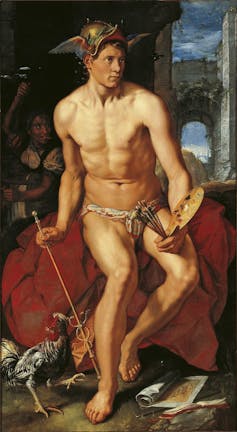
 The Latin names for the days of the week, and the Roman gods for which they were named, still live on in all the European Romance languages, like French, Spanish and Italian. Think of French lundi, mardi, mercredi, jeudi and vendredi, for example, and you will find the Latin Luna, Mars, Mercurius, Iovis and Venus hidden behind them.
 Traces of that history probably survive in your local pride march. Look for the people who are not worried about alarming the straights.


 According to undercover police observers, 4,000 supporters cheered when Hitler condemned “the cowardly Jews for breaking the world-liberator on the cross” and swore “not to rest until the Jews…lay shattered on the ground.” Later, the crowd sang holiday carols and nationalist hymns around a Christmas tree. Working-class attendees received charitable gifts.


 and
and 


