Showing posts with label Bush 43. Show all posts

Friday, June 12, 2009

Around the Blogosphere

Coinciding with his hosting of representatives of the Constitution Party, Libertarian Party, and Republican Party on his daily radio chat show on WINA-AM, Rob Schilling has posted a poll on The Schilling Show Blog asking:

With which political party philosophy do you most closely align?
Located on the right sidebar, the poll offers four choices -- the three parties mentioned above, plus the Democratic Party.

Over on Virginia Virtucon, Riley has uncovered a proposed piece of legislation sponsored by Representative Carolyn Maloney of New York (along with ten cosponsors) in the House and by Oregon Senator Jeff Merkley (and zero cosponsors) in the other chamber. The bill would incorporate "breastfeeding" into the Civil Rights Act of 1964 as a federally-protected civil right. It also includes quality control of breast pumps as a civil rights matter.

As Jack Paar might say, "I kid you not!" You can look up the bills on Thomas for proof: H.R. 2819 and S. 1244.

Norm Leahy asks at Tertium Quids whether charter schools could be the "big idea" that propels Bob McDonnell into the Governor's Mansion. Virginia has one of the weakest, most burdensome, and least expansive charter schools law in the country, so improving that situation would be a big boost for parents who want to choose better schools for their children, reducing bureaucratic red tape, and improving competition (and thus quality of output) in the government school system. Norm writes:
Could charters be the Big Idea? Possibly. If so, then we may be in for a campaign that actually engages in a wide-ranging debate on education reform -- a debate that Virginia has avoided for far too long.
At the Daily Beast, former President George W. Bush has a tribute to his father, former President George H.W. Bush, on the occasion of the latter's 85th birthday. (The tribute does not require any skydiving.) Bush 43 says about Bush 41:
I've lived with being "George Bush's son" all my life. Growing up, I probably didn't want to be like him. Today it's ironic that much of my career parallels his. He went to Yale. I went to Yale. He was a Navy pilot. I flew F-102s in the Texas Air National Guard. Now that I'm in political life, I like to say I've inherited half of his friends and all of his enemies. Of course, there will be some who will prejudge me, but that's OK: I don't expect to get all of the votes anyway. Being George Bush's son is a tremendous plus....

My dad and I continue to have an honest relationship, very straightforward. I considered him a mentor, not only as a young lad but also as an adult. And he's still a mentor today. I occasionally talk to him about policy matters. He has great judgment. I'm George Bush's son—and I think the world of him.
Warning: Many of the posted comments underneath the article are snarky and rude.


Be sure to visit my CafePress store for gifts and novelty items!
Read my blog on Kindle!

Wednesday, May 06, 2009

Obama Administration Imprisons 16-Year-Old Boy Under PATRIOT Act

Why would a 16-year-old boy from Oxford, North Carolina, who has no criminal record, call in a bomb threat to South Bend, Indiana, more than 800 miles away?

This is a fundamental question the FBI and Obama administration Department of Justice have refused to answer in the case of Ashton Lundeby, who was pulled from his bed on the night of March 5 and whisked away from his home to a jail in Indiana, without access to his family or an attorney.

The administration is using the USA PATRIOT Act, passed in the wake of the terrorist attacks of September 11, 2001, without being read by any Member of Congress. Legislators voted for the law under a veil of ignorance and assurances by the Bush administration that the law would never be used to violate the civil liberties of American citizens.

Ashton's story is told best in this news report from WRAL-TV in Raleigh, now available on YouTube:


Notice how the 16-year-old homeschooler's bedroom is decorated with a patriotic theme. Perhaps the Obama administration is following the lexicon published by the Department of Homeland Security (uncovered by the Washington Times) that defines "patriots" as potential terrorists. "Patriot movement," the DHS says, is:
A term used by rightwing extremists to link their beliefs to those commonly associated with the American Revolution. The patriot movement primarily comprises violent antigovernment groups such as militias and sovereign citizens.
In the only local print media report on Ashton's arrest by gun-wielding gangsters-with-badges, reporter William West of the Daily Dispatch wrote:
Annette Lundeby, a disabled widow, lives in a modern home and has three cats.

She told the Dispatch that, on the night of March 5, she was about to go to sleep, that her son was asleep on a sofa and that her 12-year-old daughter was in bed when the knocking on the door began.

According to Annette Lundeby, the authorities arrived in unmarked cars and remained on the property until roughly 1 a.m.-1:30 a.m.

And according to Annette Lundeby, at the time of the search she was prohibited from making any phone calls, including to an attorney, and that agents told her she had to be at her son's detention hearing the next morning in Raleigh.

And she added that she was unable to sleep after the authorities left and that her daughter was traumatized. Both of her children are home-schoolers.

Annette Lundeby maintains that a hacker — that is, one who is determined to seek unauthorized access to a computer — got her son's Internet provider address and used such access to both make crank phone calls and falsely give the impression of the calls coming from the residence.

She claimed the judge questioned an FBI agent at the hearing in Raleigh about whether one could hack one's Internet provider address and claimed the agent replied this was virtually impossible. And she claimed that the agent told the judge that he did not know of any computer software available on the Internet to hack an Internet provider address.
"Virtually impossible"? Apparently the FBI doesn't talk to other government agencies. In that DHS "Domestic Extremism Lexicon," there is this definition of "hacktivism":
(A portmanteau of “hacking” and “activism.”) The use of cyber technologies to achieve a political end, or technology-enabled political or social activism. Hacktivism might include website defacements, denial-of-service attacks, hacking into the target’s network to introduce malicious software (malware), or information theft.
In addition to incompetences like this, government law enforcement agencies are extremely shy about apologizing for mistakes. (They almost never do so, unless by court order.) So Ashton Lundeby, no matter how strong the case for his innocence is, will likely be kept in jail for years as the government tries out new and more ridiculous charges against him, until they find one that sticks or they wear Ashton down so thoroughly that he confesses to crimes he did not commit (and probably did not occur).

Under the USA PATRIOT Act, law enforcement agencies are not our friends. John Whitehead of the Rutherford Institute recently wrote:
Since 9/11, it has become apparent that the federal government, unless it is kept within the bounds of the law, will develop into an immense monster that no one can curb. The end result will be that the American people will lose control of their government.
The Rutherford web site notes:
Our government is becoming more and more intrusive. With the passage of sweeping laws such as the USA Patriot Act many find themselves questioning whether we really are living under Orwell’s Big Brother government.
Annette Lundeby understands this quite well:
"We have no rights under the Patriot Act to even defend them, because the Patriot Act basically supersedes the Constitution," she said. "It wasn't intended to drag your barely 16-year-old, 120-pound son out in the middle of the night on a charge that we can't even defend."
If President Barack Obama genuinely wants to reverse the assault on civil liberties begun during his predecessor's administration, he can start by freeing Ashton Lundeby and sacking the idiot who approved the raid on the Lundeby family's home.

UPDATE: New information has come to light regarding Ashton Lundeby. Read about it here.


Read my blog on Kindle!

Tuesday, January 20, 2009

Insulting Two Presidents

On the eve of the presidential inauguration ceremony in Washington, an advocate of affirmative action programs in higher education managed to insult both of the Presidents who will serve the United States during this 24-hour period, virtually without taking a breath.

On National Public Radio's "Talk of the Nation" on January 19, Shanta Driver, chairperson of By Any Means Necessary, a national advocacy group, was a guest discussing the future of affirmative action programs along with John McWhorter of the Manhattan Institute. (Charlottesville's Dahlia Lithwick gave an overview of the issue earlier in the program.)

Just past the middle of the discussion, Driver said:

It obviously made a difference for Barack Obama to have been able to go to Harvard and without affirmative action programs, he wouldn't have been able to go there.
The only inference to make from that statement is that Barack Obama was, absent affirmative action based on race, otherwise unqualified to be a Harvard law student. What a low opinion Driver has of the 44th president! (That Obama had earlier graduated from Columbia University, spent several years after college as a community organizer, and then went on to become editor of the Harvard Law Review, belies Driver's insulting insinuation.)

Driver is, however, an equal-opportunity snob. She quickly went on to say about the 43rd president:
[Minority students] never have the opportunity to be able to get the same kind of education as lots and lots and lots of white students at those universities, who are there purely because their parents went there and their grandparents went there and they're legacy admits, as George Bush was at Yale, who are clearly not qualified to be at those elite institutions...
That's quite an accusation, considering that George Bush earned better grades at Yale than were earned by his contemporary, John Kerry. Bush went on to earn an MBA at Harvard (where he was not a "legacy admit") and had a life of ups and downs leading to the ultimate success of being elected President of the United States.

Let me make it clear that I believe that both Barack Obama and George Bush were qualified to be students at Harvard University, even without programs that tip the scales on the basis of some irrelevant characteristic such as from which gene pool the academic candidates emerge.


Be sure to visit my CafePress store for gifts and novelty items!
Read my blog on Kindle!

Thursday, September 25, 2008

What Kind of Fools Do They Think We Are?

The audacity of the Bush administration knows no bounds.

Brian Wingfield and Josh Zumbrun report
on Forbes.com:

In fact, some of the most basic details, including the $700 billion figure Treasury would use to buy up bad debt, are fuzzy.

"It's not based on any particular data point," a Treasury spokeswoman told Forbes.com Tuesday. "We just wanted to choose a really large number."

The gossamer bailout will solve Wall Street's problems by flooding the financial industry with spun sugar.

Why not? If they're making up the numbers, any solution will do.


Craig Ferguson Gets It

Late-night chat-show host Craig Ferguson may have been a U.S. citizen for less than a year, but he has a more profound understanding of the spirit of democratic capitalism than any three dozen professional pundits on Fox, CNN, or MSNBC.

The last few minutes of Ferguson's opening monologue tonight were devoted to a critique of the Bush administration's corporatist, quasi-fascist (yes, I am using "fascist" in an historically appropriate manner) plan to bail out Wall Street investors who made major mistakes.

Ferguson, a high school dropout, is an autodidact whose opinions do not always match mine but are nonetheless usually well-considered and thoughtful.

In his September 24/25 monologue, which mixes political commentary with naughty humor, Ferguson said:

Earlier on tonight, President Bush addressed the nation. He said, Congress must agree to the bailout of the Wall Street banks, and if we don't, then we'll invade somebody...

This is because the banks are asking the federal government for $700 billion. You know what that works out to? We all pay -- every taxpayer in America -- $3,600 each to the banks. Really.

That's right. Every man, every woman, every she-male in America, everybody has to pay. That's right, she-males, it's time you did your fair share for this country -- in addition for all the fine things you do for me.

You know, I don't know how I feel about this, the taxpayers bailing out the people on Wall Street. Let me think about it for a second. I HATE THIS!

This is the biggest robbery in American history! Or, at least, since the cute David lost American Idol and they gave it to the ratty one. I liked the cute one.

But I won't editorialize here. I'll stay neutral. Here are the facts; I'll remain objective about the financial crisis.

Basically what happened is that Wall Street are evil, they got really stupid, and they got drunk on greed. What happened is, they crashed their Ferrari, now they're crying like little bitches, and they want their Uncle Sam to buy them a new one.

No. No. No. That's not how it works here. Uncle Sam would be better off using his money to build them a nice prison. (chuckles)

I'm always suspicious of people, these traders, they don't make anything except money. You know, they just make more money. I mean, it's like, "What do you make? Do you make a car, do you paint pictures, do you make houses, do you make people laugh?" (All right, bad example, but you know what I mean.)

Or if you invest in a company that makes things, that's great, too.

I know taking a stand against Wall Street fat cats is a bold move. You know, people are not going to agree with me at all on this. It's like saying, "I hate crime" or "I hate poverty" or "I hate Trump." People are already with you, you don't even really have to say it.

What I mean is that these guys, what they do though, is that they shift money around to make more money. That's just gambling. I mean they use fancy terms to make it sound legitimate: short selling, profit chasing, bottom fishing.

I don't know what bottom fishing is. I think it's what Elton John does on vacation or something.

(To audience:) Don't "ahh" me, I didn't steal your damn money!
Here's the part where Ferguson shows his deep, if inchoate, understanding of how the free enterprise system works, and how it interacts with liberal democracy:
See, what happens is, the banks want us to lend them money. Irony, my old friend, we meet at last.

I say we do to the banks what they've been doing to us for years. I've been poor. I've had to go to the bank for money. They are never pleasant or particularly helpful...

Should we bail these people out? Here's what I think: No, let them go bankrupt.

That's what the free market does. That's the free market in effect. Some win, some lose. Right now, you lose, you hedge-fund bastards.

They're saying that if they go bankrupt, we will lose our freedom. That's crap!

Capitalism and democracy are not the same thing. Democracy creates equality. Capitalism creates inequality. They need each other to survive. They kind of complement each other, but they kind of hate each as well. They're like the Olsen twins, if you imagine.

That's what they are. They balance each other out. Evil/good, evil/good, and then somehow, it works.

I don't understand this government bailout. Where's the government bailout of the 10 million uninsured children? Where's the government bailout of the people who are losing their homes? Where's the government bailout of the people who are losing all of their money betting on Dancing With the Stars and gone horribly wrong?
Even the last little bit of tirade, which suggests a sort of leftish sentimentality to Ferguson's way of thinking, expresses well the concept of opportunity costs.

The government can take $700 billion from us taxpayers and pass it along to Wall Street fat cats without fear of judicial review or any sort of accountability, but that means there is $700 million that cannot be used for something else: college scholarships, laser weapons, or subscriptions to National Geographic for federal prisoners.

What's more important is that the government is substituting political decisionmaking, which, as Hayek explained so long ago, is constrained by the blinders of central planning, for the market, in which the wisdom of millions of actors (consumers, workers, entrepreneurs, investors, and analysts), performing millions of transactions (selling, purchasing, manufacturing, investing) leads to a general condition of equilibrium. (That is, what Ferguson referred to as the "balance" between capitalism and democracy.)

Perhaps if the late-night talk-show hosts, as well as the daytime radio hosts, jump on the anti-bailout bandwagon, the masses (that's you and me) will tell Congress to take the Paulson plan and put it where the sun doesn't shine.

At the very least, enough complaining from the people may lead Congress to do its job and deliberate about major policy questions, rather than rush to judgment stimulated by the Bush administration's (and the McCain and Obama campaigns') panic and hysteria. One would think they already learned from the mistakes made in passing the USA PATRIOT Act without first reading and understanding it.

My message to Congress: Slow down, take a deep breath, and remember how free enterprise and liberal democracy work. Don't leap into the tar pit of fascism without first thinking about it.

In the meantime, I hope somebody posts Craig Ferguson's monologue to YouTube and it gets wide distribution.

Update: Somebody at CBS-TV granted my wish and posted the last minute and 44 seconds of last night's monologue to YouTube. It's here.


Friday, July 04, 2008

Liveblogging President Bush at Monticello

From the air-conditioned comfort of my living room, I am watching this year's naturalization ceremony at Monticello, with featured guest speaker George W. Bush. Channel 29 (WVIR-TV) is covering the event live, with Crystal Cameron on the scene and the Charlottesville Municipal Band playing in the background.

Seventy-six immigrants are being sworn in as American citizens today.

Black-robed members of the judiciary are taking their seats on the platform on the west front of the house at Monticello. Governor Tim Kaine is in attendance, as well as First Lady Ann Holton.

The band is playing Ruffles and Flourishes, and "Hail to the Chief." The President is introduced.

Dan Jordan takes the podium. "What a magnificent day, and let's give a hand to the Charlottesville Municipal Band." He welcomes everyone on behalf of his wife and the trustees of the Thomas Jefferson Memorial Foundation. He notes that we are celebrating what Mr. Jefferson "that great charter of independence... an everlasting and universal expression of self-evident truths."

Jordan says we "honor the men and women who wear our country's uniform whose sacrifices make it possible for us to be here today," and he singles out a gentleman on the platform. He thanks the President and Governor for being here. (Jordan does not mention that this will be his last time presiding over this annual event, as he has announced his retirement.)

Jordan presents Judge John Charles Thomas to read the Preamble to the Declaration of Independence. (See last year's video post to hear what he says.)

The platform looks a bit more formidable than in years past. A black ruffle surrounds the stage, about waist-high.

Alice Handy takes the microphone to quote Jefferson, a few days before his death. She mentions the three previous presidents who joined us at Monticello to celebrate Independence Day: Roosevelt, Truman, and Ford. "Today that number becomes four, with George W. Bush." She introduces the President, who is cheered and applauded.

The president takes the microphone. "I am thrilled to be in Monticello."

Protesters erupt in heckles. Bush says, "We believe in free speech in the United States of America."

"This is a fitting place to celebrate the Fourth of July. Thomas Jefferson said he would rather celebrate the Fourth of July than his own birthday. For me it's easy: the Fourth of July weekend is my birthday weekend."

Bush addresses the new citizens-to-be.

More protests erupt in the background. Bush mentions the governor, Lieutenant Governor Bill Bolling, Attorney General Bob McDonnell, and other distinguished guests.

More protesters in the background. Also applause.

Bush thanks the Thomas Jefferson Foundation for "preserving this treasure," Monticello, which he calls "the first western White House."

He mentions how "late in life, he founded a public university that has become one of the nation's finest, the University of Virginia." Applause.

"It seems," he says, that Thomas Jefferson "got away with delivering only two public speeches during his presidency. I am sure there are people who wish that were the case today." Applause, then more hecklers shouting in the background.

Bush moves beyond the quips to the substance of his speech. Text will no doubt be posted to whitehouse.gov later today.

Bush says that on this occasion, "we pay tribute to the brave men and women who wear the uniform of the United States of America." Great applause, standing ovation (even from the judges, who should know better).

Loud hecklers in the background. Apparently David Swanson did a good job in organizing.

"This love of liberty is what binds our nation together," says Bush.

Bush mentions a Burmese immigrant who lives in Charlottesville. "The desire for freedom burns inside every man, woman, and child."

"I wish you all a happy Fourth of July. Thanks for inviting me.... May God continue to bless the United States of America." Speech ends. It was short; shorter than 15 minutes.

The Clerk of the Court opens the session. Judge James B. Jones is presiding and takes the microphone. It looks like J. Harvie Wilkinson is sitting to his right and behind the podium.

The names of the new citizens are read out. The immigrants walk up to the platform as their names are read. You have to give the clerk credit for pronouncing all those names in unusual languages.

The list of names is long.

Judge Jones administers the oath of citizenship, which is much wordier than the oath of office taken by the President on Inauguration Day. (Perhaps ironically, because the President is required to be native-born, he never has to take the oath of citizenship.)

Judge Jones declares the immigrants to be "citizens of the United States of America." Lengthy applause from the crowd. He invites the President to assist him in welcoming the new citizens.

Each new citizen walks across the stage to shake the President's hand and receive the certificate of citizenship. The Charlottesville Municipal Band begins to play a medley of Irving Berlin songs, starting with "This Is the Army."

The president poses for photos with some of the new Americans.

Shane Edinger and Steve Rappaport of Channel 29 provide color commentary from the studio. It reminds me of coverage of the Tournament of Roses Parade.

President Bush looks like he's really in his element. There's no doubt that he enjoys meeting and chatting with each of these new citizens. He's all smiles, standing tall, shoulders broad. For their part, the new citizens are beaming.

Edinger notes that the President flew in on Marine One today, landed at Monticello High School and then took a motorcade to Monticello from there.

Steve Rappaport mentions that Channel 29 meteorologist Clayton Stiver is a member of the Charlottesville Municipal Band.

The presentation of certificates ends. Judge Jones says "ladies and gentlemen, we can now truly address you as 'our fellow citizens.'"

Jones mentions the other judges on the platform: Wilkinson, Judge Allison Duncan from Raleigh, Judge Sam Wilson from Western District in Roanoke, Judge Norman Moon from Lynchburg, Judge Glen Conrad, Judge Jim Turk from Radford, Judge Dan P. Jordan III of the Southern District of Mississippi in Jackson. "He is the son of our beloved Dan Jordan." Judge Crigler of Charlottesville, Judge William Webb from the Eastern District of North Carolina.

Judge Jones asks Judge Wilkinson to say a few words.

Wilkinson: "I want to welcome our new citizens. I feel like giving each and every one of you a big bear hug... We couldn't be happier to see you.

"It's such a pleasure to see the president on this Independence Day. He and I were at college together and I can tell you that he was widely liked and widely admired.

"This is Dan Jordan's last naturalization ceremony as president of Monticello, and that hardly seems possible. He's been here for 25 years and he has enhanced Thomas Jefferson's legacy in the most magnificent way. He's faced some difficult and delicate controversies and he's met them with a healing and inclusive spirit....

"This is a day of family pride...

"Do you know what my favorite part of the Fourth of July is? Do you think it's the fireworks, perhaps? I love fireworks.... But as much as I love fireworks, that's not my favorite part of the Fourth of July.

"Do you think my favorite part of the Fourth of July is the Charlottesville Municipal Band?...

"I love to see the Pledge of Allegiance ... I particularly admire the Boy Scouts because I wanted to be an Eagle Scout, but I stopped at being a Tenderfoot. I couldn't tie the knots....

"The favorite part of my day is the chance to hear from you, the new citizens, because of everything you did and went through to get here. Think of all those documents you had to fill out. We had an expression in the Army called 'hurry up and wait.'...

"The wait is over now, and here you are. I want to express my appreciation to the senior citizens among you, who have waited all their lives for this day, and for those young folks....

"It's a two-way street. It's not about us telling you what America means to you. It's about America in your own words. So if some of you would ... tell us what it means to you to be here today, to say a few words about America from your heart. You might think, 'well, the President's here, I might be embarrassed'... but don't be embarrassed. If you speak from your heart, you'll do just fine.

"Congratulations to each and every one of you."

Judge Jones notes that it has been the tradition to ask the new citizens to say a few words, and invites them to come to the microphone.

Mary McFadyen (sp?) came to the United States from Scotland over 30 years ago. She is the first to take the microphone. She thanks her friends and neighbors from Herndon, Virginia. She thanks the President for giving her the inspiration to complete the naturalization process.

A man takes the microphone and says, "I am proud to be an American."

Zenia Diaz (sp?) from El Salvador says "I came here when I was ten years old, I have lived here half my life.... I am very happy and I am speechless."

A man with an unspellable name from India says "It is a great opportunity to be an American."

Another former Indian citizen says he came here to seek "a better life for my family." "Some people don't like the freedom that we live," he adds, and thanks the President.

A woman says she has lived here for about 11 years. "What I am asking, Mr. President, I need Iraq to come back to peace with God's help."

A man from Burma who has been here about six years says "I am very proud to be a U.S. citizen. Thank you."

Jason Kim says he has spent half of his life in Korea and half of it here. "The reason I am proud to be an American now is that the United States is a country where God brought people of different races ... religions ... together."

Judge Jones says "Those remarks mean a great deal to all of us."

Judge Jones says that Mr. Carl Proffitt will lead us in the Pledge of Allegiance. Mr. Proffitt landed in the first wave on D-Day in 1944.

The Clerk declares the Court "stands adjourned."

Dan Jordan returns to the podium. He congratulates the new citizens and their families. He thanks the President for his presence and his remarks. The President waves to the crowd, acknowledging their applause. Jordan thanks Judge Wilkinson.

The National Anthem is played by John D'earth. The crowd stands and is invited to sing along. (It's hard to hear if any of them do. The solo trumpet predominates. The crowd makes the right choice in listening rather than singing.)

Jordan says the program is ended but asks everyone to remain in place. The president exits through the house and says "congratulations."

Edinger and Rappaport come back to give their voice-over. The camera returns to the studio.

Crystal Cameron is back. "Quite a morning, indeed, Steve," she says. "This is truly what America is all about.... Hopes, dreams, and opportunities they could never even imagine in their homelands.... Quite an awe-inspiring morning... Overall the event was pretty peaceful."

Cameron says the president spoke for about five minutes and he was interrupted by protesters. "In classic George W. Bush style, he took it in and he smirked and said free speech is what it's all about," says Cameron.

The departing crowd closes in on Cameron and begins to interview individuals. One says: "People who stayed away missed a great day."

Someone says "it was the wrong place and the wrong day for protesters."

That's it for liveblogging. The whole thing took about an hour and ten minutes. Now it's time to enjoy the rest of the day.

Happy Independence Day, readers!

Update: The MSM is now reporting on the event. The Washington Post has an AP story on line here. NBC 29 has a text report here. WCAV-TV (another local Charlottesville station) has its report here. Business Wire has a transcript of the President's remarks.

Remembrances of Independence Days Past - Part I

Today (July 4, 2008) will see President George W. Bush speaking at Monticello's Independence Day celebration. He is the fourth sitting president to do so, following Franklin D. Roosevelt in 1936, Harry S Truman in 1947, and Gerald R. Ford in the Bicentennial Year of 1976.

Eight years ago, the principal speaker at the ceremony was, like Monticello's builder and first owner, a U.S. Secretary of State. At the swearing in of some six dozen new American citizens, Dr. Madeleine Albright spoke about her own experience as an immigrant to the United States and of the contributions foreign-born Americans have made to our culture and our communities.

I covered the event that year for the Metro Herald in Alexandria. It was my first time visiting Monticello on the Fourth of July and certainly not my last. (Last year I used the new citizen-journalist tool, YouTube, to post video of the event.)

This article appeared in the Metro Herald on July 7, 2000:

ON THE MOUNTAINTOP: A CELEBRATION OF CITIZENSHIP AND FREEDOM
Rick Sincere
Metro Herald Charlottesville Bureau Chief

Atop the “little mountain” he called by its Italian name, Monticello, Thomas Jefferson reflected on life and liberty, wrote thousands of letters, and received many visitors from Virginia and elsewhere.

As the epitaph on his gravestone, Mr. Jefferson chose to be remembered for only three things: that he was the father of the University of Virginia, the author of Virginia’s statute on religious liberty, and the author of the Declaration of Independence.

Mr. Jefferson died on the fiftieth anniversary of the Declaration of Independence, just after noon in the bedroom that was the center of his life in the home he built at Monticello.

Every year since 1963, the Thomas Jefferson Memorial Foundation – which owns and runs Monticello as a monument to the third president – has sponsored a ceremony on the anniversary of American independence and Mr. Jefferson’s death at which immigrants to the United States take the oath of citizenship, forsaking their foreign allegiances to become true Americans.

On July 4, 2000, Secretary of State Madeleine Albright was the keynote speaker at a ceremony on the West Lawn of Monticello. Nearly 80 adults from 27 foreign countries took the oath of citizenship, and nine children adopted into American families were given certificates of citizenship.

Secretary Albright, herself an immigrant (from Czechoslovakia) and a naturalized American citizen, welcomed her new compatriots in a brief but impassioned speech.

Speaking of her own arrival in New York Harbor at the age of 11, a refugee from Communist tyranny after previously fleeing Nazi occupation, Albright remembered her doubts and worries. But, she said, “I should not have been worried. At its best, America’s embrace is as vast as this continent is broad. We [her family] were welcomed, given refuge, and provided the chance to make new friends and build new lives in freedom.”

Addressing the concerns of those who fear the aliens among us, Albright reminded us that America is richer for its immigrants. Today, she said, “we see the contributions of immigrants everywhere in the vitality of our neighborhoods, the health of our economy, the strength of our democracy, and the enduring miracle of our unity.”

Gently scolding those xenophobes who would have prevented her and such eminences as Albert Einstein, Mother Frances Cabrini, and Andrew Grove from coming to America and helping to make it great, Albright noted: “There are some who resent all this and think that the day after they entered is the day the door to America should have swung shut. Let us pray that day never comes. For our nation needs the continued refreshment of new sources of energy and strength.”

It would have been impolite to fail to make note of the day’s host, Mr. Jefferson. So Secretary Albright paid tribute to him by saying that “the mind that conceived Monticello’s original design also helped to conceive an approach to government that had never truly been tried before. It was based on a conception of the individual not as a mere subject to the throne, but as a citizen with responsibilities and rights, and tracing all the powers of government back to the will and consent of the people.”

Those principles, Albright added, “fueled a revolution and launched America on its journey from wilderness to greatness – with important milestones of slavery’s abolition and the full enfranchisement of women and minorities along the way.”

Not content to make a speech and then return to her duties in Washington, Secretary Albright stood alongside the new Americans as they were sworn in by Samuel G. Wilson, the chief judge of the U.S. District Court for the Western District of Virginia. She took the oath of citizenship with them and then greeted each one of them individually, shaking their hands and presenting them with the certificates proving their new nationality.

Also speaking at the ceremony were former Virginia Supreme Court Justice John Charles Thomas, who read the stirring opening section of Mr. Jefferson’s Declaration (“We hold these truths to be self-evident, that all men are created equal, that they are endowed by their Creator with certain inalienable rights; that among these are Life, Liberty, and the Pursuit of Happiness…”), and James H. Michael, Jr., the senior U.S. District Judge, who tried to explain, in a few words, how the day’s ceremony was not the end of a journey for the new citizens, but a beginning. Opening remarks were provided by Daniel P. Jordan, president of the Thomas Jefferson Memorial Foundation, and the Foundation’s chairman, Benton S. Halsey. The ceremony closed with the Pledge of Allegiance led by local Boy Scouts and Girl Scouts, and the assembly sang the National Anthem, accompanied by the Charlottesville Municipal Band.

All photos by Rick Sincere.
(Special thanks to the Metro Herald's Greg Roscoe for digging up this piece from the newspaper's dusty archives.)

Friday, June 27, 2008

Lamentation for Independence Day

The editorial board of the Jewish Daily Forward gets it exactly right in the June 26 issue, written in anticipation of Independence Day one week from now. Under the headline, "The Gift of Freedom," the Forward says:

Most of us seldom give much thought to the Fourth of July. It’s one of the most important holidays on our national calendar, one of the very few that is observed simultaneously by all Americans without regard to faith, origin or regional whim. It is, some say, the only holiday specifically dedicated to celebrating this nation. For all that, we mostly celebrate with barbecues or trips to the beach. If we seek some holiday spirit, we might watch a parade or catch some fireworks. A few of us might even get to thinking — some joyfully, others with mixed feelings — about patriotism, the flag or our soldiers overseas.
Ever since I moved to Charlottesville (with, I think, one exception), I have spent the morning of the Fourth of July on top of Mr. Jefferson's Little Mountain to celebrate Independence Day with new citizens as they take their oath of naturalization at the able hands of judges from the Fourth Circuit Court of Appeals.

Over the years the speakers have included Secretary of State Madeleine Albright (in 2000; photo at left), author Frank McCourt, newspaper publisher Al Neuharth, artists Christo and Jeanne-Claude, and actor Sam Waterston (in 2007, photo below) (I've been hoping that late-night talk show host Craig Ferguson will be invited soon; he became an American citizen in February and talked about the process on his show -- his pride in being an AmCit is palpable.)

I've been lucky in that some years I've gone as "press" (even before I was blogging) and usually had a great seat in the media corral. Consequently, I've got some terrific pictures and (last year, for the first time) video. In addition, Albemarle County and the City of Charlottesville take turns, year by year, in setting up a voter registration table to grab the new citizens before it's too late.

I won't be going up the mountain this year, however, because although it was earlier announced that the speaker would be documentary filmmaker Ken Burns, today the word went out that Burns has been bumped by Bush -- President George W. Bush, that is.

It's not that I have any objection in principle to the president speaking. Under other circumstances, it could be interesting. But his presence is going to cause inconvenience of major proportions. What has been a rather informal, local event -- the Charlottesville Municipal Band plays patriotic tunes, local Boy Scouts and Girl Scouts lead the Pledge of Allegiance -- will be turned into a circus.

Normally, anyone can attend the naturalization ceremony. It requires no ticket, no entry fee. People are free to wander the grounds. (The ceremony ends just before noon, so that those who wish to do so can walk down to Mr. Jefferson's gravesite to observe a family service commemorating the anniversary of his death.)

None of that will be true this year. Security will be at a premium. People will be searched, prodded, and scrutinized for their political opinions. It won't be fun, entertaining, or informative -- just a hassle.

It's not just the metal detectors and body cavity searches that concern me. When President Bush comes to a public event, those who disagree with him are discouraged from attending -- sometimes even prevented from attending by force. What will happen if someone shows up with t-shirts indicating support for Barack Obama or Ron Paul? Or t-shirts with slogans like "The Constitution Means What It Says," "Stop the War!," or "What Part of 'Limited Government' Don't You Understand?"? (Placards and signs of any sort will, of course, be forbidden, though t-shirts can be hidden under other garments and displayed at the right moment.) Will Albemarle County police be on hand to arrest people for exercising their First Amendment rights?

This won't be the first time a sitting U.S. President has spoken at Monticello on July 4th. In 1976, President Gerald R. Ford was the featured speaker. Unlike our current president, Ford was modest in his approach to the office. (Churchill might have said he "has a lot to be modest about," but he would have been incorrect.)

Ford inherited the White House from another president who, like Bush, failed to understand that the Constitution provides for three co-equal branches of government. Like Bush, Richard Nixon tried to expand the powers of the presidency with utter disregard for Congress and the Courts. Like Bush, Nixon was paranoid and rigid, with little understanding for free markets or individual liberty. Nixon famously compiled an "enemies list" of those who disagreed with him on policy issues.

Ford, in contrast, understood that Congress and the Courts also had a role to play in the making of public policy. He rejected the "imperial presidency" model, although his chief of staff (later vice president) Dick Cheney took away from the Ford White House a festering theory of the "unified presidency," which manifests itself in such things as "signing statements" in which the President, rather than vetoing a bill as provided by the Constitution, signs it but explains what parts he feels the Executive Branch can disobey. (Ford vetoed more bills in a month than Bush has vetoed in the entire eight years of his presidency.)

One of the traditions at the Monticello Independence Day celebration is for the Clerk of the Circuit Court to read the preamble to the Declaration of Independence (the part that begins, "When in the course of human events ...")

Wouldn't it be delicious if this year, in addition to the preamble, he could also read the bill of indictment that makes up the core of the Declaration? For those unfamiliar with it, here are a few lines of reminder:
The history of the present King of Great Britain is a history of repeated injuries and usurpations, all having in direct object the establishment of an absolute tyranny over these states. To prove this, let facts be submitted to a candid world.

He has refused his assent to laws, the most wholesome and necessary for the public good...

He has refused to pass other laws for the accommodation of large districts of people, unless those people would relinquish the right of representation in the legislature, a right inestimable to them and formidable to tyrants only...

He has endeavored to prevent the population of these states; for that purpose obstructing the laws for naturalization of foreigners; refusing to pass others to encourage their migration hither, and raising the conditions of new appropriations of lands.

He has obstructed the administration of justice, by refusing his assent to laws for establishing judiciary powers.

He has made judges dependent on his will alone, for the tenure of their offices, and the amount and payment of their salaries.

He has erected a multitude of new offices, and sent hither swarms of officers to harass our people, and eat out their substance.

He has kept among us, in times of peace, standing armies without the consent of our legislature.

He has affected to render the military independent of and superior to civil power.

He has combined with others to subject us to a jurisdiction foreign to our constitution, and unacknowledged by our laws; giving his assent to their acts of pretended legislation:...

For depriving us in many cases, of the benefits of trial by jury:

For transporting us beyond seas to be tried for pretended offenses:...

For taking away our charters, abolishing our most valuable laws, and altering fundamentally the forms of our governments:...

He has plundered our seas, ravaged our coasts, burned our towns, and destroyed the lives of our people.

He is at this time transporting large armies of foreign mercenaries to complete the works of death, desolation and tyranny, already begun with circumstances of cruelty and perfidy scarcely paralleled in the most barbarous ages, and totally unworthy the head of a civilized nation...

In every stage of these oppressions we have petitioned for redress in the most humble terms: our repeated petitions have been answered only by repeated injury. A prince, whose character is thus marked by every act which may define a tyrant, is unfit to be the ruler of a free people....
While I would love to see the expression on George Bush's face as that text is being read out, I still prefer to spend my Fourth of July without being wanded by a security guard. So I expect I'll be as far from Monticello this year as possible. I may even head up to D.C. for the Smithsonian Folk Life Festival and the fireworks on the National Mall.

Leave it to this White House to ruin the Fourth of July.

Update, Monday, June 30: Monticello has announced that there will be a limited number of tickets available to the ceremony on July 4. Only one thousand free tickets will be distributed beginning at 7:00 a.m. on Wednesday, July 2. I wonder whether the friends and family members of the new citizens will be required to get those tickets, or if they have another means to attend the ceremony.

Saturday, May 31, 2008

Protesters Object to Cheney Visit

Vice President Dick Cheney was the featured speaker at Friday's Republican Party gala in Richmond.

His presence in the state capital did not go unnoticed by the anti-war crowd. A small number of protesters gathered at the corner of Fifth and Broad Streets in Richmond to demonstrate their disdain for the vice president and call for his impeachment.

Here are a few moments of the protest, captured on video:


You might notice some condescending comments from the protesters (amplified for all to hear) about how passers-by should start reading more and different sources of information. That's not the way to endear yourself to people who might be inclined to support your cause: to accuse them of being ignorant, and willfully so.

Sunday, April 20, 2008

What Are They Reading? And Why?


I was listening to The Joey Reynolds Show (which has reruns broadcast on WINA-AM in Charlottesville early Sunday mornings) and heard an interview with one of the authors of Baseball's Greatest Hit: The Story of Take Me Out to the Ball Game. The interview intrigued me, so I went to look up the book on Amazon.com, where this description can be found:

The authorized tie-in book to the 100th anniversary of this beloved song. "Take Me Out to the Ball Game" is the third most frequently sung song in America, after "Happy Birthday" and "The Star-Spangled Banner," and you'd be hard-pressed to find an American who doesn't know the words. With the release of this special edition, full-color, hardcover book, the complete story of the song is presented, taking us on a fascinating journey into how "Ball Game" has come to take a unique place in our cultural landscape. With images of historical newspaper clippings, baseball cards, sheet music, movie stills, ballplayers at the mic, and of course, Harry Caray leading the crowd at Wrigley, Baseball's Greatest Hit also comes packaged with a CD of rare and classic recordings, including performances by Dr. John, Arturo Sandoval, George Winston, Harry Caray and many more. Features an introduction by baseball commissioner Bud Selig and a foreword by Carly Simon. Baseball's Greatest Hit is a gorgeous celebration, not only of a song, but of baseball, music, pop culture, and the creative ways that Americans have always taken popular music and made it their own. And as the book traces the song's evolution over the last 100 years, it also traces the evolution of American culture - from the early days of Tin Pan Alley and sheet music pluggers; through the early role of women as baseball players and fans; through movie musicals, baseball's expansion west, rock and roll, and modern ballparks; right up to the present-day when in July 2007 more than 50 Hall of Famers came together to sing "Take Me Out to the Ball Game" in Cooperstown.

On the radio, the author, Robert Thompson, pointed out that neither the composer nor the lyricist of "Take Me Out to the Ballgame" attended a baseball game until long after they wrote the song. That, in itself, is intriguing (as I said).

But talk about something really provocative! Look at what turned up when I added the book to my Amazon wish list:


In case you can't read the screen shot (click to embiggen), it says

Customers who bought Baseball's Greatest Hit: The Story of Take Me Out to the Ball Game also bought:

The Last Lecture
by Randy Pausch (Author), Jeffrey Zaslow (Author)
Price: $12.07

We Would Have Played for Nothing: Baseball Stars of the 1950s and 1960s Talk About the Game They Loved (Baseball Oral History Poject)
by Fay Vincent (Author)
Price: $16.50

The Bush Tragedy
by Jacob Weisberg (Author)
Price: $17.16

Now, I can understand why people who add a book about "Take Me Out to the Ballgame" to their wish lists might also be interested in Fay Vincent's book -- the one in the middle -- but what is the connection of baseball to a book by a dying scientist and to another book that is a critical biography of George W. Bush?

The most erudite commentator on America's national pastime, George F. Will, might be the only person who could scrutinize and explain this mystery.

Monday, January 21, 2008

Plan Your SOTU Party Now

President George W. Bush will make his final State of the Union Address a week from today, on Monday, January 28, before a Joint Session of Congress at the U.S. Capitol. John McCaslin offers some ideas for how best to enjoy the speech in his "Inside the Beltway" column, which appears in the Washington Times and other newspapers:

We had reminded readers [January 17] that President Bush's final State of the Union address will be delivered on Monday, Jan. 28, at 9 p.m.

Now we are reminded of a popular pastime held each year, "The State of the Union Drinking Game 2008."

Organizers say: "If all goes well, you'll be unconscious by the time they show the other party's response."

New rules will be in place this year, but last year, every time the president said "Mahmoud Ahmadinejad," players had to take two gulps of their chosen beverage, and swallow a third if Mr. Bush pronounced the Iranian president's name correctly.

In addition, players had to take one shot of extra-virgin olive oil every time Mr. Bush said "addicted to oil," as well as one shot of tequila when he said "illegal immigration."
Coincidentally, I just bought a bottle of tequila last week, so now I'm thinking of hosting a viewing party for this year's SOTU. Anyone care to join me?

Monday, September 17, 2007

George ♥ Rudy?

Is the nomination of former federal judge Michael B. Mukasey to be the new U.S. Attorney General an implicit endorsement of the presidential candidacy of Rudy Giuliani by George Bush?

Much has already been made of the fact that Bush passed over "insiders" who were close to his circle or formerly part of his administration (such as former Solicitor General Ted Olson) in order to choose the largely unknown Mukasey. As the Washington Post reports today:

Mukasey would be the latest in a string of key Bush appointments that come from outside Texas or the president's inner circle and seem less ideological than some of his previous appointments.
Less is made of Mukasey's longstanding ties to Rudolph Giuliani. One has to scroll down far into the AP article on the nomination to find this:
Mukasey, a partner at New York-based law firm Patterson Belknap Webb & Tyler, is also a close friend to former New York Mayor Rudy Giuliani, a Republican. He is stepping down as an adviser to Giuliani's presidential campaign, on which he served as part of an advisory committee on judicial nominations.
Even that revelation is incomplete. Writing in the New York Sun, Joseph Goldstein notes this background:

For decades, Judge Mukasey has been a close friend of Mayor Giuliani. He worked beneath Mr. Giuliani both at Patterson Belknap and at the U.S. attorney's office in Manhattan. It was Mr. Mukasey who swore in Mayor-elect Giuliani in 1994 and 1998. Along with Mr. Olson, Judge Mukasey currently advises the Giuliani campaign on judicial matters. Judge Mukasey's son, Marc, is a partner in the New York office of Mr. Giuliani's law firm, Bracewell & Giuliani LLP.

Given his close ties to Mr. Giuliani, Judge Mukasey has faced teasing from friends who have told him not to get too comfortable back at his firm given the prospect of a Giuliani presidency, a source said.

Given the wide range of qualified, potential Attorney General nominees -- including some lawyers who might be advising John McCain, Mitt Romney, or Ron Paul -- is Bush's choice of Mukasey meant to send a signal to GOP activists about the president's preference for the top of the ticket in 2008?

Monday, March 19, 2007

Across Five Marches

Monday marked the fourth anniversary of the U.S. invasion of Iraq.

I remember clearly where I was when I heard the news that the actual war had begun: The evening of March 19, 2003, was the occasion of the last Washington-Lincoln-Reagan Dinner to raise funds for the Albemarle County and Charlottesville Republican parties. The after-dinner speaker was former U.S. Attorney General Dick Thornburgh. The buzz about the war news spread through the banquet room at the Boar's Head Inn even as the keynote address was still being delivered. As soon as Mr. Thornburgh finished his remarks, nearly everyone skedaddled back to their homes so they could watch CNN or (more likely) Fox News. A post-dinner reception with coffee and liqueur for high-dollar donors with Dick Thornburgh was abandoned.

It was still a very successful evening and much remembered in local GOP circles.

By lasting four years and counting, the Iraq war has already leaped over the time the United States was involved in World War I, World War II, and the Korean Conflict. (Technically, of course, the war in Korea has not yet ended; there is a ceasefire that has been remarkably solid for more than 50 years, and the shooting war has not recommenced.) The Iraq war has spanned nearly the same period as the U.S. War Between the States.

Somehow, I do not think the Bush administration expected to still be embroiled in a conflict in Iraq forty-eight months after the invasion and the relatively easy toppling of the dictatorship of Saddam Hussein. It has often been commented that the administration knew how to win the battles, but was befuddled as to how to handle the peace that followed. "Peace," of course, is used here in a relative sense.

During the run-up to the Iraq war, I wrote a piece that appeared in several religious and secular publications that outlined how to approach the impending war through the lens of Western just-war tradition. It may be useful to pull that article up today to see how it stands in retrospect. I ask my readers: Have the criteria I discuss in the article been met? If not, why not? If you believe they have, feel free to elaborate as to why you think that to be the case. (Your answers will not be graded but similar questions may appear on the semester final.)

The "Just War" and Iraq
(from The Metro Herald, September 20, 2002)

(Charlottesville, VA) --- Each day, the United States edges closer to war with Iraq, with an aim of deposing Saddam Hussein and finishing the task begun in the Gulf War of 1991. The Bush administration seeks cooperation from U.S. allies in this endeavor, even as doubts about a new U.S. invasion of Iraq are being raised in many quarters, including among Republicans on Capitol Hill, most notably House Majority Leader Dick Armey (R-TX).

Especially within the context of the broader War on Terrorism, we must assess the morality of this prospective situation in light of the "just war" theory. Although a minority pacifist tradition teaches that war can never be justified, the larger religious heritage of the West teaches that in certain circumstances the use of military force may be just, obligatory, or both.

Just war theory is the common ethical heritage of all the mainline Christian churches -- Roman Catholic, Lutheran, and Calvinist -- embraced in international law as the right of national self-defense. While most of the criteria for the just war were refined in the Middle Ages by Catholic scholars, basic documents of the Protestant Reformation reaffirm the applicability of the just war doctrine. For instance, the Augsburg Confession says: "Our churches teach that lawful civil ordinances are good works of God and that it is right for Christians to engage in just wars," and the Westminster Confession speaks about wars that are "just and necessary."

Augustine of Hippo asserted that war must be fought only as a last resort, after other political or diplomatic efforts have failed. Thomas Aquinas added that war must be authorized by a sovereign (in our case, through the democratic process defined by the U.S. Constitution), it must be for a rightful cause, and it must be fought to stop evil or advance good. Three questions require answers:

* Is the objective of the action just? According to Western norms, military action taken solely to conquer or subjugate other peoples is unjust, while military action designed to defend one's own or an ally's territory against external aggression is justified. Neither is revenge alone a just cause.

* Are the means employed both just and appropriate? The force used must be proportionate to the objective: just ends can be betrayed by unjust and inappropriate means.

* Will the chance for justice be enhanced if the action succeeds? However noble the end and just the means, military action is not justified if it has little or no prospect of achieving its objective. Assessing the chances of success or failure is a moral as well as a political imperative.

Policymakers must translate abstract goals -- peace, security, freedom -- into more specific objectives so they can choose appropriate means to achieve them. Moral judgment must be tempered with a sense of political realism.

Given the not-so-secret aim of overthrowing Saddam Hussein's regime, it may be instructive to frame the "just war" question in another way.

Ernest W. Lefever, founding president of the Ethics and Public Policy Center, turned to Abraham Lincoln for instruction on what to do when faced with a tyrannical regime. Lincoln offered philosophical and common-sense principles that Lefever summarized in this way:

People have a right to overthrow a tyrannical or utterly corrupt ruler or government when three conditions are met. First, they must have suffered the tyrant for some time; second, they must have exhausted all legal and peaceful means of getting rid of him; and third, the prospect for the tyrant's disappearing without their intervention must be bleak. Under these conditions, said Lincoln, the people have not only a right but an obligation to remove the tyrant, by violent means if necessary.

If a U.S. invasion of Iraq is considered as aid to the long-suffering Iraqi people, Lincoln's tripartite formula might inform the decision-making process.

But let's not fool ourselves. This is not a rescue mission. Whatever the political or humanitarian condition of the Iraqi people, no invasion will take place unless vital U.S. interests are at stake. And no invasion should take place unless all the conditions for a just war are met.

However we arrive at the decision, the default position must always be not to intervene, not to go to war. This is not a decision to be made capriciously nor -- as Thomas Jefferson wrote -- "for light and transient causes." Such a decision requires tough thought peppered with moral reasoning.

The job of the Bush administration is not merely to persuade our allies that the cause is just. It has to persuade the American people, as well. The administration must assure us that even if the cause is just, the war will be carried out with appropriate means and right intention, with the aim of promoting justice, peace, and security.

Readers, it's up to you: Did the Bush administration do the job I suggested in the last paragraph?

Tuesday, November 28, 2006

Greetings from Your President

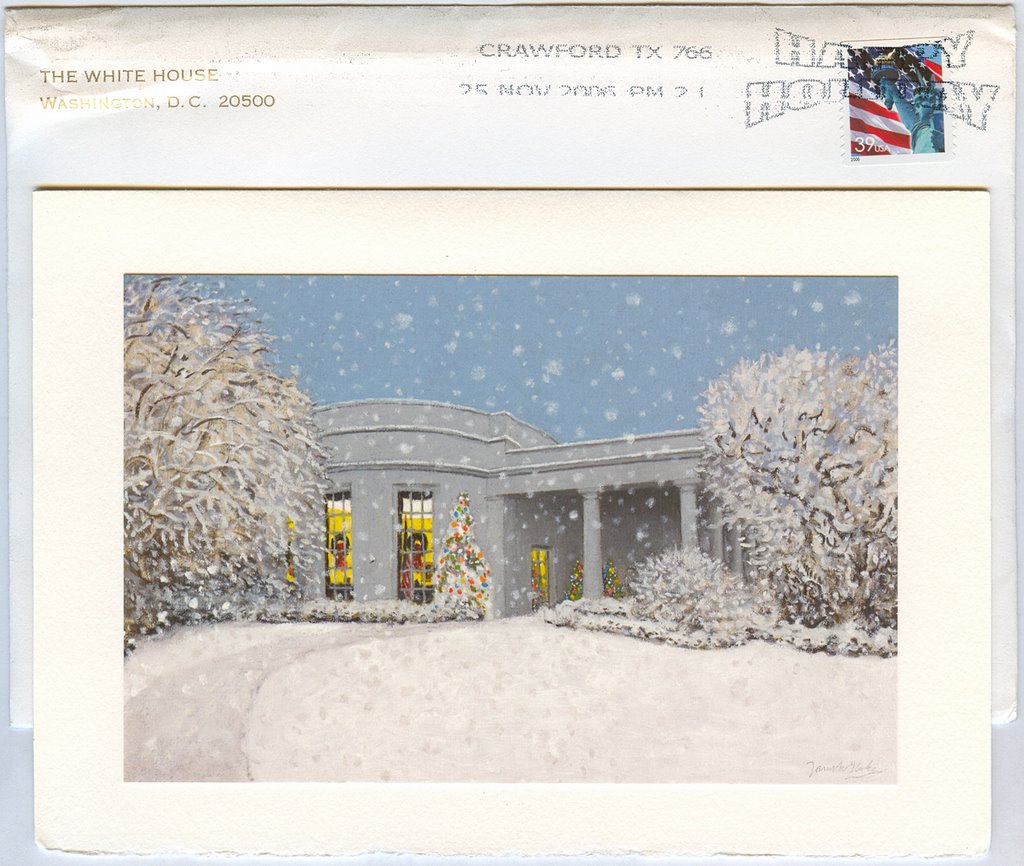
The first holiday greeting card of the 2006 season arrived in my snail-mailbox today. To my surprise, the envelope had a return address of "The White House, Washington, D.C. 20500" and a postmark of "Crawford, TX":


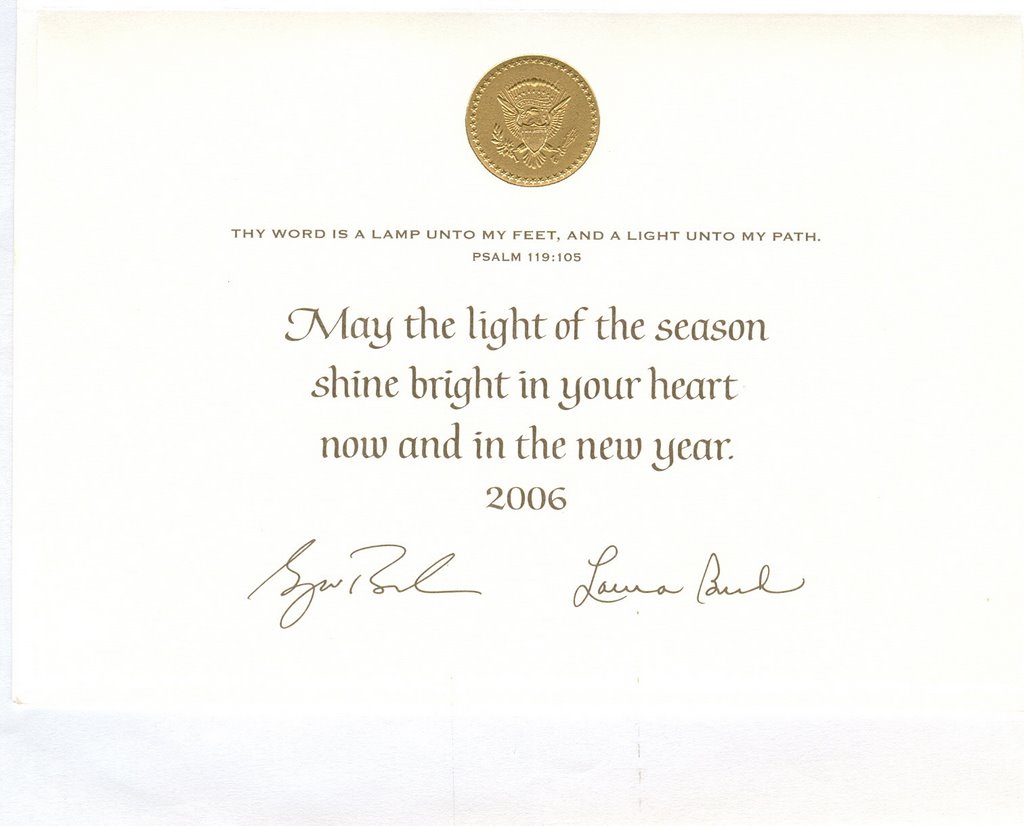
The card inside was signed -- OK, it was an autopen or even a printing-press facsimile signature -- by George and Laura Bush:


As one might expect, the back of the card informs us that it was "Paid for by the Republican National Committee. WWW.GOP.COM. Not authorized by any candidate or candidate committee." (We're also told that the picture on the front is an oil painting by James Blake entitled "The Oval Office in December.")

I'm a bit puzzled. Not by the heavy snow on the White House lawn in December, since that's just artistic license, and there are rare early snows in Washington that could serve as the basis of this painting.

My puzzlement stems, rather, from the fact that I am not a big financial contributor to the Republican Party, and I have never received a White House Christmas card in the past. I know that the list of recipients is limited to only a few thousand people, and most of them are top-dollar donors to the GOP. So how did my name get on the list?

I'm not complaining -- just curious.

It looks like now I'll have to add the Bushes to my own Christmas card list. It would be so gauche not to reciprocate.


Wednesday, February 01, 2006

State of the State of the Union

I was going to respond to President Bush's State of the Union Address, which he delivered last night, but then I looked at the text:

Three men's dress shirts (light starch)
One blue blazer
Two men's trousers
Five ties
One grey pinstripe suit
Three ladies' blouses
One blue dress
Three pairs black socks
One jogging suit
One pair tennis shorts
... and decided it's just not worth the effort.

Instead, I thought it would be fun to go back ten years and see what I wrote about another president's list of (unaccomplished) aims. From the Metro Herald in February 1996, here is what I wrote about Bill Clinton's State of the Union message for that year:
State of the Union: But, But, But ...
Richard E. Sincere, Jr.

The difference between Bill Clinton and Bob Dole is this: Although neither Clinton nor Dole really believes in anything, Clinton knows how to fake it. (Long before his 100th birthday, George Burns observed: "Acting is all about sincerity. If you can fake that, you're set for life.")
If the State of the Union Address and Dole's response indeed launched the 1996 presidential campaign, Dole is in for a sad, downhill retreat. The contrast between the two performances was stark: Clinton was relaxed, vigorous, emphatic; Dole was twitchy, anemic, soulless. Yet only in their styles did the contrast shine forth. Though their deliveries were decidedly different, their content was barely distinguishable.
Television -- which is how most Americans observed the Clinton and Dole speeches -- is a visual medium that conveys emotion much better than argument. Neither Clinton nor Dole tried for much substance in their speeches. Their themes rested entirely on feelings.
Indeed, the themes of both politicians were conservative. Clinton sounded much like Ronald Reagan -- something he does often and well, dating to his acceptance speech at the 1992 Democratic convention. He emphasizes themes of family, neighborhood, and work -- the same themes that motivated Reagan's winning 1980 presidential campaign. (Reagan himself developed these themes when he stumped the country in the 1950s and ‘60s, and used them effectively in "The Speech" that launched his career as a politician. Delivered on behalf of Barry Goldwater just before the 1964 presidential election, "The Speech" made Reagan the darling of the dawning conservative movement.)
Unfortunately, Clinton does not mean what he says. When he appears to embrace conservative -- even libertarian -- principles, he always has a fallback to traditional, failed liberal policies. In his State of the Union message, Clinton used the word "but" 27 times in 65 minutes. Each time he made a grand statement that conservatives and libertarians could readily and happily agree with -- such as "the era of big government is over" -- he qualified it with a "but." Each "but" meant that "we liberals recognize that conservatives have won over public opinion, so we're telling you we agree with them, even though we're sticking to the same policies we've advocated for thirty years."
In his faltering attempt to respond to Clinton, Dole attacked straw men that must have befuddled most viewers. Most of his attacks rang true for committed conservatives -- accusing Clinton of alignment with elitist special interests, for instance -- but they had little to do with the powerful speech Clinton had just presented. And Dole offered few specifics to distinguish himself and the Republicans from Clinton and the Democrats. He gave us no reason to vote for him, personally, or his party.
Just so. The Republicans and Democrats agree on so much in terms of keeping the government big and intrusive, they must pretend to disagree in order to trade positions of power every four years. Is it any wonder that 60 percent of Americans tell pollsters they'd like to see a third political party emerge to challenge the Republicans and Democrats?
Clinton promised to seek a higher minimum wage. All economists agree that higher minimum wages result in higher unemployment for the most marginalized workers in society -- teenagers getting their first job, illiterate and unskilled workers, single mothers re-entering the workforce after raising their children. By raising costs for businesses, minimum wage laws fatten the welfare rolls.
Dole said nothing about this.
Clinton promised to seek laws that force insurance companies to grant health insurance policies to anyone who wants them, regardless of "pre-existing conditions" (that is, being sick). This will raise the cost of insurance premiums for everyone, making health insurance unaffordable for some -- many -- Americans at a time when government interference in the health care system raises prices across the board.
Dole said nothing about this.
Both Clinton and Dole call for more intrusion into the lives of Americans. In particular, as Clinton pointed out, Republicans and Democrats agree on a number of new programs. Gene Cisewski, chairman of the D.C. Libertarian Party, mentioned a few of these in a post-speech interview: "Calling for mandatory V-chips in TV sets, expanding social programs, building up more arms on our borders, showing off his real live general for a war against the American people, and campaign finance ‘reform' that effectively blocks third parties from political access move this country in a more authoritarian direction."
If the Republicans want to win the 1996 presidential election, they need to find a more dynamic candidate than Dole (perhaps Steve Forbes) who genuinely believes in policy changes that can move the country in a positive direction. If they do end up with Dole, Tuesday's match-up shows that Clinton will mop up the floor with his opponent.
But the ultimate losers will be the American people.
* * * * * * * * * * * *
Richard Sincere is chairman of the Libertarian Party of Virginia.

(Doesn't that tagline date the piece?)
Be sure to visit my CafePress store for gifts and novelty items!
Read my blog on Kindle!
Follow my tweets on Twitter! 

Thursday, February 24, 2005

George W. Bush in Wonderland

David Brooks describes the Humpty-Dumpty, Mad Hatter world that George W. Bush lives in as his administration tries to expand government entitlements beyond FDR's wildest dreams.

Brooks notes that the Medicare prescription drug plan, which will cost far more than the administration estimated as it was strong-arming Congress to pass it, is now so sacrosanct that the President is threatening to wield his veto pen in order to preserve it at the highest price possible.

In his most recent syndicated column, Brooks refers to conservative Representatives Mike Pence and Jeff Flake and Senators Judd Gregg and Lindsey Graham as among those who are ready to "readjust the program" to reflect fiscal realities.

Brooks writes:

These fiscal conservatives want to make the program sustainable. Perhaps the benefits should be limited to those earning up to 200 percent of the level at the poverty line. Perhaps the costs should be capped at $400 billion through other benefit adjustments. These ideas are akin to what the candidate George W. Bush proposed in 2000.

But the White House is threatening to veto anything they do! Bush, who hasn't vetoed a single thing during his presidency, now threatens to veto something -- and it's something that might actually restrain the growth of government. He threatens to use his first veto against an idea he originally proposed!

Have we entered another world, where up is down and rationality is irrational?


Someone should tell the President (and Karl Rove) that, if they want to make sense out of the nonsense they're creating, their most realistic course of action -- short of delivering on the Bush 2000 campaign promises of fiscal restraint and prudence -- may be to follow the White Rabbit down a hole. There they may find a land that better fits their psychedelia-colored fiscal non-restraint. My advice?

Go ask Alice
, Mr. President.

I think she'll know

When logic and proportion
Have fallen so I'll be dead
And the white knight's talking backwards
And the Red Queen Says off with her head
Remember what the dormouse said

Feed your head
Feed your head


(Lyrics from "White Rabbit," by Grace Slick, as performed by Jefferson Airplane)

Thursday, February 03, 2005

The Queen's Speech

Like the Queen's Speech at the State Opening of Parliament, the President's State of the Union Address is usually little more than a laundry-list of legislative items -- or, more often, a wish list.

Now, since the President is a politician and the Queen is not, his delivery tends not to be quite so monotonous as hers. And he shies from phrases like "my government will seek to . . .," since he knows that the moment such words fell from his lips, his legislative agenda would be on its way to the trash bin.

Still, State of the Union speeches are remembered less for their golden oratory than ... strike that: State of the Union speeches are remembered less. Period.

The most surprising aspect of George W. Bush's 2005 State of the Union Address is that he used it for a sustained, concise but thorough, coherent presentation of his plans to reform and reinvigorate the Social Security system.

Troglodytes on the Democratic side of the aisle moaned audibly (Tim Russert of NBC News said they were yelling "No, no, no" in the manner of British backbenchers during the Prime Minister's question time) but the President was not moved by their heckling.

In 1,109 words, Bush set out an agenda to bring Social Security into the 20th century. He explained carefully and cogently how the system began, how it developed through to the present time, and how it will be bankrupt by the time today's 20-somethings are ready to retire.

It was quite masterful -- and totally unexpected.

In anticipation of the speech, Harold Meyerson of the Washington Post trotted out all the liberal bogeymen in an op-ed piece entitled "Assault on Social Security" -- as if anything designed to reconstruct the broken-down relic of the 1930s is meant to destroy it and all it stands for.

Meyerson's worst fear is that Bush may fulfill the decades-old work of conservatives and libertarians, who have been pushing for Social Security reform (let's call it by its true and honest name, privatization) since the 1970s:


And the plans to privatize Social Security, it's important to note, have been devised by people who are ideologically committed to its destruction. When Milton Friedman was calling for privatization a half-century ago, it wasn't because he feared the system would run out of money when the boomers retired. (The boomers were at that point just midway through being born.) It was because he was a committed advocate of laissez-faire capitalism.

Similarly, the advocates for privatizing Social Security have for the past quarter-century been housed at the Heritage Foundation and the Cato Institute -- the nation's leading institutions of economic libertarianism. But since 1983 -- when a commission appointed to augment Social Security's solvency declined to consider privatization, though it was appointed in part by Ronald Reagan and headed by Ayn Rand-acolyte Alan Greenspan -- they have understood that the only way to realize their libertarian hearts' desire was to convince the American people that the system was teetering on bankruptcy.


To Harold Meyerson, "ideology" is a dirty word. But why? Ideology is nothing more than the organizing principles that inform politics and policymaking. The "pragmatism" that Meyerson so admires in American voters is an ideology itself, the ideology of practicality and practicability. Was John Dewey's philosophical pragmatism any less ideological than Ayn Rand's philosophical Objectivism?

By identifying the roots of Social Security reform with the nonagenarian Milton Friedman -- why did he leave off the usual honorific, "Nobel laureate economist"? -- Meyerson tries to suggest that the idea is past its use-by date. That's just laughable.

If anything, Social Security reform is recognized as both necessary and inevitable -- as well as desirable -- by younger thinkers. Here's one example.

In an article dated January 24, Anthony Dick, a columnist for the Cavalier Daily at the University of Virginia, wrote:

Our country's current Social Security policy has a place amongst the most mind-bogglingly, hair-pullingly, eye-gougingly insipid monstrosities ever to occupy a place in the pyrite pantheon of American legislative travesty.

Amid all of today's talk about the practical issues of Social Security reform, commentators rarely step back to appreciate the absurdity of Social Security as a matter of pure principle. Under the status quo, every time you get a paycheck, a percentage of it is forcibly taken from you and put into a collective Social Security fund. If you selfishly try to keep this money that your employer has voluntarily given to you, men with guns and badges will come to your house and drag you off to jail. After many years of this lovely process, once you've reached an age that the government deems to be sufficiently old and crusty, some money from this collective fund will be doled back out to you in a monthly allowance from your kind old Uncle Sam. You may be getting robbed today, proponents say, but you'll sure be secure tomorrow. It's for your own good.

The most obvious and ugly assumption at the heart of this system is the paternalistic idea that the government knows better than you do what's best for your life and your future.


Dick concludes:

Today's defenders of the Social Security status quo urge you to ignore the quaint old idea that you should be free to form and pursue your own conception of the good life by deciding how to spend or invest your own paychecks. Such pleas make them yet another sad contingent in history's parade of callow conspirators who have claimed to serve the people's interests while at the same time severely limiting the people's freedom to control their own lives. It's time we reject this model of condescending paternalism and reclaim our financial security from the claws of stilted bureaucrats.


I, for one (and I'm obviously not the only one), am grateful for the yeoman work performed in obscurity for so many years by policy analysts at the Cato Institute and the Heritage Foundation, for the politicians in Chile and elsewhere who had the courage and good sense to ignore the U.S. example and modernize their social-security programs, and for the young voters who are willing to sneer at the reactionaries manning the liberal barricades against progress.

Let's just hope that George W. Bush has earned the political capital he needs to make Social Security modernization happen. Members of Congress may have erupted in applause 9 times during that section of his speech, but we know better than to trust them to do the right thing. As a group, they lack both principles and fortitude -- in a word, Mr. Meyerson, ideology.