Showing posts with label Bible. Show all posts

Thursday, March 15, 2018

Guest Post: Who was Mary Magdalene? Debunking the myth of the penitent prostitute

Dorothy Ann Lee, University of Divinity

Who was Mary Magdalene? What do we know about her? And how do we know it? These questions resurface with the release of a new movie, Mary Magdalene, starring Rooney Mara in the titular role.

Mary Magdalene Yvonne de CarloThe question of how we know about her is a relatively simple one. She appears in a number of early Christian texts associated with the ministry of Jesus.

These texts comprise Gospels written in the first and second century of the Common Era (CE). The earliest of them are included in the New Testament, where Magdalene plays a significant role. She also appears in later Gospels, which were not included in the Bible and come from a later period in early Christianity.

The answer about who she was and what we know of her is more complex. In Western art, literature and theology, Mary Magdalene is portrayed as a prostitute who meets Jesus, repents of her sins, and pours oil on his feet in a gesture of humility, penitence and gratitude. She is sometimes depicted kneeling at the foot of the cross, hair unbound, emphasising the sinful past from which she can never quite escape, despite being declared a saint.

The tradition of the penitent prostitute has persisted in the Western tradition. Institutions that cared for prostitutes from the 18th century onwards were called “Magdalenes” to encourage amendment of life in the women who took refuge in them. The word came into English as “maudlin”, meaning a tearful sentimentality. It is not a flattering description.
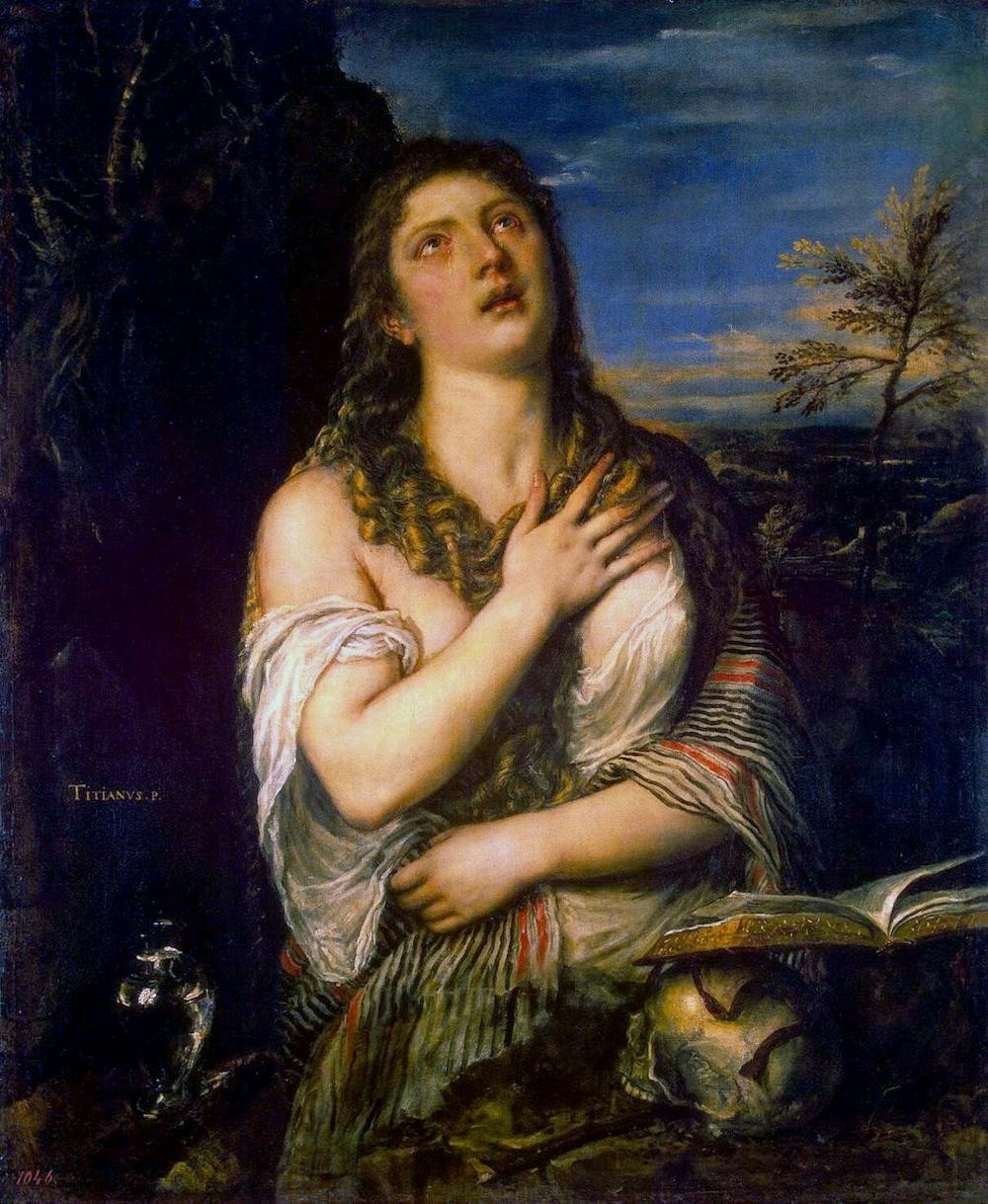


Titian Penitent Magdalene, circa 1565

Titian’s Penitent Magdalene, circa 1565.
Wikimedia Commons


Artistic depictions continued to emphasise Magadelene’s sexuality in various ways, under a facade of piety. In another twist on the same theme, she is presented as the wife of Jesus, most notably in Dan Brown’s The Da Vinci Code (2003).

The tradition of Mary Magdalene as the archetypal penitent whore, whose sexuality somehow manages to persist beyond her conversion, can be dated to a sermon preached by Gregory the Great in the sixth century CE.


Read more:
Weighing up the evidence for the 'Historical Jesus'


Admittedly, there are a confusing number of women called “Mary” in the Gospels and we might assume Pope Gregory was tired of distinguishing between them. He reduced them to two: on the one hand, Mary, the mother of Jesus, perpetual virgin, symbol of purity and goodness, and, on the other, Mary Magdalene, promiscuous whore, symbol of feminine evil from which the world must be redeemed.

A disciple of Jesus


Yet nowhere in the Gospels is Mary Magdalene associated either overtly or covertly with sexuality. The four Gospels of the New Testament present her in two significant roles.

In the first place, she is a disciple of Jesus: one among a band of women and men from Galilee who believed in his message of love and justice and followed him in his ministry.

Secondly, Magdalene is a primary witness in the Gospels to the resurrection of Jesus from the dead. Unlike many of the other disciples, she does not flee when Jesus is arrested. She remains at the cross when he dies and later visits his tomb to find it empty, with a vision of angels declaring his resurrection.

Mark’s Gospel, which we now know to be the earliest Gospel to be written, speaks of Magdalene as a disciple of Jesus who has followed him from Galilee along with other women, but it does not mention her until the crucifixion. These women disciples now stand near the cross, despite the danger in being present at the execution of a dissident.

Three of them, including Magdalene, visit the tomb on Easter morning where they meet an angel who informs them that Jesus has risen from the dead (Mark 16:1-8). The women’s subsequent departure from the tomb is ambiguous, and they leave in fear and silence, which is where the manuscript of Mark’s Gospel abruptly ends. An ending added later makes mention of the risen Jesus making an appearance first to Magdalene.

In Matthew’s Gospel, Magdalene meets the risen Christ as she leaves the tomb, this time with only one other female companion, who is also called “Mary” (Matt 28:1-10). In Luke’s account, Magdalene appears at the cross and at the empty tomb to hear the angel’s words, but she and her female companions are not believed when they convey the message of the resurrection to the apostles (Luke 24:1-11).
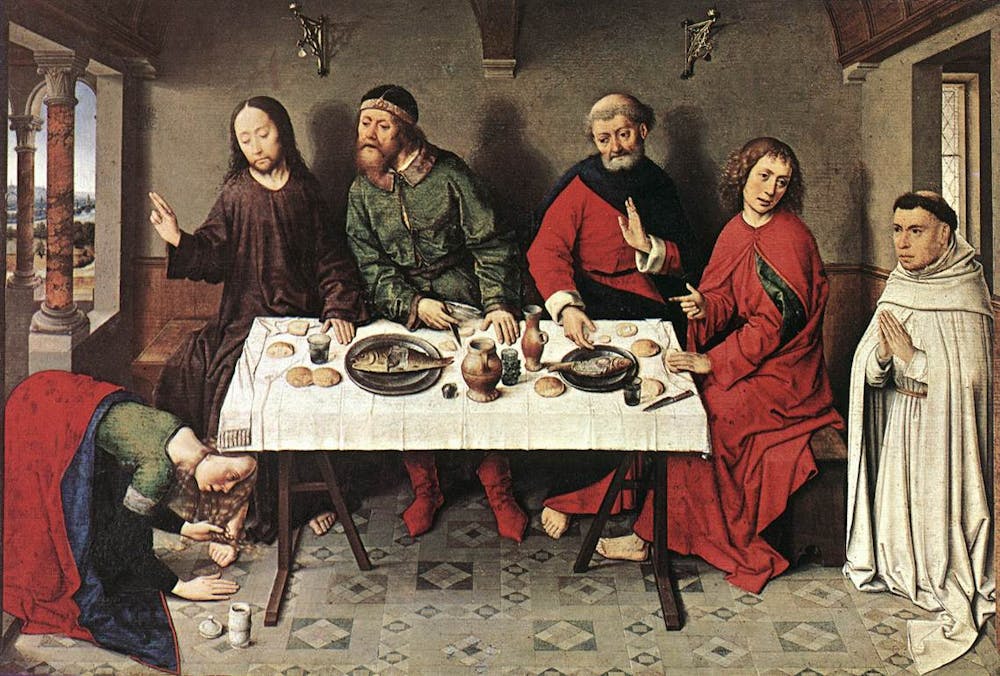


 Mary Magdalene anoints Christ’s feet in Dieric Bouts’ Christ in the House of Simon

Mary Magdalene anoints Christ’s feet in Dieric Bouts’ Christ in the House of Simon (circa 1420–1475).
Wikimedia Commons


In Luke, there is an earlier mention of Magdalene in Jesus’s ministry where she is present, along with other women, as a disciple and supporter of Jesus (Luke 8:1-3). She is described as having had seven demons cast from her. This description might lead to the conclusion, in some minds, that the many “demons” refer to her unfettered sexuality.

But that would be erroneous. Exorcisms — the casting out of evil spirits — are common in the first three Gospels. Those suffering demonic possession are never described as sinful but rather are victims of external evil.

These days, we would associate their symptoms with physical maladies such as epilepsy or mental illness. Magdalene, in other words, has been the victim of a serious illness and Jesus has healed her.


Read more:
How the Bible shapes contemporary attitudes to rape and sexual assault


Furthermore, the description is unusual here in that she is not described in relation to a male figure, as other women at the time generally were: father, husband, brother. She is simply referred to as “the Magdalene”, that is, the woman from Magdala, a Jewish village in Galilee.

We might well assume, from Luke’s description, that she is an independent woman of some means, who is well able to fund, as well as participate in, the movement around Jesus.

Her most significant role


John’s Gospel, however, gives Magdalene her most significant role. Once again, she does not appear until the crucifixion. In the narrative that follows, she comes alone to the tomb on Easter morning, finds it empty, tries unsuccessfully to gain help from two other prominent disciples, and eventually meets the risen Christ himself in the garden (20:1-18). He is alive and commissions her to proclaim the message of his resurrection.

On the basis of John’s story, later tradition gave Magdalene the title of “apostle to the apostles” and recognised something of her significance for Christian faith, witness and leadership. A tragic consequence is that her role as witness to the resurrection was later overshadowed by the apparently more alluring but inaccurate picture of her as the penitent whore.
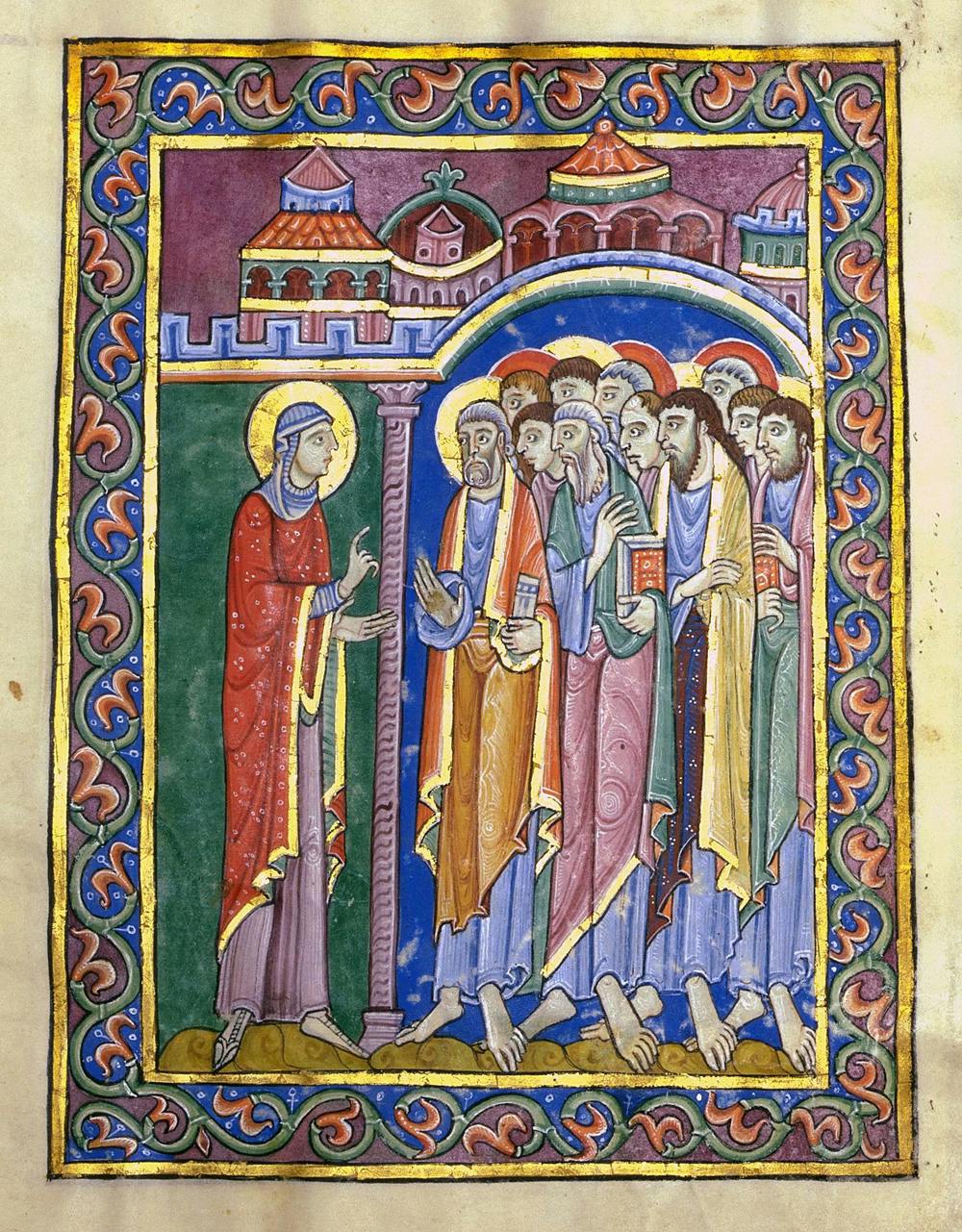


Mary Magdalene St Albans Psalter

A more accurate portrayal of Mary Magdalene announcing the risen Christ from the 12th-century English illuminated manuscript St Albans Psalter.
Wikimedia Commons


The later Gospels, beyond the New Testament, also emphasise Magdalene’s importance as a disciple of Jesus and witness to the resurrection. The manuscript of the Gospel of Mary, which describes her discussions with the risen Christ, is unfortunately damaged and the central section is missing. In this and other similar Gospels, however, Magdalene is presented as the favoured disciple. This situation leads to some tension with the other disciples, who are jealous of her closeness to Jesus and the teaching she alone is given.

One Gospel speaks of Jesus kissing her, but the imagery in the Gospel of Philip is metaphorical and refers to a spiritual union with Christ. In response to the objection by the other disciples, Jesus asks why he does not kiss them in the same way, implying that they do not as yet possess the same degree of spiritual knowledge.

No evidence of Magdalene anointing Jesus


There is no evidence, incidentally, that Magdalene ever anointed Jesus.

There are three anointing traditions in the Gospels. In one, an unnamed woman anoints Jesus’s head in prophetic recognition of his identity (Gospels of Mark & Matthew). In another, a named and known disciple, Mary of Bethany, who is a model disciple, anoints Jesus’s feet in gratitude for his raising her brother Lazarus from the dead (Gospel of John). In the third, a “sinful woman”, who is not explicitly identified as a prostitute, anoints Jesus’s feet in a gesture of repentance, gratitude and hospitality. None of these three figures is associated in any way with Mary Magdalene in the texts.

The movie Mary Magdalene, directed by Garth Davis, is a significant portrayal of this early Christian figure in the light of evidence from the earliest texts. The screenwriters, Helen Edmundson and Philippa Goslett, are quite clear that Mary is not to be associated with Jesus through her sexuality, either as harlot or wife. On the contrary, she is depicted as a faithful and deeply insightful disciple of Jesus, on whom he draws for his message of love, mercy and forgiveness.


Magdalene is beautifully portrayed in the movie, which draws on traditions from the earlier and later Gospels. She possesses an intense and compelling presence, which does much to restore her character from its later distortions.

It is true that the film makes somewhat erratic use of the New Testament, both in its presentation of Magdalene and of other characters in the story. Towards the end, for example, there is an implication that Magdalene and the church stand on opposite sides, the one in sympathy with Jesus’s teaching and the other anxious to build a self-glorifying edifice on his assumed identity.

This is unfortunate, as the New Testament itself is quite clear about the priority and identity of Magdalene as a key disciple, witness and leader in the early church, without seeing her in opposition to others.

Indeed, those who campaigned in a number of Christian churches for the ordination of women in the 20th century used precisely the example of Mary Magdalene from the New Testament as “apostle to the apostles” to support their case for women’s equality and leadership.

The recent installation of Kay Goldsworthy as Archbishop of the Anglican Diocese of Perth — the first woman in this country and across the world to be given this title — is the true heir of Magdalene as she is portrayed in the earliest Christian writings.


The ConversationThe film Mary Magdalene opens in Australian cinemas on March 22.

Dorothy Ann Lee, Frank Woods Professor of New Testament, Trinity College, University of Divinity

This article was originally published on The Conversation. Read the original article.

Thursday, December 14, 2017

Guest Post: Did 'the man who invented Christmas' plagiarize Jesus?

Matthew Robert Anderson, Concordia University

Everyone knows the story of Scrooge, a man so miserly his name has become synonymous with penny-pinching meanness. Scrooge’s conversion from miser to benefactor has been told and retold since Charles Dickens first wrote A Christmas Carol in the fall and winter of 1843. Ebenezer is a wonderful character, so richly portrayed and fascinating he’s echoed in stories from The Grinch to It’s a Wonderful Life.

Dickens the man who invented christmas christopher plummerPop culture has embraced both Dickens and his tale. With this season’s The Man Who Invented Christmas, Hollywood has done it again.

But who was Scrooge before he was, well, Christopher Plummer? The inspiration for the crotchety Christmas-hater may have been those who put Dickens’ own father into debtor’s prison and were responsible for young Charles working in a shoe-blacking factory.

Some Dickens scholars believe the author’s 1843 visit to sooty Manchester, or to “the black streets of London,” (as he described them in a letter to a friend) influenced him. It may be that the fable was a moral reminder from Dickens to himself, as he teetered on financial ruin. This is the theory proposed in the book by Les Standiford on which this year’s movie is based.

Did Dickens in fact invent Christmas, as we know it? Hollywood may think so, but others, like David Parker in his Christmas and Charles Dickens vehemently disagree.

Whatever your opinion, the prevailing wisdom is that A Christmas Carol isn’t particularly religious. As a professor of biblical studies at Concordia University and also a Lutheran minister, I have a different reading.

It’s true that the celebration of the season which Scrooge discovers has much more to do with generosity, family gatherings and large cooked birds, than the Nativity. But maybe those seeking explicit scriptural references in Dickens’ story are underestimating the Victorian novelist’s skill — and his audacity. Perhaps A Christmas Carol contains an alternative to the Bible rather than a simple borrowing from it. And perhaps that’s the point.

Jesus was a master story-teller


Jesus, by all accounts another master story-teller, told a parable that, stripped of Dickens’ English waistcoats, ledgers, fog and shutters, could almost be a mirror to A Christmas Carol:

“There once was a rich man. A poor man named Lazarus lived at his gate, with nothing to eat. Lazarus died and was carried by the angels to Abraham’s side. The rich man also died.”

There follows, in Jesus’ tale, an exchange between the rich man, who is in torment, and Abraham, who acts as the guardian of paradise. It’s hard not to think of the innocent Lazarus as a precursor to Tiny Tim.

First the rich man asks for his own relief from hell. When that’s denied, he pleads: “I beg you, send Lazarus to my father’s house. I have five brothers. Let him warn them so they don’t come to this place of agony.” Abraham replies: “They have Moses and the prophets. They must listen to them.”

“No, Father Abraham!” cries the rich man, “But if someone from the dead goes to them, they will change” (Luke 16:19-31).

One can almost hear the chains of Morley’s ghost rattling. What would have happened if Father Abraham had said yes? Something very like a first-century version of A Christmas Carol.

Let’s not forget that the people of our western English-speaking past, especially artists and writers, were imbued with Biblical references and ideas. As Northrop Frye, among others, has argued, they lived and created in a world shaped by the rhythms, narratives, images and conceptions (or misconceptions) of the King James Bible.

Parable of the Rich Man and Lazarus
Parable of Lazarus
Was Dickens familiar with Christian scriptures? All evidence points to the fact that he was more acquainted than most. Despite an antipathy to organized religion, from 1846 to 1849 Dickens wrote a short biography of Jesus for his children, titled The Life of our Lord.

He forbade that his small retelling of Jesus’ life should be published, until not only he, but also his children, had died. The “Parable of Lazarus and the Rich Man” was one of eight stories of Jesus that Dickens chose to include in that volume. But in his story of Scrooge, Dickens was too much of a writer to leave Jesus’ parable as is, and his age too suspicious of scripture to leave it “unbroken.”

A Christmas Carol unites the deliciously horrific sensibility of the Gothic movement with the powerfully simple narrative style, joined to moral concern, typical of parables.

Was Dickens perhaps dozing off some Sunday while the rector droned on about Lazarus, until he wakened with a start dreaming of Scrooge? We will never know. But it’s an intriguing possibility.

Happy endings for the rich


Surprisingly, the Sunday after Dickens was buried in Westminster Abbey, Dean Arthur Penrhyn Stanley, preaching on exactly this text, spoke of Dickens as the “parabler” of his age. Stanley said that “By [Dickens] that veil was rent asunder which parts the various classes of society. Through his genius the rich man…was made to see and feel the presence of Lazarus at his gate.”

I would go further: Dickens took the parable, and then retold and changed it, so that the rich man gets a second chance. As a privileged societal figure who had gone through financial difficulties and who cared about the poor himself, Dickens freely adapted Jesus to come up with a story that’s ultimately more about love than judgement.

When confronted with Marley’s spectre, Scrooge, unnerved but unrepentant, addresses the apparition: “You may be an undigested bit of beef, a blot of mustard, a crumb of cheese, a fragment of underdone potato.”

The perceptive reader (or viewer) of A Christmas Carol can point a finger at Marley’s ghost and add: “Or maybe you’re an ironic but hope-filled riff on Jesus, by a famous nineteenth-century author who wanted to write his own story of redemption.”

The ConversationDickens not only invented this Christmas genre, but imagined a happy ending for himself in it. He penned an enduring story about the second chance even a rich person can receive, if haunted by persistent-enough ghosts.


The Man Who Invented Christmas (Bleeker Street Media/Elevation Pictures)


Matthew Robert Anderson, Affiliate Professor, Theological Studies, Loyola College for Diversity & Sustainability, Concordia University

This article was originally published on The Conversation. Read the original article.


Saturday, June 17, 2017

Guest Post: The Qur’an, the Bible and homosexuality in Islam


Christopher van der Krogt, Massey University

Neither the Bible nor the Qur’an (Koran) has a lot to say about homosexuality, and what they do say relates only indirectly to contemporary discussions about gay rights and same-sex marriage. Like pre-modern scholars of law and ethics, these books assume heteronormativity.


Peter Paul Rubens, Lot and his family escaping from the doomed city guided by an angel, circa 1615.


Peter Paul Rubens, Lot and his family escaping from the doomed city guided by an angel, circa 1615.


As a concept, homosexuality is relatively recent, even if there is plenty of evidence for homoerotic pleasure in the past – albeit illicit in religious terms.

Scriptures and later writers usually referred only to particular sexual acts and did not raise the issue of personal sexual orientation. For religious conservatives, though, both Muslim and Christian, the occasional derogatory reference to same-sex acts is enough to prove their inherent sinfulness in all circumstances.

More liberal interpreters point to broader ethical considerations such as compassion and empathy. They argue that the condemnations of scripture do not apply to committed relationships founded on love.

Such a perspective, however, is inevitably more common among believers concerned with human rights, influenced by gender theory, and trained in contextual and holistic methods of interpretation.

Homosexuality in the Bible


Leviticus 20:13 (cf. 18:22) declares it abominable for a man to lie with another man as with a woman, and both partners are to be executed. The possibility that one party has been coerced is not discussed: both are defiled. However, the offence seems to be no worse than other capital crimes mentioned in the same context, such as adultery and incest.

Paul evidently regarded the prohibition of sexual acts between men or between women as violations of natural law known even to non-Jews – at least if their minds were not clouded by idolatry (Romans 1:18–32; 2:14–16).

He seems to have reflected contemporary views that men should be sexually assertive and women passive, and that sexual activity must be at least potentially procreative.

Sodom and sodomy


Lot fleeing with his family, by Peter Paul Rubens, 1615.

Lot fleeing with his family, by Peter Paul Rubens, 1615.
via Wikimedia Commons


For Jews, Christians, and Muslims alike, the story of Sodom is central to the traditional condemnation of male homosexuality. As recounted in Genesis 19, however, this is not a story about love or consensual sex between men: it is about rape and inhospitality.

The mob that gathers outside Lot’s house need not be exclusively male (the Hebrew plural anashim can include both genders), and the text says all ages were represented (Genesis 19:4, 11). When the crowd demands Lot’s visitors, he offers his two virgin daughters in their stead. Perhaps he considers the rape of his daughters a lesser evil than the rape of his guests.

The fact that the guests are male is not emphasised. After the visitors (angels in human form) rescue Lot and his family, God rains down fire and brimstone upon Sodom, Gomorrah, and other cities nearby.

Actually, he had already determined to punish all these towns and their inhabitants, male and female, young and old, before the angels’ visit and the attempted homosexual rape (Genesis 18:16–33). When the wickedness of Sodom is recalled in other parts of the Bible, homosexuality is not mentioned. Yet, despite this broader context, the story was often interpreted primarily as a condemnation of homosexual activity in any form.

In the Qur’an, the somewhat ineffectual Lot of Genesis becomes the Prophet Lut. The Arabic term for homosexual anal intercourse, liwat, comes from his name rather as English derived the term sodomy from the name of the town.

As in Genesis, Lut seems to argue with the men of Sodom over the relative propriety of abusing his daughters or his guests (11:78–79; 15:67–69). More often, though, the emphasis is on his condemnation of lusting after men instead of women (7:80–81; 26:165–66; 27:55; 29:29). In the Qur'an, Lut says:

Indeed, you approach men with desire, instead of women. Rather, you are a transgressing people.

Traditional Islamic perspectives


In the Hadith (thousands of stories reporting the words and deeds of Muhammad and his companions that are comparable in authority to the Qurʾan itself), there is some support for the notion that the principal offences of Sodom were idolatry and avarice. These led in turn to inhospitality and the rape of male visitors.


 Hadith Silsilat al Dhahab (Golden Chain Statue) in Nishapur, Iran.

Hadith Silsilat al Dhahab (Golden Chain Statue) in Nishapur, Iran.
Sonia Sevilla, CC BY


Nevertheless, the Hadith do unequivocally condemn male homosexual acts. The Qur’an (4:16) demands unspecified punishment for men guilty of lewdness together unless they repent.

Yet, the Prophet is supposed to have declared that both the active and the passive partner should be subject to the same penalty as for zina (illicit heterosexual sex, usually adultery), namely execution by stoning. Abu Dawud’s authoritative hadith collection records a report from Abdullah ibn Abbas:

The Prophet (peace be upon him) said: If you find anyone doing as Lot’s people did, kill the one who does it, and the one to whom it is done (38:4447).

It is doubtful whether any passage of the Qur’an refers to lesbian acts though the condemnation of women who commit indecency (4:15) is sometimes read this way. A few hadith warn women against seeing or touching each other when naked.

Traditional Islamic jurisprudence assumed strict gender roles. The 17th-century Muslim scholar Haskafi explicitly included “a male” in his list of those whom a man could not legally marry.

Marriage was understood in hierarchical terms, but although a man could have sexual relations with female slaves, he did not have the same rights over male slaves.

Pre-modern scholars who produced lists of “enormities” included liwat and sometimes tribadism (“rubbing”, that is, lesbian intercourse) after zina. Prescribed penalties for homosexual acts varied according to different schools and individual scholars. In any case, it was difficult to attain the required level of eye-witness testimony.

In practice, homosexual encounters, including with young male prostitutes, seem to have been quite common in Islamic societies. They were no more or less a cause for moralistic concern than other forms of illicit sex.

Reinterpreting the Islamic tradition


Without actually endorsing homosexuality, some Muslims in Western societies have recognised a parallel between the religious acceptance they demand and the acceptance demanded by gays and lesbians.

The New Zealand Muslim MP Ashraf Choudary (who did not realise that the Qur'an does not urge the stoning of homosexuals) observed that,

if the law allows one minority group in our society to be discriminated against then all minorities are vulnerable.

Some, such as Cambridge philosopher Abdal Hakim Murad (Timothy Winter), have accepted that a homosexual orientation may be innate but say that does not make homosexual sex permissible.

Deducing that it may therefore be legitimate remains a step too far for most.

Traditionally, if sins can be forgiven when repented, declaring forbidden acts not to be sinful has been regarded as heresy or even apostasy. Commentators such as Mehdi Hasan, after wrestling thoughtfully with the issues, have concluded that while they do not approve of homosexual acts, they cannot condone homophobia.

A similar message was offered by Tariq Ramadan, Professor of Contemporary Islamic Studies at Oxford, when he visited New Zealand: Muslims and others have to respect each other, which includes accepting that the law permits gay marriage.


Imam Daayiee Abdullah Reverend Dwayne Johnson

Imam Daayiee Abdullah, seen here with Reverend Dwayne Johnson discussing religion and LGBT rights in the U.S., is openly gay. He’s argued that ‘there is nothing wrong with Quran. The problem is with how people have interpreted it.’
East-West Center, CC BY-NC-SA


For Muslims generally, as for conservative Christians, homosexual acts are sinful. It is difficult to be openly gay or lesbian in predominantly Islamic countries, but in the West, there are even (a few) gay imams.

There are also support groups for gay and lesbian Muslims. Writers such as Scott Kugle (Siraj al-Haqq) try to reconcile Islamic identity with alternative sexual orientations. Like their Jewish and Christian counterparts, they seek the “original” meaning of scriptural texts obscured by generations of patriarchal, heteronormative interpreters.

They also question the authenticity of certain hadith – in the traditional manner by scrutinising their chains of transmission – and reopen past debates such as that concerning “temporary” marriage. The latter need not be short-term and may offer an alternative framework for co-habitation without formal marriage.

Christian gays and lesbians have had to work hard for a measure of recognition among fellow-believers; their Muslim counterparts are just beginning that struggle.


The ConversationAcknowledgement: The most useful source for this essay has been Kecia Ali, Sexual Ethics and Islam: Feminist Reflections on Qur'an, Hadith and Jurisprudence (Oneworld Publications, new edition, 2016).

Christopher van der Krogt, Lecturer in History, Massey University

This article was originally published on The Conversation. Read the original article.

Friday, January 06, 2017

Guest Post: What the magi had in common with scientists


by Roger Barlow, University of Huddersfield

Picturesque and exotic, with their crowns and camels, the three kings regularly appear on Christmas cards and in nativity scenes. But how much is original, and how much is later addition for the sake of a good story?

All we know is what Matthew’s gospel tells us, and that does not include their number. They brought gifts of gold, frankincense and myrrh, but to suppose that three gifts means three givers is no more than a guess. More importantly, they were not kings. In his account Matthew consistently describes the visitors as magoi which is the same as the English word “mage”. It’s an unusual word and is often translated as “wise men”.

The early church upgraded them to royal status, perhaps because of descriptions in Isaiah 60 and Psalm 72 of kings worshipping the messiah – but Matthew himself, whose gospel is full of references back to the psalms and prophets, does not make this link, and he would never have let such an opportunity drop.

What they saw


They had seen a star, which shows they were astronomers – or astrologers as there was no difference back then. What was this star? Some scholars have posited that in 7BC there was a triple conjunction (when the planets catch up and overtake each other: quite a dramatic sight) of Jupiter and Saturn, in the constellation of Pisces. These three elements were linked in astrology to royalty, the messiah and the Jews respectively.

Some astronomers, for example Patrick Moore, are unhappy with this theory and suggest that the star the wise men followed was a nova, a comet, or meteors. But there is no firm evidence for any of these. They point out that conjunctions are rare but not unique, and ask why were there no emissaries to Israel on other occasions. Perhaps there were – we only have this single record because of its link to the larger story.

I think what really worries them is that if you accept this interpretation it implies accepting the validity of astrology, and today’s astronomers really hate astrologers (never ask an astronomer what their star sign is). But you don’t have to. Even the sceptical can accept that a visit to Jerusalem and Bethlehem by foreigners looking for the messiah would have made a good story which would be told and retold – and eventually get attached to the birth of Jesus. Matthew wrote his gospel for a Jewish readership, and the Jewish religion then was hostile to astrology, so the suggestion that he just made up the story as propaganda is implausible.


A familiar approach


We can imagine the situation. The star was not a surprise: conjunctions are predictable – today lists of upcoming ones are available on the internet – and even if this was not available 2,000 years ago, astronomers then made careful observations on which they could make predictions using geocentric theories which were fundamentally wrong but which nevertheless seemed to work.

Stonehenge astrology astronomy science
Stonehenge astronomical observatory
For months and years beforehand the “wise men” will have discussed and organised the expedition: the practicalities, the funding. We know how they must have felt, planning a project, looking for money to pay for it, arguing whether their theory’s predictions were really firm or could have some other interpretation.

At this point we realise that we have a better word to translate magoi – a word not available to the translators of the Authorised Version of the Bible in King James’ reign, as it was only invented in 1833.

The word is scientists.

Looking back 2,000 years, they and we are not so different. They used their understanding of the universe to predict what would happen in the world – and, working as a group, they investigated their predictions, despite the cost and trouble and hardships. This is something any scientist today can recognise and identify with. Their understanding of the universe is crude and primitive in our eyes – but what will today’s scientific theories look like in 2,000 years time?

So, when we see pictures of the three kings at Christmas, we should spare them a thought, as colleagues who believed in their theories and followed through the consequences, despite the trouble and expense and personal effort involved. The strength of their conviction and their resolution to follow it, 2,000 years ago, can be an example to us today.

The Conversation

Roger Barlow, Research Professor and Director of the International Institute for Accelerator Applications, University of Huddersfield

This article was originally published on The Conversation. Read the original article.