Showing posts with label theology. Show all posts

Friday, December 08, 2017

Guest Post: Did early Christians believe that Mary was a teenager?

Christopher A. Frilingos, Michigan State University

On Nov. 13, a fifth Alabama woman came forward to accuse Roy Moore, former judge and current GOP Senate candidate, of sexual assault when she was 16. Condemnation of Moore has been widespread, but Moore himself vehemently denies these allegations. He has backing from many in Alabama.

One of his most controversial statements of support came from Alabama State Auditor Jim Ziegler, who declared: “there’s nothing immoral or illegal here…Maybe just a little unusual.” Ziegler went on to appeal to the Christian story of Mary and Joseph:

“Take Joseph and Mary. Mary was a teenager and Joseph was an adult carpenter. They became parents of Jesus.”

I find the allegations against Moore repulsive. But, in addition, as a scholar of early Christianity, Ziegler’s remarks took my breath away. As most Christians would know, an important tenet of Christian theology is that Jesus was born of a virgin mother.
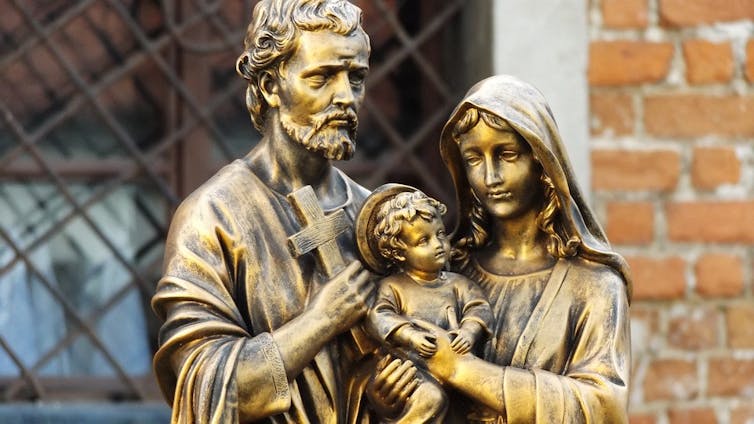


File 20171114 26420 1txgrhj.jpg?ixlib=rb 1.1

The holy family.
CC BY


However, there are many other little-known details in early Christian storytelling about the relationship between Mary and Joseph that I learned while researching my book, Jesus, Mary, and Joseph: Family Trouble in the Infancy Gospels. Early Christians believed that Mary and Joseph did not have sex, but there was much more that was worth learning from that relationship.

Listen up, Jim Ziegler.

The gospel narratives


The Christian Bible includes four gospels, or narratives, of the life of Jesus. Two of them, the Gospel of Matthew and the Gospel of Luke, include accounts of Jesus’s birth. These two versions of the “Christmas story” supply almost all of the details about Mary and Joseph that can be found in the Christian Bible.

In Matthew 1-2, readers learn about the birth of Jesus in Bethlehem, the visit of the Magi or “wise men” to see the newborn and the flight of the holy family to Egypt in order to escape King Herod’s killing of infants. Luke 1-2 describes the birth of John (the cousin of Jesus), an imperial census under the Roman Emperor Augustus and the appearance of angels celebrating the birth of Jesus in the skies above Bethlehem.

Both the gospels seem to agree that Mary conceived by supernatural means, not through sexual intercourse. Meanwhile, whatever Zeigler claims, neither the Gospel of Matthew nor the Gospel of Luke specifies the ages of Mary and Joseph.

The Proto-gospel of James


The earliest source to mention ages is another ancient Christian gospel: the Proto-gospel of James. This gospel is a prequel to the more familiar stories of the first Christmas found in the Christian Bible. It was written in the second century A.D., a hundred years or so after the gospels of the Christian New Testament. Critically, it is mostly unknown to Christians because it is not found in their Bibles.

Even so, the Proto-gospel of James is an important witness to the things that mattered to early Christians. The relationship of Mary and Joseph is one of them.

The Proto-gospel of James tends to fill in gaps left by the Gospels of Matthew and Luke. This, for example, is where readers can learn about the parents of Mary – Joachim and Anna – and about the divine intervention that leads to Anna’s conception of Mary.

This gospel also recounts the story of when Mary met Joseph, details absent from the Gospels of Matthew and Luke. In this telling, Joseph, an elderly widower, is chosen by lottery to take care of Mary, who is 12 years old at the time.

Like the Gospels of Matthew and Luke, the Proto-gospel of James reports that Mary does not conceive through sexual intercourse. She receives news from the angel Gabriel that she will become pregnant and bear a son, Jesus. But the Proto-gospel of James’s account adds a new wrinkle: Mary forgets about her encounter with the angel. When she realizes that she’s pregnant, she’s overcome with fear and confusion. Joseph is likewise confused by Mary’s pregnancy. He nevertheless remains loyal and protects the 12-year-old girl. He takes her to a cave outside of Bethlehem. Soon there is a blinding flash of light. As it recedes, a child appears.

Jesus has arrived.

Familiar and unfamiliar


Some of these details will be familiar to readers of the New Testament: the town of Bethlehem, for example, and the angelic announcement to Mary – the Annunciation – that she will become pregnant.

Other details, however, will come as a surprise: Wasn’t Jesus born in Bethlehem, and not, as the Proto-gospel of James reports, outside of Bethlehem in a cave? And what about the story of how Mary met Joseph? The Proto-gospel of James adds to and changes elements of the earlier accounts of Matthew and Luke.

And then there are details that some Christians know from their religion that other Christians do not. Most Orthodox and Roman Catholics, for example, know the names of Anna and Joachim, the parents of Mary, even though they do not include the Proto-gospel of James in their Bibles. Most Protestant Christians, by contrast, will be unfamiliar with these figures.

In fact, the Proto-gospel of James is just one example of a wide range of gospels and other early Christian writings that are not included in the Christian Bible. The storytelling about the holy family alone could fill a bookshelf: There is the Infancy Gospel of Thomas, the Gospel of Pseudo-Matthew and the History of Joseph the Carpenter. Written at different times in different places, these accounts reflect the early Christian fascination with the household of Jesus, Mary and Joseph.

Love is not predatory


One final observation that is relevant to Jim Ziegler’s comments: The Proto-gospel of James goes a step further than the Gospels of Matthew and Luke in making the point that there was no sexual contact between Mary and Joseph.
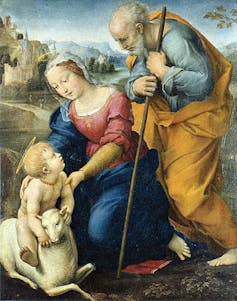


Holy family with the lamb.
Raphael via Wikimedia Commons


In the Gospel of Matthew, Joseph overcomes personal anxiety about Mary’s pregnancy. In the Proto-gospel of James, the pregnancy of Mary becomes a matter of public scrutiny: Both Mary and Joseph must drink the “water of refutation,” a life-and-death ordeal designed to test the truth of their claims of not having had sex with one another. Both pass the test.

But the Proto-gospel of James is not just a story about the virginity of Mary, nor is it just about Joseph’s lack of involvement in the conception of Jesus. Mostly, it is a story about two people being swept up in events that they do not understand.

Together, Mary and Joseph risk everything despite not knowing what it all means. Amid the chaos, they learn to lean on each other. While Mary and Joseph do not, according to the Proto-gospel of James, have a physical relationship, they do love one another.

The ConversationAnd love should not be compared to the predatory behavior alleged against Roy Moore.

Christopher A. Frilingos, Associate Professor in the Department of Religious Studies, Michigan State University

This article was originally published on The Conversation. Read the original article.


Saturday, June 17, 2017

Guest Post: The Qur’an, the Bible and homosexuality in Islam


Christopher van der Krogt, Massey University

Neither the Bible nor the Qur’an (Koran) has a lot to say about homosexuality, and what they do say relates only indirectly to contemporary discussions about gay rights and same-sex marriage. Like pre-modern scholars of law and ethics, these books assume heteronormativity.


Peter Paul Rubens, Lot and his family escaping from the doomed city guided by an angel, circa 1615.


Peter Paul Rubens, Lot and his family escaping from the doomed city guided by an angel, circa 1615.


As a concept, homosexuality is relatively recent, even if there is plenty of evidence for homoerotic pleasure in the past – albeit illicit in religious terms.

Scriptures and later writers usually referred only to particular sexual acts and did not raise the issue of personal sexual orientation. For religious conservatives, though, both Muslim and Christian, the occasional derogatory reference to same-sex acts is enough to prove their inherent sinfulness in all circumstances.

More liberal interpreters point to broader ethical considerations such as compassion and empathy. They argue that the condemnations of scripture do not apply to committed relationships founded on love.

Such a perspective, however, is inevitably more common among believers concerned with human rights, influenced by gender theory, and trained in contextual and holistic methods of interpretation.

Homosexuality in the Bible


Leviticus 20:13 (cf. 18:22) declares it abominable for a man to lie with another man as with a woman, and both partners are to be executed. The possibility that one party has been coerced is not discussed: both are defiled. However, the offence seems to be no worse than other capital crimes mentioned in the same context, such as adultery and incest.

Paul evidently regarded the prohibition of sexual acts between men or between women as violations of natural law known even to non-Jews – at least if their minds were not clouded by idolatry (Romans 1:18–32; 2:14–16).

He seems to have reflected contemporary views that men should be sexually assertive and women passive, and that sexual activity must be at least potentially procreative.

Sodom and sodomy


Lot fleeing with his family, by Peter Paul Rubens, 1615.

Lot fleeing with his family, by Peter Paul Rubens, 1615.
via Wikimedia Commons


For Jews, Christians, and Muslims alike, the story of Sodom is central to the traditional condemnation of male homosexuality. As recounted in Genesis 19, however, this is not a story about love or consensual sex between men: it is about rape and inhospitality.

The mob that gathers outside Lot’s house need not be exclusively male (the Hebrew plural anashim can include both genders), and the text says all ages were represented (Genesis 19:4, 11). When the crowd demands Lot’s visitors, he offers his two virgin daughters in their stead. Perhaps he considers the rape of his daughters a lesser evil than the rape of his guests.

The fact that the guests are male is not emphasised. After the visitors (angels in human form) rescue Lot and his family, God rains down fire and brimstone upon Sodom, Gomorrah, and other cities nearby.

Actually, he had already determined to punish all these towns and their inhabitants, male and female, young and old, before the angels’ visit and the attempted homosexual rape (Genesis 18:16–33). When the wickedness of Sodom is recalled in other parts of the Bible, homosexuality is not mentioned. Yet, despite this broader context, the story was often interpreted primarily as a condemnation of homosexual activity in any form.

In the Qur’an, the somewhat ineffectual Lot of Genesis becomes the Prophet Lut. The Arabic term for homosexual anal intercourse, liwat, comes from his name rather as English derived the term sodomy from the name of the town.

As in Genesis, Lut seems to argue with the men of Sodom over the relative propriety of abusing his daughters or his guests (11:78–79; 15:67–69). More often, though, the emphasis is on his condemnation of lusting after men instead of women (7:80–81; 26:165–66; 27:55; 29:29). In the Qur'an, Lut says:

Indeed, you approach men with desire, instead of women. Rather, you are a transgressing people.

Traditional Islamic perspectives


In the Hadith (thousands of stories reporting the words and deeds of Muhammad and his companions that are comparable in authority to the Qurʾan itself), there is some support for the notion that the principal offences of Sodom were idolatry and avarice. These led in turn to inhospitality and the rape of male visitors.


 Hadith Silsilat al Dhahab (Golden Chain Statue) in Nishapur, Iran.

Hadith Silsilat al Dhahab (Golden Chain Statue) in Nishapur, Iran.
Sonia Sevilla, CC BY


Nevertheless, the Hadith do unequivocally condemn male homosexual acts. The Qur’an (4:16) demands unspecified punishment for men guilty of lewdness together unless they repent.

Yet, the Prophet is supposed to have declared that both the active and the passive partner should be subject to the same penalty as for zina (illicit heterosexual sex, usually adultery), namely execution by stoning. Abu Dawud’s authoritative hadith collection records a report from Abdullah ibn Abbas:

The Prophet (peace be upon him) said: If you find anyone doing as Lot’s people did, kill the one who does it, and the one to whom it is done (38:4447).

It is doubtful whether any passage of the Qur’an refers to lesbian acts though the condemnation of women who commit indecency (4:15) is sometimes read this way. A few hadith warn women against seeing or touching each other when naked.

Traditional Islamic jurisprudence assumed strict gender roles. The 17th-century Muslim scholar Haskafi explicitly included “a male” in his list of those whom a man could not legally marry.

Marriage was understood in hierarchical terms, but although a man could have sexual relations with female slaves, he did not have the same rights over male slaves.

Pre-modern scholars who produced lists of “enormities” included liwat and sometimes tribadism (“rubbing”, that is, lesbian intercourse) after zina. Prescribed penalties for homosexual acts varied according to different schools and individual scholars. In any case, it was difficult to attain the required level of eye-witness testimony.

In practice, homosexual encounters, including with young male prostitutes, seem to have been quite common in Islamic societies. They were no more or less a cause for moralistic concern than other forms of illicit sex.

Reinterpreting the Islamic tradition


Without actually endorsing homosexuality, some Muslims in Western societies have recognised a parallel between the religious acceptance they demand and the acceptance demanded by gays and lesbians.

The New Zealand Muslim MP Ashraf Choudary (who did not realise that the Qur'an does not urge the stoning of homosexuals) observed that,

if the law allows one minority group in our society to be discriminated against then all minorities are vulnerable.

Some, such as Cambridge philosopher Abdal Hakim Murad (Timothy Winter), have accepted that a homosexual orientation may be innate but say that does not make homosexual sex permissible.

Deducing that it may therefore be legitimate remains a step too far for most.

Traditionally, if sins can be forgiven when repented, declaring forbidden acts not to be sinful has been regarded as heresy or even apostasy. Commentators such as Mehdi Hasan, after wrestling thoughtfully with the issues, have concluded that while they do not approve of homosexual acts, they cannot condone homophobia.

A similar message was offered by Tariq Ramadan, Professor of Contemporary Islamic Studies at Oxford, when he visited New Zealand: Muslims and others have to respect each other, which includes accepting that the law permits gay marriage.


Imam Daayiee Abdullah Reverend Dwayne Johnson

Imam Daayiee Abdullah, seen here with Reverend Dwayne Johnson discussing religion and LGBT rights in the U.S., is openly gay. He’s argued that ‘there is nothing wrong with Quran. The problem is with how people have interpreted it.’
East-West Center, CC BY-NC-SA


For Muslims generally, as for conservative Christians, homosexual acts are sinful. It is difficult to be openly gay or lesbian in predominantly Islamic countries, but in the West, there are even (a few) gay imams.

There are also support groups for gay and lesbian Muslims. Writers such as Scott Kugle (Siraj al-Haqq) try to reconcile Islamic identity with alternative sexual orientations. Like their Jewish and Christian counterparts, they seek the “original” meaning of scriptural texts obscured by generations of patriarchal, heteronormative interpreters.

They also question the authenticity of certain hadith – in the traditional manner by scrutinising their chains of transmission – and reopen past debates such as that concerning “temporary” marriage. The latter need not be short-term and may offer an alternative framework for co-habitation without formal marriage.

Christian gays and lesbians have had to work hard for a measure of recognition among fellow-believers; their Muslim counterparts are just beginning that struggle.


The ConversationAcknowledgement: The most useful source for this essay has been Kecia Ali, Sexual Ethics and Islam: Feminist Reflections on Qur'an, Hadith and Jurisprudence (Oneworld Publications, new edition, 2016).

Christopher van der Krogt, Lecturer in History, Massey University

This article was originally published on The Conversation. Read the original article.

Friday, November 29, 2013

The Pope's Medieval Economics - Still and Again

With a brief respite for Thanksgiving, social media and the blogosphere have been astir with conversations about Pope Francis' new apostolic exhortation, Evangelii Gaudium ("Joy of the Gospels"), which, despite being a lengthy disputation on the Trinity and other aspects of Catholic theological dogma, has had its few passages on economics singled out for praise and criticism.

I have earlier written about how the top ranks of the Catholic hierarchy are stuck in the Middle Ages when it comes to economic thinking, including Pope Emeritus Benedict XVI.

The core problem in the current Pope's thinking is found in this passage from Evangelii Gaudium (slightly truncated):
"In this context, some people continue to defend trickle-down theories which assume that economic growth, encouraged by a free market, will inevitably succeed in bringing about greater justice and inclusiveness in the world. This opinion, which has never been confirmed by the facts..."
This has been "confirmed by the facts" so many times I am confounded by the Pope's ignorance of free-market economics, whose theoretical principles were first propounded by the Spanish Scholastics of the early Renaissance.

This Pope, like his predecessors, adheres to a medieval mode of thinking about economics in which wealth distribution is a zero-sum game: Some people are rich because other people are poor. It completely ignores how wealth can be created (making a bigger pie, not just cutting up smaller and smaller pieces to share) through human ingenuity facilitated by the rule of law, respect for property rights, and freedom of thought and information.

The rise of capitalism -- or, as I prefer to call it, free enterprise -- has historically been the most effective driver of wealth creation and lifting people out of poverty. In the past 30 years alone, a billion people who were once living in dire poverty are now middle-class and even rich (by any standard) just in China and India, where liberalized economic policies have freed them from lives that were, by all accounts, nasty, brutish, and short (if not solitary, given those countries' large populations).

As Matt Welch, writing in Reason, put it in a slightly different way:
More people have escaped poverty the past 25 years than were alive on the planet in 1800. Their "means of escape" was largely the introduction of at least some "laws of competition" in endeavors that had long been the exclusive domain of authoritarian, monopolistic governments.
To be fair, the Pope comes from Argentina, where cronyism and mercantilism have long been presented (falsely) as free enterprise. In that context, it would be easy to assume that capitalism creates poverty rather than eliminates it. The affluence and abundance of the modern world were never envisioned by the Bible, which incorrectly prophesies that "the poor will be with us always."

As we have seen in the unprecedented progress of the past 200 years, there is no inevitability to poverty.


Monday, October 03, 2005

What Wonder Doth His Work Reveal

I came across a disturbing article in the Outlook section of Sunday's Washington Post. Written by Scott Keeter, director of survey research at the Pew Research Center, it bears the headline "What's Not Evolving Is Public Opinion" and its topic is the number of Americans who reject modern science in favor of a religious explanation for the origin of life and the universe.

The number is astounding -- astoundingly high. Keeter writes:

Regardless of how questions are posed, polls consistently find that 40 to nearly 50 percent of the public accepts a biblical creationist account of life's origins, while slightly more accept the idea of evolution. For example, in a recent Pew poll, 42 percent agreed that "humans and other living things have existed in their present form since the beginning of time," while 48 percent believe that "humans and other living things have evolved over time."

Even though it used different wording, a Gallup Poll last year found virtually the same split: 45 percent agreed that "God created human beings pretty much in the present form at one time within the last 10,000 years or so," while 51 percent thought that "humans developed over millions of years from less advanced forms of life." Gallup first asked that question in 1982, and found 44 percent choosing the creationist option and 47 percent endorsing evolution.
That's right: A large plurality of Americans believe, against all evidence, that the earth was created ex nihilo within the last ten millenia.

Are these people willfully ignorant or just plain stupid?

I had thought that these beliefs were limited to a small number of eccentrics. Instead, I discover, through articles like this, that government schools are failing miserably at conveying the discoveries of science that have taken place over the past 200 years. I'm surprised that there aren't Advanced Placement tests being offered in astrology and alchemy.

Spencer Tracy Inherit the Wind Evolution Monkey TrialOf course, I was educated in private, Catholic schools. In my first theology class as a freshman at Marquette University High School in Milwaukee, our initial unit was on Genesis. We learned the four literary sources -- Elohist, Yahwist, Priestly, and (later) Deuteronomic -- of the first five books of the Bible (the Torah, that is, or Pentateuch), and we learned that the first chapter of Genesis ("In the beginning ...") is a hymn of praise for God's creation written in the Elohist tradition, while the second creation story -- yes, there are two -- about Adam and Eve is in the Yahwist tradition. (In the first creation story, man is the last thing God creates. In the second creation story, man is the first thing God creates.) We also studied Jerome Lawrence and Robert E. Lee's play, Inherit the Wind, a fictional portrayal of the Scopes Monkey Trial, so we could better understand how rational thought might sometimes come into conflict with religious belief.

To this day I am grateful to Father Chuck Burns, S.J., for starting us off on a path that appreciates rather than denigrates human intellect. (Of course, down the hall, in a separate unit of the same introductory theology course, another priest used a slide show to demonstrate graphically the difference between circumcised and uncircumcised penises. But that topic comes up in a later chapter of Genesis, so it may not be relevant here.)

In college, including in courses called "Judaism" and "Introduction to Biblical Literature," these lessons were confirmed and expanded upon. I didn't need to take evolutionary biology to understand the mythological nature of the Biblical creation story; theology was sufficient.

Naif that I am, I thought most people learned these things in school. That's why I could be amused reading about the self-appointed docent in Denver, for instance, who does "biblically correct" tours of a natural history museum there. According to an article in the Denver Post:
God made dinosaurs on the sixth day of Creation, the same day he made people, according to Rusty Carter's interpretation of the Bible.

"The word 'dinosaur' was not invented back then, but in Job 38, there's two large creatures, behemoth and leviathan," said Carter, director of the Littleton-based Biblically Correct Tours, as he prepared to give his first tour of the school year.

Either or both creatures were probably dinosaurs, he said.

Nineteen kids trailed behind Carter on Saturday morning at the Denver Museum of Nature & Science, most of them nodding knowingly as their tour guide pointed out flaws in exhibits.

"What do you guys think? Is the world really 4.5 billion years old?" Carter asked. "Nonsense!" one girl called out. The adults in the group smiled....

Biblically Correct's tours cost $5 a person plus entrance fees, and most of Carter's clients are from Christian schools, churches or home schools.
P. T. Barnum would be proud. There really is a sucker born every minute.

But Denver is not alone, and there are a lot of suckers out there. The Washington Post reported last month ("In Evolution Debate, Creationists Are Breaking New Ground," September 25) on a full-fledged museum near Cincinnati, being built at a cost of $25 million and dedicated to passing off the creation myth as scientific fact:
The guide, a soft-spoken fellow with a scholarly aspect, walks through the halls of this handsome, half-finished museum and points to the sculpture of a young velociraptor.

"We're placing this one in the hall that explains the post-Flood world," explains the guide. "When dinosaurs lived with man."

A reporter has a question or two about this dinosaur-man business, but Mark Looy -- the guide and a vice president at the museum -- already has walked over to the lifelike head of a T. rex, with its three-inch teeth and carnivore's grin.

"We call him our 'missionary lizard,' " Looy says. "When people realize the T. rex lived in Eden, it will lead us to a discussion of the gospel. The T. rex once was a vegetarian, too."
"Dinosaurs lived with man"? These are people whose idea of an instructional video is an episode of The Flintstones.

It would all be laughable if it weren't all so frightening. That upwards of 40 percent of Americans are ignorant of -- or choose to ignore -- everything learned since the Enlightenment about geology, paleontology, genetics, biology, and astrophysics is astonishing.

It's like they've never opened a book, never seen a documentary on the Discovery Channel, never paid attention to the annual Nobel prizes in physiology or chemistry. Do they also hold to a Ptolemaic, pre-Copernican view that posits the sun moves around the earth along with the moon and the stars? What do they make of the discovery of the tenth planet in our solar system (if they know what the "solar system" is), Xena and her moon, Gabrielle? (Is that the first planet-moon combination named for a lesbian couple?)

Lest anyone think this is a conservative/liberal debate or religious-believer/non-believer debate, I think just a few references will disarm that notion.

John Derbyshire is a Burkean conservative who writes for National Review. He is as disturbed as I am at the prospect of teaching myth as science in our schools. Reacting to this summer's off-hand comment by President George W. Bush that so-called "intelligent design" theory should be taught in science classrooms, Derbyshire wrote:
This is Bush at his muddle-headed worst, conferring all the authority of the presidency on the teaching of pseudoscience in science classes. Why stop with Intelligent Design (the theory that life on earth has developed by a series of supernatural miracles performed by the God of the Christian Bible, for which it is pointless to seek any naturalistic explanation)? Why not teach the little ones astrology? Lysenkoism? Orgonomy? Dianetics? Reflexology? Dowsing and radiesthesia? Forteanism? Velikovskianism? Lawsonomy? Secrets of the Great Pyramid? ESP and psychokinesis? Atlantis and Lemuria? The Hollow Earth Theory? Does the President have any idea, does he have any idea, how many varieties of pseudoscientific flapdoodle there are in the world? If you are going to teach one, why not teach the rest? Shouldn’t all sides be “properly taught”? To give our kids, you know, a rounded picture? Has the President scrutinized Velikovsky’s theories? Can he refute them? Can you?

And every buncombe theory — every one of those species of twaddle that I listed — has, or at some point had, as many adherents as Intelligent Design.
Derbyshire continues:
I think intelligent teenagers should also be given some acquaintance with pseudoscience, just so that they might learn to spot it when they see it. A copy of that excellent magazine Skeptical Inquirer ought to be available in any good high school library, along with books like Gardner’s [ Fads and Fallacies in the Name of Science]. I am not sure that either pseudoscience or its refutation has any place in the science classroom, though. These things properly belong in Social Studies, if anywhere outside the library.

And what should we teach our kids in biology classes, concerning the development of living things on earth? We should teach them Darwinism, on exactly the same arguments. There is no doubt this is consensus science. When the Intelligent Design people flourished a list of 400 scientists who were skeptical of the Theory of Evolution, the National Center for Science Education launched “Project Steve,” in which they asked for affirmation of the contrary view, but only from scientists named Steve. (Which they estimate to be about one percent of all U.S. scientists.) The Steve-O-Meter stands at 577 as of this July 8, implying around 57,000 scientists on the orthodox side. That’s consensus science. When the I.D. support roster has 57,000 names on it, drop me a line.

And Darwinism ought to be taught conservatively, without skepticism or equivocation, which will only confuse young minds. Darwinism is the essential foundation for all of modern biology and genomics, and offers a convincing explanation for all the phenomena we can observe in the life sciences. It may be that, as we get to finer levels of detail, we shall find gaps and discrepancies in Darwinism that need new theories to explain them. This is a normal thing in science, and new theories will be worked out to plug the gaps, as happened with Newtonism a hundred years ago. If this happens, nobody — no responsible scientist — will be running round tearing his hair, howling “Darwinism is a theory in crisis!” any more than the publication of Einstein’s great papers a hundred years ago caused physicists to make bonfires of the Principia. The new theories, once tested and validated, will be welcomed and incorporated, as Einstein’s and Planck’s were. And very likely our high schools will just go on teaching Darwinism, as mine taught me Newtonism fifty years after Einstein’s revolution. They will be right to do so, in my opinion, just as my schoolmasters were right.
On the religious question, I have already indicated how, through my own experience, I learned that the Catholic church teaches there is no contradiction between the church's doctrine and scientific teaching about evolution. As explained by Mark Brumley, editor of Catholic Dossier, in a 1996 article about Pope John Paul II and evolution:
To paraphrase Santayana: Newspapers ignorant of history are condemned to reprint it. How else should we interpret the recent headline, describing Pope John Paul II's address to the Pontifical Academy of Sciences, "Pope Says Evolution Compatible with Faith"?

There's not much "news" there. Fifty years ago Pope Pius XII said almost the same thing in the encyclical Humani generis: "The Teaching Authority of the Church does not forbid that, in conformity with the present state of human sciences and sacred theology, research and discussions, on the part of men experienced in both fields, take place with regard to the doctrine of evolution, insofar as it inquiries into the origin of the human body as coming from pre-existent and living matter."
Pope John Paul, Brumley wrote,
said that evolution, so far as it concerns man's bodily origins, is really a theological non-issue. With certain qualifications such as God's ultimate role in man's creation, the direct creation of the human soul by God and man's inherent dignity as a person, the theory of evolution needn't be seen as contrary to Christian revelation.
And it's not like Catholics are alone among Christians -- or religious believers in general -- in holding that the scientific body of knowledge related to evolution is not contrary to religious faith. Washington Post blogger Joel Achenbach points to an article by Presbyterian minister Henry Brinton:
He believes religion and science ask different questions (why and how, respectively), and he has no troubled [sic] reconciling evolution with his deep faith in the guidance of God. He believes that creationism (aka Intelligent Design) has no place in a science curriculum. This is obviously a high-stakes issue for the pastor of a Christian church, and his article strikes me as not only lucid but courageous.
Achenbach quotes Brinton's article as saying:
It's a tenet of my faith that there is divine intelligence at work in every aspect of the universe. Where I differ from some Christians is in my acceptance of evolution as a part of God's creative plan. I think natural selection fits very nicely with the Ten Commandments, for instance: Break the rule about adultery, and you will find your longevity threatened by a sexually transmitted disease or a jealous husband; and, on the positive side, it appears to me that love and altruistic actions generally enhance a life, rather than diminish it. There's an elegant simplicity to natural selection that fits very well with the concept of a God who's willing to take His time with us, and let us face the logical consequences of our actions, both bad and good.
Getting back to my original point, should we see the results of the Pew and Gallup polls as evidence that government schools are abject failures when it comes to teaching science?

The Associated Press reported in December 2000:
American high school 12th graders scored near the bottom of all nations - out performing only Cyprus and South Africa. A comparison of the high-school elite - those who took physics and advanced math - showed American tied for the bottom. William Schmidt of Michigan State University said, "for sometime now, Americans have comforted themselves when confronted with such bad news about their education system by believing that our better students compare favorably with the better students in other nations - but, this test again bursts another myth."
Writing for the American Society for Clinical Investigation in 2002, Alan Dove noted:
For years, tests and surveys have highlighted a paradox in American science education: the nation that leads the world in research brings up the rear in public understanding of science. How can this be?

The Third International Mathematics and Science Study, begun in 1995, yielded an important insight. Comparing the educational systems of 50 countries, the study found that US students scored near the top of the group at the fourth-grade level. Unfortunately, it’s all downhill after that. By the eighth grade, the American students drop into the average group, and they almost reach the global bottom by the time they finish high school.

The US research enterprise compensates for this nosedive by focusing on undergraduate and graduate student training. This approach explains the paradox in which an ample pool of highly qualified scientists drives competitive research while the general public remains largely ignorant.
Dove seems to think that one solution to the problem would be more federal funding for, and interference in, local education. I think the opposite: We need to get rid of the federal Department of Education, promote more private schooling (which, because it is better at engaging parents, students, and teachers in a joint enterprise, always engenders higher standards and higher expectations and, consequently, better results), and urge families to abandon government schools that are more interested in feeding the bureaucratic maw than in educating pupils.

Whatever choices we make, we have to overcome this woeful ignorance that manifests itself in calls for teaching creation "science" in schools instead of real science. Especially since it's pretty clear that the teaching of real science is dismally lacking as it is.

My final question is: Why do the believers in a literal view of the biblical story creation have such little respect for the greatest of God's creations, the human intellect? There is no contradiction between religious belief and the scientific search for knowledge. None.