Guest Post: Sweet potatoes, Donald Trump – and the Special Relationship
Rebecca Earle, University of Warwick
Two days after the US presidential election, The Independent reported that “Donald Trump has spoken with nine world leaders but has yet to call Theresa May, throwing her claim of a ‘special relationship’ into tatters.”
Eventually, the phone call was made. “Concerns over ‘special relationship’ allayed as Trump calls May,” read the headline in The Guardian a few days later. Time magazine reassured US readers that “Donald Trump and Britain’s Theresa May Affirm ‘Special Relationship’.”
It seems especially apt, as people in the US gather to celebrate Thanksgiving, to ponder the nature of the relationship between the two countries. After all, Thanksgiving forms part of an origin myth about how English settlers began the slow process of transforming themselves into Americans. The holiday commemorates the 1621 celebrations held at the Puritan settlement in Plymouth, which included, apparently, a large meal, some parading and a short religious service.
Scholars (and cartoonists) have deconstructed the holiday comprehensively, noting the invented nature of many of its core elements, its sporadic celebration before the 20th century, its erasure of European violence towards Native Americans and many other aspects. Overall, it’s clear that this holiday, like all national holidays, is an invented tradition based not only on collective remembering but also collective forgetting.
At the same time, while Thanksgiving masks a range of troubling and enduring aspects of US history, one feature merits some serious celebration: the sweet potato. Sweet potatoes in some form or another are now a structural element in the canonical Thanksgiving menu.
The authoritative New York Times cookery section recommends 14 different sweet potato side dishes, from classic maple-candied sweet potatoes to less traditional takes such as roasted sweet potatoes with horseradish butter. And that’s not even starting on sweet potato pies and puddings. This year, I plan to bake Paul Prudhomme’s sweet potato pecan pie. (After that, I will hibernate for an entire year while my digestive system processes the 4m calories it has ingested.)
A tart that is courage
The sweet potato is in fact part of a transatlantic food alliance that predates the original Thanksgiving feast. Sweet potatoes originated in the Americas, and formed a staple of the diets of Caribbean islanders. Columbus had never seen anything like them when he landed in the Bahamas in 1492. He compared them to African yams; others thought they tasted like turnips or chestnuts.
Once introduced into Europe, however, sweet potatoes quickly spread. By the late 16th century, they were grown on a commercial scale in the area around Malaga, Spain, and were considered “a good thing to eat” – in the words of one Spanish Jesuit.
But when did the sweet potato reach the British Isles? The English herbalist John Gerard included an illustration in his 1597 Herball. “Howsoever they bee dressed, they comfort, nourish, and strengthen the body”, he reported enthusiastically. Sweet potatoes quickly became popular in England, and many of the earliest recipes for “potatoes” may in fact refer to sweet potatoes. They were even grown at Hampton Court, for the delectation of Henry VIII, who reportedly learned to enjoy their honeyed delights from the ill-fated Catherine of Aragon.
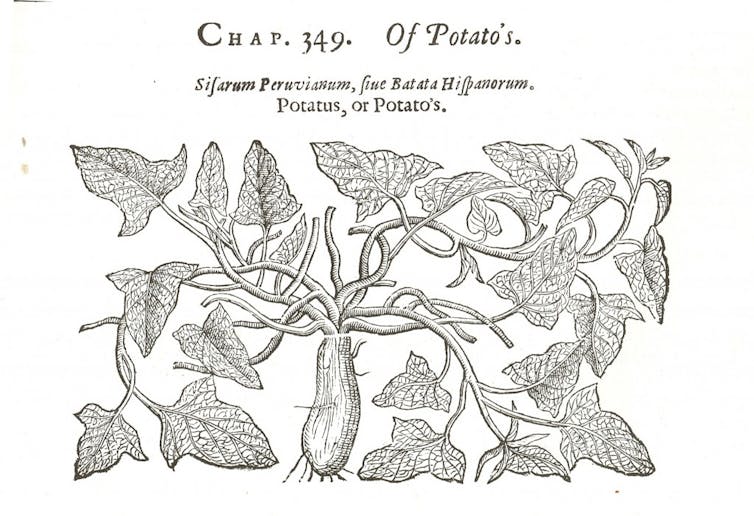
Sweet potatoes: ‘they comfort, nourish, and strengthen the body’.
John Gerard's 'Herball' (1596)
After their marriage disintegrated, Henry had to rely on home-grown sweet potatoes, rather than Spanish imports. Gardeners at Hampton Court have recently demonstrated that sweet potatoes grow perfectly well in our scarcely tropical climate. The first printed recipe containing sweet potato is probably the description of how to make “a tart that is a courage to a man or woman”, which appeared in the Good Huswife’s Jewell, a cookbook published in London in 1596.
Before NATO … the sweet potato
Ironically, while Henry VIII enjoyed sweet potatoes in Tudor England, pilgrims in 1621 New England almost certainly did not feast on maple-candied sweet potatoes, or any sweet potatoes at all. Early records of the settlement make no mention of them and they were not native to the chilly shores of the north Atlantic. The oldest documents in the US that refer to sweet potatoes are actually from England.
Washington’s Folger Library, which holds a major collection of Shakespeariana, has recently unearthed an early recipe for sweet potato pudding from … Warwickshire! The pudding calls for potatoes (sweet or ordinary), eggs, sugar and a good dose of sherry. So new world sweet potatoes have been criss-crossing the Atlantic since the 16th century, forming a special relationship of eaters and growers that long predates NATO.
But what about Donald Trump? Does he have anything to do with this long history? Not really, although the internet is replete with images of sweet potatoes that resemble the president-elect and critics have called him a “xenophobic sweet potato”. Will Trump tuck into a traditional sweet potato pie or candied sweet potatoes for his Thanksgiving dinner? I don’t know and I certainly don’t care. But the sweet potato, unlike Trump, is unquestionably one of the new world’s gifts to Britain – and the world.
A recipe for sweet potato tart from Charles Carter, The Complete Practical Cook (London, 1730).
POTATOE TORT.
TAKE a Pound and half Spanish Potatoes [sweet potatoes]; boil them and blanch them, and cut them in Slices, not thin; sheet a Dish with Puff-paste, lay some Citron in the Bottom, lay over your Potatoes, and season them with Ginger, Cinnamon, Nutmeg, and Sugar; then take the Marrow of two Bones, cut it into Pieces as big as Walnuts, roll it in Yolks of Eggs, and season it as the Potatoes; lay it on them, and between the Lumps of Marrow lay Citron and Dates slic’d, and Eringoe Roots [I’d use candied angelica], sprinkle over some Sack and Orange-flower Water; then draw up a Quart of Cream boil’d with the Yolks of ten Eggs, and pour all over, bake it, and stick over some Citron, and serve it.

Rebecca Earle, Professor of HIstory, University of Warwick
This article is republished from The Conversation under a Creative Commons license. Read the original article.
 While there is

