Friday, June 09, 2017

Guest Post: What it's like to be gay and a Muslim


Rusi Jaspal, De Montfort University

The Orlando shooting was a hate crime against gay people – even if, once it emerged that the attacker had been a Muslim, many people claimed this as a terrorist attack rather than a hate crime. And, in an important sense, this was also a terror attack, since its aim was to spread fear in the LGBT community. The Conversation


gay Islam muslims homosexual

shutterstock.
Nando Machado/Shutterstock.com


Since the massacre there has been a lot of speculation about Islam and homosexuality and there are fears that one man’s despicable act of terrorism could fan the flames of Islamophobia and other forms of social exclusion, leading to discord and unrest in an era of elevated Islamophobia.

It is difficult to define the “Islamic position” on homosexuality, as a monolithic phenomenon, simply because Islam is a very diverse faith group with some 1.6 billion followers on six continents. In most Muslim countries, homosexuality is illegal and in some countries, including Iran and Saudi Arabia, it is punishable by death. But in others, such as Jordan and Turkey, homosexuality is not considered a crime.

Most Islamic scholars are in agreement that homosexuality is incompatible with Islamic theology. They tend to draw on the story of Lot in the Koran (also in the Old Testament) which recounts the destruction of the tribe of Lot allegedly due to their engagement in homosexual acts as “evidence” for God’s condemnation of homosexuality. Many scholars also cite the Ahadith (statements attributed to the Prophet Muhammed) that are condemnatory of homosexuality. Theological and legal condemnations of homosexuality can engender perceptions at a social level that homosexuality is wrong and that it should not be permitted.

Muslims on homosexuality


In 2009, a Gallup survey revealed negative attitudes towards homosexuality among European Muslims. In France, 35% of Muslims viewed homosexuality as “morally acceptable” (versus 78% of the general public). In Germany, 19% of Muslims viewed it as morally acceptable (versus 68% of the general public). In the UK, none of the Muslim respondents viewed homosexuality as morally acceptable (versus 58% of the general public who did).

Earlier this year, a survey commissioned by Channel 4 was conducted among a random sample of 1,081 individuals who self-identified as Muslim. The results found that 18% of the British Muslim respondents agreed that homosexuality should be legal in Britain while the majority (52%) disagreed. Conversely, only 5% of the general public thought homosexuality should be illegal. Furthermore, 47% of the British Muslim respondents indicated that they did not believe that it was acceptable for a gay person to become a teacher. These data suggest that there are low levels of acceptance of homosexuality in Muslim communities in the UK.


However, qualitative interview data can provide more nuanced understandings of what Muslims think and why they might hold these views.

In my research into attitudes concerning homosexuality among samples of first and second-generation British Muslims of Pakistani descent, I found that attitudes tend to be largely negative. Although research into attitudes towards homosexuality in the general population points to demographic variables, such as age and level of education, as key determinants of the nature of attitudes, this has not been the case in my own work with British Muslims. Muslims of various ages, education levels and socio-economic backgrounds have participated in my studies and generally perceive homosexuality in negative terms. In substantiating these attitudes people often draw on holy scripture. As one 54-year-old woman said:

It says it in the Koran that it’s wrong and sorry I’m not the one who made it. It’s what the God revealed to the Prophet so it’s the truth and that’s my belief system.

Many interviewees draw upon holy scripture as the basis of their views regarding homosexuality. There appears to be a desire not to “re-interpret” holy scripture – to accommodate homosexuality – because of the divinity of its origin. Moreover, there was a fundamental rejection of essentialist arguments concerning the origins of sexual orientation – that people are born gay and that they do not “choose” to be gay – and interviewees often argued that people had “chosen” to be gay. One 28-year-old man said:

God doesn’t create gay people. It’s a path they’ve chosen and that’s an incorrect path according to our faith.

Indeed, previous research has shown that believing the essentialist argument regarding homosexuality is correlated with less discrimination and greater acceptance.


Koran homosexuality gay muslim Islam

What does the Koran say about homosexuality?
Lord Harris/BritishMuseum, CC BY


First-hand relationships


Although many British Muslims may disapprove of the concept of homosexuality, several individuals reported positive first-hand experiences of contact with LGBT people. A 45-year-old man said:

Homosexuality is wrong, I believe … I have a gay neighbour and he lives with his partner. He’s a very nice guy – both of them [are]. They are very respectful. We consider them friends.

Some people spoke fondly of their LGBT friends, neighbours and acquaintances, suggesting that first-hand contact may challenge homophobia which exists at an abstract, conceptual level. It is also vital to stress that the Muslim interviewees overwhelmingly rejected violence against LGBT people. As one woman put it:

Violence and hate crimes are un-Islamic. We are not supposed to kill or hurt others, as Muslims. No, they can’t have it both ways so they won’t be accepted in our community but it’s for God to punish, not us.

It was difficult for British Muslim interviewees to accept homosexuality given the overwhelming “evidence” of its prohibition in Islam. Individuals simply had no positive theological frame of reference given the absence of LGBT affirmative voices at an institutional level. This led some individuals to view endorsement of homosexuality as a violation of their religious faith and its norms:

Being gay is un-Islamic and so is encouraging it.

Put simply, the acceptance or endorsement of homosexuality was perceived as contravening key tenets of Islam.

Gay Muslims speak out


Clearly, the stigma attached to homosexuality in Islamic communities can have profound effects for those Muslims who also self-identify as gay. For almost a decade, I have been researching the social psychological aspects of being Muslim and gay. In view of the generally negative attitudes towards homosexuality in Muslim communities and the silence that can surround discussions of sexuality, most of my Muslim gay interviewees have manifested a poor self-image and low psychological well-being. Many view their sexual orientation as “wrong” and, thus, express a hope to change it in the future. One young gay Muslim man said:

It’s [being gay] wrong, really, isn’t it? … In the mosque we’re told that Shaitan [Satan] tries to tempt Muslims because he is evil and he makes us do evil things. I know that doing gay things is evil but I hope I’ll change my ways and take the right path soon … It’s all about temptation, really. Life is a big test.

Those gay Muslims who conceptualise their sexuality as immoral and wrong can understandably struggle to derive self-esteem, which is key to well-being. They may come to view their sexual orientation as “evil” and resist it. Some attempt to change their sexual orientation, sometimes by entering into marriages of convenience. This conceptualisation of homosexuality stems from their understanding of the Islamic stance on it. Said by a 28-year-old man:

What the Prophet said was right and that’s always going to stand, yeah. Men having sex with other men was wrong in his eyes. He hated it.

It is easy to see how belief in the negativity of homosexuality from the perspective of one’s faith (which, in countless studies has emerged as an important identity among British Asian Muslims) could cause some gay Muslims to develop internalised homophobia and, in some cases, to doubt the authenticity of their Muslim identity.

Gay Muslims may cope with this internal conflict in a number of ways. While some hope to change their sexual orientation and to “become” straight, others may deny that they are actually gay:

Maybe I’m not bisexual because I’ve never been with a woman but I can’t call myself gay either … I refuse to do that because I just don’t feel gay.

Crucially, in making sense of the “causes” underlying their sexual orientation, some gay Muslims were of the view that they had “become” gay as a result of their social environment and consequently blamed British society:

I’m gay because I was brought up here [in Britain] but I reckon if I’d been brought up in Pakistan then I would have turned out straight because this doesn’t happen that much there. Like I haven’t heard of any gays in our village. Here there are clubs and that and so I just kind of fell into the gay culture.

We tend to attribute aspects of our identity that we see as undesirable to external factors. This is a means of protecting one’s sense of self from threats. Some of the gay Muslim interviewees in my studies have identified British (or Western) culture as the reason for their sexual orientation.

Reconciling homosexuality and Islam


Many individuals of religious faith struggle to accept homosexuality given the centrality of heterosexuality to faith life, according to most faith groups. Muslims are no exception. Individuals use all sorts of strategies for protecting their sense of identity and some of these strategies can actually have poor social and psychological outcomes. Social psychologists have long argued that intergroup contact is a good starting-point for improving relations between different social groups.

Universities are obvious contexts in which different groups can come together – LGBT and Islamic student societies on university campuses could collaborate with the aim of increasing inter-group contact between Muslims and LGBT people (and indeed those who identify with both categories).

Of course, inter-group contact needs to be characterised by positive images of the outgroup. So there needs to be much more discussion of homosexuality in Muslim communities – which will admittedly be difficult given the cultural taboo around sexuality. Faith and community leaders should broach the topic. My view is that people need to be exposed to LGBT affirmative images. This has already happen to some extent.

As I’ve written elsewhere, the Eastenders storyline concerning Syed Mehmood, a gay Muslim character who struggles to come out to his parents, generated some discussion in the British Muslim community and led some individuals to acknowledge the existence of homosexuality within their community.
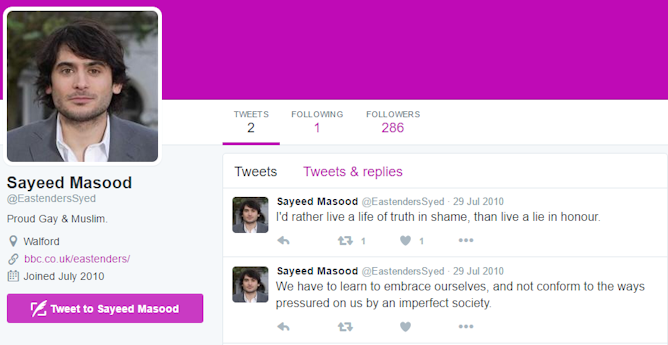


Syed Eastenders Twitter gay Muslim

Coming out: Syed from Eastenders on Twitter.
Twitter


This is a positive step forward and one that can be built on. Similarly, there needs to be more acknowledgement and acceptance of faith groups in LGBT contexts which tend to be secular. In my research, I’ve also found that gay Muslims can face Islamophobia on the gay scene, which can hinder their sense of belonging in these spaces.

In addition to improving relations between groups, it is likely that this exercise will have positive outcomes for well-being among those individuals who self-identify as Muslim and gay. Growing up in an environment in which you are led to believe that your sexual orientation is wrong, sinful or symptomatic of mental illness can lead to profound social and psychological challenges, including internalised homophobia, low self-esteem, depression and, in some cases, suicidal thoughts.

The reasons underlying the horrendous attacks perpetrated by Omar Mateen in Orlando may never be fully understood. But if it is true that he was a closeted homosexual – it was reported that he had used gay dating applications and frequented gay bars, including the one that he attacked – he clearly had a very difficult relationship with this aspect of his identity. There is already some empirical evidence that homophobia is associated with homosexual arousal, which suggests that homophobia might be a means of distancing homosexuality from one’s sense of self.

Could it be that his actions were in part a result of his internalised homophobia? Did he attack the LGBT community in an attempt to distance his own sexuality from his sense of self?

In any case, we as a society have a responsibility to acknowledge diversity and to allow people the space and opportunity to self-identify in ways in which they choose. We have a responsibility to challenge prejudice (of all kinds) when it shows its ugly face. We have a responsibility to support and protect minorities who are vulnerable to marginalisation and exclusion. Sometimes this will be challenging particularly when it means that we have engage with sensitive issues such as religious norms and customs but we must persevere – for the sake of freedom, peace and well-being for all of society.

Rusi Jaspal, Professor of Psychology & Sexual Health, De Montfort University

This article was originally published on The Conversation. Read the original article.


Thursday, June 08, 2017

From the Archives: Gay groups comment on Obama's 2014 State of the Union address


Gay groups comment on Obama's 2014 State of the Union address
January 29, 2014 11:22 PM MST


Two gay conservative organizations, Log Cabin Republicans and GOProud, issued statements this week in response to President Barack Obama's 2014 State of the Union message.

Log Cabin

Log Cabin Republicans GOProud Barack Obama State of the Union 2014 gay conservatives
The older group, Log Cabin Republicans, released a statement from its executive director, Gregory Angelo, soon after Obama concluded his address to Congress on January 28.

“For a moment,” Angelo said, “I thought the news accidentally re-ran last year’s State of the Union, because all I really saw was more of the same.”

Obama's “only new ideas,” he continued, “involved using ‘a pen and a phone’ to push a liberal agenda for which hard-working Americans have no appetite.”

Angelo criticized “the absence of any mention of the Employment Non-Discrimination Act for LGBT workers” as well as Obama's “threat to exercise unilateral Executive actions with the explosive potential to ignite class warfare, while at the same time remaining silent on signing a common-sense Executive Order barring federal workplace discrimination.”

He called that last item “an empty promise to LGBT Americans that stands unfulfilled after six years. That’s one re-run we’re tired of seeing.”

GOProud
The next day, GOProud – which calls itself “a national organization of gay and straight Americans seeking to promote freedom by supporting free markets, limited government and respect for individual rights” – issued its own statement in reaction to the President's remarks.

GOProud caustically said that Obama's speech was made up of “the same baseless platitude- and hope-laden rhetoric that we’ve seen in every one of his flowery speeches. Fortunately, the American people don’t buy it anymore. The only thing new in the President’s address was the announcement that his vague agenda will now be guaranteed by threat of executive order.”

On specific issues, the statement (unattributed to any individual) continued by noting that “the President talked a good game about the need for quality education, but failed to mention anything about school choice. He talked about the minimum wage but did little more than toss out an arbitrary number to pacify his ultra-left wing groupies.”

The President, GOProud said, “spoke eloquently about the benefits of ending wars in the Middle East, yet spent a good portion of his time convincing Americans that they should instead be at war with each other. It’s always the us-versus-them mentality with Democrats, as they can’t seem to get Americans to believe in their message without convincing them to hate someone.”

Log Cabin Republicans (LCR) began in California in 1977 and has grown into a national organization with some three dozen local and state chapters. GOProud was started by former LCR members in 2009.

Publisher's note: This article is part of a series to mark June as Gay Pride Month. It was originally published on Examiner.com on January 29, 2014. The Examiner.com publishing platform was discontinued July 1, 2016, and its web site went dark on or about July 10, 2016.  I am republishing this piece in an effort to preserve it and all my other contributions to Examiner.com since April 6, 2010. It is reposted here without most of the internal links that were in the original.

Wednesday, June 07, 2017

Guest Post: Forgotten origins of the modern gay rights movement in World War I


Laurie Marhoefer, University of Washington

One of the World War I’s most enduring legacies is largely forgotten: It sparked the modern gay rights movement. The Conversation

Gay soldiers who survived the bloodletting returned home convinced their governments owed them something – full citizenship. Especially in Germany, where gay rights already had a tenuous footing, they formed new organizations to advocate in public for their rights.

Though the movement that called itself “homosexual emancipation” began in the 19th century, my research and that of historian Jason Crouthamel shows that the war turned the 19th-century movement into gay rights as we know it today.

A death in Russia


In the winter of 1915, a German soldier died in a field hospital in Russia. The soldier, whose name is missing from the historical record, had been hit in the lower body by shrapnel when his trench came under bombardment. Four of his comrades risked their lives to carry him to the rear. There, he lay for weeks, wracked by pain in the mangled leg and desperately thirsty. But what troubled him most was loneliness. He sent letters to his boyfriend whenever he could manage it.

“I crave a decent mouthful of fresh water, of which there isn’t any here,” he wrote in his final letter. “There is absolutely nothing to read; please, do send newspapers. But above all, write very soon.”


 Laurie Marhoefer World War I, WWI gay rights history Germany Europe

German infantrymen aim machine guns from a trench near the Vistula River in 1916.
AP-Photo


This soldier, who had to keep his relationship hidden from those around him, was just one of the approximately two million German men killed in World War I. His suffering is not unlike what many others experienced. What his loved ones made of that suffering, however, was different, and had enormous consequences.

His boyfriend, identified in surviving documents only as “S.,” watched the man he loved go off to serve in a war that he did not fully endorse, only to die alone and in pain as S. sat helplessly by hundreds of miles away. S. told their story in a letter to the Scientific Humanitarian Committee, which published it in April 1916.

The Scientific Humanitarian Committee was then the world’s leading homosexual emancipation group, boasting a membership of about 100 people. The soldier’s story took a cruel twist at its very end: S.‘s loving replies were lost in the chaos of the war and never reached the soldier.

“He died without any contact from me,” S. wrote.

Demanding the rights of citizens


After the war, many believed the slaughter had been for nothing. But S. saw a lesson in his partner’s suffering and death.

“He has lost his bright life … for the Fatherland,” wrote S. That Fatherland had a law on the books that banned sex between men. But the sodomy law was just the tip of the iceberg: S. and men like him generally could not reveal their love relationships in public, or even to family members. Homosexuality meant the loss of one’s job, social ostracism, the risk of blackmail and perhaps criminal prosecution.

S. called it “deplorable” that “good citizens,” soldiers willing to die for their country, had to endure the status of “pariahs.” “People who are by nature orientated toward the same sex … do their duty,” he wrote. “It is finally time that the state treated them like they treat the state.”

A new phase of gay rights


 Laurie Marhoefer League for Human Rights gay WWI World War I history Germany

A magazine put out by the League for Human Rights in 1930.
Author provided


Many veterans agreed with S. When the war ended, they took action. They formed new, larger groups, including one called the League for Human Rights that drew 100,000 members.

In addition, as I argue in my book, the rhetoric of gay rights changed. The prewar movement had focused on using science to prove that homosexuality was natural. But people like S., people who had made tremendous sacrifices in the name of citizenship, now insisted that their government had an obligation to them regardless of what biology might say about their sexuality.

They left science behind. They went directly to a set of demands that characterizes gay rights to this day – that gay people are upstanding citizens and deserve to have their rights respected. “The state must recognize the full citizenship rights of inverts,” or homosexuals, an activist wrote in the year after the war. He demanded not just the repeal of the sodomy law, but the opening of government jobs to known homosexuals – a radical idea at the time, and one that would remain far out of reach for many decades.

Respectable citizens


Ideas of citizenship led activists to emphasize what historians call “respectability.” Respectability consisted of one’s prestige as a correctly behaving, middle-class person, in contrast to supposedly disreputable people such as prostitutes. Throughout the 20th century, gay rights groups struggled for the right to serve openly in the military, a hallmark of respectability. With some exceptions, they shied away from radical calls to utterly remake society’s rules about sex and gender. They instead emphasized what good citizens they were.

In 1929, a speaker for the League for Human Rights told an audience at a dance hall, “we do not ask for equal rights, we demand equal rights!” It was, ironically, the ghastly violence and horrible human toll of the World War I that first inspired such assertive calls, calls that characterized gay rights movements around the world in the 20th century.

It would take nearly a century for these activists to achieve one of their central goals – the repeal of sodomy laws. Germany enjoyed a 14-year period of democracy after World War I, but the Nazis came to power in 1933 and used the sodomy law to murder thousands of men. A version of the law remained in force until the 1990s. The United States struck down its sodomy laws only in 2003.

Laurie Marhoefer, Assistant Professor of History, University of Washington

This article was originally published on The Conversation. Read the original article.

Tuesday, June 06, 2017

From the Archives: On D-Day anniversary, historian Arthur Herman recalls WWII industrial effort

On D-Day anniversary, historian Arthur Herman recalls WWII industrial effort
June 6, 2012 12:22 PM MST

Charlottesville-based historian Arthur Herman is the author of six books, including the Pulitzer-Prize finalist Gandhi & Churchill (2008) and the New York Times best-seller How the Scots Invented the Modern World (2001).

Herman’s latest book is Freedom’s Forge: How American Business Produced Victory in World War II, which was published last month by Random House.

On the 68th anniversary of the D-Day landings at Normandy, the historian met with the Charlottesville Libertarian Examiner at the Boar’s Head Inn to talk about the new book, which he sums up as a story about “releasing the innate productive power of American business.”

Herman pointed out there were two business enterprises in Charlottesville that manufactured products that were critical to the American war effort.


Charlottesville’s war effort
One was Ix Mills, located where the Frank Ix building still stands south of downtown.

Arthur Herman AEI Charlottesville historian Freedom's Forge WWII
During the war, he said, Ix Mills “moved from making commercial textiles to making parachute cloth. They really became the center of the parachute cloth making for the Second World War.”

The soldiers “who jumped on D-Day” as portrayed in Stephen Spielberg’s film, Saving Private Ryan, as well as the “airmen who had to jump out over Germany and at sea during the Second World War were using Charlottesville-produced parachutes.”

The other Charlottesville company that Herman discovered during his research was Southern Welding, which “made various kinds of iron piping and steel tubing. During the war, they shifted to making the steel tubing for aircraft, to contain all the electric lines and so on in B-24s and B-25s. What they also did, and their real breakthrough, is they developed the parts for arrester gear on navy aircraft carriers.”

The arrester gear allowed planes to land on the carriers without being pulled apart by a braking mechanism.

“Southern Welding, here in Charlottesville, developed the parts and manufactured the parts that went on aircraft carriers all across the Pacific. In fact, at one point, Charlottesville-made arrester gear and tailhook gear was on 43 separate aircraft carriers during the Second World War.”


Remembering D-Day

When Herman thinks about D-Day, in particular, he focuses on two things.

Arthur Herman AEI World War II Charlottesville historian Freedom's Forge
“First of all,” he explained, D-Day was about more than amassing military personnel “but also amassing a vast industrial effort.”

Two thirds of the landing craft and sea-going vessels used on D-Day were produced in American factories, he said, and “it’s a tribute not just to the bravery of our armed forces but also to the huge logistical possibilities that American industry could generate a landing and an enterprise of the sort that the world had never seen.”

The second thing about D-Day that comes to Herman’s mind is that “the very first Americans to get news that the landings were successful were the people working the night shifts in the factories on the East Coast.”

At the Bethlehem Shipyard in Sparrow’s Point in Baltimore, he recalled, “work stopped and everybody sank to their knees and said the Lord’s Prayer as they got the news.”

That, he said, is “really fitting, that the people who produced the tools that made that victory possible were the very first to learn that what they had done, and what they had contributed to, had been a success.”


Publisher's note: Today is the 73rd anniversary of the D-Day landings during World War II

This article is drawn from my Examiner.com archives. It was originally published on Examiner.com on June 6, 2012. The Examiner.com publishing platform was discontinued July 1, 2016, and its web site went dark on or about July 10, 2016.  I am republishing this piece in an effort to preserve it and all my other contributions to Examiner.com since April 6, 2010. It is reposted here without most of the internal links that were in the original.

Monday, June 05, 2017

From the Archives: Obama’s announcement prompts question, Is gay marriage a ‘new right’?

Obama’s announcement prompts question, Is gay marriage a ‘new right’?
May 9, 2012 4:02 PM MST

With President Barack Obama’s surprise announcement today that he supports the rights of gay and lesbian couples to legally wed, political pundits are debating whether this was a calculated move designed to help the president’s re-election bid, or whether it will help presumptive Republican nominee Mitt Romney, instead.

Obama’s statement came on the heels of North Carolina voters decisively adding a constitutional amendment to prohibit same-sex marriage and civil unions in that state. The president said, perhaps with that news in mind, that he thinks legalizing gay marriage should be decided on a state-by-state basis, without intervention from the federal government – or, presumably, through judicial decisions by the courts.

Some opponents of same-sex marriage assert that the Founders, in drawing up the Constitution, did not intend its protections to include gay individuals who wish to marry each other.

‘Life, liberty, or property’

Bert Ernie gay marriage archives Barack Obama 2012
Since the Fourteenth Amendment is usually cited by those who believe the Constitution does, in fact, protect a right to same-sex marriage (“nor shall any State deprive any person of life, liberty, or property, without due process of law; nor deny to any person within its jurisdiction the equal protection of the laws”), opponents of gay marriage argue that the post-Civil War amendments were intended only to extend constitutional protections on the basis of race and that their authors would not have also extended those protections on the basis of sexual orientation.

To be fair, there are also people who favor extending equal marriage rights to all citizens but who argue that this should be done legislatively, because, they say, courts should not be creating new rights not present in the language of the Constitution or the minds of its authors.

Since the “new rights” meme is so common, it may be useful to consult a different analogy (unrelated to race) to reveal why this objection is logically flawed.

The argument of the opponents of same-sex marriage is that it is an entirely new concept and therefore courts should not extend the right of marriage to gay people.

‘Not a new concept’
Yet “marriage” is not a new concept, and it may be engaged in legally by most, but not all, people who desire opposite-sex marriages.

White House Barack Obama same sex marriage gay 2012 election
In every state except Mississippi and Nebraska, any adult from the age of 18 may wed another person without parental permission. (In Mississippi, the legal age to freely marry is 21; in Nebraska, it is 19.) In many of the states, the marriageable age was once 21 but has been changed to 18.

In all these states, the legal age of majority is 18 – people who have reached that age can enter into contracts, buy and sell goods and services, own a home, join the military, pay taxes, vote in elections and – in some cases – serve in elective public office, including the state legislature.

If someone in Mississippi sued for the right to marry at the age of 18 or 19, it would not be unreasonable for a court to rule that the current prohibition on marriage there before the age of 21 is unconstitutional, because it deprives that person of a liberty (to marry) guaranteed by the Fourteenth Amendment.

Nobody would argue that that court was creating a “new,” previously non-existent right. It would simply be expanding the pool of otherwise eligible adult citizens who can enjoy that right.

That is because, for virtually every other person in the country older than 18 years of age, marriage is legal and available to them.

‘Extending a right’
The point is that judges who recognize the right of gay couples to marry are not creating a “new right.” Rather, they are extending a right that is already recognized for all other adults.

“Marriage” is legal for all adults, except those who are gay or lesbian. To recognize that being gay or lesbian is no impediment to marriage is no more creating a “new right” than to say that 18-year-old adult citizens of Mississippi should be able to marry today rather than wait three years.

There may be compelling arguments, on policy grounds, to continue to prohibit gay marriage. Seven states, the District of Columbia, Canada, several European countries, and South Africa (among other governments) have rejected those arguments, if they exist.

But one argument that does not stand up to scrutiny is that same-sex marriage is a “judge-created right.” With President Obama’s return to a position he first held in 1996, the political debate over the rights of gay citizens to marry takes a new direction.


Publisher's note: This article is part of a series to mark June as Gay Pride Month. It was originally published on Examiner.com on May 9, 2012. The Examiner.com publishing platform was discontinued July 1, 2016, and its web site went dark on or about July 10, 2016.  I am republishing this piece in an effort to preserve it and all my other contributions to Examiner.com since April 6, 2010. It is reposted here without most of the internal links that were in the original.


Sunday, June 04, 2017

Guest Post: Faggots, punks, and prostitutes: the evolving language of gay men


Peter Robinson, Swinburne University of Technology

Joe Jackson’s 1982 hit Real Men was the first time I had heard gays referred to as faggots. I was just out of the closet and in my first gay relationship in London. Jackson’s lyrics about how only our friends and other gays could call us faggots was encouraging, coming as it did from a straight man singing a song just before AIDS hit.


Faggot, often-considered a slur, has been reclaimed many times over by gay men, including in a new play by Declan Greene, The Homosexuals, or “Faggots”, currently showing at the Malthouse in Melbourne. The play looks at gay male relationships and their politics, and is apt as middle-class gay men and lesbians struggle with acceptance all over again in the face of their call for marriage equality.

Joe Jackson Real Men vinyl fags faggotsMy friends and I called ourselves fags because it was a way of turning the abuse on its head and laughing at the straight bullies.

And in merry-old-England there was abuse: one night when leaving gay club Heaven, a bunch of lads called us and our female friends “pooh jabbers”. It was graphic and offensive (“bum bandit” being a similar, anal-fixated term from about the same time) and it occurred to me how deeply, viscerally they hated us.

Language defines who you are. But words used by others to define gay people can say a great deal more about them than us.

From prostitutes to gays


Let’s begin with the most common term, “gay”, which baby-boomer homosexuals appropriated for their liberationist cause in the late 1960s and early 1970s. Its pedigree is longer and according to Edmund White originally applied to women and meant loose or immoral, as in a prostitute. And “gay-house” was the term for a brothel. “In the past one asked if a woman was "gay,” much as today one might ask if she “swings,”“ wrote White.

"Homosexual” (or “homosexualist”) has similar 19th-century origins and was originally coined in 1869 by a Hungarian doctor, Karoly Maria Benkert.

“Faggot” has had different meanings according to where and when it was used. In eighteenth-century London it was first a term for prostitute then for homosexual. In 1920s New York, it described an effeminate homosexual who sought social/sexual relations with “normal men”, according to George Chauncey while a “flaming faggot” was an extremely obvious, flamboyant gay man.

In 1970s Australia, the ubiquitous “poofter” covered all forms of deviancy including men who had sex with other men, poor-performing sportsmen, politicians and motorists. Meanwhile, as the documentary Deep Water revealed, the literal bashing and killing of poofters caught at it in public parklands was something of a pastime.

“Cat” from “catamite” is ancient Roman with connotations of effeminacy, prostitution, and the passive role in a sexual encounter. “Fruit” was, like faggot, according to US historian Randolph Trumbach, a term first used in the 18th century for a prostitute and then a sodomite. “Fairy” and “queer” had similar origins between the world wars.

Why the fixation on prostitution? As Trumbach explains, there is a “long tradition in English usage” of words that are used to designate a prostitute being appropriated one generation later to describe sodomites.

This tendency for the words for prostitute to be later used for homosexual dates from 18th-century England when they often shared common social spaces, argues gay historian Rictor Norton.

Much later, historians such as Chad Heap and George Chauncey found similar intermingling in the underground bars that operated in New York and Chicago during Prohibition in the US.

The words gays use for themselves


Because of the sardonic nature of gayness, all of the above would have to be included also in the vocabulary of gay men and queers.

As well, there are community-specific terms, such as “clone”. Historically-specific, it connotes the style of gay men mid-1970 to mid-1980s (moustache, short hair, faded, baggy Levis and pocket and/or neck handkerchief) as exemplified by the lead singer of the Bronski Beat at the time of their hit single, Smalltown Boy.


More arcane terms include “ganymede” (a young male) which was used by Oscar Wilde and his contemporaries and “Marianne” and “Molly” from the earlier 18th century, again connoting an effeminate (or passive) male.

“Nance” and “nancy boy” as well as “Nelly” and “nellies” were terms used by both gays and straights also connoting effeminacy or youthfulness. According to one of writer Keith Vacha’s interviewees, nellies were “common queens” by which he meant: “ones with bleached blonde hair and plucked eyebrows”.

And finally, perhaps to the consternation of some of today’s toughs, there is “punk,” which according to Rudolph Trumbach was once the slang term for both prostitute and sodomite.

Terms of abuse and endearment


Terms of abuse are a way of distinguishing those whom we choose to marginalise because we do not like the look of them or because we were there first. In other words, they are the “outsiders” of sociologist Norbert Elias’s important work from the mid-1960s.

Bronski Beat Smalltown Boy gay slang faggotHumans have been doing this from the outset. Gangs and groups, them and us, and in the case of sexual preference, there are the straights, the “normals”, if you like, and the others, the sexual outcasts.

The terms I’ve illustrated were used by the majority to exclude prostitutes and homosexuals from “polite” society. While these terms were used to mark their difference, this did not prevent males from that same polite society from using the good services of prostitutes and homosexuals when it suited them. And as they did so then, they still do so now.

What is also interesting is the way in which sexual outcasts could adopt terms of abuse used for them and turn them into terms of endearment for each other — as my friends and I did in the 1980s when we called ourselves fags. And so, self mockery becomes a form of defence against the strictures of the priests and preachers.

It was literally the priests and the preachers, and later doctors and lawyers, who sought to demarcate “useful” sexual activity from wasted sexual activity. According to historian Michel Foucault the monogamous heterosexual couple produced new workers; those erotic and sexual activities that detracted from or weakened it were identified, categorised, and punished by law.

That young, gay men are now starting to reclaim these words is significant. It could mean that they are becoming interested in finding out where they have came from, that is, what are the origins of the culture they inhabit?

Twenty-one years ago, AIDS, which was then the dominant concern for gay men and culture, ceased to be a death sentence and instead became a manageable disease. Young men who have grown up since then could feel that other aspects of gay life can now be explored with greater freedom.

If this is so, it would suggest a strengthening of gay culture and community because people can only start exploring their past, warts and all, when they feel safe.

The Homosexuals, or “Faggots” will be showing at Melbourne’s Malthouse Theatre until March 12.

Peter Robinson, Senior lecturer in History and Sociology, Swinburne University of Technology

This article was originally published on The Conversation. Read the original article.

Saturday, June 03, 2017

From the Archives: Author Brian Doherty explains Ron Paul’s ambivalence on gay issues

Publisher's note: This article is part of a series to mark June as Gay Pride Month. It was originally published on Examiner.com on May 18, 2012. The Examiner.com publishing platform was discontinued July 1, 2016, and its web site went dark on or about July 10, 2016.  I am republishing this piece in an effort to preserve it and all my other contributions to Examiner.com since April 6, 2010. It is reposted here without most of the internal links that were in the original.

Author Brian Doherty explains Ron Paul’s ambivalence on gay issues
May 18, 2012 10:13 PM MST

Ron Paul gay issues Rick Sincere
Republican presidential candidate Ron Paul has a record on gay-rights issues that can best be described as mixed.

For instance, Dr. Paul was one of only four Republicans in the House of Representatives to vote in favor of repealing the ban on openly gay personnel in the armed forces known as “Don’t Ask Don’t Tell.”

Paul also opposes a federal constitutional amendment that would prohibit same-sex marriage across the United States, yet he is the sponsor of legislation that would remove from federal courts the jurisdiction to hear and rule upon challenges to laws that ban gay marriage.


‘Voluntary and consensual agreements’
In his 2011 book, Liberty Defined, Paul suggests there should be a separation of marriage and state, just like there is separation of church and state.

In his chapter on marriage, he argues that “[if] the government was not involved, there would be no discussion or controversy over the definition of marriage. Why should the government give permission to two individuals for them to call themselves married? In a free society, something that we do not truly enjoy, all voluntary and consensual agreements would be recognized. If disputes arose, the courts could be involved as in any other civil dispute.”

This reference to the courts as protectors of contracts seems to be at odds with the bill he introduced to take marriage laws out of the jurisdiction of the federal courts.


‘One man and one woman’

Brian Doherty Ron Paul gay issues
While Paul seems to be tepidly endorsing the idea that same-sex couples could wed, he has said on several occasions that he thinks marriage should be limited to one man and one woman.

While campaigning in Iowa earlier this year, he said that he believes “that marriage is between one man and one woman and must be protected. I supported the Defense of Marriage Act, which used Congress’ constitutional authority to define what other states have to recognize under the Full Faith and Credit Clause to ensure that no state would be forced to recognize a same sex marriage license issued in another state.”

Journalist Brian Doherty has covered Ron Paul since 1999. He is the author of a new book, Ron Paul's rEVOLution: The Man and the Movement He Inspired. After a panel discussion about his book this week at the Cato Institute, the Charlottesville Libertarian Examiner asked Doherty about what appears to be Ron Paul’s “uncharacteristically studied ambivalence” about gay rights issues, particularly with regard to marriage equality.

Something ‘weird’
Paying a compliment to his interviewer, Doherty replied that “It is likely that you know every twist and turn of his thoughts on this issue better than me,” but he did go on to offer a partial explanation for Paul’s positions.

“I remember where he’s come to at this point, where I think he reliably will give the ‘get government out of marriage entirely’ answer, but I know his history with things like DOMA is more complicated than that. I’ve honestly forgotten every twist and turn of it.”

At bottom, Doherty explained, Paul’s inconsistent positions on gay rights issues can be explained by the fact that “he’s a 77-year-old American man who’s lived in Texas. There probably is a personally rooted, religiously rooted sense” – and here Doherty spoke sotto voce – “that there’s something a little ‘weird’ about homosexuality that maybe he’s not entirely comfortable with.”

‘Bruno-esque’
At the same time, Doherty noted, “I’m pretty sure both from watching him and knowing some of his associates, that that doesn’t come out in person, except possibly in a Bruno-esque situation” -- referring to a bizarre episode in the 2009 film Bruno in which actor Sacha Baron Cohen makes a pass at Ron Paul in a dimly-lit hotel room – “which I think is understandable.”

But, Doherty added, “circumstances and time had to probably open his mind a little on that question and I don’t personally fault him for it too much.”

In the end, he said, the answer to the gay-rights question that Ron Paul has come to embrace “seems to me about the correct libertarian-qua-libertarian answer.”

Complete audio of this interview with Brian Doherty can be heard as a podcast through Bearing Drift.

Additional excerpts from this interview focus on a post-Ron Paul political future and the decentralized nature of the Ron Paul phenomenon.

Friday, June 02, 2017

Guest Post: A brief history of Polari: the curious after-life of the dead language for gay men


Paul Baker, Lancaster University

In early February, the Church of England College expressed regret that in an evening liturgy in Cambridge, God was referred to as the Duchess. The service had been advertised as a Polari evening prayer in anticipation of LGBT History Month, and was described as a liturgical experiment. So what was Polari and how did it end up in an evening prayer? The Conversation

Polari is a secret language, which has now largely fallen out of use, but was historically spoken by gay men and female impersonators. My research has tracked how it grew out of the world of entertainment, stretching back from West End theatres, through to 19th-century music halls and beyond that to travelling entertainers and market-stall holders.

It developed from an earlier form of language called Parlyaree which had roots in Italian and rudimentary forms of language used for communication by sailors around the Mediterranean. Also associated with travellers, buskers, beggars and prostitutes, it found its way into Britain, especially London and port cities, and gradually became used by gay men and female impersonators, especially during the first half of the 20th century.


Polari Bible gay language Britain

The Polari bible.
Joe Richardson, Author provided


Polari itself had Parlyaree as a base, but once in Britain was supplemented with a wealth of slang terminology from different sources, including Cockney Rhyming Slang, backslang (pronouncing a word as if it was spelt backwards), French, Yiddish and American airforce slang.

In a period when homosexuality was illegal and heavily stigmatised, it was useful as a means of conducting conversations in public spaces, which would have alerted others to your sexuality. Many of the words allowed speakers to gossip about mutual friends or to critique the appearance of people who were in the immediate vicinity.

Vada the naff strides on the omee ajax” meant look at the awful trousers on the man nearby. Inserting a Polari word – such as bona (good) or palone (woman) – into a sentence could act as a coded way of identifying other people who might be gay. The language itself, full of camp, irony, innuendo and sarcasm, also helped its speakers to form a resilient worldview in the face of arrest, blackmail and physical violence.

Polari speakers “christened” themselves with camp names like Scotch Flo or Diamond Lil, affording themselves alternative identities that reclaimed the representations of them as effeminate in positive ways.

Surplus to requirements


In the 1990s, I based my doctoral thesis around the study of Polari, examining its varied history and complicated etymology, the ways that it resembled a language, its social functions and the reasons for its eventual decline. I interviewed speakers of the language and analysed texts, including scripts of the 1960s comedy radio series Round the Horne, which had a regular sketch voiced by Kenneth Williams and Hugh Paddick, who played Polari-speaking actors.

The version of Polari that was used in Round the Horne was necessarily simplified and toned down for the British public, and by the 1960s, there was a feeling that Polari had already overstayed its welcome. Round the Horne spoiled the secret, rendering the language less attractive to its speakers. Meanwhile the decriminalisation of homosexuality in 1967 was round the corner, making it less necessary for a secret lingo in any case.


Some younger gay men were more interested in concepts like gay pride, gay liberation and coming out and viewed Polari as a naff byproduct of a more repressive time. In the 1970s, in an early gay magazine called Lunch, activists branded Polari as ghettoising and it gradually became surplus to requirements. When I carried out a survey of 800 gay men in the year 2000, about half the respondents had never heard of it.

Renewed interest


While few gay men today actively use Polari, in recent years it has gained a kind of latent respectability as an historic language – similar to the way Latin is seen by the Catholic faith. From a political standpoint, Polari is now recognised as historically important, an example of the perseverance of a reviled group of people who risked arrest and attack just for being true to who they were.

gay talk homosexual language slang In 2012 a group of Manchester-based artists used Polari to highlight the lack of LGBT inclusivity in education. They created an exam in LGBT studies, getting volunteers to sit it under strict exam conditions. The language portion of the exam was about Polari.

Another group of activists called the Sisters of Perpetual Indulgence created a Polari Bible, running a Polari wordlist through a computer program on an English version of the Bible. The Bible was bound in leather and displayed in a glass case at the John Rylands Library in Manchester. This was not to mock religion but to highlight how religious practices are filtered through different cultures and societies, and that despite not always being treated well by mainstream religions, there should still be space for gay people to engage with religion.

In 2012, I participated in a group effort to carry out the longest ever Polari Bible reading which took place in a Manchester Art gallery. In a nice touch of high camp we had to wear white gloves while touching the Bible, to ensure the oils from our fingers didn’t ruin the paper. We took turns reading lines such as: “And the rib, which the Duchess Gloria had lelled from homie, made she a palone, and brought her unto the homie.” Translation: “And the rib which God had taken from man was made into a woman and brought to the man.”

The Polari Evensong at Cambridge, carried out by trainee priests, however, took place in a more official context and provoked a range of conflicting opinion. Some people think it is hilarious, some are concerned about Church of England rules being broken and disrespect for religious tradition, while others think that God should be prayed to in any language and that the Evensong was perfectly valid. As someone who has spent 20 years documenting the rise and fall of Polari, I find it fascinating that even now, it is finding new ways to cause controversy. Never has a dead language had such an interesting afterlife.

Paul Baker, Professor of Linguistics and English Language, Lancaster University

This article was originally published on The Conversation. Read the original article.