Sunday, December 17, 2006

Literary Gaydar

The other day, as I was reading the Style section of the Washington Post, a book review caught my eye, perhaps because of this first paragraph:

Mark Grosfeld, the hero of Robert Marshall's "A Separate Reality," is not like other boys. As a 12-year-old during the election year of 1972, he reads Carlos Castaneda, not J.D. Salinger.
I continued reading because, although I was not 12 years old in 1972 (I was 13), I was acutely aware that year about the presidential campaign. It was the first election year in which I was truly paying attention. So I continued to read.

Then something curious happened, as I began to absorb the review. Each time David Levithan (the reviewer) brought up a tidbit about the character of Mark Grosfeld, I became more assured that the character was gay.

It might also have been the title of the book at hand, A Separate Reality, with its echoes of A Separate Peace, John Knowles' 1960 homophilic novel of coming-of-age during World War II, which I first read when I was about 13 years old. (Though I did not learn until years later how Knowles had toned down the eroticism that had been in the novel's predecessor short story, "Phineas".)

But the evidence of young Mark's homosexual orientation kept piling up, in my estimation, in the paragraphs that followed, for instance:
In fact, he brings "The Catcher in the Rye" with him to summer camp only because he's afraid "the other books might look too weird."

He tries to read it on the plane but is paralyzed by what Holden Caulfield might think of him. This makes sense; instead of the rueful, deeply pained nature of the usual Caulfield-clone narrator, Mark's view of the world is impressionistic and spiritual.
As a youngster, I, too, was reluctant to read The Catcher in the Rye. (I never did finish it, and somehow avoided English classes that required it.) More from the review:
When his mother lumps him in with his father and brother as "you boys," he observes, "The words stung. Boys: a chalk mark across the family, assigning me to Dad and Jason, keeping me from her and Sharon. We worked in the backyard; they did laundry."
And:
Since Mark lives almost entirely in his head, readers must live there, too. Ultimately, the book hinges on our reaction to his voice. When Mark acts somewhere near his age, Marshall has a wonderful way of getting at truths. Take this pitch-perfect scene with his father, which is as good an encapsulation of adolescence as you're likely to read:

"The next day I told Dad I was sorry.

" 'I accept your apology, Mark.'

"But the next night he asked why I was looking like such a martyr.

" 'Because you're being such a fascist.'

"I was sent to my room."
And finally:
It's funny when Mark measures the success of his own epic poem by whether it has grown longer than "The Waste Land." And it's insightful when he observes that "saying what you mean is an immense task -- you're honest and then no one understands." But it would be more believable if he were in high school. (We are told often that Mark is old for his age. Some readers will buy it; some won't.)
Now, to someone who has never been a gay teenager (which would be true for most people reading this, and for most people reading the book review in the Washington Post), none of these disparate items drawn from a 429-page novel would add up to much with regard to being gay (or being straight, for that matter).

But for someone who did live through that period of questioning, uncertainty, awkwardness, and (above all) sense of isolation, these are all pointers in a single direction.

Yet, as I was reading along, I began to think that my assumptions were wrong, since most book critics would mention if a protagonist -- especially a very young one -- were gay.

Then, in the review's penultimate paragraph, my literary gaydar was rewarded. There is no spoiler here, though Levithan seems disappointed by author Robert Marshall's sense of timing:
An awkward scene at the beginning of the book tells us that Mark grows up to be a gay man in New York, a revelation that gives away the ending before the story really begins. Perhaps it would have been better to leave Mark on the cusp of understanding.
The last quotation David Levithan takes from A Separate Reality has a sentence that seems apt in regard to my notes here: "My intuition is becoming more powerful, I thought."

Gaydar -- a form of intuition, to be sure -- generally works best in person, when one can observe another's facial expressions, gestures, posture, and tone of voice (among other aspects of one's personality). Yet it seems it can also be accurate through observations of the printed page, as well.

Friday, December 15, 2006

Bill of Rights Video Blog


As announced earlier today, the Jefferson Area Libertarians sponsored a reading (out loud) of the Bill of Rights on Charlottesville's Downtown Mall this afternoon. The occasion was the 215th anniversary of the ratification of the first ten amendments to the U.S. Constitution.

The weather cooperated nicely: temperatures were in the 50s (perhaps even the low 60s) and the sun was just beginning to set, giving the setting a nice, even light that was neither too bright nor too dull. This resulted in some good photos, like this one taken near the big city Christmas tree at Central Place:


I was at the event and managed to get most of it recorded with my handy cell phone. Unfortunately, while the audio is pretty good, the video is rather blurry. Still, it's the words that are more important than the images.

The three gentlemen who conducted the ceremony were John Munchmeyer, Jim Lark, and Arin Sime. (Arin is also a candidate for the Virginia State Senate, running in the 2007 election in the 24th District.)

The ceremony was introduced by John Munchmeyer:


Then the three traded off in reading sections of the Bill of Rights, including the seldom-referenced preamble:


This was followed by comments by Jim Lark:


Arin Sime then spoke briefly about the threat to the Bill of Rights from eminent domain abuses:


Finally, John closed out the ceremony with a few summary remarks:


I thought it noteworthy that the commemoration took place just an hour or so before the beginning of Chanukah (at sunset), which may be the most libertarian of religious holidays, in that it memorializes a righteous uprising against tyranny.

Bob Barr Joins Libertarian National Committee


Former U.S. Representative Bob Barr (R-Georgia) has surprised the political world by formally affiliating himself with the Libertarian Party and dissolving his ties to the Republican Party.

A news release on the LP web site explains that Barr has accepted a position on the Libertarian National Committee, as a regional representative of the party's equivalent of a board of directors.

The news release states in part:

LNC Chair William Redpath stated, "Bob Barr's willingness to serve as a leader of the Libertarian Party represents a significant and positive development for our organization. The Libertarian Party played a pivotal role in key races in 2006 and has emerged as a strong and principled political force."

Redpath continued, "The antiquated two-party system was dealt a blow today as we have welcomed a patriotic statesman into our ranks with the intent of using his vast experience and widespread respect to help recruit and elect Libertarian candidates of his caliber."

Barr's first official action as LNC representative will be to organize a meeting with state party leaders to address party building and political goals for 2007.

After accepting the position, former Congressman Barr stated, "I'm pleased to assist the Party of Principle in this capacity and hope to further our political success as we move closer to the 2008 election cycle. Being a member of this body is a serious and long-term commitment that I gladly accept. As importantly, I'm happy to announce that I am now a proud, card-carrying Libertarian who is committed to helping elect leaders who will strive for smaller government, lower taxes and abundant individual freedom. I encourage other Americans from across the political spectrum to join me."
The LP's news release also provided background information on the former legislator, who is the most prominent individual to join the LP in recent years. (Republican Congressman Ron Paul of Texas was the Libertarian candidate for president in 1988, when he was in retirement from Congress. In 1996, he regained a congressional seat despite virulent opposition from the GOP establishment.)

According to the LP,
In addition to having served eight years in the House of Representatives, Barr serves as a Board Member of the National Rifle Association and is Chairman of Patriots to Restore Checks and Balances. He also is a member of The Constitution Project’s Initiative on Liberty and Security at Georgetown University. He advises a variety of public policy organizations, including the American Conservative Union and the American Civil Liberties Union. Barr is President and CEO of Liberty Strategies, an Atlanta-based consulting firm with offices in the Washington, DC area. He practices both civil and criminal law.
Reporting on the Barr/LP announcement, the Associated Press said:
Barr became a darling of conservatives over his persistent attacks on President Clinton in the 1990s.

At the same time, Barr showed an independent streak that at times frustrated Republicans.

He has frequently criticized President Bush over privacy concerns stemming from the Patriot Act and other federal anti-terrorism efforts.

Georgia Republican Party Chairman Marty Klein called the move disappointing, saying -- quote -- "We're leading based on principles here in Georgia."
(The Washington Post has a somewhat different version of the AP story on its own web site.)

Although the AP also noted that "Barr said he has no plans to run for office," one has to wonder whether he might not be persuaded to seek the LP's nomination for a congressional (or Senate) seat in Georgia or even for President in 2008. We'll wait and see.

My question is: Has Barr reversed his pro-drug war positions, which he has defended so vociferously (such as in debates with radio talk-show host Neal Boortz)? I hope so; he's too smart to continue supporting such a miserable failure.

Bill of Rights Day Commemoration

Today is the 215th anniversary of the ratification of the Bill of Rights to the Constitution, which took effect upon the approval of three-quarters of the states on December 15, 1791.

It should come as no surprise, but did you know that, at least since 1990, the U.S. Congress has not once issued an official commemoration of this historic event? (I looked it up on Thomas. Nada.)

We can be grateful that a local activist group, the Jefferson Area Libertarians, wants us to remember the Bill of Rights and its importance to Americans. Today in both Waynesboro and Charlottesville, the JAL will be conducting a bit of street theatre in the form of an "acclamation" of the first ten amendments to the U.S. Constitution.

Here's their announcement regarding Waynesboro:

The Jefferson Area Libertarians will hold a "Bill of Rights Acclamation" on Bill of Rights Day (Friday, December 15th, 2006). The event will be held in downtown Waynesboro from 12:00 to 12:30 p.m. at the Municipal Building at the corner of Main Street and Wayne Avenue. JAL members will read aloud the Bill of Rights, speak about its profound impact on freedom, and of recent events injurious to its purpose.

Location: Municipal Building
Corner of Main Street and Wayne Avenue
Waynesboro, Virginia
JAL member Jim Lark -- faculty advisor to Students for Individual Liberty at the University of Virginia and former national chairman of the Libertarian Party -- was a guest this morning of Jane Foy and Rob Schilling on WINA-AM. Dr. Lark noted the planned acclamation in Charlottesville later this afternoon and discussed some of the contemporary threats to the Bill of Rights, including the Kelo v. New London decision of the U.S. Supreme Court, the Military Commissions Act of 2006, and the McCain-Feingold campaign finance "reform" law.

Today's Bill of Rights Day celebration in Charlottesville, will be at Central Place (Main St. & 2nd St. East, next to the fountain) on the Downtown Mall and not -- as one would expect -- at the Free Speech Monument near City Hall, from 4:00 to 4:30 p.m. (just before sundown):


I realize this is rather late notice to my Charlottesville readers (and those across the mountain) but I hope many of you will join the Jefferson Area Libertarians to proclaim, loudly and proudly, that the Bill of Rights is still relevant and vibrant after 215 years.

Thursday, December 14, 2006

But I'm a Carnivore!

An article from WorldNetDaily that asserts soy-based food products cause homosexuality -- tofu in particular -- is taking a beating in the blogosphere. When I sent a copy of the article to a group of friends, the first response I got was: "This has got to be satire."

Sadly, it's not.

Still, one might get the impression from its headline that the article originates from The Onion: "A devil food is turning our kids into homosexuals." I should say, from the original headline when it was first posted on line. The editors at WND must have caught wind of what a laughingstock the piece is and they have since changed the headline to read "Soy is making kids 'gay'." Not much better, but somewhat less diabolical.

Written not by a physician or nutritionist or any sort of scientist, but rather by James Rutz, a self-appointed minister at "Megashift Ministries" (which sounds like the name of a 1970s-era gay bar), the opinion piece makes some astounding claims:

The dangerous food I'm speaking of is soy. Soybean products are feminizing, and they're all over the place. You can hardly escape them anymore.

I have nothing against an occasional soy snack. Soy is nutritious and contains lots of good things. Unfortunately, when you eat or drink a lot of soy stuff, you're also getting substantial quantities of estrogens.

Estrogens are female hormones. If you're a woman, you're flooding your system with a substance it can't handle in surplus. If you're a man, you're suppressing your masculinity and stimulating your "female side," physically and mentally....

Soy is feminizing, and commonly leads to a decrease in the size of the penis, sexual confusion and homosexuality. That's why most of the medical (not socio-spiritual) blame for today's rise in homosexuality must fall upon the rise in soy formula and other soy products. (Most babies are bottle-fed during some part of their infancy, and one-fourth of them are getting soy milk!) Homosexuals often argue that their homosexuality is inborn because "I can't remember a time when I wasn't homosexual." No, homosexuality is always deviant. But now many of them can truthfully say that they can't remember a time when excess estrogen wasn't influencing them.
Rutz ends on a somewhat hopeful note, for those of us who frequent Asian restaurants:
Soy sauce is fine. Unlike soy milk, it's perfectly safe because it's fermented, which changes its molecular structure. Miso, natto and tempeh are also OK, but avoid tofu.
I do avoid tofu, not because it's "feminizing," but because it's unappetizing.

Real scientists have already debunked Rutz's ridiculous ramblings. Vivian Paige points to a rebuttal (if I can call it that -- a rebuttal should be reserved to reply to an authentic argument) at Science Blogs that says, in reference to Rutz's assertions about delayed menarche in girls and puberty in boys, that
I searched PubMed, and there's nothing on soy and menarche or menstruation; I found a few articles on soy and puberty, and they say things like "The literature offers no evidence of endocrine effects in humans from infant consumption of modern soy-based formulas" and "To date, no adverse effects of short- or long-term use of soy proteins have been observed in humans and exposure to soy-based infant formulas does not appear to lead to different reproductive outcomes than exposure to cow milk formulas" and "Available evidence from adult human and infant populations indicates that dietary isoflavones in soy infant formulas do not adversely affect human growth, development, or reproduction." There are many more papers on its putative effects on breast cancer and the symptoms of menopause, and even there it's a study in ambiguity: some reports of slight positive effects, many more stating that there isn't a detectable effect.

There doesn't seem to be any strong evidence that eating tofu will turn your sons into girlie-boys, I'm afraid; there are better grounds to be concerned about known endocrine disruptors like atrazine and PCBs.
Andrew Sullivan, meanwhile, goes back to Alfred Kinsey himself to knock down Rutz's assertion that homosexual men have small genitalia. Quoting a 2004 article in the Archives of Sexual Behavior ("The Relation between Sexual Orientation and Penile Size") that examined a Kinsey survey of the 1940s, he says:
The relation between sexual orientation and penile dimensions in a large sample of men was studied. Subjects were 5,122 men interviewed by the Kinsey Institute for Research in Sex, Gender, and Reproduction from 1938 to 1963. They were dichotomously classified as either homosexual (n = 935) or heterosexual (n = 4187). Penile dimensions were assessed using five measures of penile length and circumference from Kinsey's original protocol. On all five measures, homosexual men reported larger penises than did heterosexual men. Explanations for these differences are discussed, including the possibility that these findings provide additional evidence that variations in prenatal hormonal levels (or other biological mechanisms affecting reproductive structures) affect sexual orientation development.
(I know I'm now going to be inundated with visits derived from Google hits for "penile size," "larger penises," "penile length," and "penile circumference." Those will be high on the list, along with "Jeremy Sumpter nude," "creationists circumcision," "granddad sex movies," and "Alex Trebek shirtless." I hope those readers stick around to read some more, but I digress ...)

Waldo Jaquith also got a nice discussion going on this topic, in which he makes the equally plausible claim that evangelical megachurches cause homosexuality (at least in their pastors).

Just when you think you've seen it all, now the third-graders will have a new name to tag their less-than-butch friends with: "tofu-eater!" (And when I say "third-graders," you know who I mean. And him, too.)

Wednesday, December 13, 2006

J. Donald Freeze, S.J.: R.I.P.

Sad news comes to Georgetown University alumni from Philadelphia, where Father J. Donald Freeze, S.J., passed away on Sunday, December 10. He was 74 years old.

Father Freeze was provost of Georgetown University during my undergraduate years and through the 198os. (I believe he retired in 1991, though I am open to correction.)

Although the provost's job is to oversee the teaching faculty of a university, Father Freeze was always accessible to students. He lived in a student residence hall as a campus minister, his door always metaphorically open.

Ironically, despite the many academic accomplishments that Georgetown could claim during his tenure, he will probably best be remembered for "Freeze's Breeze," the Mass he celebrated at 10:00 p.m. each Sunday in Copley Hall's St. William's Chapel. It came with a guarantee to students who participated -- that it would last no longer than 20 minutes. Anything that was optional (such as a homily) was left out. There are a lot of Georgetown alums who probably would have forsaken their weekly obligation had the option of Freeze's Breeze not been available late on Sunday evenings.

There will be a viewing on Friday, December 15, from 2:30 to 4:00 p.m. at Saint Joseph's University Chapel, 5600 City Avenue in Philadelphia, and another on Saturday, December 16, from 9:30 to 11:00 a.m. at Loyola College Alumni Memorial Chapel, 4501 N. Charles Street in Baltimore. The funeral will follow at 11:00 a.m., also at the Loyola Chapel.

Father Freeze will be missed.

Update: Here is more information, as it appears on the Georgetown alumni web site:

J. Donald Freeze, S.J., longtime provost of Georgetown, passed away on Dec. 10, at Manresa Hall Jesuit Community, St. Joseph's University, Philadelphia.

Freeze first came to the Hilltop in 1971 as assistant dean for Georgetown College, and was named assistant vice president for academic affairs to Rev. Aloysius Kelley in 1974. He served in that post until being appointed provost by then-President Timothy S. Healy, S.J., in 1979. After his resignation in June 1991, Freeze served as the academic director of Georgetown's Villa le Balze in Florence, Italy, for the following academic year. Under his leadership, the gift of the Villa and its use as a Georgetown study abroad program was developed. Subsequently, he was appointed rector of Loyola Retreat House in Faulkner, Md., and then treasurer of the Maryland Province of the Society of Jesus.

During his tenure at Georgetown, Freeze addressed a wide range of issues facing the university, such as undergraduate curriculum revision and the physical renewal of campus facilities. He was a valued senior administrator and often acted as the president's closest assistant. "His hallmark was his concern for students and faculty," says Georgetown Provost James J. O' Donnell. "He was accessible, responsive and effective. Father Freeze's Christian concern and saving humor were rich gifts."

A Mass of Christian burial will be celebrated by Rev. Aloysius Kelly, S.J., on Dec. 16, at 11:00 a.m. in the Loyola College Alumni Memorial Chapel, 4501 N. Charles Street in Baltmore. There will be a wake at the chapel preceding the Mass from 9:30 to 11:00 a.m.

Arrangements are being made for a memorial Mass to be celebrated on the Georgetown campus in January 2007.

Tuesday, December 12, 2006

Carnival of the Mundane Coming Soon ...

I have volunteered to host the bi-weekly Carnival of the Mundane on Friday, December 22. This carnival will have a Christmas theme, but if you'd like to contribute, don't feel constrained by holiday-related topics.

For those unfamiliar with the Carnival of the Mundane, here is a description in 100 words or less:

The Carnival of the Mundane is a bi-weekly forum for bloggers who write tales of daily life. You may think your latest post about how you accidentally backed into your garage door isn't very interesting, but you're wrong. We're interested, and there are lots of us out there. The Carnival of the Mundane is the only blog carnival to have its own blog. We are open to all bloggers and readers, and everyone is welcome to take a turn hosting.

The Carnival of the Mundane was created by Dean and is organized by Dean with help from Postmodern Sass.
Guidelines for submissions to the Carnival of the Mundane can be found here.

About 200 people have, cumulatively, contributed to the Carnival of the Mundane in the past. We'd be happy to have new faces and bylines -- and now is your chance. Send me your stories of daily life, including (but not limited to) pleasant (or slightly twisted) anecdotes of Christmas.

Any questions? You know where to find me.

Monday, December 11, 2006

Congress Honors Friedman


It was little noted -- except as a passing snigger in a story syndicated by the St. Louis Post-Dispatch -- but the U.S. House of Representatives last week passed a resolution honoring the life and work of Milton Friedman, who died last month at the age of 94.

Introduced by Representative Cliff Stearns (R-Florida), the resolution had 55 cosponsors and passed on a voice vote on December 6. As a non-binding resolution, it was not conveyed to the Senate and will not require the President's signature.

One of the cosponsors, Scott Garrett of New Jersey, said in a news release from his congressional office:

“Millions all over the world have benefited from this dedicated man’s work. I am pleased to introduce this bill with my colleague, Cliff Stearns of Florida, honoring a noble life,” said Garrett. “I will continue to work to further the effort he began: expanding people’s liberty and improving their opportunities to live out their dreams for a better life.”
The resolution, designated H. Res. 1089, states in part:
Whereas Doctor Milton Friedman is widely regarded as the leader of the Chicago School of economics, and the developer of the theory of monetarism that stresses the central importance of the quantity of money as an instrument of government policy and as a determinant of business cycles and inflation;

Whereas Doctor Friedman's writings and ideas have influenced Presidents, other world leaders, entrepreneurs, and students of economics, and he gave himself generously to public service as an economic adviser to Senator Barry Goldwater's campaign for the presidency in 1964, Richard Nixon's presidential campaign in 1968, the Nixon Administration, Ronald Reagan's 1980 presidential campaign, and the Reagan Administration as a member of President Reagan's Economic Policy Advisory Board;

Whereas Doctor Friedman is a 1976 Nobel Laureate economist and received the John Bates Clark Medal in 1951 honoring the top economists under the age of forty, the Grand Cordon of the First Class Order of the Sacred Treasure by the Japanese government in 1986, the Presidential Medal of Freedom in 1988, the National Medal of Science in 1988, and honorary degrees from universities in the United States, Japan, Israel, and Guatemala;

Whereas Doctor Friedman's ideas were the model for the free market reforms undertaken in eastern European countries as they emerged from communist domination in the early 1990s, helping extend the blessings of prosperity to millions who had long been denied them;

Whereas Doctor Friedman was a prolific producer of both scholarly and popular articles, essays, books, and broadcast media, including the books Capitalism and Freedom and Free to Choose, tri-weekly columns for Newsweek, commentaries in the Wall Street Journal, and two multi-part Public Broadcasting Service television series;

Whereas Doctor Friedman was one of the world's foremost champions of liberty, not just in economics but in all respects;

Whereas Doctor Friedman will be remembered both as one of the most influential economists in history and as one of the twentieth century's greatest heroes of freedom...
It concludes:
Resolved, That the House of Representatives, on the occasion of the death of Doctor Milton Friedman--

(1) mourns Doctor Friedman's passing and expresses its deepest condolences to his family, including his widow Rose Friedman, who is herself an accomplished economist and was instrumental in co-authoring some of his major works; and

(2) honors Doctor Friedman's lifetime of achievements and recognizes his outstanding contributions to freedom, the study of economics, the United States of America, and the world.
One must only hope that the Members of Congress who voted for this resolution actually understand what Milton Friedman said and what principles he propounded. (At least three of the H. Res. 1089's cosponsors -- Jeff Flake, Ron Paul, and Dana Rohrabacher -- surely do understand.)

Looking at this resolution somehow brought to mind an essay written by former Vice President Dan Quayle when he was in his first term as a member of the House of Representatives. It appears in a slim volume published in 1979 by Hillsdale College as Volume 6 of The Ludwig von Mises Lecture Series, entitled Champions of Freedom. (That volume seems to be out of print, but Volume 33 in the series, published in January 2006, is available at Amazon.com.) As a historical note, the other contributors to that volume were former Treasury Secretary William E. Simon, former CIA director George Bush, and economists Benjamin Rogge and Alan Reynolds.

In his own essay, "Von Mises Looks at Congress," Quayle quoted the distinguished Austrian economist as saying:
As Professor von Mises proclaimed, "The idea that political freedom can be preserved in the absence of economic freedom, and vice versa, is an illusion. Political freedom is a corollary of economic freedom. It is no accident that the age of capitalism became also the age of government by the people. If individuals are not free to buy and sell on the market, they turn into virtual slaves dependent on the good graces of the omnipotent government, whatever the wording of the Constitution may be" (p. 4).
A few pages later, Quayle offers some observations in his own words. Keep in mind he was writing in the dark days of stagflation and the Carter administration; Ronald Reagan's election was still more a year in the future. Then-Congressman Quayle noted at the time:
We must reassert the capitalist system. We have drifted -- and what we have now is not capitalism, but a strange perversion in which the government can and does step in and dictate the rules of the game. Business must always obey. Under these circumstances, business is never free to compete. It must take into account during every business transaction the unknown factor of government interference and regulation. Business cannot plan for the future when a supply of capital can be so threatened by restrictive tax law changes, or when the profits needed to survive can be curtailed at any time by wage and price controls (p. 9).
If anyone wants to see how things have not changed much in the nearly three decades since Quayle was writing, take a look at this front page story from Sunday's Washington Post, which demonstrates how powerful business interests can persuade Congress to punish competitors through regulation, subsidies, and coercion: "Dairy Industry Crushed Innovator Who Bested Price-Control System." (That this sad episode occurred during the Republicans' control of Congress provides little hope or consolation for the future under the Democrats -- or the distant future under the Republicans again.)

Anyway, Quayle went on to say:
We do not have an easy road to travel. Von Mises understood what we must now understand if our economy is to make the changes necessary for its survival. Economic freedom is not just the ability of businesses to operate at will -- it is the absolute freedom of the individual to make decisions for himself regarding the conduct of his own life. It is the freedom to own property, to enter into business transactions, to grow and to prosper. We must learn again -- and the whole world with us -- that economic freedom is the indispensable prerequisite for individual political freedom. You cannot have one without the other (pp. 9-10).
Milton Friedman couldn't have said it better himself.

I have always maintained that Vice President Dan Quayle was severely underestimated. He was the true champion of freedom (to coin a phrase) in the Bush 41 administration, standing up for classical liberal principles when others around the Cabinet table failed to do so. He was (and is) also highly intelligent. Unfortunately, his treatment by the press and by late-night comics deep-sixed any future he might have had in political leadership. Our country is poorer for that.

Now a lot has changed in the 27-plus years since Quayle lectured in memory of Ludwig von Mises. The Soviet Empire collapsed and countries like Estonia are among the freest in the world. China -- Red China, that is -- is opening up its banking industry to foreign investors. The United States and Vietnam have regularized trade relations. Fidel Castro is on his deathbed (Santa, there's one thing you can do for Cuban boys and girls this Christmas...)

And, in the United States, we still live with the legacy of the Reagan years. Regulation has been (somewhat) reduced. Tax rates are (somewhat) lower. Productivity and employment are at record high rates. The cost of living is lower than ever, the middle class has expanded, and Americans enjoy more luxury products at lower prices than at any time in history. But that doesn't mean we should be complacent. The lessons taught by Friedman, von Mises, and even Quayle still need to be heard and heeded.

Will members of the 110th Congress follow the advice of Dan Quayle during the 96th Congress?

A Listener's Message to WINA

This post is of particular concern to readers in Charlottesville, and even more specifically to those in Charlottesville who, like me, stay up late into the night listening to the radio.

It is a message to the programming department at radio station WINA-AM: Bring back Joey Reynolds!

You see, I learned last week that WINA has replaced its long-running overnight program, The Joey Reynolds Show, which originates live from WOR-AM in New York City, with a pre-recorded piece of pap called The John and Jeff Show.

I realize that WINA -- like most radio stations -- has few listeners in the middle of the night, so the programmers are unlikely to hear from many of us regarding the programming change that took effect this week.

When I turned on the radio early last Tuesday morning, I thought an engineering error had resulted in a different program from The Joey Reynolds Show being broadcast. So I let it pass. When I tuned to WINA as soon as I passed Airport Road on my way back from Washington at around 3:00 a.m. on Wednesday, however, I had the shock of learning there was no mistake -- something that was confirmed by checking WINA's web site.

I wrote to program director Jay James, to whom I described my reaction as both shocked and disappointed. I told him I have been a faithful -- essentially daily -- listener of The Joey Reynolds Show since moving to Charlottesville in 1999 and finding WINA. (So far I have not received a reply to my email.) To have the show canceled, with no warning, was distressing to me.

The Joey Reynolds Show brings a sophisticated mix of talk, music, and entertainment that is sorely missing from most talk-radio stations. He actually has lively conversations involving multiple participants, not just interviews with the author- or celebrity- or politician-of-the-day. (Though interesting and informative interviews are part of his format, too.) These conversations ramble, go off-track, explore the nooks and crannies of their subjects (when they have one!), and -- because of or in spite of all that -- are wonderfully vibrant.

Listening to Joey Reynolds is like being a guest at a dinner party, with many regular participants, including legendary guitarist (and inventor of the electric guitar) Les Paul. Other frequent guests are biographer (most recently of Jimmy Stewart) Marc Eliot; Broadway producer (Hairspray, The Wedding Singer) Adam Epstein; borscht-belt comic Mickey Freeman (Pvt. Zimmermann from the original Sgt. Bilko show with Phil Silvers); The Amazing Kreskin; and David Randolph, the nonagenarian conductor of New York's St. Cecilia Chorus and Orchestra. UVa grad Jack Donahue, an actor, nightclub singer, and theatre director, has also been a guest on The Joey Reynolds Show, in addition to up-and-coming Broadway stars like Raul Esparza, Alice Ripley, and Melissa Errico.

Joey, with the help of regular Myra Chanin, books guests you simply don't hear on other programs: young poets, artists, and musicians who are playing their first gigs in New York; playwrights, psychologists, psychics, and policy analysts (yes, Tim Carney of CEI was there to talk about his book, The Big Ripoff: How Big Business and Big Government Steal Your Money); and people with engaging stories to tell about their lives, from inventors of gadgets to survivors of genocide.

The Joey Reynolds Show is a rare island of urbanity in the otherwise vapid sea of talk radio. It provides the sort of civil conversation so prized by WINA's afternoon chat host, Coy Barefoot -- just in a different, less lucrative time slot.

Joey Reynolds himself has a great story to tell. Once the most highly-paid DJ in the country during the rock-and-roll '60s (he helped discover Frankie Valli and the Four Seasons), he later got into the backstage side of the film industry, attended the same Southern California church as Ronald and Nancy Reagan, and returned to radio after a rocky relationship with drugs and alcohol. (His own memoir, Let a Smile Be Your Umbrella...But Don't Get a Mouthful of Rain, provides the details.)

My point is, The Joey Reynolds Show is the kind of programming that best suits discerning insomniacs.

I hope that the radio station's management will reconsider this programming change and bring back The Joey Reynolds Show to WINA. It will take some work to do so, with listeners who care about this making their views known. So, if there are any Joey Reynolds fans reading this, please call Jay James at WINA's office (434-220-2300) or send him a fax (434-220-2304) or email (jj@wina.com) with the simple message: Bring back Joey Reynolds!

As I told Jay in my own message, I tend to stay up late nearly every night, and if the current change becomes permanent, I'll just turn my dial to another station (probably WVTF-FM to listen to classical music) or search the Internet for a station that streams the Joey Reynolds Show live. Without a reversal of this decision, the upshot will be that WINA will have fewer dedicated, night-time listeners.

Friday, December 08, 2006

Jeane Kirkpatrick Dead at 80


I heard a breaking news story on WMAL-AM in Washington just a few minutes ago: Former Georgetown professor Jeane J. Kirkpatrick has died. She was 80 years old.

Best known as the U.S. Permanent Representative to the United Nations during the Reagan Administration, Kirkpatrick had an acerbic style that endeared her to anti-Communist conservatives and drove her political opponents up the wall. A neo-conservative when that term did not have negative connotations, Kirkpatrick was one of the Scoop Jackson Democrats who joined forces with the Republican party in the late 1970s and early 1980s on issues related to the Cold War.

Kirkpatrick was a solid intellectual force who was a popular teacher in her years on Georgetown's campus (both before and after her tenure as UN Ambassador). Her speech at the 1984 Republican National Convention put the term "San Francisco Democrats" into the nation's political lexicon years before anyone had heard of Speaker Nancy Pelosi.

Fox News reports that Kirkpatrick's death

was announced Friday at the senior staff meeting of the U.S. mission to the United Nations.

Spokesman Richard Grenell said that Ambassador John Bolton asked for a moment of silence. An announcement of her death also was posted on the Web site of the American Enterprise Institute, a conservative-oriented think tank here where she was a senior fellow.

Kirkpatrick's assistant, Andrea Harrington, said that she died in her sleep at home in Bethesda, Md. late Thursday. The cause of death was not immediately known.

Earlier this year, I wrote about Ambassador Kirkpatrick's commencement speech on the day I was graduated from Georgetown University.

Tuesday, December 05, 2006

Ayn Rand in the Funny Papers

Objectivist philosopher and novelist Ayn Rand turns up in the most curious places -- most recently in this past Sunday's comics pages.

Somehow I think Mayor LaGuardia would have had some problems explaining this one over the radio to the kiddies, though the sentiment expressed may apply to more people than the folks at ARI would care to admit.

Saturday, December 02, 2006

Seasonal Silliness

Seeing the editorial pages of the Washington Times and Washington Post in agreement is a rare thing. Even rarer is to see an editorial on the same day, in the same location on the page, in each newspaper making the same point.

The issue in question was the decision by bureaucrats in Fairfax County, Virginia, to require that individuals and churches who feed the homeless must have health-department-approved, commercial-quality kitchens, or else be subject to civil penalties. The reasoning, apparently, was that it is better for people to go hungry than to risk food poisoning (as if the alternative, dumpster diving, is e coli-free).

Here's how the Washington Times put it in its December 1 editorial (titled "C'mon, Fairfax County"):

What's really happening here is the bureaucratization of charity. County officials have spotted inconsistent application of a law -- and they can't stand it. They see that churches and grandmas are allowed to donate below the regulatory radar, whereas others are not. So, per small minds and hobgoblins and all that, the Gradgrinds in Fairfax want the same rules to apply to everyone.

That's logically consistent, but unfriendly to spontaneous charity and common sense. The goal of homeless shelters continues to be a simple one: Feeding people who need to be fed. Let's not let the perfect be the enemy of the good.
Meanwhile, at the OP (that's what Timesers and old Washington Star scribes call the Washington Post, "the Other Paper"), news has reached the editorial writers that Fairfax has already reconsidered. The editorial ("Food Folly," also on December 1) said:
WHEN FAIRFAX officials tried to put the kibosh on donations of home-cooked food to homeless shelters, they didn't figure they would get egg on their faces. Thankfully, though, common sense prevailed, and a worthwhile program to help the homeless will be allowed to continue....

The policy was overturned when Gerald E. Connolly (D), chairman of the Board of Supervisors, recognized its absurdity. No doubt he did not relish that Fairfax had become a national laughingstock....

We have no doubt that the zealous officials in this case were well-intentioned. But it is worrisome that they didn't realize that the very thing they said they were protecting -- the public health -- was undermined by their actions....
Halfway across the country, in Chicago, city officials reached a supremely silly decision: Prohibiting the marketing of the new movie called "The Nativity Story" from the annual Christkindlmarket (that's "Christ child market" in German). The purported reason? Promoting a film with a religious theme is "too commercial" for a public space filled with vendors hawking trinkets, gifts, food, and Christmas decorations.

Here's what the Chicago Tribune editorial page had to say, calling the action "a clumsy attempt at political correctness":
The city refused to allow film clips from "The Nativity Story," a movie that depicts the biblical story of Mary, Joseph and the birth of Jesus. The filmmaker also was dropped as an event sponsor. Officials say the movie is too commercial.

Too commercial? In a downtown market where capitalism is in full throttle? That's like saying the Nativity display itself (and there is one, by the way, in the plaza) is too religious.

Veronica Resa, spokeswoman for the office of special events, told the Tribune earlier this week: "This particular incident is about a movie studio aggressively marketing a movie and trying to sell tickets to that movie."

Jim Law, the city's executive director of special events, initially called this a sensitivity issue for festival-goers. He said that showing scenes from the movie would be "insensitive to the many people of different faiths." That's people of different faiths who knowingly and willingly attend a traditional Christmas festival that includes carolers and a "holiday" tree, as well as an Islamic crescent and a Jewish menorah.
There are still 22 shopping days 'til Christmas. Stay tuned for more seasonal silliness. It's bound to happen.


Wednesday, November 29, 2006

'Return with Us Now to Those Thrilling ...'

An innovative -- in a retro-sort-of-way -- project was announced today by the American Century Theater in Arlington, Virginia. I like the way it uses modern telecommunications technology (a toll-free teleconference) to emulate old-fashioned radio. Here's the text of the news release I received a few minutes ago:

American Century Theater Performs 365 Days/365 plays
In the Style of Classic Radio Theater via Teleconference on December 18th

In the largest theatrical collaborative effort ever undertaken in the United States, theaters across America are joining creative forces to present Suzan-Lori Parks’ epic 365 Days/365 plays over a 52 week span. But only Arlington’s American Century Theater is audacious enough to present its week of original plays in the style of old-time live radio drama to truly capture the power of the words.

On December 18, at 8:00 PM, DC area audience members will be able to call a toll-free number and connect to a unique theatrical event. They will hear seven original plays Parks wrote for the week of December 18-24, performed by professional actors with live sound effects. They can also connect the broadcast to a speaker phone and invite their friends and family to experience the “theater of the imagination” that made radio drama so effective and memorable.

Suzan-Lori Parks is one of the most celebrated of rising young playwrights, the first black woman to win a Pulitzer Prize for drama for her 2002 play, Top Dog/Underdog. Parks, a MacArthur "genius" award winner, completed a collection of 365 short plays of five to seven minutes a piece, one for each day of the year. Cities, including Washington, D.C., will be presenting the plays in order, with a different theater company taking each week. DC's Studio Theatre is coordinating the project for the Washington area.

“The radio theater format gives us an opportunity to get live theater into the homes of people who may not be able to travel, during a time of year that can be very stressful" explained TACT Artistic Director Jack Marshall. "We are bringing live theater directly into homes. This is free, and both new and nostalgic. All anyone needs is a telephone.”

The troupe of actors performing the plays include Mary McGowan (The Autumn Garden), vocal artist Rick Rohan (A Thousand Clowns) and Marshall. But, the key person in the production is TACT sound designer Keith Bell. He provides the technical skills to make this experimental radio drama happen. "I promise that over the phone the plays will sound just like a studio production," said Marshall.

The 800 number and the PIN Code will be available to anyone wishing to hear the broadcast beginning Monday, December 4, by calling the TACT message line (703-553-8782), or by going to www.americancentury.org, The entire performance will be approximately forty minutes long.

“Our company is dedicated to presenting great plays and musicals that have been neglected, and now we are presenting a classic form of drama that has been neglected,” says Marshall. “There is nothing like live drama performed over the radio, and this holiday season, that is our gift to the community.”

The American Century Theater is a 501 (c)(3) professional nonprofit theater company dedicated to producing great, important and neglected 20th Century American plays and playwrights. TACT is funded in part by Arlington County through the Cultural Affairs Division of the Department of Parks, Recreation and Cultural Resources and the Arlington Commissioner for the Arts; the Virginia Commissioner for the Arts and numerous foundations and many generous donors.

# # #

Consuming Porn Will Make You Sick

According to the Journal News, which covers the Lower Hudson Valley in New York, consuming pornographic images may cause sickness. In story datelined Mahopac, we learn:

A local man is facing burglary and animal-cruelty charges after police said he broke into a barn Thanksgiving morning and spray painted three pet goats and left pornographic magazines behind.

The Boer goats - two males and a female - then got sick after eating the magazines, according to their veterinarian.

"They weren't the nicest magazines," police Lt. Brian Karst said today.

Let this be a warning: Do not feed your goats any publications other than The New Yorker and Architectural Digest, lest they have indigestion.

Virginia Appeals Court Says, Obey the Law

The Virginia Court of Appeals on Tuesday told lower courts that their job is to apply the law, not make it up as they go along, in a stern rebuke to activist judges.

According to Overlawyered.com:

Reversing a lower court, the Virginia Court of Appeals "ruled Tuesday that Virginia state courts had a constitutional obligation to defer to the rulings of Vermont courts in a child custody dispute involving two lesbian partners who had entered into a Vermont civil union." (Jurist, Nov. 28; opinion in PDF format). The ruling will come as no real surprise to those who've read previous posts in this space (Aug. 26, 2006; Dec. 16 and Aug. 15, 2004). Some social-conservative commentators had unwisely applauded the efforts of Liberty Counsel, a misnamed Religious Right litigation strike force, to help client Lisa Miller evade the jurisdiction of a Vermont court order ordering visitation rights to former partner Janet Jenkins.
Michael Hardy explains the ruling further in today's Richmond Times-Dispatch:
Lisa Miller-Jenkins, the mother impregnated by sperm from an anonymous donor, won her battle in a Virginia court to deny her former partner, Janet Miller-Jenkins, rights granted under Vermont law that recognized their civil union there in late 2000.

But the three-judge Virginia panel said yesterday that the federal Parental Kidnapping Prevention Act trumped the trial court's ruling on behalf of Lisa Miller-Jenkins.

In November 2003, Lisa Miller-Jenkins filed a complaint in a Vermont trial court to dissolve the civil union and determine visitation and other rights.

"By filing her complaint in Vermont, Lisa invoked the jurisdiction of the courts of Vermont and subjected herself and the child to that jurisdiction," Judge Jere M.H. Willis Jr. emphasized.

The court reversed the subsequent decision of a Frederick County judge giving Lisa Miller-Jenkins sole custody of the girl. The judge mistakenly relied, it argued, on Virginia's Marriage Affirmation Act, which voids same-sex unions.

"This case does not place before us the question whether Virginia recognizes the civil union entered into by the parties in Virginia," the court said. "Rather, the only question before us is whether, considering the [federal law], Virginia can deny full faith and credit to the orders of the Vermont court regarding custody and visitation. It cannot."
Here's the message for judges -- in Frederick County or elsewhere -- who want to legislate from the bench: Don't do it.

Tuesday, November 28, 2006

'Ain't Misbehavin'' Comes to Charlottesville

This news release from Live Arts crossed my desk yesterday. I'll be going to see the show on Friday.

LIVE ARTS PRESENTS: Ain’t Misbehavin’ The joint will be jumpin’!

Charlottesville, VA - Live Arts proudly presents Ain’t Misbehavin’, a Fats Waller musical show. Directed by John Owen, Ain’t Misbehavin’ runs in the DownStage theater December 1 -23, 3006. Show sponsors are R.E. Lee & Son, Inc., Elizabeth and Joe LeVaca and Nelson Byrd Woltz. Show community partner is Charlottesville Chapter of the LINKS, Inc. Season media sponsor is C-VILLE Weekly.


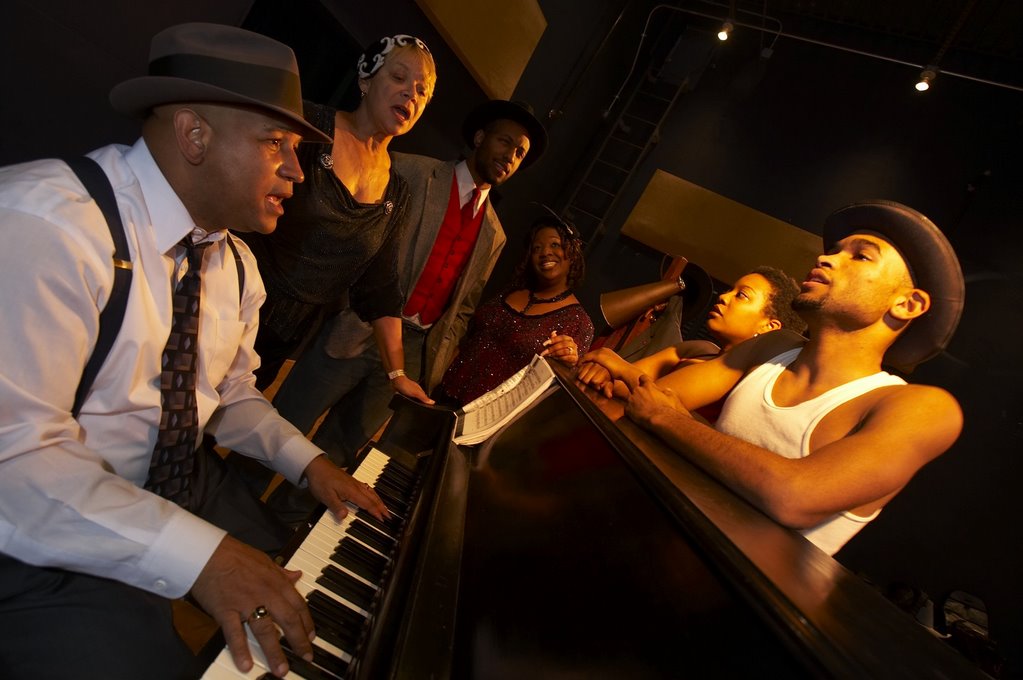
Join us in our DownStage as it will also resonate with the radiant and joyful energy of Thomas “Fats” Waller in Ain’t Misbehavin’. Featuring an 11-person ensemble of music and choreographed dance, this cabaret-style performance of 25 songs will showcase everything from “Honeysuckle Rose” to “I’m Going to Sit Right Down and Write Myself a Letter.” The walls will be thumping with the rhythmic notes of Fats’ memorable jive!

When asked about Ain’t Misbehavin’, director John Owen responded, “The work of Fats Waller is in all of our minds because his work lives at the very foundation of jazz. It is a tribute to an artist who brought us music that has been and will be re-interpreted forever. If someone says ‘I’ve never heard of Fats Waller,’ you can bet that if you hum a few bars they'll smile and say, ‘Oh sure, I KNOW THAT ONE!"

Born in 1904 in New York City to a Baptist minister father, Fats Wallers’ budding career began as a child under the instruction of the musical director at his Baptist church who taught him the classical organ compositions of J.S. Bach. During his 20s, he was then introduced to the stride style of piano by legendary Harlem pianist James P. Johnson, sparking his mastery of this musical form characterized by improvisation and swing rhythms. Early success in his five- or six-piece combo group “Fats Waller and his Rhythm” later developed into a burgeoning solo pianist career, composing more than 450 pieces, among which is the hit “Ain’t Misbehavin’!” Known for his larger than life exuberance and roguish stage presence, all 285 pounds of Fats maintained a ravenous appetite for life in every sense of the word. More than 60 years after his death, we pay homage to this American icon of jazz music.

Making its Broadway debut at the Longacre Theatre on May 9, 1978, Ain’t Misbehavin’ ran for a total of 1604 performances. It reaped critical acclaim by being nominated for five Tony Awards and winning three in its opening year including Best Director, Best Featured Actress and Best Musical. Ever since, Ain’t Misbehavin’ has been seen on stages across the world and it is with great pride that Live Arts brings this musical performance to our DownStage theater.

Tickets for Ain’t Misbehavin’ go on sale to the public Monday, November 13 and may be purchased in one of three ways. Tickets are sold via phone at the Live Arts Box Office, in person Monday through Friday from 10a.m. to 6p.m., or one hour before the performance. The preview performance of Ain’t Misbehavin’ is November 30 at 8 p.m. Free tickets to this Thursday preview are available in person at C-VILLE Weekly starting Wednesday November 22. This ticket giveaway will be available on a first come, first served basis, and will continue until gone. Limit is two tickets per person, and free admission is only via these tickets.
The photo at upper right shows the Charlottesville cast of Ain't Misbehavin' and is courtesy of Live Arts. The poster on the left from the national touring company of Ain't Misbehavin' has been hanging on my kitchen wall for more years than I care to remember.

Greetings from Your President

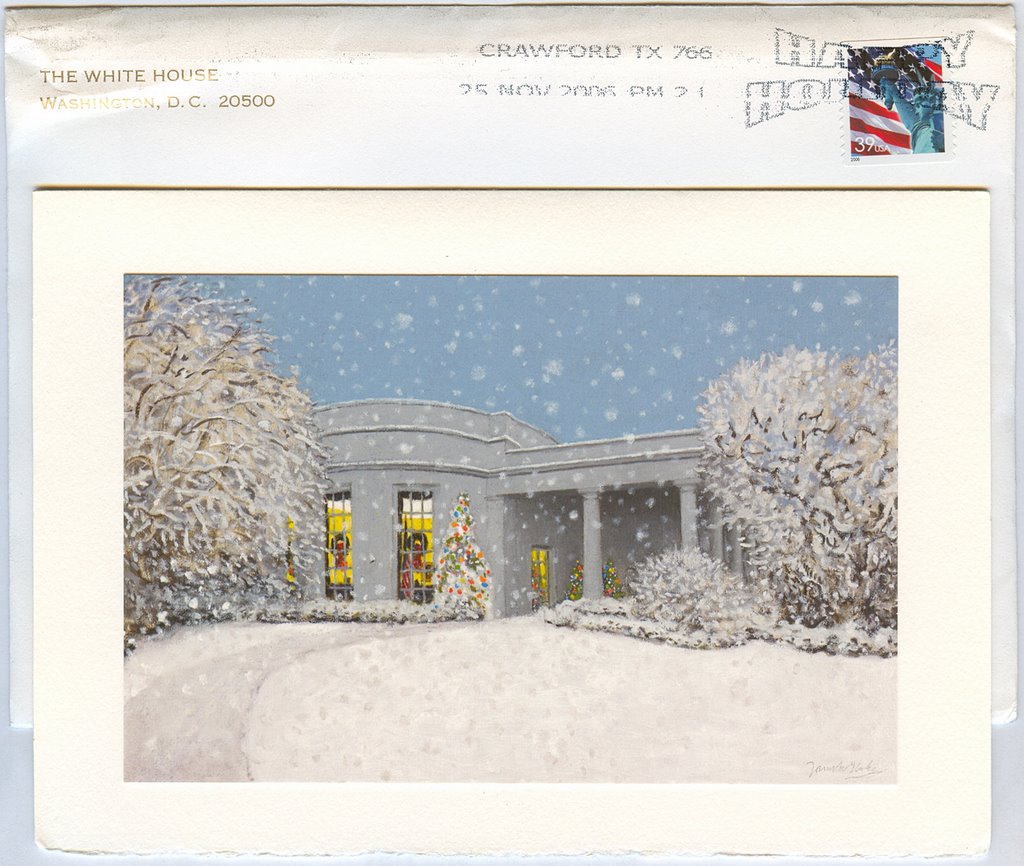
The first holiday greeting card of the 2006 season arrived in my snail-mailbox today. To my surprise, the envelope had a return address of "The White House, Washington, D.C. 20500" and a postmark of "Crawford, TX":


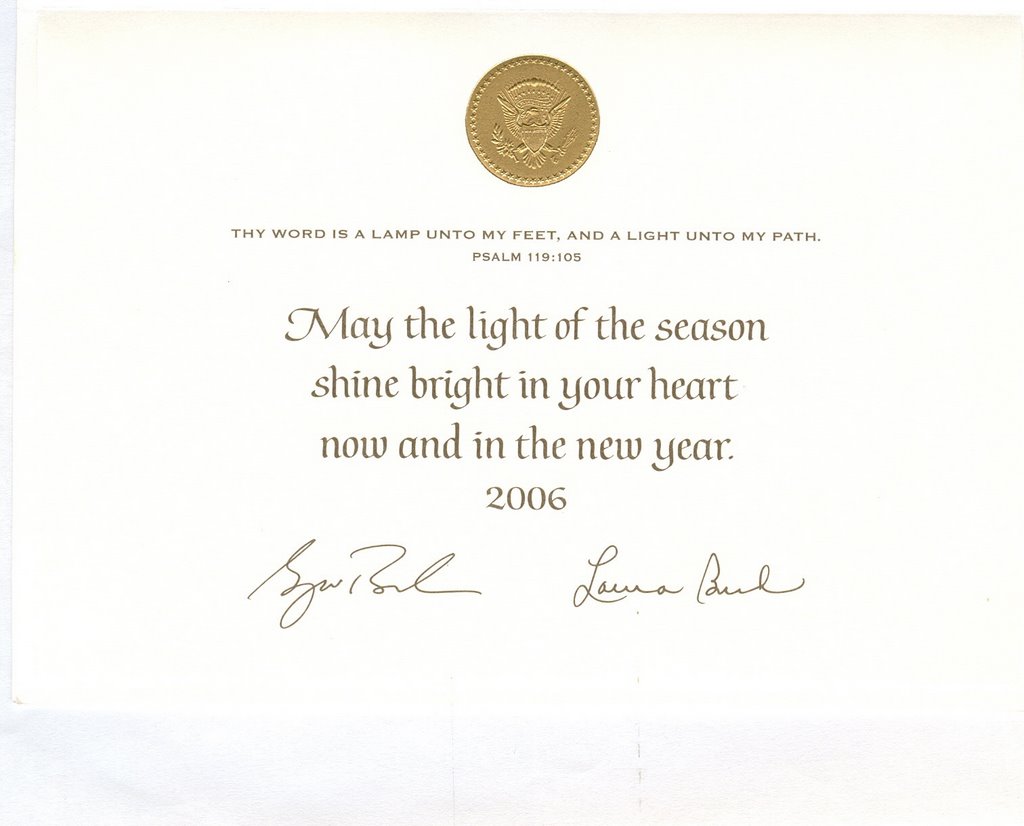
The card inside was signed -- OK, it was an autopen or even a printing-press facsimile signature -- by George and Laura Bush:


As one might expect, the back of the card informs us that it was "Paid for by the Republican National Committee. WWW.GOP.COM. Not authorized by any candidate or candidate committee." (We're also told that the picture on the front is an oil painting by James Blake entitled "The Oval Office in December.")

I'm a bit puzzled. Not by the heavy snow on the White House lawn in December, since that's just artistic license, and there are rare early snows in Washington that could serve as the basis of this painting.

My puzzlement stems, rather, from the fact that I am not a big financial contributor to the Republican Party, and I have never received a White House Christmas card in the past. I know that the list of recipients is limited to only a few thousand people, and most of them are top-dollar donors to the GOP. So how did my name get on the list?

I'm not complaining -- just curious.

It looks like now I'll have to add the Bushes to my own Christmas card list. It would be so gauche not to reciprocate.


Thursday, November 23, 2006

'Legends!' Lays an Egg

Here is a preview of my review of Legends!, which should appear in The Metro Herald a week from Friday:

Legends! Lays an Egg:
Twenty Years On, “Comedy” Still Not Ready for Broadway
Rick Sincere
Metro Herald Entertainment Editor

Advice to producers: If you’re putting on a show about putting on a show, don’t include a line like “We’re putting on a steaming turd.” For a theatre critic, that’s the equivalent of handing a teenage boy the keys to a Ferrari with a pat on the back and a “Go for it, kid!”

Legends!, a two-act comedy by James Kirkwood, opened at the National Theatre on Thanksgiving eve, and oh!, what a turkey it was.

Developed two decades ago as a vehicle for theatre legends Carol Channing and Mary Martin, this “revival” of a play that never made it to New York was reconceived, instead, as a vehicle for legendary television rivals Joan Collins and Linda Evans.

As one of the few who saw the original, I can testify that Channing and Martin were far better suited for the material – what little there is of it – and that Collins and Evans fall flat. If one really wanted to take this show to Broadway (the producers’ stated goal), the roles of Sylvia and Leatrice could be far more adroitly handled by the likes of Candice Bergen and Lily Tomlin. Who knows? Perhaps they were offered the chance and discerningly turned it down.

In a nutshell, Legends! is about two washed-up actresses brought together by a manipulative producer who wants them to star in his play. Apparently the producers of Legends! were successful in getting life to imitate art when they recruited Collins and Evans to play themselves – or, at least, cardboard cutouts of themselves.

What we have in Legends! is unrealized farce.

Kirkwood’s play has only enough comic moments in it to fill a half-hour failed pilot episode for a 1970s or ‘80s TV sitcom. The deadening moments in between are best forgotten. What’s worse, that sitcom would not center around the alleged legends of Sylvia and Leatrice (Collins and Evans), but rather around the secondary character of Aretha, the maid (played by Tonye Patano), who is forced to deal with their antics with composure and aplomb, despite gratuitous racial barbs aimed at her by Sylvia.

The characters of Sylvia and Leatrice are drawn so poorly that it is hard to eke out any sympathy for them, even after heart-tugging speeches about a cruel mother and a mastectomy. Of the two, Joan Collins as Sylvia may deliver the better performance, but that’s not saying much: Linda Evans’ portrayal of Leatrice has about as much electricity as Martha Stewart on Valium. It is hard to imagine either of these two actresses as Oscar-winning movie stars (as the script alleges).

Unfortunately for our leading ladies, the best writing (and acting) in the play comes with two short, curtain-raising scenes, which feature solo turns by Joe Farrell as Martin Klemmer, a budding Max Bialystock and “producer of the off-Broadway hit, ‘Craps,’” who hopes to produce the turkey-within-a-turkey. (His proposed title, which serves little purpose: “Star Wars: The Musical.”)

Farrell’s two monologues both involve multiple telephone conversations (one in the first act including Paul Newman, who is such a good sport that he allows his voice to be heard). In the second act, he juggles receivers from three subway-station pay phones as he deals with potential investors, his secretary, and a caller to a suicide hotline. He hits every note with a bull’s eye, as he does later, when he finally gets to interact with Sylvia, Leatrice, and Aretha.

As for the writing itself, it is embarrassingly flaccid, and in some cases demonstrates that adjustments have not been made for the new cast. (An off-color joke about Ethel Merman only really had impact when it made Mary Martin blush.) A line about Elizabeth Taylor, Debbie Reynolds, and Eddie Fisher simply went over the heads of a 21st-century audience. References to Bernard Jacobs and the Nederlanders might work for a New York audience, but on the road the point is lost in the ether. Scenes involving a male stripper and hash brownies are sad examples of "been there, done that." Fresh is a not a word to describe Legends!

Some of the play’s best comic potential is wasted. Off-stage characters are mentioned, tantalizingly described, and then forgotten. (I would have liked to have known more about the woman eaten by cats in her snowbound Vermont farmhouse.) Set-ups in the first act lack a substantial payoff in the second – even though they are transparently set-ups, and we see limp payoffs casually thrown off.

I came to Legends! under the disadvantage of just having seen the tributes to Neil Simon on the PBS telecast of the Kennedy Center’s presentation of the Mark Twain Prize for American Humor. Remembering what a master like Simon can do makes Kirkwood’s writing in Legends! pale by comparison.

There is a nugget of farce in Legends! that could have been fully realized if the script had been adapted as, say, a television movie, which could have included flashbacks, location shots, and a larger cast of characters. A low-budget stage production lacks the capacity for these things, and the constraints show.

If Legends! succeeds – and I use the term advisedly – it will be by relying on the star power (such as it remains) of Joan Collins and Linda Evans. Yet fans of Dynasty will be disappointed to learn that the pair’s only real catfight occurs off-stage and that the rest of the play is limited to weak verbal sparring and sub-par bitchiness.

Only the above-the-title names are going to fill theatre seats for Legends!, and if the investors are going to see any return, this show had better stay on the road for a long, long time, since it’s surely not ready for Broadway.

Legends!, directed by John Bowab and starring Joan Collins, Linda Evans, Joe Farrell, Will Holman, Ethan Matthews, and Tonye Patano opens November 21 and runs through December 3 at the National Theatre in Washington. Tickets, priced $36.25 to $71.25, are on sale now through Telecharge, at Telecharge.com or by calling (800) 447-7400. Tickets are also available at The National Theatre box office. Group tickets are available by calling (800) 432-7780.

For more background on Legends!, see my "Interview with Tonye Patano."

Update: Washington Post drama critic Nelson Pressley largely agrees with my assessment, though he gives a bit more attention to the physical look of the play: costumes, set design. No one else seems to have yet bothered to review Legends!

Further Update: More reviews -- Tom Avila in D.C.'s Metro Weekly calls Legends! "decidedly undelightful." The play next moves to Kansas City, where it opens on December 5.

Sunday, November 19, 2006

HRT Cancels 2007 Season

The shortcomings of the Daily Progress web site became clear again to me as I searched and searched for an article I read in Saturday's print edition, to no avail.

Local entertainment correspondent Jane Dunlap Morris reports that the Heritage Repertory Theatre, the decades-old summer stock company at the University of Virginia, has decided to cancel its 2007 season, because construction near the Drama Department's building will make it difficult for patrons to attend performances.

In the article, which appears on page B7, inside the sports section, cites the assistant business manager of the UVa Department of Drama, James Scales, as explaining that

construction of UVa's nearby studio art building and a new parking garage that's slated to accommodate 478 cars will overlap, creating headaches for Heritage patrons, hunting for parking spaces.

After looking for alternatives, officials decided to go dark for the 2007 season, [Scales] said.

"Our plan had been to shuttle folks from the Ivy-Emmet Garage," Scales said.

They learned that shuttle buses would be able to bring theatergoers only as far as Beta Bridge on Rugby Road, and patrons would have to walk up Culbreth Road to the theaters, which could be difficult for disabled or elderly guests and inconvenient for everyone, Scales said.
The Heritage Rep is a real treasure, and even a temporary absence is a loss to Charlottesville's community of culture. While some might say it sticks to the tried-and-true, its ambitious (and emotionally moving) production of Sunday in the Park with George in the Culbreth this year more than made up for Nunsense and Don't Hug Me in the Helms.

Perhaps the HRT's decision will serve as an incentive for Live Arts to expand its Summer Theatre Festival, which shrank last year, and for Ash Lawn-Highland to add more offerings to its summer opera festival -- perhaps even staging a genuine opera next year, instead of ill-suited, dance-oriented musical plays (this past summer's West Side Story) and operettas (2006's The Merry Widow).

Saturday, November 18, 2006

Portrait of the Artist as a Young Visionary

About a year ago, I had the pleasure of visiting the O. Winston Link Museum in Roanoke, Virginia.

O. Winston Link (his parents thought it cute to give him the initials “OWL”) was a trained engineer who went into the public relations business during the 1930s. A self-taught photographer, he experimented with light and shadow for his own amusement and also took photos for his PR projects and advertising campaigns.

In the mid-1950s, Link decided to photograph the dying years of the Norfolk and Western Railway in Virginia. At his own expense, and with no intention of exhibiting or selling his work, he devoted almost two full years of his life to setting up elaborate photographs of coal-fired train engines, watering stops, train depots, railway trestles, and other sites along the tracks of the Norfolk and Western. Oddly enough, this photographer supported his hobby by recording the sounds of the railroad and selling the records to train buffs around the country.

Link used his engineer’s training to create what is no less than sculpture of light and dark, of shadow and smoke. He created many of his photographs simply because he saw a challenge in getting them done. For him, photography was as much an intellectual as an aesthetic experience. He sought self-satisfaction and perfection in his work.

It was not until years after he completed his project that his photographs landed in a public exhibition. When a New York gallery put them on display, they elicited sensational reviews. People simply had not seen the kind of photographs that O. Winston Link created – largely because he found unique settings and went to great lengths to get the light and movement exactly right.

In the process of enjoying himself, Link created a new vision for photography, one that has echoes in contemporary works, such as the black-and-white cinematography in George Clooney’s 2005 film, Good Night, and Good Luck.

I was reminded of my trip to the O. Winston Link Museum (which is housed in an old railroad terminal in downtown Roanoke) when I came across a young artist in New York City who is also working in a new medium and expressing himself in pioneering experimentation.

Calling himself Skydin, he just turned 18 years old but already has a bachelor of fine arts degree from New Jersey City University. He has exhibited his work at the Jadite Gallery in New York City and at the VAB Gallery and Courtney Gallery in Jersey City, the Puffin Foundation in Teaneck, and the Montclair Art Museum in Montclair, New Jersey.

Skydin’s medium is computer generated imagery (CGI) – something most of us are familiar with in animated movies like Toy Story and Antz, as well as the epic battle sequences in the Star Wars and Lord of the Rings movies. A lot of CGI in daily life can be mundane and banal – it is simply the background that shows up on web sites and TV commercials, sort of a visual white noise in too many cases.

Skydin’s ambition is to make CGI into something greater: “I want to change how digital art is viewed,” he says. To him, “it is the new ‘painting.’”

“People have a misconception of CGI or digital art,” Skydin explains, because “they believe it’s inherently commercial. It isn’t, it’s a tool like any other, [but] it’s a non-physical tool.” Continuing to make his point, Skydin argues that “it’s the motive that defines what’s commercial. When I create digitally I’m doing it to sell a concept or image, not a product. A painting can be used to sell Coke,” he says, or it can be appreciated simply for what it is.

Noting that many consumers of art – which includes all of us, whether we realize it or not – have trouble accepting CGI as highbrow as well as middlebrow culture, Skydin offers that “the reason it’s misunderstood is the same reason photography was misunderstood: it’s a new medium, one step less physical than the previous, one step more technological. However, the artist is still the controller.”

Skydin aims to open the eyes of the 21st-century arts audience. “One problem with the viewing of art,” he explains, “is that many tend to equate quality with physical difficulty or physical labor. Even with digital art there is high degree of technical understanding and work that has to be undertaken. But even so, that’s not the sole identifier of strong work; concept and composition are very important and are actually inherently more focused elements in this quasi-physical medium, digital art.”

Something of a prodigy, Skydin got his start early in life. “When I was around 6,” he told me, “I was drawing more than other kids. It was a pretty big part of what I did during the day. But [as far as] realizing I had talent, that came later, when I was 11 or so. My parents were supportive, especially my Dad who taught me my first color rendering techniques with colored pencils.”

He experienced different environments growing up. “I grew up in many, many neighborhoods, [with] no stable memory of home,” he says, which may have influenced the slightly disoriented feel for some of his landscape and architectural renderings. Even his portraits – many of them self-portraits – have a certain dream-like quality, suggesting both alienation and eroticism.

These aspects of Skydin’s work, however, make them fascinating to observe. They are neither static nor mundane. They insist that the viewer think about them. When I first came across Skydin’s work on the Internet, I associated it in my mind with the challenging, photographic self-portraiture of Anthony Goicolea, who populates his group scenes with images of himself. Both Goicolea and Skydin possess ethereal, androgynous personae that leap from the screen (or wall) and become integrated with the immediate environment. Their faces haunt you from the moment you first see them.

Skydin is an exceptionally gifted and ambitious artist. He jokes that, through his art, “I’m going to make everyone think I’m an angel and when I have power I’m going to create an army of giant robot toys and take over the world.” That impishness permeates the gallery of works available for viewing on his web site. Some of the self-portraits, especially, leave you wondering whether this artist is a devil in angel’s garb, or an angel disguised as a devil.

That’s up to you to decide.

The O. Winston Link Museum in Roanoke, Virginia, is open 10 am to 5 pm , Monday through Saturday, 12 pm to 5 pm, Sunday. Entrance fee is $5 for Adults, $4 for Seniors, $3 for Children. Call the Museum at (540) 982-LINK for information or visit the web site at www.linkmuseum.org.

Skydin’s digital imagery can be seen at www.skydin.com. Some of Skydin’s works are available for purchase through the Yessy Art Gallery and at ArtWanted.com.